Company Outreach in 2026: A Practical Playbook for B2B Teams
Company outreach is broken when it's a spray-and-pray numbers game. Here's the 2026 playbook for targeting, personalizing, and sequencing outreach that actually books meetings.
Company Outreach in 2026: A Practical Playbook for B2B Teams
Company outreach is the disciplined process of identifying the right accounts, finding the right people inside them, and reaching those people with a relevant message across email, phone, and social — at a cadence that earns replies without burning your reputation. Done well, it's the single most reliable pipeline engine in B2B. Done badly, it's a spam machine that torches your domain and your brand in the same quarter.
The difference in 2026 isn't effort. It's precision. Buyers get more cold messages than ever, filters are smarter, and generic "just checking in" sequences get ignored or reported. This playbook breaks down how modern teams run company outreach that actually books meetings — the targeting, the data, the message, the channels, and the metrics that matter.
TL;DR#
- Company outreach = account selection + contact data + relevant message + multi-channel cadence. Weakness in any one link caps the whole system.
- Targeting beats volume. A tight ICP with 200 well-researched accounts outperforms 5,000 random ones on reply rate and pipeline quality.
- Data quality is the hidden lever. Bad emails kill deliverability before your copy ever gets read — verify before you send.
- Multi-channel wins. Email + LinkedIn + phone in a coordinated sequence roughly doubles connect rates versus email alone.
- Measure replies and meetings, not sends. Open rate is noise in 2026; positive-reply rate and booked meetings are signal.
What is company outreach and why does it still work?#
Company outreach is proactively contacting target organizations to start a sales conversation, rather than waiting for them to find you. Think of it like fishing with a spear instead of a net: inbound casts a wide net and hopes; outreach picks a specific fish and aims. Both feed you, but outreach lets you choose which accounts enter your pipeline.
It still works — despite a decade of "cold email is dead" headlines — because buyers rarely wake up ready to buy. Most of your total addressable market doesn't know your product exists or doesn't feel the pain acutely enough to search. Outreach creates demand instead of harvesting it. The catch is that the bar has risen. In 2026 a relevant, well-timed message to the right person converts; a templated blast to a scraped list gets filtered, reported, and damages your email deliverability for months.

The teams that win treat outreach as a system with four dependent links: account selection, contact data, message relevance, and channel cadence. A break in any link caps the entire output. You can write brilliant copy, but if it lands on a dead mailbox, none of it matters.
How do you build a target list that converts?#
Start with your Ideal Customer Profile (ICP), not with a list you can buy. Your ICP is the intersection of firmographics (industry, size, revenue, geography), technographics (the tools they run), and trigger events (hiring, funding, leadership changes, product launches). The tighter this definition, the higher your reply rate — because relevance scales with specificity.
Here's the practical build sequence most high-performing teams use:
- Define the account tier. Split your market into Tier 1 (dream accounts, deep research, human-written outreach), Tier 2 (good fit, semi-personalized), and Tier 3 (broad fit, lightly templated). Effort should match tier.
- Source the accounts. Pull from your CRM, a B2B database, intent signals, and manual research on trigger events. Aim for fit first, volume second.
- Find the right people. For each account, identify the economic buyer, the champion, and the blocker. A single-threaded contact is a fragile deal.
- Get verified contact data. Use a domain search to pull every relevant email at the company, then confirm each address before it enters a sequence.
- Enrich the record. Add role, seniority, LinkedIn, phone, and a personalization hook so your reps aren't researching mid-send.
- Segment for messaging. Group contacts by persona and pain so one message variant serves a whole segment without going generic.
The mistake most teams make is inverting this order — buying a giant list and reverse-engineering an ICP to justify it. That's how you end up emailing 10,000 people who will never buy and wondering why your domain got throttled.
Which outreach channels should you use in 2026?#
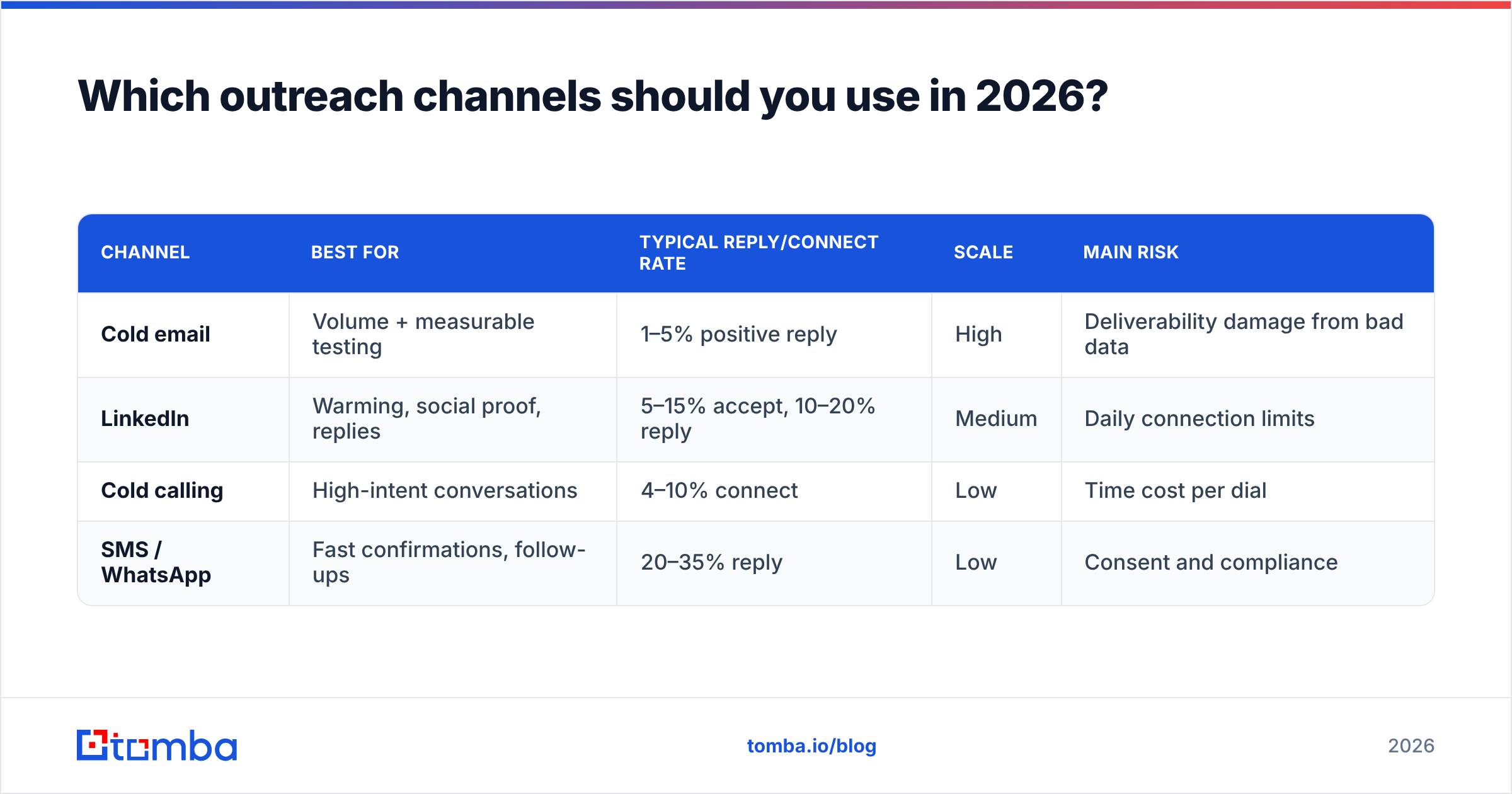
No single channel carries a modern sequence. Email is the workhorse for scale, LinkedIn builds familiarity and warms replies, and the phone closes the gap when digital goes quiet. The point isn't to pick one — it's to sequence them so each channel reinforces the others.
Here's how the primary channels compare on the dimensions that matter for planning a cadence:
| Channel | Best for | Typical reply/connect rate | Scale | Main risk |
|---|---|---|---|---|
| Cold email | Volume + measurable testing | 1–5% positive reply | High | Deliverability damage from bad data |
| Warming, social proof, replies | 5–15% accept, 10–20% reply | Medium | Daily connection limits | |
| Cold calling | High-intent conversations | 4–10% connect | Low | Time cost per dial |
| SMS / WhatsApp | Fast confirmations, follow-ups | 20–35% reply | Low | Consent and compliance |
The winning pattern is a coordinated multi-touch sequence: a LinkedIn view and connect on day 1, a personalized email on day 2, a value-add email on day 5, a call on day 7, and a LinkedIn message on day 9. Each touch is aware of the others. When a prospect sees your name on LinkedIn, then reads your email, then picks up a call, you've built familiarity that no single channel produces alone. Research from teams tracked on G2 consistently shows multi-channel cadences outperforming email-only ones on connect and meeting rates.
To make phone work at scale, you need accurate numbers — a phone finder plus validation keeps reps dialing live lines instead of dead ones. The same discipline you apply to email data applies to every channel.
Why does data quality decide the whole game?#
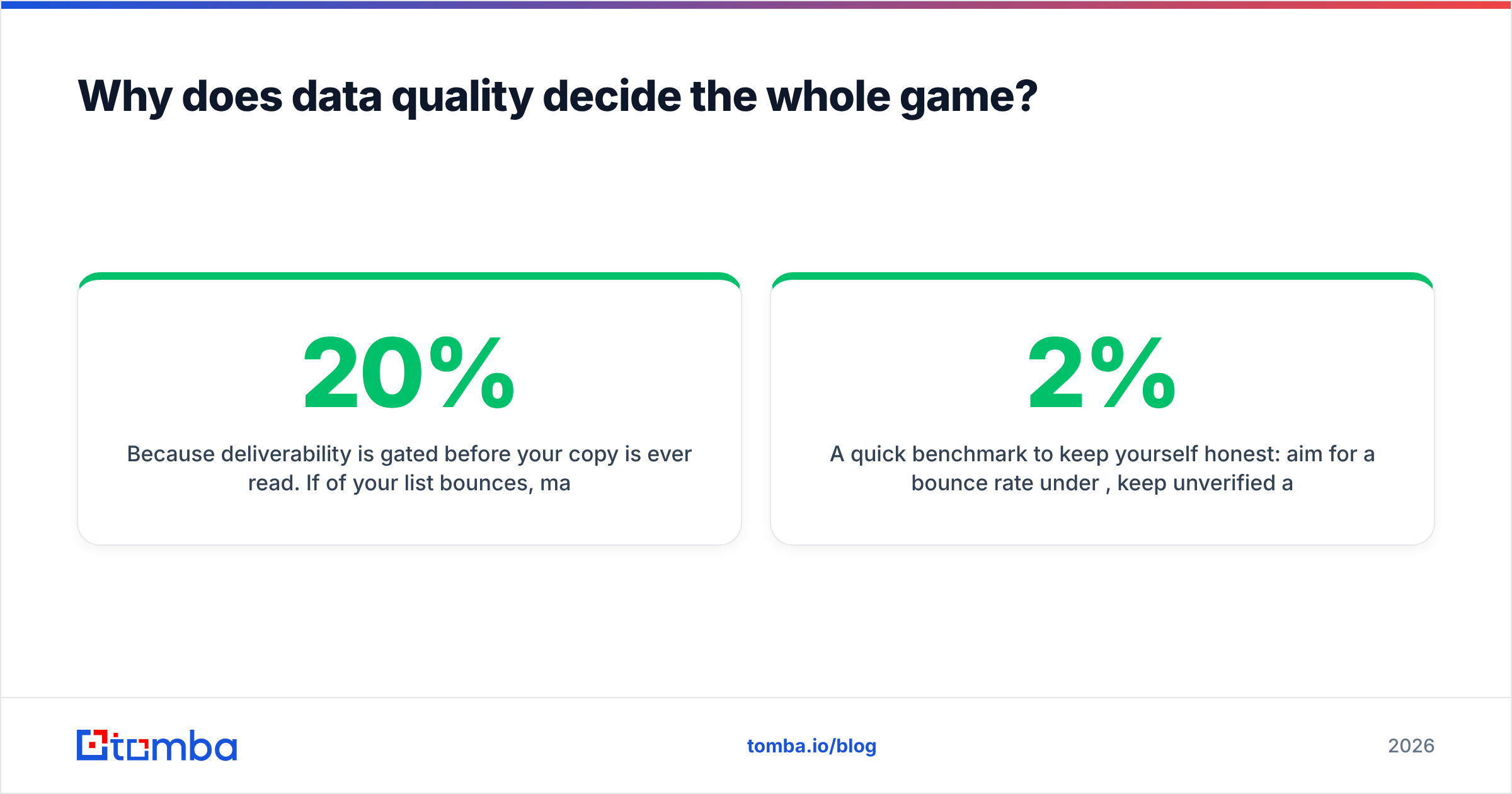
Because deliverability is gated before your copy is ever read. If 20% of your list bounces, mailbox providers read that as a spam signal, throttle your sending, and quietly route even your good emails to spam. One bad send list can cost you weeks of sender reputation recovery. Data quality isn't a nice-to-have — it's the gate that determines whether the rest of your system runs at all.
There are three data disciplines every outreach team needs:
- Find accurately. Use a real email finder with source transparency, not a guess-and-permutate generator that fabricates addresses.
- Verify before sending. Run every address through an email verifier to strip invalids, and use a catch-all verifier to handle domains that accept everything.
- Enrich for relevance. Layer in data enrichment so every record carries the context your reps need to personalize.
A quick benchmark to keep yourself honest: aim for a bounce rate under 2%, keep unverified addresses out of live sequences entirely, and re-verify any list older than 90 days. Contact data decays at roughly 2–3% per month as people change jobs, so a list you built last quarter is already partly stale.
What makes an outreach message get a reply?#
Relevance, brevity, and a single clear ask. The best cold messages read like they were written by one human to one human — because the personalization is real, not a mail-merge {{first_name}} trick. In 2026, buyers can smell a template in the first line, and a template signals that you didn't do the work.
Use this structure for a cold email that earns replies:
- Opener (relevance): A specific observation about their company — a trigger event, a role, a public detail. Not "I hope this finds you well."
- Bridge (the problem): Connect that observation to a problem you know their persona faces. Show you understand their world.
- Value (the proof): One concrete result or capability, ideally quantified. No feature dumps.
- Ask (one CTA): A single, low-friction question — "Worth a 15-minute look next week?" Not three asks stacked together.
- Signature (credibility): Clean, human, with a real name and role.
Keep it under 120 words. Every extra sentence is a reason to stop reading. And resist the urge to sell in message one — the goal of the first touch is a reply, not a signed contract. If you need a starting point, a bank of proven cold email templates beats writing from a blank page, as long as you customize the opener for every Tier 1 account.
The follow-up matters as much as the first send. Most replies come on touches two through five, yet most reps quit after one. A polite, value-adding follow-up sequence — new angle, new proof point, never just "bumping this up" — is where the majority of meetings are actually booked.
How do you scale outreach without becoming spam?#
You scale the system, not the sending. The trap teams fall into is treating scale as "send more from one domain." That's exactly what breaks deliverability. Scaling responsibly means spreading volume, protecting reputation, and automating the boring parts while keeping the human parts human.
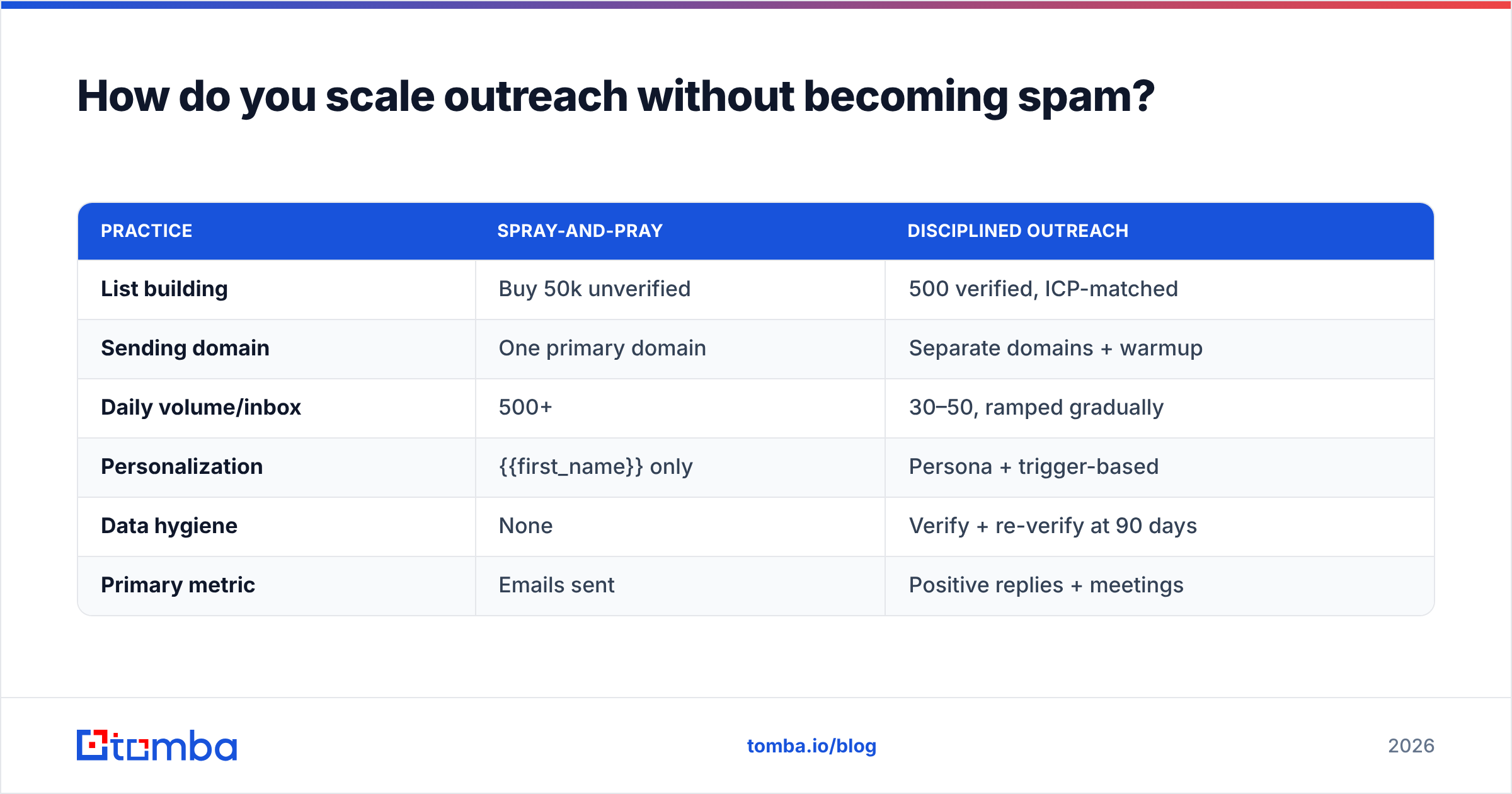
Here's what disciplined scale looks like versus the spray-and-pray approach:
| Practice | Spray-and-pray | Disciplined outreach |
|---|---|---|
| List building | Buy 50k unverified | 500 verified, ICP-matched |
| Sending domain | One primary domain | Separate domains + warmup |
| Daily volume/inbox | 500+ | 30–50, ramped gradually |
| Personalization | {{first_name}} only | Persona + trigger-based |
| Data hygiene | None | Verify + re-verify at 90 days |
| Primary metric | Emails sent | Positive replies + meetings |
A few non-negotiables for staying out of the spam folder while scaling: warm up new domains before you send at volume, authenticate with SPF, DKIM, and DMARC, keep per-inbox volume low and ramp it slowly, and monitor your sender reputation continuously. If you run outbound at scale, connecting your stack through native integrations — pushing verified contacts straight into your CRM and sequencer — removes the copy-paste errors that quietly poison list quality.
Automation should handle the mechanical: enriching records, verifying addresses, logging activity, triggering the next touch. It should never write your Tier 1 openers or decide who's worth a human call. The moment automation touches judgment, your reply rate falls off a cliff. Guidance from established playbooks like HubSpot's sales resources echoes the same principle: automate the process, personalize the message.
Which metrics actually tell you outreach is working?#
Track positive-reply rate and booked meetings — everything else is a leading indicator or noise. Open rate became nearly useless once privacy features started auto-loading pixels, and "emails sent" measures activity, not outcome. If your dashboard leads with sends and opens, you're optimizing for the wrong thing.
The metrics that map to pipeline:
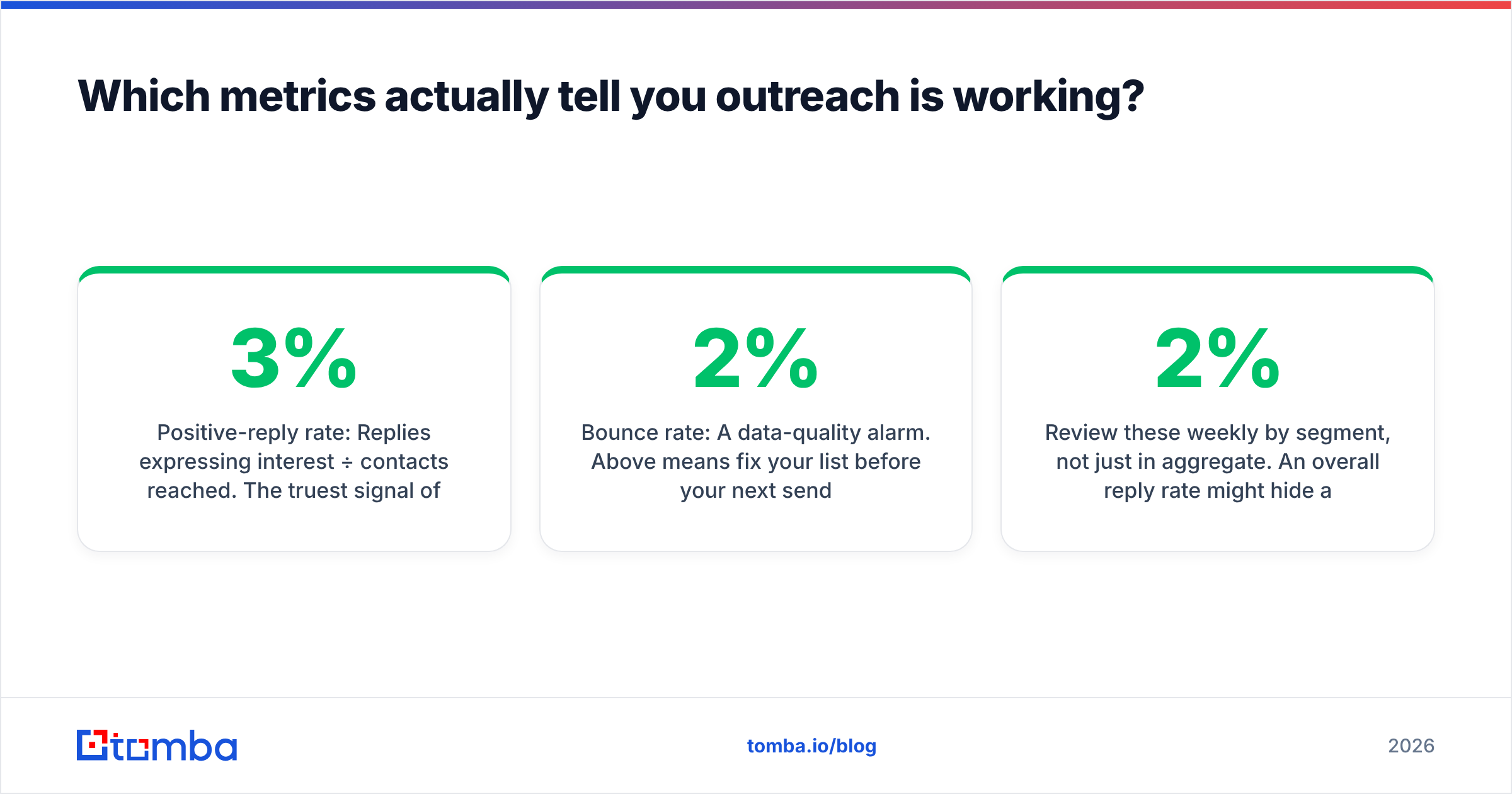
- Positive-reply rate: Replies expressing interest ÷ contacts reached. The truest signal of message-market fit. Target 3%+ for cold email.
- Meetings booked: The only metric that pays rent. Everything upstream exists to move this.
- Reply-to-meeting rate: Reveals whether your qualification and CTA are tight.
- Bounce rate: A data-quality alarm. Above 2% means fix your list before your next send.
- Sequence completion vs. positive-reply timing: Shows how many touches it actually takes to earn a reply, so you can right-size cadences.
Review these weekly by segment, not just in aggregate. An overall 2% reply rate might hide a 6% winner in one persona and a 0% dud in another. Segment-level data is what lets you cut the dead angles and double down on the ones producing meetings. For deeper benchmarking, compare your numbers against category data on review platforms like Capterra rather than trusting vendor-published averages.
Putting it together: your 2026 company outreach stack#
Company outreach in 2026 rewards precision over volume at every layer. Tight ICP, verified data, genuinely relevant messages, coordinated channels, and outcome-based metrics — that's the whole system. Skip any layer and the rest underperforms. Nail all five and outbound becomes the most predictable pipeline source you have.
The foundation under all of it is accurate contact data, because a perfect message to a wrong or dead address is worth exactly zero. Start there: use the Tomba Email Finder to pull verified professional emails by name, company, or domain, then verify and enrich before anything enters a sequence. Plans start free with 25 searches a month and scale from $49/mo — you can review the full Tomba pricing to match a tier to your outreach volume. Get the data layer right, and every other part of your outreach system finally gets the chance to work.
Related guides#
Ready to find emails that actually work?
Join 150,000+ professionals who stopped guessing and started sending. Free credits on signup — no credit card required.
Get the Tomba newsletter
Practical outbound tactics and product updates — once every two weeks.
About the author