Connecting With Prospects in 2026: A Practical Playbook
Most reps confuse contacting prospects with connecting with them. Here is a channel-by-channel playbook for starting real conversations in 2026 — with the data, timing, and messaging that actually earn replies.
TL;DR
- Connecting with prospects is not the same as contacting them — a delivered email or a sent connection request is activity, not a relationship.
- The reps who consistently book meetings win on three inputs: accurate contact data, relevant timing, and a message that references the buyer's world instead of your feature list.
- Multichannel beats single-channel by a wide margin, but only when the channels reinforce one message — not when they repeat it.
- Bad data is the silent killer: you can run a perfect sequence into a dead inbox and never know why it failed.
- Start with clean, verified contacts, personalize the first line around a real trigger, and follow up with value — not "just bumping this to the top."
What does "connecting with prospects" actually mean?#
Connecting with a prospect means starting a two-way conversation with a person who has a reason to care — not landing a message in their inbox and hoping.
Think of it like knocking on a neighbor's door versus taping a flyer to it. The flyer (a blast email, a bulk connection request) technically reaches them. But connecting is when they open the door and say "yeah, what's this about?" That reply — even a skeptical one — is the whole game. Everything before it is just setup.
Most reps measure the setup: emails sent, dials made, requests fired off. Those are activity metrics, and activity feels like progress. But your pipeline doesn't grow from sent messages. It grows from replies, from a prospect agreeing to fifteen minutes, from a "not now, but reach out in Q3." Connecting is the moment a stranger becomes a conversation.
The gap between contacting and connecting is where most outreach quietly dies. You can send 500 emails a week and connect with almost no one if the addresses are wrong, the timing is off, or the message reads like it was written for anyone.
Why do most prospecting attempts fail before they start?#
Because the foundation is broken before the message is ever written. Three failure points account for the majority of dead outreach.
1. The contact data is wrong. B2B data decays fast — people change jobs, companies rebrand, email formats shift. Industry estimates put B2B data decay at roughly 22–30% per year. If you're working a list that's twelve months old, up to a third of it may already be junk. You'll never connect with a prospect whose email bounces or whose direct dial rings a former employee.
2. The timing is irrelevant. Reaching out the week after a prospect signed a two-year contract with your competitor is a waste of a good message. Reaching out the week they announced funding, opened a new office, or posted about a hiring push is a different story entirely.
3. The message is about you. "We're the leading platform for X" tells the prospect nothing about their problem. It reads like every other email in a crowded inbox, so it gets the same treatment: ignored.
The uncomfortable truth is that the flashiest sequence in the world can't fix a broken first input. Clean data isn't the exciting part of prospecting, but it's the part that decides whether anything else matters.
Which channels work best for connecting with prospects in 2026?#
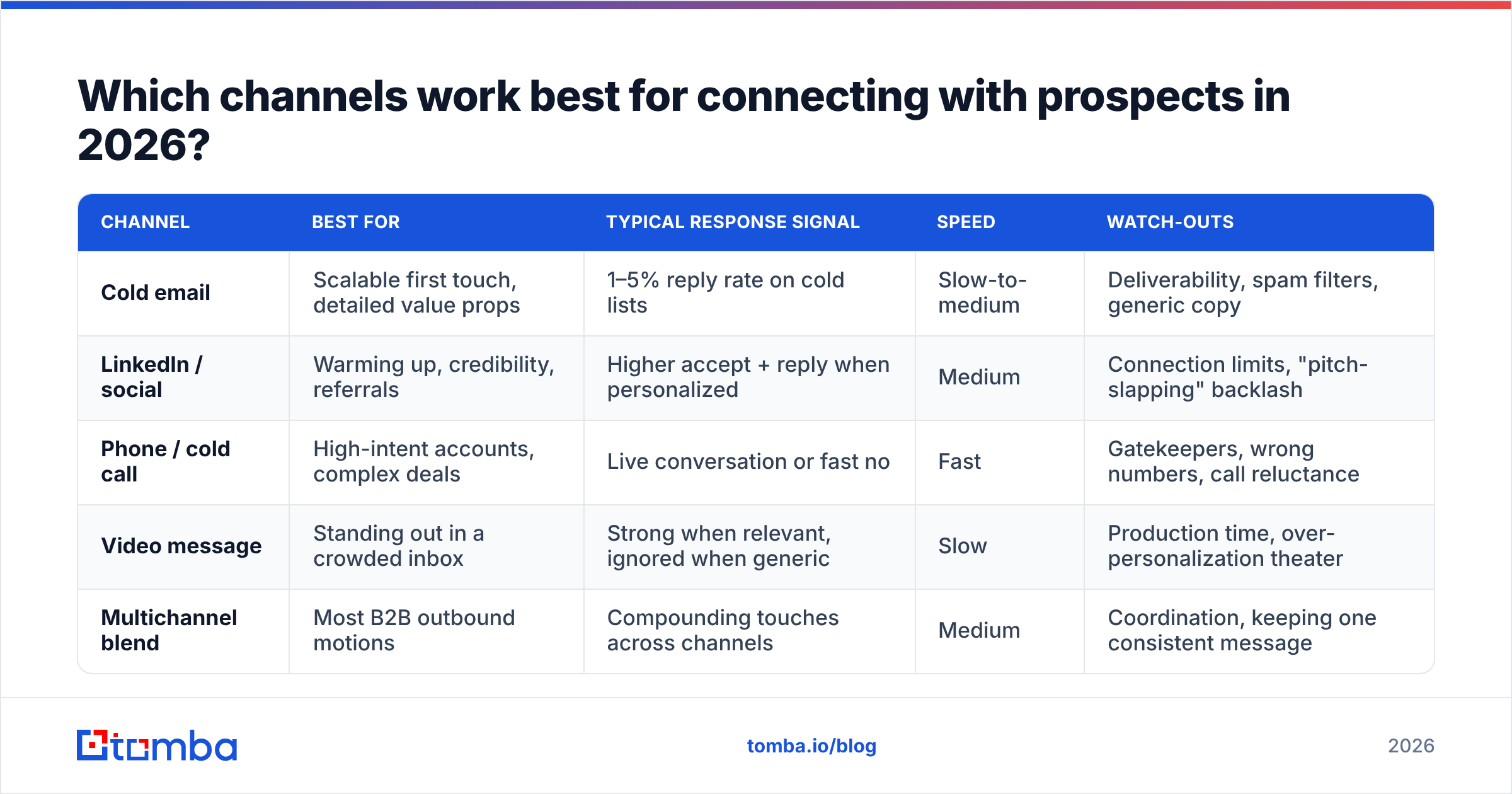
There's no single "best" channel — there's the right channel for the moment, and a combination almost always outperforms any one on its own. Here's how the main options compare.
| Channel | Best for | Typical response signal | Speed | Watch-outs |
|---|---|---|---|---|
| Cold email | Scalable first touch, detailed value props | 1–5% reply rate on cold lists | Slow-to-medium | Deliverability, spam filters, generic copy |
| LinkedIn / social | Warming up, credibility, referrals | Higher accept + reply when personalized | Medium | Connection limits, "pitch-slapping" backlash |
| Phone / cold call | High-intent accounts, complex deals | Live conversation or fast no | Fast | Gatekeepers, wrong numbers, call reluctance |
| Video message | Standing out in a crowded inbox | Strong when relevant, ignored when generic | Slow | Production time, over-personalization theater |
| Multichannel blend | Most B2B outbound motions | Compounding touches across channels | Medium | Coordination, keeping one consistent message |
The pattern that wins in 2026 is a coordinated blend: an email that references a trigger, a LinkedIn touch that adds a human face, and a call that ties them together. The mistake is treating channels as separate campaigns that each repeat the same pitch. When your email, your LinkedIn outreach, and your voicemail all say slightly different, complementary things, the prospect experiences one coherent story instead of three copies of the same ad.
How do you personalize outreach without spending an hour per prospect?#
Personalization at scale sounds like a contradiction, but it isn't — the trick is separating the researched layer from the repeatable layer.
Follow a tiered approach so you spend deep-research time only where it pays off:
- Tier 1 — named accounts (deep personalization). Your top 20–50 targets get real homework: recent posts, earnings notes, product launches, org changes. One custom line per prospect, grounded in something only they would recognize.
- Tier 2 — segment personalization (fast + relevant). Group prospects by role, industry, and trigger. Write one strong template per segment that references a shared pain, then swap two variables (company, a specific detail).
- Tier 3 — volume plays (light-touch). For broad top-of-funnel, personalize only the opening line and the CTA. Relevance to the segment beats fake intimacy.
The non-negotiable across all three tiers is that the personalization has to be true. "I loved your recent post" when there's no recent post destroys trust instantly. This is why enrichment matters: when you know a prospect's exact role, seniority, tech stack, and company signals, your "personalized" line writes itself from facts rather than flattery. Good data enrichment turns a name and an email into enough context to say something a stranger couldn't.
A simple rule: if your first sentence could be copy-pasted to any prospect in your list without changing meaning, it's not personalization — it's decoration.
What role does accurate contact data play in connecting with prospects?#
Accurate data is the difference between a conversation and a bounce — it's the input that quietly determines your ceiling.
Here's the math nobody likes. Say you build a 1,000-person list and your outreach converts replies at a solid 4%. On paper, that's 40 conversations. But if 25% of your contacts are stale or wrong, you're really working 750 valid contacts — and the invalid ones don't just fail silently. Bounces drag down your sender reputation, which hurts deliverability for the good addresses too. One bad list can poison the well for weeks.
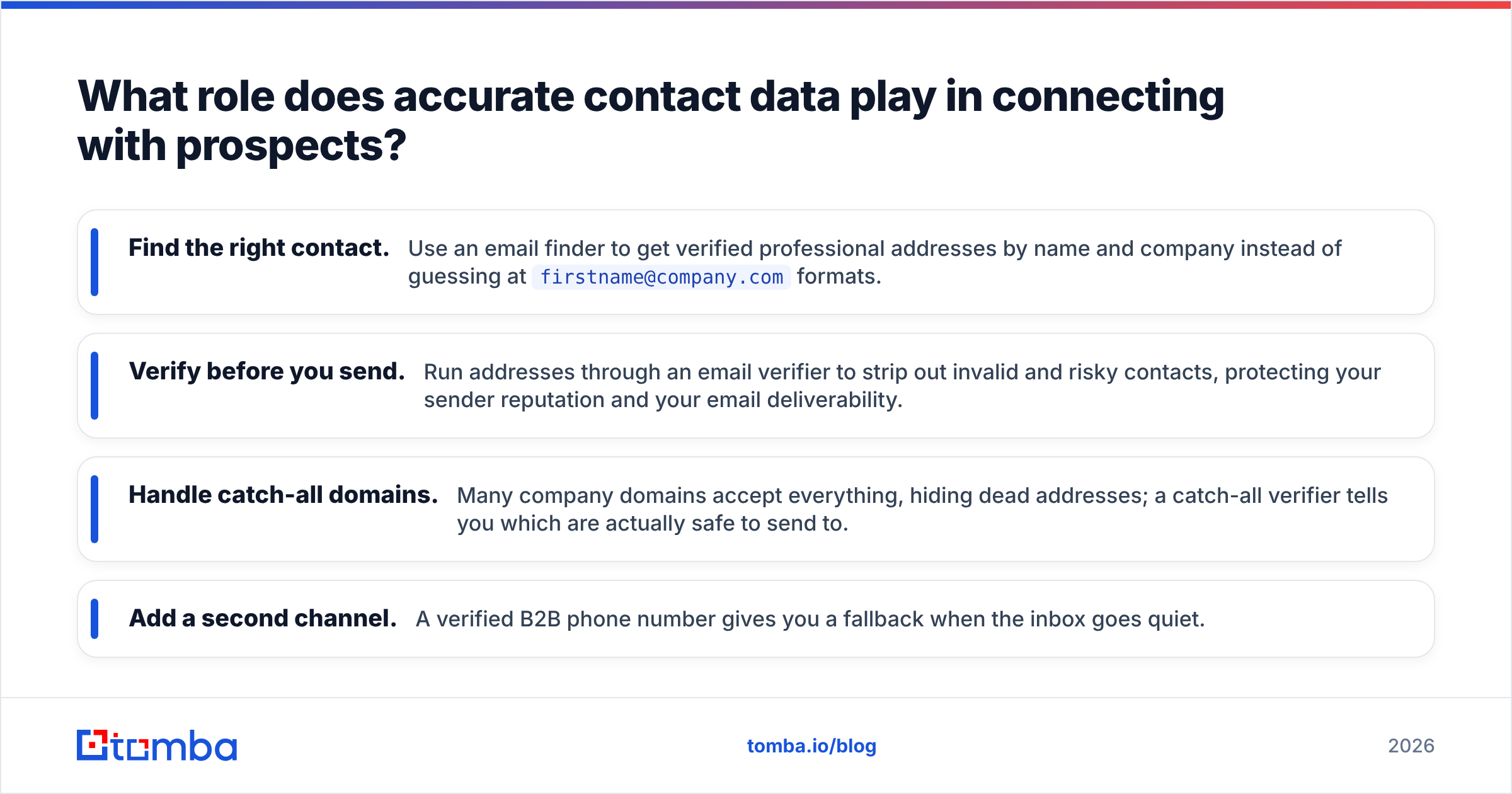
This is where the boring foundation earns its keep:
- Find the right contact. Use an email finder to get verified professional addresses by name and company instead of guessing at
firstname@company.comformats. - Verify before you send. Run addresses through an email verifier to strip out invalid and risky contacts, protecting your sender reputation and your email deliverability.
- Handle catch-all domains. Many company domains accept everything, hiding dead addresses; a catch-all verifier tells you which are actually safe to send to.
- Add a second channel. A verified B2B phone number gives you a fallback when the inbox goes quiet.
None of this is glamorous. But it's the part that decides whether your carefully written message reaches a human at all. You can't connect with someone you can't actually reach.
How should you structure a first message that earns a reply?#
Structure the first message around the prospect, not your product — a simple four-part frame works across email and social.
- The hook (1 sentence). Reference a specific, true trigger: a role change, a company announcement, a post, a hiring signal. This proves you're not blasting.
- The relevance bridge (1–2 sentences). Connect that trigger to a problem you know their segment faces. You're showing you understand their world, not reciting your capabilities.
- The proof (1 sentence). A concrete, relevant outcome — ideally a peer company or a specific number. Keep it short and believable.
- The ask (1 sentence). One clear, low-friction next step. "Worth a 15-minute look next week?" beats "Let me know if you'd like to explore synergies."
Keep the whole thing under 90 words for a first cold email. Long emails signal effort to you and obligation to the reader — and obligation gets deleted. If you need a starting point, a library of proven cold email templates will save you from staring at a blank draft, but always rewrite the opener so it's specific to the person.
For a deeper look at building sequences that actually convert, HubSpot's sales prospecting resources and G2's category of sales engagement platforms are solid, vendor-neutral references worth bookmarking.
How many follow-ups are too many?#
The answer is: as many as you can make genuinely valuable — which in practice usually means four to seven touches over two to three weeks, then a graceful pause.
The reason most reps under-follow-up is that they think of follow-ups as reminders ("just bumping this"). A reminder adds nothing; it just pesters. A good follow-up adds a new angle every time:
- Follow-up 1: a relevant case study or peer result.
- Follow-up 2: a specific insight about their industry or a common mistake.
- Follow-up 3: a soft question that's easy to answer ("Is this even a priority this quarter?").
- Follow-up 4: a genuine breakup email that makes it easy to say "not now."
Each touch should be able to stand alone as something a busy person might actually find useful. If a follow-up only makes sense in the context of your previous email, it's a reminder, not value — cut it.
And know when to stop. Persistence and pestering look identical from the outside except for one thing: relevance. The moment your outreach stops being relevant, one more message doesn't build the relationship — it burns it. A polite pause with the door left open often outperforms a seventh "just checking in."
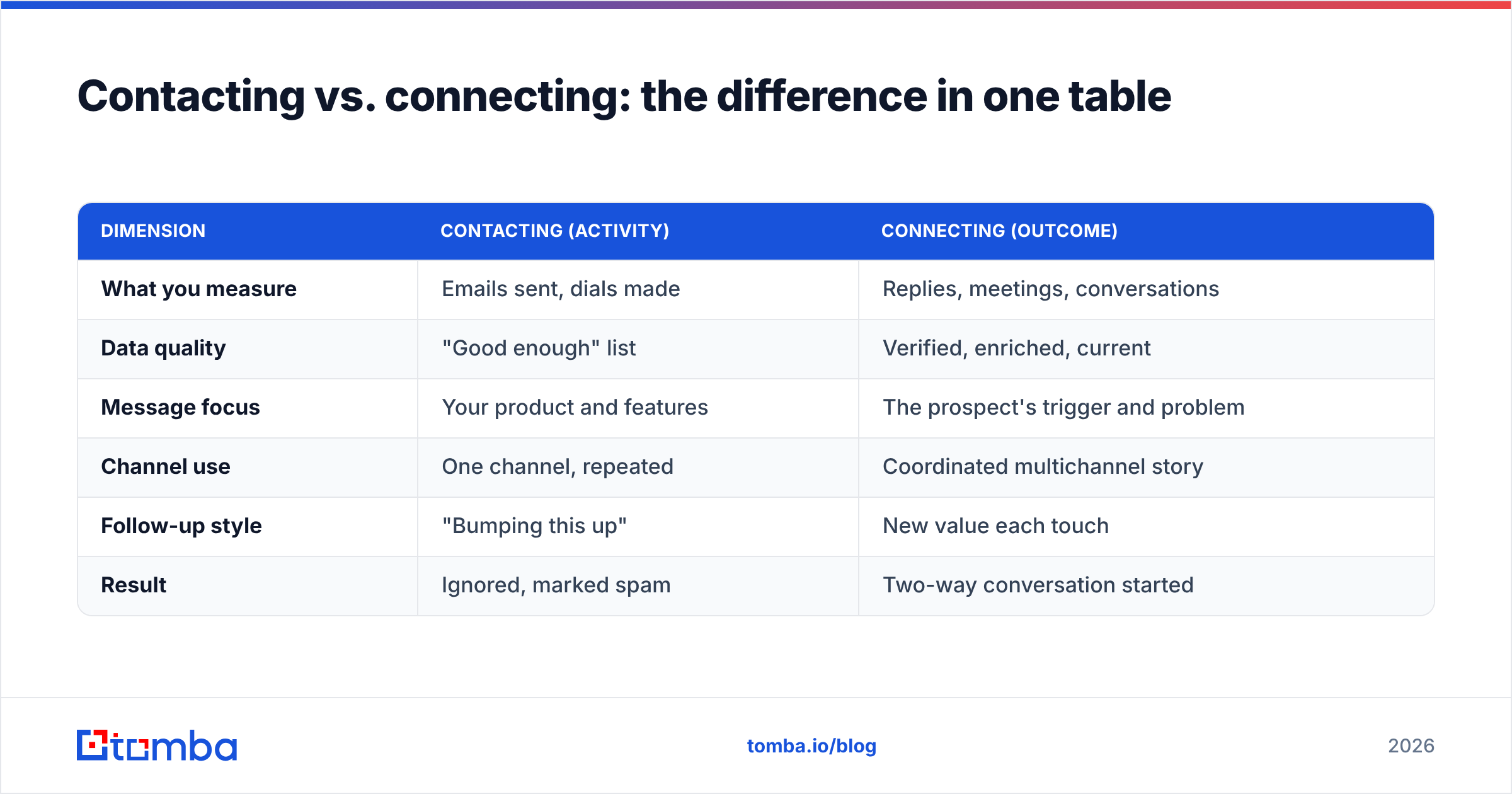
Contacting vs. connecting: the difference in one table#
| Dimension | Contacting (activity) | Connecting (outcome) |
|---|---|---|
| What you measure | Emails sent, dials made | Replies, meetings, conversations |
| Data quality | "Good enough" list | Verified, enriched, current |
| Message focus | Your product and features | The prospect's trigger and problem |
| Channel use | One channel, repeated | Coordinated multichannel story |
| Follow-up style | "Bumping this up" | New value each touch |
| Result | Ignored, marked spam | Two-way conversation started |
If your prospecting lives in the left column, more volume won't fix it — it'll just scale the frustration. Moving to the right column starts with the least exciting decision you'll make all quarter: fixing your data before you send anything.
Where should you start?#
Start with the input that gates everything else — the contact data — then layer relevance and consistency on top.
A realistic first-week plan:
- Pick one tight segment (role + industry + a shared trigger).
- Build a list of 50–100 real, verified emails — no guessing, no scraped junk.
- Write one strong segment template with a truly personalized first line per prospect.
- Sequence it across email plus one other channel over two to three weeks.
- Measure replies and meetings, not sends. Iterate on the openers that earn responses.
Do that once, cleanly, and you'll learn more about what makes prospects respond than you would from ten thousand sprayed messages.
Ready to connect with the right prospects?#
Connecting with prospects starts with reaching real people at real addresses — everything downstream depends on it. Tomba's Email Finder gives you verified professional emails by name, company, or domain, so your outreach lands in live inboxes instead of bouncing into the void. Pair it with the built-in email verifier to protect your deliverability, and start on the free tier (25 searches/month) before scaling up on a paid Tomba plan when your pipeline is humming. Build your list on clean data, write like a human, and let relevance do the connecting.
Related guides#
Ready to find emails that actually work?
Join 150,000+ professionals who stopped guessing and started sending. Free credits on signup — no credit card required.
Get the Tomba newsletter
Practical outbound tactics and product updates — once every two weeks.
About the author