Conversational Selling in 2026: Framework, Scripts, and Tools
Conversational selling is not chatbots and it is not "be more human." It is a repeatable system for starting two-way conversations at scale. Here is the framework, the scripts, and the honest tradeoffs.
TL;DR
- Conversational selling means running outbound as a two-way dialogue — asking, listening, adapting — instead of broadcasting a pitch and hoping for a reply.
- It is not "add a chatbot." The chatbot is one surface. The method is what changes: shorter first messages, one question per touch, no pitch until the buyer signals interest.
- It wins on reply rate and meeting quality, and it loses on raw volume. If your quota depends on 2,000 sends a week, it will hurt before it helps.
- It only works on clean data. A conversational opener sent to a bounced or role-based address is still a bounce — verification and enrichment are the unglamorous prerequisite.
- The realistic 2026 stack: a data layer (find + verify contacts), a sequencing layer, a live-chat/social layer, and an AI layer for research — not one tool doing all four badly.
What is conversational selling, actually?#
Conversational selling is an outbound and inbound approach where the goal of every touch is to earn a reply, not to deliver a pitch.
The traditional cold sequence is a monologue: five emails, each one a slightly more desperate restatement of your value prop. Conversational selling flips the unit of progress. A touch succeeds if the buyer says something back — even "not now, ask me in Q3." That single sentence is worth more than 400 opens, because it gives you routing information: timing, authority, pain, or a clean no.
Think of it like the difference between a street busker and a bartender. The busker plays the same set to everyone walking past and measures success in coins. The bartender asks one question, listens to the answer, and pours accordingly. Both are working the same foot traffic. Only one of them knows anything about the customer at the end of the shift.
The methodology sits under a bigger umbrella that Gartner and most enterprise analysts now describe as buyer-led selling: buyers do 70%+ of their evaluation before they talk to a rep, so the rep's job shifts from "explain the product" to "help the buyer make sense of what they already half-know." Conversational selling is the tactical layer of that shift.
The four rules that separate it from "friendly cold email"#
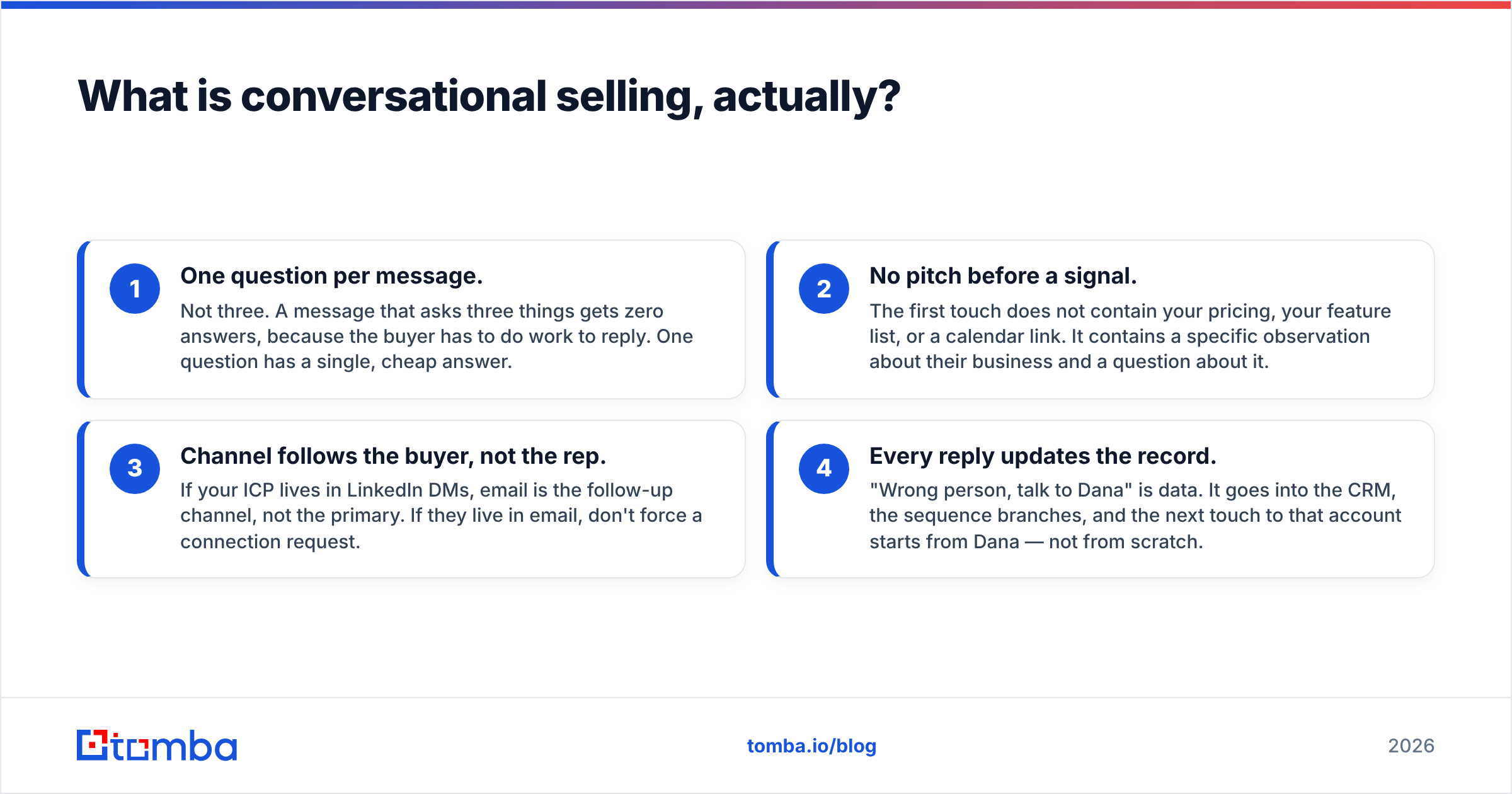
- One question per message. Not three. A message that asks three things gets zero answers, because the buyer has to do work to reply. One question has a single, cheap answer.
- No pitch before a signal. The first touch does not contain your pricing, your feature list, or a calendar link. It contains a specific observation about their business and a question about it.
- Channel follows the buyer, not the rep. If your ICP lives in LinkedIn DMs, email is the follow-up channel, not the primary. If they live in email, don't force a connection request.
- Every reply updates the record. "Wrong person, talk to Dana" is data. It goes into the CRM, the sequence branches, and the next touch to that account starts from Dana — not from scratch.
Break any one of those and you're back to spray-and-pray with a warmer tone of voice.
Why is conversational selling gaining ground in 2026?#
Three things broke at once.
Volume stopped working. Google and Yahoo's bulk-sender enforcement, tightened again through 2025, made high-volume unauthenticated sending expensive. Spam complaint thresholds are now enforced at the mailbox-provider level, and a 0.3% complaint rate can throttle a domain you spent nine months warming. When the cost of a bad send goes up, the value of a targeted send goes up with it. If you're unclear on the mechanics there, start with email deliverability and sender reputation before you touch messaging strategy at all.
AI made generic personalization worthless. Every rep now has a tool that scrapes a LinkedIn profile and generates "I saw you're passionate about scaling SaaS!" Buyers pattern-match that in half a second. The differentiator moved from personalized to provably specific — a real observation about their pricing page, their job posts, their tech stack, their new office.
Buyers reply to questions and ignore statements. This isn't new psychology, it's just newly measurable. Reply-rate data across most outbound tooling vendors points the same direction: short, question-ending messages outperform pitch-ending messages by a wide margin. The honest caveat is that vendor-published benchmarks are self-selected — treat them directionally, not as gospel, and measure your own baseline before you claim a lift.
How does conversational selling compare to other sales methodologies?#
Most methodologies aren't mutually exclusive — you can run a conversational opener into a MEDDIC qualification. But they optimize for different things, and that matters when you pick one to train the team on.
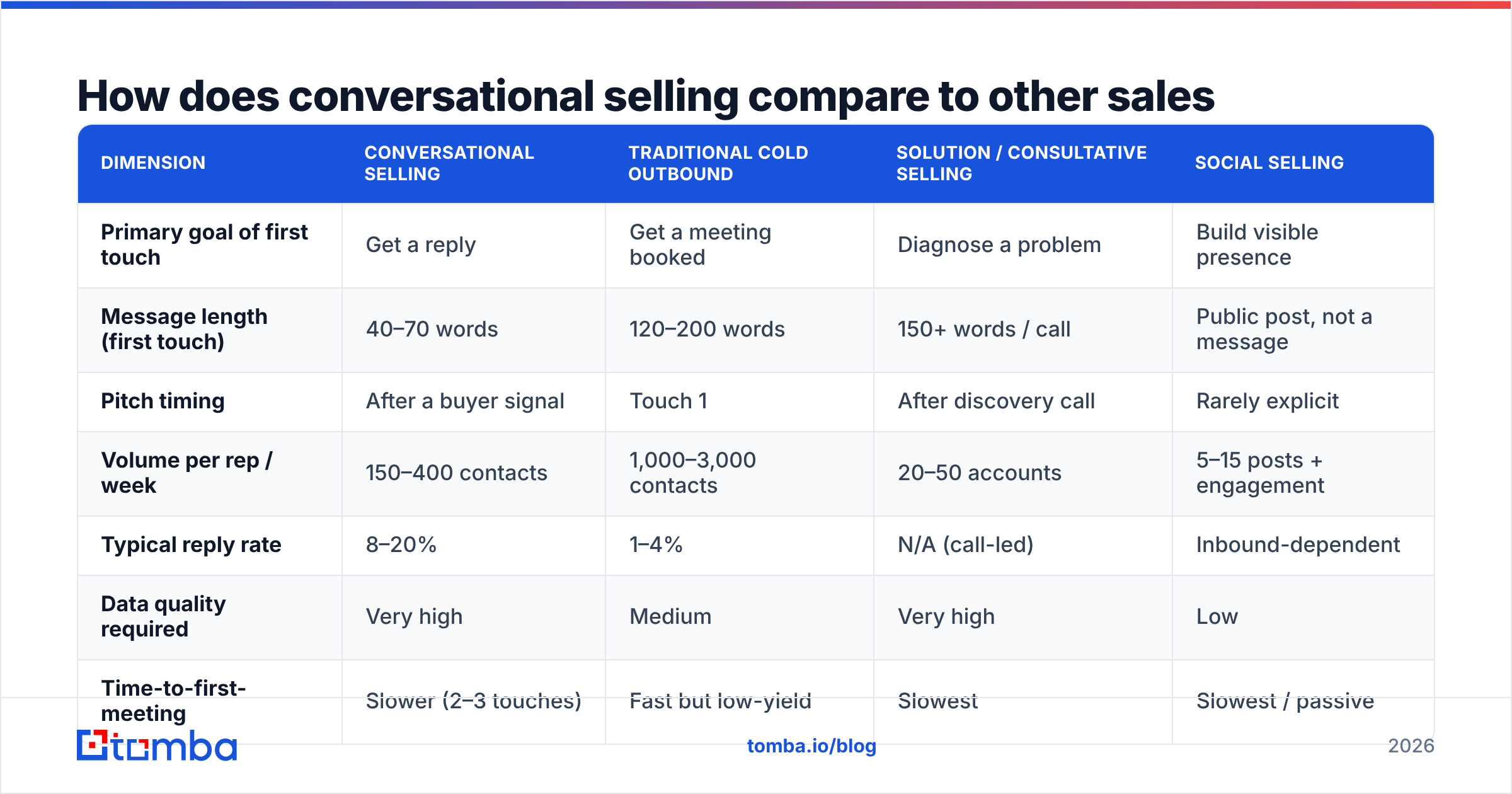
| Dimension | Conversational Selling | Traditional Cold Outbound | Solution / Consultative Selling | Social Selling |
|---|---|---|---|---|
| Primary goal of first touch | Get a reply | Get a meeting booked | Diagnose a problem | Build visible presence |
| Message length (first touch) | 40–70 words | 120–200 words | 150+ words / call | Public post, not a message |
| Pitch timing | After a buyer signal | Touch 1 | After discovery call | Rarely explicit |
| Volume per rep / week | 150–400 contacts | 1,000–3,000 contacts | 20–50 accounts | 5–15 posts + engagement |
| Typical reply rate | 8–20% | 1–4% | N/A (call-led) | Inbound-dependent |
| Data quality required | Very high | Medium | Very high | Low |
| Time-to-first-meeting | Slower (2–3 touches) | Fast but low-yield | Slowest | Slowest / passive |
| Best for | ACV $5k–$100k, defined ICP | High-volume SMB, low ACV | Enterprise, long cycles | Founder-led, brand-heavy |
| Main failure mode | Reps stall in chit-chat | Domain burn, spam folder | Doesn't scale past 1 rep | No pipeline attribution |
The pattern in that table is the tradeoff you're actually buying: conversational selling trades reach for response. You touch a quarter as many people and get four to six times the reply rate. Net-net you're often flat on meetings booked in month one — and clearly ahead by month three, because the meetings you booked were with people who chose to talk to you.
That's also why it fails in orgs where the comp plan or the manager dashboard still rewards activity count. If "sends per day" is the number on the wall, no framework survives contact with it. Fix the scoreboard first — this is a revenue operations problem before it's a rep-skill problem.
What does a conversational sequence actually look like?#
Here's a four-touch sequence for a fictional ICP: a Head of RevOps at a 200-person B2B SaaS company that just posted three SDR job openings.
Touch 1 — Email, day 0 (52 words)
Subject: three SDR reqs
Hi Priya — saw the three SDR openings on your careers page this month. That usually means either the current team is at capacity or the pipeline coverage math stopped working.
Which one is it for you?
— Sam
No pitch. No link. No calendar. One question, and the question demonstrates that you understand the two realistic reasons someone hires three SDRs at once. If she replies with either answer, you now know more about her business than a discovery call would have told you in week three.
Touch 2 — LinkedIn, day 3 (if no reply)
Sam: Priya — emailed you about the SDR hiring. Ignore it if the timing's off. Genuinely curious though: are you having them source their own lists, or is that centralized?
Same rule. One question. Different angle. Explicit permission to ignore, which paradoxically raises reply rate because it removes the pressure.
Touch 3 — Email, day 7
Subject: re: three SDR reqs
Priya — last one from me. Most RevOps leads I talk to who staff up SDRs first discover their contact data is the bottleneck, not headcount. Two of our customers cut list-building time per rep from 9 hours a week to under 2.
Worth a 15-minute look, or should I close the file?
This is where the pitch finally appears, and it's still framed as a question with a graceful exit. "Should I close the file?" is the highest-converting closing line in cold outbound precisely because it's easy to say yes to — and a surprising number of people say "no, don't."
Touch 4 — Breakup, day 14
Closing the loop, Priya. If SDR ramp becomes a priority in Q4, I'll be here. Good luck with the hires.
No question. No hook. Actually mean it. Roughly 5–8% of breakup emails get a reply, and about a third of those replies are "actually, wait."
What data do you need before any of this works?#
This is the part every conversational-selling article skips, and it's the part that decides whether the framework produces pipeline or produces a burned domain.
A conversational message is more fragile than a generic one, not less. A generic blast survives 15% bad data because nobody was going to reply anyway. A conversational sequence built on bad data fails loudly: you reference the wrong company, you email a person who left in 2024, or you hit a spam trap and lose the mailbox you were carefully protecting.
The prerequisite checklist, in order:
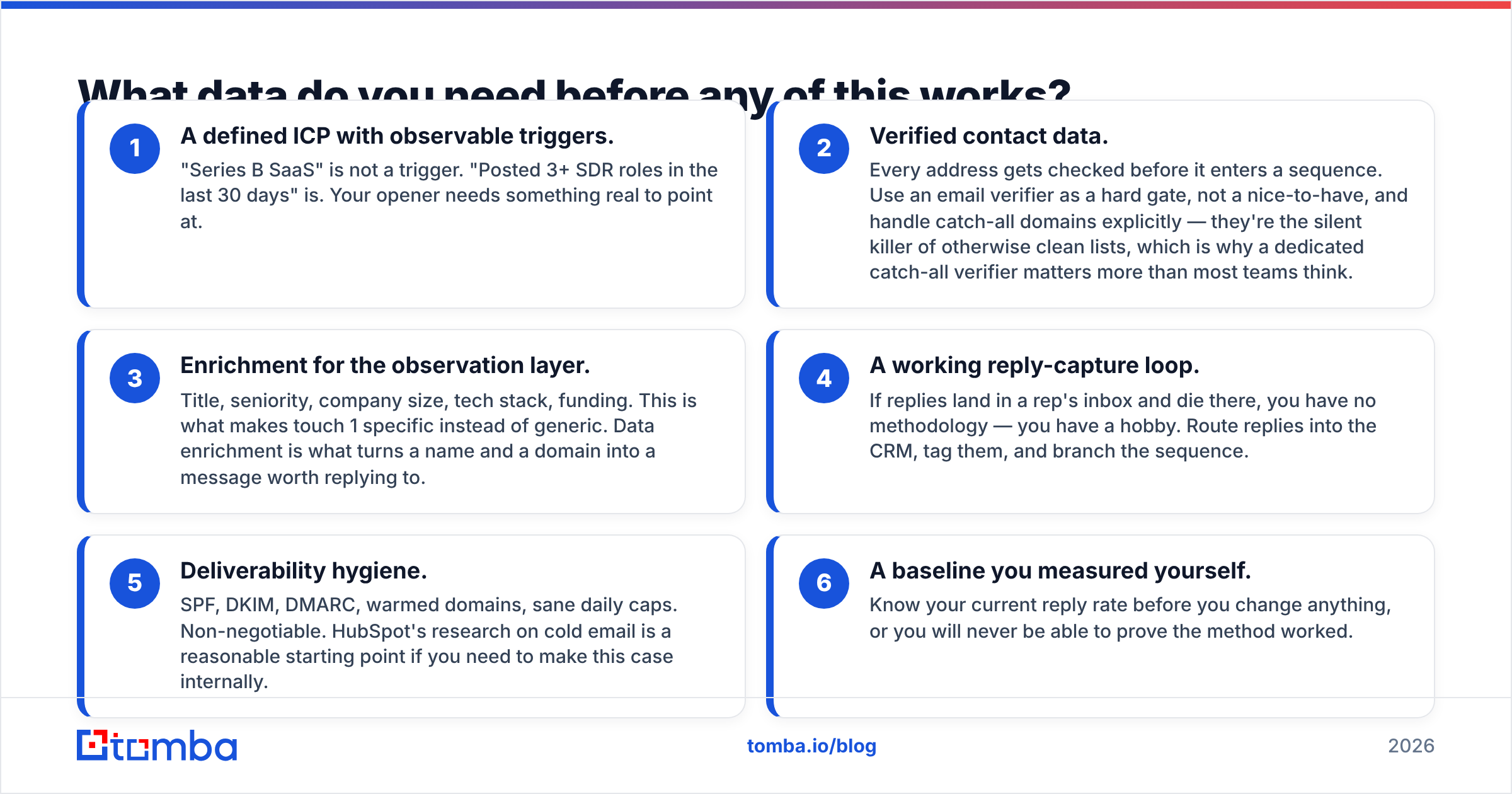
- A defined ICP with observable triggers. "Series B SaaS" is not a trigger. "Posted 3+ SDR roles in the last 30 days" is. Your opener needs something real to point at.
- Verified contact data. Every address gets checked before it enters a sequence. Use an email verifier as a hard gate, not a nice-to-have, and handle catch-all domains explicitly — they're the silent killer of otherwise clean lists, which is why a dedicated catch-all verifier matters more than most teams think.
- Enrichment for the observation layer. Title, seniority, company size, tech stack, funding. This is what makes touch 1 specific instead of generic. Data enrichment is what turns a name and a domain into a message worth replying to.
- A working reply-capture loop. If replies land in a rep's inbox and die there, you have no methodology — you have a hobby. Route replies into the CRM, tag them, and branch the sequence.
- Deliverability hygiene. SPF, DKIM, DMARC, warmed domains, sane daily caps. Non-negotiable. HubSpot's research on cold email is a reasonable starting point if you need to make this case internally.
- A baseline you measured yourself. Know your current reply rate before you change anything, or you will never be able to prove the method worked.
Skip step 2 and the rest is decoration.
Which tools support conversational selling in 2026?#
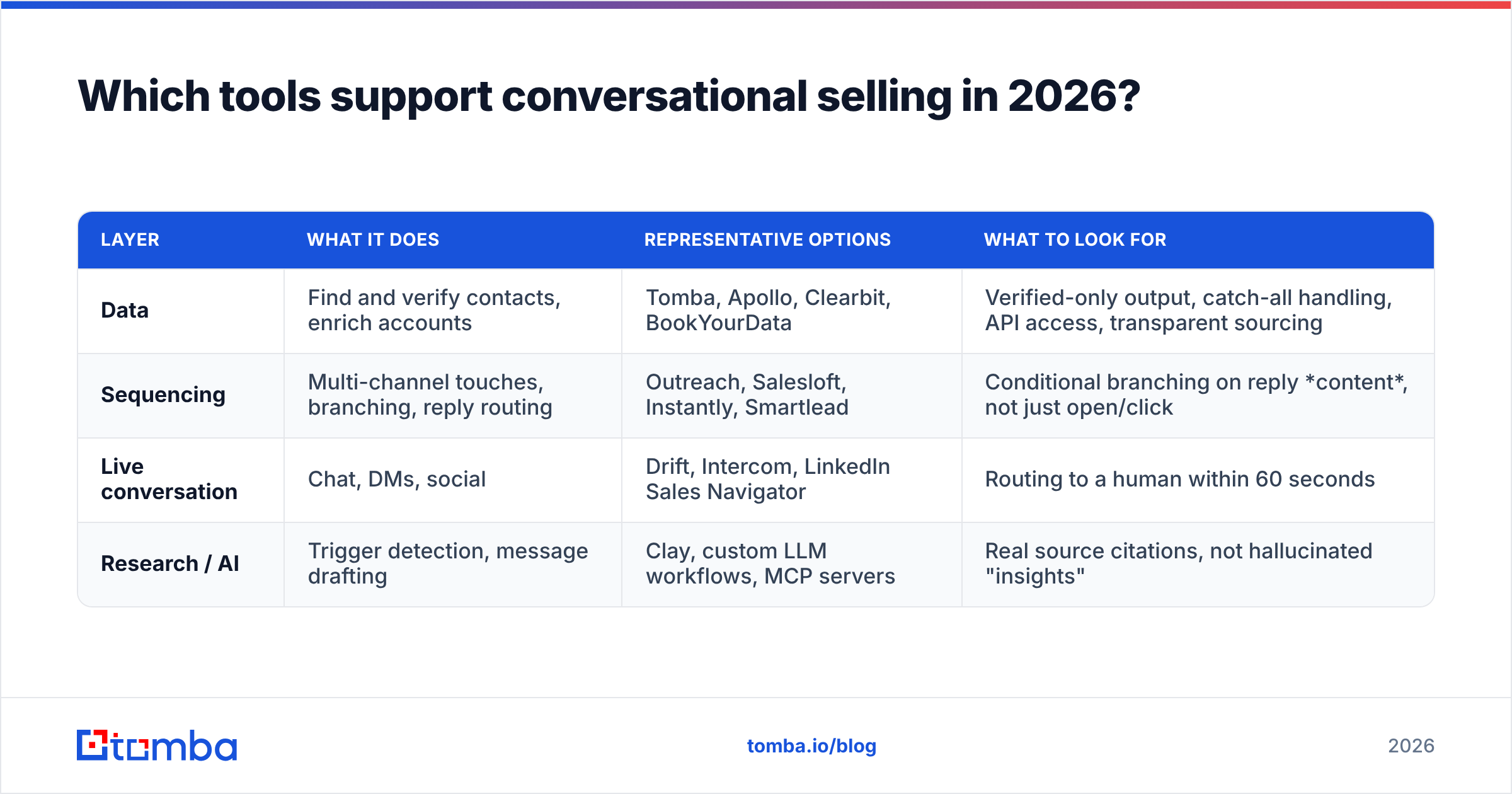
There is no single "conversational selling platform," and any vendor claiming to be one is selling you a sequencer with a nicer landing page. What you actually need is four layers, and the honest advice is to buy best-in-class at each layer rather than a mediocre suite.
| Layer | What it does | Representative options | What to look for |
|---|---|---|---|
| Data | Find and verify contacts, enrich accounts | Tomba, Apollo, Clearbit, BookYourData | Verified-only output, catch-all handling, API access, transparent sourcing |
| Sequencing | Multi-channel touches, branching, reply routing | Outreach, Salesloft, Instantly, Smartlead | Conditional branching on reply content, not just open/click |
| Live conversation | Chat, DMs, social | Drift, Intercom, LinkedIn Sales Navigator | Routing to a human within 60 seconds |
| Research / AI | Trigger detection, message drafting | Clay, custom LLM workflows, MCP servers | Real source citations, not hallucinated "insights" |
On the data layer, the thing to actually evaluate is whether the tool returns verified results or guessed results. Most email finders will happily hand you a permutation of first.last@domain.com with a confidence score attached and no SMTP check behind it. That's fine for a volume play and fatal for a conversational one.
This is where Tomba fits the method well: the finder and the verifier are the same pipeline, so what comes out has already been checked rather than pattern-guessed, and the free tier (25 searches/month) is enough to test the framework on a small list before you commit budget. If it works, Tomba pricing starts at $49/mo for Starter, $99/mo for Growth. Cross-check any vendor's claims on G2 before you buy — including ours.
BookYourData is worth a look if you want pre-built, human-verified lists rather than a self-serve search API; it's a different shape of the same problem, and for teams without an ops person to run enrichment workflows, buying the list outright is often the faster path to a first campaign.
What are the honest downsides?#
It's slower to show results. Month one usually looks worse on activity dashboards. If your board reviews SDR output monthly, warn them before you switch.
It's harder to hire for. Volume outbound can be run by a 22-year-old with a script. Conversational selling requires the rep to actually understand the buyer's business well enough to ask a smart question. That's a real skill and it takes 6–10 weeks to build.
It doesn't scale linearly. You cannot 10x it by adding 10x reps. It scales through better data and better triggers, not more bodies — which is a harder story to tell in a board deck.
AI is eroding the moat. The "specific observation" opener is getting easier to fake at scale. In 18 months the bar will be higher again. Assume this is a moving target, not a permanent edge.
Where should you start this quarter?#
Pick one segment. Not your whole TAM — one segment of 200 accounts where you can name a real trigger.
Build the list properly: find the contacts, verify every address, enrich enough to write one true sentence about each account. Write a four-touch sequence where touch 1 is under 70 words and ends in a question. Run it for three weeks. Compare reply rate, meeting-held rate, and meeting-to-opportunity rate against your current baseline — not against a vendor's benchmark.
If reply rate goes up and meeting-held rate goes up, expand. If reply rate goes up and meetings don't, your data was fine and your qualification is broken. If reply rate doesn't move at all, your list was wrong before your copy ever got a chance.
Conversational selling isn't a script. It's a discipline about who you talk to and what you ask them. The script is the easy half.
Start with the list. Every conversational sequence lives or dies on whether the person you wrote that carefully-observed opener to actually exists, still works there, and can receive mail. The Tomba Email Finder finds professional addresses by domain, name, or company and verifies them in the same pass — so the only thing you're testing is your message, not your data. Free tier is 25 searches a month, no card. Build one 200-account list, run the four-touch sequence above, and let the reply rate tell you whether the method works for your ICP.
Related guides#
Ready to find emails that actually work?
Join 150,000+ professionals who stopped guessing and started sending. Free credits on signup — no credit card required.
Get the Tomba newsletter
Practical outbound tactics and product updates — once every two weeks.
About the author