Copy.ai Alternatives: 9 Best AI Writing Tools for 2026
Copy.ai pivoted from marketing copy to a GTM platform, and a lot of teams got left behind. Here are 9 Copy.ai alternatives ranked by pricing, output quality, and the one thing AI writers can't fix: bad data.
TL;DR
- Copy.ai stopped being a copywriting tool. It repositioned as a "GTM AI platform" with workflow credits, and the free tier that got most people in the door is effectively gone. That's why search volume for Copy.ai alternatives keeps climbing.
- If you want pure writing quality, Jasper and raw Claude/ChatGPT beat it. If you want GTM workflows, Clay and Lavender are the sharper tools. If you want cheap and simple, Writesonic and Rytr undercut everything.
- Pricing is the real story: Copy.ai's entry paid tier starts around $49/user/month, and their GTM plans move into five-figure annual contracts fast.
- No AI writer fixes a bad list. A 12% bounce rate kills your domain regardless of how good the first line is — which is why the pairing that actually works is a cheap writer plus a verified data source.
- Best default stack for a small B2B team in 2026: Claude or ChatGPT for drafts, Lavender for coaching, and a verified contact layer underneath both.
Why are people searching for Copy.ai alternatives in 2026?#
Because the product you signed up for isn't the product you're paying for now.
Copy.ai launched as a template-driven copywriting tool — pick "cold email," paste a value prop, get five variants. It was cheap, it was fast, and the free tier was generous enough that solo founders and junior SDRs used it daily. Then the company repositioned. The homepage now sells a "GTM AI Platform": workflow builder, data enrichment routing, agent-style automations, sales-and-marketing orchestration.
That's a legitimate business move. It's also a completely different product with a completely different buyer. If you're one person writing ten cold emails a week, you are no longer the customer. You're paying platform prices for a workflow engine you don't use.
Three complaints show up over and over in G2 reviews and in outbound communities:
- Credit math is confusing. Workflow credits burn differently than word credits, and running a multi-step GTM workflow across 500 accounts eats them faster than people expect.
- Output has gotten generic. The same prompt through Claude or GPT-4-class models produces less template-shaped copy.
- The free tier is a demo, not a workspace. It's enough to evaluate, not enough to work.
If any of those describe you, you're in the right article.
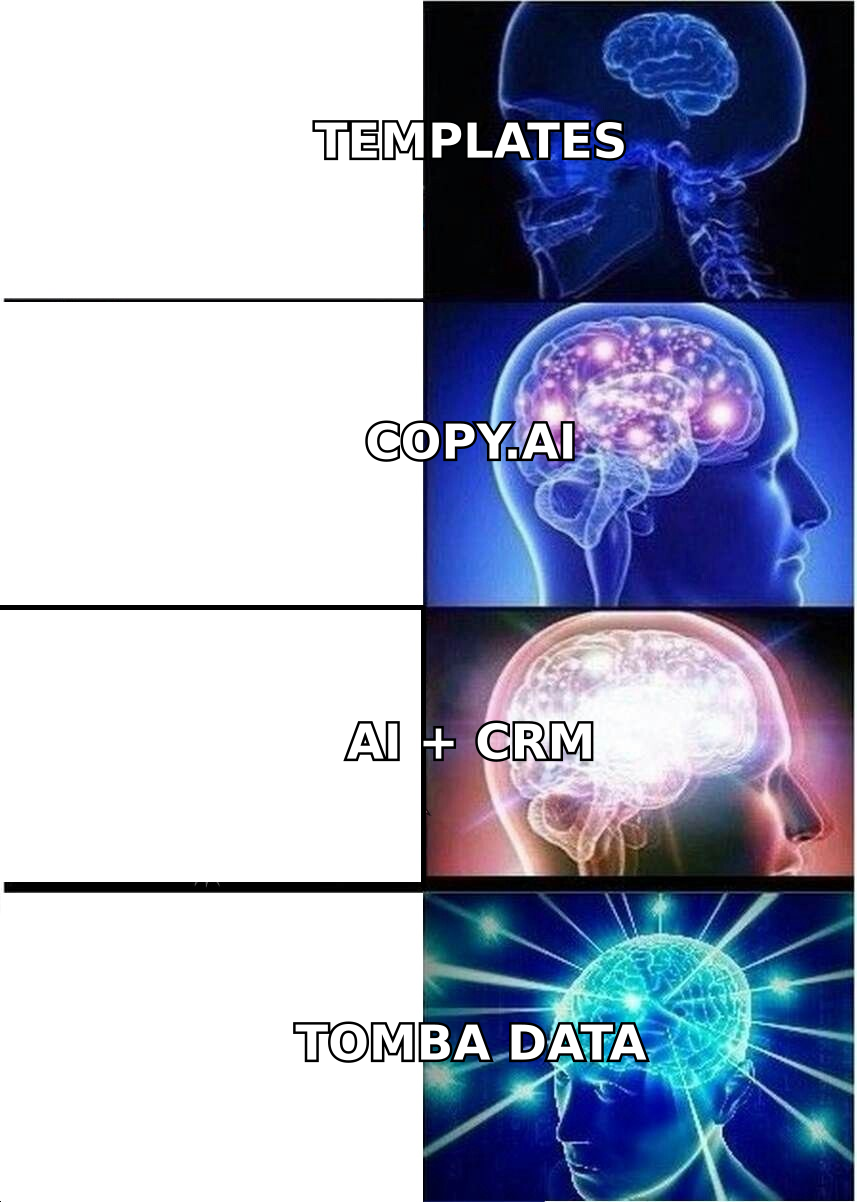
What should you actually compare when choosing a Copy.ai alternative?#
Most "best AI writing tool" listicles compare feature checkboxes. That's useless. Here's what actually decides whether a tool survives in your workflow past week three.
- Output quality on your ICP, not on generic prompts. Test every tool on the same brief: a 90-word cold email to a VP of Engineering at a 200-person fintech. Generic SaaS-copy prompts make every tool look competent.
- Cost per usable output, not cost per seat. A $39/mo tool where you throw away 4 of 5 drafts is more expensive than a $99/mo tool where you keep 3 of 5.
- Whether it touches your data. A writing tool that can't see who you're writing to produces "I noticed your company is growing" slop. A tool wired into firmographics or CRM context produces something a human might answer.
- Brand-voice retention over long documents. Most tools nail 100-word emails and fall apart at 1,200-word posts.
- Export and integration path. If getting copy out means copy-paste into your sequencer, you've bought a fancy notepad.
- The deliverability floor. This is the one nobody lists. If your list is unverified, your reply rate is capped by your bounce rate — no amount of copy quality moves it.
That last point matters more than anything else on this page. A perfectly written email to a dead mailbox is a bounce, and enough bounces damage your sender reputation permanently. Fix the list before you optimize the sentence.
Which Copy.ai alternatives are worth paying for?#
Here's the honest field. Prices are entry-level published rates as of early 2026 and move around — check the vendor before you buy.
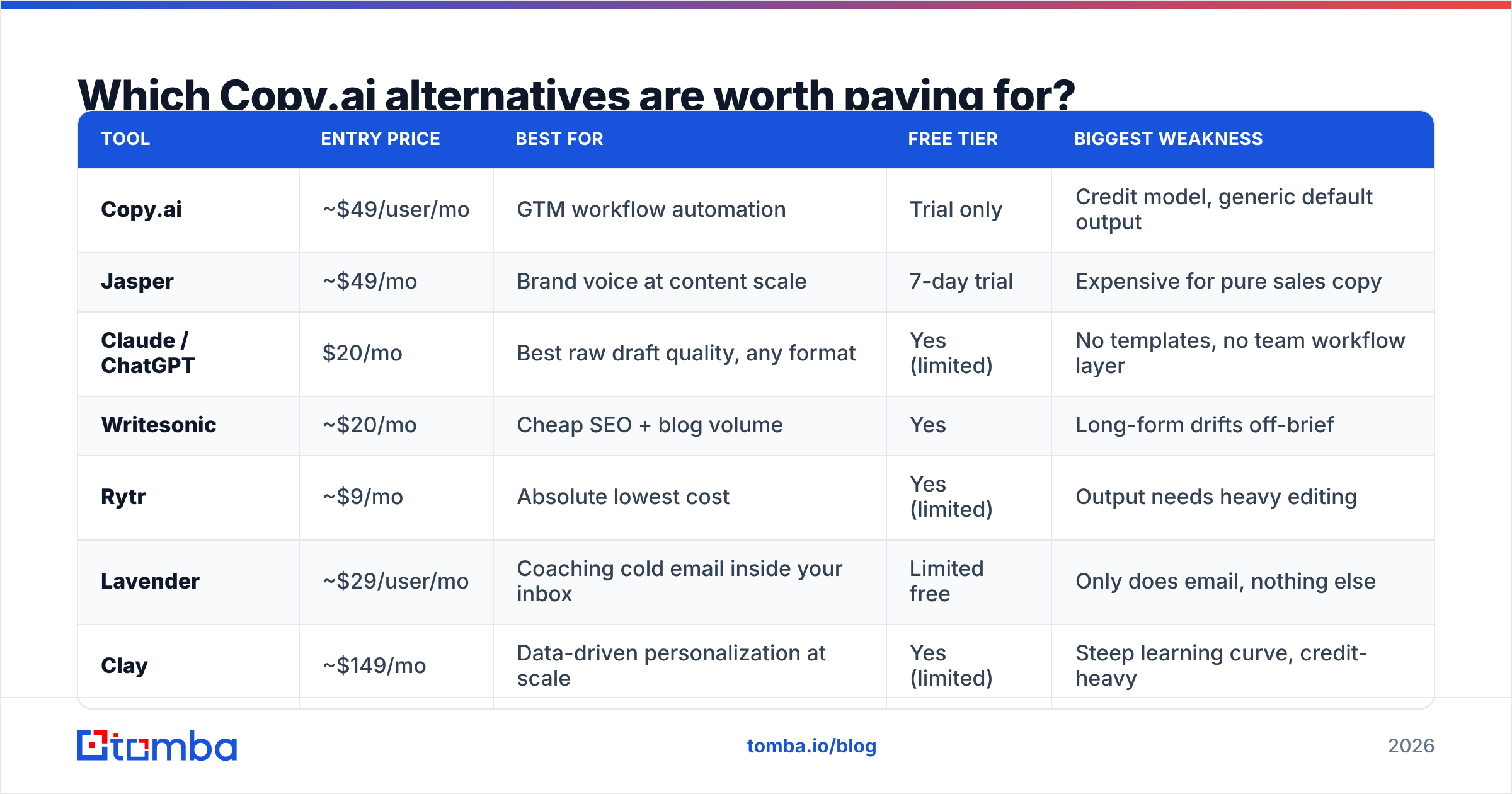
| Tool | Entry price | Best for | Free tier | Biggest weakness |
|---|---|---|---|---|
| Copy.ai | ~$49/user/mo | GTM workflow automation | Trial only | Credit model, generic default output |
| Jasper | ~$49/mo | Brand voice at content scale | 7-day trial | Expensive for pure sales copy |
| Claude / ChatGPT | $20/mo | Best raw draft quality, any format | Yes (limited) | No templates, no team workflow layer |
| Writesonic | ~$20/mo | Cheap SEO + blog volume | Yes | Long-form drifts off-brief |
| Rytr | ~$9/mo | Absolute lowest cost | Yes (limited) | Output needs heavy editing |
| Lavender | ~$29/user/mo | Coaching cold email inside your inbox | Limited free | Only does email, nothing else |
| Clay | ~$149/mo | Data-driven personalization at scale | Yes (limited) | Steep learning curve, credit-heavy |
| Anyword | ~$49/mo | Predictive performance scoring | 7-day trial | Scores are directional, not gospel |
| Instantly AI writer | Bundled | Teams already sending in Instantly | With plan | Writer is a feature, not a product |
Jasper — the closest like-for-like swap#

Jasper is what Copy.ai used to be, grown up. Brand Voice actually works: feed it 10 pieces of your existing copy and it stops writing like a LinkedIn ghostwriter. Knowledge base lets it reference your real product facts instead of inventing them.
Pick it if you produce content at volume — blog, landing pages, ads, plus sales enablement. Skip it if your only job is cold email; you'll pay for a content platform to write 90-word messages.
Claude and ChatGPT — the answer most teams refuse to accept#
The uncomfortable truth: a $20/month frontier model with a good prompt beats most $49/month wrappers on output quality. The wrappers exist to sell you templates, a workflow UI, and team seats. If you have one strong writer who can build a prompt library, you don't need the wrapper.
What you lose: no team template library, no usage governance, no analytics, no one-click brand voice. For a 3-person team, that's fine. For a 30-person SDR floor, it isn't — you'll get 30 different prompt styles and zero consistency.
Lavender — the one that actually improves reply rates#
Lavender doesn't write for you. It sits in Gmail or Outlook and scores what you wrote: length, reading level, question count, tone, personalization. It nags you when you write a 220-word email with three CTAs.
That coaching loop is the highest-ROI thing on this list for an outbound team, because it changes the rep, not just the draft. It's a narrow tool — email only — but within that lane nothing beats it.
Clay — if your real problem was never the copy#
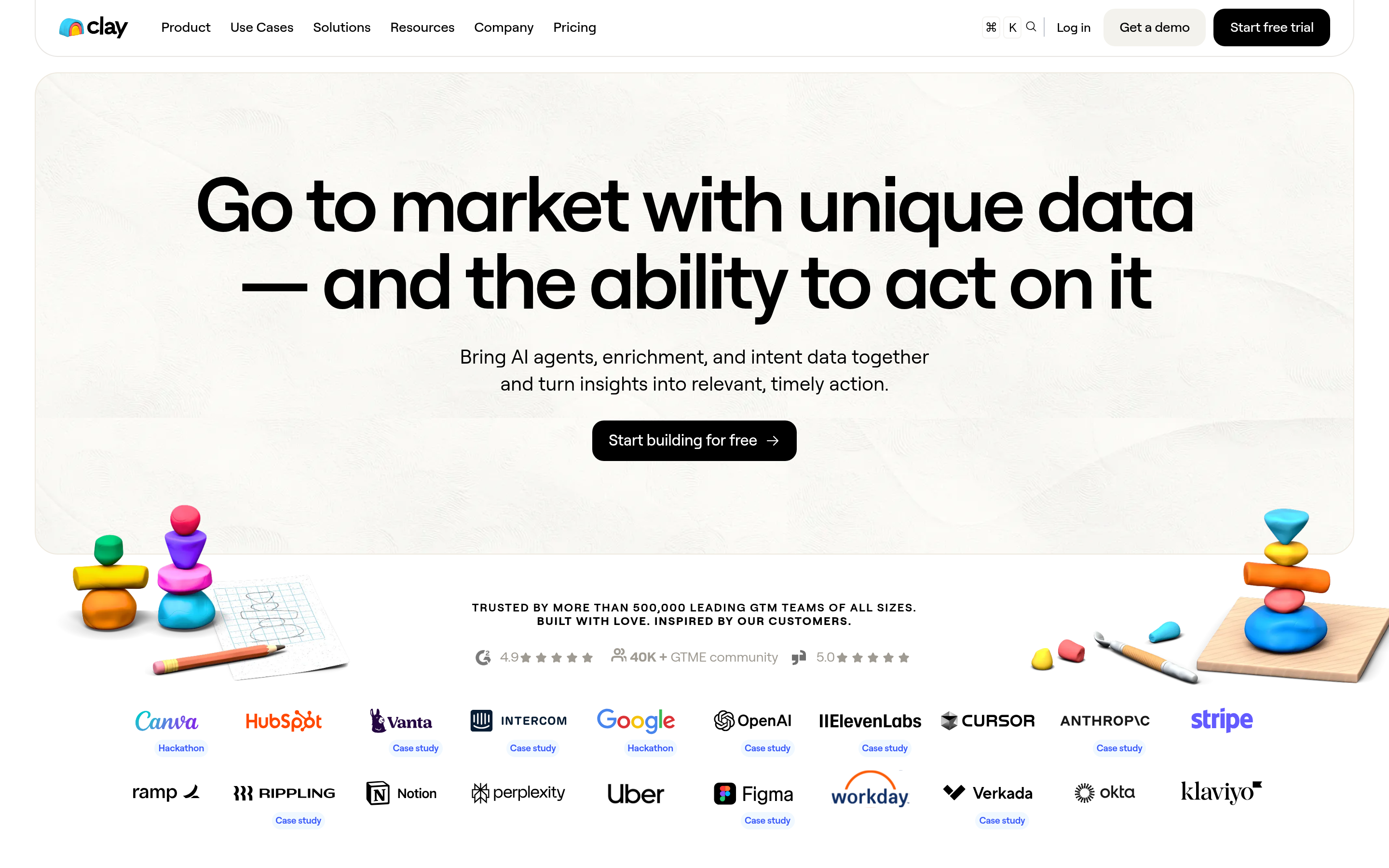
Clay is a data orchestration tool with AI writing bolted on. You enrich a list from 50+ sources, then run AI over each row to generate a personalized line grounded in real signals — funding, hiring, tech stack, job change.
This is the correct answer if your emails are generic because you don't know anything about the prospect. It's the wrong answer if you just want faster drafts; the learning curve is real and the credit model is aggressive.
Writesonic and Rytr — the budget lane#
Both are cheaper than Copy.ai and both are honest about what they are: fast draft generators. Writesonic leans SEO/blog. Rytr is the cheapest credible option on the market at roughly $9/month.
You will edit everything they produce. That's the trade.
Is Copy.ai still worth it for anyone?#
Yes — for one specific buyer: a RevOps or GTM engineering team that wants to build multi-step, data-triggered workflows and doesn't already own Clay.
Copy.ai's workflow builder genuinely does things a chat interface can't: watch a trigger, enrich the account, route it, draft outbound, push to CRM. If that's your job description, the platform pricing makes sense and this article isn't for you.
If your job is "write emails," you're overpaying for infrastructure you don't touch.
How do AI writing tools compare on the thing that actually drives replies?#
Here's the part every AI-copy roundup skips.
Reply rate is a product of three multiplied factors, not one:
- Deliverability — did it land in the inbox at all?
- Relevance — is this person actually a buyer for this?
- Copy — is the message worth answering?
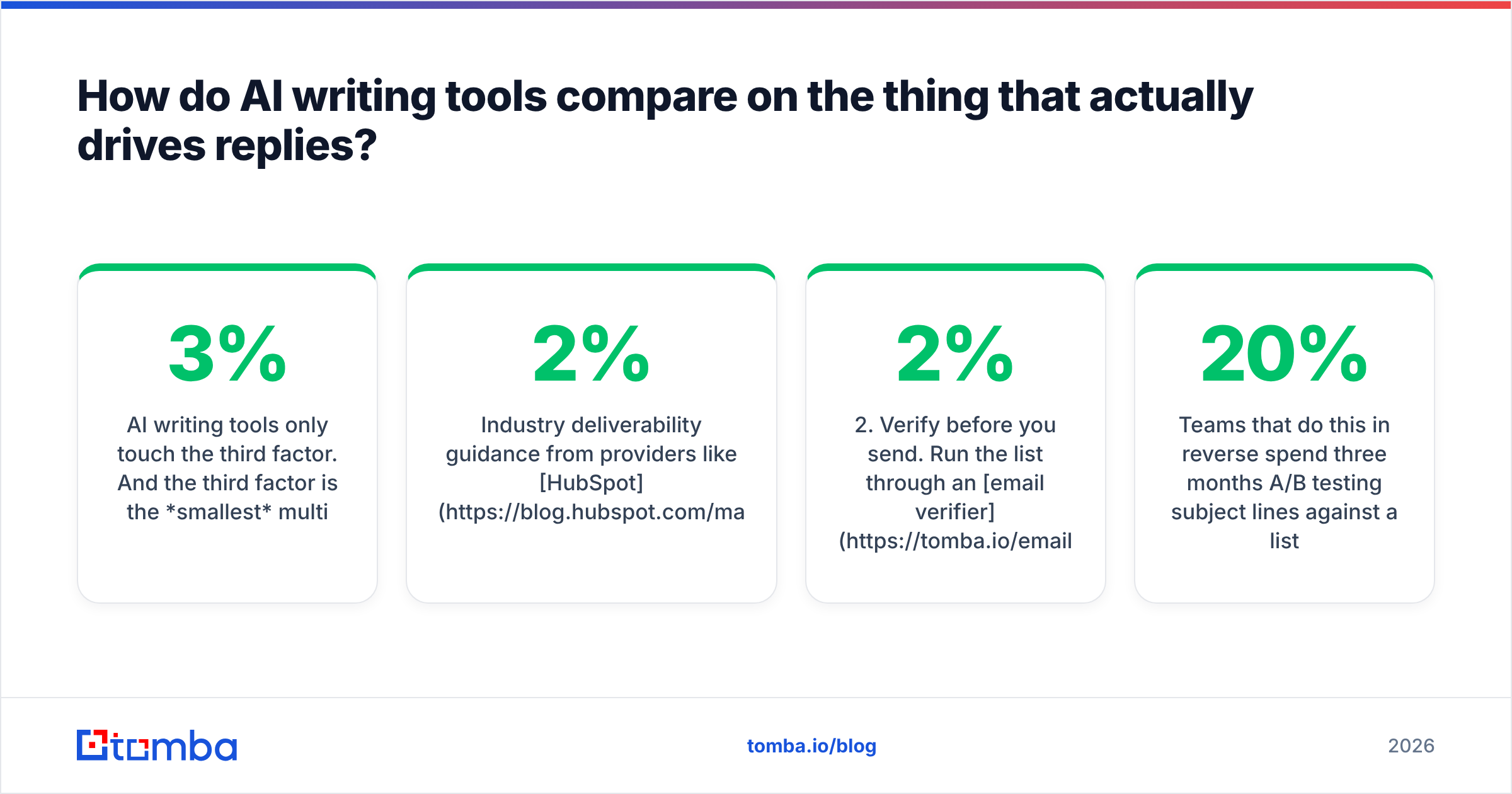
AI writing tools only touch the third factor. And the third factor is the smallest multiplier of the three. Going from mediocre copy to great copy might take you from a 3% reply rate to a 6% reply rate. Going from a 15% bounce rate to a 1% bounce rate takes you from "burned domain in six weeks" to "sustainable channel."
Industry deliverability guidance from providers like HubSpot and mailbox providers themselves converges on the same threshold: keep hard bounces under 2%, and keep spam complaints under 0.1%. Blow past those and your email deliverability collapses no matter what your subject line says.
So the sequencing is:
- Build a clean, targeted list first. Use a domain search to pull real contacts at your ICP accounts rather than scraping a stale database.
- Verify before you send. Run the list through an email verifier so your bounce rate stays under 2%. Catch-all domains need their own catch-all verifier pass — they're the single most common source of surprise bounces.
- Then optimize copy. Now the AI writer is working on a list where good copy can actually earn a reply.
Teams that do this in reverse spend three months A/B testing subject lines against a list that was 20% dead on arrival, conclude "cold email doesn't work," and move on.
What's the best stack to replace Copy.ai?#
Depends on which Copy.ai you were using. Three honest recommendations:
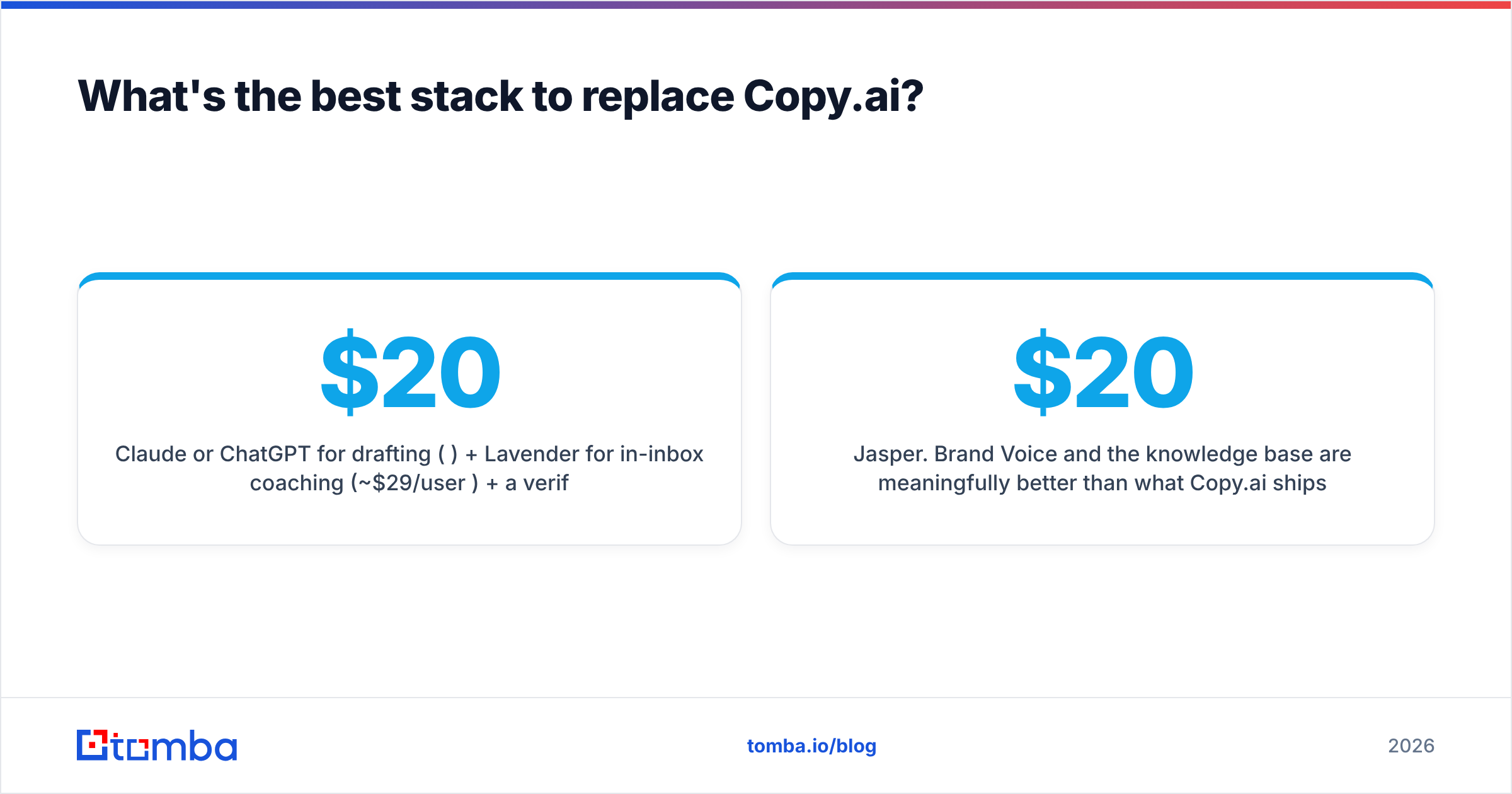
If you were using it for cold email (most people): Claude or ChatGPT for drafting ($20/mo) + Lavender for in-inbox coaching (~$29/user/mo) + a verified contact layer. Total under $60/user/month, and every piece is best-in-class at its job. This beats Copy.ai on output quality and costs less.
If you were using it for content marketing: Jasper. Brand Voice and the knowledge base are meaningfully better than what Copy.ai ships for long-form, and the price is comparable. If budget is tight, Writesonic at ~$20/mo covers 80% of it.
If you were using it for GTM workflows: Clay, and budget real onboarding time. Or stay on Copy.ai — genuinely, if the workflows are working, don't churn for the sake of it.
If you're a solo founder or a two-person team: ChatGPT or Claude plus a free-tier email finder. That's the whole stack. Don't buy a platform.
A note on data vendors, since people always ask: purpose-built B2B contact providers like BookYourData are a reasonable option when you want to buy a pre-built list rather than build one, and they're a solid peer in this category. The distinction is build-vs-buy: pre-built lists get you volume immediately, while finding and verifying contacts yourself gets you a tighter, fresher list at lower cost per usable contact. Most teams end up doing both.
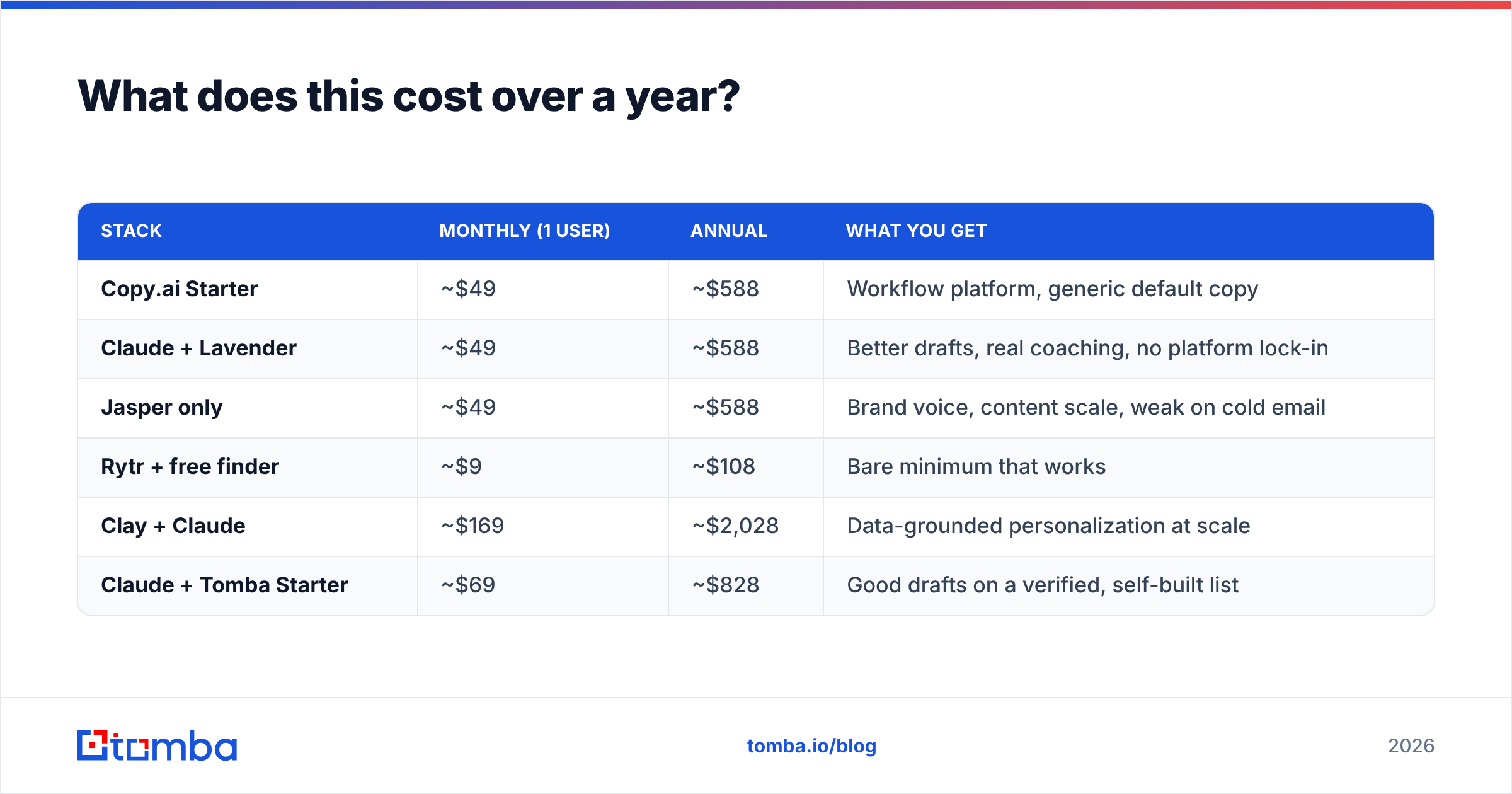
What does this cost over a year?#
| Stack | Monthly (1 user) | Annual | What you get |
|---|---|---|---|
| Copy.ai Starter | ~$49 | ~$588 | Workflow platform, generic default copy |
| Claude + Lavender | ~$49 | ~$588 | Better drafts, real coaching, no platform lock-in |
| Jasper only | ~$49 | ~$588 | Brand voice, content scale, weak on cold email |
| Rytr + free finder | ~$9 | ~$108 | Bare minimum that works |
| Clay + Claude | ~$169 | ~$2,028 | Data-grounded personalization at scale |
| Claude + Tomba Starter | ~$69 | ~$828 | Good drafts on a verified, self-built list |
The most common mistake in this table is spending $588/year on writing and $0 on data. You end up with beautiful emails going to addresses that stopped existing in 2023.
Frequently asked questions#
Is there a free Copy.ai alternative? Yes. ChatGPT's and Claude's free tiers produce better copy than most paid wrappers. Rytr has a free plan with a monthly character cap. For data, most email finders — Tomba included — have a free tier you can build a first list on.
Does Copy.ai still have a free plan? Copy.ai has repositioned around paid GTM plans and the historically generous free tier has been curtailed. Check their pricing page directly, because it has changed more than once.
Which alternative is best for cold email specifically? Lavender for coaching, Claude for drafting. Neither is a "Copy.ai clone," and that's exactly why they work better — they're specialists.
Will AI-written emails hurt my deliverability? Not directly. AI copy doesn't trigger spam filters on its own. What hurts you is volume without verification, a cold domain, and high bounce rates. Run a spam checker on your template and verify your list — those two moves matter more than who wrote the words.
Where to start#
Pick your writer based on what you actually do — Jasper for content, Claude for drafts, Lavender for cold email coaching, Clay if data is your bottleneck. Any of those beats paying platform prices for a product that moved on from your use case.
Then fix the layer underneath it. Before you send another AI-drafted sequence, build the list properly: use the Tomba Email Finder to pull verified, current addresses at your target accounts, with a free tier at 25 searches/month and paid plans starting at $49/mo. Great copy on a clean list is a channel. Great copy on a dead list is a bounce report.
Related guides#
Ready to find emails that actually work?
Join 150,000+ professionals who stopped guessing and started sending. Free credits on signup — no credit card required.
Get the Tomba newsletter
Practical outbound tactics and product updates — once every two weeks.
About the author