Creative ABM Campaigns: 9 Plays That Actually Book Meetings
Most ABM programs die in the ad-retargeting graveyard. Here are nine creative ABM campaigns that book real meetings, what each costs, and the account data you need before you spend a dollar.
TL;DR
- Most "ABM" programs are just retargeting ads plus a spreadsheet. Creative ABM campaigns win because they are specific to one account, not because they are expensive.
- The nine plays below are ranked by cost-per-meeting and effort, from a $0 custom teardown video to a $180-per-account direct mail drop.
- Every play collapses if your contact data is wrong. Personalization sent to a bounced address is just budget on fire.
- Run 25–50 accounts per play, not 500. Depth beats reach in ABM every single time.
- Build the account list first, enrich and verify it second, get creative third. In that order.
What counts as a "creative" ABM campaign in 2026?#
Creative ABM campaigns are account-specific plays where the creative asset itself could not be sent to any other company. That is the whole test. If you could swap the logo and mail it to a different account, it is not ABM — it is a template with a merge tag.
The distinction matters because the ABM category has drifted. Account-based marketing started as a high-touch, low-volume strategy borrowed from enterprise sales. Then platforms industrialized it: buy intent data, sync a target list, run display ads at 200 accounts, call it a program. That works fine as air cover. It does not book meetings on its own, and it is why so many ABM budgets get cut in year two.
What actually books meetings is asymmetric effort — you spending 90 minutes on one account, visibly, so the buyer feels obligated to reply. That asymmetry is the entire mechanism. Everything below is a way to manufacture it.
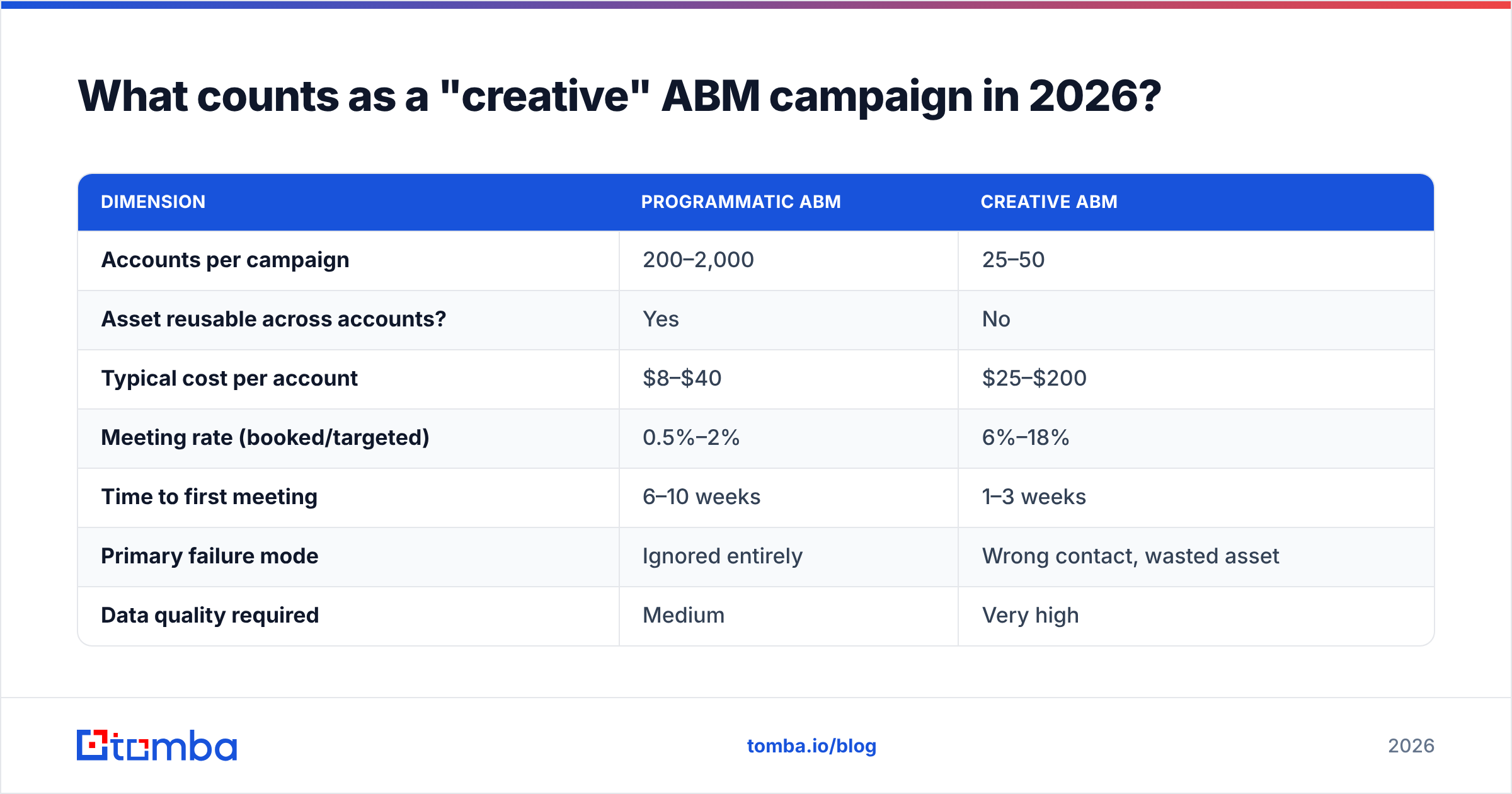
Here is how the two approaches diverge in practice:
| Dimension | Programmatic ABM | Creative ABM |
|---|---|---|
| Accounts per campaign | 200–2,000 | 25–50 |
| Asset reusable across accounts? | Yes | No |
| Typical cost per account | $8–$40 | $25–$200 |
| Meeting rate (booked/targeted) | 0.5%–2% | 6%–18% |
| Time to first meeting | 6–10 weeks | 1–3 weeks |
| Primary failure mode | Ignored entirely | Wrong contact, wasted asset |
| Data quality required | Medium | Very high |
Note that last row. Programmatic ABM tolerates a 20% bad-data rate — the ad just doesn't serve. Creative ABM does not. You cannot send a custom-built microsite link to an email address that bounces, and you certainly cannot ship a $180 gift box to a VP who left nine months ago. The creative is the visible part; the data is the load-bearing part.
Why do most ABM campaigns quietly fail?#
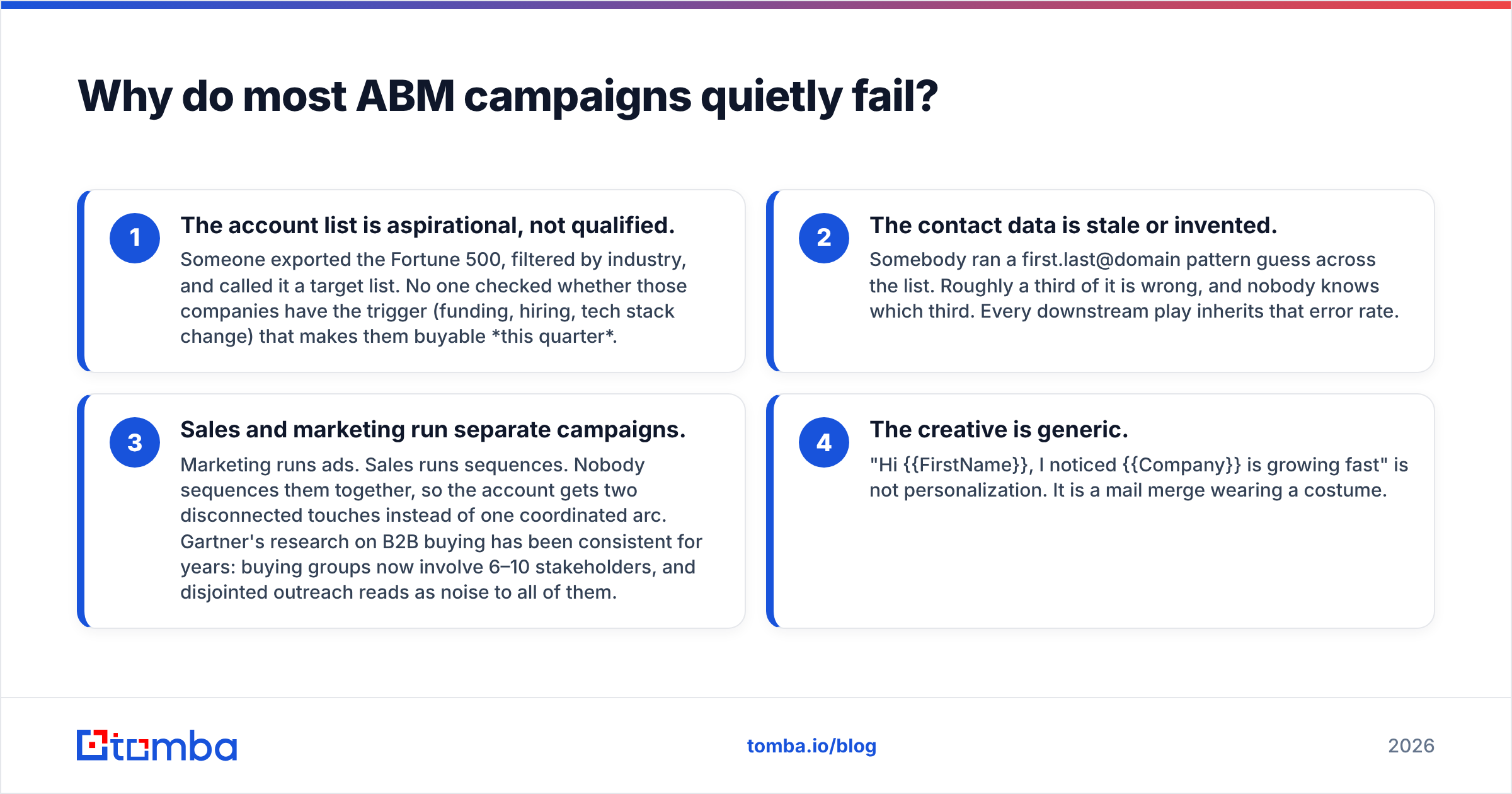
They fail for four reasons, and only one of them is creative.
- The account list is aspirational, not qualified. Someone exported the Fortune 500, filtered by industry, and called it a target list. No one checked whether those companies have the trigger (funding, hiring, tech stack change) that makes them buyable this quarter.
- The contact data is stale or invented. Somebody ran a first.last@domain pattern guess across the list. Roughly a third of it is wrong, and nobody knows which third. Every downstream play inherits that error rate.
- Sales and marketing run separate campaigns. Marketing runs ads. Sales runs sequences. Nobody sequences them together, so the account gets two disconnected touches instead of one coordinated arc. Gartner's research on B2B buying has been consistent for years: buying groups now involve 6–10 stakeholders, and disjointed outreach reads as noise to all of them.
- The creative is generic. "Hi {{FirstName}}, I noticed {{Company}} is growing fast" is not personalization. It is a mail merge wearing a costume.
Fix 1 and 2 before you touch 3 and 4. A brilliant campaign aimed at the wrong people at the wrong companies is a more expensive way to lose.
Getting the data layer right means three things, concretely:
- Firmographic accuracy — the account is real, the size band is right, and the entity you're targeting is the buying entity (not a subsidiary with no budget).
- Contact completeness — you have the actual buying committee, not just whoever's LinkedIn profile ranked highest. That usually means 3–6 named people per account.
- Deliverable, verified addresses — every email is confirmed to accept mail before a single asset is built. Use an email verifier as a hard gate, not a nice-to-have. Bounces on a 40-account list don't just waste sends — they tank your domain reputation right when your best-fit accounts are getting your best work.
- Multi-channel reach — email plus a direct dial. For late-stage plays you want a phone finder so the follow-up isn't hostage to inbox placement.
What are the nine creative ABM campaigns worth running?#
Ranked roughly by effort-to-impact. Pick two, not nine.
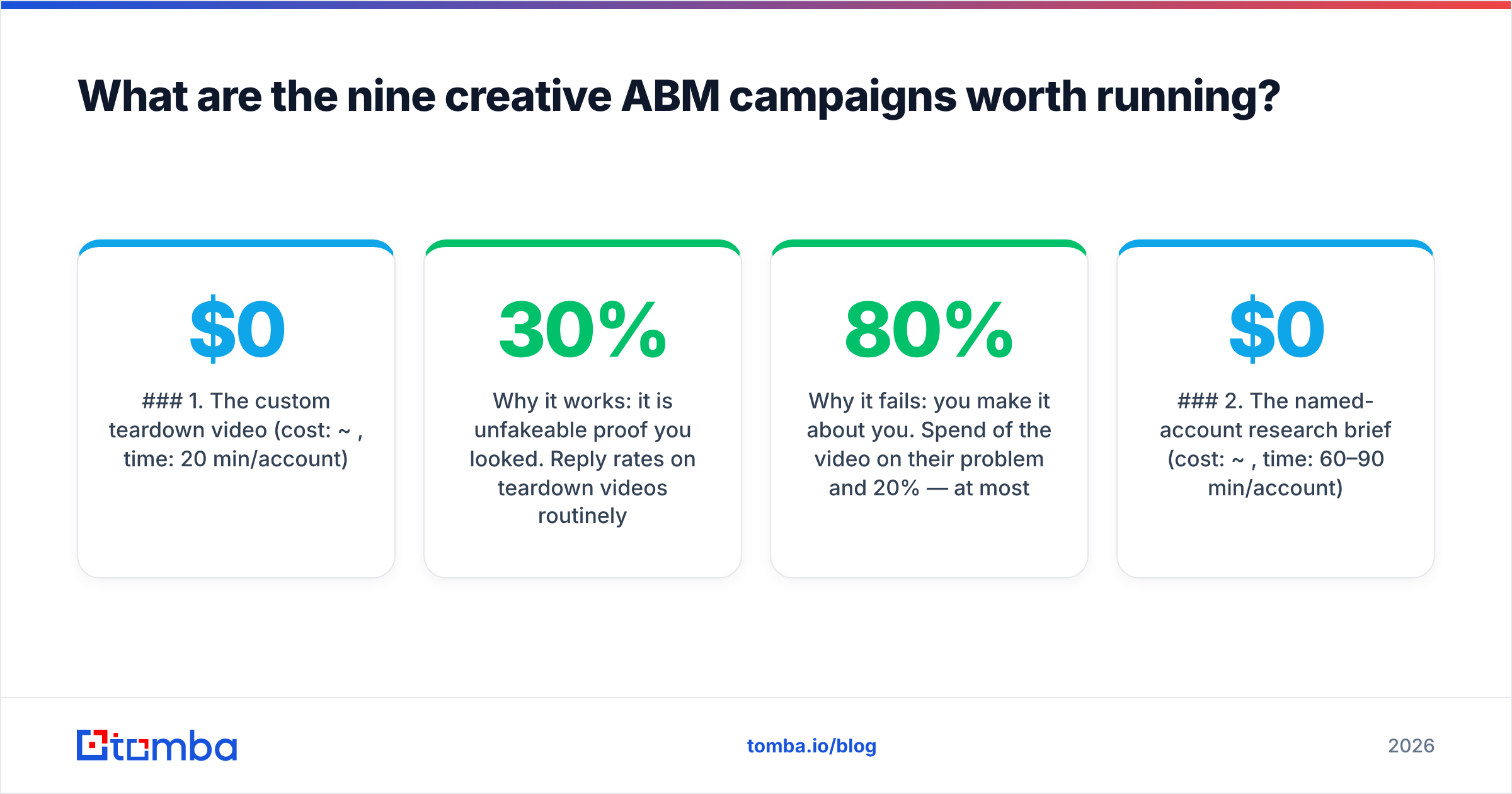
1. The custom teardown video (cost: ~$0, time: 20 min/account)#
Record a 3–5 minute Loom walking through the prospect's actual website, pricing page, signup flow, or job posting. Say specifically what's broken and what you'd change. Send it as the first touch, not the third.
Why it works: it is unfakeable proof you looked. Reply rates on teardown videos routinely land in the 15–30% range for well-chosen accounts, because the buyer opens it out of pure curiosity about what a stranger thinks is wrong with their site.
Why it fails: you make it about you. Spend 80% of the video on their problem and 20% — at most — on what you do about it.
2. The named-account research brief (cost: ~$0, time: 60–90 min/account)#
Write a two-page PDF about their market: three competitor moves they may not have tracked, one regulatory shift, one benchmark comparing them to peers. Put your logo in the footer and nowhere else. Send it with a single line: "Wrote this for your team. No ask."
This is the highest-trust play in the list, and the slowest. Reserve it for your top 10 accounts.
3. The reverse job-post play (cost: ~$0, time: 10 min/account)#
Companies broadcast their pain in job descriptions. A posting for "Marketing Ops Manager — must consolidate three overlapping data tools" is a buying signal with a return address. Reference the exact posting, reference the exact line, and offer the thing that makes the hire's first 90 days easier.
4. The competitor-migration microsite (cost: ~$400 build, reusable, time: 2 hrs setup)#
Build one templated landing page — logo slot, headline slot, three-bullet slot — that renders a per-account URL like yoursite.com/for/acme. It's the one place where light templating is honest ABM, because the page still speaks to one account by name and the switching-cost math is theirs, not generic.
Pair it with a real migration offer (data import, parallel run, no-charge overlap month). Track opens per URL — a second visit from the same account is your call-now signal.
5. The executive gift with a reason (cost: $60–$180/account)#
Not swag. Swag is landfill with a logo. Send something with a reason attached: their CEO mentioned a book on a podcast, send it annotated. Their team just shipped a feature, send a framed screenshot of the launch tweet. The reason is the gift; the object is the wrapper.
Direct mail hit rates depend entirely on getting the physical recipient right, which is precisely why this play sits below the data section in this article and not above it.
6. The customer-panel invite (cost: $200–$600 total, time: 3 hrs)#
Instead of pitching, invite five target-account executives to speak on a roundtable alongside two of your customers. You're not selling — you're conferring status. Nobody declines a panel invitation as reflexively as they decline a demo request.
The conversion happens afterward, in the follow-up, when the panelist has already spent an hour associating your brand with their own expertise.
7. The intent-triggered warm sweep (cost: platform-dependent)#
When an account shows up on your site anonymously, identify it and route it to a human within the hour. Website visitor reveal turns anonymous traffic into a named account you can act on while the interest is still warm. The creative here isn't the asset — it's the speed. A same-day, specific note beats a beautiful campaign that arrives three weeks later.
8. The internal-champion enablement kit (cost: ~$0, time: 30 min/account)#
Your buyer has to sell you internally, to people you'll never meet. Give them the deck: a one-slide business case, a three-line Slack message they can paste, and a rebuttal to the objection you know their CFO will raise. Make it editable. Make it theirs.
This is the most underused play in B2B, and it's the one that most reliably unsticks stalled deals.
9. The "we were wrong" re-engagement (cost: ~$0)#
For closed-lost accounts: an honest note admitting what you got wrong last time, what changed in the product since, and an explicit "if the answer's still no, tell me and I'll close the file." The candor does the work. Closed-lost lists are the densest source of qualified accounts most teams own and the one they touch least.
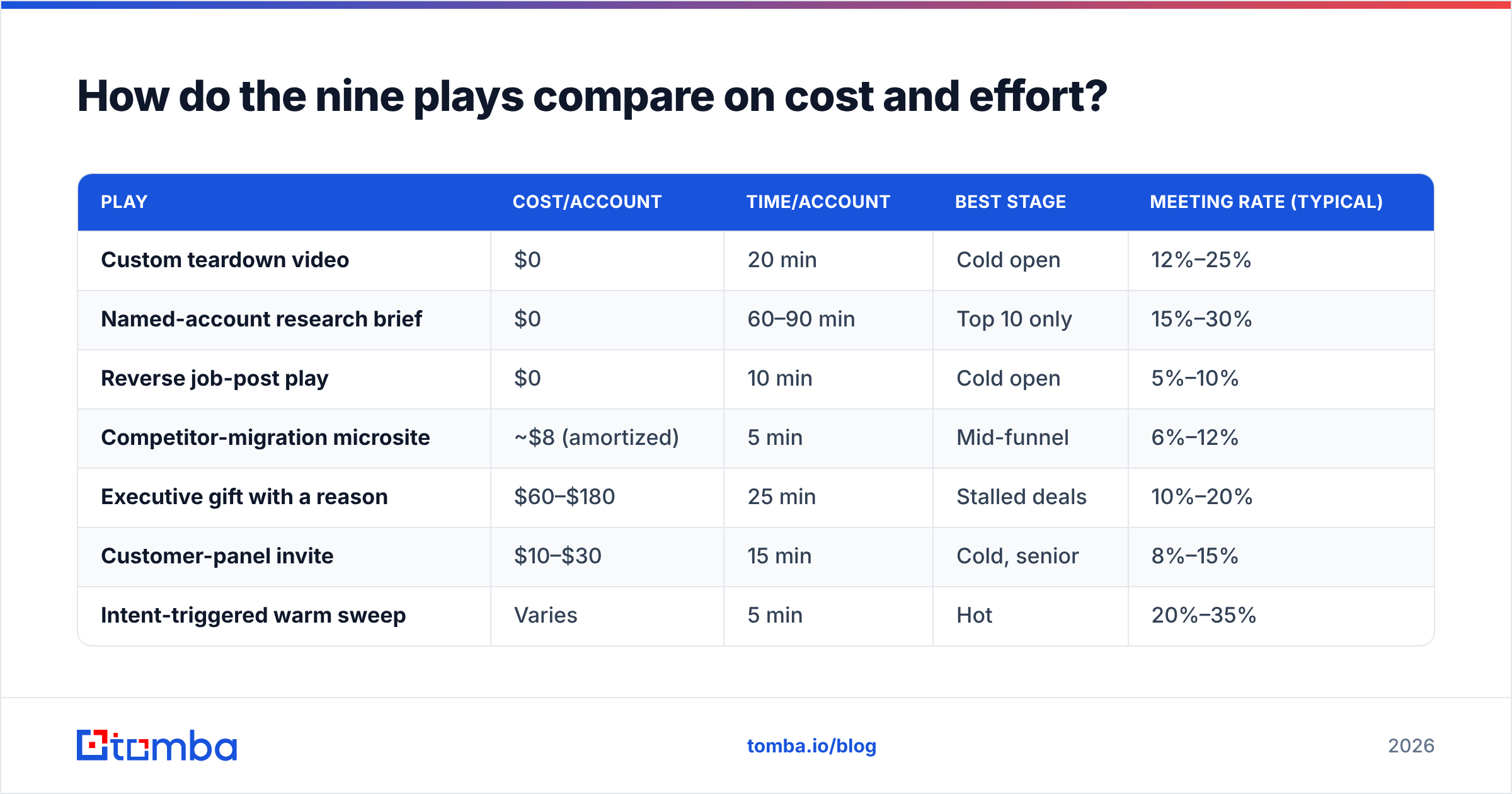
How do the nine plays compare on cost and effort?#
| Play | Cost/account | Time/account | Best stage | Meeting rate (typical) |
|---|---|---|---|---|
| Custom teardown video | $0 | 20 min | Cold open | 12%–25% |
| Named-account research brief | $0 | 60–90 min | Top 10 only | 15%–30% |
| Reverse job-post play | $0 | 10 min | Cold open | 5%–10% |
| Competitor-migration microsite | ~$8 (amortized) | 5 min | Mid-funnel | 6%–12% |
| Executive gift with a reason | $60–$180 | 25 min | Stalled deals | 10%–20% |
| Customer-panel invite | $10–$30 | 15 min | Cold, senior | 8%–15% |
| Intent-triggered warm sweep | Varies | 5 min | Hot | 20%–35% |
| Champion enablement kit | $0 | 30 min | Late-stage | n/a (accelerator) |
| "We were wrong" re-engagement | $0 | 15 min | Closed-lost | 7%–14% |
Treat these rates as planning ranges from typical B2B programs, not guarantees — your ICP fit and list quality will move them more than the creative will. Vendor-reported ABM benchmarks on G2's ABM platform category skew optimistic; assume the low end of each band until your own data says otherwise.
What data do you need before you launch?#
Everything above assumes a clean, complete account map. Here's the build order.
Step 1 — Define the account list by trigger, not by wish. Fifty accounts with an active buying signal beat five hundred that merely fit your ICP on paper.
Step 2 — Map the buying committee. For each account, name the economic buyer, the champion, and the blocker. Three roles minimum. Domain search gets you every findable address at a company in one pass, which is faster than hunting people one at a time.
Step 3 — Enrich to a usable record. Title, seniority, department, LinkedIn, direct dial. Data enrichment fills the gaps so your creative can reference something real instead of something guessed.
Step 4 — Verify before you spend. Every address gets checked. Catch-all domains — common in enterprise — need a catch-all verifier or you'll ship your best campaign into a black hole and record it as "no reply."
Step 5 — Refresh quarterly. B2B contact data decays at roughly 25–30% per year. Your Q1 list is not your Q3 list.
On sourcing: you can build the list yourself with a finder-and-verifier stack, or buy a prepackaged one. Providers like BookYourData are a reasonable shortcut when you need a clean, ready-made list fast and your ICP is broad. Self-built lists win when your targeting is narrow and trigger-based, because you're filtering on signals a prepackaged list can't know about. Most mature teams do both — buy the base, build the edges.
Which ABM plays should you run first?#
If you have a small team and no budget: run the custom teardown video at 30 accounts and the reverse job-post play at another 30. Zero cost, two weeks, and you'll learn more about your ICP from the replies than from any intent dashboard.
If you have budget but a stalled pipeline: run the champion enablement kit across every open opportunity and the executive gift with a reason at your top 15 stalled deals. Both are acceleration plays, and acceleration is cheaper than acquisition.
If you have volume and no differentiation: fix the data first. Nothing on this list works on a list that's 30% wrong.
Get the account data right before you get creative#
Creative ABM campaigns are a leverage play: small list, deep effort, disproportionate reply rates. But leverage cuts both ways. Every hour you spend building a bespoke asset for the wrong person, at the wrong company, at a bounced address, is an hour that would have been better spent on a generic sequence.
Start with the contacts. Tomba's Email Finder gives you verified, deliverable addresses for the buying committee at every account on your target list, with a free tier of 25 searches a month to test the accuracy against accounts you already know. Paid plans start at $49/mo, and full Tomba pricing scales with your list, not your headcount. Build the list, verify it, then go make something worth opening.
Related guides#
Ready to find emails that actually work?
Join 150,000+ professionals who stopped guessing and started sending. Free credits on signup — no credit card required.
Get the Tomba newsletter
Practical outbound tactics and product updates — once every two weeks.
About the author