9 Best Dealroom Alternatives in 2026: Data, Price, Fit
Dealroom is excellent at startup and funding intelligence — and expensive if all you need is companies to contact. Here are nine Dealroom alternatives compared on data depth, contact coverage, and real cost.
TL;DR
- Dealroom is a startup, scale-up and investor intelligence platform. It is genuinely strong at funding rounds, ownership graphs and ecosystem mapping — and it is priced for research teams, not outbound teams.
- Most people searching for Dealroom alternatives do not actually want a cheaper Dealroom. They want the contactable layer: which companies match my ICP, and how do I reach the humans inside them.
- If you need investor-grade private-market data, your real alternatives are PitchBook, CB Insights and Tracxn. If you need GTM data, they are Apollo, BookYourData, Crunchbase and an email-finding layer like Tomba.
- Quote-only pricing is the hidden cost. Several platforms on this list start in the five figures per seat per year, which is why the "stack it yourself" approach keeps winning for teams under 50 reps.
- The cheapest working setup for most B2B teams in 2026: a firmographic source for targeting plus a dedicated finder/verifier for contacts, wired together over an API.
What is Dealroom and who actually uses it?#
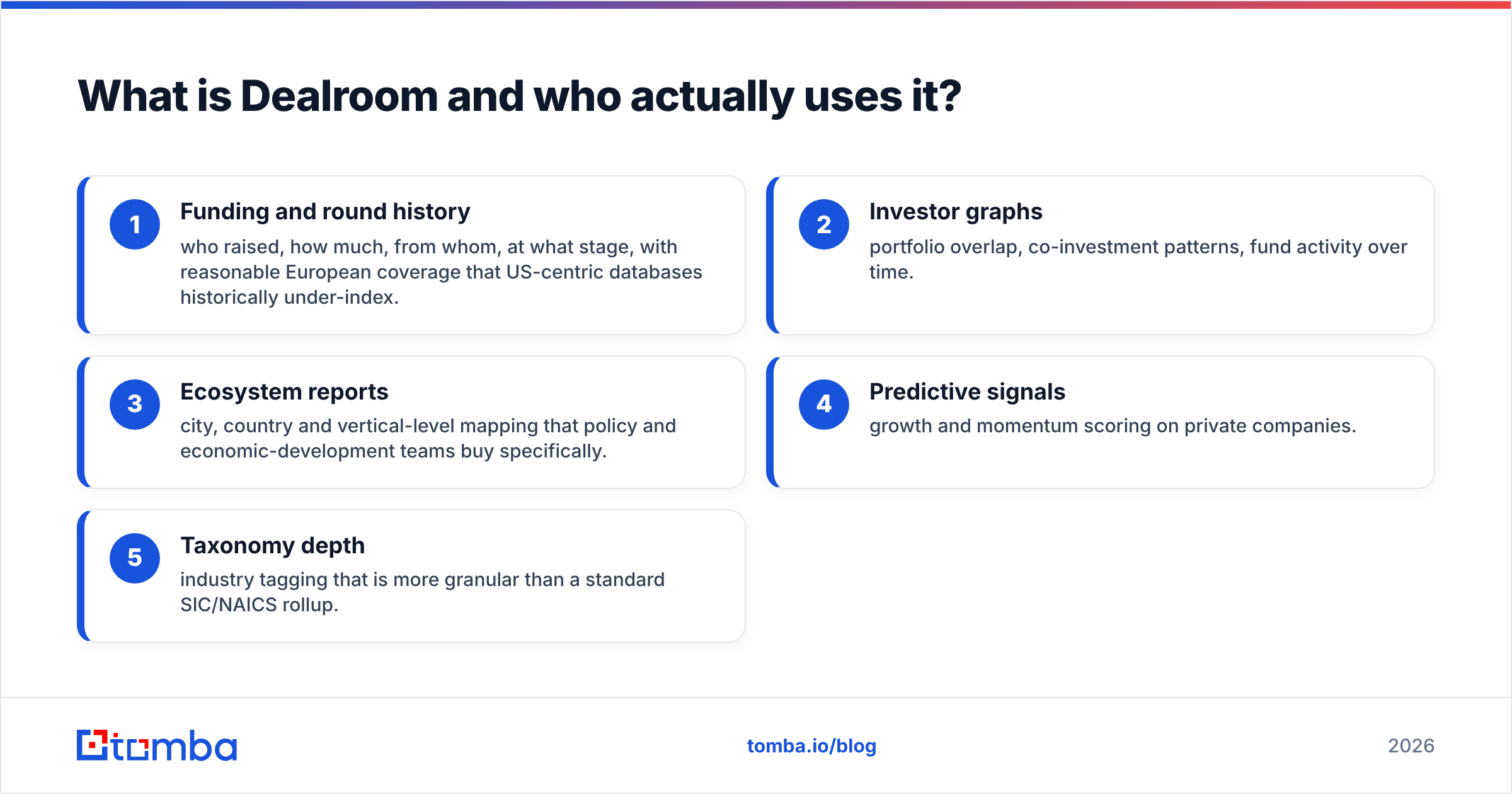
Dealroom.co is a private-market intelligence platform. It tracks startups, scale-ups, funding rounds, investors, corporates and ecosystems, and it sells that data to VCs, corporate development teams, government innovation agencies and market researchers.
Its core strengths are specific:
- Funding and round history — who raised, how much, from whom, at what stage, with reasonable European coverage that US-centric databases historically under-index.
- Investor graphs — portfolio overlap, co-investment patterns, fund activity over time.
- Ecosystem reports — city, country and vertical-level mapping that policy and economic-development teams buy specifically.
- Predictive signals — growth and momentum scoring on private companies.
- Taxonomy depth — industry tagging that is more granular than a standard SIC/NAICS rollup.
Notice what is not on that list: verified work emails, direct dials, job-change tracking, sequence-ready contact records. Dealroom tells you a company exists, is interesting, and just raised a Series B. It does not hand your SDR the VP of Engineering's inbox.
That gap is the reason this article exists.
Why do teams look for Dealroom alternatives?#
Four reasons come up over and over in review threads on G2 and in RevOps communities:
- Price versus job-to-be-done. Dealroom quotes annually and does not publish a self-serve tier. If you are using it to build target lists rather than to underwrite investments, you are paying research pricing for a prospecting outcome.
- Contact data is thin. Company records are rich. Person records are not. Teams end up buying a second tool anyway, which doubles the line item.
- Geographic and segment fit. Dealroom's European and emerging-market coverage is a genuine advantage. If your ICP is US mid-market SaaS or, worse, non-venture-backed businesses (agencies, manufacturers, clinics, local services), a large share of the database is irrelevant to you.
- Export and API friction. Seat-based research platforms typically meter exports. That is fine for an analyst writing a memo, painful for an ops person syncing 20,000 accounts into a CRM.
What should you compare before switching?#
Before you look at a single vendor page, decide which of these five dimensions you are actually optimizing. Most bad tool purchases are a mismatch here, not a bad product.
- Data type — Do you need market data (rounds, valuations, investors, ecosystems) or go-to-market data (companies, roles, emails, phones)? Almost no vendor is best at both.
- Coverage shape — Venture-backed only, or the whole economy? A database of 4M funded startups is useless if your buyer runs a 40-person logistics firm that has never raised a dollar.
- Contact depth and freshness — Company records decay slowly. Person records decay fast: roughly 25–30% of B2B contacts go stale each year through job changes. Ask how often person data is re-verified, not just how many rows exist.
- Delivery model — UI search, CSV export, API, CRM sync, or a spreadsheet add-in. A research UI you cannot automate becomes a bottleneck the moment volume grows.
- Pricing mechanics — Per seat, per credit, or per record? Seat pricing punishes teams; credit pricing punishes waste. Know which failure mode you can live with.
Write your answer to those five down. Then the shortlist below sorts itself.
What are the best Dealroom alternatives in 2026?#
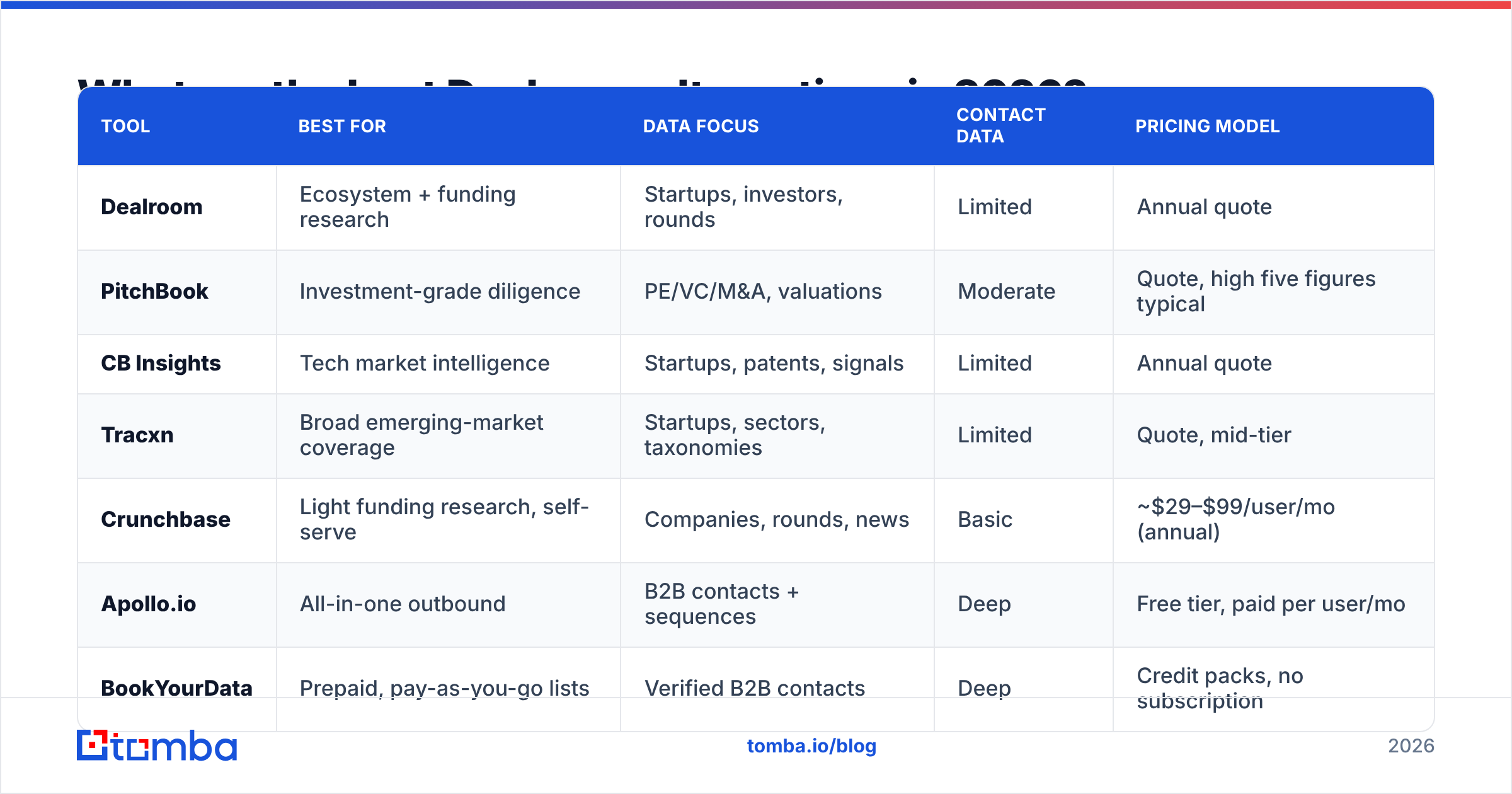
Here is the head-to-head. Pricing reflects publicly listed or commonly reported figures; anything marked "quote" is not published by the vendor and varies by seat count, region and data scope.
| Tool | Best for | Data focus | Contact data | Pricing model |
|---|---|---|---|---|
| Dealroom | Ecosystem + funding research | Startups, investors, rounds | Limited | Annual quote |
| PitchBook | Investment-grade diligence | PE/VC/M&A, valuations | Moderate | Quote, high five figures typical |
| CB Insights | Tech market intelligence | Startups, patents, signals | Limited | Annual quote |
| Tracxn | Broad emerging-market coverage | Startups, sectors, taxonomies | Limited | Quote, mid-tier |
| Crunchbase | Light funding research, self-serve | Companies, rounds, news | Basic | ~$29–$99/user/mo (annual) |
| Apollo.io | All-in-one outbound | B2B contacts + sequences | Deep | Free tier, paid per user/mo |
| BookYourData | Prepaid, pay-as-you-go lists | Verified B2B contacts | Deep | Credit packs, no subscription |
| Clearbit (HubSpot) | Enrichment inside HubSpot | Firmographic enrichment | Moderate | Bundled with HubSpot tiers |
| Tomba | Finding + verifying work emails | Domains, people, patterns | Deep, verified | Free (25/mo), $49 → $249/mo |
PitchBook#
The most defensible replacement if your use case is genuinely financial. Valuations, cap tables, comps, LP data and M&A history are deeper than Dealroom's, and the Excel plugin is a real workflow advantage for analysts. PitchBook does not publish pricing and is widely reported to sit well into five figures per seat annually. If you are an SDR team, this is the wrong shelf entirely.
CB Insights#
Strong on technology market intelligence, patent activity, and its own scoring models. Better than Dealroom at "where is this category going," weaker at "list every seed-stage fintech in Portugal." Quote-based, enterprise-priced, and clearly aimed at strategy and corporate-innovation teams.
Tracxn#
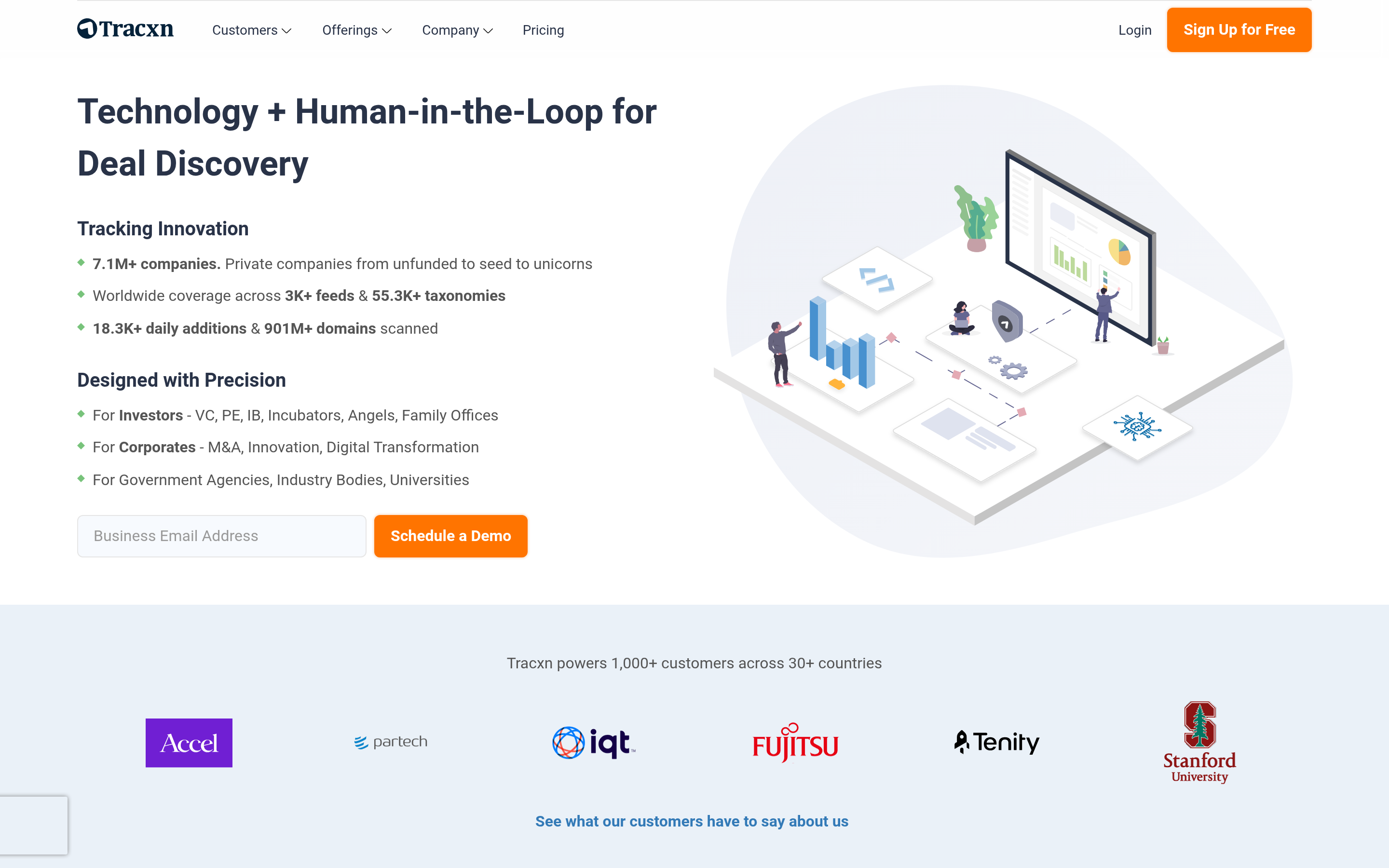
Frequently the value pick against Dealroom. Very wide company counts, aggressive sector taxonomies, and strong coverage in India, Southeast Asia and the Middle East. Analysts debate the depth-per-record versus PitchBook, but for "map this category globally" tasks it holds up, usually at a materially lower quote.
Crunchbase#
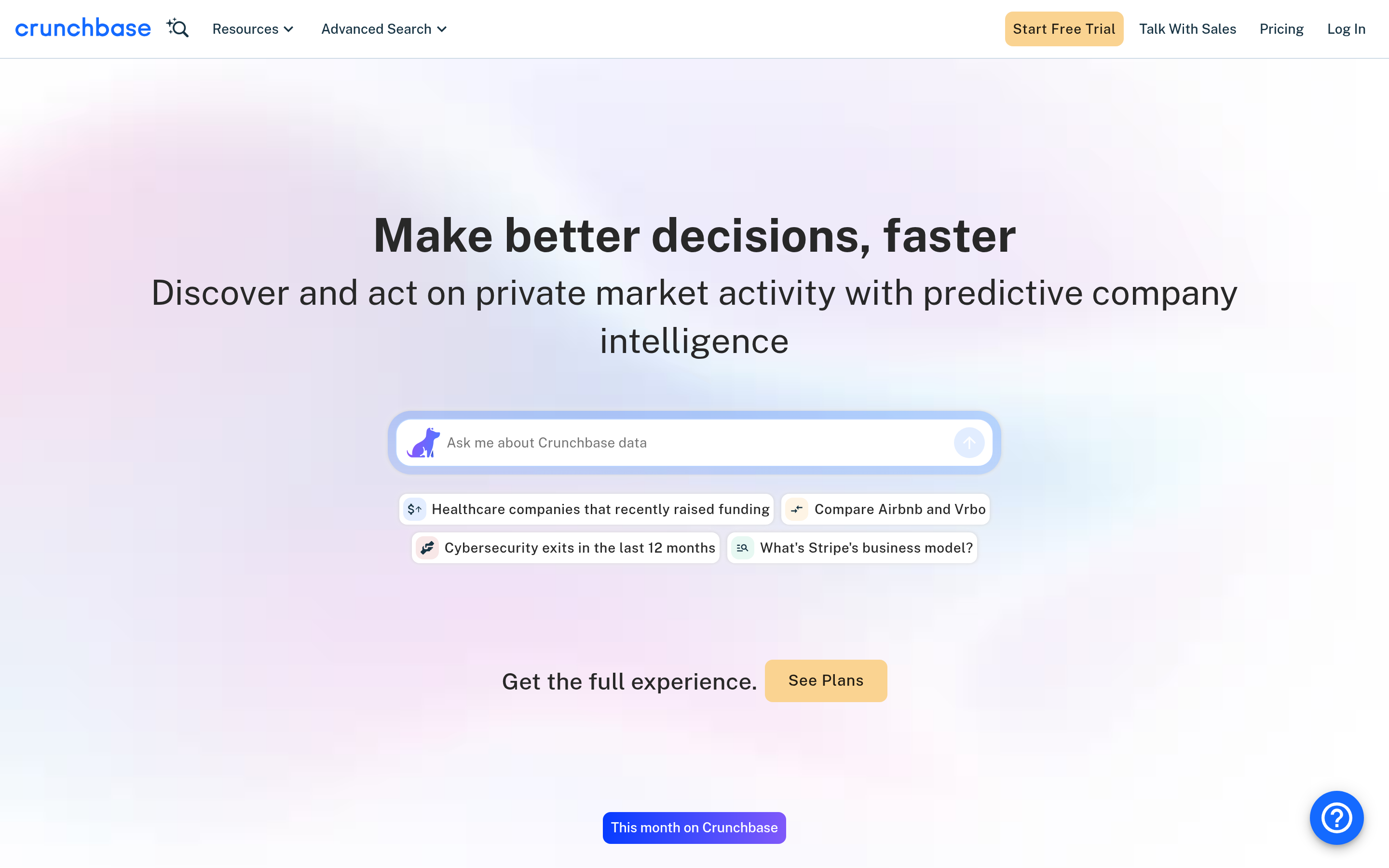
The only true self-serve option in the research tier. Crunchbase publishes plans and lets one person expense it without a procurement cycle. Funding data is respectable, contact data is thin, and export limits bite quickly. Think of it as a research starting point, not a GTM engine.
Apollo.io#
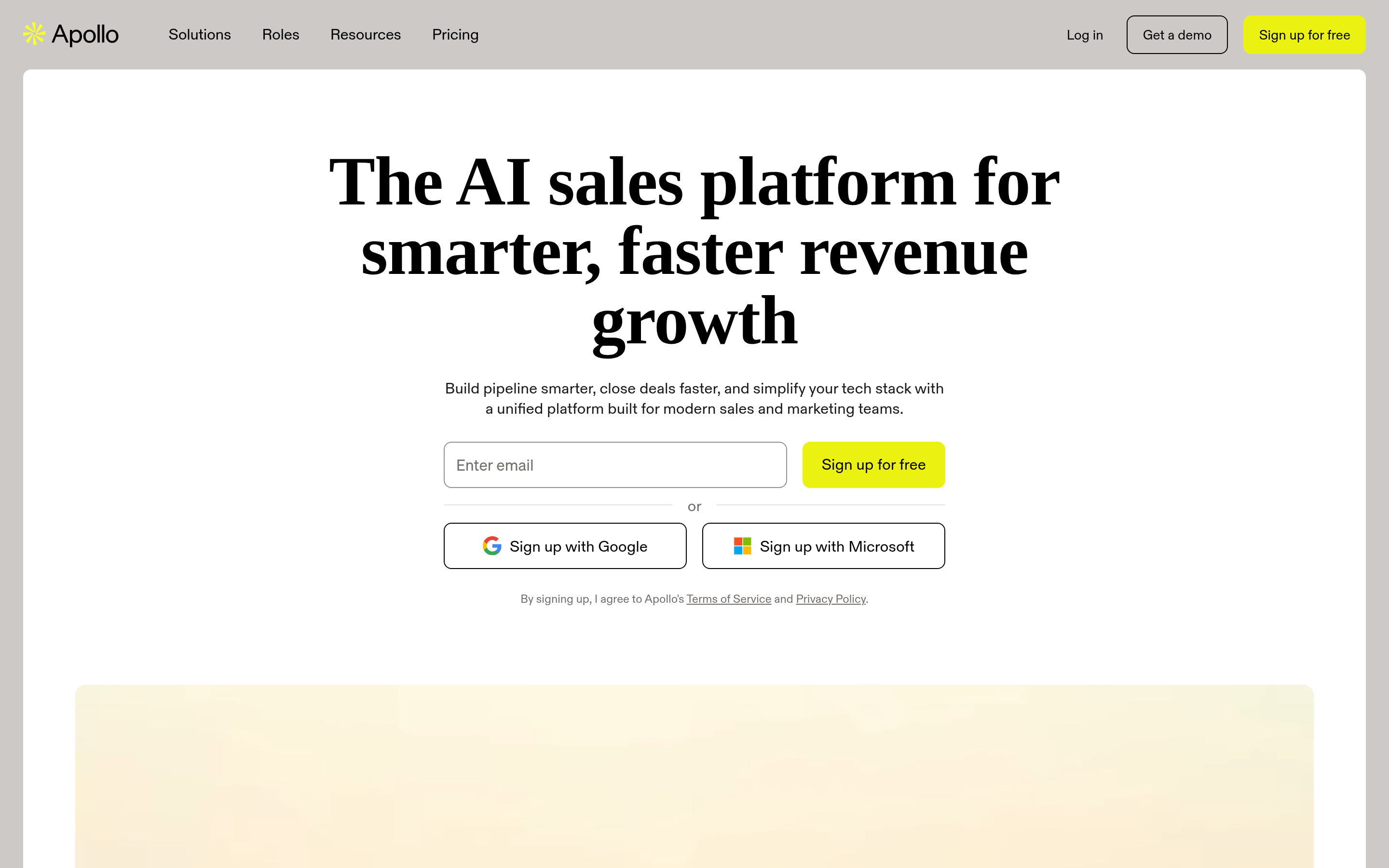
A different category answer: skip market intelligence, buy an outbound database with sequencing attached. Huge contact volume, built-in dialer and email, native CRM sync. The trade-off is data accuracy variance at scale and per-seat costs that climb with team size. Many teams run Apollo for discovery and layer a dedicated verifier on top before sending.
BookYourData#
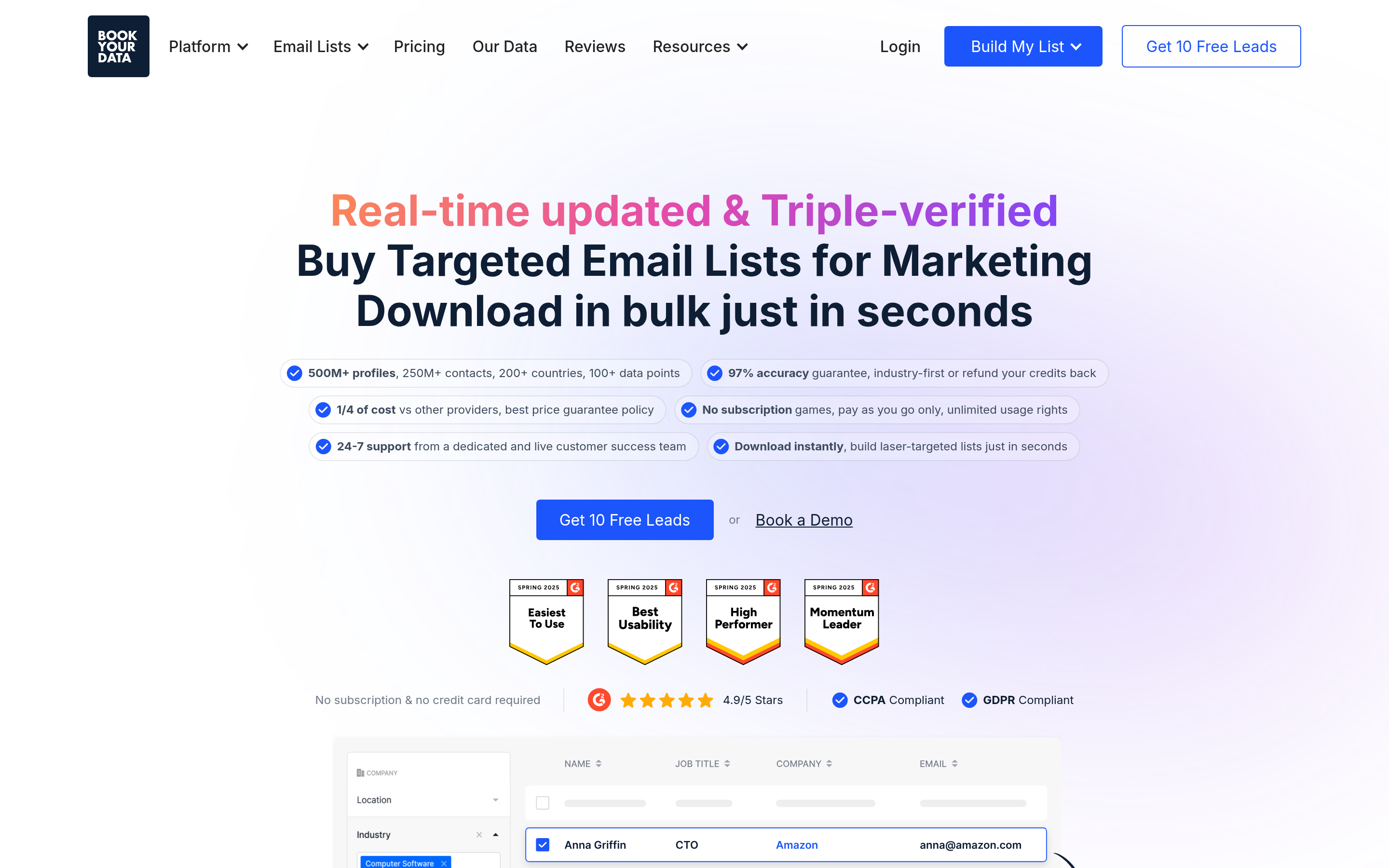
A solid choice when you want contacts without a subscription. It sells prepaid credits against filterable B2B lists with an accuracy guarantee, which suits agencies and consultants running campaign-shaped work rather than always-on outbound. If your buying pattern is "three good lists a quarter," a credit model beats paying twelve months for four months of usage.
Clearbit (now HubSpot Breeze Intelligence)#
Post-acquisition, Clearbit's enrichment lives inside the HubSpot ecosystem. If you already run HubSpot as your CRM, this is the lowest-friction way to enrich inbound records. If you don't, it is not a standalone Dealroom replacement.
Tomba#
Purpose-built for the layer Dealroom leaves empty: turning a company into reachable people. Domain search returns the email pattern and known addresses for any company domain, the email verifier validates deliverability before you send, and data enrichment fills in the rest of the record. Pricing is published: free tier at 25 searches/month, Starter at $49/mo, Growth at $99/mo, Pro at $249/mo, Enterprise on request — see Tomba pricing for the current credit allocations.
It does not replace Dealroom's funding graph, and it doesn't pretend to. It replaces the second, more expensive tool you were going to buy to make Dealroom's output actionable.
Which Dealroom alternative fits your use case?#
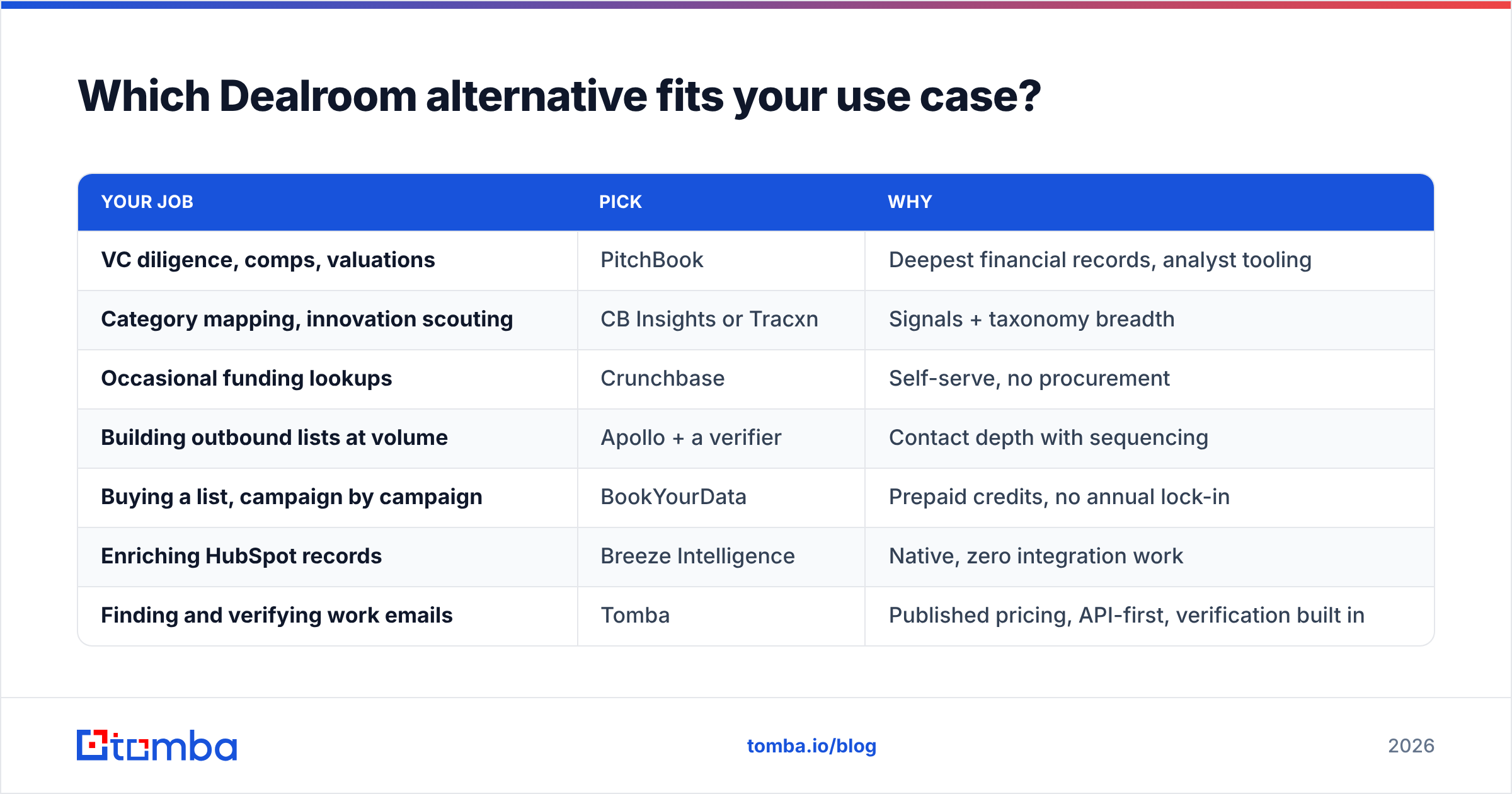
| Your job | Pick | Why |
|---|---|---|
| VC diligence, comps, valuations | PitchBook | Deepest financial records, analyst tooling |
| Category mapping, innovation scouting | CB Insights or Tracxn | Signals + taxonomy breadth |
| Occasional funding lookups | Crunchbase | Self-serve, no procurement |
| Building outbound lists at volume | Apollo + a verifier | Contact depth with sequencing |
| Buying a list, campaign by campaign | BookYourData | Prepaid credits, no annual lock-in |
| Enriching HubSpot records | Breeze Intelligence | Native, zero integration work |
| Finding and verifying work emails | Tomba | Published pricing, API-first, verification built in |

Can you replace Dealroom with a stack instead of a single tool?#
Usually, yes — and for GTM teams it is normally cheaper and more flexible.
The pattern looks like this:
- Targeting layer. A source of companies that match your ICP. That can be Crunchbase for funded startups, a firmographic filter in Apollo, a bought list from BookYourData, or your own scraped set of domains from conference exhibitor pages and marketplace directories.
- Signal layer. Whatever tells you now is the moment — funding news, hiring spikes, tech-stack changes, or website visits. If you drop Dealroom, an RSS feed of funding announcements plus a job-board watch covers a surprising amount of it.
- Contact layer. Domain in, verified people out. This is where a dedicated email finder earns its keep. Run domains in bulk, get patterns and named contacts back, verify before sending.
- Orchestration layer. The Tomba API or a no-code automation joins the pieces so a new company in your targeting sheet automatically comes back enriched with contacts, without anyone opening a UI.
The honest caveat: this stack does not reproduce Dealroom's proprietary ecosystem reports or its predictive scoring. If those specific artifacts are what you present to a board or a government client, keep paying for them. If they were a nice-to-have you looked at twice last quarter, the stack wins on cost by a wide margin.
Is Dealroom still worth it in 2026?#
Yes — for a narrow, well-defined buyer.
Keep Dealroom if you are a VC, a corporate development team, an accelerator, or an economic-development agency whose output is analysis about private markets. The funding data, the ownership graph, and the European coverage are hard to reassemble from cheaper parts, and the annual fee is small relative to a single deal decision it improves.
Drop Dealroom if your output is pipeline. The moment your daily question changes from "what is happening in this market" to "who do I email today," you are paying research prices for a job that costs a fraction as much to do properly. The switch is not a downgrade; it is a re-pointing of budget at the layer that actually produces revenue.
A useful test: look at the last ten things you exported from Dealroom. If most of them ended up in a CRM as accounts to contact, you have a contact-data problem, not a market-data problem — and no amount of extra funding-round granularity will fix it.
How do you migrate without breaking your list-building?#
Do it in this order and nothing goes dark:
- Export your saved searches and watchlists while your contract is live. Domains are the durable asset — names, URLs, countries, categories. Everything else can be rebuilt.
- Rebuild the targeting filter in whichever cheaper source matches your ICP shape, and check overlap against your export. If a replacement recovers 80%+ of your relevant accounts, it is good enough.
- Run the domain list through a contact layer in bulk rather than one search at a time. A bulk email finder turns a 5,000-row domain file into contactable records in one pass.
- Verify before the first send. New source, unknown hygiene — assume the list is dirty until proven otherwise, or your domain reputation eats the difference.
- Wire the API last. Get the manual version working end to end first; automate only the steps you have already run by hand twice.
Ready to turn company lists into real conversations?#
If your Dealroom renewal is coming up and most of what you export ends up as accounts to contact, start with the contact layer instead of another research seat. Tomba Email Finder takes a domain or a name and returns verified professional email addresses, with confidence scoring and built-in verification so you know what is safe to send before you send it. Try it free at 25 searches per month, then scale to Starter at $49/mo when the pipeline justifies it — no annual contract, no procurement cycle, no quote to chase.
Related guides#
// get started
Find, verify and enrich your first contacts today
Start on the free plan with 25 searches a month, then scale when your team is ready.
Free plan · No credit card required · GDPR & CCPA
// about the author