Dealroom vs Jet Leads Pro: An Honest 2026 Comparison
Dealroom is a company-intelligence platform. Jet Leads Pro is a lead-list tool. They solve different halves of the same problem — and picking wrong costs you a quarter of pipeline. Here is the honest breakdown.
Dealroom vs Jet Leads Pro is a matchup that trips people up. One tool maps markets. The other ships lists. Here is what each does well, and what both leave out.
TL;DR
- Dealroom and Jet Leads Pro are not really competitors. Dealroom is a funding and private-company intelligence platform. It is built for investors, corp dev, and market researchers. Jet Leads Pro is a self-serve lead-list and contact-sourcing tool for sellers.
- Pick Dealroom if your question is "which companies matter and why." Pick Jet Leads Pro if your question is "give me 5,000 rows I can email on Monday."
- Neither one is a complete outbound stack. Dealroom hands you accounts, not verified inboxes. Lead-list tools hand you volume, not signal. Volume without verification is how a domain gets burned.
- Pricing transparency differs sharply. Dealroom sells annual seats through sales-led quotes. Jet Leads Pro leans self-serve. Get both in writing first; quoted pricing moves more than published pricing does.
The realistic answer for most B2B teams in 2026 is a two-layer stack. One source selects the accounts. A second source supplies verified contact data. That second layer is where a dedicated email finder earns its keep, at a fraction of platform seat cost.
What are Dealroom and Jet Leads Pro?#
Start here. Most head-to-head posts blur the two categories, and the comparison stops making sense.
Dealroom is an Amsterdam-based company intelligence platform. Its core asset is a structured database of private companies: funding rounds, investors, valuations, headcount, tech categories, and ecosystem mapping.
Its heaviest users are venture funds, corp dev and M&A teams, innovation groups inside large enterprises, and economic development agencies mapping a regional startup ecosystem. Dealroom also powers public ecosystem dashboards for governments and accelerators. That is a decent proxy for how seriously the data modelling is taken.
What Dealroom is not is a sales prospecting database. There is company-level data and some people-level data. But the platform is not built around "give me every VP of Engineering at Series B fintechs with a verified work email." That is an outbound problem. Dealroom solves a research problem.
Jet Leads Pro sits on the other side. It is marketed as a lead-generation and contact-sourcing tool: filter a database, export a list, plug it into your sequencer.
Public documentation is thin compared to Dealroom's. You will find better signal in current G2 and Capterra reviews than in secondhand blog roundups. Treat any credit count or accuracy figure you read elsewhere — including here — as something to confirm on the vendor's own pricing page.
That thin public footprint is not a red flag by itself. Plenty of solid tools run lean marketing. But it changes how you evaluate. For Dealroom you can audit the data model in public. For a smaller lead tool, run a paid pilot on your own ICP first.
Dealroom vs Jet Leads Pro: how do they compare head-to-head?#
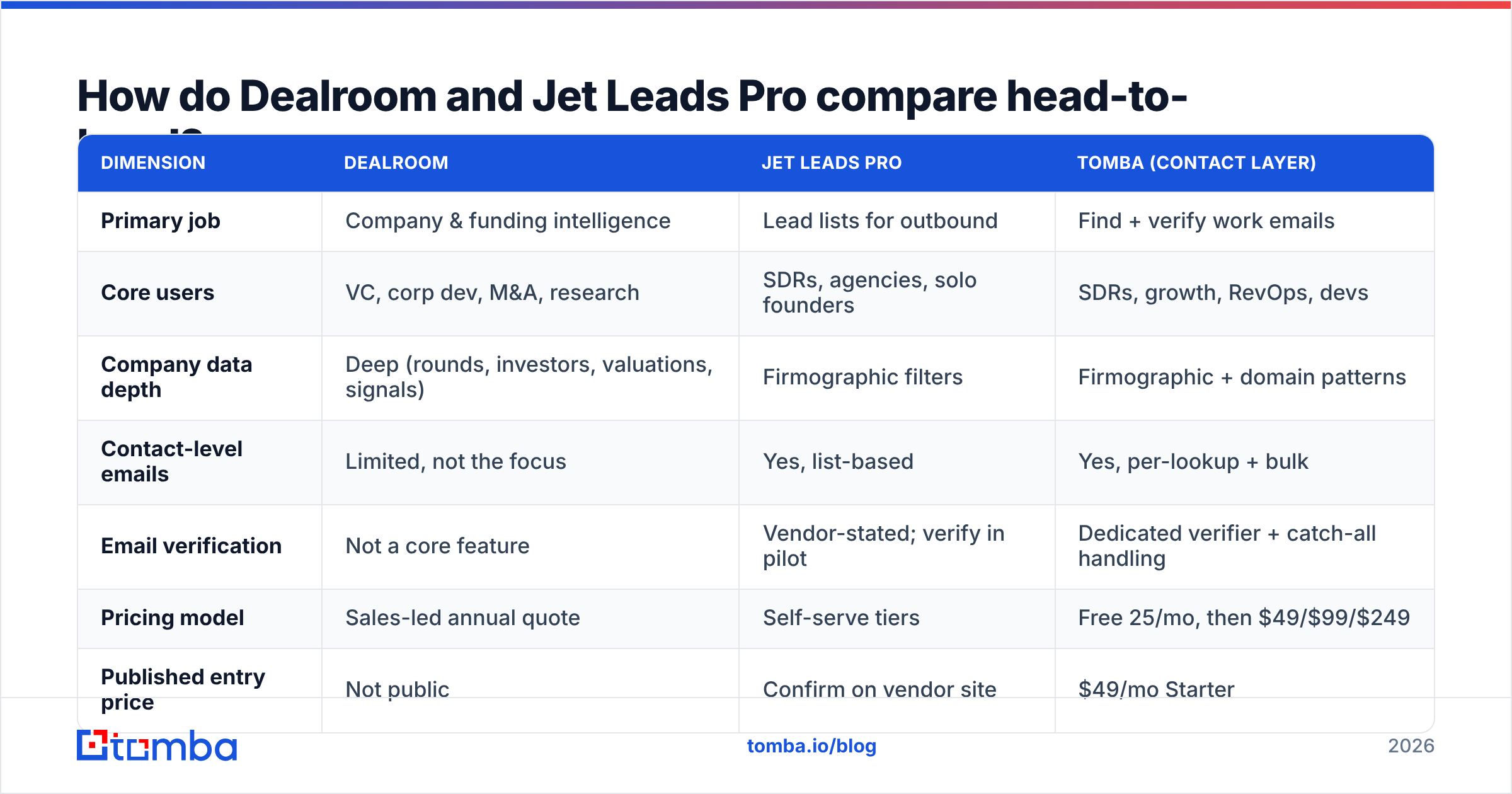
Here is the honest scorecard. Where a figure is not publicly documented, I have said so rather than inventing one.
| Dimension | Dealroom | Jet Leads Pro | Tomba (contact layer) |
|---|---|---|---|
| Primary job | Company & funding intelligence | Lead lists for outbound | Find + verify work emails |
| Core users | VC, corp dev, M&A, research | SDRs, agencies, solo founders | SDRs, growth, RevOps, devs |
| Company data depth | Deep (rounds, investors, valuations, signals) | Firmographic filters | Firmographic + domain patterns |
| Contact-level emails | Limited, not the focus | Yes, list-based | Yes, per-lookup + bulk |
| Email verification | Not a core feature | Vendor-stated; verify in pilot | Dedicated verifier + catch-all handling |
| Pricing model | Sales-led annual quote | Self-serve tiers | Free 25/mo, then $49/$99/$249 |
| Published entry price | Not public | Confirm on vendor site | $49/mo Starter |
| API access | Yes, enterprise tier | Confirm current docs | Yes, all paid plans |
| Best single use case | Market mapping, deal sourcing | Fast volume list building | Turning any account list into inboxes |
Two things jump out of that table.
First, the overlap is narrower than the "vs" framing implies. Both hold company records. That is about where the similarity ends. If you are genuinely torn, the real question — what am I trying to do this quarter? — has not been settled.
Second, both leave the same gap. Neither is an email accuracy engine. And email accuracy is what decides whether your outbound lands or bounces.
What is Dealroom actually good at?#
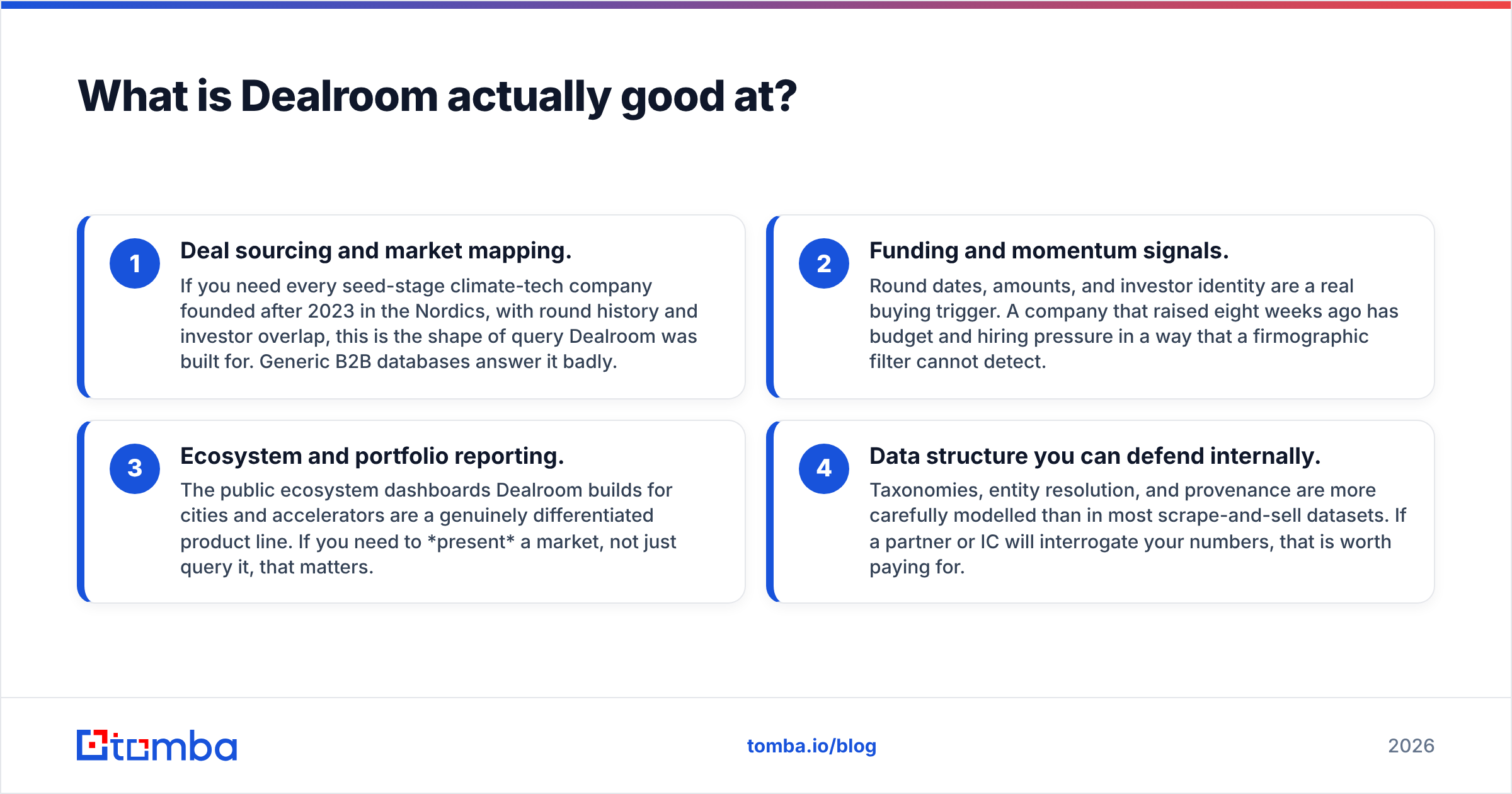
Four things, concretely:
- Deal sourcing and market mapping. Say you need every seed-stage climate-tech company founded after 2023 in the Nordics, with round history and investor overlap. That is the shape of query Dealroom was built for. Generic B2B databases answer it badly.
- Funding and momentum signals. Round dates, amounts, and investor identity are real buying triggers. A company that raised eight weeks ago has budget and hiring pressure. A firmographic filter cannot see that.
- Ecosystem and portfolio reporting. The public dashboards Dealroom builds for cities and accelerators are a differentiated product line. If you need to present a market, not just query it, that matters.
- Data structure you can defend internally. Taxonomies, entity resolution, and provenance are modelled more carefully than in most scrape-and-sell datasets. If a partner or an IC will question your numbers, that is worth paying for.
Where Dealroom is a poor fit: high-volume outbound. Seat-based annual pricing plus thin contact-level email coverage means paying enterprise rates for the wrong layer. Teams that try it end up exporting company lists and then hunting for contacts by hand. That is a workflow, not a failure, and I will come back to it.
Where does Jet Leads Pro fit?#
The self-serve lead-list category — Jet Leads Pro and dozens of similar tools — wins on three things: speed, price, and volume. You sign up, filter, export, and you are sequencing the same day. No procurement cycle. No annual commitment. No implementation call.
The trade-off holds across the whole category, so it is worth stating plainly rather than pretending it is vendor-specific:
- Freshness decays fast. B2B contact data rots at roughly 25–30% a year through job changes alone. A list built from a static snapshot is already partly wrong the day you download it.
- Advertised accuracy is a fleet average, not your average. A tool claiming 95%+ may be measuring its full corpus, which is dominated by large, well-indexed US companies. If your ICP is 40-person European manufacturers, your hit rate will be lower. That is a sampling artifact, not dishonesty. It is also why a pilot on your ICP beats any published benchmark.
- Catch-all domains break naive verification. Many B2B domains accept all mail at the SMTP layer. A simple ping returns "valid" for addresses that do not exist. Handling that takes a dedicated catch-all verifier, not a checkbox.
None of that disqualifies Jet Leads Pro. Size your commitment to what you can verify. Buy the smallest plan, export 500 rows in your real ICP, and measure the bounce rate before you scale.
Which one gives you contact data you can actually email?#
Neither, fully. This is the most useful thing in the article.
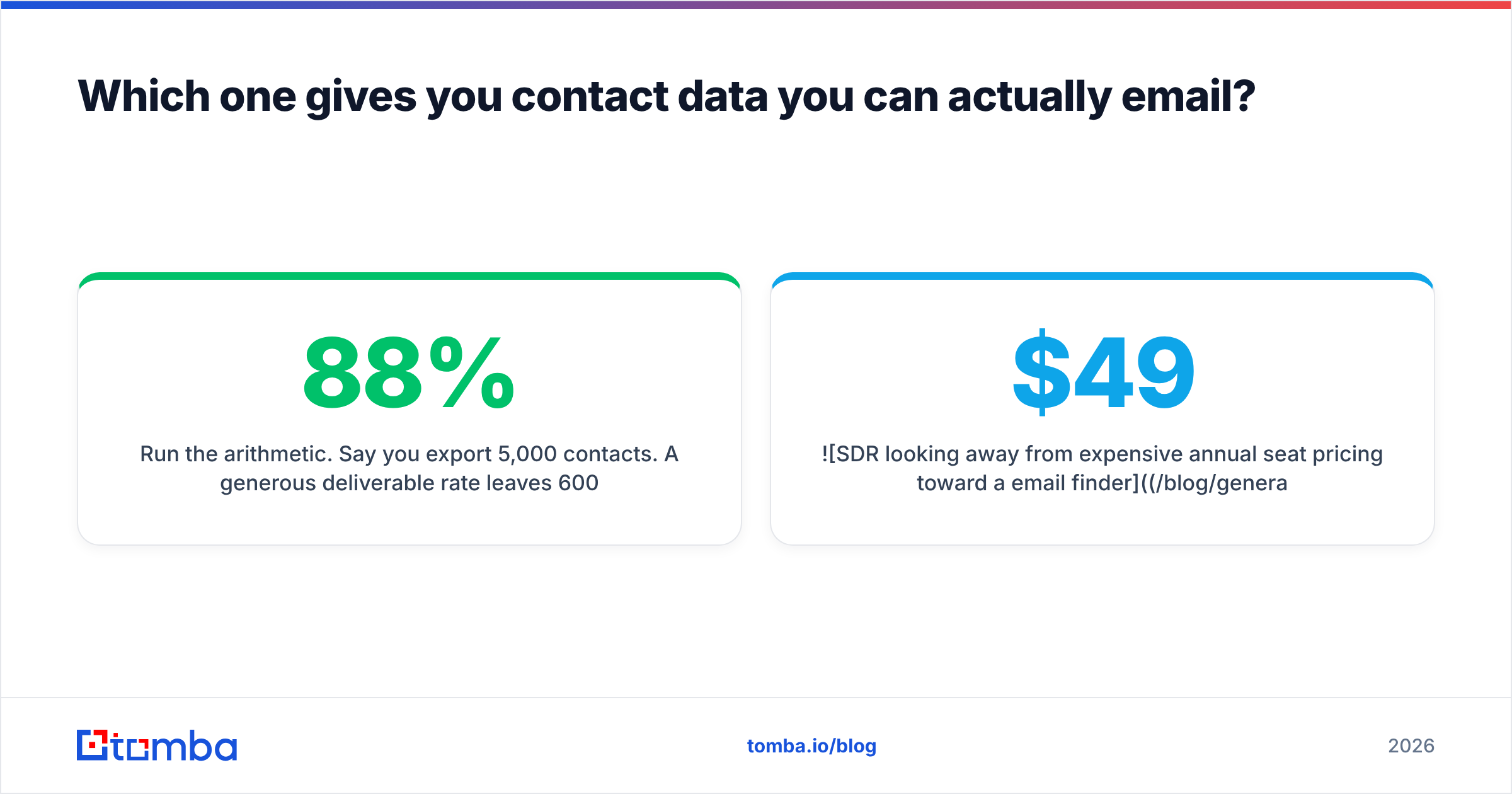
Run the arithmetic. Say you export 5,000 contacts. A generous 88% deliverable rate leaves 600 bad addresses. Send those cold and you post a 12% bounce rate. Mailbox providers treat sustained bounce rates above 2–3% as a spam signal.
So that single send damages your sender reputation. It also suppresses delivery for the 4,400 good addresses on the same list for weeks afterward.
That is the asymmetry people miss. Bad data does not just waste the bad rows. It taxes the good ones.
So the practical architecture for 2026 looks like this:
- Selection layer — decide which accounts deserve attention. Dealroom is excellent here if you sell into startups or run investment-adjacent workflows. A firmographic database is fine if you sell broadly.
- Contact layer — turn each account into named people with verified, working email addresses. That is a specialised job. Buy a specialised tool for it.
- Verification gate — re-verify right before send, not at export time. The gap between "exported in March" and "sent in June" is where bounces are born.
- Enrichment layer — fill in title, seniority, location, and phone for routing and personalisation. Data enrichment runs continuously, not once.
Splitting the stack this way also stops you overpaying. You do not need enterprise seats for step 2. You need an API and a credit balance.

How should you evaluate pricing on both?#
Compare cost per usable record, not cost per record. That single reframing kills most bad purchasing decisions.
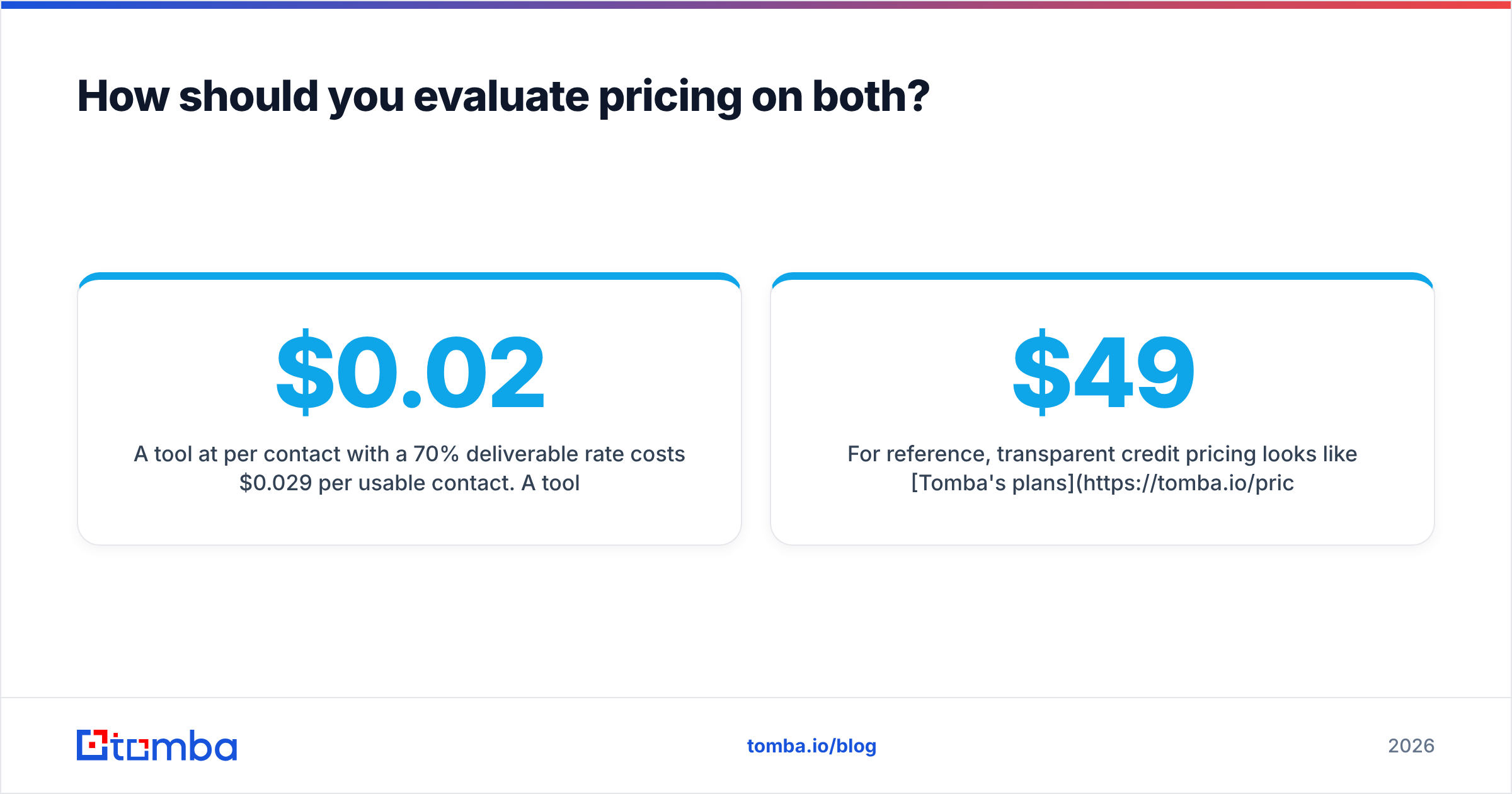
A tool at $0.02 per contact with a 70% deliverable rate really costs $0.029 per usable contact. A tool at $0.04 with a 95% rate costs $0.042. But it does not cost you a burned domain, a rewarming cycle, and three weeks of suppressed replies. Price the downside.
Concrete questions to put to any vendor in this Dealroom vs Jet Leads Pro comparison:
- Is pricing per seat or per credit? Seat pricing punishes you for adding a junior SDR. Credit pricing scales with usage. Dealroom is seat-and-contract shaped; self-serve lead tools are usually credit shaped.
- Do failed lookups consume credits? This is the largest hidden cost in the category. Ask for the answer in writing.
- Is there an annual lock-in? For any tool with a thin public track record, monthly-first is the right risk posture.
- What is the export limit per plan? Some tools cap exports well below the credit allowance, which changes effective cost.
- Does the API cost extra? If RevOps plans to automate enrichment, an API locked behind an enterprise tier is a dealbreaker.
For reference, transparent credit pricing looks like Tomba's plans: a free tier at 25 searches a month, Starter at $49/mo, Growth at $99/mo, Pro at $249/mo, and custom Enterprise. API access comes with every paid tier, not just the top one. You can test the real hit rate on your ICP before spending anything, which is the only benchmark that matters.
What does a realistic 2026 stack look like?#
Three patterns cover most teams:
Pattern A — Investment or startup-focused GTM. Use Dealroom for account selection and funding triggers, exported by domain. Then run domain search to pull the people at each account. Finish with bulk verification before the list enters your sequencer. You pay Dealroom for signal, not for contacts.
Pattern B — High-volume SMB outbound. Use a self-serve list tool like Jet Leads Pro for raw coverage, then verify every export. Treat the tool's own validity flags as a first filter, not a final one. Re-verify anything older than 30 days.
Pattern C — Precision ABM. Skip broad lists. Build a 200-account target list by hand or from an intelligence platform. Then find and verify each contact one at a time. Low volume, high accuracy, best reply rates. Per-lookup pricing beats every seat-based model here.
If you are also weighing alternatives in the list-buying category, BookYourData is worth a look. It sells prepaid, filterable B2B lists on a pay-as-you-go model, which suits teams that want to own a list rather than rent a subscription. Different shape of purchase, and legitimately good at what it does.
Whatever pattern you land on, run a verification pass with an email verifier as the last step before send. It is the cheapest insurance in the stack.
Dealroom vs Jet Leads Pro: which should you choose?#
Choose Dealroom if you are an investor, a corp dev team, an accelerator, or a seller whose ICP is venture-backed companies. You are buying a research asset with defensible structure. Budget for it as such.
Choose Jet Leads Pro if you need volume fast, you are price-sensitive, and you will run a paid pilot on your own ICP before scaling. Start monthly. Measure bounce rate on your first 500 rows. Scale only if the number holds.
Choose neither as your whole stack. Both leave the contact-accuracy layer underserved, and that layer is where outbound quietly succeeds or fails.
If your bottleneck is turning target companies into verified inboxes — which, for most teams reading a "vs" post, it is — start with the Tomba Email Finder. The free tier gives you 25 searches a month with no card. Run 50 of your hardest domains through it, compare the hit rate against whatever you pay for today, and let the numbers pick the winner.
Related guides#
Ready to find emails that actually work?
Join 150,000+ professionals who stopped guessing and started sending. Free credits on signup — no credit card required.
Get the Tomba newsletter
Practical outbound tactics and product updates — once every two weeks.
About the author