Dealroom vs Leadzenai (2026): Which B2B Data Tool Wins?
Dealroom vs Leadzenai is a common shortlist, but an odd one. Dealroom sells market intelligence. Leadzen.ai sells contact intelligence. They solve different problems, and neither is a complete outbound stack. Here's the honest breakdown.
Dealroom vs Leadzenai is a common shortlist. It is also an odd one. The two tools do different jobs. Dealroom maps markets. Leadzen.ai finds people. This guide shows which one fits your use case, and what both of them miss.
TL;DR
- Dealroom is a market intelligence database, not a prospecting tool. It tracks startups, funding rounds, investors and M&A across global ecosystems. You buy it to answer "which companies exist in this space and how are they funded," not "what's this VP's email."
- Leadzen.ai is a lead intelligence platform built for outbound teams, with contact discovery, a LinkedIn extension, and unusually strong coverage of Indian and APAC companies.
- They barely overlap. If you're genuinely choosing between them, one of your requirements is probably mis-scoped.
- Both leave the same gap: contact-level email accuracy. Neither is built as a verification layer. Both can hand you addresses that bounce. Check them before you send cold.
- Cheapest sane stack for most teams: pick the intelligence layer you actually need. Then bolt on a dedicated email finder and a verifier. That beats paying enterprise rates for contact data you can't trust.
What are Dealroom and Leadzen.ai, exactly?#
Start here. Comparison sites lump both products into the same "B2B data" bucket. They are not the same category of software.
Dealroom.co is an Amsterdam-based intelligence platform. It covers startups, scaleups, investors, funding rounds, valuations and exits. Its customers are venture funds, corporate development teams, economic development agencies, and government innovation bodies. The unit of analysis is the company and the transaction: who raised what, from whom, at what stage, in which ecosystem. Dealroom also powers many of the public ecosystem dashboards you've seen, like city and country startup maps. That's a good tell about who it's built for.
Leadzen.ai is a lead intelligence and prospecting platform. The unit of analysis is the person. You search for people who match a profile. You pull their business contact details. Then you push them into a sequence or CRM and go. It has a browser extension for LinkedIn, bulk search, and real-time lookup. Coverage in India and nearby APAC markets is deeper than in most US-first tools. That's the main reason it shows up on shortlists next to Apollo, Lusha, and ZoomInfo.
So the honest framing of Dealroom vs Leadzenai is not "which is better." It's "which problem am I actually solving — market mapping or pipeline generation?"
How do Dealroom and Leadzen.ai compare head-to-head?#
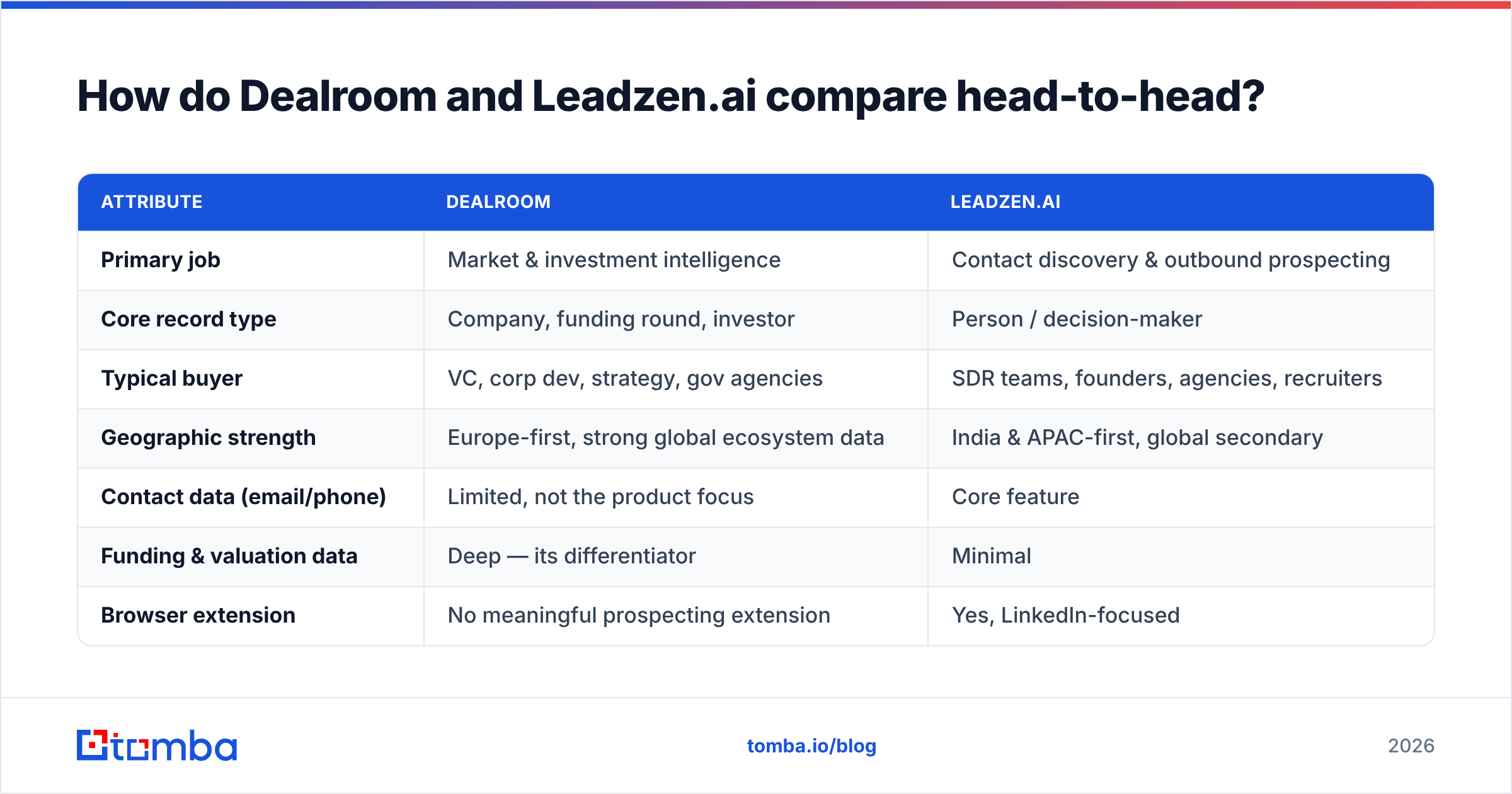
| Attribute | Dealroom | Leadzen.ai |
|---|---|---|
| Primary job | Market & investment intelligence | Contact discovery & outbound prospecting |
| Core record type | Company, funding round, investor | Person / decision-maker |
| Typical buyer | VC, corp dev, strategy, gov agencies | SDR teams, founders, agencies, recruiters |
| Geographic strength | Europe-first, strong global ecosystem data | India & APAC-first, global secondary |
| Contact data (email/phone) | Limited, not the product focus | Core feature |
| Funding & valuation data | Deep — its differentiator | Minimal |
| Browser extension | No meaningful prospecting extension | Yes, LinkedIn-focused |
| Pricing model | Quote-based annual contracts | Credit packs / tiered subscriptions |
| Free option | Limited public profiles, no real free tier | Trial credits |
| Best used for | "Who should we acquire, fund, or partner with?" | "Who do I email on Monday?" |
That table is the whole argument in miniature. If the row you care most about is "funding & valuation data," stop reading comparisons and buy Dealroom. If it's "contact data," Dealroom was never in the running.
Which one has better data coverage?#
Wrong question — but here's the useful version of it.
Dealroom's coverage is deep and narrow. It tracks well over a million companies with structured funding histories. Its round-level data in European ecosystems is hard to beat. Where it thins out is predictable: small non-venture-backed businesses, service companies, local SMBs. A 40-person accounting firm in Ohio has no Series A, so Dealroom has little reason to model it richly.
Leadzen.ai's coverage is broad and shallower per record. It indexes people and companies to produce one actionable row: name, title, company, email, phone, LinkedIn. In India it's one of the stronger options available. Mobile number coverage is a real differentiator there, since many US-built tools treat +91 numbers as an afterthought. Outside its home region, coverage is competitive but no longer exceptional. Sample the data before you commit to an annual plan.
Here's the part neither vendor puts on the homepage: coverage and accuracy are different metrics. A database can return an email for 90% of your list and still bounce a quarter of the time. Coverage means "I got a value back." Accuracy means "that value still reaches a human." Most B2B databases refresh company records far more often than they re-check individual mailboxes. Re-checking costs money, and few buyers churn over it — until their domain gets burned.
If you're buying either platform mainly for email addresses, run a sample of 500 records through an independent email verifier first. Two hundred dollars of verification credits is cheap insurance against a five-figure annual contract built on stale data.
What does each one actually cost?#
Neither vendor publishes clean, comparable pricing. That tells you something about both sales motions.
Dealroom is quote-based. Access tiers scale by seats, modules and export limits. Buyers report annual contracts from a few thousand to several tens of thousands per year, depending on scope. Investor-grade access with full exports sits at the high end. There is a free public layer where you can browse company profiles. It's a marketing surface, not a workable product tier.
Leadzen.ai sells credit-based subscriptions with published entry tiers and trial credits. Pricing is far more approachable for a small team. The catch is the one every credit model has. A credit can be spent on a reveal that returns nothing useful. Bulk export limits often sit behind higher tiers. Read the credit rules before you compare headline prices. That's where the real cost per usable contact hides.
For reference, here's how a dedicated email-finding layer prices against both:
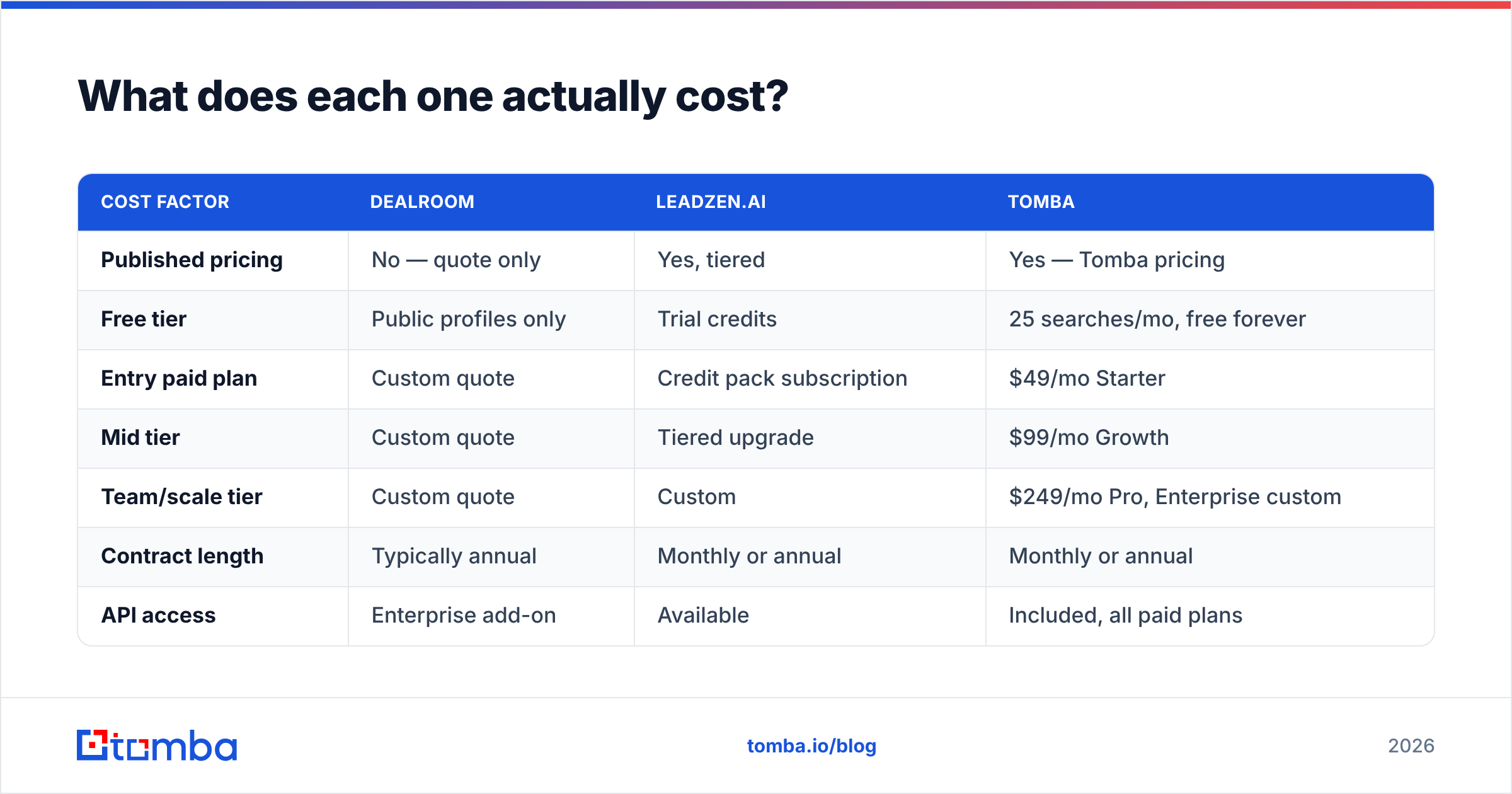
| Cost factor | Dealroom | Leadzen.ai | Tomba |
|---|---|---|---|
| Published pricing | No — quote only | Yes, tiered | Yes — Tomba pricing |
| Free tier | Public profiles only | Trial credits | 25 searches/mo, free forever |
| Entry paid plan | Custom quote | Credit pack subscription | $49/mo Starter |
| Mid tier | Custom quote | Tiered upgrade | $99/mo Growth |
| Team/scale tier | Custom quote | Custom | $249/mo Pro, Enterprise custom |
| Contract length | Typically annual | Monthly or annual | Monthly or annual |
| API access | Enterprise add-on | Available | Included, all paid plans |

The pattern is consistent across the B2B data market: the more strategic the dataset, the less likely the price is public. That's not a scandal, just procurement reality. Budget three to six weeks for a Dealroom evaluation and about an afternoon for Leadzen.ai.
Who should choose Dealroom?#
Pick Dealroom if two or more of these describe you:
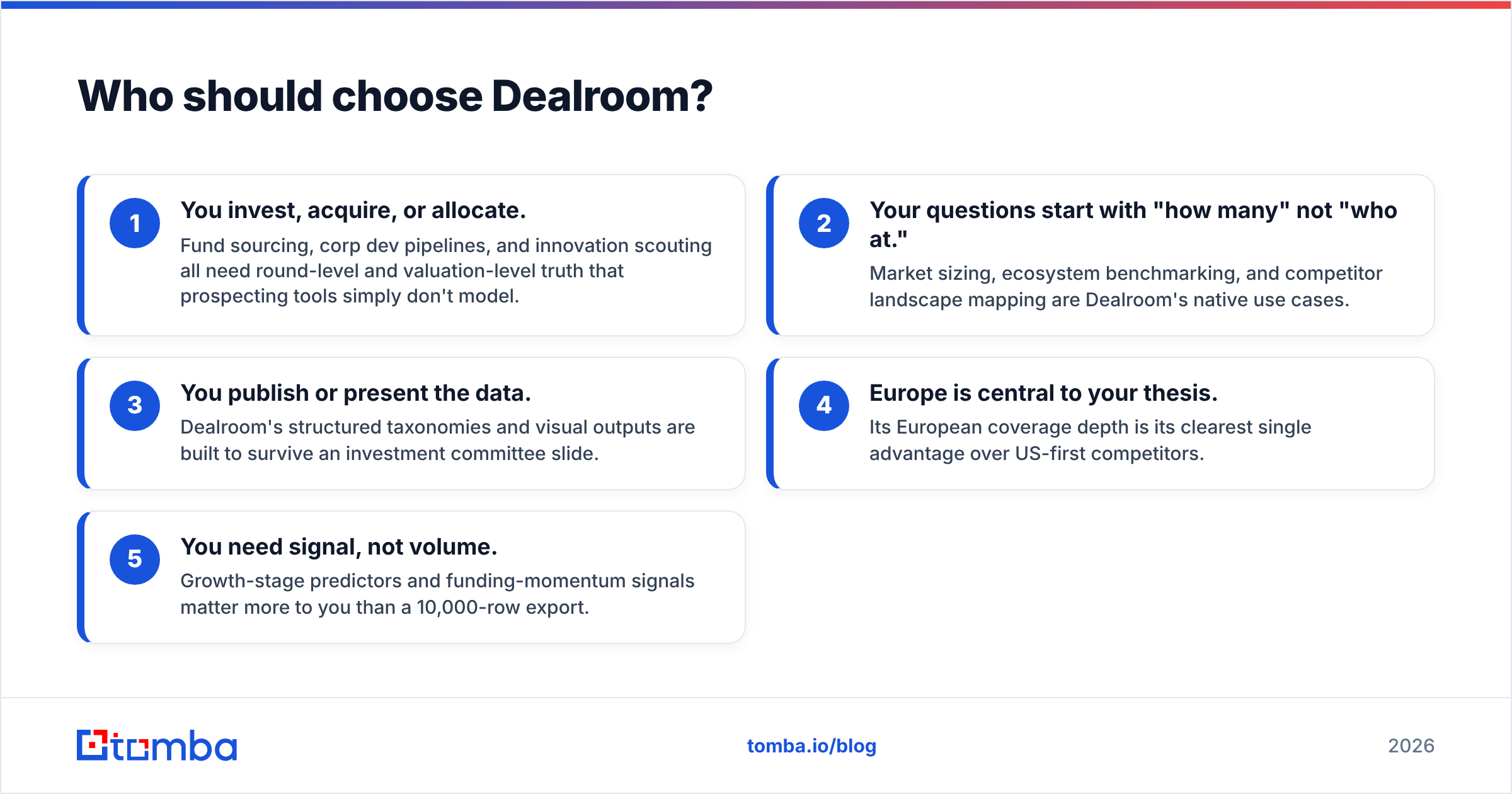
- You invest, acquire, or allocate. Fund sourcing, corp dev pipelines and innovation scouting need round-level and valuation-level truth. Prospecting tools don't model it.
- Your questions start with "how many" not "who at." Market sizing, ecosystem benchmarking and competitor mapping are Dealroom's native use cases.
- You publish or present the data. Dealroom's structured taxonomies and visual outputs are built to survive an investment committee slide.
- Europe is central to your thesis. Its European coverage depth is its clearest single advantage over US-first competitors.
- You need signal, not volume. Growth-stage predictors and funding-momentum signals matter more to you than a 10,000-row export.
If you're an SDR asked to book 12 meetings this month, none of the above describes your Tuesday.
Who should choose Leadzen.ai?#
Pick Leadzen.ai if:
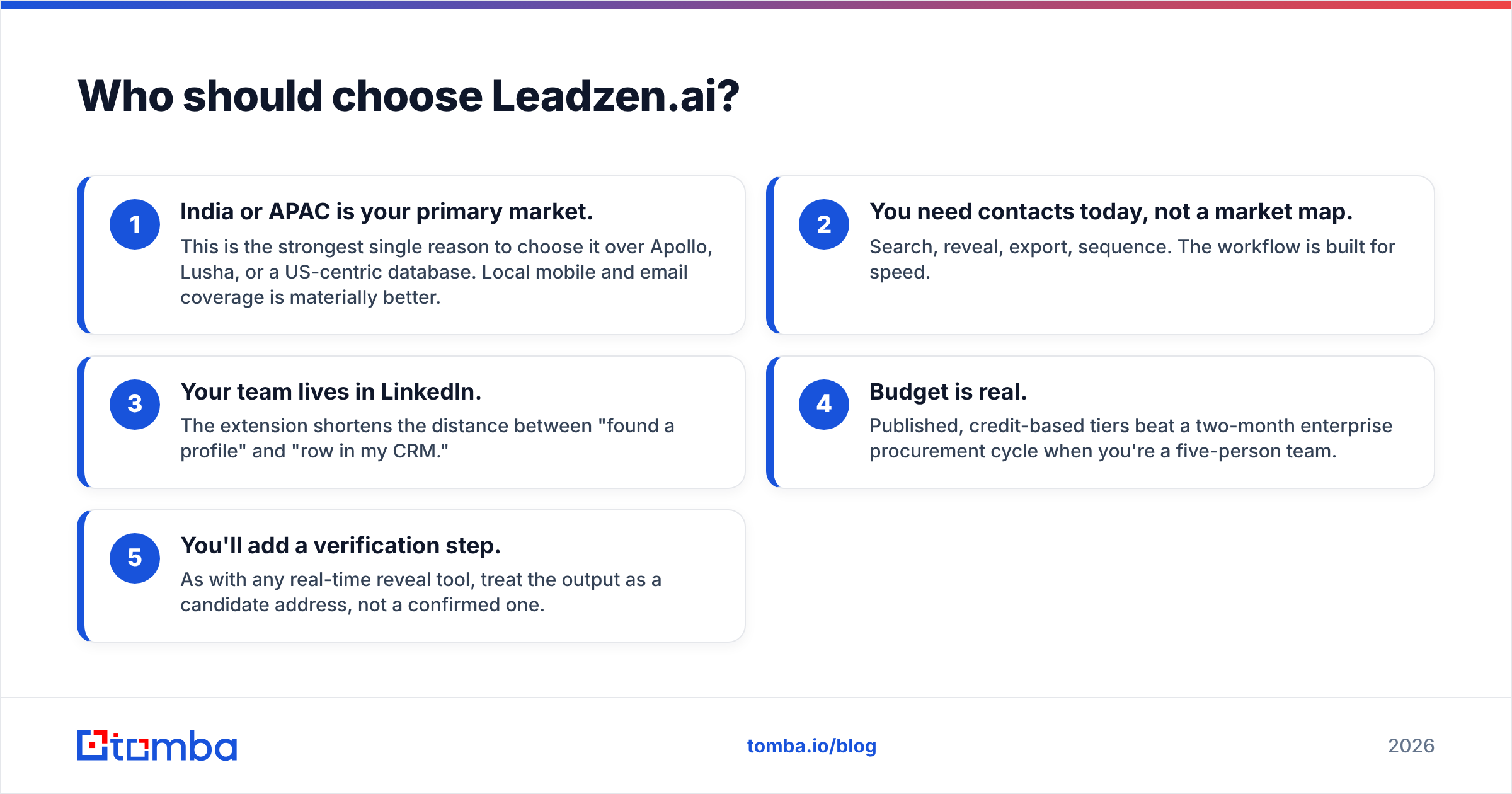
- India or APAC is your primary market. This is the strongest single reason to choose it over Apollo, Lusha, or a US-centric database. Local mobile and email coverage is materially better.
- You need contacts today, not a market map. Search, reveal, export, sequence. The workflow is built for speed.
- Your team lives in LinkedIn. The extension shortens the distance between "found a profile" and "row in my CRM."
- Budget is real. Published, credit-based tiers beat a two-month enterprise procurement cycle when you're a five-person team.
- You'll add a verification step. As with any real-time reveal tool, treat the output as a candidate address, not a confirmed one.
Where do both tools leave a gap?#
Both platforms are strong at their core job. Neither is built as an email accuracy layer. That gap shows up in three predictable places.
Catch-all domains. Many mid-market and enterprise domains accept mail for any address at the SMTP layer. A naive check can't tell a real mailbox from a typo. Databases often mark these "valid" because the server didn't reject them. If your ICP skews enterprise, you need a purpose-built catch-all verifier. Without one, you're flying blind on a big chunk of your list.
Role changes. B2B contact data decays at roughly 20-30% per year. It decays fastest where you care most: senior titles at fast-growing companies. A record that was accurate at ingestion can be dead six months later. Neither vendor re-verifies your saved lists for you.
Pattern-guessed addresses. When a database can't source an address, some systems fall back on the company's dominant pattern (first.last@). They ship it with modest confidence. Sometimes that's right. When it isn't, you paid a credit for a bounce — and bounces are the fastest way to damage sender reputation.
The fix is boring and effective. Keep your intelligence layer and your verification layer separate. Use Dealroom or Leadzen.ai to decide who to contact. Then run the addresses through a dedicated finder and verifier before anything enters a sending tool. Review sites like G2 help sanity-check vendor claims, since bounce complaints surface in reviews long before they surface in sales calls.
Can you use both — or neither?#
Yes to both, and often yes to neither.
Both makes sense for a fund with a portfolio-support function. Use Dealroom for sourcing and market intelligence, and Leadzen.ai for outreach into target companies. The datasets don't conflict. They sit at different altitudes.
Neither makes sense more often than vendors like to admit. Say your ICP is narrow: 800 mid-market SaaS companies in three countries. You don't need a subscription to a million-company database. You need the right 800 domains and accurate contacts inside them. That's a domain search problem plus a verification problem, and it costs a fraction of either platform.
A practical three-step version of that stack:
- Build the account list from whatever source you trust — a filtered export, a conference attendee list, a scraped directory, or your CRM's closed-lost pile.
- Find the people with a domain-level search that returns every discoverable address at each company, with confidence scores and sources.
- Verify before send, including catch-all handling, and re-verify anything older than 90 days.
Dealroom vs Leadzenai: what's the verdict?#
If you have to pick one: choose Dealroom when your output is a decision, like an investment, an acquisition, or a market entry. Choose Leadzen.ai when your output is a conversation, like a booked meeting. That rule beats any feature-by-feature score.
The Dealroom vs Leadzenai call gets tricky in the middle case: a GTM team that needs some market context and a lot of contact accuracy. Buying Dealroom for its contact data overpays for the wrong strength. Buying Leadzen.ai for market intelligence underbuys for the wrong strength. Split the job. Use a focused intelligence source for context and a purpose-built contact layer for execution.
One last note on evaluation hygiene. Run both trials against the same 200-company list from your real pipeline, not a demo list the vendor supplies. Score three things: match rate, bounce rate after independent verification, and time-to-first-usable-row. Those three numbers will settle the argument faster than any comparison post, including this one.
Ready to fix the accuracy layer? Whichever intelligence platform you land on, the addresses still have to be right on send day. Tomba Email Finder finds professional emails by domain, name, or company. It returns confidence scores and sources, and hands off directly to verification. Start free with 25 searches a month, then $49/mo when you outgrow it. Test it against whatever your current database returns and let the bounce rate decide.
Related guides#
Ready to find emails that actually work?
Join 150,000+ professionals who stopped guessing and started sending. Free credits on signup — no credit card required.
Get the Tomba newsletter
Practical outbound tactics and product updates — once every two weeks.
About the author