Definitive Healthcare vs Tomba: Honest 2026 Comparison
One is a healthcare commercial intelligence suite with claims data and provider affiliations. The other is a $49/mo email finder that works across every industry. Here is which one actually fits your pipeline.
TL;DR
- Definitive Healthcare and Tomba are not really competitors. One sells healthcare market intelligence (claims data, provider affiliations, facility profiles); the other sells verified B2B email addresses across every industry.
- Definitive Healthcare is quote-only and lands in the five figures annually for most teams. Tomba starts free and runs $49/mo (Starter) to $249/mo (Pro).
- If your ICP is hospitals, IDNs, physician groups, or payers and you need clinical/claims context to segment, Definitive Healthcare earns its price. If you already know who to contact and need their work email, it is enormous overkill.
- If you need contact data — email, phone, LinkedIn — across healthcare and everything else, Tomba does that job for roughly 2% of the cost.
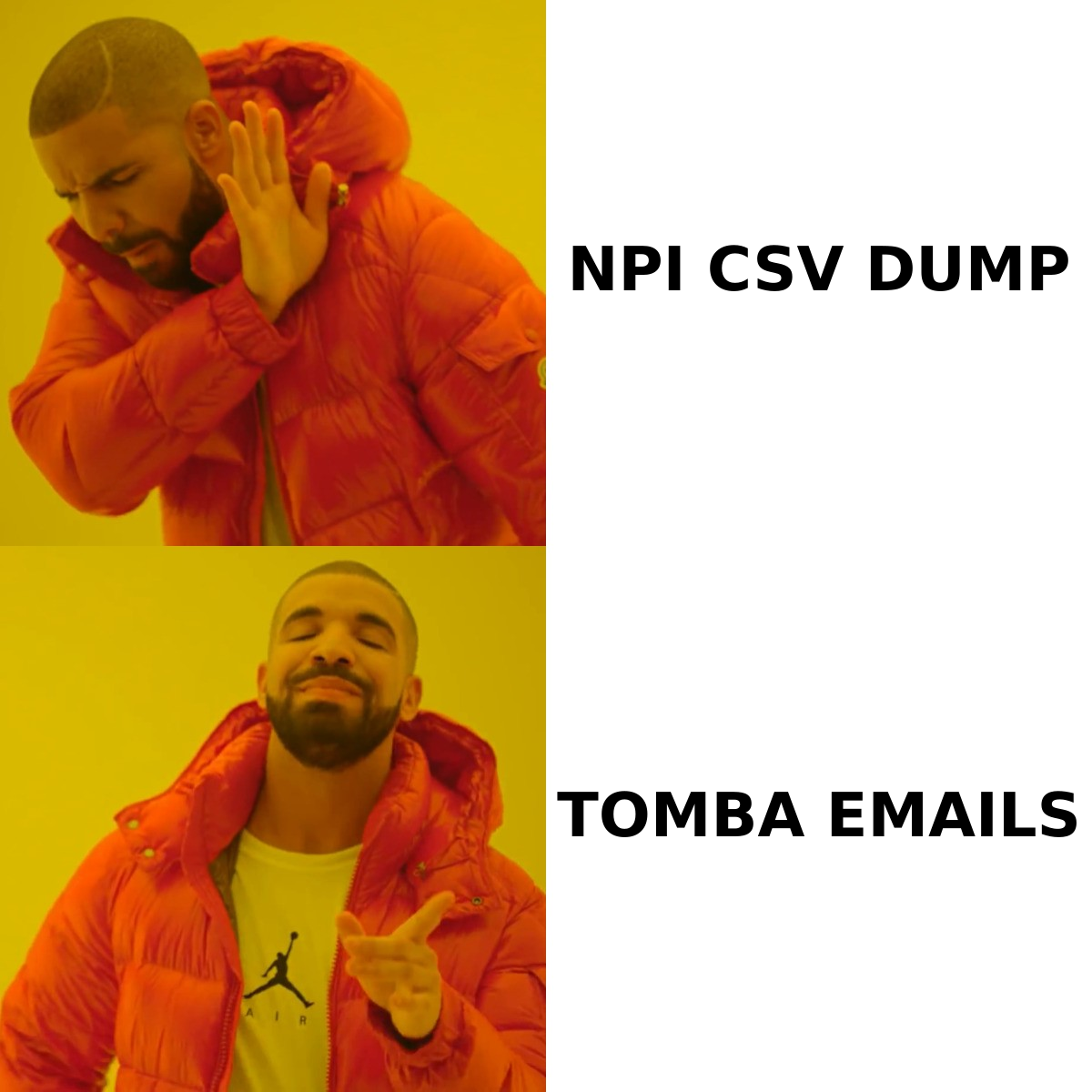
- The most common real-world setup: Definitive Healthcare (or a free NPI export) for targeting, Tomba for the actual email and phone layer.
What is Definitive Healthcare?#
Definitive Healthcare is a healthcare commercial intelligence platform. It is not a prospecting tool that happens to cover healthcare — it is a healthcare data company that added prospecting workflows on top.
The core asset is a stitched-together view of the US healthcare market: roughly 9,000+ hospitals, hundreds of thousands of physician group practices, imaging centers, ASCs, long-term care facilities, payers, and several million individual providers. Around each entity it layers:
- Claims-derived volumes — procedure counts, diagnosis mix, referral patterns, and where patients actually flow between facilities.
- Affiliation mapping — which physician sits under which group, which group rolls up to which health system, and when that changed.
- Technology install data — which EHR, PACS, RCM, or clinical system a facility runs, plus contract timing signals where available.
- Financial and quality metrics — Medicare cost report data, HCAHPS scores, net patient revenue, bed counts.
- Executive contacts — named CIOs, CNOs, VPs of supply chain, practice administrators, attached to the entity record.
That fifth bullet is the one that gets Definitive Healthcare compared to contact-data tools, and it is also the smallest part of the product. You are not paying five figures for emails. You are paying for the ability to say "show me every 200+ bed hospital running Epic in the Southeast with rising orthopedic surgical volume and no ASC affiliation" — and get a targetable list back.
That query is genuinely hard to reproduce anywhere else. It is also useless to about 90% of B2B sellers.
What is Tomba?#
Tomba is a B2B email finder and contact enrichment platform. The problem it solves is narrow and universal: you know the person or the company, you need the deliverable work email.
The stack around it:
- Email finder — name + domain in, verified professional email out.
- Domain search — give it
mayoclinic.organd get back the discoverable email addresses at that domain, with roles and detected pattern (first.last@,flast@, etc.). - Email verifier — SMTP-level checks plus catch-all detection before you send.
- Phone finder and data enrichment — direct dials and firmographic fill-in.
- Tomba API, CLI, Chrome extension, Google Sheets add-on, and native HubSpot/Salesforce/Pipedrive connectors.
No claims data. No procedure volumes. No healthcare taxonomy. Tomba does not know that an NPI number means anything. What it does know is how to turn "Sarah Chen, VP Clinical Informatics, Baylor Scott & White" into a mailbox that accepts your message.
Definitive Healthcare vs Tomba: how do they actually compare?#
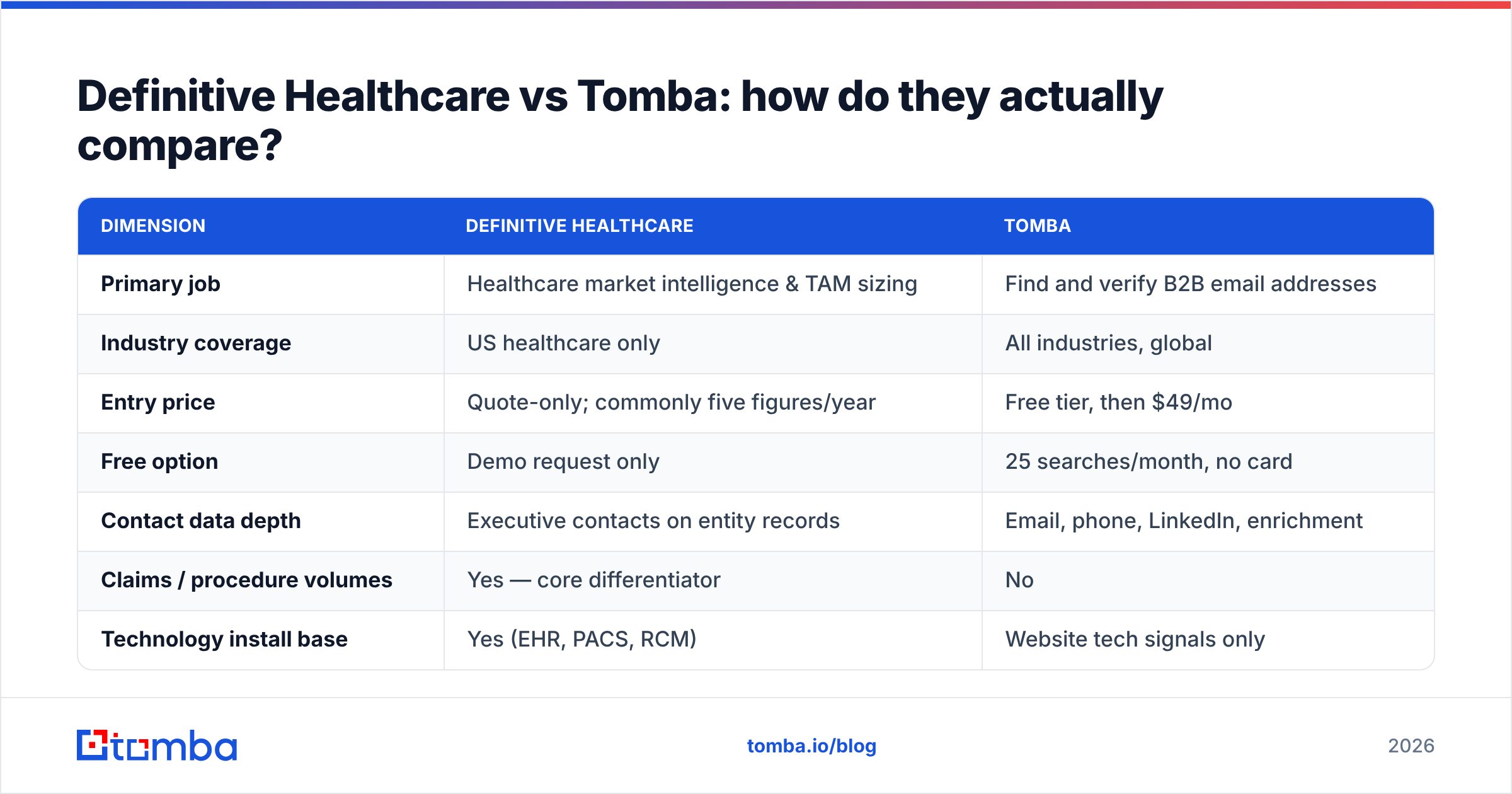
Here is the honest side-by-side. Note how few rows have real overlap.
| Dimension | Definitive Healthcare | Tomba |
|---|---|---|
| Primary job | Healthcare market intelligence & TAM sizing | Find and verify B2B email addresses |
| Industry coverage | US healthcare only | All industries, global |
| Entry price | Quote-only; commonly five figures/year | Free tier, then $49/mo |
| Free option | Demo request only | 25 searches/month, no card |
| Contact data depth | Executive contacts on entity records | Email, phone, LinkedIn, enrichment |
| Claims / procedure volumes | Yes — core differentiator | No |
| Technology install base | Yes (EHR, PACS, RCM) | Website tech signals only |
| Email verification | Basic hygiene | Dedicated verifier + catch-all handling |
| API access | Enterprise tiers | All paid plans, including $49/mo |
| Contract term | Annual, typically multi-seat | Monthly, cancel anytime |
| Time to first list | Demo → security review → onboarding | Minutes |
| Best for | Healthcare-only GTM teams with budget | Any team that needs contacts fast |
The pattern should be obvious: these tools answer different questions. Definitive Healthcare answers who should I target and why. Tomba answers how do I actually reach them.
How much does each one really cost?#
Definitive Healthcare does not publish pricing. Buyer reviews on G2 and Capterra consistently describe annual contracts in the five-figure range, scaling with seat count, module access (claims data and technology install data are usually priced separately), and export limits. Multi-year deals get discounts. Single-seat deals are rare and not cheap.
There is also a hidden cost: procurement time. Quote-only enterprise data contracts mean demos, security reviews, legal, and a renewal negotiation every year. Budget six to twelve weeks from first call to first export if you are at a company with any procurement process at all.
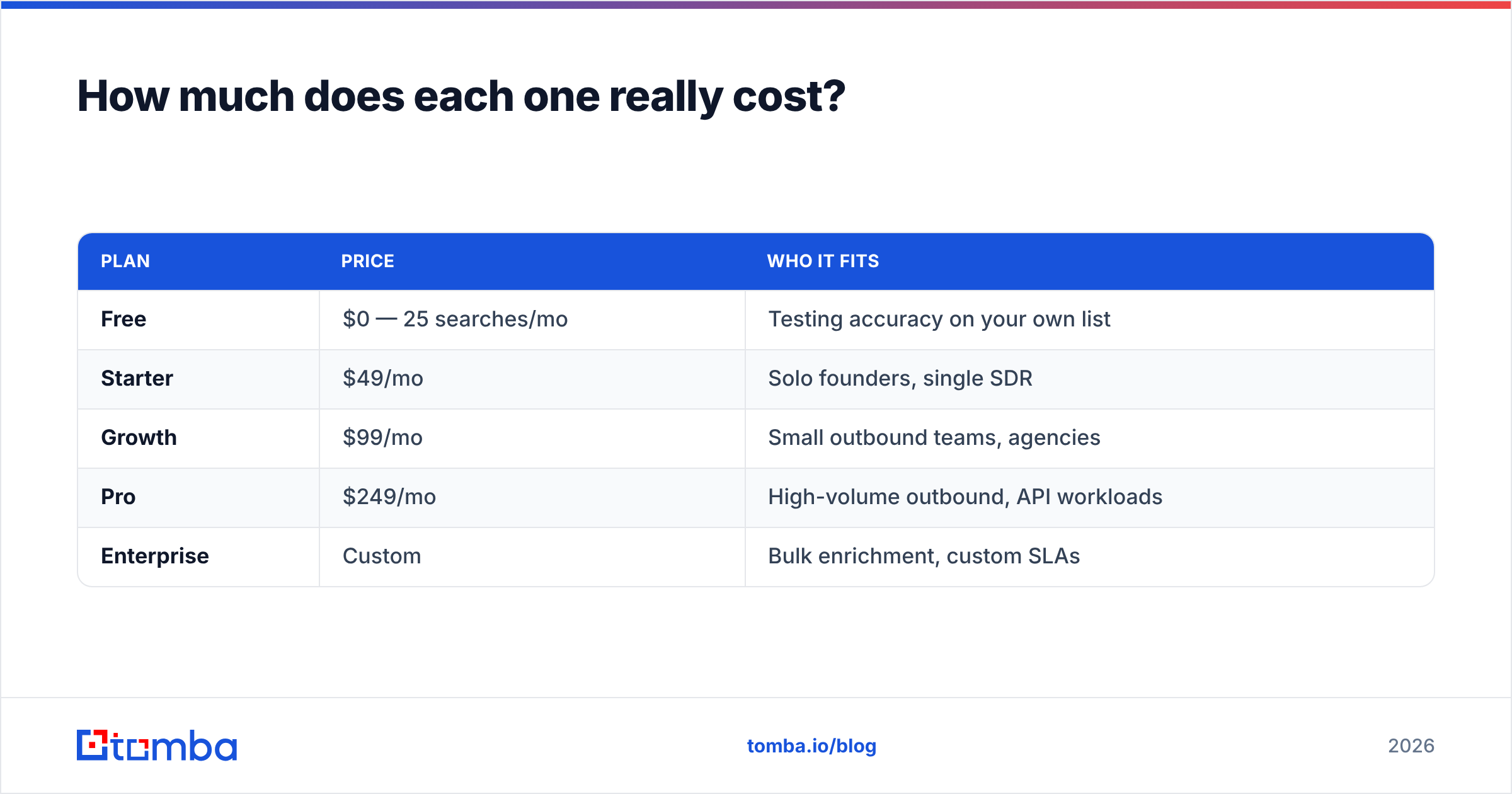
Tomba is transparent and self-serve:
| Plan | Price | Who it fits |
|---|---|---|
| Free | $0 — 25 searches/mo | Testing accuracy on your own list |
| Starter | $49/mo | Solo founders, single SDR |
| Growth | $99/mo | Small outbound teams, agencies |
| Pro | $249/mo | High-volume outbound, API workloads |
| Enterprise | Custom | Bulk enrichment, custom SLAs |
Full Tomba pricing is on one page with no "contact sales" wall until Enterprise. You can validate accuracy against your own known-good contacts before spending anything — which, frankly, is the test you should run against every data vendor, including this one.
The blunt math: a Pro seat at $249/mo runs $2,988/year. That is often less than 10% of a single Definitive Healthcare seat. Whether that gap is justified depends entirely on whether you need claims data. If you do, the gap is irrelevant. If you don't, you are financing a healthcare research database to send cold emails.

Which one gives you better contact data?#
Different failure modes, so judge them differently.
Definitive Healthcare's contact records are tied to verified organizational entities. When it tells you that a named person is the CIO at a specific health system, the affiliation is usually right, because the affiliation is derived from claims and organizational filings rather than scraped profiles. That is a real advantage over generic databases where half the healthcare titles are three reorgs out of date.
The weakness is coverage depth and email freshness. Not every entity has a full contact roster. Mid-market physician groups and independent practices often have the facility record populated but few named contacts. And because contact refresh is not the product's core loop, emails can go stale between updates — healthcare has high executive churn and hospital domains change during acquisitions.
Tomba's failure mode is the opposite. It has no idea whether the person you searched still works there — it finds and verifies the address pattern for the domain you gave it. Feed it a stale target and you get a well-verified email for someone who left. But within its lane it is deliberately built for freshness: results are verified at query time, catch-all domains are flagged rather than silently passed through, and the catch-all verifier exists specifically because hospital systems run catch-all configurations constantly. If you have ever bounced a campaign into a @commonspirit.org catch-all, you know why that matters.
Practical read: Definitive Healthcare is stronger on who and where. Tomba is stronger on will this message land. Run a 100-contact sample through each against your CRM's known-good records before you sign anything longer than a month.
Who should choose Definitive Healthcare?#
Pick Definitive Healthcare if three or more of these are true:
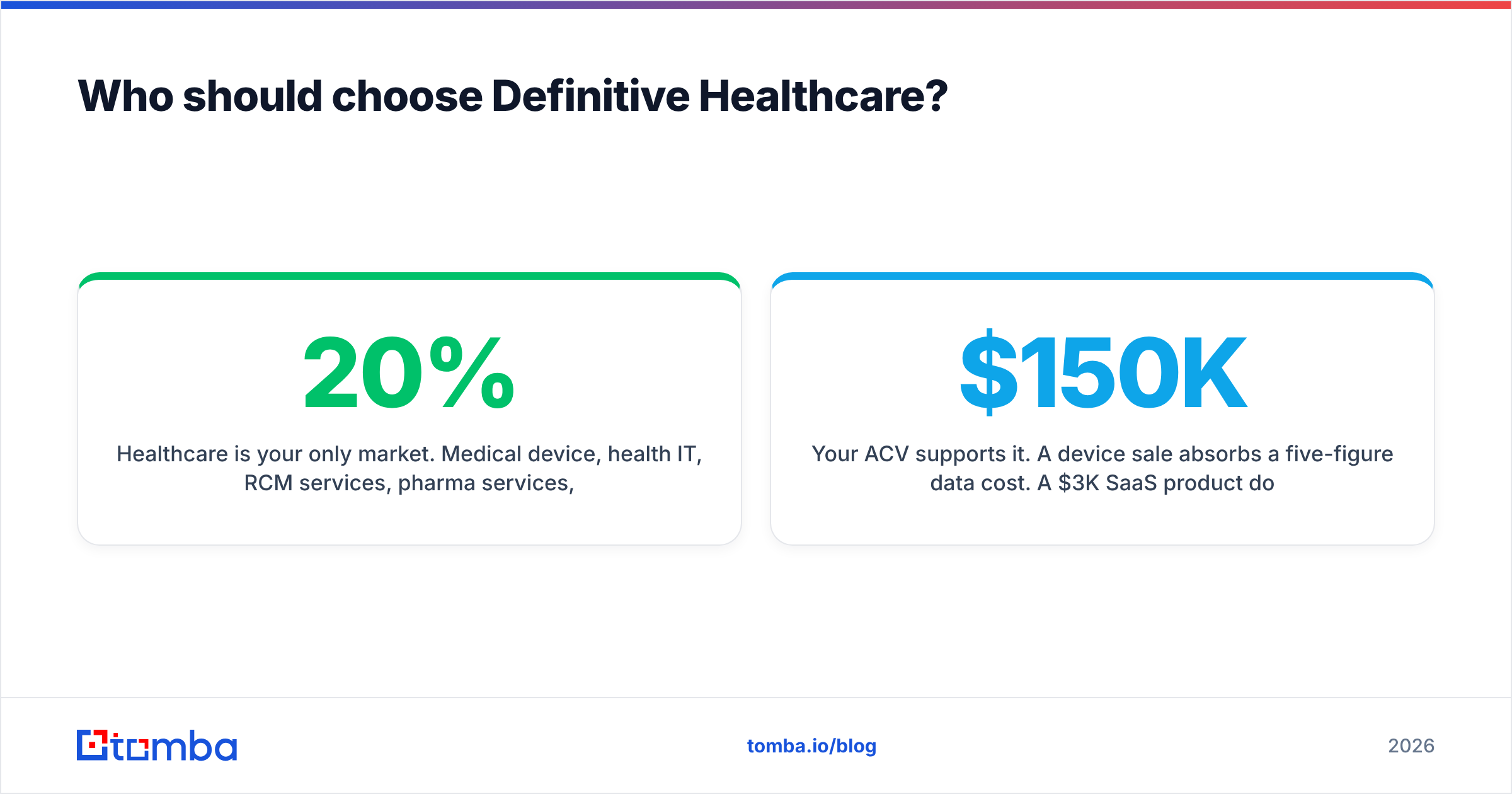
- Healthcare is your only market. Medical device, health IT, RCM services, pharma services, staffing. If you sell horizontally, you are paying for a database you'll use 20% of.
- Your segmentation needs clinical signal. "Hospitals with growing cardiac cath volume" is not a filter any generic B2B database can produce. This is the one thing money genuinely buys here.
- You do TAM analysis and territory planning, not just outbound. Definitive Healthcare gets used by product and strategy teams as much as sales.
- You need technology install data to time replacement cycles for EHR-adjacent products.
- Your ACV supports it. A $150K device sale absorbs a five-figure data cost. A $3K/year SaaS product does not.
Related tools worth benchmarking against it: IQVIA, H1, and Doximity for provider-level intelligence. If claims data is the requirement, those are your real comparison set — not email finders.
Who should choose Tomba?#
Pick Tomba if:
- You already know your target accounts. From an NPI export, a conference list, an association directory, a LinkedIn Sales Navigator search, or your CRM. Targeting is solved; contact data is the gap.
- You sell to healthcare and other verticals. Most B2B SaaS does. A healthcare-only database forces you to buy a second tool anyway.
- You want to start this afternoon. Free tier, no demo, no security review, no annual commitment.
- You need an API or bulk workflow. Bulk email finding and the API are available on paid plans, not gated behind an enterprise tier.
- You want to verify before you send. Deliverability is a data problem before it is a copy problem. Sending to unverified hospital domains is the fastest way to torch sender reputation.
Where Tomba honestly loses: it will never tell you which facility to target based on procedure mix. It has no healthcare taxonomy. If your entire GTM thesis depends on clinical segmentation, Tomba is a component, not a replacement.
Can you use both together?#
Yes, and for well-funded healthcare GTM teams this is the correct architecture rather than a compromise.
The stack looks like this:
- Targeting layer — Definitive Healthcare (or free CMS/NPI public data if budget is tight) defines which facilities and providers qualify.
- People layer — LinkedIn Sales Navigator or the entity's own leadership page identifies named humans in the buying committee.
- Contact layer — Tomba's domain search and email finder resolve those names into verified emails and direct dials.
- Hygiene layer — the email verifier and catch-all handling run before anything hits your sequencer.
- CRM layer — everything syncs into HubSpot or Salesforce, where enrichment keeps records from decaying.
Teams that run this split usually find they need fewer Definitive Healthcare seats than they were sold. Two analyst seats for list building beats eight seats where six people only ever used it to look up an email address — a job a $49/mo tool does better and faster.
If you cannot justify the intelligence layer at all, the downgrade path is real: CMS publishes NPI, hospital cost report, and quality data for free. It is uglier and requires actual work, but it covers a surprising amount of basic firmographic targeting. Pair that with Tomba and you have a functioning healthcare outbound motion for under $100/month.
What should you actually do next?#
Run the test, don't take anyone's word for it — including this post's.
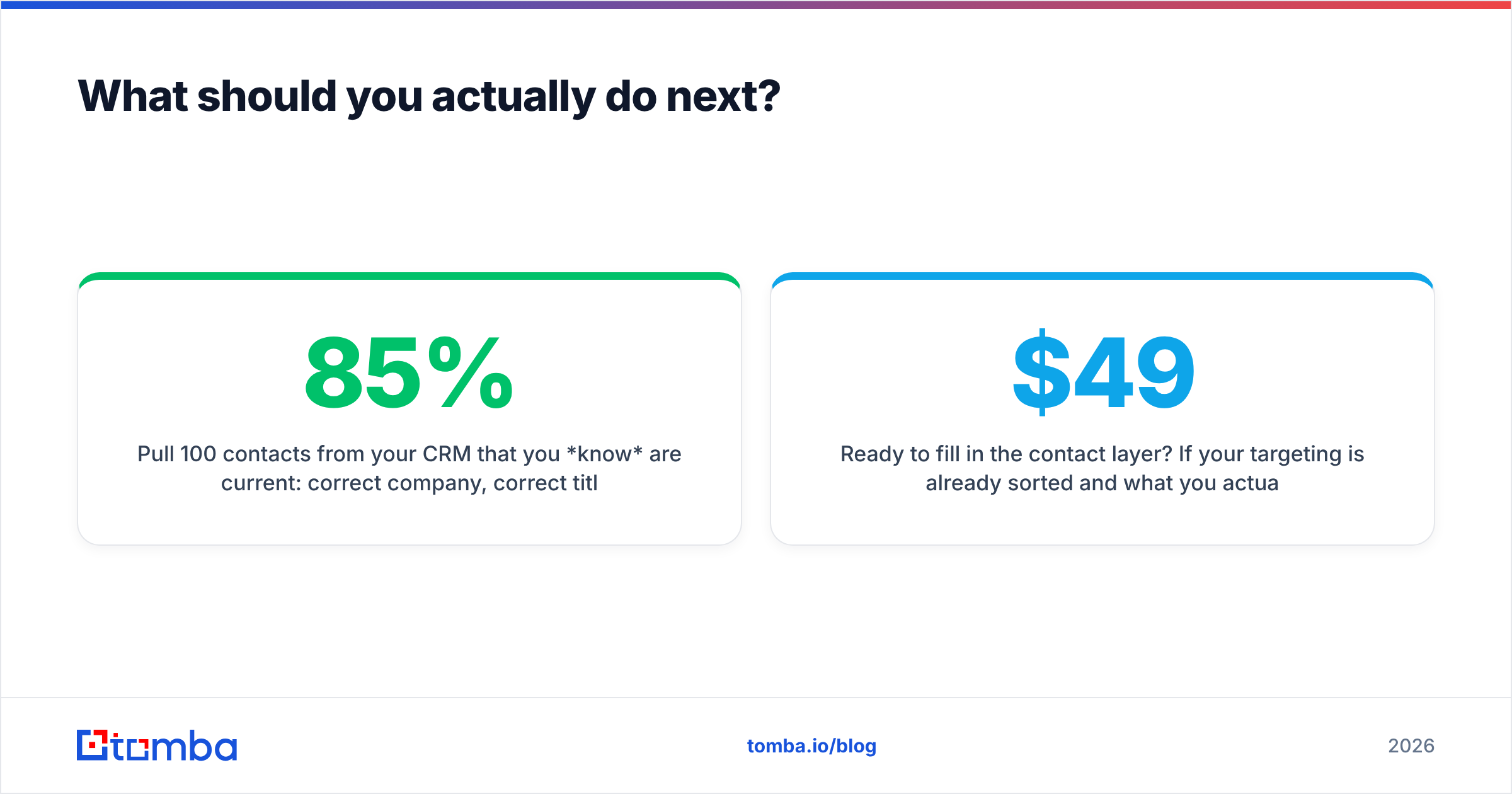
Pull 100 contacts from your CRM that you know are current: correct company, correct title, email you have successfully sent to. Run them through any vendor's free tier or trial. Measure two numbers: match rate (how many did it find) and accuracy (how many matched what you already knew). Anything above 85% accuracy on a clean sample is strong. Below 70% and you are buying bounces.
Do it for Definitive Healthcare during the demo — ask them to run your list live rather than showing you a curated example. Do it for Tomba on the free tier before you spend a dollar. Vendors that resist this test are telling you something.
Ready to fill in the contact layer? If your targeting is already sorted and what you actually need is the verified email behind each name, start with the Tomba Email Finder. The free tier gives you 25 searches a month — enough to run the accuracy test above on your own data before committing to anything. Paid plans start at $49/mo with full API access, and you can cancel any month you want. No demo, no procurement cycle, no annual contract.
Related guides#
Ready to find emails that actually work?
Join 150,000+ professionals who stopped guessing and started sending. Free credits on signup — no credit card required.
Get the Tomba newsletter
Practical outbound tactics and product updates — once every two weeks.
About the author