Dreamdata vs HockeyStack 2026: B2B Attribution Tools Compared
Both promise to show which marketing actually drives pipeline. They get there very differently. Here's how Dreamdata and HockeyStack compare on data model, pricing, setup time, and who each one really fits in 2026.
TL;DR
- Dreamdata is the deeper data platform: full account-level journey stitching, a transparent BigQuery-style data model, and multi-touch attribution built for long, committee-driven B2B cycles.
- HockeyStack is the faster-to-value analytics layer: strong session-level tracking, AI-generated insights, and a UI your demand gen lead can run without a data engineer.
- Pricing lands in a similar range for mid-market teams. Expect roughly $1,000–$2,500/month depending on tracked contacts and integrations. Neither publishes a self-serve credit card tier.
- Pick Dreamdata if you want to own the underlying data and run custom models. Pick HockeyStack if you want opinionated dashboards and answers this quarter.
- Both are only as good as the contact and account data feeding them. Broken CRM records and unverified emails corrupt attribution no matter which vendor you buy.
What problem are Dreamdata and HockeyStack actually solving?#
Most Dreamdata vs HockeyStack shortlists start with the same painful meeting. Your CFO asks which channel produced last quarter's pipeline. Your CRM says "Webform." Your ad platforms collectively claim 340% of actual revenue. Nobody can reconcile the two.
That gap is the entire category. Dreamdata and HockeyStack both stitch anonymous web sessions, ad clicks, CRM objects, marketing automation events, and closed-won revenue into a single account timeline. Then they assign credit across it. Think of it like a security camera system for your funnel. Each camera (GA4, HubSpot, LinkedIn Ads) shows a fragment. Attribution software splices the footage into one continuous tape per account.
The difference between the two comes down to what you're allowed to do with the tape.
Dreamdata vs HockeyStack: how do they compare head to head?#
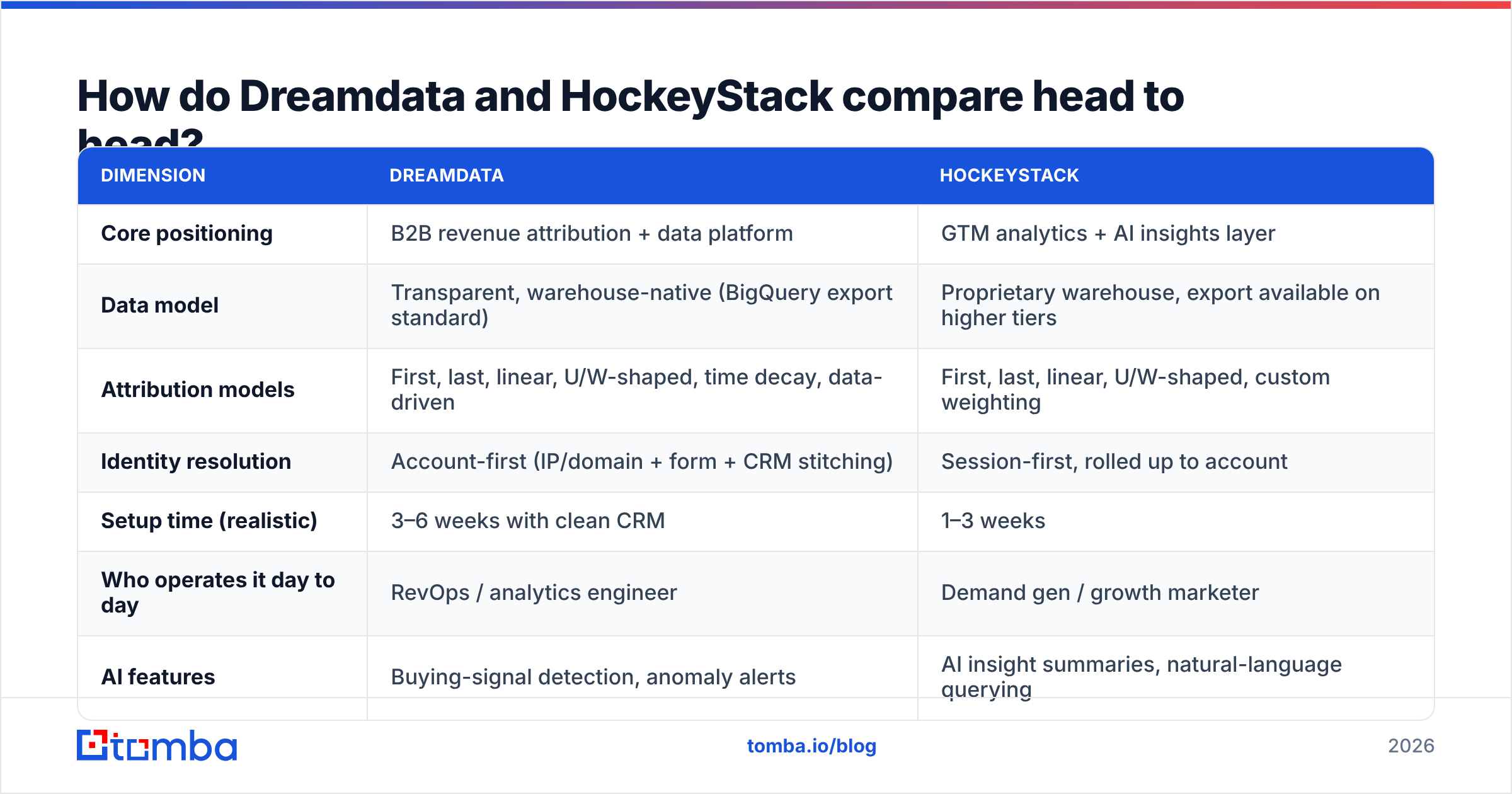
| Dimension | Dreamdata | HockeyStack |
|---|---|---|
| Core positioning | B2B revenue attribution + data platform | GTM analytics + AI insights layer |
| Data model | Transparent, warehouse-native (BigQuery export standard) | Proprietary warehouse, export available on higher tiers |
| Attribution models | First, last, linear, U/W-shaped, time decay, data-driven | First, last, linear, U/W-shaped, custom weighting |
| Identity resolution | Account-first (IP/domain + form + CRM stitching) | Session-first, rolled up to account |
| Setup time (realistic) | 3–6 weeks with clean CRM | 1–3 weeks |
| Who operates it day to day | RevOps / analytics engineer | Demand gen / growth marketer |
| AI features | Buying-signal detection, anomaly alerts | AI insight summaries, natural-language querying |
| Free tier | Limited free plan historically offered | No |
| Typical entry price | ~$1,000+/mo | ~$1,000+/mo |
| Best for | Data-mature teams, complex enterprise cycles | Mid-market teams wanting speed |
Both vendors negotiate. Both scale price on tracked contacts, connected sources, and seat count. Neither list price is public in a way you should plan a budget around. Get a quote against your actual contact volume.
Which one handles B2B attribution better?#
Attribution quality depends less on the model dropdown and more on identity resolution. The real question is whether the tool knows that the anonymous visitor reading your pricing page belongs to the same account as the SDR-sourced opportunity in Salesforce.
Dreamdata's approach is account-first. It leans heavily on firmographic reverse-IP, form fills, email domain matching, and CRM object hierarchy to build an account timeline, then attaches individual contacts to it. In a 9-month enterprise cycle with 11 stakeholders, that architecture matters. You'll see the security reviewer who read three docs pages in month 6 without ever filling a form.
HockeyStack's approach starts at the session and rolls up. It's excellent at behavioral granularity: what someone did, in what order, how long they stayed. That maps well onto product-led or self-serve motions where a single champion drives most of the deal. On a 40-person buying committee it does the job, but the account-level roll-up is a layer on top rather than the foundation.
Practical read: if your average deal has more than five touched contacts and a procurement stage, Dreamdata's model will feel more honest. If your ACV is under $30K and deals close in 60 days, HockeyStack's session depth is more useful than account gymnastics you don't need.
What does each platform actually cost in 2026?#
Neither vendor publishes a clean pricing page you can screenshot for a budget deck. Here's the shape of the market based on public plan structures and buyer reports on G2:
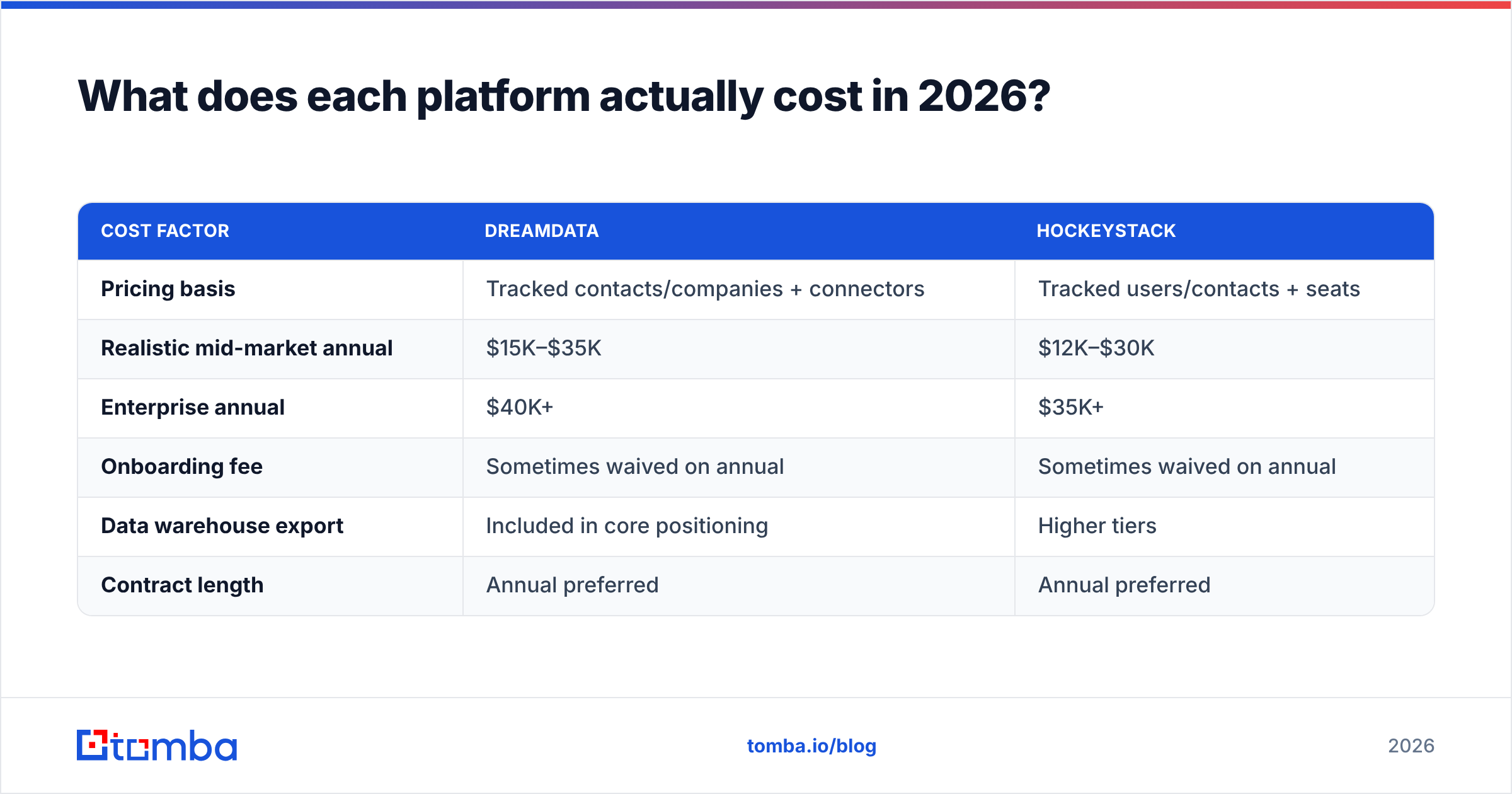
| Cost factor | Dreamdata | HockeyStack |
|---|---|---|
| Pricing basis | Tracked contacts/companies + connectors | Tracked users/contacts + seats |
| Realistic mid-market annual | $15K–$35K | $12K–$30K |
| Enterprise annual | $40K+ | $35K+ |
| Onboarding fee | Sometimes waived on annual | Sometimes waived on annual |
| Data warehouse export | Included in core positioning | Higher tiers |
| Contract length | Annual preferred | Annual preferred |
Two budget traps to plan for:
- Contact volume grows faster than you forecast. Both meters count tracked records. A single large webinar or a scraped list import can push you into the next tier mid-contract. Clean your list before it hits the platform.
- The implementation cost is not the license cost. Budget 20–60 RevOps hours for either tool. Dreamdata's warehouse depth means more hours, but those hours produce reusable assets.
Which is easier to implement?#
HockeyStack, clearly. And it's not particularly close.
A typical HockeyStack rollout is: install the tracking script, connect HubSpot or Salesforce, connect ad accounts, wait for backfill, start reading dashboards. Two to three weeks, mostly waiting.
Dreamdata's rollout is longer. You install tracking and connect the CRM, then spend real time defining stages, mapping custom objects, and deciding what counts as a qualified account. After that you validate that the revenue numbers match finance. Four to six weeks is honest. Teams with messy CRM hygiene routinely take longer, because Dreamdata surfaces every data problem you've been ignoring rather than smoothing over it.
That surfacing is a feature, not a bug. But it means the tool's time-to-value depends on how much cleanup you're willing to do first.
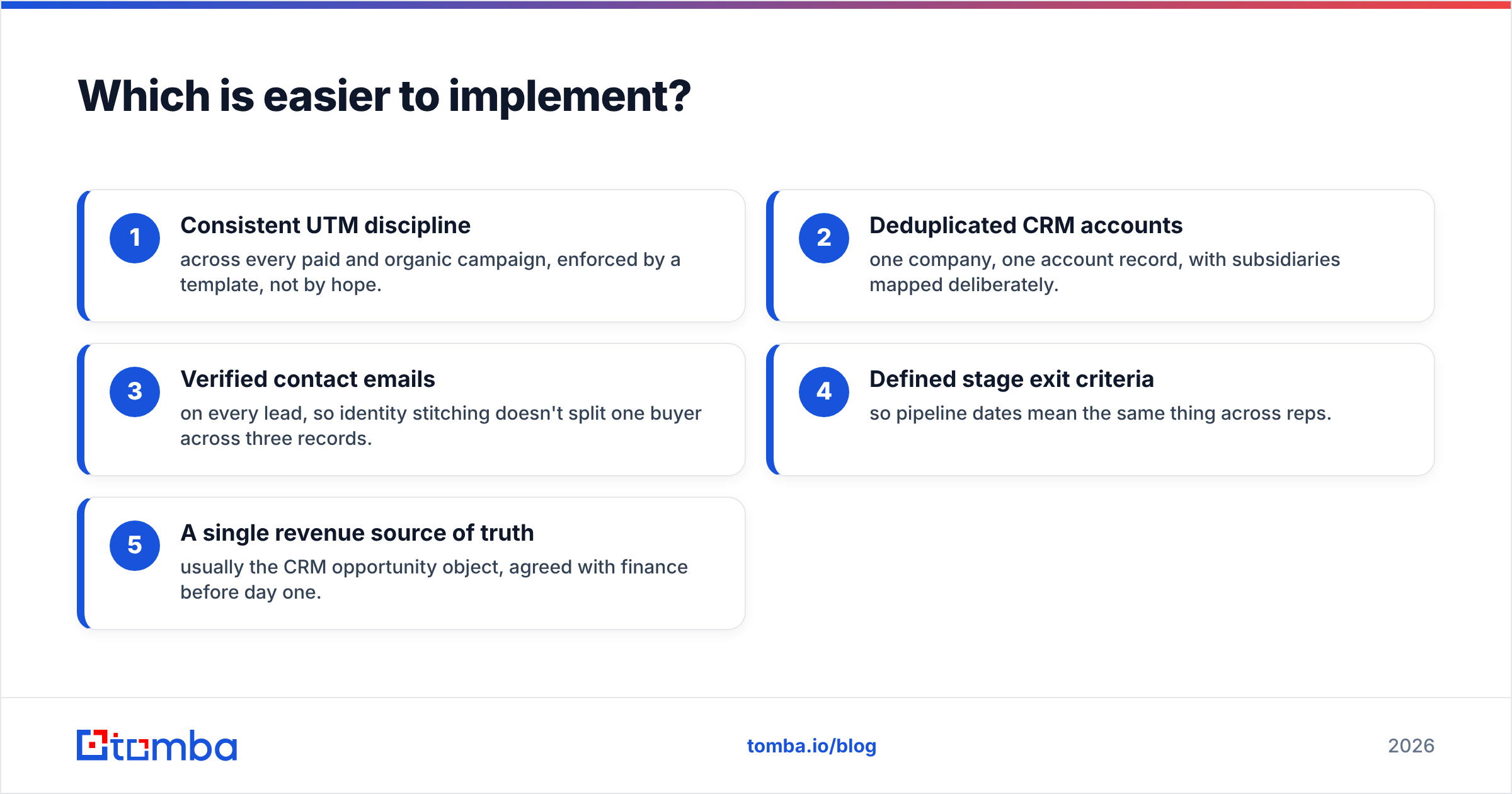
The five prerequisites both tools assume you already have:
- Consistent UTM discipline across every paid and organic campaign, enforced by a template, not by hope.
- Deduplicated CRM accounts — one company, one account record, with subsidiaries mapped deliberately.
- Verified contact emails on every lead, so identity stitching doesn't split one buyer across three records.
- Defined stage exit criteria so pipeline dates mean the same thing across reps.
- A single revenue source of truth — usually the CRM opportunity object, agreed with finance before day one.
Skip any of those and both platforms will produce confident, well-designed, wrong charts.
How do the AI features compare?#
Both shipped AI layers over the last two years. Both are more useful than the category average, which is a low bar.
HockeyStack's insight engine leans conversational. Ask "why did SQLs drop in June" and get a narrative answer with supporting segments. It's genuinely good for the weekly marketing standup, and it lowers the skill floor for reading the data. The tradeoff is that you're trusting a summary you didn't build yourself.
Dreamdata's AI work leans toward signal detection. It flags accounts showing buying-intent patterns, surfaces anomalies in channel performance, and scores journey stages. It's less chatty and more operational. It feeds workflows rather than meetings.
Neither replaces an analyst. Both cut the number of ad-hoc requests your analyst fields.
Is there a scenario where you'd pick neither?#
Yes, three of them.
You're under $2M ARR. At that stage, attribution software solves a problem you don't have yet. A well-maintained spreadsheet plus honest self-reported attribution on your demo form outperforms a $20K platform reading noisy data. Spend the money on pipeline generation instead.
Your CRM is genuinely broken. If you have duplicate accounts, unmapped opportunity stages, and half your contacts missing valid email addresses, attribution software will amplify the mess with charts. Fix the foundation first. Dedupe records, run email verification across the database, and enforce required fields. Six weeks of hygiene beats six months of pretty dashboards.
You need one specific answer, not a platform. "Which content assets appear in closed-won journeys?" is answerable with a warehouse query and a week of analyst time. Don't buy a platform to answer one question.

What do real buyers complain about?#
Neither tool is beloved unconditionally. Recurring themes from review sites and buyer conversations:
Dreamdata
- Steeper learning curve; non-technical marketers often need a RevOps translator.
- Setup surfaces data-quality problems that stall the rollout — accurate, but frustrating.
- Reporting flexibility is high, which means more decisions and more ways to configure it wrong.
HockeyStack
- Account-level depth on very long enterprise cycles is thinner than warehouse-native alternatives.
- Some buyers want more control over the underlying data model than the platform exposes on lower tiers.
- Fast growth means the roadmap moves quickly; features you evaluate may look different in a year.
Both complaint lists are shorter than the category norm. This is a comparison between two competent products, not a rescue mission.
Dreamdata vs HockeyStack: which should you choose?#
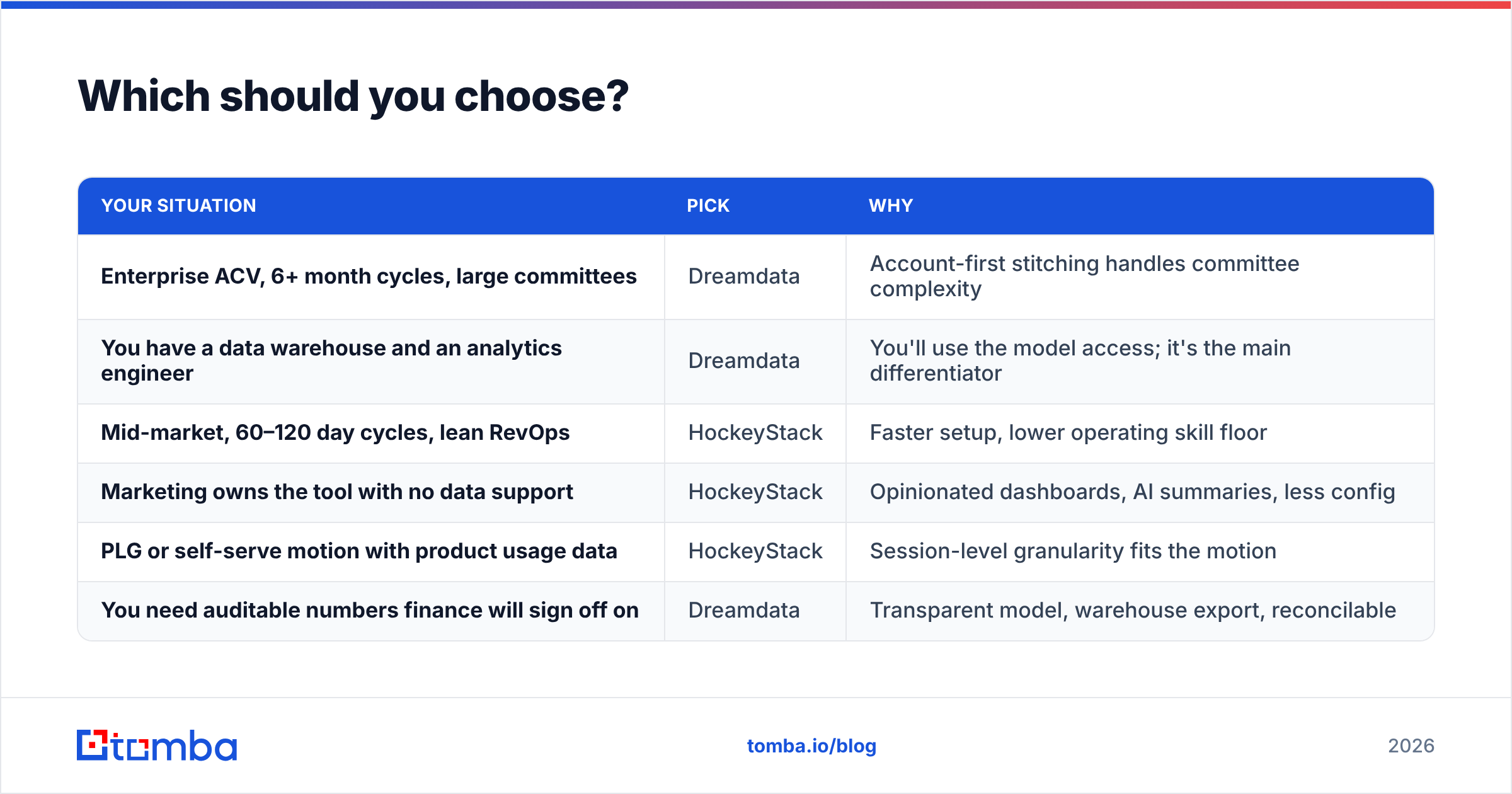
Straight answer, by team shape:
| Your situation | Pick | Why |
|---|---|---|
| Enterprise ACV, 6+ month cycles, large committees | Dreamdata | Account-first stitching handles committee complexity |
| You have a data warehouse and an analytics engineer | Dreamdata | You'll use the model access; it's the main differentiator |
| Mid-market, 60–120 day cycles, lean RevOps | HockeyStack | Faster setup, lower operating skill floor |
| Marketing owns the tool with no data support | HockeyStack | Opinionated dashboards, AI summaries, less config |
| PLG or self-serve motion with product usage data | HockeyStack | Session-level granularity fits the motion |
| You need auditable numbers finance will sign off on | Dreamdata | Transparent model, warehouse export, reconcilable |
If you're genuinely split, run both in parallel for 30 days against the same data sources. The tracking scripts don't conflict. Compare each tool's reported pipeline for a channel you already understand well. If one of them tells you something you know is wrong, that's your answer.
How do you keep the data underneath either tool clean?#
Attribution is downstream of contact data. Every duplicate contact record splits a buying journey in half. Every bounced email breaks the identity link between a session and an account. Every missing job title makes persona-level reporting useless.
Three habits that pay for themselves regardless of vendor:
- Verify before import. Run every list through verification before it touches the CRM. Invalid addresses inflate your tracked-contact meter and corrupt journey stitching. A bulk pass through an email verifier takes minutes.
- Enrich at the point of capture. Append company domain, size, and role automatically so segmentation works on day one. Data enrichment at form submission beats a quarterly cleanup project.
- Standardize the account key. Company domain is the most reliable join key across web analytics, ad platforms, and CRM. Make it a required field and both platforms' identity resolution gets measurably better.
If you're building the account list that feeds all of this, that work sits upstream of attribution entirely. It's revenue operations plumbing, and it decides how much value you extract from whichever platform you sign.
The bottom line#
The Dreamdata vs HockeyStack decision comes down to data maturity, not feature count. Dreamdata gives you the data model and expects you to bring the rigor. HockeyStack gives you the answers and expects you to trust the model. Neither is a mistake. Buying the wrong one for your team's data maturity is.
Before you sign either contract, audit what you're feeding it. If your contact records are incomplete, duplicated, or full of addresses that bounce, no attribution platform will save you. It will just render the mess in higher resolution.
Start upstream. Build clean, verified target-account lists with Tomba Email Finder. Find verified professional emails by domain, name, or company, enrich them with firmographic data, and push them into your CRM with a consistent domain key. Plans start free with 25 searches per month, with Starter at $49/mo and Growth at $99/mo; see full Tomba pricing for team volumes. Get the inputs right, and whichever attribution platform you pick will finally tell you the truth.
Related guides#
// get started
Find, verify and enrich your first contacts today
Start on the free plan with 25 searches a month, then scale when your team is ready.
Free plan · No credit card required · GDPR & CCPA
// about the author