EasyLeadz vs LimeLeads (2026): Which B2B Data Tool Wins?
EasyLeadz sells direct dials from a phone-first database. LimeLeads sells downloadable US email lists. They solve different problems badly if you pick the wrong one. Here is the honest breakdown.
TL;DR
- EasyLeadz is a phone-first tool. Its core value is direct dial numbers, especially for India and wider APAC, pulled one contact at a time through a LinkedIn extension. Email is a secondary output.
- LimeLeads is a list-builder. You filter a static US-heavy B2B database by industry, size, and title, then export a CSV. It is closer to a data broker than to a live lookup engine.
- Neither is a real-time email finder. If your bottleneck is "I have 400 companies and need verified work emails this week," both tools will frustrate you for different reasons.
- Cost per usable lead is the only number that matters. A $0.10 record that bounces 25% of the time costs more than a $0.20 record that bounces 2%.
- The practical setup for most teams in 2026: a live email finder plus verification for the email channel, and a dedicated dial source only if you actually run a calling motion.
If you are comparing EasyLeadz vs LimeLeads, you are usually asking one of two questions: where do I get phone numbers or where do I get bulk email lists. These two tools sit on opposite sides of that split, which is exactly why head-to-head reviews of them tend to be useless. This one is not going to pretend they are interchangeable.
What is EasyLeadz and what does it actually do?#
EasyLeadz is an Indian B2B contact data company best known for "Mr. E," a Chrome extension that sits on top of LinkedIn profiles and returns a direct dial phone number for the person you are looking at. You click, it spends a credit, you get a mobile or desk number and often an email.
The product philosophy is contact-at-a-time. You are not building a 10,000-row list in the UI. You are working a shortlist, enriching each person, and dropping them into a dialer or CRM. There is an API and bulk enrichment for teams that want it, but the extension is the front door and the thing people renew for.
Where it genuinely stands out:
- India and APAC mobile coverage. Most Western data vendors thin out badly below the executive layer in India, Singapore, and the Gulf. EasyLeadz is denser there than almost anything priced comparably.
- Mobile numbers, not switchboards. A direct dial is worth several times a company main line. That is the whole pitch.
- Fast to adopt. An SDR can install the extension and be productive in ten minutes with zero admin setup.
Where it gets weaker: coverage in North America and Western Europe is respectable but not category-leading, email is clearly the second-class output next to phone, and credits burn fast because every reveal costs one whether or not the result is useful to you.
What is LimeLeads and how is it different?#
LimeLeads is a browser-based B2B list-building platform. You open a search, apply filters — industry, employee count, revenue band, job title, location, technology — see a live count of matching records, and then spend credits to unlock and export those rows as a CSV. Emails come with the record.
It is deliberately simple and deliberately cheap. There is no sequencer, no dialer, no CRM, no intent scoring. It sells one thing: filtered rows of US-centric B2B contacts with email addresses attached.
That simplicity is real value for a specific buyer. If you need 2,000 office managers at 50–200 employee companies in Texas for a campaign next week, LimeLeads gets you there in about fifteen minutes with no sales call and no annual contract.
The trade-off is the one every static database carries: the record was true when it was collected, not when you exported it. B2B contact data decays somewhere in the range of 25–30% per year according to most industry estimates, and job-change churn since 2023 has pushed the practical number higher in tech and SaaS. A list is a photograph, not a live feed. It is also worth noting that LimeLeads was named in a widely reported 2020 database exposure, which is a reasonable thing to factor into your vendor due diligence alongside its current security posture.

EasyLeadz vs LimeLeads: how do they compare head-to-head?#
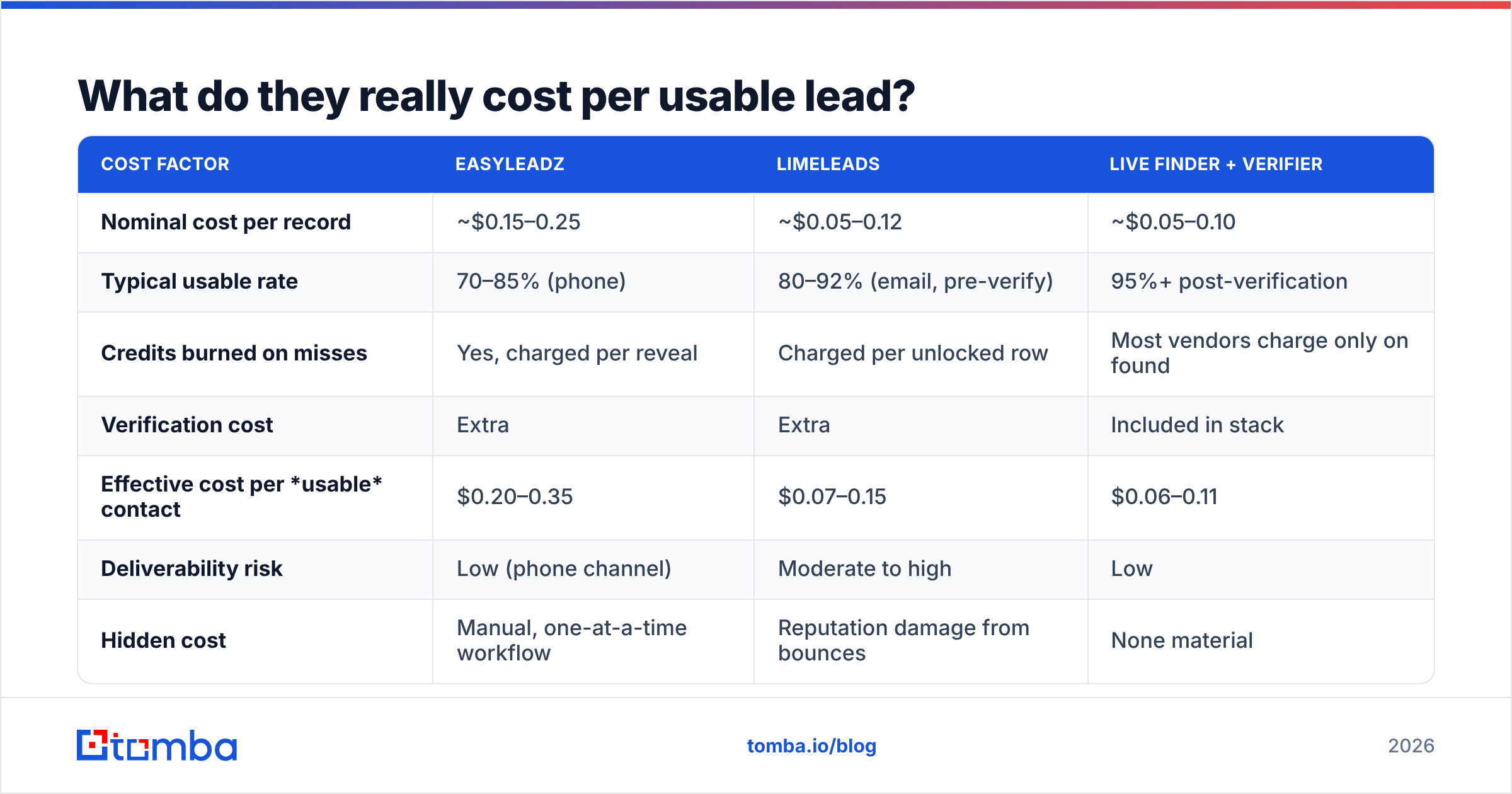
Here is the practical comparison, stripped of marketing language. Pricing moves, so treat the figures as the published entry points at time of writing and verify on each vendor's page before you buy.
| Dimension | EasyLeadz | LimeLeads | Tomba |
|---|---|---|---|
| Primary output | Direct dial phone numbers | Bulk email lists (CSV) | Verified work emails |
| Data model | Live lookup per contact | Static filtered database | Live lookup + verification |
| Geographic strength | India, APAC, Middle East | United States, some Canada | Global, strongest in US/EU |
| Workflow | LinkedIn Chrome extension | Web app with filters and export | Web app, API, extension, Sheets, Excel |
| Free tier | Limited trial credits | Limited trial credits | 25 searches/month, no card |
| Entry paid plan | ~$59/mo range | ~$60/mo range | $49/mo Starter |
| Bulk processing | Available, secondary | Core use case | Core use case |
| Built-in verification | Basic | Claimed, list-level | Dedicated verifier with catch-all handling |
| API | Yes | Limited | Full REST API, CLI, MCP |
| Best for | Calling motions in APAC | Cheap US list volume | Email-led outbound at scale |

The table makes the real answer obvious: these tools rarely compete for the same budget. A team that buys EasyLeadz has a dialer. A team that buys LimeLeads has a sending tool and wants volume. If you are genuinely torn between them, that usually means neither is what you need, and what you actually need is a live email source that returns verified addresses on demand.
Which one has better data accuracy?#
Accuracy is where these two diverge hardest, and where the comparison stops being about features.
EasyLeadz's phone data holds up well in its home markets. Independent user reviews on G2 consistently praise APAC mobile hit rates and are more mixed on US and European coverage. Because it resolves a contact at request time rather than serving a cached row, freshness is structurally better than a static export.
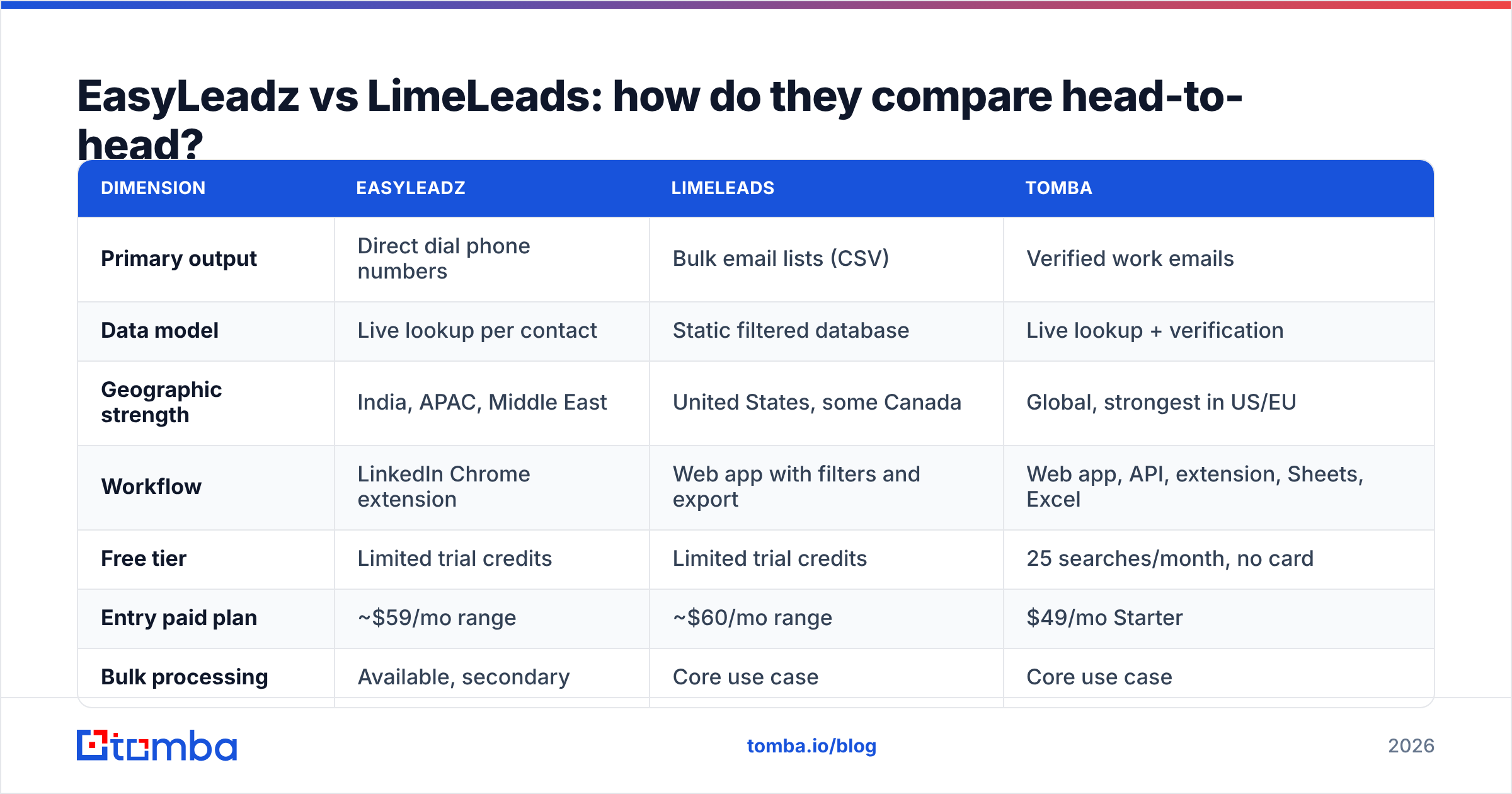
LimeLeads' accuracy is the accuracy of its underlying database on the day the record was compiled. Users routinely report bounce rates in the 8–20% range on unfiltered exports, which is normal for the category and not a scandal — but it is well above the under-3% threshold that keeps a sending domain healthy in 2026. Google and Microsoft both tightened bulk-sender enforcement, and a 15% bounce rate on a 3,000-contact send is enough to visibly damage sender reputation for weeks.

The practical rule, regardless of which vendor you choose:
- Never send to an unverified export. Run every list through an email verifier before it touches your sequencer. This is not optional anymore.
- Treat catch-all domains separately. A large share of enterprise domains accept everything at SMTP level, so a naive verifier marks them "valid" and you find out the truth from your bounce log. Use a proper catch-all verifier or segment them into a lower-risk send.
- Re-verify anything older than 60 days. Especially in tech, where layoffs and role changes have kept churn elevated.
- Measure bounce rate per source. If you buy from two vendors, tag the source in your CRM. Within one campaign you will know which one actually earns its price.
What do they really cost per usable lead?#
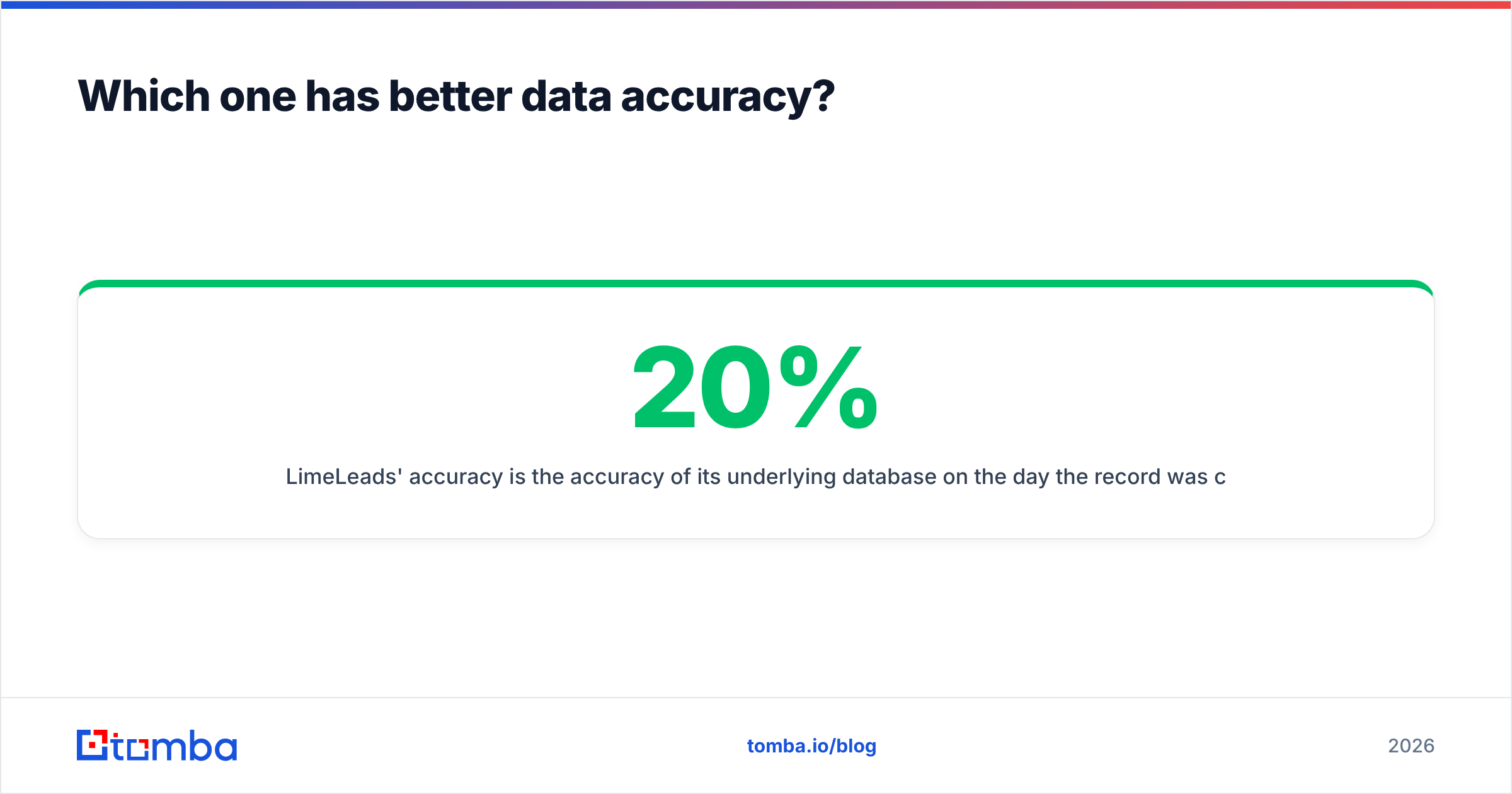
Sticker price is the least interesting number in a data contract. Here is the math that matters, using conservative assumptions and a 1,000-contact campaign.
| Cost factor | EasyLeadz | LimeLeads | Live finder + verifier |
|---|---|---|---|
| Nominal cost per record | ~$0.15–0.25 | ~$0.05–0.12 | ~$0.05–0.10 |
| Typical usable rate | 70–85% (phone) | 80–92% (email, pre-verify) | 95%+ post-verification |
| Credits burned on misses | Yes, charged per reveal | Charged per unlocked row | Most vendors charge only on found |
| Verification cost | Extra | Extra | Included in stack |
| Effective cost per usable contact | $0.20–0.35 | $0.07–0.15 | $0.06–0.11 |
| Deliverability risk | Low (phone channel) | Moderate to high | Low |
| Hidden cost | Manual, one-at-a-time workflow | Reputation damage from bounces | None material |
Two things jump out. First, LimeLeads is genuinely cheap per row and stays cheap even after you account for waste — that is its honest advantage. Second, EasyLeadz's per-record cost only makes sense if you value the phone channel, because on email alone you are overpaying for a secondary output.
The credit model deserves its own warning. Both tools charge on reveal, not on success. If you burn 40 credits searching for a niche title that neither database covers well, you paid 40 credits for zero contacts. Ask any vendor directly whether failed lookups are refunded before you commit to an annual plan.

Who should choose EasyLeadz?#
Pick EasyLeadz if all of these are true:
- You run a real calling motion. Not "we call sometimes." You have a dialer, call scripts, and reps whose day is structured around connect rate.
- Your ICP is in India, Southeast Asia, or the Middle East. This is the strongest single reason to choose it over any Western alternative.
- Your reps prospect from LinkedIn. The extension workflow assumes the profile page is your starting point.
- Volume is moderate. A few hundred enriched contacts a month per rep, not tens of thousands.
If you want dials but your market is US or EU, look harder at your options first — the coverage gap is real, and pairing a US-strong data source with a dedicated phone finder is often better value.
Who should choose LimeLeads?#
Pick LimeLeads if all of these are true:
- You need volume in the US, fast, at the lowest possible per-row price.
- Your ICP is broad and firmographic. "Restaurants with 10–50 employees" works. "VPs of Platform Engineering at Series B fintechs" does not — niche filters run thin.
- You already own verification. You must budget a verification pass on top, or the cheap list becomes the expensive mistake.
- You want no sales call and no annual lock-in. This is a real differentiator versus enterprise data vendors.
Worth knowing: it is not the only credible list vendor at that price point. BookYourData is a well-regarded option in the same bracket with a pay-as-you-go model and a published accuracy guarantee, and it is worth putting side by side with LimeLeads before you decide.
What are the main limitations of both tools?#
Four gaps show up in almost every review of either product.
- No live domain-level discovery. Neither tool lets you say "give me every contact at these 300 domains, right now, verified." That is the single most common B2B prospecting job, and it is exactly what domain search exists for.
- Weak enrichment of your existing CRM. Both are acquisition tools. If your real problem is 12,000 half-empty records already in HubSpot, you need data enrichment and a bulk pipeline, not a new list.
- Thin automation surface. EasyLeadz has an API; LimeLeads is largely export-driven. If you want lookups inside a workflow — Sheets, Airtable, a script, an agent — you will hit walls fast.
- Verification is an afterthought in both. In a year where mailbox providers punish bounce rates aggressively, treating verification as a separate purchase is a design flaw, not a pricing choice.
What is the better alternative for email-led outbound in 2026?#
If your growth motion runs on email rather than phone, the honest answer is that neither of these tools is built for you.
What email-led teams actually need is: a live lookup that resolves a name plus domain into a work address at request time, verification baked into the same call, catch-all handling that does not lie to you, bulk processing for the list you already have, and an API so none of it stays trapped in a browser tab.
That is the shape of Tomba. Tomba pricing starts with a free tier of 25 searches per month, Starter at $49/mo, Growth at $99/mo, and Pro at $249/mo, with the finder, verifier, domain search, and catch-all tooling in the same account rather than sold as separate line items. For teams processing existing lists, the bulk email finder handles the volume side without a per-seat extension bottleneck.
The clean decision rule:
- Calling motion in APAC → EasyLeadz.
- Cheap US list volume, verification handled separately → LimeLeads or a comparable list vendor.
- Verified emails on demand, at scale, wired into your stack → a live email finder.
Final verdict#
EasyLeadz wins on direct dials in Asia. LimeLeads wins on raw cost per US row. Both lose to a live lookup engine the moment your primary channel is email, because a static list decays from the day you download it and a phone-first tool charges you premium credits for an output you were not buying.
Start by naming your channel. Everything else follows from that, and most of the confusion in EasyLeadz vs LimeLeads comparisons comes from teams that never made the call.
If email is your channel, start with the Tomba Email Finder. Run 25 free searches against the domains you care about most, verify the results, and compare the bounce rate against whatever list you are currently paying for. That single test will settle the vendor question faster than any comparison table, including this one.
Related guides#
// get started
Find, verify and enrich your first contacts today
Start on the free plan with 25 searches a month, then scale when your team is ready.
Free plan · No credit card required · GDPR & CCPA
Get the Tomba newsletter
Product and data updates
// about the author