EasyLeadz vs Salesbot 2026: Contact Data or AI Sales Bot?
EasyLeadz sells you contacts. Salesbot sells you conversations. They get compared constantly, but they solve different halves of the same problem — and picking wrong costs you a quarter of pipeline.
TL;DR
- EasyLeadz and Salesbot are not really competitors. EasyLeadz is a contact-data provider (direct dials and business emails, strongest in India and APAC). Salesbot is a conversational AI layer that qualifies and replies to leads you already have.
- If your problem is "I don't know who to contact," EasyLeadz-type tools are the fit. If your problem is "leads come in and nobody follows up in under an hour," Salesbot-type tools are the fit.
- Buying the wrong one is expensive in a specific way: an AI bot with no contact data has nothing to talk to, and a contact database with no follow-up engine just fills your CRM with untouched rows.
- Both leave the same gap open — verification. Neither is built to prove an email address will actually accept mail before you send.
- Most teams that get this right run a three-layer stack: a data source, a verification pass, and an engagement layer. Tomba slots into the first two at a lower per-contact cost than either tool.
What is EasyLeadz, exactly?#
EasyLeadz is an Indian B2B contact-intelligence company best known for Mr. E, its Chrome extension that pulls direct phone numbers and business emails off LinkedIn profiles and company pages. You install it, open a prospect's profile, click, and it returns a mobile number and an email if it has one on file.
Its reputation is built on one specific strength: direct dials in India and wider APAC. Most US-headquartered data vendors have thin coverage of Indian mid-market companies — regional job boards, local business registries, and non-English company sites simply are not in their crawl set. EasyLeadz built its index around exactly that gap, which is why you see it recommended in APAC sales communities far more often than in North American ones.
What it is not: an outreach tool. EasyLeadz gives you a contact record. What you do with it — sequences, dialers, CRM sync — happens somewhere else. Some of that is available through integrations and its API, but the core product is a lookup, not a workflow. You can read their own positioning on the EasyLeadz site and cross-check the user reviews on G2 before you commit.
What is Salesbot, and why does the name confuse people?#
Here is the first thing to sort out, because half the "EasyLeadz vs Salesbot" searches are people comparing two things they haven't clearly defined.
"Salesbot" is used in the market three different ways:
- Salesbot as a standalone AI SDR platform — conversational agents that engage inbound leads on your site, over WhatsApp, or by email, qualify them against your ICP, and book meetings on a rep's calendar.
- Salesbot as a feature inside a CRM — Kommo (formerly amoCRM) ships a feature literally called Salesbot, a no-code automation builder for chat sequences. If someone tells you "we use Salesbot," this is often what they mean.
- Salesbot as a generic label — any chat-based sales automation, used the way people say "a CRM."
For the rest of this comparison, treat Salesbot as category 1 and 2 combined: an AI-driven conversation and qualification layer. That's the honest framing, because whichever specific product you land on, the buying decision against EasyLeadz is the same one — data acquisition versus conversation automation.
That distinction matters more than any feature checklist. You are not choosing between two versions of the same tool. You are choosing which end of the funnel to spend money on first.
How do EasyLeadz and Salesbot compare head-to-head?#
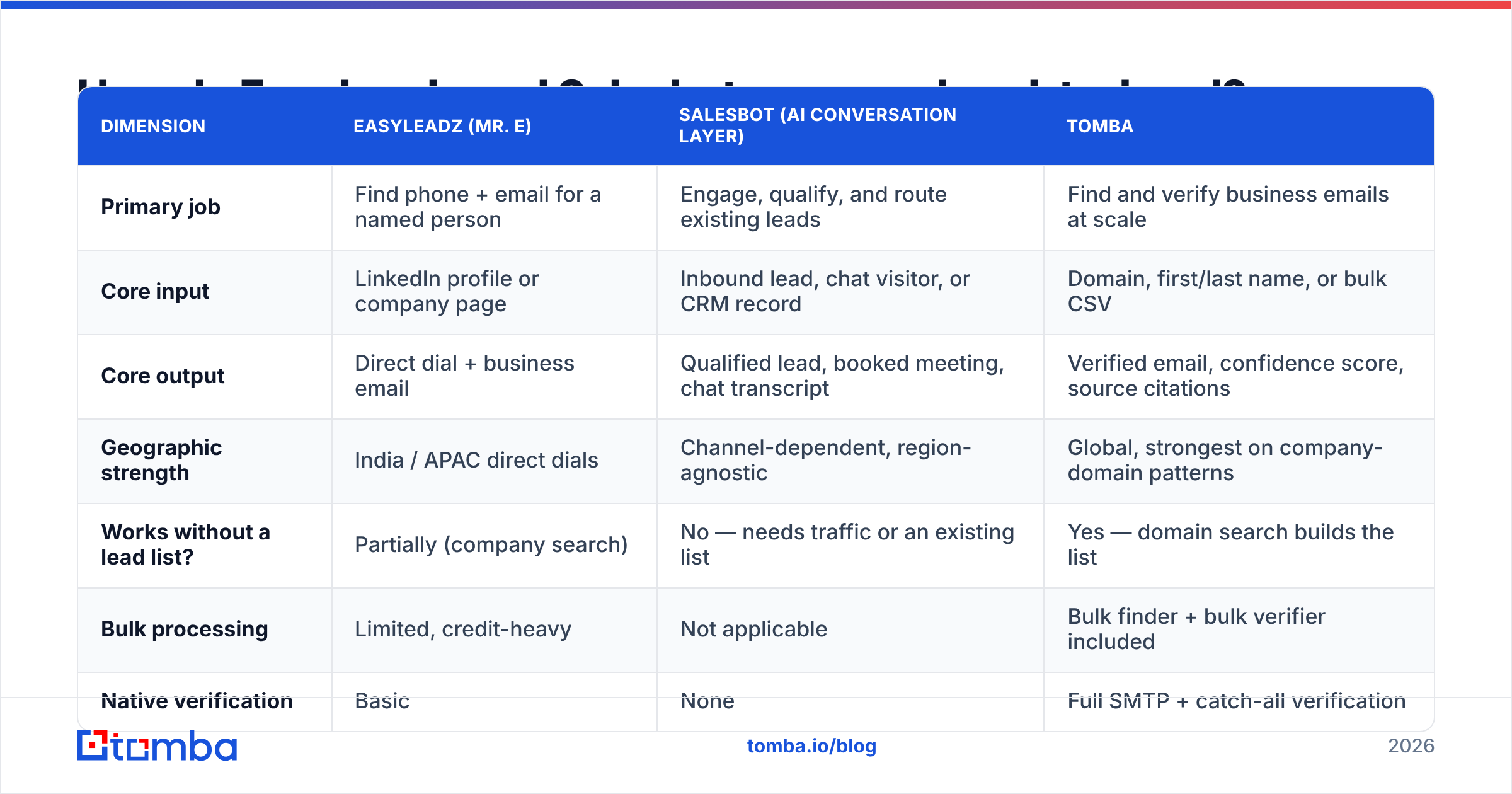
| Dimension | EasyLeadz (Mr. E) | Salesbot (AI conversation layer) | Tomba |
|---|---|---|---|
| Primary job | Find phone + email for a named person | Engage, qualify, and route existing leads | Find and verify business emails at scale |
| Core input | LinkedIn profile or company page | Inbound lead, chat visitor, or CRM record | Domain, first/last name, or bulk CSV |
| Core output | Direct dial + business email | Qualified lead, booked meeting, chat transcript | Verified email, confidence score, source citations |
| Geographic strength | India / APAC direct dials | Channel-dependent, region-agnostic | Global, strongest on company-domain patterns |
| Works without a lead list? | Partially (company search) | No — needs traffic or an existing list | Yes — domain search builds the list |
| Bulk processing | Limited, credit-heavy | Not applicable | Bulk finder + bulk verifier included |
| Native verification | Basic | None | Full SMTP + catch-all verification |
| API access | Yes | Yes | Yes, on all paid plans |
| Free tier | Trial credits | Usually trial only | 25 searches/mo, no card |
| Entry paid price | ~$59/mo (credit-based) | ~$25–$99/mo per seat, varies widely | $49/mo Starter |
Pricing on both EasyLeadz and Salesbot-class tools moves often and is frequently quoted per credit, per seat, or per conversation rather than flat. Treat the numbers above as directional and confirm on the vendor's own page before you sign anything. Tomba's numbers are fixed and published on the Tomba pricing page: Free (25 searches/mo), Starter $49/mo, Growth $99/mo, Pro $249/mo, Enterprise custom.
Which one actually fills your pipeline?#
Run this test on your own numbers before you look at a single feature list.
Count your qualified inbound leads per month. If that number is under 50, an AI conversation layer has almost nothing to do. You'd be paying a subscription to reply faster to a trickle. Spend on data and outbound instead.
Count your untouched CRM records. If you have 4,000 contacts sitting in a "not contacted" state, more data isn't your bottleneck — throughput is. That's a case for automation, and a Salesbot-class tool earns its keep there.
Check your bounce rate on the last 500 sends. If it's above 5%, neither tool fixes your actual problem. Bad data poisons both paths: the AI bot emails dead addresses and the direct dials go to people who left the company 14 months ago.
Check where your ICP lives. If more than a third of your accounts are Indian or Southeast Asian mid-market, EasyLeadz's coverage advantage is real and hard to replicate with a US-centric vendor. If your ICP is North American or European SaaS, that advantage evaporates and you're paying for an index built for someone else.
Why does neither tool solve the deliverability problem?#
Because it's not what either is built for, and that's a fair thing to say about both.
EasyLeadz returns an address it believes is correct based on its index. Salesbot sends to whatever address it's handed. Neither runs the layer in between: an actual mailbox-level check that the address exists, isn't a spam trap, isn't a role account, and isn't sitting behind a catch-all domain that accepts everything and delivers nothing.
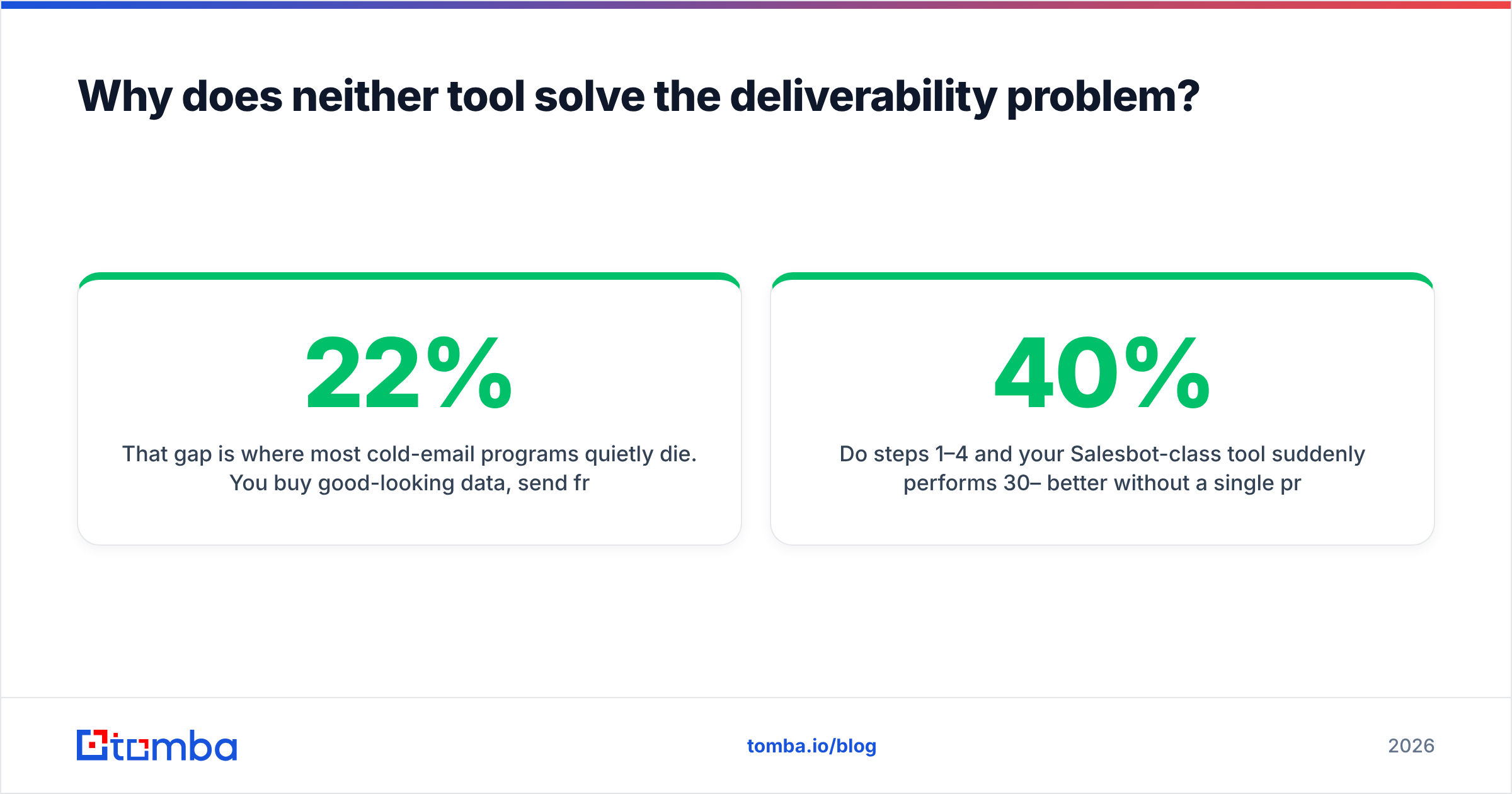
That gap is where most cold-email programs quietly die. You buy good-looking data, send from a warm domain, and watch a 22% bounce rate torch your sender reputation in nine days. The tool wasn't lying to you — the contact changed jobs, the company migrated its mail, the address was a distribution alias. Data decays at roughly 2–3% per month in normal B2B, faster in high-churn segments like startups and agencies.

Practical fix, in order:
- Source the contact — from a domain search, a LinkedIn lookup, or a data vendor.
- Verify before it ever enters a sequence — run the address through an email verifier and drop anything below your confidence floor.
- Handle catch-alls separately — a catch-all verifier tells you whether a domain accepts everything, so you can route those to a low-volume test batch instead of your main send.
- Re-verify quarterly — anything older than 90 days gets re-checked before reuse.
- Then hand it to your engagement layer, AI or human.
Do steps 1–4 and your Salesbot-class tool suddenly performs 30–40% better without a single prompt change. Skip them and no amount of AI copywriting saves the campaign.
What does a realistic three-layer stack look like?#
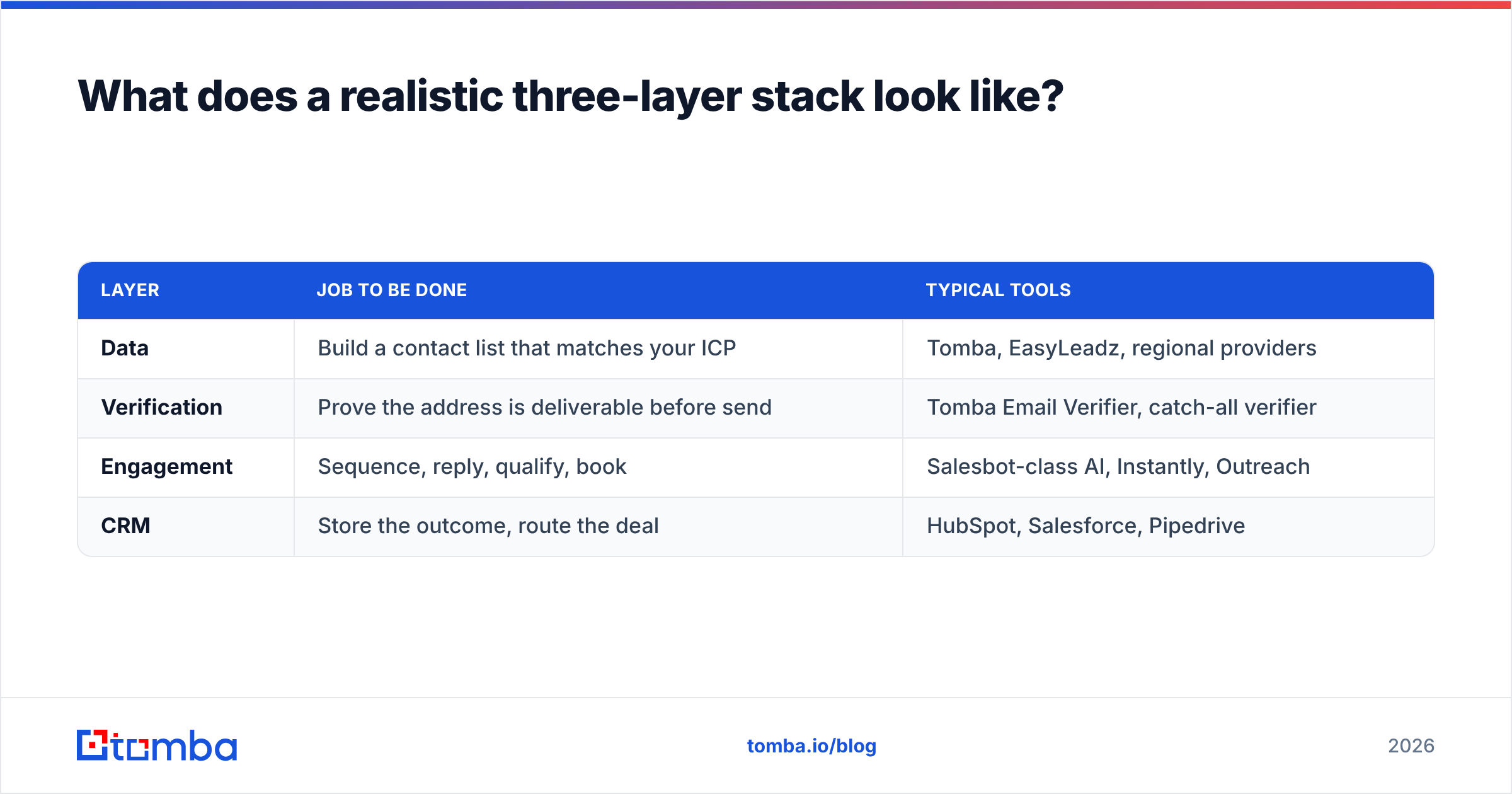
Nobody serious runs one vendor end to end. The teams with clean funnels split the job:
| Layer | Job to be done | Typical tools |
|---|---|---|
| Data | Build a contact list that matches your ICP | Tomba, EasyLeadz, regional providers |
| Verification | Prove the address is deliverable before send | Tomba Email Verifier, catch-all verifier |
| Engagement | Sequence, reply, qualify, book | Salesbot-class AI, Instantly, Outreach |
| CRM | Store the outcome, route the deal | HubSpot, Salesforce, Pipedrive |
Notice what happens to cost when you split it this way. You're not paying a premium per-credit data rate for records you'll never contact, and you're not paying per-seat conversation pricing for leads that were never deliverable. You pay for volume where volume is cheap and for intelligence where intelligence matters.
Tomba's email finder and domain search cover the first layer for global targets — feed it a domain and it returns the company's email pattern plus the people it can confirm against it, with source citations you can audit. For phone-first workflows, the phone finder covers the direct-dial job that EasyLeadz is known for, though EasyLeadz still holds an edge specifically on Indian mobile coverage. That's an honest split, not a marketing claim.
Is EasyLeadz or Salesbot better value at scale?#
Value depends entirely on where your marginal dollar goes furthest, so here's the arithmetic that actually matters.
Say you need 2,000 verified contacts a month.
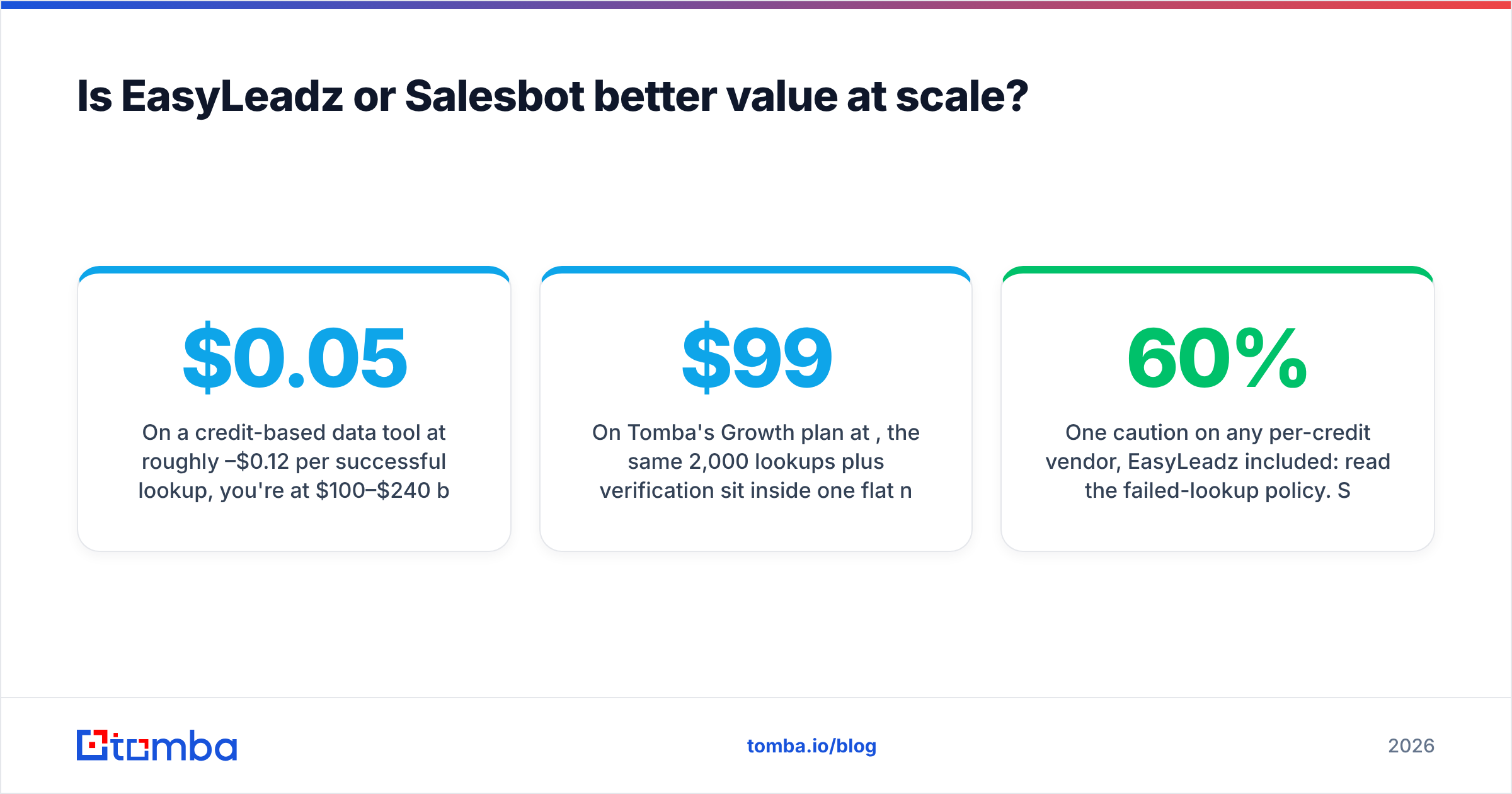
- On a credit-based data tool at roughly $0.05–$0.12 per successful lookup, you're at $100–$240/mo before verification, and credits burn on failed lookups on most plans.
- On a per-seat conversation tool, 2,000 contacts costs the same as 200 — you're paying for reps, not records. Great if you have volume, terrible if you don't.
- On Tomba's Growth plan at $99/mo, the same 2,000 lookups plus verification sit inside one flat number, with the Tomba API available if you want to wire it into your own enrichment job.
The break-even is usually clear once you write it down. Under ~500 contacts a month, the credit model and the flat model land in the same place and you should optimize for coverage in your specific region. Above ~1,500, flat pricing wins by a wide margin and credit-based tools start eating a suspicious share of the budget.
One caution on any per-credit vendor, EasyLeadz included: read the failed-lookup policy. Some refund a miss, some don't. On a database with 60% coverage for your segment, that difference is a 40% price increase hiding in the terms.
Who should choose what?#
Choose EasyLeadz if your outbound motion is phone-first and your accounts are concentrated in India or APAC. Nothing else on this list beats it on that specific coverage, and if you're dialing Indian mid-market, that's the whole ballgame.
Choose a Salesbot-class tool if you have meaningful inbound volume — say 200+ leads a month — and a measurable response-time problem. AI qualification pays for itself when speed-to-lead is your leak, and it pays for nothing when it isn't. HubSpot's research on lead response time is the standard starting point for sizing that gap.
Choose neither, yet, if your bounce rate is above 5%. Fix data quality first. Everything downstream is multiplied by it.
Run a combination if you're doing serious volume: a global data source for the bulk of your list, a regional provider for the segments it covers better, verification on everything, and one engagement layer on top. That's more vendors than a founder wants to manage, but it's the setup that survives a 10x volume increase.
What's the actual verdict on EasyLeadz vs Salesbot?#
There isn't a winner, because there isn't a shared category. EasyLeadz wins the "who do I call in Bangalore" question. Salesbot wins the "why did that inbound lead wait six hours" question. If you're forced to pick one and you're early, pick the data — you can follow up manually, but you cannot automate outreach to contacts you don't have.
What you should not do is buy either one and assume it covers verification. It doesn't, and that's the layer with the highest return per dollar in the entire stack. Clean data makes a mediocre sequence work. Dirty data makes a brilliant one fail.
Start with the free tier: run 25 searches through the Tomba Email Finder, check the results against contacts you already know are good, and see what the confidence scores and source citations look like on your own ICP. If the accuracy holds up on accounts you can verify by hand, you have a data layer you can trust — and then the EasyLeadz-versus-Salesbot question becomes what it always should have been: which specialist do I add on top?
Related guides#
Ready to find emails that actually work?
Join 150,000+ professionals who stopped guessing and started sending. Free credits on signup — no credit card required.
Get the Tomba newsletter
Practical outbound tactics and product updates — once every two weeks.
About the author