Email Hippo vs OneMoreLead: Which B2B Data Tool Wins in 2026?
Email Hippo verifies emails you already have. OneMoreLead sells you emails you don't. That single difference decides which one belongs in your stack — and whether you actually need a third option.
TL;DR
- Email Hippo vs OneMoreLead is not a like-for-like fight. Hippo verifies lists you already own. OneMoreLead sells you a database of contacts you don't have yet.
- Email Hippo wins on verification depth. It runs multi-stage SMTP checks, flags catch-alls and spam traps, and ships a well-documented API.
- OneMoreLead wins on volume and price. You pay a flat fee for tens of millions of records, with no per-credit math.
One caveat before you buy either:
- Every static database decays. B2B contact data goes stale at 22-30% a year. Bought lists need verification before they touch your sending domain.
- Want find and verify in one place? A live-search tool like Tomba covers both, starting at $49/mo.
Email Hippo vs OneMoreLead: what are they, actually?#
Two different categories wearing similar marketing language.
Email Hippo (emailhippo.com) is a UK-based email verification specialist. You feed it addresses from a CSV, a form field, or an API call. It tells you whether each one is deliverable, risky, or dead. It does not find emails for you. The product splits into three lanes: MORE for bulk file checks, CORE for the real-time API, and WHOIS tooling for fraud and compliance teams. Hippo has been around since 2011. It leans hard on GDPR posture, ISO 27001 certification, and audit-friendly reporting.
OneMoreLead (onemorelead.com) is a B2B contact database. You pay for access to a pool of stored records — name, title, company, email, sometimes phone. Then you filter down to the segment you want. The pitch is volume at a flat rate. You buy the haystack and get handed a magnet, rather than paying per needle. It does make some verification claims. But verification here is a feature of the database, not the product itself.
So the honest framing for Email Hippo vs OneMoreLead: Hippo cleans, OneMoreLead supplies. Say you already have 40,000 addresses from webinar signups and old conference lists. Hippo is the tool. Say you have nothing and need HR directors at 200-500 person US manufacturers. OneMoreLead is the tool. Mix the two up and you pay twice, then still bounce at 12%.
Email Hippo vs OneMoreLead: how do features and pricing compare?#
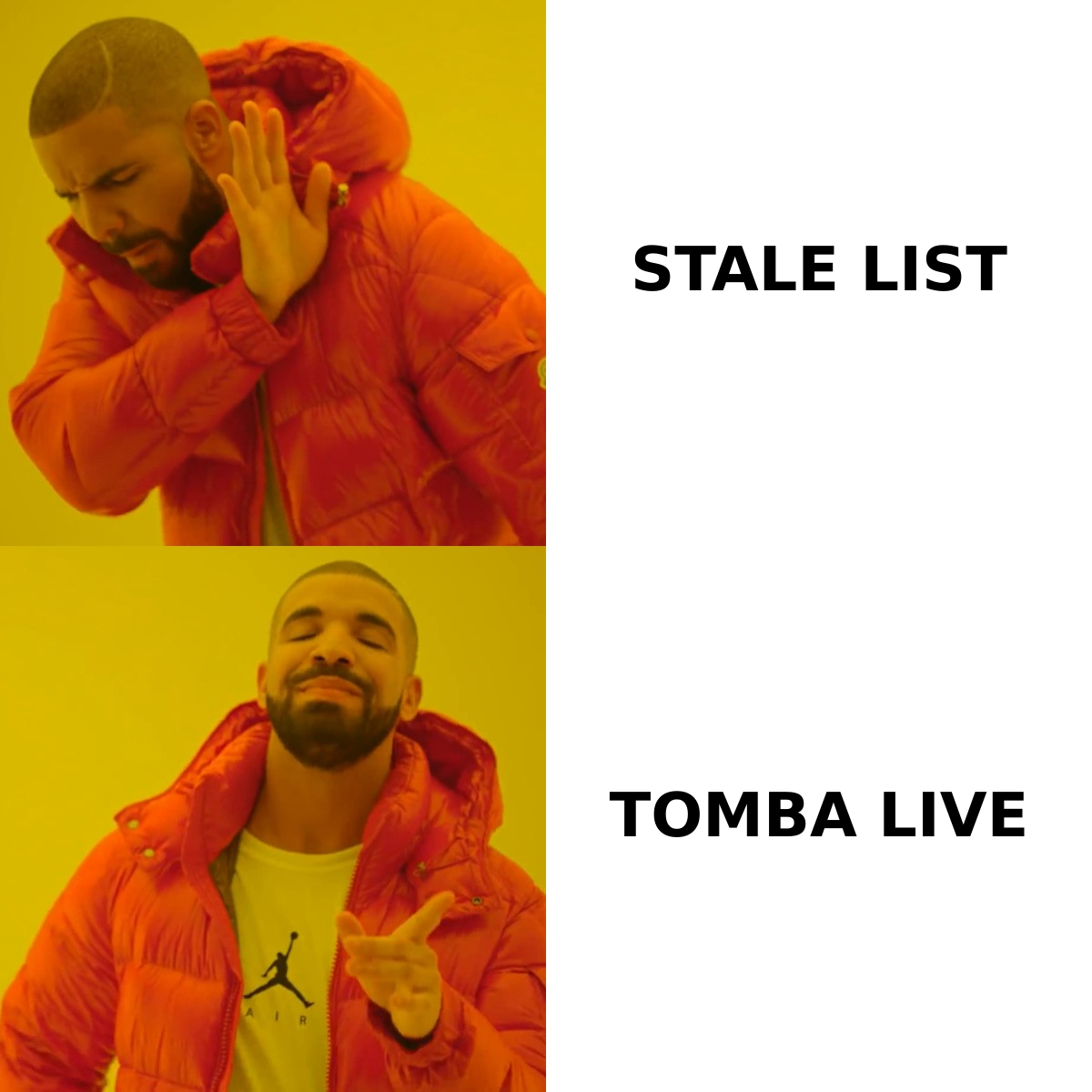
Here's the side-by-side. Prices reflect publicly listed rates as of early 2026. Both vendors quote custom enterprise tiers, so treat the top end as directional.
| Attribute | Email Hippo | OneMoreLead | Tomba |
|---|---|---|---|
| Primary job | Email verification | Static B2B database | Email finding + verification |
| Finds new emails | No | Yes (from stored records) | Yes (live domain search) |
| Verifies emails | Yes — multi-stage SMTP | Partial / claimed at ingest | Yes — dedicated verifier |
| Catch-all handling | Flagged, scored | Not surfaced clearly | Dedicated catch-all verifier |
| Pricing model | Per-credit, prepaid packs | Flat subscription for DB access | Tiered credits |
| Entry price | ~$0.01/verification at volume | Mid-hundreds/mo range | Free (25 searches), then $49/mo |
| Free tier | Free trial credits | Sample data on request | 25 searches/mo, no card |
| API | Yes — well documented | Limited | Full REST API + CLI + MCP |
| Best for | Cleaning owned lists | Bulk TAM building | Targeted outbound, find-then-verify |
| Weakest at | Cannot source contacts | Data recency | Very large static TAM exports |
Two things jump out.
First, neither tool is a full outbound data stack on its own. Hippo without a source of emails is a hammer with no nails. OneMoreLead without verification is a nail gun aimed at your sender reputation.
Second, the pricing models don't compare the way the vendors imply. Hippo charges per credit, so a 100,000-address cleanup has a knowable cost. OneMoreLead charges flat, so the marginal record is free. That sounds great. It also nudges teams to blast 50,000 unqualified contacts.
Email Hippo vs OneMoreLead: which one has better data accuracy?#
Each wins on its own axis. So let's be specific about what accuracy means for each.
For a verifier, accuracy means one thing: when it says valid, does the message land? Hippo runs a layered check — syntax, DNS/MX, disposable domains, role accounts, mailbox-level SMTP probing, and spam-trap heuristics. Published accuracy sits in the high 90s for non-catch-all domains. That matches the serious players in the category. Catch-all domains are where every verifier gets murky, Hippo included. The receiving server accepts everything and tells you nothing. Hippo scores these instead of guessing, which is the honest move. You still carry the risk.
For a database, accuracy means something else: is this record still true? Here any static B2B dataset fights physics — OneMoreLead and every rival in that shape. Vendors and analysts alike put B2B contact decay at 22% to 30% a year. People change jobs. Companies rebrand domains. Someone's @acquiredcompany.com becomes @parentco.com overnight.

That decay math is why the flat-fee, unlimited-records pitch needs an asterisk. Take a database of 50 million contacts built 18 months ago. Statistically, north of 15 million of those records are now wrong in some way. The database doesn't lie to you on purpose. It just can't outrun churn.
The practical takeaway: if you buy from a static database, budget for verification as a separate line item. That's not a knock on OneMoreLead. It's true of the whole category, including well-regarded operators like BookYourData, which verifies at the point of export rather than shipping a frozen file. Any vendor that verifies at export instead of at ingest is doing you a real favor.
When should you pick Email Hippo?#
Pick Hippo when verification is the job, not a sub-step.
- You inherited a list. Marketing ran three years of gated content and handed you 60,000 addresses. You have no idea which ones still resolve. This is Hippo's ideal case: a one-time bulk clean with a per-record report.
- You need audit-grade compliance. ISO 27001 and a GDPR-forward stance matter in fintech, healthcare, or EU public sector deals. Procurement will ask. Hippo has the answers ready.
- You're verifying at the form. The real-time API sits on your signup field and rejects junk before it reaches your CRM. That's a different job from bulk cleanup, and Hippo does it well.
- You need fraud signals, not just deliverability. Hippo's assessment tooling scores addresses for risk. That helps when the question is whether a signup is a real human, not whether an email will land.
Where Hippo frustrates people: cost at scale on the real-time API. And the hard ceiling — it will never tell you who to email. If your problem is an empty pipeline rather than a dirty list, Hippo doesn't touch it.
When should you pick OneMoreLead?#
Pick OneMoreLead when you need breadth fast and have a plan for cleanup.
- TAM sizing and market research. You want to know how many companies fit a segment and roughly who runs them. A static database is genuinely good at this. You're querying for shape, not for one person's accuracy.
- Predictable budget at high volume. If your finance team hates variable per-credit billing, a flat subscription is easier to defend. The number in January is the number in December.
- Broad ABM list-building. Ads platforms and intent tools tolerate more decay than a cold email sequence does. A wrong title on a right company is still a usable ad target.
- You already own a verifier. OneMoreLead plus a strong email verifier is a coherent stack. OneMoreLead alone, plugged straight into a sending tool, is how domains get burned.
Where OneMoreLead frustrates people: recency. It's also hard to confirm one specific person's current email. If you need to reach one named VP at one named company this week, a database lookup is the wrong instrument.
Is there a third option that does both?#
Yes. The Email Hippo vs OneMoreLead choice isn't the only one on the table, and the category difference is worth understanding before you buy either.
Live-search email finders work differently from static databases. They don't store a frozen copy of the world. They resolve a contact at request time: given a domain and a name, they infer the pattern, check public sources, and validate the mailbox against the live mail server. The record you get back was built seconds ago, not eighteen months ago.
That's the model behind Tomba's email finder. A few things follow from live search:
- Domain search returns every discoverable address at a company plus the detected email pattern. You can extrapolate to people the index hasn't seen.
- Verification is built in, not bolted on. That includes a dedicated catch-all verifier for the exact domains where generic verifiers shrug.
- Data enrichment fills in title, company size, and social profiles on records you already have. That covers part of what you'd otherwise buy a database for.
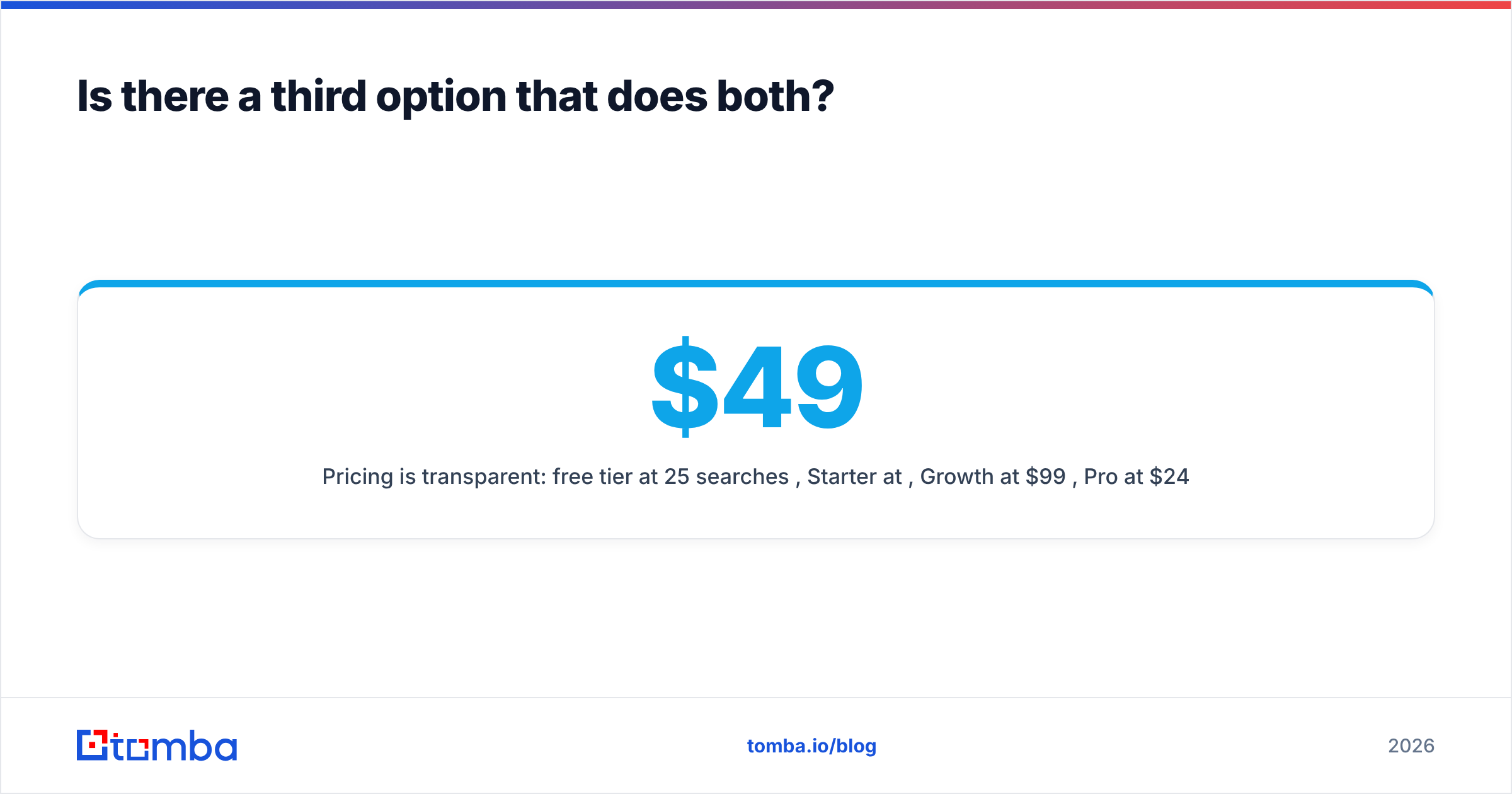
- Pricing is transparent: free tier at 25 searches/mo, Starter at $49/mo, Growth at $99/mo, Pro at $249/mo. Full Tomba pricing is public, with no contact-sales wall on the mid tiers.

This isn't a claim that live search beats static databases at everything. It doesn't. Need to export 200,000 records for a market study? A database wins on throughput and cost per record. Live search is built for precision — the right person, right now — not for bulk dumps.

Email Hippo vs OneMoreLead vs live search: what changes in practice?#
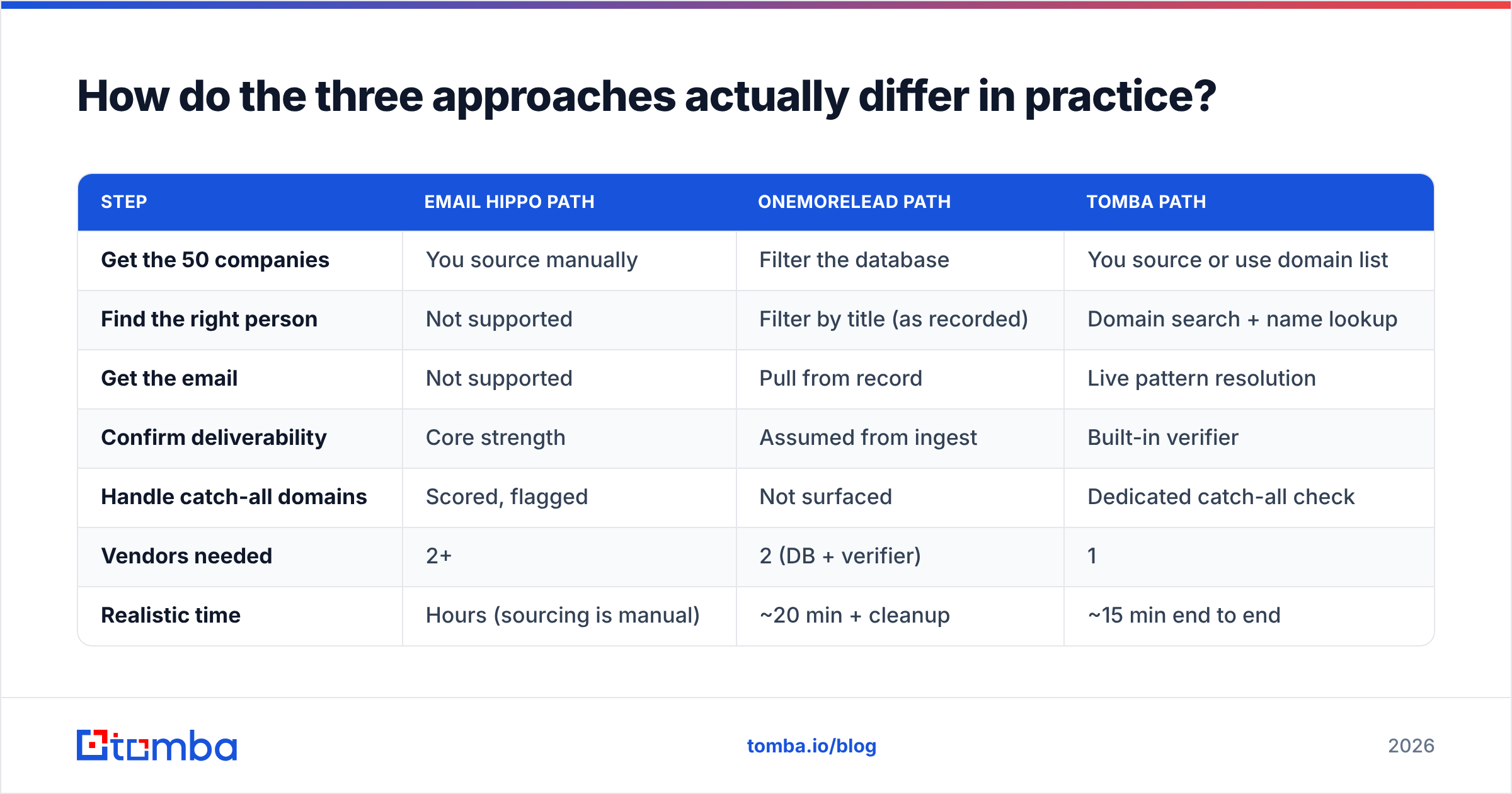
Run the same task through each and the differences get concrete. The task: reach the Head of Engineering at 50 mid-market SaaS companies.
| Step | Email Hippo path | OneMoreLead path | Tomba path |
|---|---|---|---|
| Get the 50 companies | You source manually | Filter the database | You source or use domain list |
| Find the right person | Not supported | Filter by title (as recorded) | Domain search + name lookup |
| Get the email | Not supported | Pull from record | Live pattern resolution |
| Confirm deliverability | Core strength | Assumed from ingest | Built-in verifier |
| Handle catch-all domains | Scored, flagged | Not surfaced | Dedicated catch-all check |
| Vendors needed | 2+ | 2 (DB + verifier) | 1 |
| Realistic time | Hours (sourcing is manual) | ~20 min + cleanup | ~15 min end to end |
The vendor-count row is the one most teams underweight. Every extra tool adds a data handoff, a CSV export, a field-mapping decision, and one more place for records to drop silently. Two-vendor stacks are fine. Plenty of good teams run them. But the operational tax is real, and it compounds every month.
What should you check before you commit to either?#
Five questions separate a good purchase from a regret, whichever vendor you pick:
- Can you test on your own data? Not their sample file. Take 200 addresses you know the status of — five current colleagues, five people who left last year, a few catch-alls — and run them through. Vendor test sets are curated.
- What's the bounce guarantee, in writing? Serious verifiers commit to a number, often 97-99% on non-catch-all, and credit you when they miss. High accuracy in marketing copy is not a commitment.
- How does the vendor handle catch-all domains? This is the single biggest source of surprise bounces. A vendor that marks them all valid is passing you a live grenade. Run a free email checker on a known catch-all domain and see what comes back.
- Where does the data come from? For databases especially, provenance drives both legal exposure and freshness. Reputable vendors publish it. See how Tomba documents its data sources for the level of detail you should expect.
- What happens at renewal? Flat-fee database access often re-prices sharply after year one. Per-credit models skip that cliff but can balloon with usage. Model both at 3x your current volume.
Cross-check whatever you're told against third-party reviews on G2. Pay attention to reviewers at your own size. A tool that works at 50 people often behaves differently at 500.
What's the verdict on Email Hippo vs OneMoreLead?#
If you already have contacts and need them clean: Email Hippo. It's a specialist that does one thing to a high standard, with the compliance paperwork to survive procurement. The per-credit cost is fair, and the API docs are genuinely good.
If you need contacts in volume and can budget for cleanup: OneMoreLead. Flat pricing, real breadth, and a sensible fit for TAM work and broad ABM targeting. Just don't skip the verification pass. No static database escapes decay, and the ones that pretend otherwise are the ones to worry about.
If you're building outbound from scratch and don't want two vendors: find-and-verify in one place is the lower-friction path. You lose some bulk-export power. You gain precision, freshness, and one less integration to babysit.
Whichever you choose, verification before send is non-negotiable. Bounce rates above 3% push mailbox providers to start filtering your domain. Recovering sender reputation takes far longer than the verification step you skipped.
Still stuck on Email Hippo vs OneMoreLead? Tomba's Email Finder resolves contacts live against the mail server instead of serving you an aging record. Verification, catch-all handling, and domain search all sit in the same workflow. Start on the free tier with 25 searches a month, no card required, then move to Starter at $49/mo when the pipeline justifies it.
Related guides#
Ready to find emails that actually work?
Join 150,000+ professionals who stopped guessing and started sending. Free credits on signup — no credit card required.
Get the Tomba newsletter
Practical outbound tactics and product updates — once every two weeks.
About the author