Email Hippo vs Seamless.AI: Which Wins for B2B Data in 2026
One tool verifies addresses you already have. The other invents a pipeline from scratch. Here's an honest, side-by-side breakdown of Email Hippo vs Seamless.AI — accuracy, pricing, contracts, and the cheaper stack most teams end up building instead.
TL;DR
- These two tools are not really competitors. Email Hippo is a specialist email verification engine. Seamless.AI is a lead database that finds contacts. Comparing them head-to-head only makes sense because teams keep evaluating them in the same buying cycle.
- Pick Email Hippo if you already own a list — from a CRM, a webinar, a form, or a scraper — and you need to know which addresses are safe to mail.
- Pick Seamless.AI if your problem is "we have no one to email" and you want a searchable contact database with a Chrome extension and CRM push.
- Pricing transparency is the sharpest split. Email Hippo publishes per-verification rates. Seamless.AI is quote-based, seat-priced, and frequently annual — expect a sales call before a number.
- Most teams end up buying neither in isolation. A finder + verifier that share one API and one credit pool (Tomba, for example, starts at $49/mo with both included) covers the same job for less operational overhead.
What do Email Hippo and Seamless.AI actually do?#
Think of it like a kitchen. Email Hippo is the food-safety inspector: it doesn't bring ingredients, it tells you which ones will make people sick. Seamless.AI is the supplier that shows up with crates of produce — some excellent, some bruised, and nobody inspecting the crate on the way in.
Email Hippo is a UK-based email verification company. Its products split roughly into three jobs: bulk list cleaning, real-time API verification at the point of form submission, and a deeper "assess" layer that scores risk signals like disposable domains, role accounts, and low-quality free-mail patterns. It does not find you new contacts. That is not a criticism — it's the product boundary.
Seamless.AI is a sales-intelligence platform. You search by title, industry, headcount, or company, and it returns contact records with emails and phone numbers, which it assembles and validates in real time rather than serving from a static snapshot. It ships a Chrome extension, list-building, and CRM sync. Verification exists, but it's a step inside the pipeline, not the product itself.
So when people search "Email Hippo vs Seamless.AI," they're usually asking one of two questions:
- "Which one fixes my bounce rate?" → That's Email Hippo's lane.
- "Which one fills my pipeline?" → That's Seamless.AI's lane.
If you're asking both at once, you're shopping for a stack, not a tool — and that changes the math significantly, as you'll see in the pricing section.

How do Email Hippo and Seamless.AI compare feature by feature?#
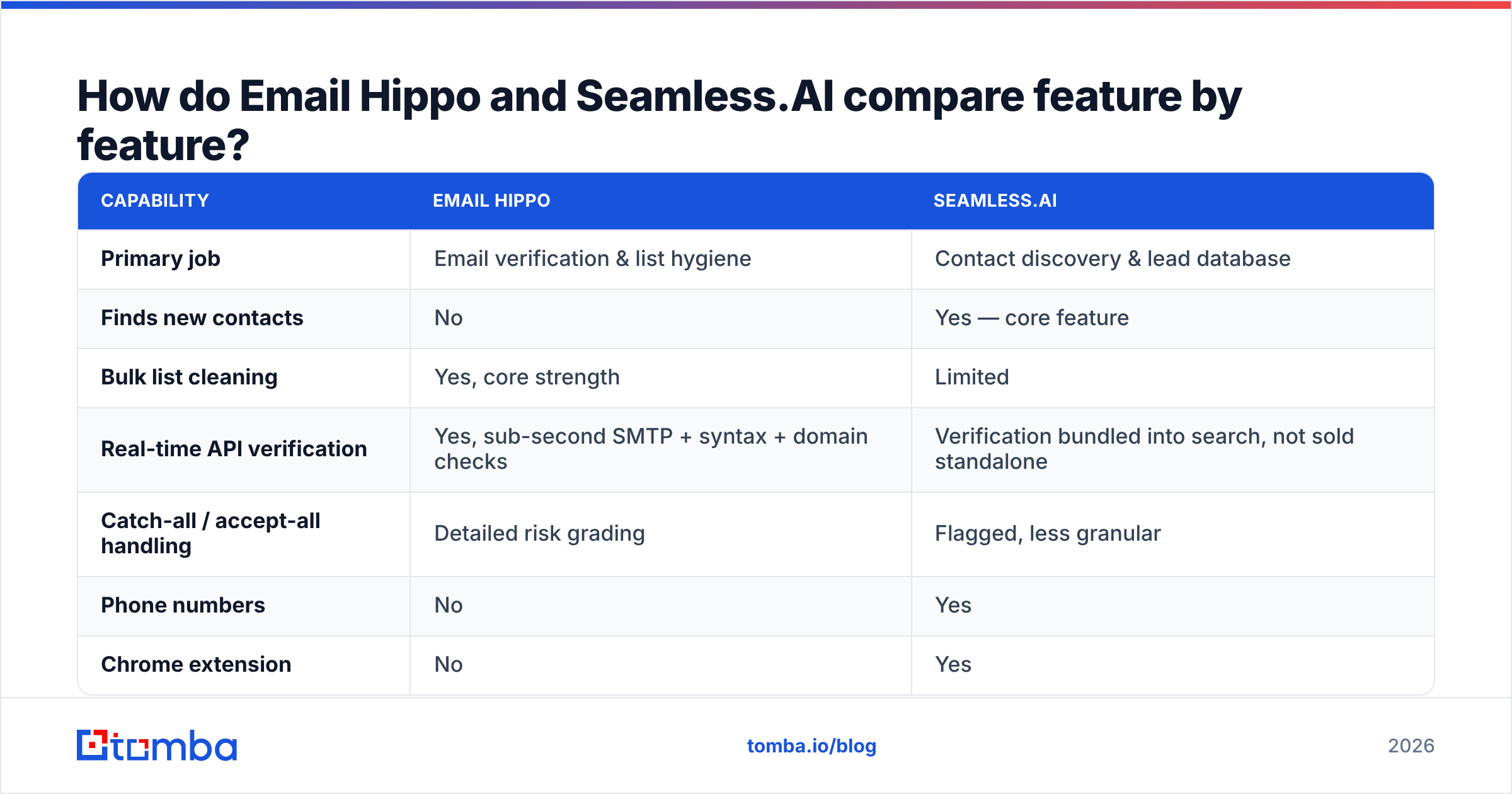
Here's the honest side-by-side. Where a vendor doesn't publish a number, this says so rather than inventing one.
| Capability | Email Hippo | Seamless.AI |
|---|---|---|
| Primary job | Email verification & list hygiene | Contact discovery & lead database |
| Finds new contacts | No | Yes — core feature |
| Bulk list cleaning | Yes, core strength | Limited |
| Real-time API verification | Yes, sub-second SMTP + syntax + domain checks | Verification bundled into search, not sold standalone |
| Catch-all / accept-all handling | Detailed risk grading | Flagged, less granular |
| Phone numbers | No | Yes |
| Chrome extension | No | Yes |
| CRM integrations | Via API / Zapier | Native Salesforce, HubSpot, Pipedrive |
| Pricing model | Published, per-verification credits | Quote-based, per seat |
| Free trial | Free tier for a small monthly volume | Free plan with limited credits |
| Best for | RevOps, email marketers, deliverability owners | SDR teams, outbound-heavy orgs |
The pattern is clean: Email Hippo goes deep on one problem, Seamless.AI goes wide across the prospecting workflow. Neither is "better." They're answers to different questions.
Which one is more accurate — and accurate at what?#
This is where most comparison posts get lazy, because "accuracy" means two completely different things for these two tools.
For Email Hippo, accuracy = did the verdict match reality? You send an address, it returns valid/invalid/unknown, and the score is whether mail actually delivered. Verification engines are judged on two failure modes: false positives (it said valid, the address bounced) and excessive "unknown" verdicts (it punted on catch-all domains and left you to decide). Email Hippo is generally strong on the first and transparent about the second — it grades risk rather than pretending certainty exists where it doesn't.
For Seamless.AI, accuracy = was this the right person's real email? That's a harder problem, and user reviews on G2 reflect it. The consistent themes across public feedback: coverage is broad, the Chrome extension saves real time, and a meaningful share of returned addresses are stale, guessed, or belong to someone who left the company two years ago. Real-time generation is a genuine engineering advantage over stale snapshots, but it also means the same query on two different days can return different data.

The practical consequence: if you buy Seamless.AI, you still need verification. Not because the platform is careless, but because any database-derived email should pass through an independent email verifier before it touches a sending domain you care about. Bounce rates above 2–3% are what trigger inbox-provider throttling, and no lead database is clean enough to skip that step.
That's the awkward conclusion of a straight Email Hippo vs Seamless.AI matchup: the "winner" for a lot of teams is both, which is exactly why the combined cost matters more than either sticker price.
What do Email Hippo and Seamless.AI cost in 2026?#
| Cost factor | Email Hippo | Seamless.AI | Tomba |
|---|---|---|---|
| Pricing visibility | Published per-verification tiers | Quote-based, sales call required | Fully published |
| Entry paid plan | Low-volume credit packs | Not publicly listed | $49/mo (Starter) |
| Free tier | Small monthly verification allowance | Limited free credits | 25 searches/mo |
| Seat cost | Not seat-based | Per seat — main cost driver | Not seat-based |
| Contract | Flexible / pay-as-you-go options | Commonly annual | Monthly or annual |
| Finding + verifying in one bill | No (verify only) | Partially | Yes |
| Mid-tier | Volume-based | Quote | $99/mo (Growth) |
| High-volume | Enterprise pricing | Enterprise, negotiated | $249/mo (Pro), Enterprise custom |
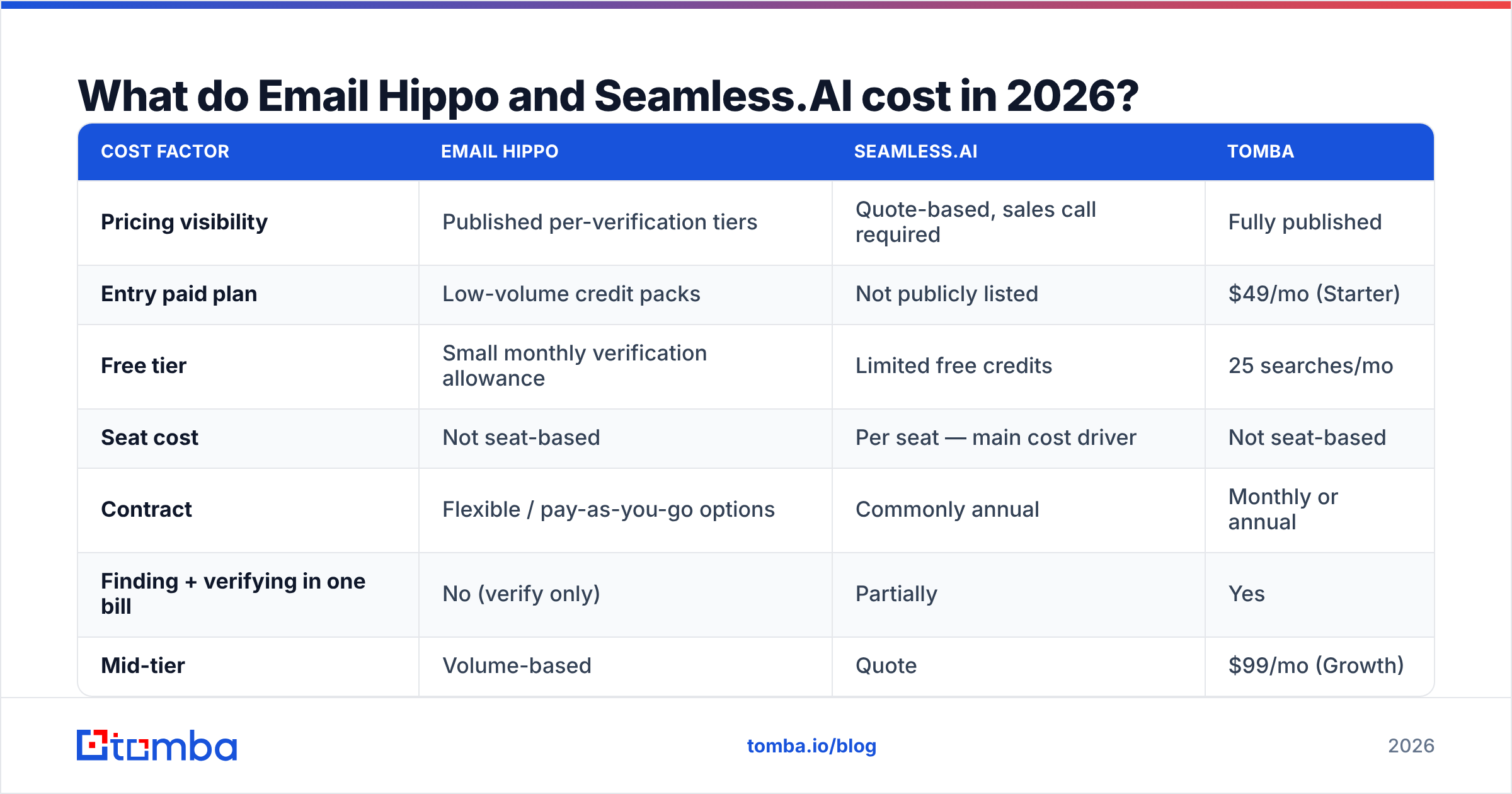
Two things to flag honestly.
First, Seamless.AI's opacity is a real evaluation cost. You cannot benchmark a tool you can't price. Buyers routinely report that per-seat annual commitments land well north of what they modeled, and that credit allowances behave differently in practice than they read on a slide. That's not a scandal — it's standard enterprise sales motion — but it means the comparison isn't "$X vs $Y," it's "published rate vs unknown until you talk to someone."
Second, stacking gets expensive fast. If you buy Seamless.AI for discovery and Email Hippo for hygiene, you're paying two vendors, reconciling two credit systems, and writing glue code between them. That's the specific pain that drove a lot of teams toward consolidated platforms. Compare it against Tomba pricing, where finding, verifying, and catch-all handling all draw from a single plan and a single API key.

Who should choose Email Hippo?#
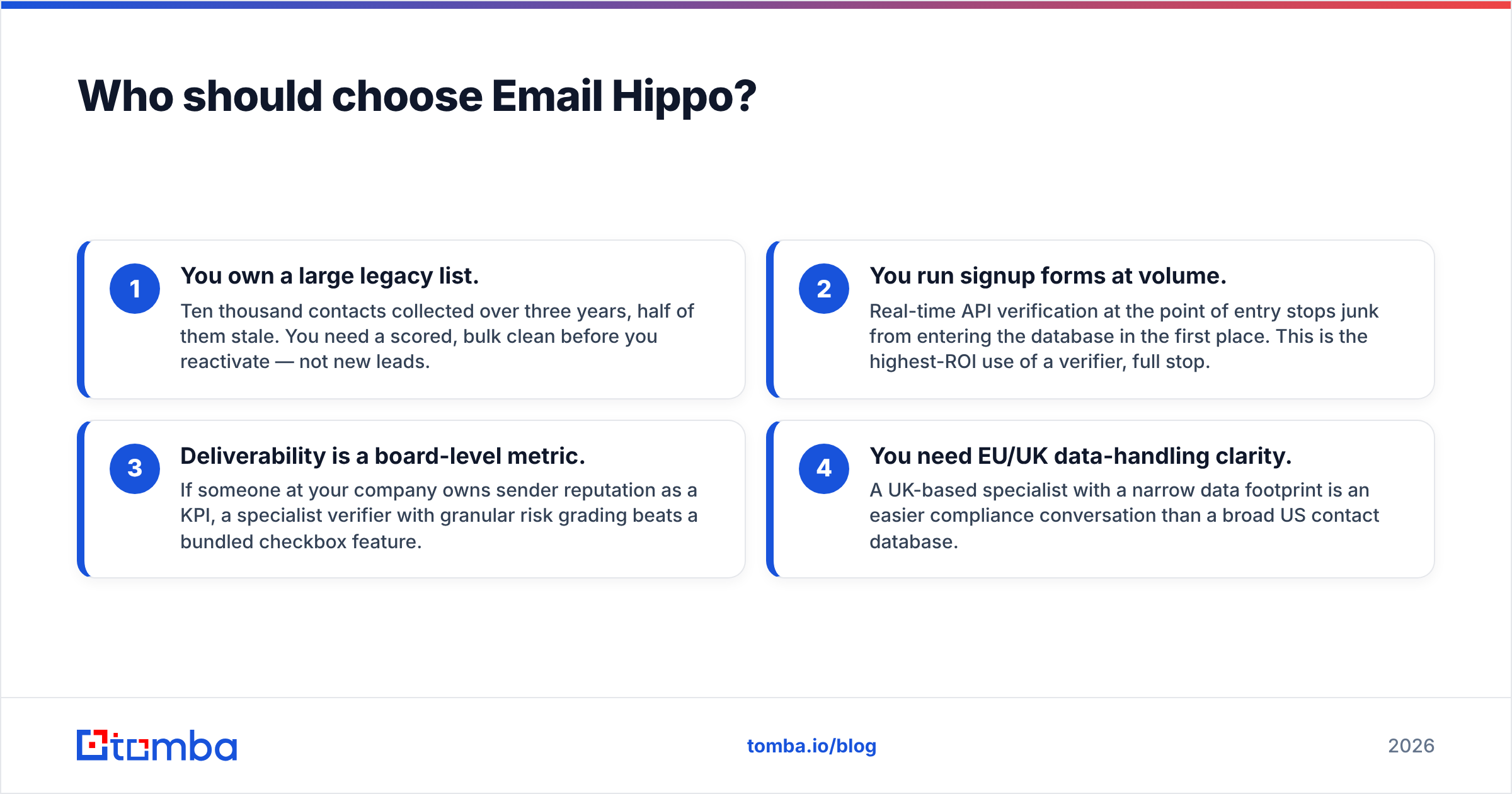
Email Hippo is the right call in four situations:
- You own a large legacy list. Ten thousand contacts collected over three years, half of them stale. You need a scored, bulk clean before you reactivate — not new leads.
- You run signup forms at volume. Real-time API verification at the point of entry stops junk from entering the database in the first place. This is the highest-ROI use of a verifier, full stop.
- Deliverability is a board-level metric. If someone at your company owns sender reputation as a KPI, a specialist verifier with granular risk grading beats a bundled checkbox feature.
- You need EU/UK data-handling clarity. A UK-based specialist with a narrow data footprint is an easier compliance conversation than a broad US contact database.
Where it falls short: it will never solve an empty pipeline. If your SDRs are asking "who do I email?", Email Hippo has no answer.
Who should choose Seamless.AI?#
Seamless.AI earns its place when:
- You're building outbound from zero. No list, no ICP data, no CRM history. A searchable database plus a Chrome extension gets reps moving in a day.
- You need phones as well as emails. Multi-channel outbound — cold call plus email — needs both, and a verifier gives you neither.
- Your reps live in the browser. Prospecting on LinkedIn or company sites all day makes the extension genuinely valuable, more than any accuracy percentage on a slide.
- You have budget for seats and a champion to negotiate. Per-seat annual pricing works when you have a stable, sized team. It punishes teams that flex headcount.
Where it falls short: cost predictability, data freshness on long-tail companies, and the fact that you'll still want an independent verification layer before you send.
Is there a middle option that does both?#
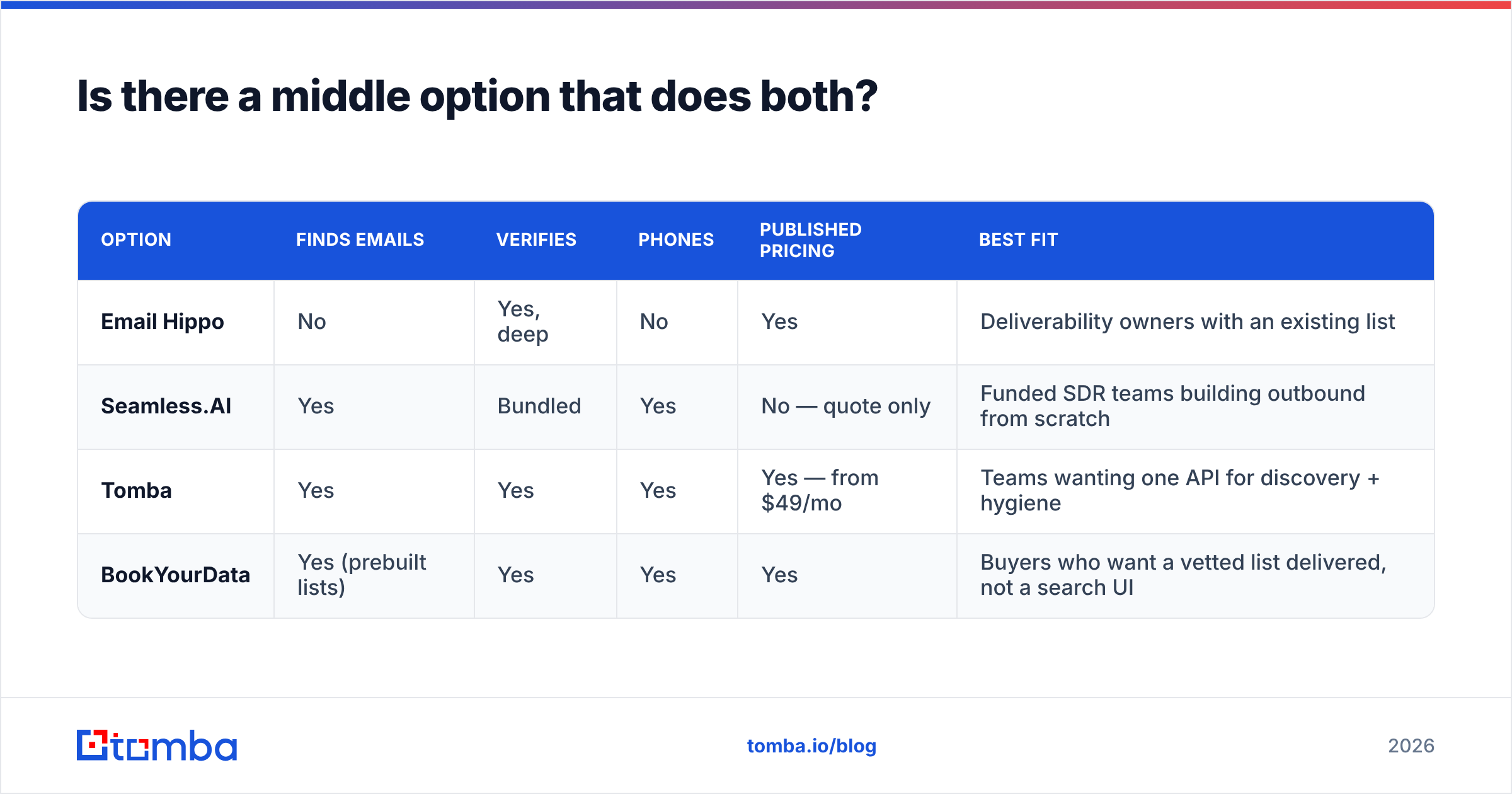
Yes — and it's where a growing share of buyers land after running this exact comparison. The category is "find and verify in one system," and the evaluation criteria are simple: does the finder also verify, is pricing published, is there an API, and can you avoid per-seat billing?

| Option | Finds emails | Verifies | Phones | Published pricing | Best fit |
|---|---|---|---|---|---|
| Email Hippo | No | Yes, deep | No | Yes | Deliverability owners with an existing list |
| Seamless.AI | Yes | Bundled | Yes | No — quote only | Funded SDR teams building outbound from scratch |
| Tomba | Yes | Yes | Yes | Yes — from $49/mo | Teams wanting one API for discovery + hygiene |
| BookYourData | Yes (prebuilt lists) | Yes | Yes | Yes | Buyers who want a vetted list delivered, not a search UI |
A note on that last row: BookYourData solves a genuinely different shape of the problem. Instead of searching and enriching record by record, you specify a segment and receive a validated list. If your buying process is "give me 5,000 verified HR directors in DACH" rather than "give me a tool," it's a strong fit and worth pricing alongside the others.
For the search-and-enrich workflow, the consolidated approach looks like this in practice:
- Start with the company, not the person. Run a domain search to pull every discoverable address at a target account, along with the dominant email pattern.
- Fill named gaps. When you know the person but not the address, the finder resolves first name + last name + domain into a verified email.
- Verify before send — always. Every result passes SMTP, syntax, domain, and role checks. No exceptions for "it looked right."
- Grade the catch-alls separately. Accept-all domains are the single biggest source of silent bounces; a dedicated catch-all verifier tells you which ones are worth the risk.
- Push clean records only. Enrich and sync to the CRM after verification, not before. Dirty records in a CRM are permanent — someone will always mail them eventually.
If you're already leaning away from seat-based contracts, the Seamless.AI alternative breakdown covers the migration specifics.
What's the verdict on Email Hippo vs Seamless.AI?#
If you must pick one: choose Email Hippo when you have a list and a bounce problem; choose Seamless.AI when you have budget and an empty pipeline. That's the honest split, and no amount of feature-table gymnastics changes it.
If you're building a stack: neither one alone is the answer, and buying both means two contracts, two credit pools, and integration work you'll maintain forever. The consolidation case is strong — one API key, one bill, published pricing, no seat tax.
Three questions to settle before you sign anything:
- What's your actual bottleneck — not enough contacts, or not enough deliverable contacts? Answer this first and half the shortlist disappears.
- Can you get a number without a sales call? Opaque pricing is a real switching cost, not a minor annoyance.
- Does the tool bill by seat? If your team size moves, per-seat pricing will hurt you in month seven, not month one.
Run a 100-record bake-off before committing. Take a segment you know well — accounts where you can independently confirm a handful of contacts — push it through each tool, and measure two things: match rate and bounce rate on a small live send. Vendor-published accuracy figures, including everyone's in this post, are marketing. Your own test on your own ICP is the only benchmark that transfers.
Ready to stop paying two vendors for one job? Tomba's Email Finder resolves names and domains into verified, deliverable addresses in a single call — verification included, no seat fees, no sales call to see a price. Start free with 25 searches a month, or move to Starter at $49/mo when you're ready to scale outbound.
Related guides#
Ready to find emails that actually work?
Join 150,000+ professionals who stopped guessing and started sending. Free credits on signup — no credit card required.
Get the Tomba newsletter
Practical outbound tactics and product updates — once every two weeks.
About the author