Email Hippo vs Smarte (2026): Verification vs Prospecting Data
Email Hippo verifies addresses you already own. Smarte finds contacts you don't have yet. Here's an honest breakdown of accuracy, pricing, coverage, and which one your outbound motion actually needs in 2026.
TL;DR
- These two tools solve different problems. Email Hippo is a verification specialist — it tells you whether an address you already have is safe to send to. Smarte is a prospecting and enrichment database — it gives you contacts you didn't have.
- If your bounce rate is the problem, Email Hippo wins. Its multi-stage SMTP checks and clear risk grading are built for list hygiene at scale, and the free single-check tool is genuinely useful.
- If your pipeline is the problem, Smarte wins. Compliance-conscious B2B contact data, company firmographics, and a Chrome extension beat a verifier you can't source leads from.
- Neither is a complete stack on its own. Most teams end up paying for a finder and a verifier — which is where consolidated platforms like Tomba (free tier, then $49/mo) change the math.
- Skip both if you're under 5,000 contacts a month. The per-credit economics of enterprise-leaning tools rarely pay off at small volume.
What exactly do Email Hippo and Smarte do?#
Start here, because the "vs" framing hides how little these two overlap.
Email Hippo is a UK-based email verification company that has been running since 2014. Its products split into three lanes: ASSESS (free single-address checks in the browser), MORE (bulk list cleaning via upload), and CORE (a real-time verification API for signup forms and CRMs). Everything it does starts from an address you already possess. Email Hippo does not find you new contacts, does not maintain a prospecting database, and does not attach job titles or company revenue to a record.
Smarte sits on the opposite side of the funnel. It's a B2B contact and company data platform aimed at go-to-market teams — you search by industry, headcount, technology, geography, or title, and it returns contacts with work emails and phone numbers. Its market differentiator has consistently been compliance posture: Smarte leans hard on GDPR and CCPA alignment, which matters if you sell into the EU and your legal team asks awkward questions about data provenance.
Think of it like a kitchen. Smarte is the grocery run — it fills your fridge. Email Hippo is the sniff test before you cook — it stops you serving something that's turned. You need both operations. You do not need to buy them from the same shelf, but doing so is usually cheaper.
Which one is actually more accurate?#
Wrong question, mostly — but the answer still matters, so here's the honest version.
Accuracy means two different things for these tools:
- Verification accuracy (Email Hippo's metric): of the addresses you submit, how many does the tool correctly classify as deliverable, undeliverable, or risky? The failure mode is a false "OK" that bounces, or a false "bad" that makes you discard a real buyer.
- Match accuracy (Smarte's metric): of the prospects you search for, how many does the database return a real, current address for? The failure mode is a stale record for someone who left the company eighteen months ago.
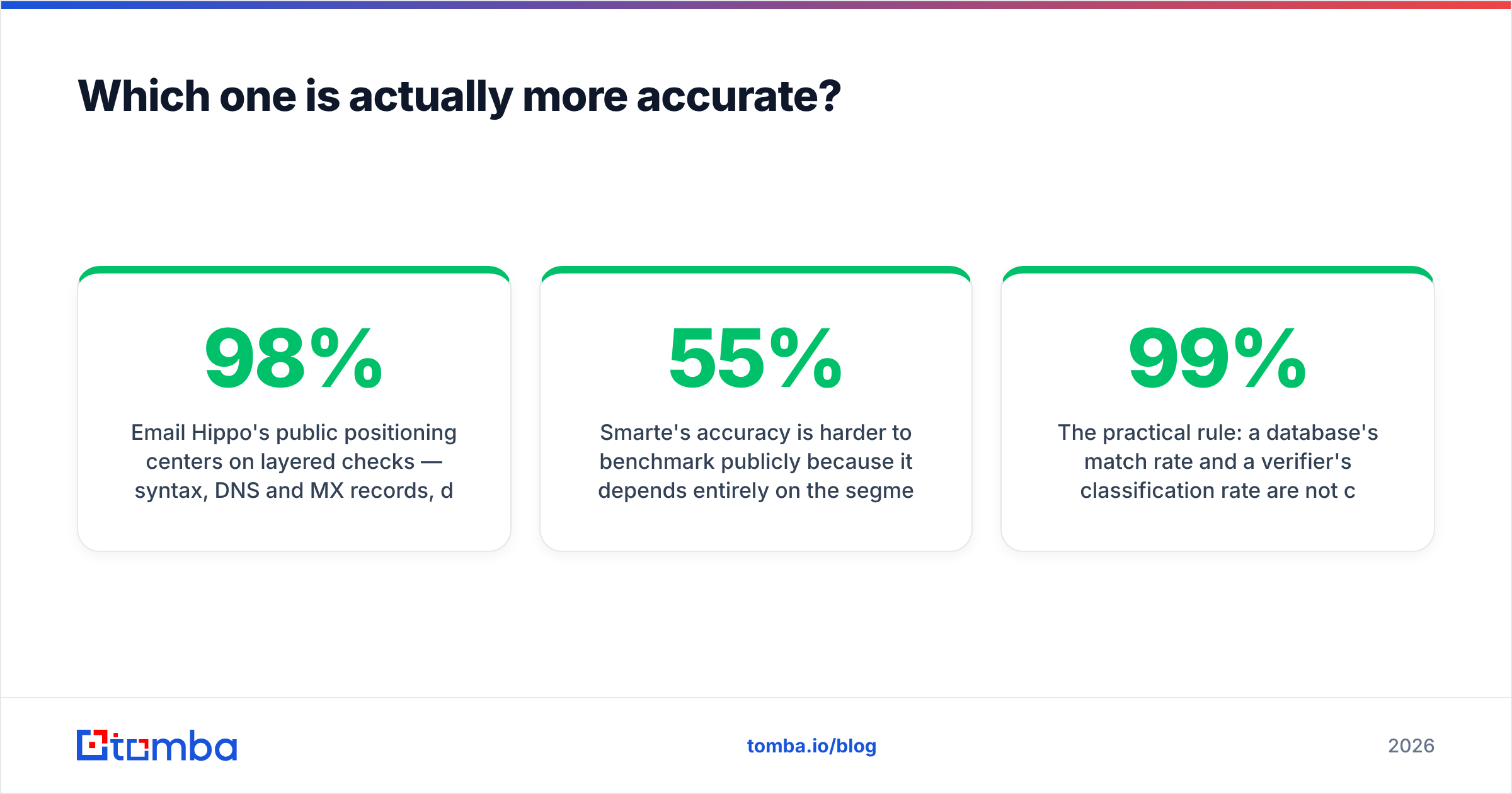
Email Hippo's public positioning centers on layered checks — syntax, DNS and MX records, disposable-domain detection, role-account flags, and SMTP-level mailbox probing — returning a graded result rather than a binary yes/no. In practice, well-built verifiers cluster in the same range on clean lists (95–98% agreement with real send outcomes). The gap between vendors shows up on the ugly 10%: catch-all domains, greylisted servers, and Microsoft 365 tenants that accept everything at the SMTP handshake and bounce later.

Smarte's accuracy is harder to benchmark publicly because it depends entirely on the segment you query. Vendor-reported match rates on B2B databases generally sit between 55% and 75% for mid-market and enterprise targets in North America and Western Europe, and drop sharply for SMBs, non-English markets, and fast-churning industries. Check the segment-specific reviews on G2 rather than the headline number on any vendor site — buyer reviews from your own vertical are worth more than a marketing page.
The practical rule: a database's match rate and a verifier's classification rate are not comparable numbers. If a vendor markets "99% accuracy" without saying which one it means, treat the claim as decoration.

How do Email Hippo and Smarte compare feature by feature?#
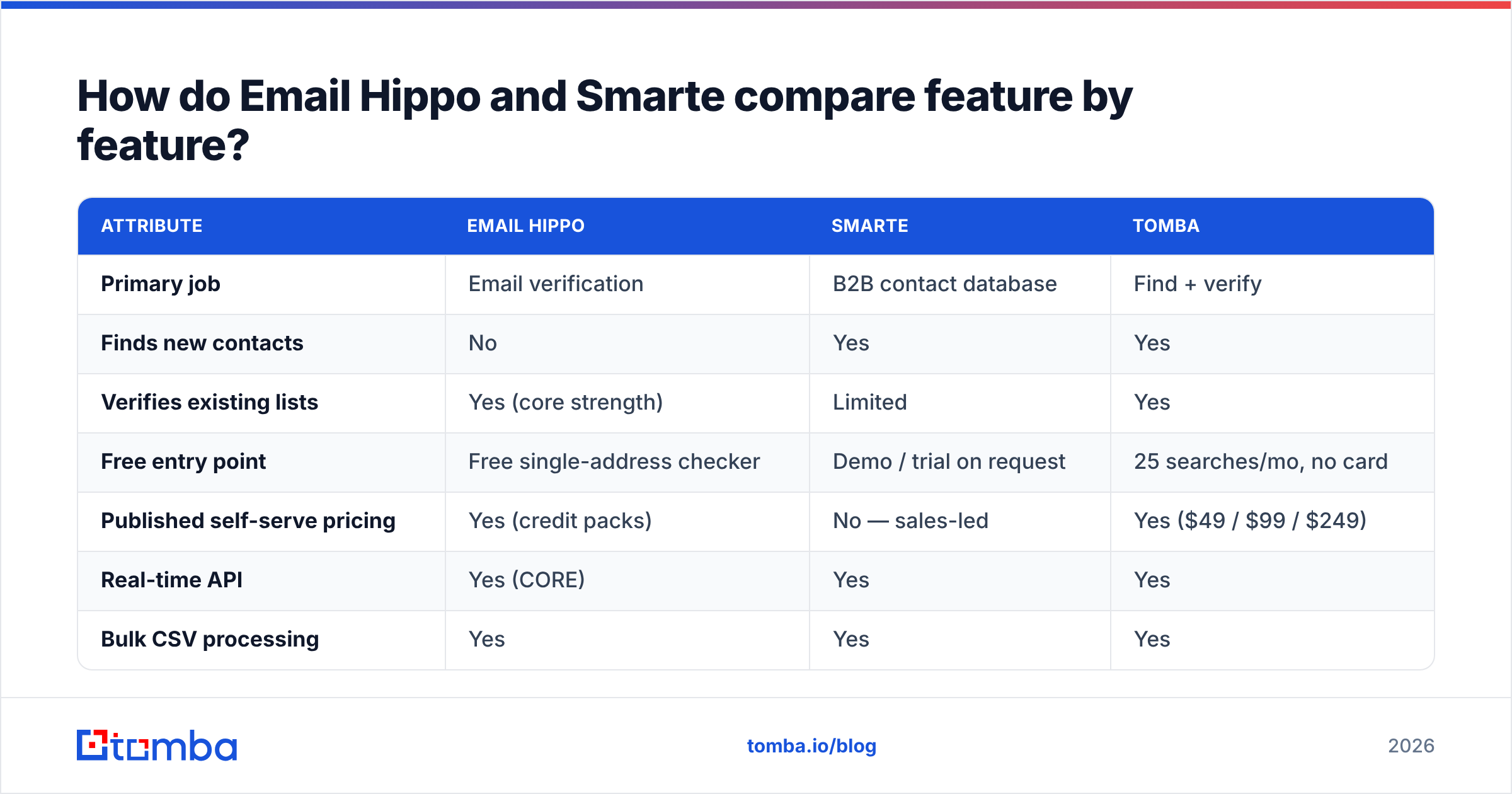
Here's the head-to-head on the attributes that actually change your workflow.
| Attribute | Email Hippo | Smarte | Tomba |
|---|---|---|---|
| Primary job | Email verification | B2B contact database | Find + verify |
| Finds new contacts | No | Yes | Yes |
| Verifies existing lists | Yes (core strength) | Limited | Yes |
| Free entry point | Free single-address checker | Demo / trial on request | 25 searches/mo, no card |
| Published self-serve pricing | Yes (credit packs) | No — sales-led | Yes ($49 / $99 / $249) |
| Real-time API | Yes (CORE) | Yes | Yes |
| Bulk CSV processing | Yes | Yes | Yes |
| Chrome extension | No | Yes | Yes |
| Phone numbers | No | Yes | Yes |
| Catch-all handling | Risk-graded | Not a focus | Dedicated catch-all verifier |
| Firmographic enrichment | No | Yes | Yes |
| Typical buyer | Ops / deliverability lead | SDR team / RevOps | Founder, SDR, growth |

Two rows deserve a second look.
Published pricing. Email Hippo lists credit pack pricing openly; Smarte routes you through a demo. That's not a knock on Smarte — sales-led pricing is standard for contact databases because seat count and credit volume vary wildly — but it does mean you cannot evaluate Smarte on a Friday afternoon without booking a call. If you need to move this week, that's a real cost.
Catch-all handling. Roughly 15–25% of B2B domains are configured as catch-all, meaning the mail server accepts every address at the door and sorts it out later. A verifier that returns "unknown" on all of them has handed the decision back to you. Look specifically at how each vendor grades these — it's the single biggest source of variance in real bounce rates. Tomba splits this into a dedicated catch-all verifier precisely because generic SMTP checks fall over here.
What does each one really cost?#
Pricing models differ enough that a straight per-record comparison is misleading. Here's the shape of each.
- Email Hippo — credit-based, verification only. You buy verification credits in packs or subscribe for a monthly allowance. Unit cost falls as volume rises, which is standard. Because it only does one job, your total stack cost is Email Hippo + whatever you pay for lead sourcing.
- Smarte — seat plus credit, sales-negotiated. Expect an annual commitment, a per-seat component, and a credit allowance for contact reveals. Enterprise-style contract dynamics apply: the list price is a starting position, and end-of-quarter timing matters.
- Tomba — flat monthly tiers covering both jobs. Free (25 searches/mo), Starter $49/mo, Growth $99/mo, Pro $249/mo, Enterprise custom. Finding and verifying draw from the same plan, so there's no second vendor invoice. Full breakdown on the Tomba pricing page.
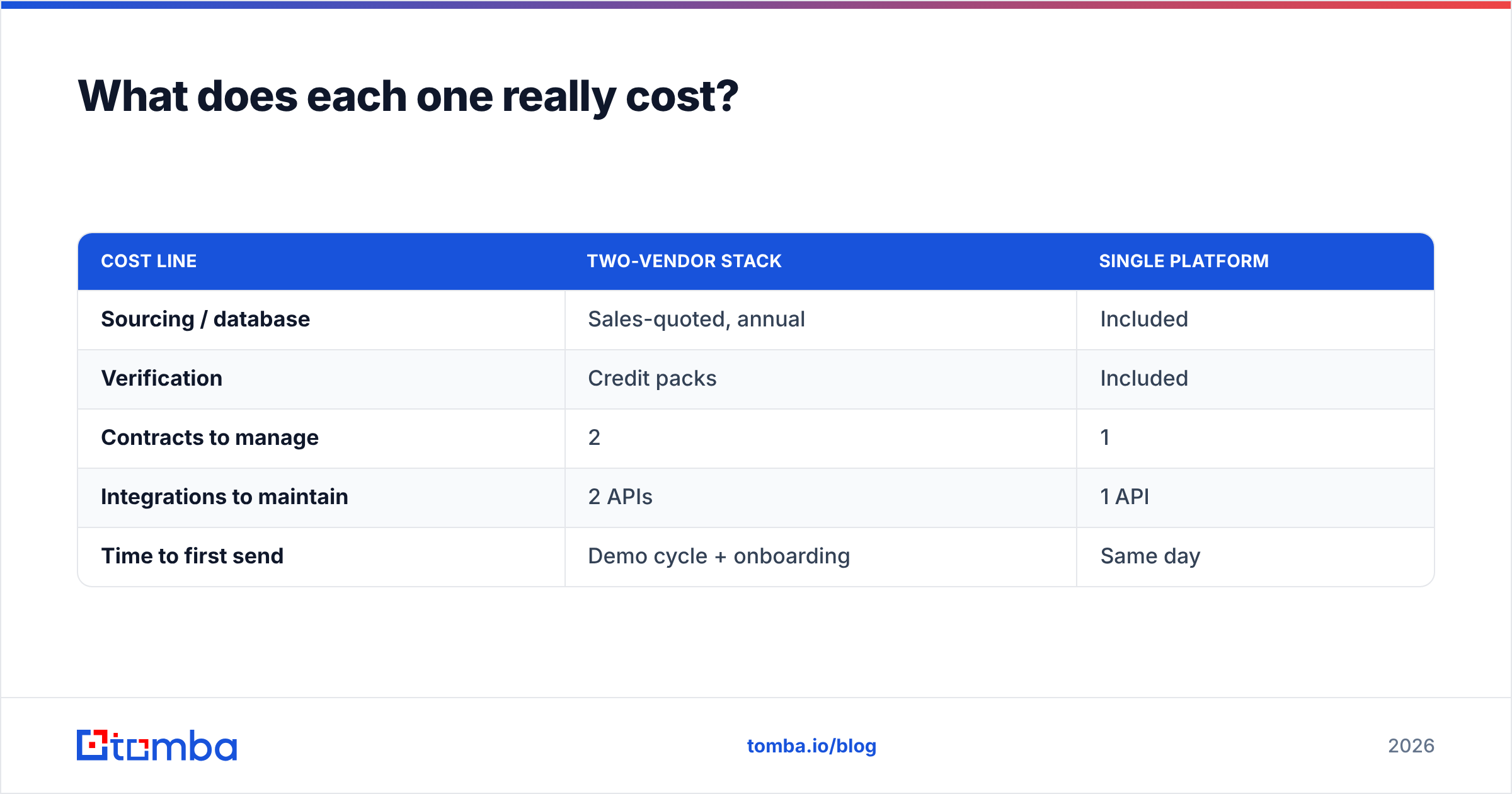
The comparison that matters isn't "Email Hippo vs Smarte" — it's "two-vendor stack vs one-vendor stack." A team running Smarte for sourcing and Email Hippo for hygiene is managing two contracts, two APIs, two credit balances, and two renewal conversations. That overhead is invisible in a feature table and painfully visible in a quarterly ops review.
Rough scenario for a 3-SDR team processing 10,000 contacts a month:
| Cost line | Two-vendor stack | Single platform |
|---|---|---|
| Sourcing / database | Sales-quoted, annual | Included |
| Verification | Credit packs | Included |
| Contracts to manage | 2 | 1 |
| Integrations to maintain | 2 APIs | 1 API |
| Time to first send | Demo cycle + onboarding | Same day |
Who should choose Email Hippo?#
Pick Email Hippo when verification is the project, not a step inside a bigger one.
- You inherited a list. A 200,000-record CRM export of unknown age needs cleaning before anything touches it. This is Email Hippo's home turf.
- You're protecting a signup form. The CORE API rejecting typos and disposable addresses at the point of entry is the highest-ROI use of a verifier, full stop. Prevention beats cleanup by an order of magnitude.
- You have a deliverability incident. If your sender reputation has cratered and bounce rate is the suspect, a specialist verifier plus a disciplined warmup plan is the right response.
- You already have a data source you like. If your contacts come from inbound, events, or an existing database contract, adding a verifier is all you need.
Where it falls short: you cannot build a prospecting motion on it. No search, no firmographics, no phone numbers, no browser extension. It is a very good hammer that is not, and does not claim to be, a toolbox.
Who should choose Smarte?#
Pick Smarte when net-new contact discovery is the bottleneck and compliance scrutiny is high.
- You sell into the EU. Smarte's GDPR-forward positioning is a genuine differentiator when procurement asks where the data came from. Not every database can answer that comfortably.
- You need firmographic filtering. Building segmented lists by headcount, tech stack, or industry is a database job. A verifier can't do it.
- You want SDRs working inside LinkedIn. The extension workflow — pull a contact while you're already looking at the profile — beats CSV round-trips for daily prospecting.
- You have budget for an annual contract. Sales-led pricing usually means annual terms. Fine at scale, heavy for a two-person team.
Where it falls short: verification depth. A contact database that returns an address has an incentive to return something, and its internal confidence scoring is not the same as an independent SMTP-level check. Most serious teams verify database exports through a second tool anyway — which puts you right back at the two-vendor problem.

Where does Tomba fit in this comparison?#
Honestly: Tomba is the answer to "why am I paying two vendors for one workflow," not a claim that either specialist is bad at its job.
Tomba's email finder sources addresses by name and domain, domain search returns everyone published at a company, and the email verifier runs SMTP-level checks on whatever comes out — all inside one plan and one API key. Bulk workflows, a Chrome extension, phone lookup, and enrichment sit in the same account.
Where Tomba does not beat these tools:
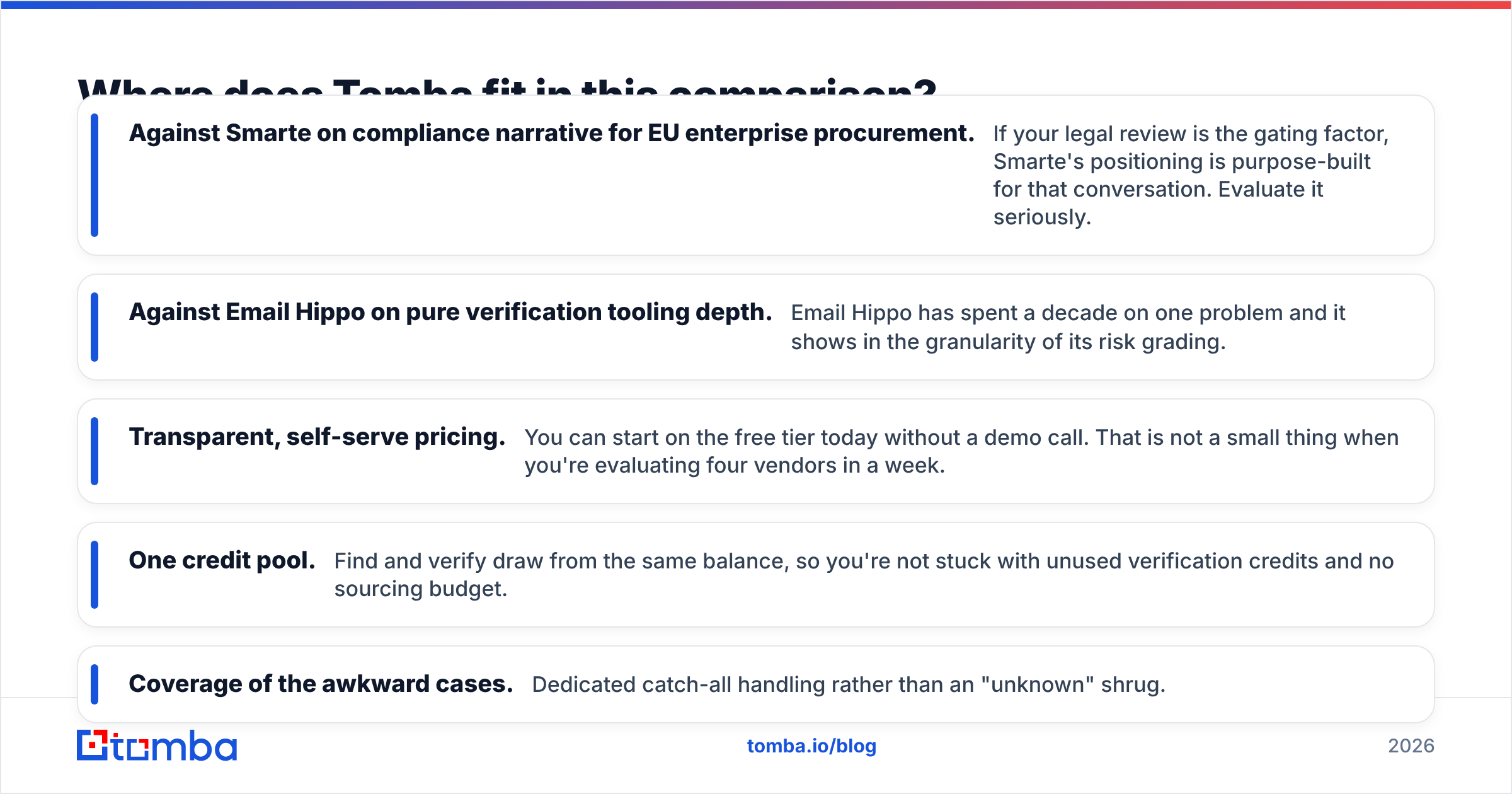
- Against Smarte on compliance narrative for EU enterprise procurement. If your legal review is the gating factor, Smarte's positioning is purpose-built for that conversation. Evaluate it seriously.
- Against Email Hippo on pure verification tooling depth. Email Hippo has spent a decade on one problem and it shows in the granularity of its risk grading.
Where Tomba does win:
- Transparent, self-serve pricing. You can start on the free tier today without a demo call. That is not a small thing when you're evaluating four vendors in a week.
- One credit pool. Find and verify draw from the same balance, so you're not stuck with unused verification credits and no sourcing budget.
- Coverage of the awkward cases. Dedicated catch-all handling rather than an "unknown" shrug.
What's the verdict on Email Hippo vs Smarte?#
If you must pick one: choose Email Hippo if you already have contacts and they're bouncing. Choose Smarte if you don't have contacts and you sell into regulated European markets. Those are the two clean cases, and in both of them the "loser" isn't losing on quality — it's just answering a question you didn't ask.
If you're honest about needing both: price out the two-vendor stack against a consolidated platform before you sign anything. Run the same 100 target contacts through each option's trial, check the match rate on your segment, then send to a seed inbox and count what actually lands. Vendor-reported numbers are marketing; your own 100-record test is evidence.
If you're a small team: start free, prove the motion, then buy scale. Both Email Hippo's free checker and Tomba's 25-search free tier let you validate the workflow before any commitment. There is no reason to enter an annual contract to test a hypothesis.
Ready to stop paying two invoices for one workflow? Start with the Tomba Email Finder — 25 free searches a month, no credit card, verification included in the same plan. Find the contact, confirm it's real, and send with a bounce rate you can defend in a QBR.
Related guides#
Ready to find emails that actually work?
Join 150,000+ professionals who stopped guessing and started sending. Free credits on signup — no credit card required.
Get the Tomba newsletter
Practical outbound tactics and product updates — once every two weeks.
About the author