Emailable vs SeamlessAI: Verification vs Data in 2026
Emailable verifies the emails you already have. Seamless.AI tries to hand you new ones. Here's how the two actually compare on accuracy, credits, contracts, and cost per usable contact in 2026.
Emailable vs SeamlessAI is a comparison of two different jobs, not two rival products. One cleans the list you already have. The other builds a list you don't. Here is how each side performs, what each really costs, and which gap is costing you more right now.
TL;DR
- The two tools do not compete on the same axis. Emailable verifies emails you already hold. Seamless.AI sells you new ones.
- Emailable wins on predictable credit pricing. You know the cost per 10,000 records before you buy.
- Seamless.AI wins on breadth. It hands you contacts you didn't have, including mobile numbers. G2 reviewers flag two trade-offs: accuracy varies, and contracts run annual.
- Need both jobs on one cancellable plan? A combined tool beats stacking a database on top of a verifier.
- Budget check: verification runs single-digit dollars per thousand records. Seamless.AI sits in the quote-based annual tier. Tomba covers both from $49/mo, with a free tier to test first.
Emailable vs SeamlessAI: what are you actually comparing?#
You're comparing a scalpel to a shovel. That sounds dismissive of one of them. It isn't — a real outbound motion needs both, just not for the same task.
Here's the honest split:
- Emailable is a verifier. You hand it a list. It runs syntax, MX, and SMTP checks, spots role accounts and disposable domains, then classifies catch-alls. It finds nobody new.
- Seamless.AI is a data platform. You search by title, industry, headcount, or tech stack. It returns contact records, sometimes with a mobile number. Verification is a byproduct here, not the product.
- The overlap is thin. Both will call an email "valid." Only Emailable is built around that one claim. Only Seamless.AI builds a 5,000-row list from a persona.
- Buying differs more than features. Emailable publishes credit pricing you can pay with a card. Seamless.AI routes volume through sales, usually on an annual term.
- Failure modes differ too. A wrong verifier costs you a bounce. A wrong database costs you that bounce plus the hour your SDR spent writing to someone who quit two years ago.
Once you frame it that way, "which is better" becomes "which gap costs me more money right now?"
What does Emailable do well?#
Emailable's pitch is boring in the best way: high-throughput verification with a clear accuracy claim and an API that doesn't fight you.
Where it earns its keep:
- Bulk list cleaning. Upload a CSV, get a scored file back. This is the common case. You bought or scraped a list, you don't trust it, and you'd rather not learn the truth from your sender reputation.
- Real-time API validation at signup. A verification call on your signup form kills typos and disposable addresses before they reach your CRM. That is where verifiers quietly pay for themselves.
- Catch-all handling. Catch-all domains accept everything at the SMTP layer. A naive verifier marks them all "valid," and your bounce report corrects it later. Emailable classifies them separately instead. Catch-all verification is its own problem.
- Transparent credits. Credits don't expire on the pay-as-you-go path. That matters when your list cleaning is lumpy rather than monthly.
What it doesn't do: give you anyone new. If your problem is "40 target accounts, no contacts," Emailable is the wrong purchase.

What does Seamless.AI do well?#
Seamless.AI's strength is coverage at the top of funnel. If you're an SDR with a quota and a blank sheet, it gets you to a working list fast.
Genuine advantages:
- Search-first workflow. Persona filters and a Chrome extension let you prospect from LinkedIn, a company site, or the platform itself. No context switching.
- Mobile numbers. Direct dials change the math on a cold-call sequence. Most pure email tools skip them. If phone coverage is your bottleneck, price a dedicated phone finder first.
- Free plan to start. A small daily credit allowance is enough to check ICP coverage before you talk to a rep.
- Volume ceiling. Enterprise tiers handle teams pulling tens of thousands of records a month.
Public reviews are consistent enough that you should plan around them. Data freshness varies, especially for smaller companies and non-US regions. Onboarding upsell is aggressive. Annual agreements are hard to exit mid-term.
Read the G2 category listings for both tools and sort by most recent. The pattern shows up in weeks, not years.
How do Emailable and Seamless.AI compare on features and pricing?#
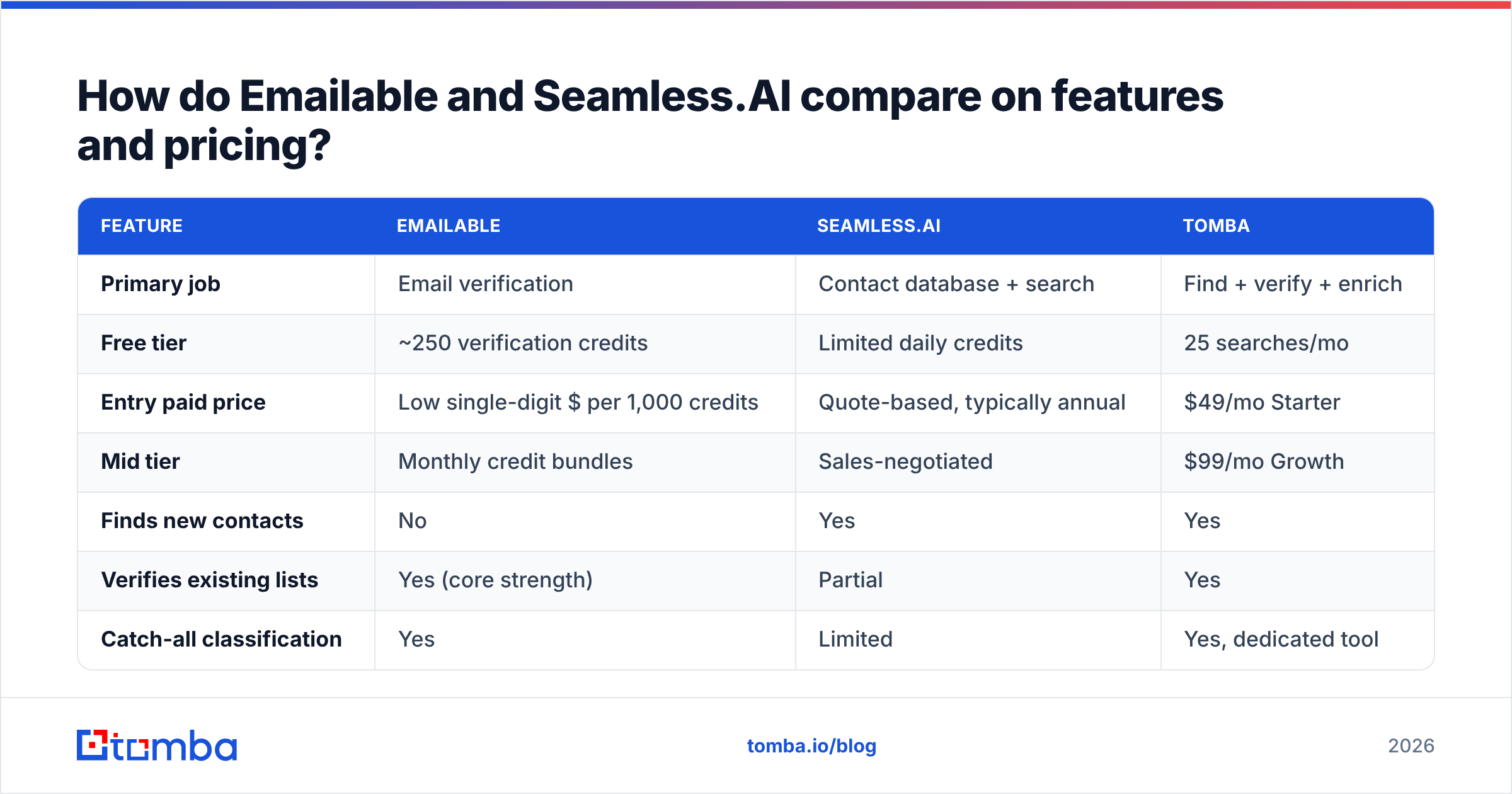
Numbers below reflect published list pricing at the time of writing. Seamless.AI's paid tiers are quote-based, so treat the range as directional, not a quote.
| Feature | Emailable | Seamless.AI | Tomba |
|---|---|---|---|
| Primary job | Email verification | Contact database + search | Find + verify + enrich |
| Free tier | ~250 verification credits | Limited daily credits | 25 searches/mo |
| Entry paid price | Low single-digit $ per 1,000 credits | Quote-based, typically annual | $49/mo Starter |
| Mid tier | Monthly credit bundles | Sales-negotiated | $99/mo Growth |
| Finds new contacts | No | Yes | Yes |
| Verifies existing lists | Yes (core strength) | Partial | Yes |
| Catch-all classification | Yes | Limited | Yes, dedicated tool |
| Phone numbers | No | Yes | Yes |
| API access | Yes | Yes, higher tiers | Yes, all paid plans |
| Contract term | Monthly or PAYG | Commonly annual | Monthly, cancel anytime |
| Credit rollover | Yes on PAYG | Varies by plan | Plan-dependent |

The line that matters most is the second-to-last one. A monthly verifier you can pause costs nothing when Q3 goes quiet. An annual seat you signed in January bills the same in August, whether your SDR team grew or shrank.
How accurate is each one, really?#
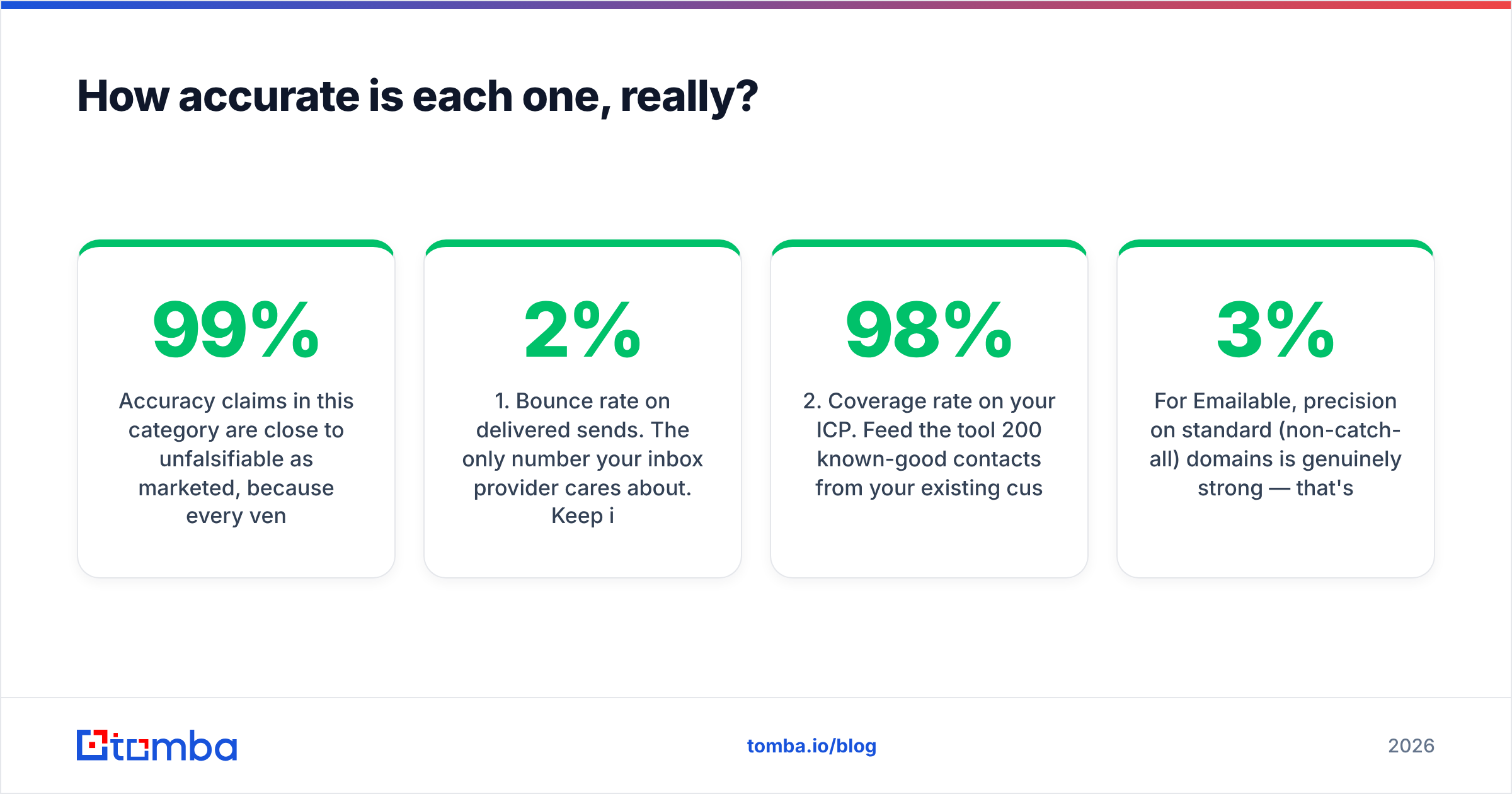
Accuracy claims here are close to unfalsifiable as marketed. Every vendor measures a different denominator. "99% accurate" usually means "of the addresses we returned as valid, 99% did not hard bounce." That says nothing about how many findable contacts the tool missed.
Two metrics you should actually demand:
- Bounce rate on delivered sends. The only number your inbox provider cares about. Keep it under 2%, or under 1% while you warm new domains.
- Coverage rate on your ICP. Feed the tool 200 known-good contacts from your customer base. How many come back with the correct work email? 98% precision at 30% coverage is a bad deal in a good disguise.

For Emailable, precision on standard (non-catch-all) domains is genuinely strong. That is the whole product.
For Seamless.AI, precision varies by segment. It is solid on mid-market US tech and noticeably softer on SMB, EU, and recently changed roles. That isn't unique to Seamless.AI. It's the structural weakness of any large static index: records decay at roughly 2-3% per month as people change jobs. A six-month-old snapshot is meaningfully worse than last week's.
The practical implication: whatever database you buy, verify at send time anyway. A fresh email verifier pass over your export on launch day is not redundant work. It's the step that separates a 0.7% bounce rate from a 6% one.
Which tool fits which workflow?#
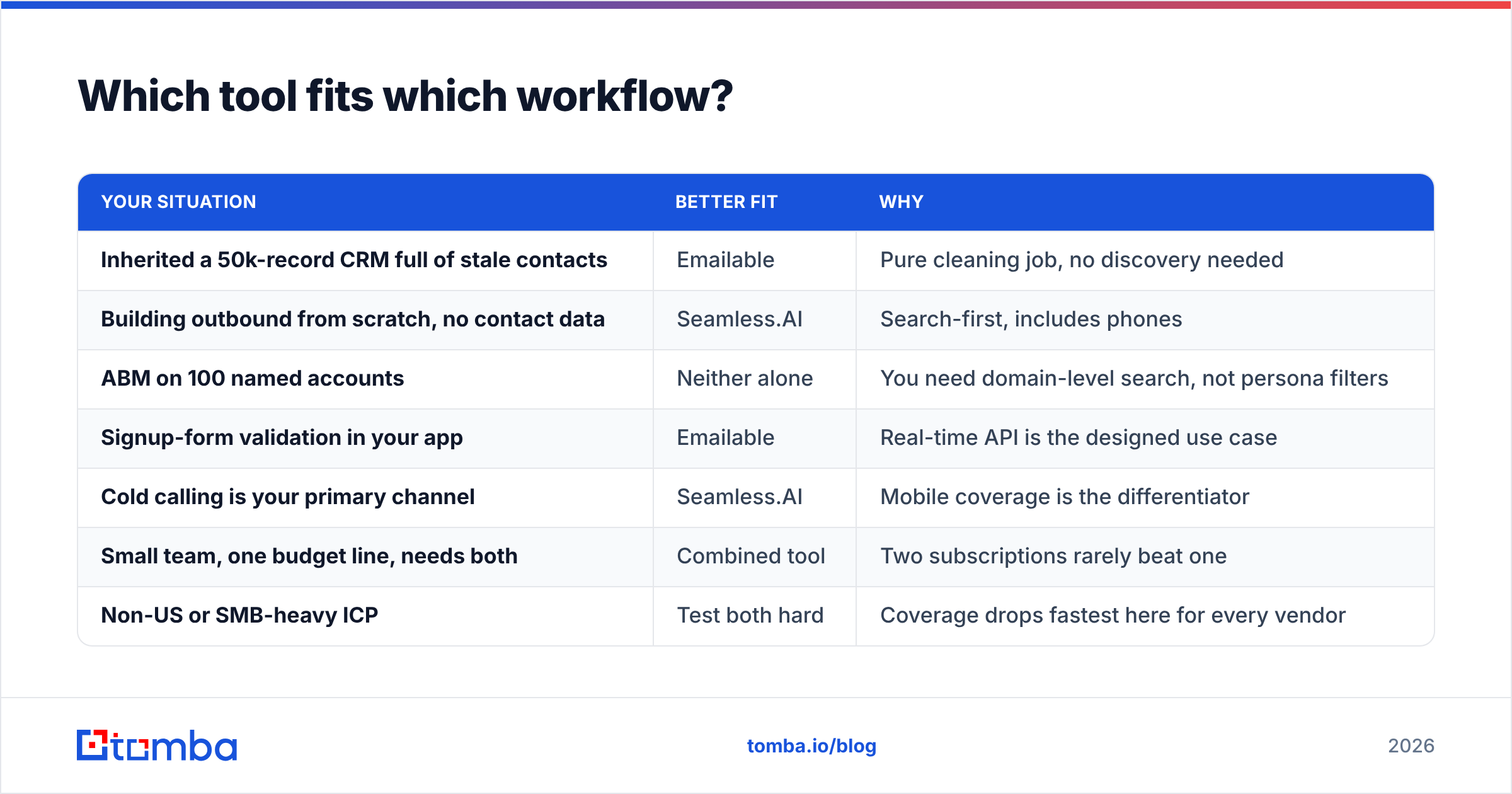
| Your situation | Better fit | Why |
|---|---|---|
| Inherited a 50k-record CRM full of stale contacts | Emailable | Pure cleaning job, no discovery needed |
| Building outbound from scratch, no contact data | Seamless.AI | Search-first, includes phones |
| ABM on 100 named accounts | Neither alone | You need domain-level search, not persona filters |
| Signup-form validation in your app | Emailable | Real-time API is the designed use case |
| Cold calling is your primary channel | Seamless.AI | Mobile coverage is the differentiator |
| Small team, one budget line, needs both | Combined tool | Two subscriptions rarely beat one |
| Non-US or SMB-heavy ICP | Test both hard | Coverage drops fastest here for every vendor |

What are the hidden costs on each side?#
The sticker price is the least interesting number in this comparison. Three costs get missed:
- Credit burn on unknowns. Some verifiers charge for "unknown" results, where the SMTP handshake was inconclusive. On a catch-all-heavy list that can be 20-30% of your file. Ask, in writing, whether unknowns consume credits.
- Seat minimums. Database platforms often price per seat with a floor. A three-person SDR team that needs one prospector still pays for the floor. Verifiers don't work this way, which is part of why they look cheaper.
- The bounce tax. Almost nobody models this one. 5,000 contacts at 8% bad addresses is 400 bounces. Past roughly 2%, mailbox providers throttle you and your good emails land in spam. Recovery means a new domain, a new warmup cycle, and three weeks of lost pipeline. That dwarfs any subscription difference. The Gmail sender guidelines are explicit about keeping invalid recipients low.
Model cost per usable contact, not cost per credit. A $0.02 record at 92% accuracy costs more per usable contact than a $0.03 record at 99%.
Where does Tomba fit between the two?#
Directly in the gap, which is the honest answer rather than a flattering one.
Tomba's core product is an email finder. Give it a name and a domain, or just a domain, and it returns verified work addresses. Around that sit the pieces both tools above only partly cover: an email verifier, a domain search for every discoverable address at a company, a dedicated catch-all verifier, a phone finder, bulk processing, and enrichment. Same credit pool, same dashboard, one bill.
Where Tomba is the better pick:
- You want find and verify without two vendors and two invoices.
- You want monthly billing you can cancel, not an annual seat commitment.
- You work domain-first (ABM, agency client lists, partner sourcing) rather than persona-first.
- You need programmatic access early. The Tomba API is on paid plans rather than gated to enterprise, and there are Sheets, Excel, and Chrome extension paths for non-engineers.
Where Tomba is not the better pick: if your entire motion is cold calling and you need thousands of verified mobile numbers a month, a phone-first database will out-cover an email-first platform. Buy for your dominant channel.
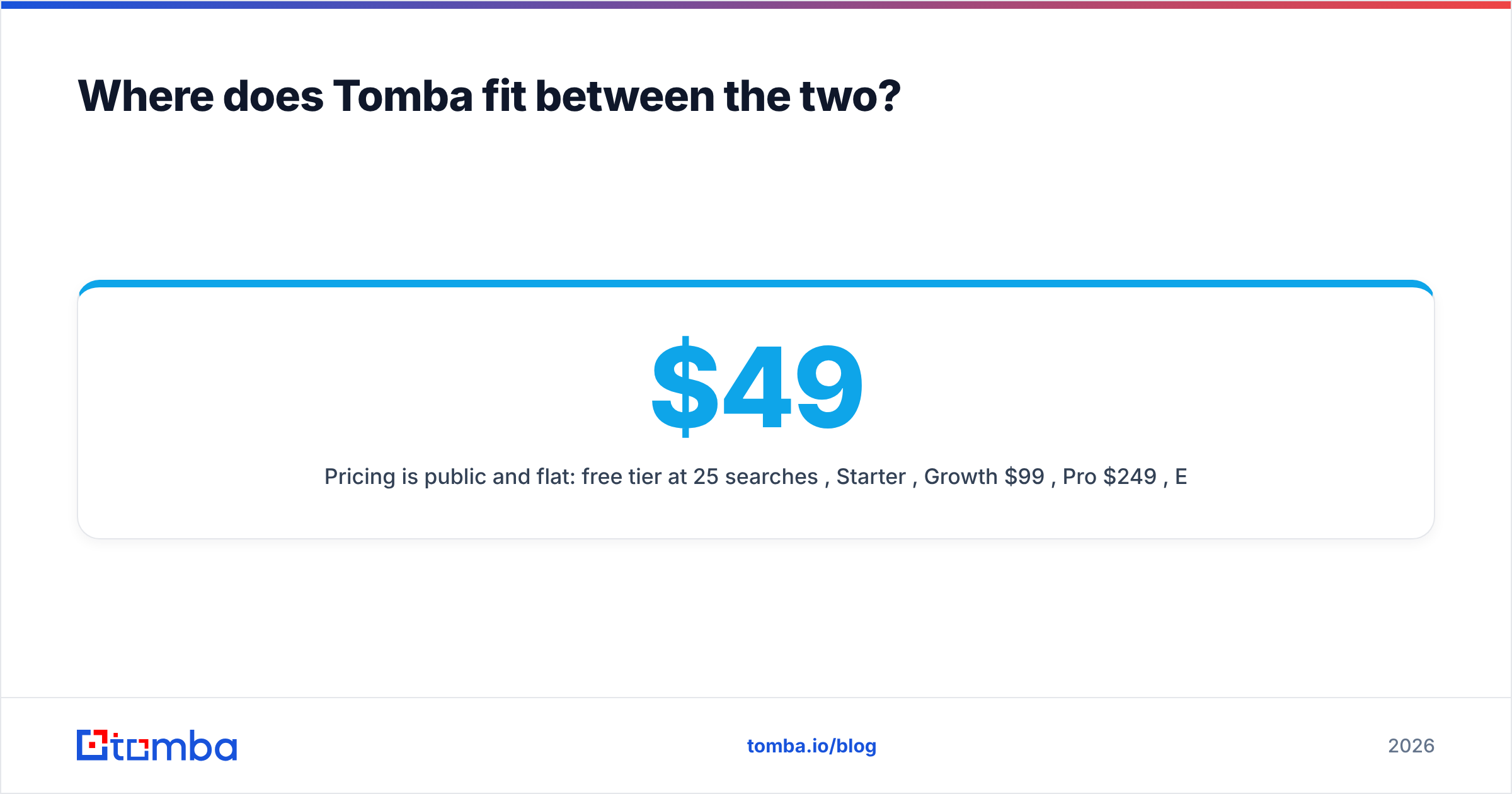
Pricing is public and flat: free tier at 25 searches/mo, Starter $49/mo, Growth $99/mo, Pro $249/mo, Enterprise custom. Full Tomba pricing breaks down the credit allocations per tier.
How should you run the evaluation?#
Most Emailable vs SeamlessAI arguments end the moment someone runs a real test. Don't treat a comparison post — including this one — as a substitute for 30 minutes of work. Run this:
- Build a truth set. Pull 100 contacts from closed-won deals where you know the email was correct. Strip the email column.
- Run every candidate on the same 100 rows. Free tiers are enough for this.
- Score coverage and precision separately. How many did it find? Of those, how many match the known-good address?
- Send a real 200-contact batch through your actual sequencer and record the bounce rate. That is the only number that predicts production behavior.
- Price the winner per usable contact, including the seat floor and any credit expiry.
Teams that run this test usually walk out with a different answer than they walked in with. Usually a cheaper one.
FAQ#
Is Emailable a Seamless.AI alternative? Not really. It replaces the verification function, not the prospecting function. Cancel Seamless.AI and buy Emailable, and you'll have clean lists and nothing to clean.
Can I use both together? Yes, and plenty of teams do: Seamless.AI for discovery, Emailable as the pre-send gate. It works. It's also two subscriptions and two credit systems to reconcile, which is the main argument for consolidating.
Does Seamless.AI verify emails before delivering them? It performs validation, but it isn't equivalent to a dedicated verifier's SMTP pass at send time. Records age. Verify again the day you send.
What bounce rate should I aim for? Under 2% as a ceiling, under 1% on new domains. Above 5%, stop the campaign rather than push through it.
Which is cheaper? Emailable, almost always, because it does less. That's not a criticism. Scope down and the price follows.
Ready to stop stacking tools? If your bottleneck is finding verified work emails at named companies — not buying a persona-filtered list you'll have to clean anyway — start with the Tomba Email Finder. Run your 100-contact truth set on the free tier, check the coverage number yourself, and upgrade only if it beats what you pay today. That's the same test we'd tell you to run on Emailable and Seamless.AI, and it's the only one that settles this comparison for your ICP.
Related guides#
Ready to find emails that actually work?
Join 150,000+ professionals who stopped guessing and started sending. Free credits on signup — no credit card required.
Get the Tomba newsletter
Practical outbound tactics and product updates — once every two weeks.
About the author