12 Best EmailListValidation Alternatives for 2026 Teams
EmailListValidation is cheap per credit, but slow bulk jobs and thin catch-all handling push teams elsewhere. Here are 12 alternatives compared on price, accuracy, and API depth.

TL;DR
- EmailListValidation (EmailListVerify's sibling in most buyer shortlists) wins on raw price per credit, but loses on catch-all resolution, API depth, and finding emails you don't already have.
- If your bottleneck is sourcing addresses — not just cleaning them — a verifier alone is the wrong tool. You want a finder plus a verifier in one credit pool.
- Best overall alternative: Tomba ($49/mo Starter, finder + verifier + catch-all in one account). Best pure-verify-at-scale: ZeroBounce. Best for prebuilt lists: BookYourData.
- Catch-all domains are where cheap verifiers quietly fail. Any vendor that returns "unknown" on 30%+ of your B2B list is charging you for a shrug.
- Run a 500-address bake-off before committing. Same list, three vendors, then send and count actual bounces. Vendor-published accuracy numbers are marketing.
What is EmailListValidation and who actually uses it?#
EmailListValidation is a bulk email verification service. You upload a CSV, it runs syntax checks, MX record lookups, SMTP handshakes, disposable-domain matching, and role-account detection, then hands back a scored file. Pricing is credit-based and aggressive at the low end — a few dollars per thousand verifications at volume, cheaper still on large one-time packs.
That model fits one buyer really well: someone who already owns a big list and needs it clean before an ESP migration or a re-engagement send. Marketing ops teams inheriting a decade-old HubSpot database. Agencies scrubbing client lists before onboarding. Anyone whose problem is "I have 400,000 addresses and no idea how many are dead."
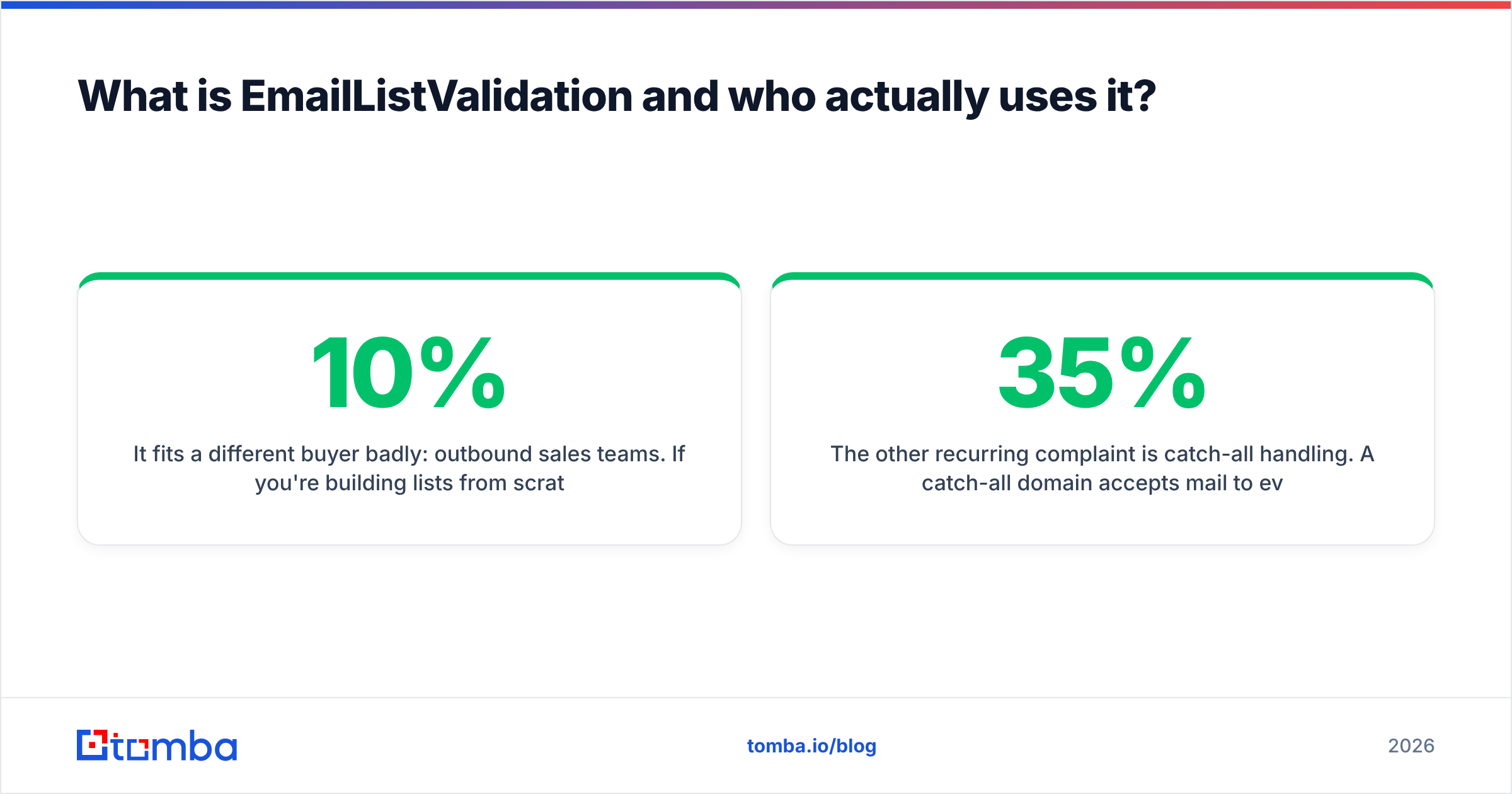
It fits a different buyer badly: outbound sales teams. If you're building lists from scratch — prospecting into named accounts, pulling contacts off LinkedIn, working an ICP list of 2,000 companies — verification is the last 10% of the job. The first 90% is finding the address at all. EmailListValidation doesn't do that, so you end up paying two vendors and reconciling two credit pools.
The other recurring complaint is catch-all handling. A catch-all domain accepts mail to every address at the SMTP layer, so a handshake proves nothing. Cheap verifiers return "unknown" or "accept-all" and move on. In B2B, catch-alls are common — Microsoft 365 tenants configured loosely, agencies, mid-market companies with legacy relay setups. When 25–35% of your list comes back "unknown," you've paid for a verification that didn't verify.

Why do teams look for EmailListValidation alternatives?#
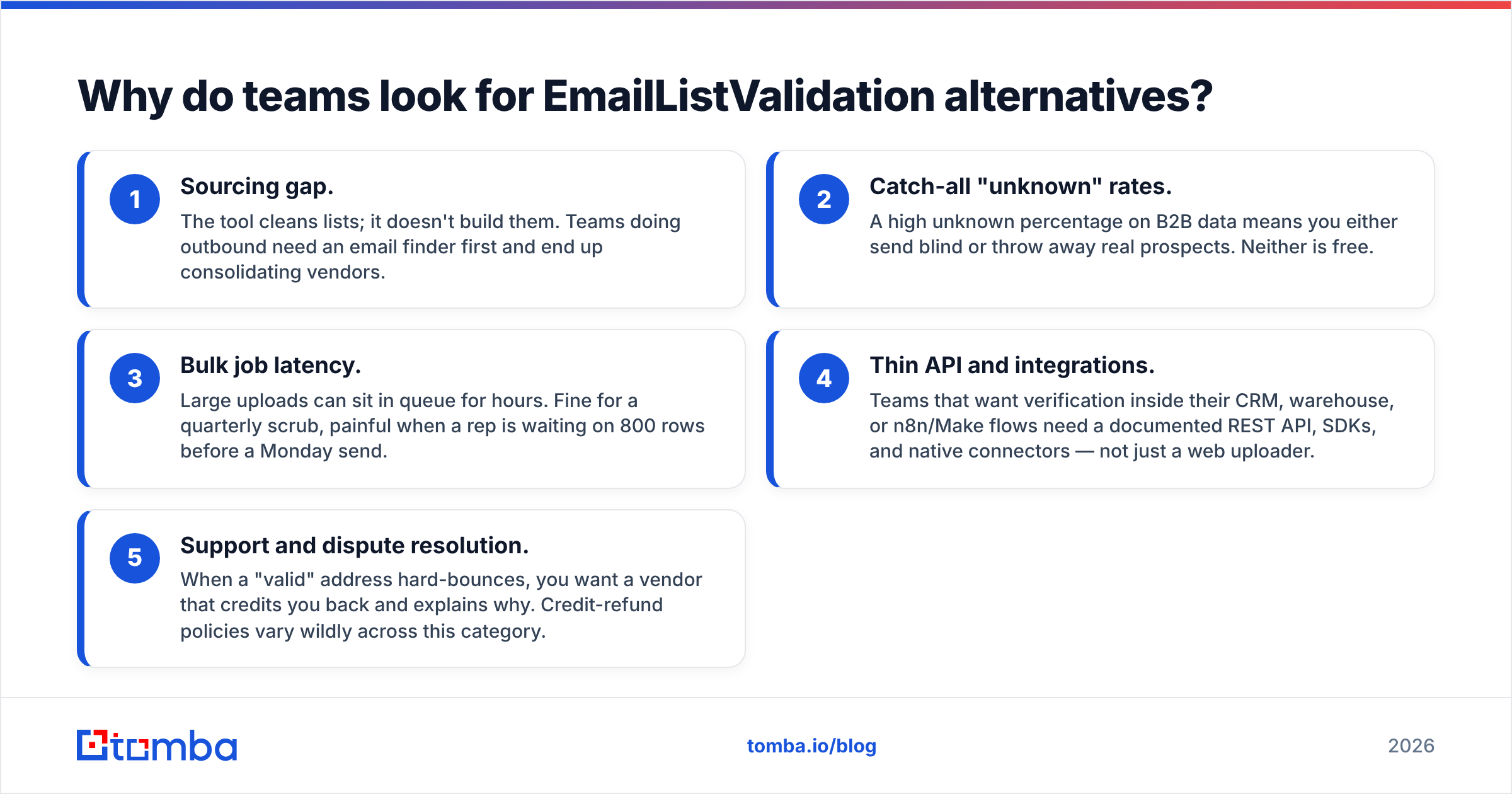
Five patterns show up over and over in switching stories:
- Sourcing gap. The tool cleans lists; it doesn't build them. Teams doing outbound need an email finder first and end up consolidating vendors.
- Catch-all "unknown" rates. A high unknown percentage on B2B data means you either send blind or throw away real prospects. Neither is free.
- Bulk job latency. Large uploads can sit in queue for hours. Fine for a quarterly scrub, painful when a rep is waiting on 800 rows before a Monday send.
- Thin API and integrations. Teams that want verification inside their CRM, warehouse, or n8n/Make flows need a documented REST API, SDKs, and native connectors — not just a web uploader.
- Support and dispute resolution. When a "valid" address hard-bounces, you want a vendor that credits you back and explains why. Credit-refund policies vary wildly across this category.
None of these make EmailListValidation a bad product. They make it a narrow one. Match the tool to the job.
Which EmailListValidation alternatives are worth comparing in 2026?#
Here's the shortlist, grouped by what each one is actually good at.
The 12 alternatives at a glance#
- Tomba — Finder + verifier + catch-all verifier in one credit pool. Best fit for outbound teams who need to source and clean. Free tier is 25 searches/mo; Starter $49/mo, Growth $99/mo, Pro $249/mo.
- ZeroBounce — Deep pure-verification feature set (activity data, abuse detection, scoring). Strong choice when verification alone is the whole job and budget is flexible.
- BookYourData — Different model entirely: buy prebuilt, pre-verified B2B contacts by industry, title, and geo with a bounce guarantee. Good when you want a list delivered rather than built.
- NeverBounce — Enterprise-grade bulk, real-time API, strong ESP integrations. Priced accordingly.
- Bouncer — EU-based, GDPR-forward, clean UI, solid toxicity/risk scoring.
- Clearout — Aggressive catch-all handling and good per-credit economics at mid volume.
- DeBounce — Budget tier, closest direct substitute on price alone.
- MillionVerifier — Very cheap bulk packs, simple product, minimal API.
- Emailable — Developer-friendly API, good docs, real-time endpoint.
- Hunter — Finder-first with verification attached; strong domain search, smaller database than Apollo-class tools.
- Snov.io — Finder plus sequencing; good if you want outreach in the same tab.
- Kickbox — Sendex quality score, strong deliverability reputation, enterprise support.
Head-to-head comparison#

Accuracy claims deserve scrutiny. Every vendor in this category publishes a 95%+ number, and every one of those numbers is measured on a different test set. The only figure that matters is your own bounce rate on your own list after a real send.
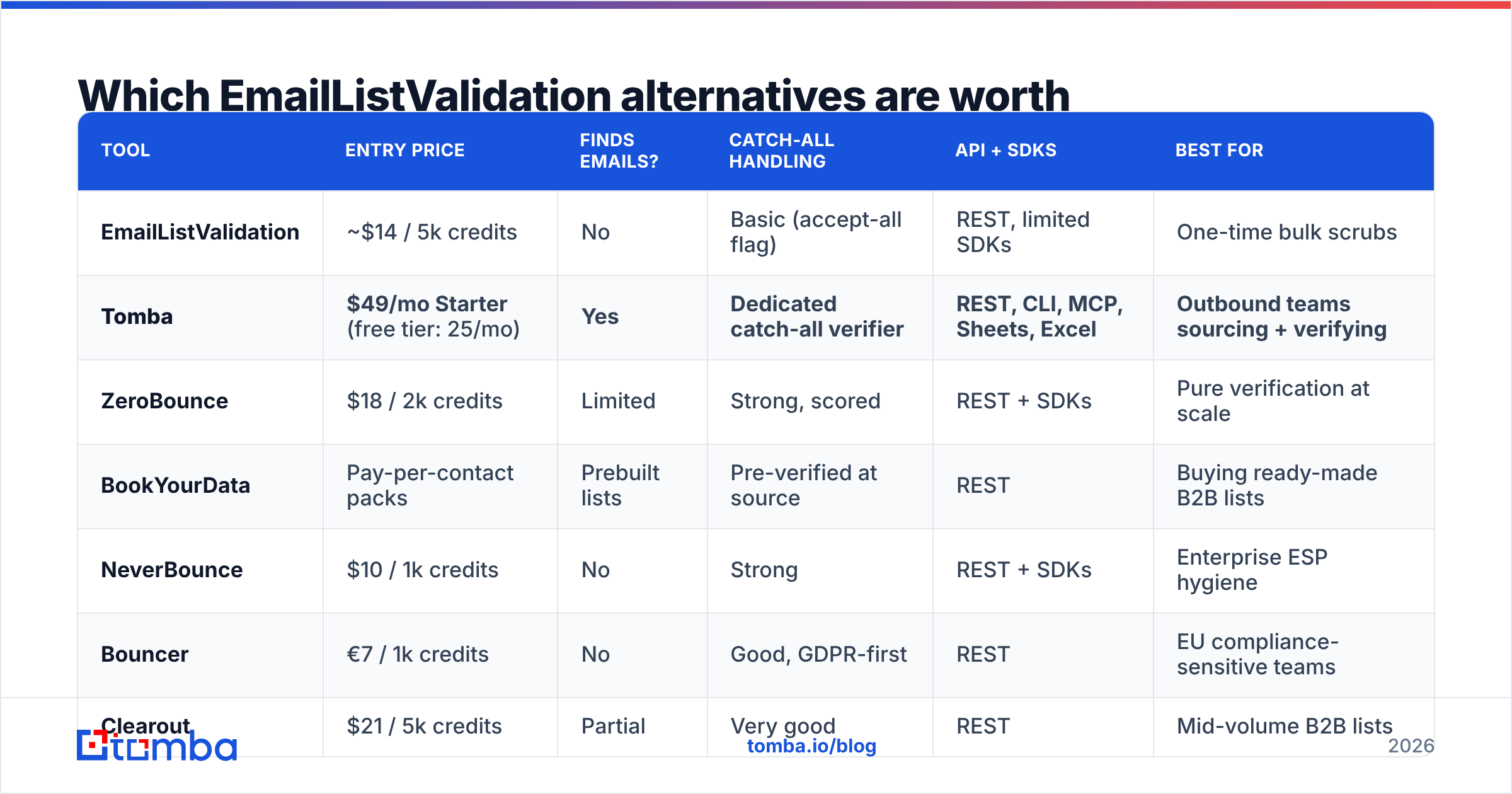
| Tool | Entry price | Finds emails? | Catch-all handling | API + SDKs | Best for |
|---|---|---|---|---|---|
| EmailListValidation | ~$14 / 5k credits | No | Basic (accept-all flag) | REST, limited SDKs | One-time bulk scrubs |
| Tomba | $49/mo Starter (free tier: 25/mo) | Yes | Dedicated catch-all verifier | REST, CLI, MCP, Sheets, Excel | Outbound teams sourcing + verifying |
| ZeroBounce | $18 / 2k credits | Limited | Strong, scored | REST + SDKs | Pure verification at scale |
| BookYourData | Pay-per-contact packs | Prebuilt lists | Pre-verified at source | REST | Buying ready-made B2B lists |
| NeverBounce | $10 / 1k credits | No | Strong | REST + SDKs | Enterprise ESP hygiene |
| Bouncer | €7 / 1k credits | No | Good, GDPR-first | REST | EU compliance-sensitive teams |
| Clearout | $21 / 5k credits | Partial | Very good | REST | Mid-volume B2B lists |
| MillionVerifier | $37 / 50k credits | No | Basic | Minimal | Cheapest bulk cleanup |
The row that changes buying decisions is the "Finds emails?" column. If it's a "No," you need a second vendor, a second contract, and a second reconciliation step every month.
Is a finder-plus-verifier stack better than a standalone verifier?#
Yes — for outbound. No — for list hygiene.
Think of it like a kitchen. A standalone verifier is a dishwasher: brilliant at cleaning what you already have, useless at producing a meal. A finder-plus-verifier is the full kitchen — you source ingredients and plate the dish in the same room.
Concretely, an outbound workflow with a standalone verifier looks like this:
- Export target accounts → find contacts in Tool A → export CSV → upload to Tool B → wait → download → re-import to CRM → send.
With a consolidated stack:
- Export target accounts → domain search returns verified contacts → push to CRM via integration → send.
Two fewer file handoffs, one credit pool, one support ticket queue when something breaks. The Tomba API exposes finder and verifier on the same key, so an engineer wires it once.
Where the standalone verifier still wins: you have 900,000 legacy addresses and zero need to find new ones. Buy credits from a bulk specialist, run the job, move on. Don't pay for finder capability you'll never touch.
How much do EmailListValidation alternatives actually cost?#
Sticker price per credit is the wrong metric. Cost per usable address is the right one.
Run this math on any vendor:
- Credits consumed — including credits burned on results that came back "unknown."
- Unknown rate — the share of your list the tool refused to judge. Multiply your list size by this to find how many addresses you paid for and can't use.
- False-valid rate — addresses marked valid that hard-bounced. These are the expensive ones; they damage sender reputation, not just your budget.
- Second-vendor cost — if the verifier doesn't find emails, add the finder's monthly cost.
- Engineering time — hours spent gluing two APIs together, at whatever your loaded eng rate is.
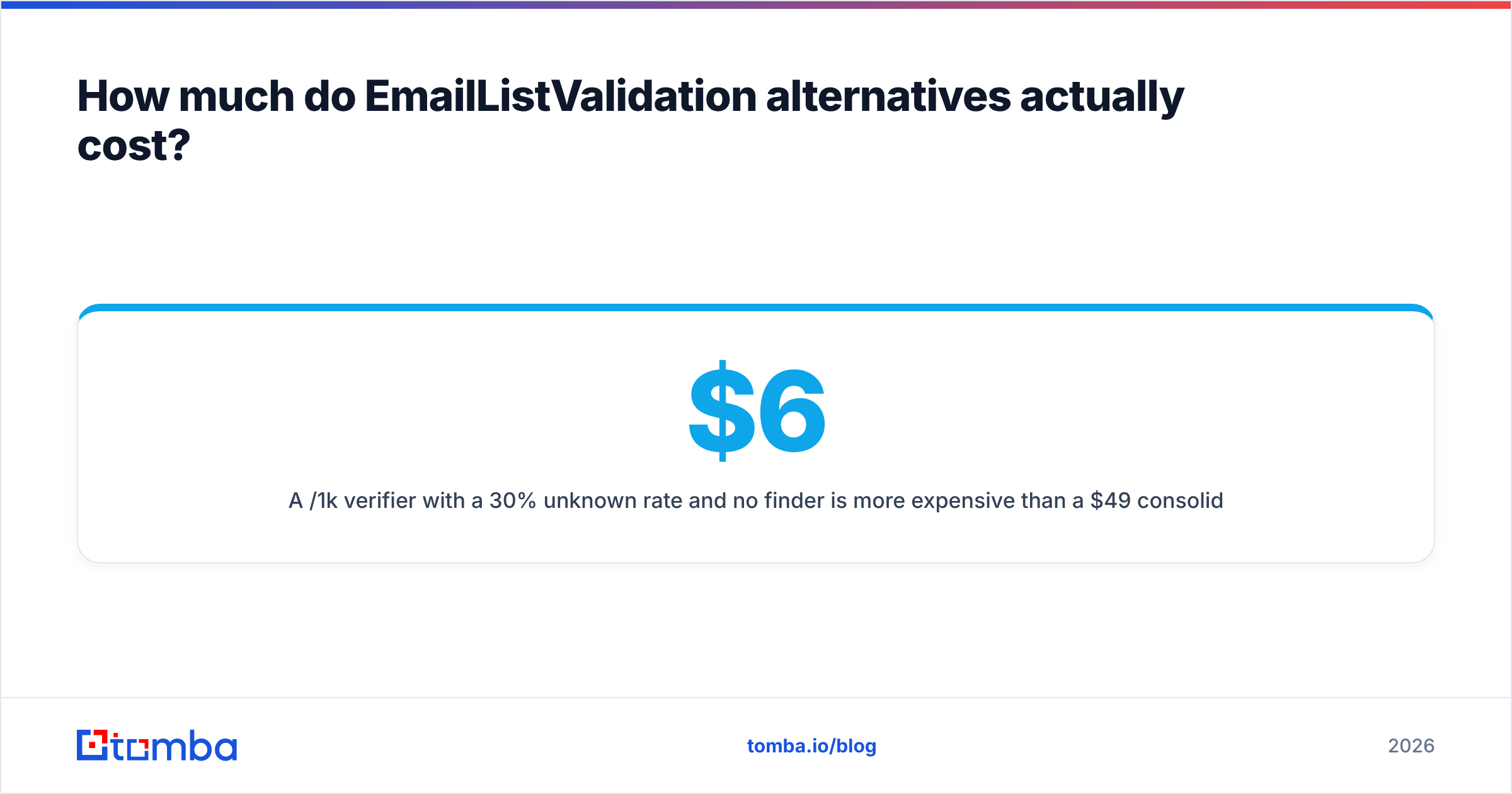
A $6/1k verifier with a 30% unknown rate and no finder is more expensive than a $49/mo consolidated tool for most teams under 20,000 monthly lookups. Above that, the arithmetic flips and dedicated bulk vendors win on unit cost. Check Tomba pricing against your actual monthly volume rather than against a competitor's headline rate.

What should you test before switching verification vendors?#
Do a bake-off. It takes an afternoon and it's the only evidence that counts.
The 500-address protocol:
- Build the sample. Pull 500 real addresses from your actual ICP — not a public test list. Include a deliberate mix: 100 known-good (people who replied last quarter), 100 known-dead (hard bounces from your ESP logs), and 300 unknowns.
- Run all three vendors on the identical file. Same day, same file, no dedup differences.
- Score the knowns first. A vendor that marks your known-good addresses as invalid is over-aggressive; one that passes your known-dead addresses is under-aggressive. Both are disqualifying.
- Count unknowns on the 300. This is the catch-all test. Lower is better only if the confident answers are also correct.
- Send to the survivors and measure. Real bounce rate after a real send, from a warmed domain. Anything above 2% means the vendor's "valid" label isn't load-bearing.
- Time the job. Note queue time on a 500-row file. Multiply by your typical batch size to project the real wait.
Also check the boring stuff before you sign: credit expiry (do unused credits roll over?), refund policy on false positives, data residency if you operate in the EU, and whether the API rate limit fits your batch pattern. G2 and Capterra reviews are useful here — filter to reviews from companies your size, since a 5-person agency and a 500-person enterprise experience these tools completely differently.
Which alternative fits which team?#
You're an outbound SDR team building lists from scratch. You need finding and verification together. Tomba's Starter at $49/mo covers a typical rep's monthly volume, and the bulk email finder handles account-list uploads. Add the Chrome extension for LinkedIn-adjacent workflows.
You're marketing ops cleaning a legacy database once a quarter. A dedicated bulk verifier is fine. ZeroBounce or NeverBounce for accuracy-first, MillionVerifier or DeBounce for price-first. You don't need finder credits.
You want the list handed to you, already clean. BookYourData sells prebuilt, verified B2B contacts filtered by title, industry, company size, and geography, with a bounce guarantee attached. That's a genuinely different purchase than a verification credit pack — you're buying data, not a service — and it's the right call when you have budget but no time to build.
You're an engineer embedding verification in a product. Prioritize API quality over price. Read the docs before you buy. Check rate limits, webhook support, SDK language coverage, and whether there's a real-time single-lookup endpoint or only batch. Emailable, Kickbox, and the email verification API all document this properly.
You're EU-based with a strict DPO. Bouncer's EU hosting and GDPR posture will save you a procurement cycle. Verify data-processing agreements before anything else.
Common mistakes when switching verifiers#
- Testing on a public sample list. Every vendor has tuned against the well-known test files. Use your own data.
- Ignoring catch-alls entirely. Treating "unknown" as "invalid" throws away real buyers. Treating it as "valid" tanks deliverability. Use a catch-all finder to resolve them properly instead of guessing.
- Verifying once and never again. B2B data decays roughly 2–3% per month as people change jobs. A list verified in January is measurably worse by June. Re-verify before every major send.
- Blaming the verifier for infrastructure problems. If your SPF, DKIM, and DMARC aren't right, a perfect list still lands in spam. Check your SPF record and warm your domain before you blame data quality.
- Buying annual on day one. Monthly for the first quarter. Prove the accuracy on your data, then commit.
Final verdict#
If you're only cleaning lists, EmailListValidation is defensible and cheap, and its closest substitutes — DeBounce, MillionVerifier, Clearout — compete on the same axis. Pick on unknown rate and turnaround time, not headline price.
If you're building pipeline, the category is the wrong shape. You'll spend more time moving CSVs between a finder and a verifier than you spend actually prospecting, and you'll pay two invoices for one workflow.
Start with a free Tomba account — 25 searches a month, no card — and run the 500-address bake-off described above against whatever you're using now. Use the Tomba Email Finder to source contacts by domain, name, or company, then verify them in the same credit pool without a single export. If the numbers beat your current stack on cost per usable address, upgrade to Starter at $49/mo. If they don't, you've lost an afternoon and gained a benchmark you can point at the next time someone asks why your bounce rate is what it is.
Sources worth reading before you decide: G2's email verification category, Capterra's comparison grid, and HubSpot's guide to list hygiene.
Related guides#
Ready to find emails that actually work?
Join 150,000+ professionals who stopped guessing and started sending. Free credits on signup — no credit card required.
Get the Tomba newsletter
Practical outbound tactics and product updates — once every two weeks.
About the author