EmailOversight vs Generect: Which B2B Data Tool Wins in 2026?
EmailOversight cleans lists. Generect sources them. Here's an honest head-to-head on accuracy, pricing, API depth, and which one actually belongs in your outbound stack in 2026.
TL;DR — EmailOversight vs Generect at a glance
- EmailOversight vs Generect is not a fair fight. The two tools do different jobs.
- EmailOversight cleans lists you already own. It tests each address in several ways.
- Generect builds lists from scratch. It pulls live B2B data the moment you ask.
- Bounce rate at 9%? Pick EmailOversight. No list at all? Pick Generect.
- Neither tool covers find, verify, and enrich alone. Most teams end up paying two vendors.
- The pricing shapes differ. EmailOversight leans on pay-as-you-go credits. Generect leans on monthly plans plus API volume.
- Judge cost per usable contact. Never judge cost per credit.
EmailOversight vs Generect: what are these two tools?#
Start the emailoversight vs generect question here. Think of your outbound pipeline as a water system. Generect is the well. It pulls fresh contacts out of the ground. EmailOversight is the filter. It strips out the junk before it reaches the tap. Both matter. They do very different jobs.
EmailOversight is a US email hygiene company. Its core job is to tell you if an address is real. It does not stop at the standard SMTP ping. It checks syntax and domain too. It flags known-bad addresses and honeypots. It screens spam traps, serial complainers, and litigators. A real-time API blocks bad data right at the form.
EmailOversight also sells email append. You hand over a partial record. It hands back a verified business email.
Generect is a B2B lead data provider, and its design is API-first. Most rivals keep one huge static database. Those files rot by 25–30% a year. Generect runs live queries instead. It hits the source when you search. Then it returns companies, people, and contact details.
Generect aims at agencies, GTM engineers, and product teams. Those teams want lead search inside their own tools.
So the honest frame for emailoversight vs generect is simple. Do not ask which tool is better. Ask which half of the data problem you need to fix this quarter.
EmailOversight vs Generect: what does EmailOversight do well?#
Multi-method checking is the whole pitch. It matters more than it sounds.
A single-method tool opens an SMTP chat with the mail server. Then it reads the reply code. That works, until it does not. Microsoft 365 domains often reply with a shrug. Catch-all domains accept every address. Some hosts feed back junk on purpose to stop scrapers.
EmailOversight stacks more signals on top:
- Spam-trap and honeypot checks — these addresses exist only to catch people who scrape or buy lists. One hit can wreck your sender reputation for weeks.
- Complainer and litigator screening — it flags serial complainers. In the US, it also flags addresses tied to CAN-SPAM lawsuits. Few rivals ship this.
- Bot and click-fraud filters — it splits real human clicks from security scanners. That helps if you score leads on opens and clicks.
- Real-time API checks — a form-level test, so bad addresses never reach your CRM.
- Email append — send a name plus a company. It tries to return a live business email.
Here is the gap. EmailOversight does not prospect. You cannot ask it for every Head of RevOps at Series B fintechs in Germany. It assumes you already have the contacts.

EmailOversight vs Generect: what does Generect do well?#
Generect argues about freshness. The argument holds up.
Every static B2B database shares one flaw. It was right on the day it was crawled. People switch jobs every two or three years. In tech, the gap is shorter. A file refreshed each quarter is months stale by the time you query it.
Generect looks at the source when you ask. In practice, that shows up as:
- Live company search — filter by industry, headcount, region, and tech signals. You get the current staff roster, not a snapshot.
- People search that tracks job moves — the query runs live. A contact who moved last month is less likely to come back as a dead address.
- API-first delivery — REST endpoints, CSV export, and connectors. Lead search can sit inside your own app.
- Agency and reseller fit — built for teams running many client campaigns at once.
The trade-offs are real. Live lookups run slower than a cached index. Bulk jobs above 100k rows behave very differently than a database dump. Coverage tracks what the live sources expose. It is strong for tech, SaaS, and pro services in North America and Europe. It is thinner for SMB, trades, and non-English markets. Generect does check emails. But that check is a side feature, not the main product.
Feature by feature: the full comparison#
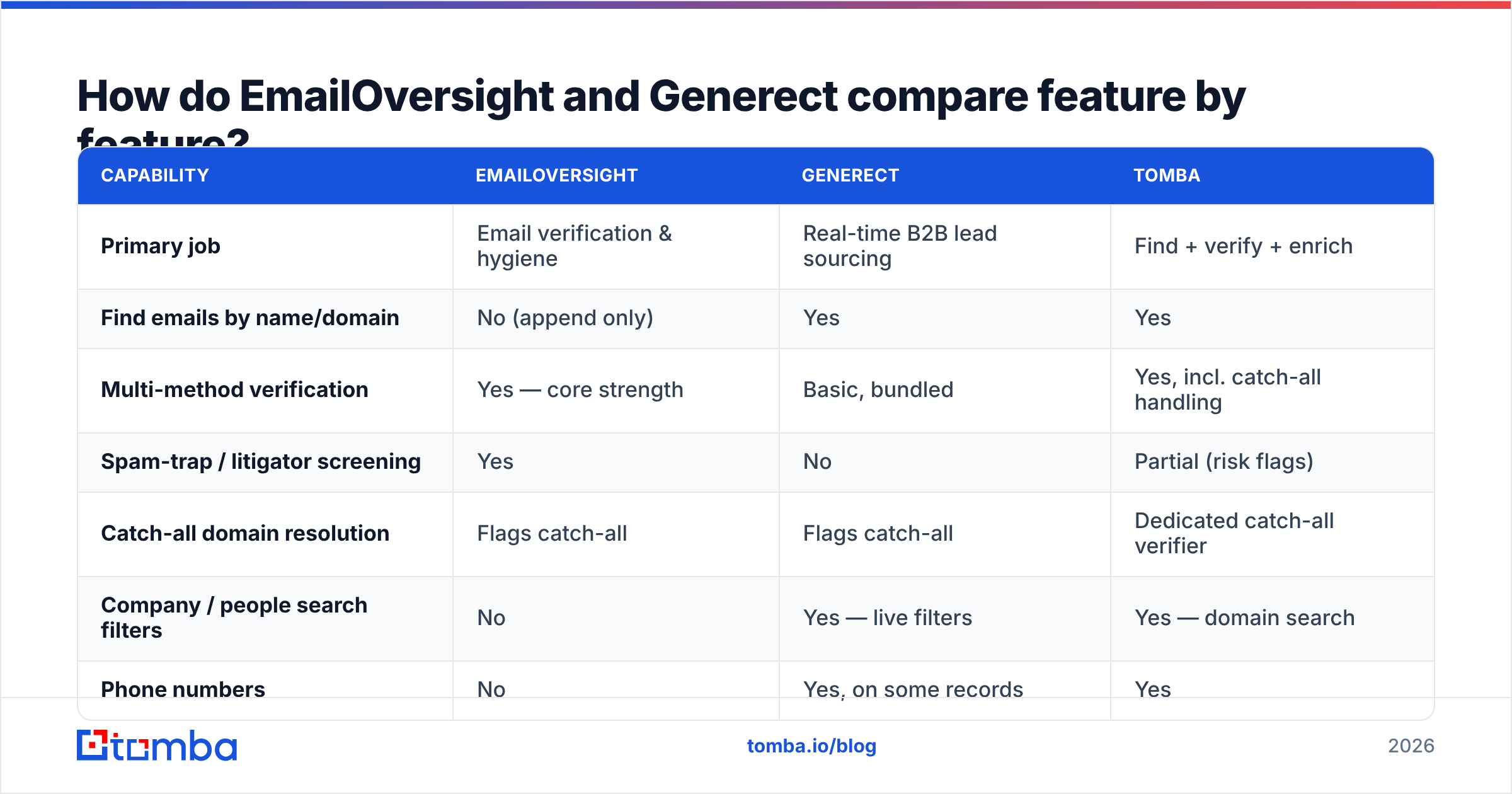
| Capability | EmailOversight | Generect | Tomba |
|---|---|---|---|
| Primary job | Email verification & hygiene | Real-time B2B lead sourcing | Find + verify + enrich |
| Find emails by name/domain | No (append only) | Yes | Yes |
| Multi-method verification | Yes — core strength | Basic, bundled | Yes, incl. catch-all handling |
| Spam-trap / litigator screening | Yes | No | Partial (risk flags) |
| Catch-all domain resolution | Flags catch-all | Flags catch-all | Dedicated catch-all verifier |
| Company / people search filters | No | Yes — live filters | Yes — domain search |
| Phone numbers | No | Yes, on some records | Yes |
| Public API | Yes | Yes — API-first | Yes, plus CLI and MCP |
| Free tier | Trial credits | Demo / trial | 25 searches per month |
| Native spreadsheet add-ons | Limited | Limited | Sheets, Excel, Airtable |
| Best for | Cleaning lists you already own | Building lists from scratch | Running both in one workflow |
Two things jump out of that grid. First, the overlap is tiny — maybe one row. Second, pick either tool alone and you leave a hole in the pipeline.

EmailOversight vs Generect: which one is more accurate?#
That is the wrong question. Most comparison posts get lazy right here. "Accuracy" means two different things.
For EmailOversight, accuracy means bounce prediction. Ask one thing. Of the addresses it marked valid, how many bounced? A good checker keeps bounces under 2% on a list it cleared. Its multi-method stack aims to push that number down. It helps most on the hard cases: role accounts, catch-alls, throwaway domains, and traps.
For Generect, accuracy means match rate and freshness. Ask a different thing. Of the contacts it returned, how many are still in that role, at that firm, with that address? Live sourcing wins here. No static database can match it.
You cannot compare those two numbers head to head. Do not trust any vendor's published figure either. Ours included. Run your own test instead. Here is the test that settles it.
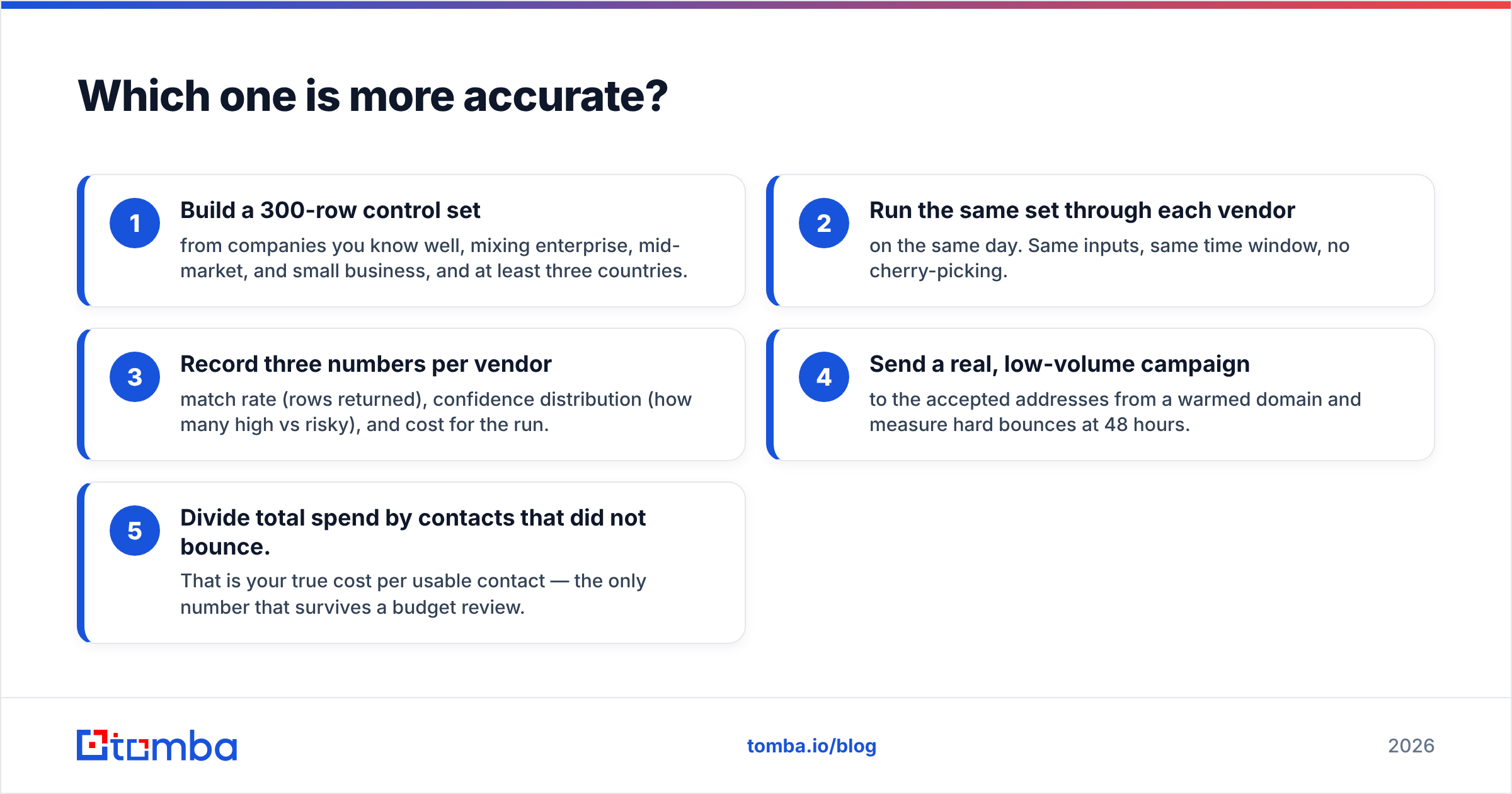
- Build a 300-row control set. Use firms you know well. Mix enterprise, mid-market, and small business. Cover at least three countries.
- Run the same set through each vendor on the same day. Same inputs. Same time window. No cherry-picking.
- Record three numbers per vendor: match rate, confidence spread, and cost for the run.
- Send a small, real campaign to the accepted addresses. Use a warmed domain. Count hard bounces at 48 hours.
- Divide total spend by contacts that did not bounce. That is your true cost per usable contact.
Most teams find the cheaper credit is not the cheaper outcome. Say a vendor charges more per lookup. If it returns 20% more live addresses, it still wins on the math. Want a second opinion first? Vendor profiles on G2 help you spot repeat billing and support gripes. Those never show up on a pricing page.
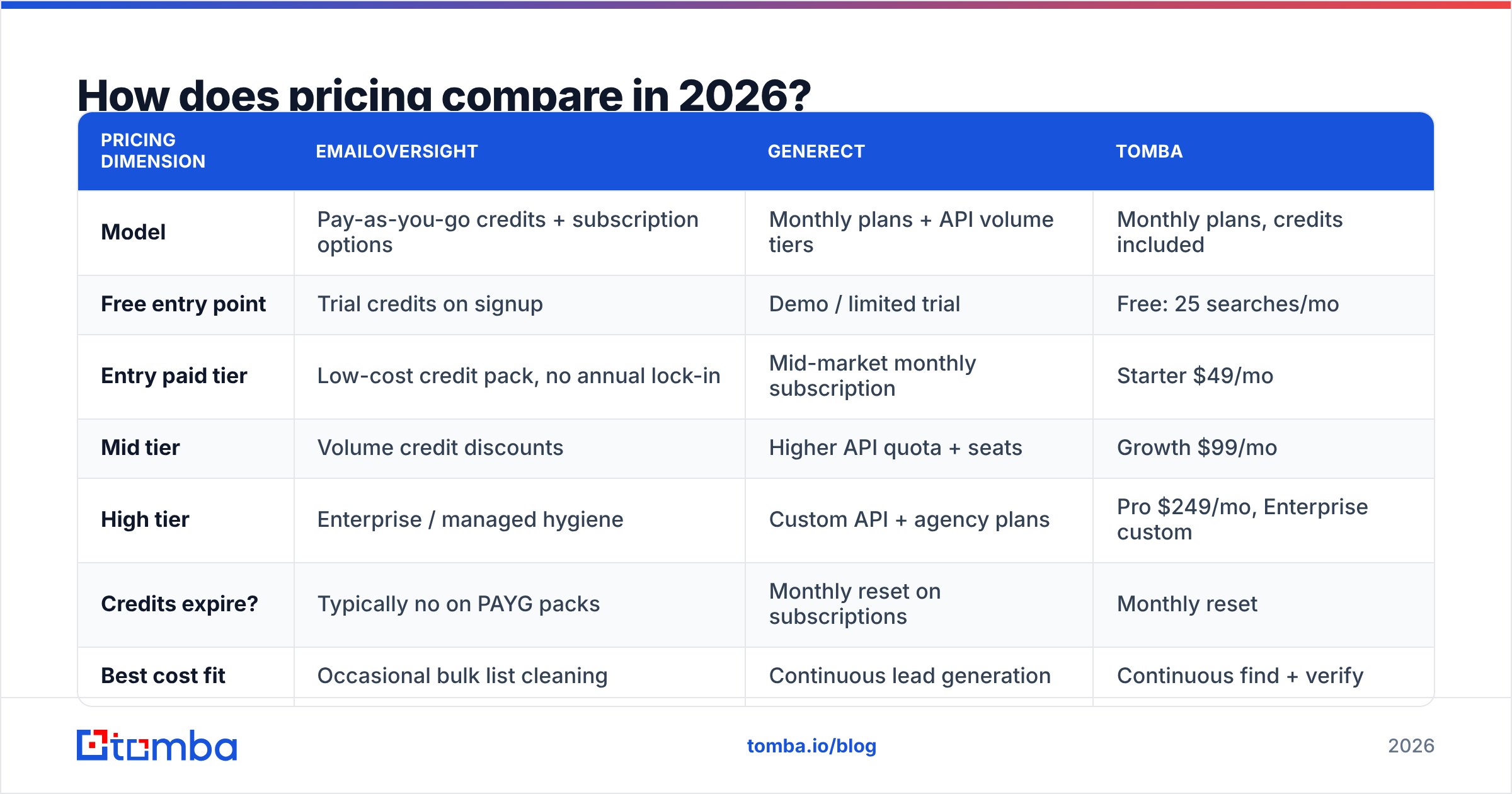
EmailOversight vs Generect: how does pricing compare in 2026?#
Both vendors change their prices. So treat the shape of each model as the lasting lesson. Check the current numbers on their own sites before you buy.
| Pricing dimension | EmailOversight | Generect | Tomba |
|---|---|---|---|
| Model | Pay-as-you-go credits + subscription options | Monthly plans + API volume tiers | Monthly plans, credits included |
| Free entry point | Trial credits on signup | Demo / limited trial | Free: 25 searches/mo |
| Entry paid tier | Low-cost credit pack, no annual lock-in | Mid-market monthly subscription | Starter $49/mo |
| Mid tier | Volume credit discounts | Higher API quota + seats | Growth $99/mo |
| High tier | Enterprise / managed hygiene | Custom API + agency plans | Pro $249/mo, Enterprise custom |
| Credits expire? | Typically no on PAYG packs | Monthly reset on subscriptions | Monthly reset |
| Best cost fit | Occasional bulk list cleaning | Continuous lead generation | Continuous find + verify |
The shape matters more than the sticker price. Pay-as-you-go suits spiky work. You inherit a 200k-row list from a merger, clean it once, and walk away. Subscriptions suit steady work. Think of a team pulling 2,000 new contacts every month, forever.
Buying a subscription for one cleanup is waste. Buying credit packs for a daily habit is death by a thousand top-ups.
Check two lines of fine print nobody reads. First, do unknown or catch-all results burn credits? Many tools charge for them. Second, can the API rate limit on your tier handle your batch size?

Which should you pick for your use case?#
- You own a large old list and bounces are climbing — pick EmailOversight. Spam-trap and complainer screening saves domains. Few rivals ship it. Pair it with an email verifier for new contacts.
- You have no list and need one every week — pick Generect. Live sourcing beats a stale file for roles that churn fast. The API-first build lets you wire it into your own product.
- You run an agency with many client campaigns — use Generect to source. Add a real verifier before every send. Client domains are not yours to burn.
- You are a solo founder doing both jobs — neither, alone. Two vendors means two invoices, two APIs, and CSV shuttling by hand. That is a real tax on a two-person team.
- You need phone numbers too — Generect covers some records. A phone finder fills the rest.
- Catch-all domains are your bottleneck — both tools return "unknown" here. A catch-all verifier built for that exact problem clears a real slice of them.
That last point deserves weight. On many big domains, 20–40% of results come back catch-all. If your tool marks them unknown, you have two bad options. You drop real prospects, or you send blind and eat the bounce. Neither works at scale.
Where does Tomba fit in the emailoversight vs generect debate?#
Straight answer. Tomba is the merge play. It is not a swap for either tool.
EmailOversight goes deeper on hygiene forensics. If litigator screening is your top need, it is a specialist. Specialists win on their specialty. Generect is stronger on live lead discovery. Its real-time build beats a cached file.
Tomba removes the seam between the two. One API key covers domain search, email finder, verification, catch-all resolution, phone lookup, and data enrichment. A contact is found, checked, and enriched in one call chain. No three vendor round-trips. No CSV glue.
Say you would otherwise buy a sourcing tool and a hygiene tool. Merging the two usually costs less than both plans combined. It also kills the format-mismatch work nobody budgets for.
Here are the numbers. Tomba pricing starts free at 25 searches a month. Starter is $49/mo. Growth is $99/mo. Pro is $249/mo. The same credit pool covers finding and verifying. Weigh that against one checker plus one sourcing tool.
One honest caveat. High-volume marketing email needs deep spam-trap and litigator screening. EmailOversight still does something there that we do not. Choose the specialist when the specialty is your real risk.
How should you run the decision?#
Give yourself two weeks. Set aside about $100 in trial credits across all three tools.
Week one, build the 300-row control set. Run it through every vendor. Week two, send from a warmed domain. Count hard bounces at 48 hours. Then work out cost per non-bouncing contact. Pick the winner on that one number.
Ignore feature checklists. Ignore the review-site badges. Ignore the sales engineer's slide. Bounce-adjusted cost is the only figure that tracks revenue.
Merging instead of specializing? Start with the free Tomba Email Finder tier. That is 25 searches a month, no card. Run it against the same control set you throw at the other two. If one API beats two vendors on live-contact math, you will see it inside a week. If it does not, you paid nothing to find out.
Related guides#
Ready to find emails that actually work?
Join 150,000+ professionals who stopped guessing and started sending. Free credits on signup — no credit card required.
Get the Tomba newsletter
Practical outbound tactics and product updates — once every two weeks.
About the author