EmailOversight vs Seamless.AI (2026): Honest Head-to-Head
One tool cleans the list you already have. The other builds a list from scratch and asks you to sign an annual contract. Here's how EmailOversight and Seamless.AI actually compare on data, accuracy, and total cost in 2026.
EmailOversight vs Seamless.AI is not the matchup most buyers think it is. One tool cleans the list you already own. The other builds a list you do not have yet. Here is how the two compare on data, accuracy, and real cost in 2026.
TL;DR
- These two tools do not compete on the same job. EmailOversight verifies and cleans lists. Seamless.AI is a contact database that finds new prospects.
- EmailOversight wins on list hygiene. It checks each address with several engines, flags spam traps and complainers, and prints its credit prices. If bounce rate is the problem, it is the safer buy.
- Seamless.AI wins on the volume of net-new contacts. But you negotiate price with a rep, you likely sign for a year, and you re-verify a good share of what you export.
- Neither is a complete stack. Most teams pay twice: once to find contacts, once to clean them.
- If you want both in one line item, a combined finder plus verifier like Tomba starts at $49/mo, with public pricing and a free tier.
What are EmailOversight and Seamless.AI, actually?#
Start with the category confusion. It drives most of the bad buying decisions here.
EmailOversight is an email hygiene company. You bring a list — from a form, a webinar, a CRM export, a bought file — and it tells you which addresses are safe to mail. The twist is that it runs an address through several engines, not one. Then it adds threat checks: spam traps, known complainers, litigators, and throwaway domains. It also sells email appending, which attaches an email address to a name-and-company record you already hold.
Seamless.AI is the opposite motion. It is a B2B contact database with a search-and-scrape engine on top. You define an ICP — title, industry, headcount, geography — and it returns contacts with emails and phone numbers. You then push those into a CRM or a sequencer. It is sold as a prospecting engine, not a data-quality product.
Think of it like a restaurant kitchen. Seamless.AI is the supplier truck that drops off crates of produce each morning. EmailOversight is the prep cook who throws out the bruised items before anything hits a pan. You can run a kitchen with only one of them. It just will not go well.
How do the two products actually differ?#
Here is the split that matters when you write the check. Three differences show up in the product itself:
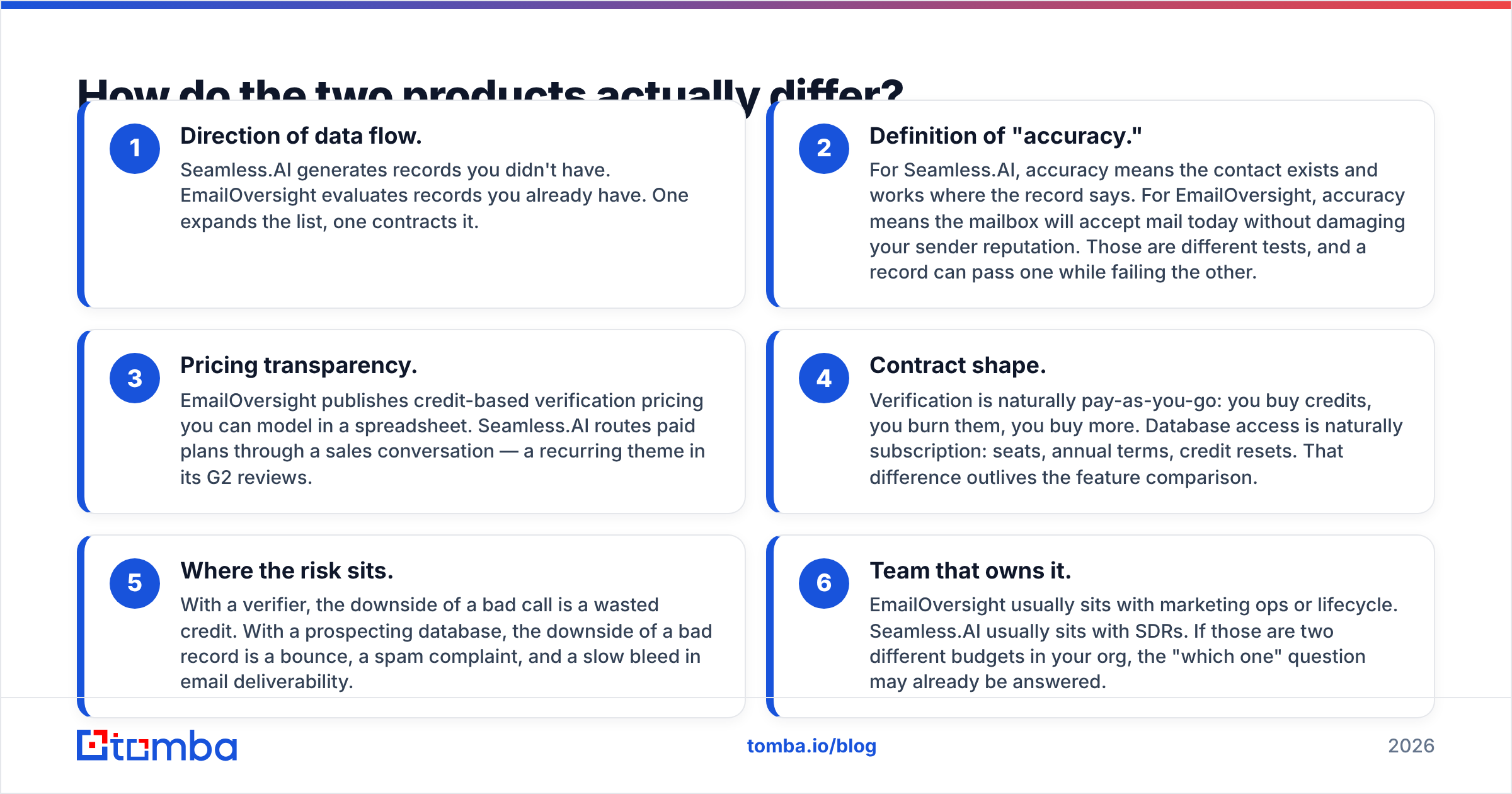
- Direction of data flow. Seamless.AI creates records you did not have. EmailOversight grades records you already have. One grows the list, one shrinks it.
- The meaning of "accuracy." For Seamless.AI, it means the contact is real and works where the record says. For EmailOversight, it means the mailbox will take mail today without hurting your sender score. Those are different tests. A record can pass one and fail the other.
- Where the risk sits. With a verifier, a bad call costs you one credit. With a database, a bad record costs you a bounce, a spam complaint, and a slow bleed in email deliverability.
Three more show up in the contract and the org chart:
- Pricing transparency. EmailOversight prints credit prices you can model in a spreadsheet. Seamless.AI routes paid plans through a sales call. That comes up often in its G2 reviews.
- Contract shape. Verification is pay-as-you-go by nature: buy credits, burn them, buy more. Database access is a subscription: seats, annual terms, credit resets. That gap outlives any feature list.
- Team that owns it. EmailOversight tends to sit with marketing ops. Seamless.AI tends to sit with SDRs. If those are two budgets in your org, the "which one" question may be settled already.

EmailOversight vs Seamless.AI: how do they compare feature by feature?#
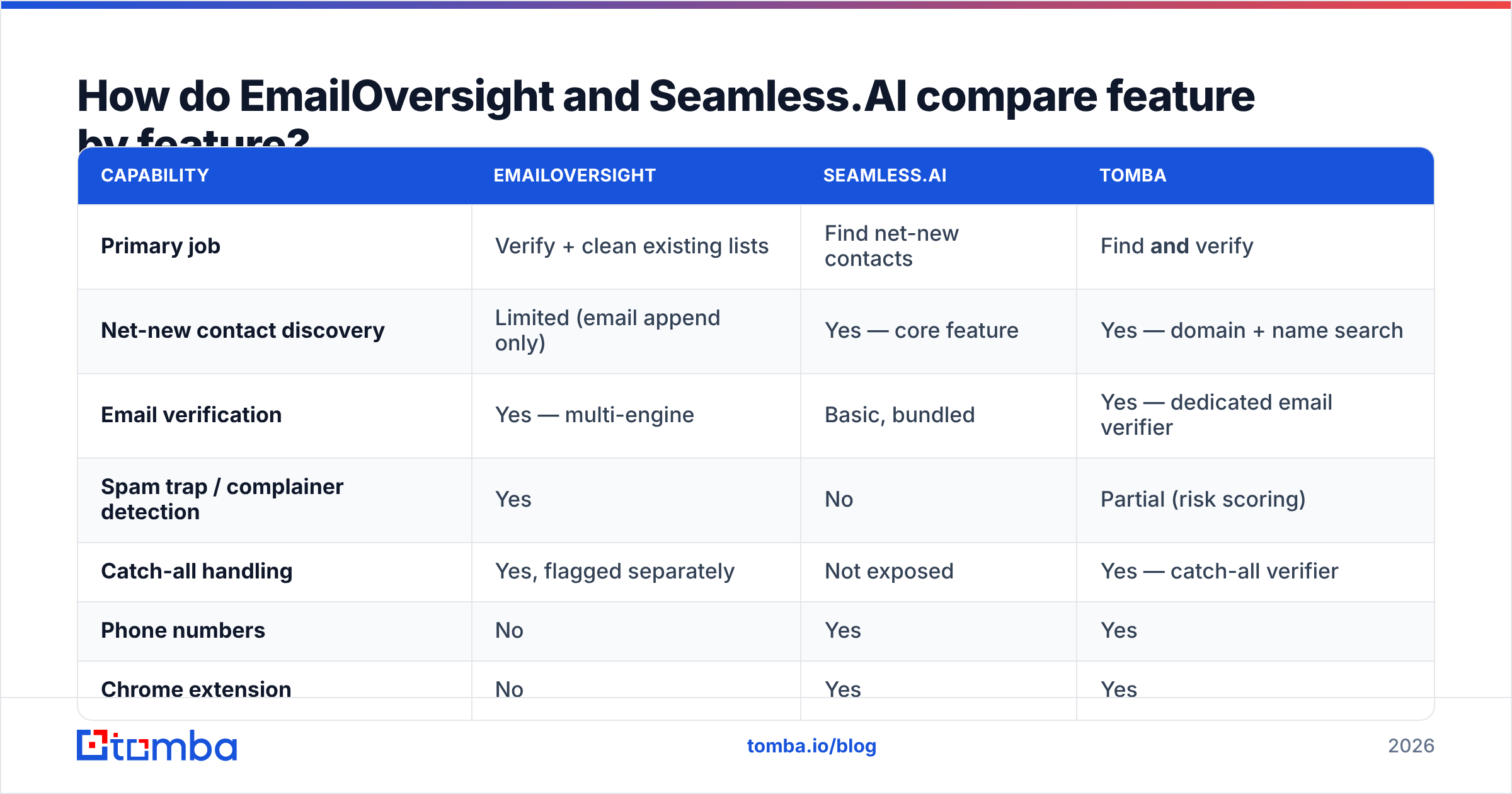
| Capability | EmailOversight | Seamless.AI | Tomba |
|---|---|---|---|
| Primary job | Verify + clean existing lists | Find net-new contacts | Find and verify |
| Net-new contact discovery | Limited (email append only) | Yes — core feature | Yes — domain + name search |
| Email verification | Yes — multi-engine | Basic, bundled | Yes — dedicated email verifier |
| Spam trap / complainer detection | Yes | No | Partial (risk scoring) |
| Catch-all handling | Yes, flagged separately | Not exposed | Yes — catch-all verifier |
| Phone numbers | No | Yes | Yes |
| Chrome extension | No | Yes | Yes |
| Public API | Yes | Yes | Yes — Tomba API |
| Published pricing | Yes (credit packs) | No — quote only | Yes — from $49/mo |
| Free tier | Trial credits | 50 credits | 25 searches/mo |
| Typical contract | Pay-as-you-go | Annual, seat-based | Monthly or annual |

The table makes the core tension clear. EmailOversight has depth on one axis and a hole on the other. Seamless.AI is broad on discovery and thin on hygiene. Buy either alone and you buy half a workflow.
Which one is more accurate?#
Wrong question — but here is the answer anyway, split by what each tool is asked to do.
On verification accuracy, EmailOversight is the stronger product. It runs an address through several engines and compares the results. That catches cases a single SMTP handshake misses: servers that greylist and time out, gateways that accept everything, and mailboxes that are live but tied to a known complainer. If you want bounce rate under 2%, this is the design you want.
On discovery accuracy, Seamless.AI is more mixed than the marketing suggests. Its engine builds records from public sources and pattern guesses. That gives broad coverage and uneven precision. Users often report exports where a real slice of addresses were guessed and never checked against a live mailbox. That is not fraud. It is how pattern-based generation works. But it means an export is a starting point, not a send-ready file.

The practical read: if you use Seamless.AI, budget for verification on top. If you use EmailOversight, budget for a source of contacts underneath. Either way you pay two line items unless you consolidate.
One more accuracy note gets skipped a lot. Catch-all domains accept mail to any address at the domain, and they break naive verifiers. EmailOversight flags them honestly instead of marking them valid. Seamless.AI does not surface catch-all status where most users will see it. If much of your ICP sits on catch-all servers — common in enterprise and in EU mid-market — that one behaviour matters more than any headline accuracy number.
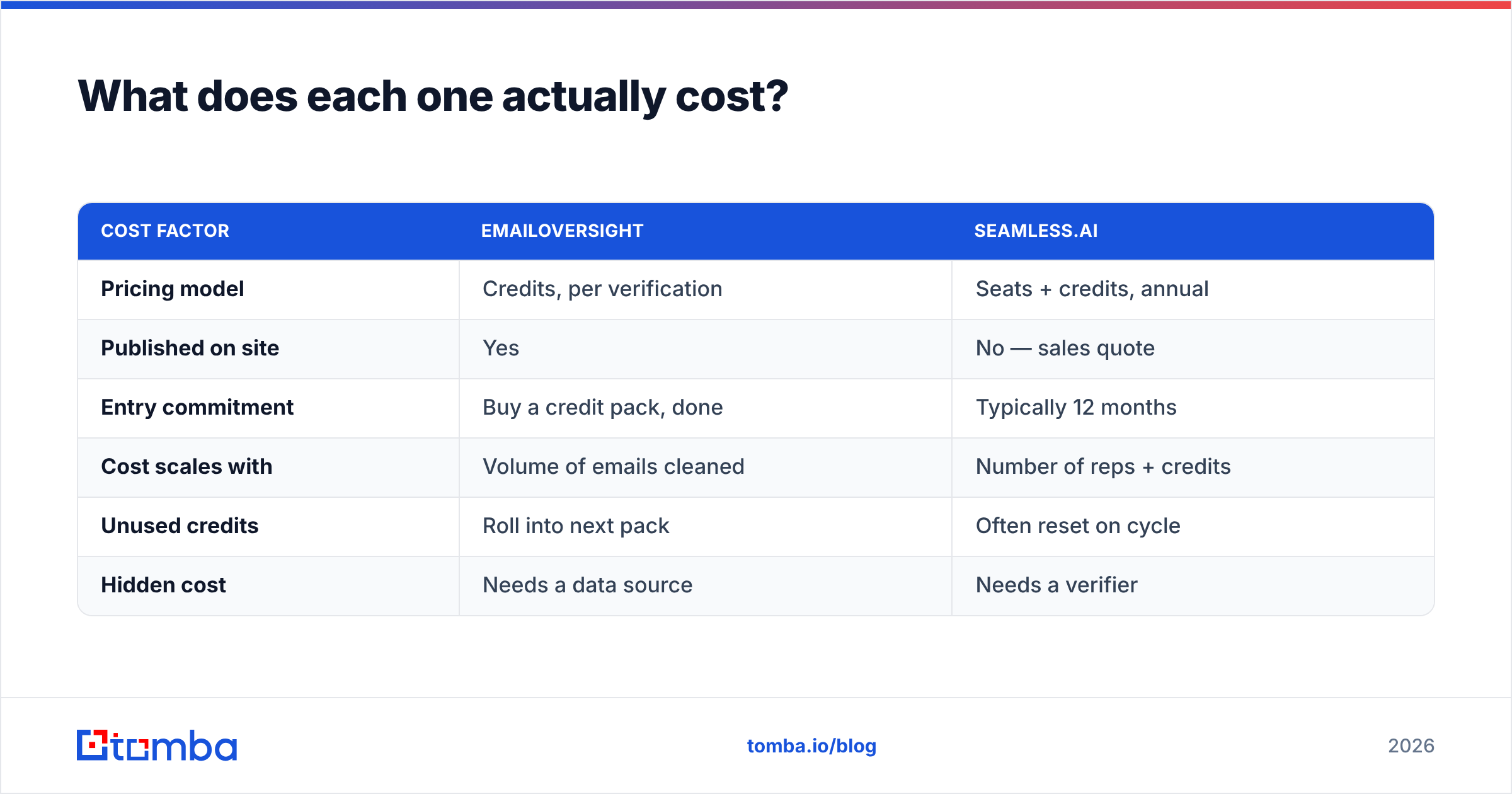
What does each one actually cost?#
| Cost factor | EmailOversight | Seamless.AI |
|---|---|---|
| Pricing model | Credits, per verification | Seats + credits, annual |
| Published on site | Yes | No — sales quote |
| Entry commitment | Buy a credit pack, done | Typically 12 months |
| Cost scales with | Volume of emails cleaned | Number of reps + credits |
| Unused credits | Roll into next pack | Often reset on cycle |
| Hidden cost | Needs a data source | Needs a verifier |
The pricing gap is the biggest decision input, and it is not about the sticker.
EmailOversight's credit model is boring in the best way. You can forecast a year of spend from a spreadsheet with two columns. When list volume drops, spend drops.
Seamless.AI's model is the one that surprises people. Paid plans come through a rep. Terms skew annual. Credits reset instead of rolling over. Teams that scale down mid-year, or that find their real usage was a third of what the rep sized, do not get that money back. Read the renewal clause before you sign, not in month eleven.
For comparison, Tomba pricing is public in full: a free tier with 25 searches a month, Starter at $49/mo, Growth at $99/mo, Pro at $249/mo, and custom Enterprise. You can test the data before anyone asks for your phone number. Most teams say they want that, and rarely get it.
Who should choose EmailOversight?#
Pick EmailOversight when your problem is a list you already own and do not trust.
Concrete signals:
- Bounce rate is above 3% and Gmail or Outlook has started to throttle you.
- You inherited a CRM with years of old contacts and no hygiene process.
- You buy or license lists and want a neutral referee before import.
- You send at high volume, and spam-trap hits carry real consequences with your ESP.
- Your ICP is already sourced. You do not need more names, you need fewer bad ones.
Where it falls short: it will not fill an empty pipeline. If your SDRs stare at a blank prospect list on Monday, EmailOversight has nothing to give them.
Who should choose Seamless.AI?#
Pick Seamless.AI when your problem is too few contacts, and your team will tolerate cleanup.
Concrete signals:
- You run a high-volume outbound motion, and several reps need fresh lists each week.
- Phone numbers matter as much as email. Dialer-heavy teams get more out of it.
- Your ICP is broad enough that coverage beats precision.
- You already own a verifier and treat export → verify → send as a fixed ritual.
- You have budget for an annual contract and a rep-led purchase.
Where it falls short: hygiene, contract flexibility, and clear pricing. If any of the three is a hard requirement, look at a Seamless.AI alternative before you sign for a year.
Where does each tool break down in real workflows?#
EmailOversight breaks down at the top of funnel. A verifier is a filter. A filter with nothing flowing into it produces nothing. Teams that buy hygiene first and sourcing second end up with a very clean list of 400 contacts and a quota built for 4,000.
Seamless.AI breaks down at the send. Push an unverified export into a sequencer and the first send teaches you what your data quality really was. Bounces cluster in the first 48 hours. Your domain reputation takes the hit. Recovery costs weeks of lower volume. The tool is not at fault — skipping the check is. But the product does not stop you, and that is a design choice worth pricing in.
Both break down on the handoff. Export from one system, upload to another, wait for a batch, re-import, then map fields into a CRM. That is four places to lose records. Every extra hop is an ops tax that shows up on neither invoice.
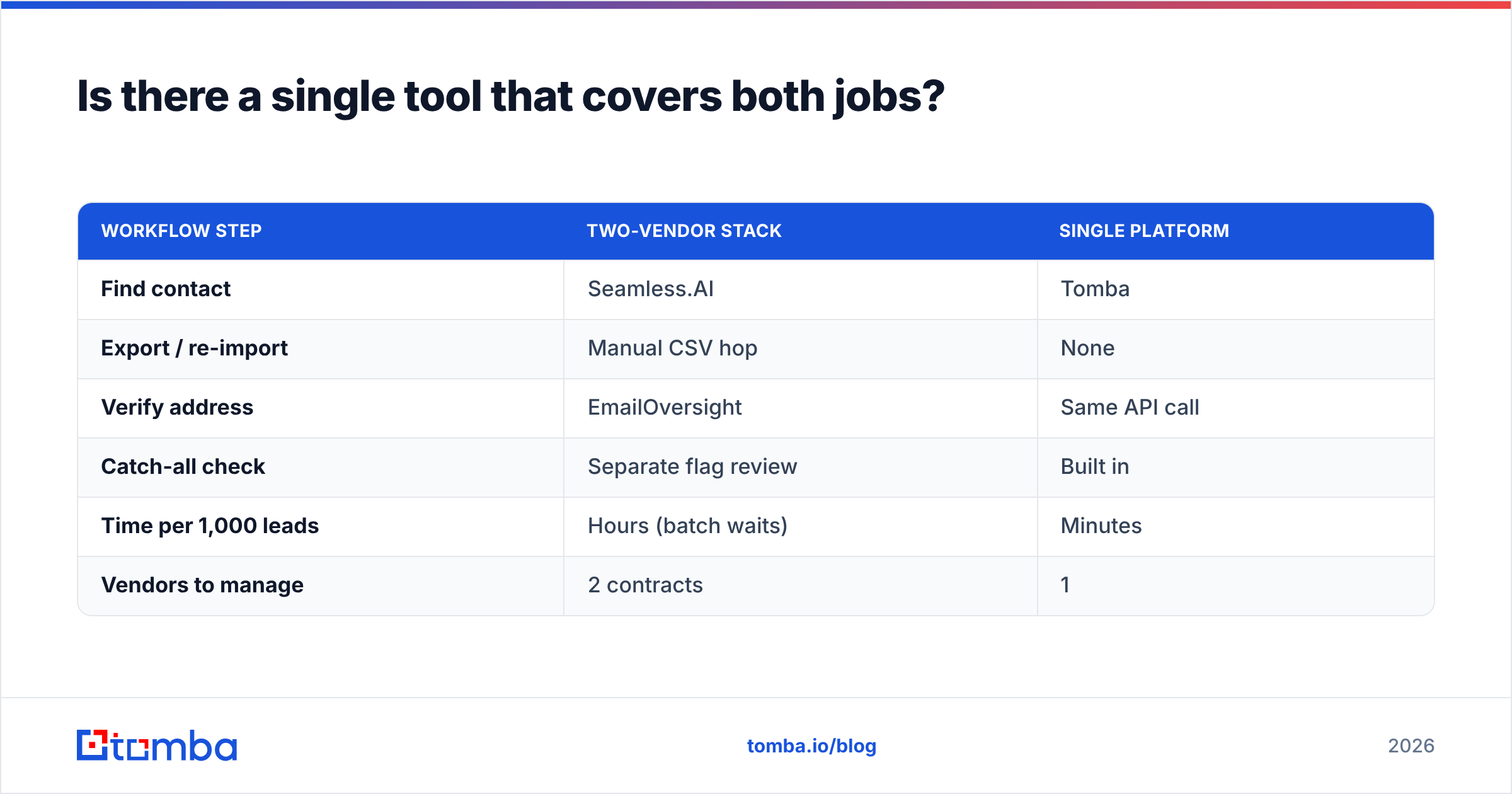
Is there a single tool that covers both jobs?#
Yes, and it is why most teams consolidate in the end.
A combined platform does discovery and verification in one call. You search by company domain or by name, get an address, and get its verification status in the same response. No export, no second vendor, no batch wait. Tomba works this way: the email finder locates the address, the verifier scores it before it reaches your sequencer, and domain search pulls every known address at a company in one query.
| Workflow step | Two-vendor stack | Single platform |
|---|---|---|
| Find contact | Seamless.AI | Tomba |
| Export / re-import | Manual CSV hop | None |
| Verify address | EmailOversight | Same API call |
| Catch-all check | Separate flag review | Built in |
| Time per 1,000 leads | Hours (batch waits) | Minutes |
| Vendors to manage | 2 contracts | 1 |
The honest caveat: a combined tool will not match a dedicated hygiene platform on complainer and litigator lists. If you mail seven figures of records a month into consumer-adjacent audiences, a specialist verifier still earns its keep. For the 95% of B2B teams sending tens of thousands of targeted emails a month, one platform covers it.
How should you decide this week?#
Run a bake-off instead of reading more comparison posts — this one included.
- Take 100 real target accounts from your actual ICP, not a demo list.
- Source contacts for them in the discovery tool you are testing. Note coverage: how many of the 100 returned a usable contact?
- Verify the output with a second tool. Note what share survives.
- Send a small batch — 200 addresses, warmed domain — and record the real bounce rate against the tool's claim.
- Multiply the gap by your annual volume. That number, not the monthly fee, is the real cost difference.
Most teams find the gap between claimed and observed accuracy is worth more than the whole subscription, in either direction. Run the test on trial credits before a rep gets you on a call.
The verdict: EmailOversight vs Seamless.AI#
EmailOversight vs Seamless.AI is not a rivalry. They are two halves of one pipeline, sold apart. Choose EmailOversight if bounce rate is the fire. Choose Seamless.AI if an empty prospect list is the fire, and accept that you will pay a verifier downstream and likely sign for twelve months.
If you would rather not run two contracts and a CSV shuttle between them, start with Tomba Email Finder. You get discovery by domain or name, verification in the same response, honest catch-all handling, and pricing you can read on the site — free for 25 searches a month, $49/mo when you scale. No quote call, no annual lock-in, and no surprise on renewal day.
Related guides#
Ready to find emails that actually work?
Join 150,000+ professionals who stopped guessing and started sending. Free credits on signup — no credit card required.
Get the Tomba newsletter
Practical outbound tactics and product updates — once every two weeks.
About the author