EmailValidation.io vs SMARTe: Which Data Tool Wins in 2026?
One cleans lists you already have. The other builds lists you don't. Here's how EmailValidation.io and SMARTe actually differ on accuracy, pricing, coverage, and API depth — plus when neither is the right buy.
EmailValidation.io vs SMARTe is not the matchup it looks like. One tool cleans the emails you already own. The other sells you emails you do not have yet. Here is how to pick the right one — and when to skip both.
TL;DR
- They are not really competitors. EmailValidation.io is a verification API. It tells you whether an address you already have is deliverable. SMARTe is a B2B contact-data platform. It hands you addresses and phone numbers you did not have.
- Pick EmailValidation.io if your problem is bounce rate, list hygiene, or signup-form fraud, and you want a thin, cheap, single-purpose API.
- Pick SMARTe if your problem is pipeline coverage. You need contacts at target accounts, with mobile numbers and non-US reach.
- Buying both is common and expensive. A combined find-plus-verify platform usually beats two point tools on cost per usable contact.
- The real benchmark is not the "accuracy %" on a vendor page. It is your own 500-row test file, run through both tools and scored on bounce rate and reply rate.
EmailValidation.io vs SMARTe: what does each tool do?#
Start with the category confusion. It is the reason most teams end up unhappy with one of these tools.
EmailValidation.io is an email verification API. You send it an address. It runs syntax parsing, domain and MX checks, disposable-domain detection, role-account detection, free-provider detection, and an SMTP-level mailbox probe. It returns a clear verdict: valid, invalid, unknown, or a set of flags you read yourself.
There is a free tier for low-volume testing, and usage-based paid plans above it. There is no contact database behind it. It cannot tell you the email address of a VP of Engineering at a company. It can only tell you whether the address you guessed will bounce.
SMARTe sits at the other end of the funnel. It is a B2B go-to-market data provider: a contact and company database with a Chrome extension, CRM integrations, and a focus on direct dials. Coverage outside the US is the selling point, and EMEA and APAC are where many US-centric databases thin out.
You search by company, title, geography, or tech stack, then export contacts. Verification lives inside SMARTe as a quality layer on its own data. It is not a service you can point at a list you bought somewhere else.
So the honest framing of EmailValidation.io vs SMARTe is cleaning versus sourcing. The two only meet because both show up in the same buying talk: "we need better email data." That phrase means two different things, and it depends on which end of your funnel is broken.
Five questions that tell you which category you need#
- Do you already have the addresses? If yes, you have a verification problem. If no, you have a sourcing problem.
- Is your bounce rate above 3%? That is a hygiene issue, and verification fixes it. Below 2%, your money is better spent on coverage.
- Are reps spending more than an hour a day hunting for contacts? That is a database problem, not a validation problem.
- Do you need phone numbers? Verification APIs never provide them. Data platforms do, with hit rates that vary a lot.
- Do you need non-US coverage? North American data is a commodity. EMEA and APAC direct dials are where providers separate.
Answer "both" to questions 1 and 3 and you are looking at two subscriptions, unless you consolidate. Most outbound teams answer "both."
EmailValidation.io vs SMARTe: a feature-by-feature comparison#
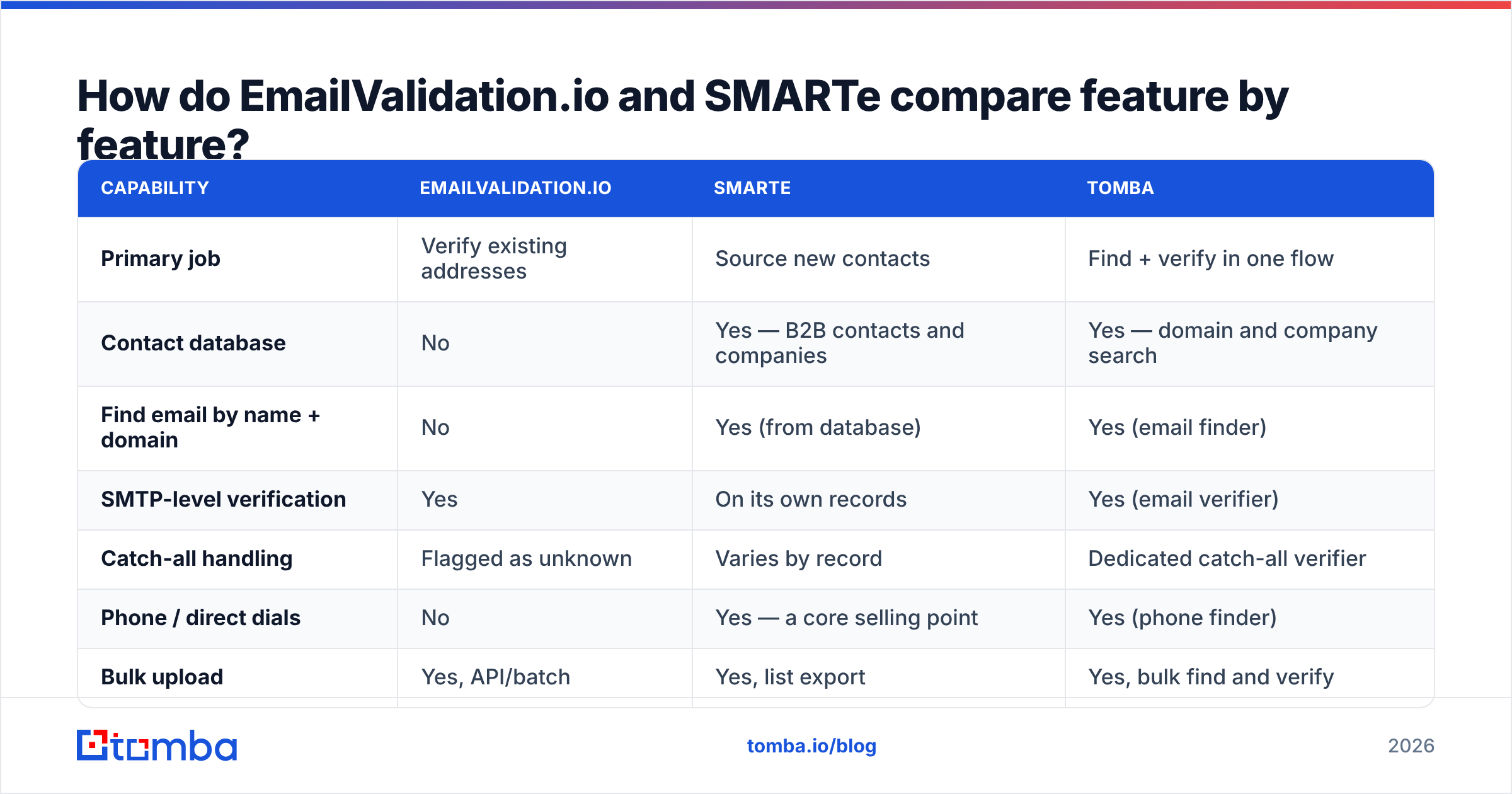
Here is the side-by-side, with a consolidated option in the third column. It shows what buying both looks like next to buying one platform that does find and verify.
| Capability | EmailValidation.io | SMARTe | Tomba |
|---|---|---|---|
| Primary job | Verify existing addresses | Source new contacts | Find + verify in one flow |
| Contact database | No | Yes — B2B contacts and companies | Yes — domain and company search |
| Find email by name + domain | No | Yes (from database) | Yes (email finder) |
| SMTP-level verification | Yes | On its own records | Yes (email verifier) |
| Catch-all handling | Flagged as unknown | Varies by record | Dedicated catch-all verifier |
| Phone / direct dials | No | Yes — a core selling point | Yes (phone finder) |
| Bulk upload | Yes, API/batch | Yes, list export | Yes, bulk find and verify |
| Public REST API | Yes — the whole product | Yes, on higher tiers | Yes, full API |
| Spreadsheet add-ons | No | CRM-first | Sheets, Excel, Airtable |
| Free tier | Yes, limited monthly requests | Trial credits, sales-gated | 25 searches/mo, no card |
| Entry paid price | Low, usage-based | Sales-quoted seat/credit plans | $49/mo Starter |
| Best for | Devs, signup forms, list hygiene | AEs and SDRs needing coverage | Teams doing both at one price |

Two things jump out of that table.
First, the overlap is nearly zero. EmailValidation.io wins on API ergonomics and price per check. SMARTe wins on everything that needs owned data. Nobody should agonise over the pick. Diagnose the problem you have, then buy for it.
Second, the combined cost is where the decision gets made. A verification API plus a sales-quoted data platform lands most 3–5 seat teams well into four figures a year. That is before anyone sends a single email. Consolidated tools exist to exploit that gap.
EmailValidation.io vs SMARTe accuracy: how would you know?#
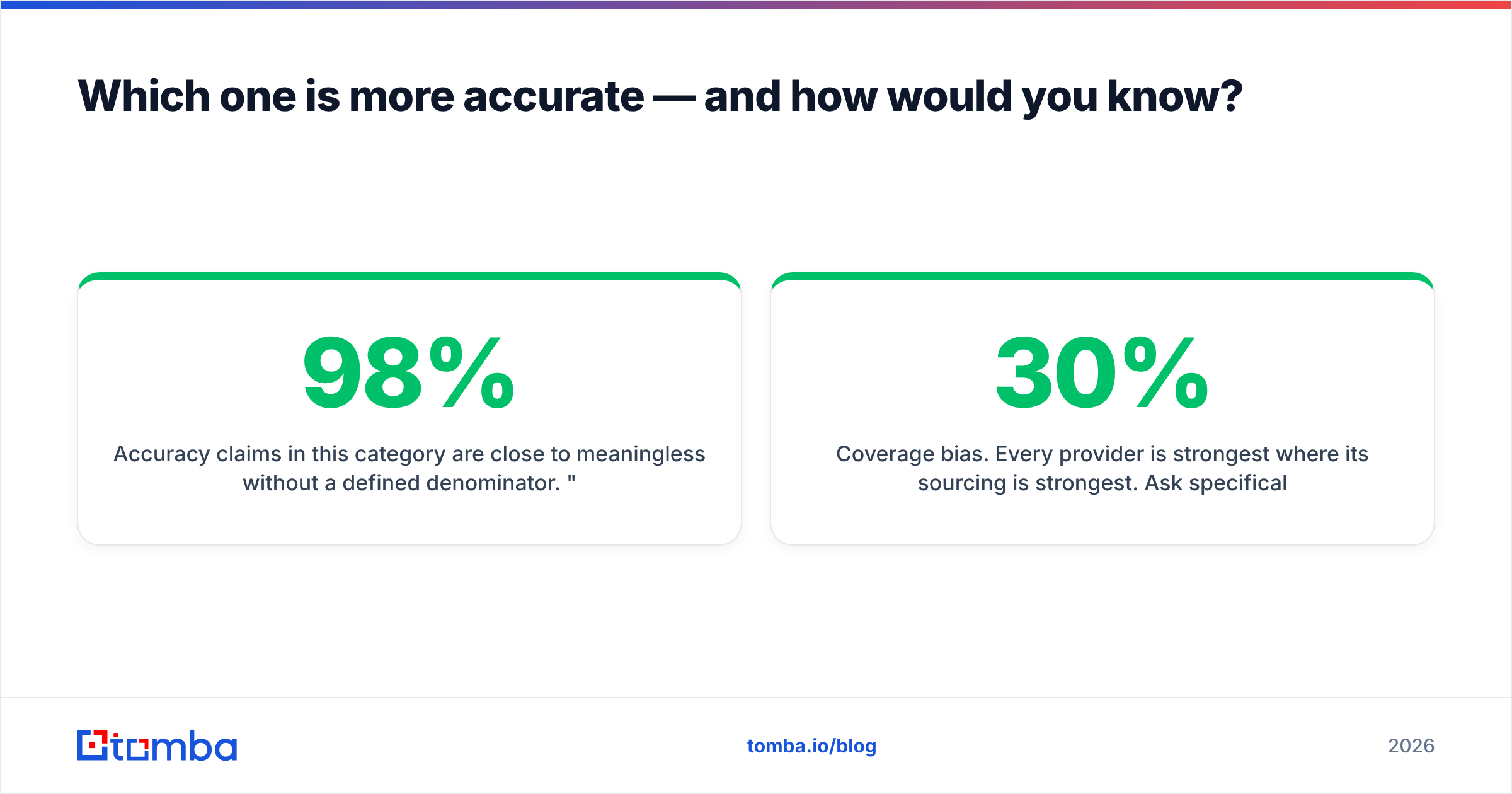
Accuracy claims in this market mean little without a stated denominator. "98% accurate" can mean three things. It can mean 98% of the verdicts the vendor felt sure about were right. It can mean 98% of deliverable addresses were flagged correctly. It can mean 98% of a sample list the vendor picked. Those are very different numbers.

What actually moves your bounce rate:
- Catch-all handling. About a fifth of B2B domains accept mail for any address, so a probe cannot tell a real inbox from a black hole. EmailValidation.io flags these as unknown. That is correct, and annoying, because "unknown" rows are the rows reps want. A dedicated catch-all finder adds pattern confidence on top of the SMTP result.
- Freshness, not correctness. A record can be well formed and still dead, because the person changed jobs eight months ago. This is SMARTe's real battleground. Test it with recent hires and recent leavers.
- Greylisting and rate limits. Large mail providers throttle SMTP probes, and some feed them false answers. Any verifier claiming exact results at Google Workspace scale is overselling.
- Coverage bias. Every provider is strongest where its sourcing is strongest. Ask about your ICP's geography and company size. A vendor that shines for US SaaS may cover 30% of small EU manufacturers.
The only test that counts takes an afternoon. Pull 500 rows from your real ICP and split them 250/250. Run one half through each tool. Send a small, warmed campaign. Then compare hard bounce rate and reply rate. Vendor benchmarks are marketing. Your bounce log is data. To spot-check a few rows without burning credits, a free email checker is enough.
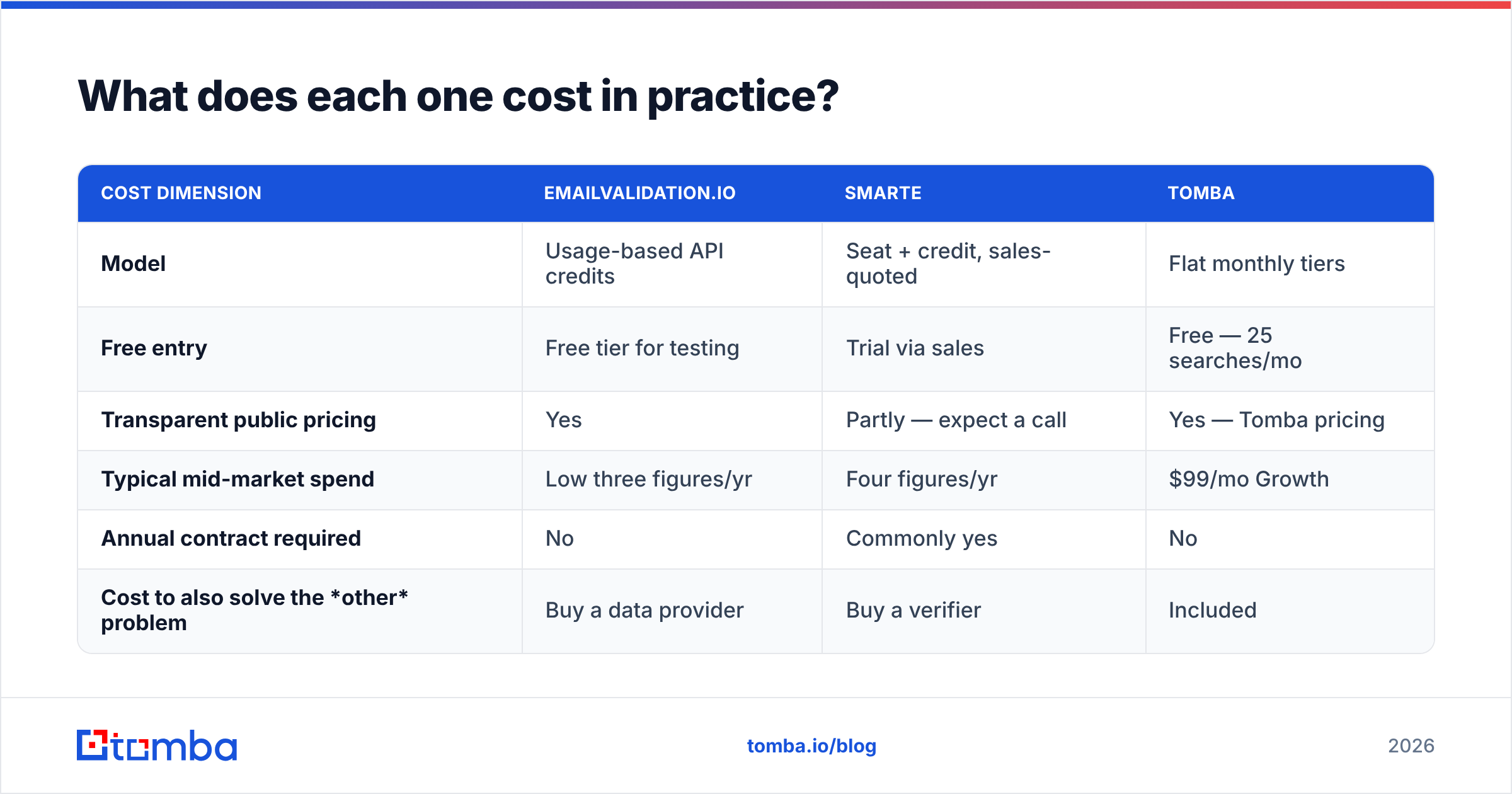
What does each one cost in practice?#
Pricing models differ enough that a per-month comparison misleads. Compare cost per usable contact instead. That is the price of everything you had to buy to get one verified, reachable person into a sequence.
| Cost dimension | EmailValidation.io | SMARTe | Tomba |
|---|---|---|---|
| Model | Usage-based API credits | Seat + credit, sales-quoted | Flat monthly tiers |
| Free entry | Free tier for testing | Trial via sales | Free — 25 searches/mo |
| Transparent public pricing | Yes | Partly — expect a call | Yes — Tomba pricing |
| Typical mid-market spend | Low three figures/yr | Four figures/yr | $99/mo Growth |
| Annual contract required | No | Commonly yes | No |
| Cost to also solve the other problem | Buy a data provider | Buy a verifier | Included |
The pattern most teams hit is simple. EmailValidation.io is cheap and stays cheap, because a verification check is a commodity. SMARTe is priced like an enterprise data subscription, because owning and refreshing contact data costs real money. Neither is wrong.
But say your budget talk is "we need contact data and clean lists for under $150 a month." The two-vendor path is off the table before it starts. That is the point where EmailValidation.io vs SMARTe stops being a choice and turns into a hunt for a third option.

Who should choose EmailValidation.io?#
This is the cleaning half of EmailValidation.io vs SMARTe. Buy it if you recognise yourself here:
- You are a developer, not an SDR. You want one endpoint, predictable JSON, no seat licences, and no UI to onboard anyone into.
- Your problem is inbound, not outbound. You block throwaway addresses at signup, dedupe a marketing list, or clean a CRM import before it harms your sender reputation.
- You already have a data source. Maybe a partner list, a conference export, a scraped dataset, or a database you already pay for. You just do not trust it.
- Volume is spiky. Usage-based pricing beats seats when you verify 200,000 rows in March and nothing in April.
Where it will frustrate you: it will never grow into a prospecting tool. The day your CEO asks for "a list of every RevOps leader at Series B fintechs in Germany," EmailValidation.io has nothing to offer.
Who should choose SMARTe?#
This is the sourcing half of EmailValidation.io vs SMARTe. Buy it if:
- Coverage is your bottleneck. Reps cannot find contacts at target accounts, and the ones they find are stale.
- You call as well as email. Direct dials are a real differentiator, and free tools are useless here. Any cold calling motion with a sub-10% connect rate is proof.
- Your ICP is international. EMEA and APAC coverage is a fair reason to pay more than the US-only price.
- You are CRM-first. SDRs who live in Salesforce or HubSpot want enrichment where they already work, not a separate tab.
Where it will frustrate you: pricing is sales-gated, contracts are usually annual, and you still cannot point it at an outside list and get a clean bounce verdict. Buyers who want a self-serve, published price often shortlist Clearbit alternatives or a prepaid-list provider like BookYourData. That is a good fit when you would rather buy a one-time targeted list than sign a subscription.
Is there a third option that does both?#
Yes. And it is worth being direct about the trade-off, rather than pretending consolidation is free.
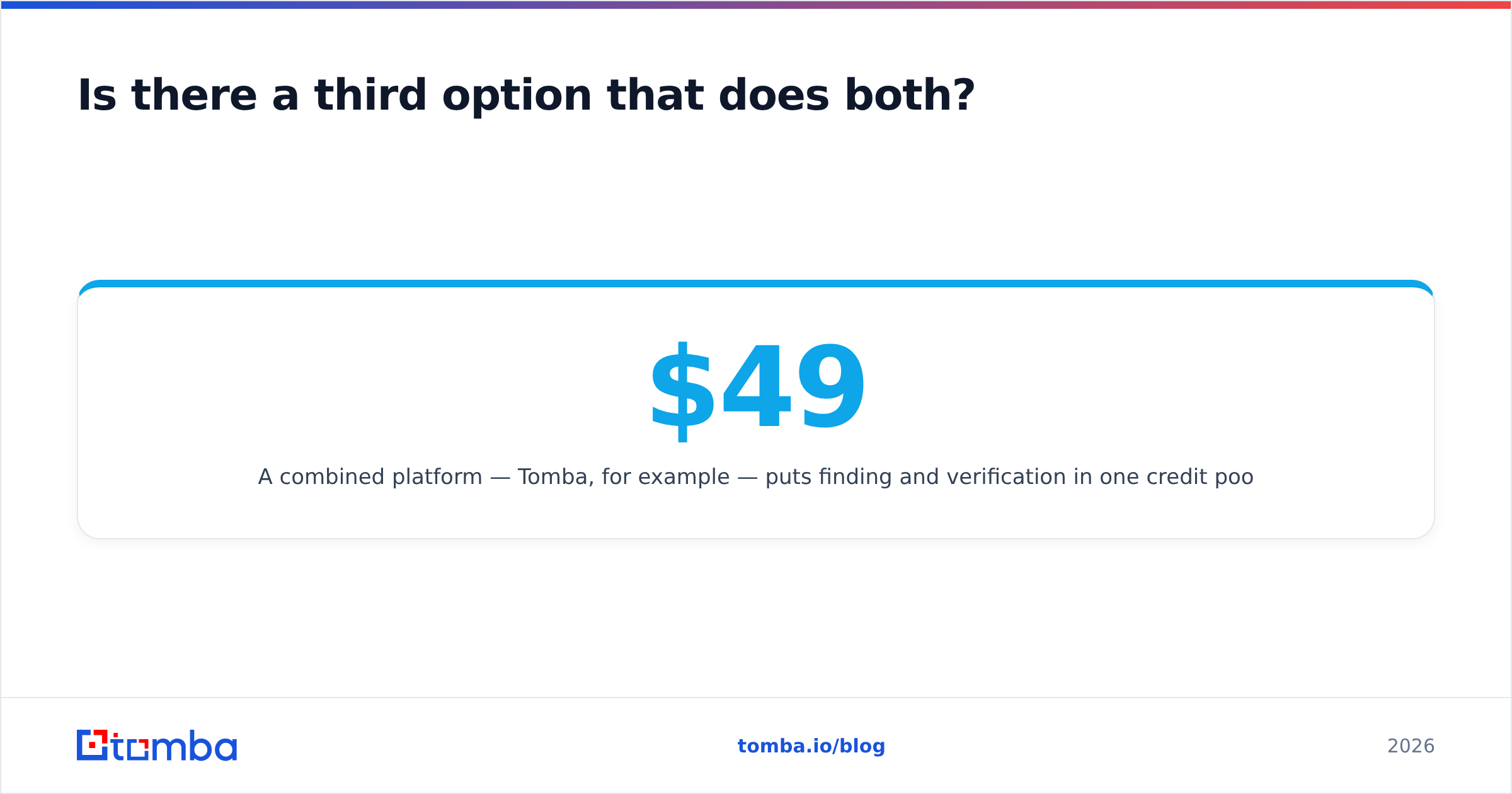
A combined platform — Tomba, for example — puts finding and verification in one credit pool. You get domain search to pull every published address at a company, an email finder for name-plus-domain lookups, an SMTP verifier with explicit catch-all handling, phone lookup, and data enrichment to fill in the rest. Pricing is published: a free tier at 25 searches a month, Starter at $49/mo, Growth at $99/mo, and Pro at $249/mo. No sales call to see a number.
The honest trade-off: a generalist rarely beats a specialist on the specialist's home turf. A pure verification API handles odd edge cases and huge volumes with more control. A pure data platform with heavy direct-dial spend will out-cover a generalist on mobile numbers in some regions. What you get in exchange is one bill, one API, one credit pool, and no clean-up work between two datasets that disagree about the same person.
For most teams under 20 reps, that trade is worth making. Above that, it is fair to run a specialist data provider next to a cheap verification API. That holds double if you have a data ops function and region-specific coverage needs.
How do you run a fair one-week bake-off?#
Do not buy on a demo. Run this instead. It settles EmailValidation.io vs SMARTe with your own data, in a week.
- Build the test file. Take 500 rows from your real ICP, not a clean sample. Include recent job-changers, catch-all domains, and one fringe geography.
- Hold back a control. Keep 100 rows you verify by hand. That is your ground truth.
- Run both tools on the same rows. Log coverage and confidence apart. A tool that returns fewer results but zero bounces may be the better buy.
- Send real mail. Use 50 addresses per tool, from a warmed domain, with the same copy. Track hard bounces at 48 hours and replies at 7 days.
- Score cost per reply, not cost per credit. Divide total spend by replies. The cheapest credits routinely lose this maths.
- Check the integration tax. A tool that needs a weekly CSV ritual costs more than its invoice says. Compare integrations first.
Publish the scorecard internally. It kills the "but I like the UI" argument, and it gives you leverage at renewal.
EmailValidation.io vs SMARTe: frequently asked questions#
Can EmailValidation.io find email addresses? No. It validates addresses you supply. Pair it with a finder, or use a tool that does both.
Does SMARTe verify emails from external lists? Verification applies to its own database records. It is not a general-purpose verification API for lists you sourced elsewhere.
Which has the better GDPR posture? Both publish compliance documents. A database provider carries more duty, because it holds personal data at rest. Read the DPA, and check reviews on G2 before you assume parity.
Will verification alone fix my deliverability? No. Verification prevents bounce-driven damage. Authentication, warmup, volume pacing, and copy quality do the rest — see email deliverability for the full checklist.
Is a free tier enough to evaluate? For verification, usually yes. For contact data, no. Free credits are too few to measure coverage on your ICP.
The bottom line#
EmailValidation.io vs SMARTe comes down to one sentence: "we need better contact data." One tool makes the addresses you have trustworthy. The other gives you addresses you never had. If you only have one of those problems, buy the specialist and move on.
If you have both, and you are not ready to sign two contracts, start with the Tomba Email Finder. Find the address, verify it, check the catch-all, and pull the phone number in one flow. The price is published, and 25 free searches let you test against your own list first. Run the bake-off above. Let your bounce log pick the winner.
Related guides#
Ready to find emails that actually work?
Join 150,000+ professionals who stopped guessing and started sending. Free credits on signup — no credit card required.
Get the Tomba newsletter
Practical outbound tactics and product updates — once every two weeks.
About the author