EmailVerify.io vs Seamless.AI: Honest 2026 Comparison
One cleans lists, the other builds them. A neutral breakdown of EmailVerify.io vs Seamless.AI on accuracy, pricing, contracts, and which one your outbound stack actually needs in 2026.
TL;DR
- EmailVerify.io and Seamless.AI are not really competitors. One is a bulk verification service that cleans a list you already have; the other is a contact database that generates the list in the first place.
- EmailVerify.io wins on price transparency and pay-as-you-go credits. Seamless.AI wins on volume of records and CRM integrations, but its pricing is quote-only and its contracts are the most common complaint in public reviews.
- If you buy Seamless.AI, you will still need a verifier before you send. If you buy EmailVerify.io, you will still need a source of contacts.
- Accuracy claims from both vendors are self-reported. Test 200 known-good contacts on your own ICP before you sign anything.
- A combined finder + verifier (Tomba, Hunter, Findymail) usually costs less than running two separate vendors, and removes the handoff step entirely.
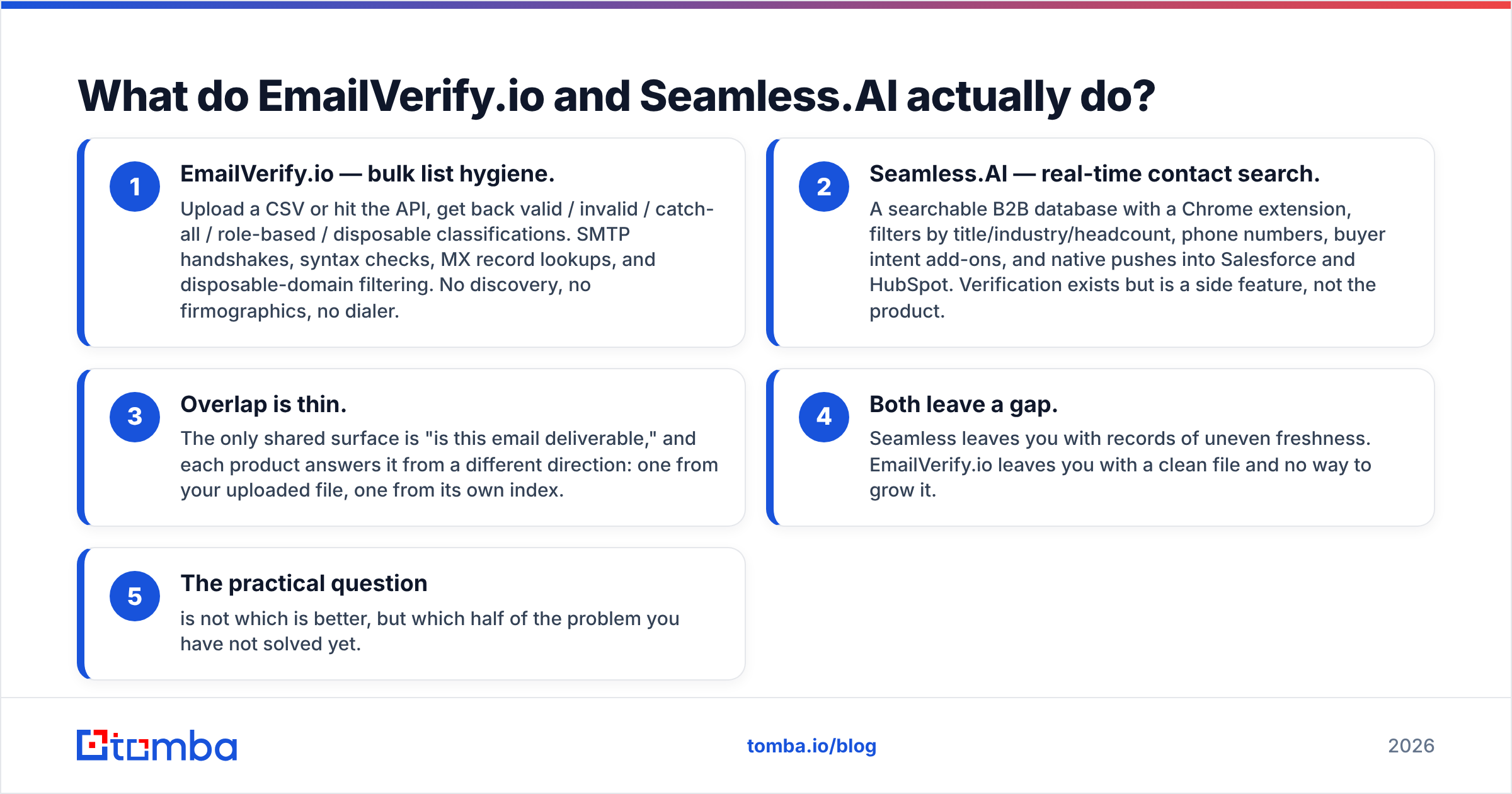
What do EmailVerify.io and Seamless.AI actually do?#
Think of it like buying groceries. Seamless.AI is the supermarket: it stocks millions of items and you fill your cart. EmailVerify.io is the food inspector: it does not sell you anything, it tells you what is spoiled before you cook with it.
That distinction matters because most "EmailVerify.io vs Seamless.AI" searches come from someone with a budget line for one tool and a vague sense that both "do emails." They do not overlap much:
- EmailVerify.io — bulk list hygiene. Upload a CSV or hit the API, get back valid / invalid / catch-all / role-based / disposable classifications. SMTP handshakes, syntax checks, MX record lookups, and disposable-domain filtering. No discovery, no firmographics, no dialer.
- Seamless.AI — real-time contact search. A searchable B2B database with a Chrome extension, filters by title/industry/headcount, phone numbers, buyer intent add-ons, and native pushes into Salesforce and HubSpot. Verification exists but is a side feature, not the product.
- Overlap is thin. The only shared surface is "is this email deliverable," and each product answers it from a different direction: one from your uploaded file, one from its own index.
- Both leave a gap. Seamless leaves you with records of uneven freshness. EmailVerify.io leaves you with a clean file and no way to grow it.
- The practical question is not which is better, but which half of the problem you have not solved yet.
Replace that mental model before you compare feature lists, or you will end up paying for a database when your real problem was a 22% bounce rate.

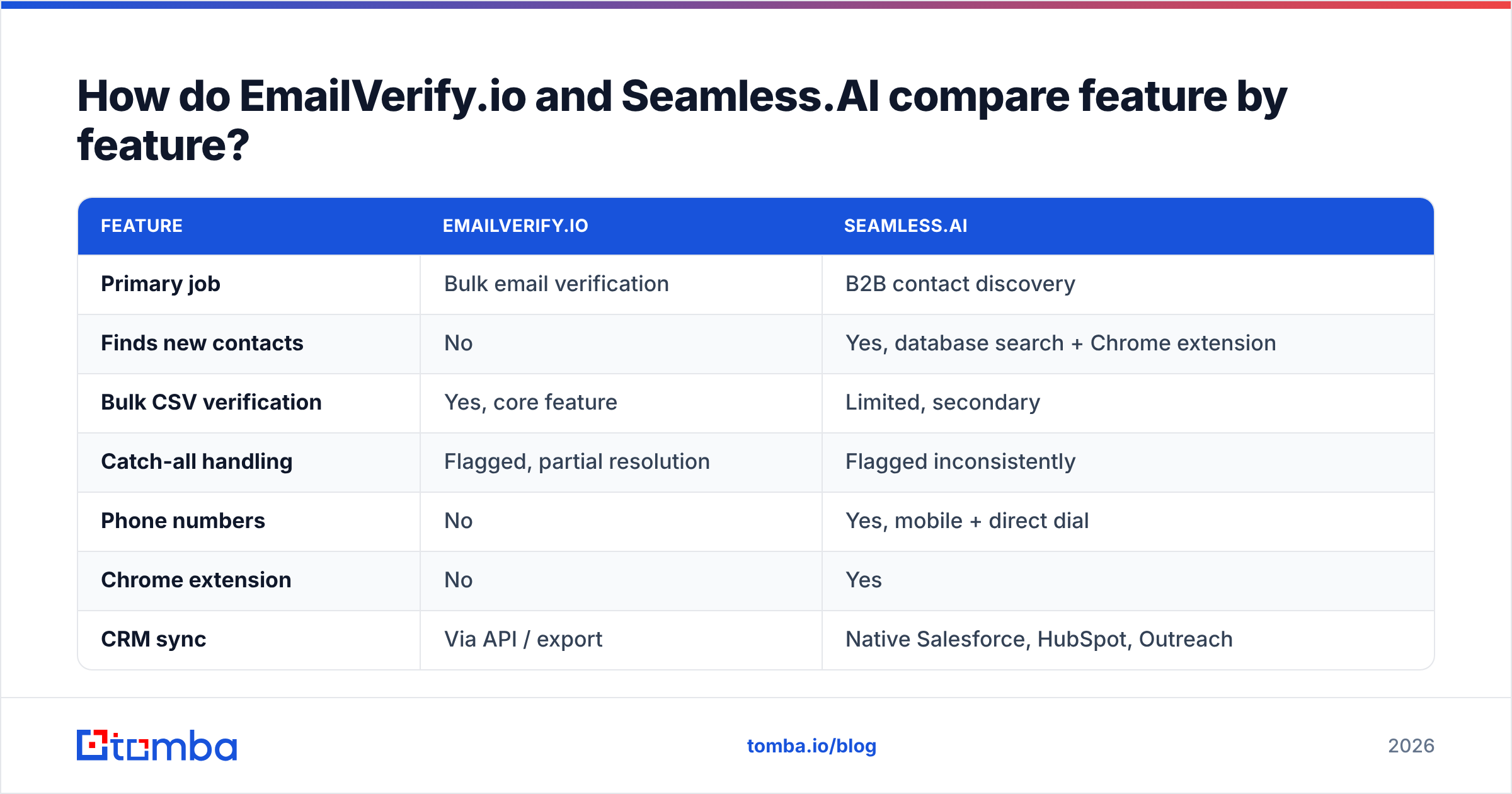
How do EmailVerify.io and Seamless.AI compare feature by feature?#
Here is the head-to-head on the attributes that actually change your workflow. Figures reflect publicly listed information at the time of writing — both vendors change packaging often, so confirm on their own pages before you buy.
| Feature | EmailVerify.io | Seamless.AI |
|---|---|---|
| Primary job | Bulk email verification | B2B contact discovery |
| Finds new contacts | No | Yes, database search + Chrome extension |
| Bulk CSV verification | Yes, core feature | Limited, secondary |
| Catch-all handling | Flagged, partial resolution | Flagged inconsistently |
| Phone numbers | No | Yes, mobile + direct dial |
| Chrome extension | No | Yes |
| CRM sync | Via API / export | Native Salesforce, HubSpot, Outreach |
| Pricing model | Pay-as-you-go credits + subscriptions | Annual contract, quote-only |
| Free tier | Small trial credit pack | 50 credits, gated by demo in many regions |
| API | Yes, REST | Yes, on higher tiers |
| Best for | Cleaning lists before send | Building lists from scratch |

Two rows deserve extra attention.
Catch-all handling. A catch-all domain accepts every address at the SMTP layer, so a standard verifier cannot prove a mailbox exists. Verifiers that simply mark these "unknown" hand the risk back to you. If a meaningful slice of your target accounts are enterprise domains, catch-all logic is the single most valuable thing a verifier can do, and it is worth testing specifically with a catch-all verifier against a sample of known-good addresses.
Pricing model. EmailVerify.io publishes credit packs you can buy with a card. Seamless.AI routes you through a sales conversation and, in most public accounts, an annual commitment. Neither approach is wrong, but they suit very different buyers. A three-person agency that verifies 20,000 addresses a quarter should not be signing a twelve-month SaaS contract.
How accurate is each tool in practice?#
Both vendors quote high accuracy numbers. Treat every self-reported figure — from either company, and from Tomba too — as marketing until you have run your own sample.

The two products fail in different ways, which is why a single "accuracy %" is misleading:
- EmailVerify.io failures are false negatives and unknowns. Strict SMTP probing against providers that throttle or greylist can return "unknown" on perfectly valid mailboxes. You lose reachable contacts rather than burn your domain. That is the safer failure mode.
- Seamless.AI failures are stale records. Its index is large and refreshed continuously, but public reviews on G2 repeatedly mention job-change decay and generic
info@style addresses eating credits. That is the expensive failure mode, because you only find out when the bounce lands.
Run this test before committing to either. It takes an afternoon:
- Pull 200 contacts you already know are live — customers, partners, people who replied last quarter.
- Strip the email column and feed the names + domains to the discovery tool. Measure hit rate against the known truth.
- Take a second list of 200 addresses with a known mix of valid, dead, and catch-all, and run it through the verifier. Measure how many valid addresses come back "unknown."
- Compare cost per confirmed correct record, not cost per credit. A cheaper credit that returns "unknown" costs you more.
That last point is where a lot of budgets quietly leak. If a tool charges you for every lookup but only resolves 60% of them, your effective price per usable contact is 66% higher than the sticker.
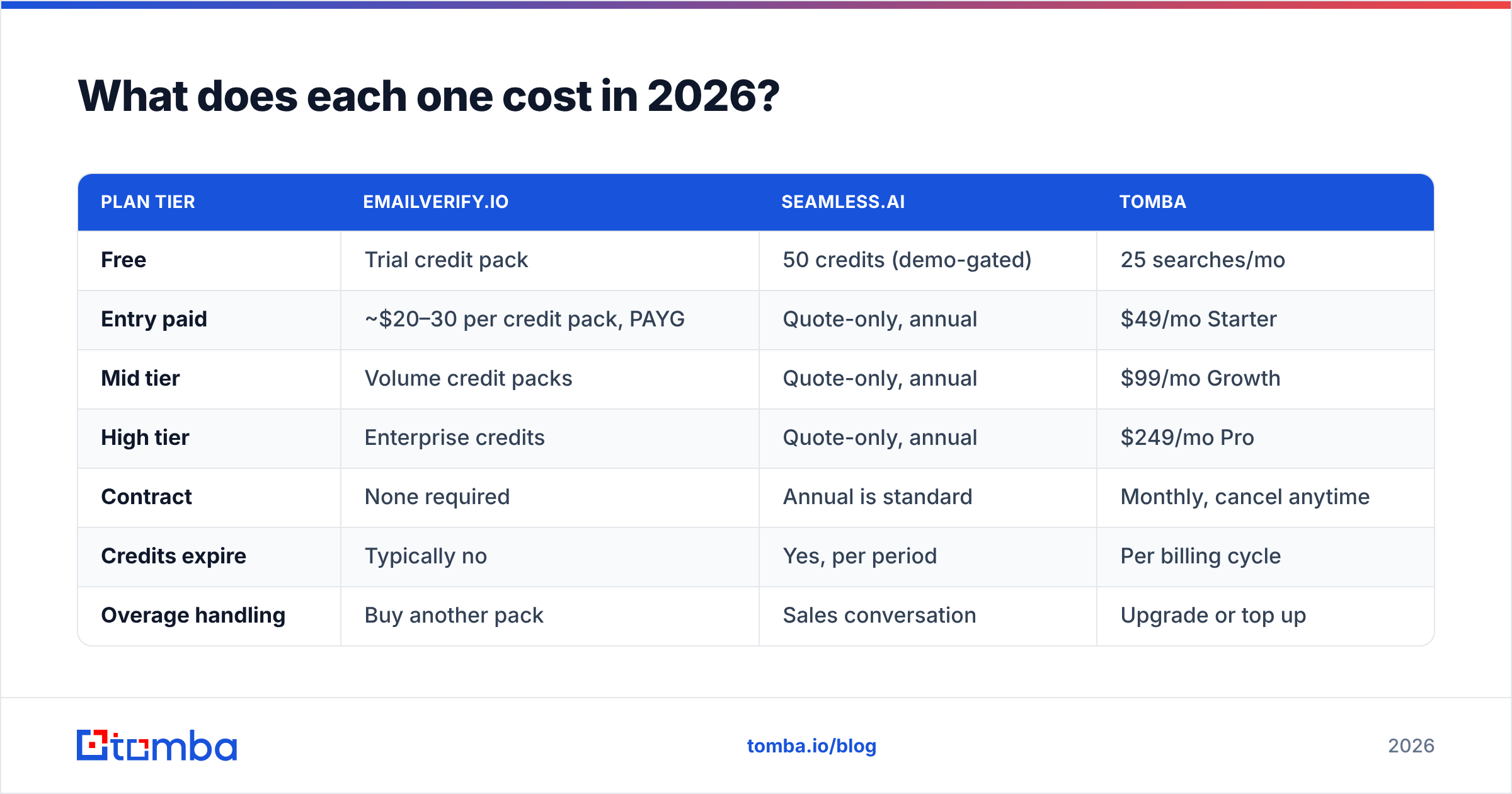
What does each one cost in 2026?#
| Plan tier | EmailVerify.io | Seamless.AI | Tomba |
|---|---|---|---|
| Free | Trial credit pack | 50 credits (demo-gated) | 25 searches/mo |
| Entry paid | ~$20–30 per credit pack, PAYG | Quote-only, annual | $49/mo Starter |
| Mid tier | Volume credit packs | Quote-only, annual | $99/mo Growth |
| High tier | Enterprise credits | Quote-only, annual | $249/mo Pro |
| Contract | None required | Annual is standard | Monthly, cancel anytime |
| Credits expire | Typically no | Yes, per period | Per billing cycle |
| Overage handling | Buy another pack | Sales conversation | Upgrade or top up |
The structural difference is more important than the numbers. EmailVerify.io credits behave like prepaid fuel: buy what you need, use it when you need it. Seamless.AI behaves like a gym membership: you commit for the year and the value depends entirely on whether you actually show up every month.
Ask any quote-only vendor these four questions in writing before you sign:
- Do credits roll over? If not, seasonal outbound teams overpay for eleven months.
- What counts as a credit? Some vendors charge for a search that returns nothing.
- What is the renewal notice window? Auto-renew with a 60-day notice period is the most common complaint pattern in review sites for this category.
- Can I export what I paid for? Some contracts restrict bulk export of records after cancellation.
If you want a reference point for what non-negotiated, published-on-the-website pricing looks like in this space, the Tomba pricing page lists every tier with no demo call attached. Whether or not Tomba is the right fit, use it as a benchmark for what you should be paying per confirmed contact.
Which one should you pick for your workflow?#
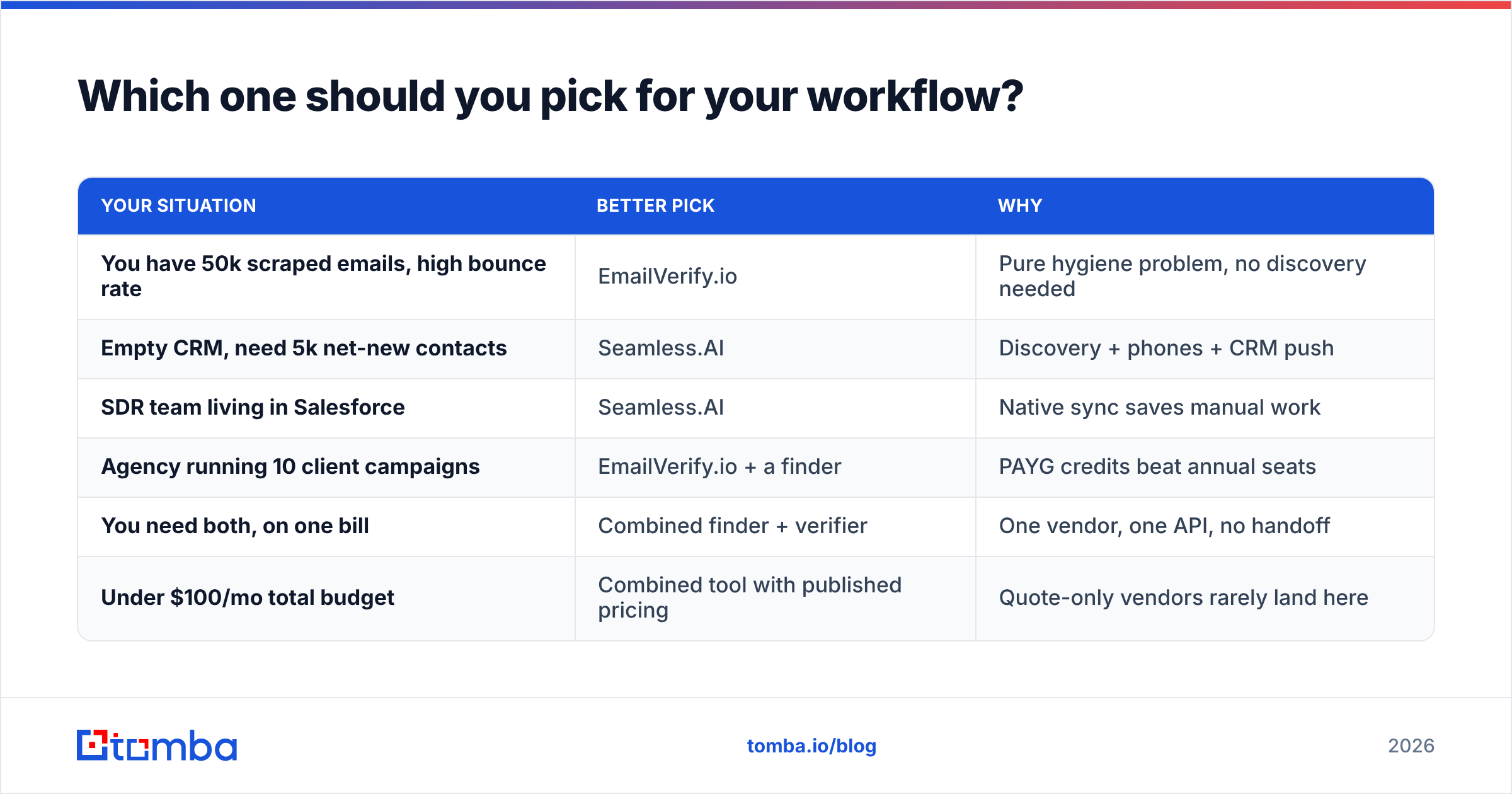
Match the tool to the bottleneck, not to the feature list.
| Your situation | Better pick | Why |
|---|---|---|
| You have 50k scraped emails, high bounce rate | EmailVerify.io | Pure hygiene problem, no discovery needed |
| Empty CRM, need 5k net-new contacts | Seamless.AI | Discovery + phones + CRM push |
| SDR team living in Salesforce | Seamless.AI | Native sync saves manual work |
| Agency running 10 client campaigns | EmailVerify.io + a finder | PAYG credits beat annual seats |
| You need both, on one bill | Combined finder + verifier | One vendor, one API, no handoff |
| Under $100/mo total budget | Combined tool with published pricing | Quote-only vendors rarely land here |
Pick EmailVerify.io if: your list-building is already handled — inbound forms, event scans, a scraper, a data partner — and your problem is deliverability. Pair it with proper authentication; a clean list will not save you if your SPF record is broken. Google's and Microsoft's bulk-sender requirements now enforce authentication and complaint-rate thresholds regardless of how clean your list is, so verification is necessary but not sufficient.
Pick Seamless.AI if: you are staffing an SDR motion, need dial-ready phone numbers alongside emails, and your reps live inside Salesforce or HubSpot all day. The Chrome extension and CRM push genuinely save time at that scale. Budget for a separate verification step on top — and negotiate the contract terms hard.
Pick neither if: you are a small team that needs both halves. Running two vendors means two bills, two credit systems, two APIs, and a manual CSV shuffle between them. That handoff is where lists get stale, because the gap between "found" and "sent" is often weeks.
Where does a combined finder-plus-verifier fit?#
This is the third option most comparison posts skip, and it is the one that fits the majority of small and mid-size teams.
A combined tool does discovery and verification in a single pass, so an address is validated at the moment it is found rather than in a batch job three weeks later. Freshness at the point of send is what actually determines your bounce rate.
Concretely, a stack like this covers both jobs:
- Discovery — find email addresses by name and domain, or sweep a whole company with domain search when you want every contactable role at an account.
- Validation — run every address through an email verifier before it enters your sequencer, not after.
- Scale — bulk email finder jobs for list-level work, so you are not clicking through a UI 4,000 times.
- Automation — a single email finder API call that returns the address and its verification status together, which is what you want if you are enriching inside your own app.
The economics usually favor consolidation. Two vendors at $60–150/mo each, plus quote-only annual commitments, tends to exceed a single $49–99/mo plan that does both. Tomba's free tier gives 25 searches a month, which is enough to run the 200-contact benchmark described above before you spend anything. Competitors like Hunter, Findymail, and Prospeo occupy the same slot — run the same test across two or three and let your own ICP decide.
One honest caveat: a combined tool will not match Seamless.AI on raw record count or on native dialer workflows. If your team's core motion is cold calling with 200 dials a day, a dedicated database with phone coverage earns its keep. For email-first outbound, it rarely does.
What should you check before you commit to either?#
Before the card comes out, work through this list:
- Sample test on your ICP. 200 known contacts, both tools, same day. Measure hit rate and false "unknown" rate, not vendor-quoted accuracy.
- Cost per confirmed contact. Divide total spend by records you would actually send to. This is the only number that survives contact with reality.
- Catch-all policy. Ask exactly what happens to catch-all domains and whether you are charged for them.
- Contract exit. Notice period, renewal terms, and data export rights on cancellation.
- Integration reality. Does it push into the CRM you use, or does someone on your team become a CSV janitor?
- Compliance. Check the vendor's stated sourcing and GDPR/CCPA posture — data provenance matters more every year, and both categories have been scrutinized for it. HubSpot's GDPR resources are a reasonable neutral starting point if you are new to this.
You can sanity-check individual addresses for free with a free email checker while you evaluate, which is a fast way to spot-check whatever a paid tool returns during a trial.
The verdict#
EmailVerify.io and Seamless.AI solve different halves of the same pipeline, so the honest answer to "which wins" depends on which half you are missing. EmailVerify.io is the better buy for teams with a list and a bounce problem, and its pay-as-you-go pricing is friendlier to anyone who cannot commit annually. Seamless.AI is the better buy for staffed SDR teams that need net-new contacts plus phones inside a CRM, provided you go in with clear eyes on the contract.
For everyone in between — the two-to-twenty-person team that needs to find contacts and trust them — buying two vendors is usually the wrong shape. Start with a tool that does both in one call, benchmark it against your own known-good list, and only add a specialist vendor when you can point at the specific gap it fills.
Ready to test that? The Tomba Email Finder returns the address and its verification status in a single request, with 25 free searches a month, published pricing from $49/mo, and no sales call in between. Run your 200-contact benchmark on it this week and let the hit rate decide.
Related guides#
Ready to find emails that actually work?
Join 150,000+ professionals who stopped guessing and started sending. Free credits on signup — no credit card required.
Get the Tomba newsletter
Practical outbound tactics and product updates — once every two weeks.
About the author