EmailVerify.io vs Smarte: Which B2B Email Tool Wins in 2026?
EmailVerify.io cleans lists. Smarte sells contact data. They get compared constantly, but they solve different halves of the same problem. Here is where each one actually wins in 2026 — and what it costs you.
EmailVerify.io vs Smarte comes down to one question: are you fixing a list, or building one?
TL;DR
- EmailVerify.io vs Smarte is not a true head-to-head. EmailVerify.io is a list-hygiene tool. It tells you if an address you already have is safe to mail. Smarte is a B2B data platform. It hands you contacts you did not have.
- Bounce rate at 9% and your domain getting flagged? EmailVerify.io is the cheaper, faster fix.
- Forty target accounts and no contacts? You need a data provider like Smarte, or an email finder. Verification alone cannot create records.
- Smarte prices by quote and sells to enterprise teams. EmailVerify.io sells credit packs at a public rate. Expect a 10x gap in annual spend.
- Most teams need both jobs done. Two vendors is the common path, but one platform is usually cheaper. That is the case for tools like Tomba, whose Starter plan runs $49/mo. A free 25-search tier lets you test first.
EmailVerify.io vs Smarte: what does each tool do?#
Think of it like buying groceries. A data provider is the store. It hands you ingredients you did not have. A verifier is the sniff test before you cook. It tells you whether the food in your fridge has gone bad. Both matter. Neither replaces the other.
EmailVerify.io (emailverify.io) sits on the hygiene side. You upload a list as a CSV, or push records through the API. It runs each address through syntax checks, MX record lookups, SMTP handshakes, disposable-domain detection, role-account flagging (info@, sales@, support@), and spam-trap checks.
You get back a status per row: valid, invalid, catch-all, or unknown. It does not tell you who to email. It tells you if the mailbox you already found will accept mail.
Smarte (smarte.pro) sits on the other side. It is a B2B contact and company data platform built around GTM intelligence. You build an ICP filter, pull matching companies and decision-makers, and get emails and direct dials. Firmographic and technographic fields come with them. From there you push the result into your CRM or sequencer.
Its Chrome extension shows contact data while you browse LinkedIn or a company site. Pricing is quote-based, which is normal for data vendors that sell seats plus credits.
So the honest framing of EmailVerify.io vs Smarte is not "which is better." It is: which half of your pipeline is broken right now?
Here is the split in plain terms:
- You have contacts and a high bounce rate. That is a verification problem. EmailVerify.io, or any dedicated email verifier, fixes it in an afternoon.
- You have companies but no contacts. That is a data problem. Smarte, an email finder, or a domain search tool solves it.
- You have neither, and a quota. You need both. Think hard about vendor count before you sign two contracts.
- You have both, but nothing syncs. That is an integration problem. Check which side writes to your CRM before you blame the data.
- Your list is mostly catch-all domains. Most verifiers punt on this case. You need a catch-all verifier, not a generic status flag.

EmailVerify.io vs Smarte: the head-to-head table#
The table below shows why these two rarely belong on the same shortlist. Treat the vendor numbers as directional. Check the live pricing pages before you buy, because data vendors change packaging often.

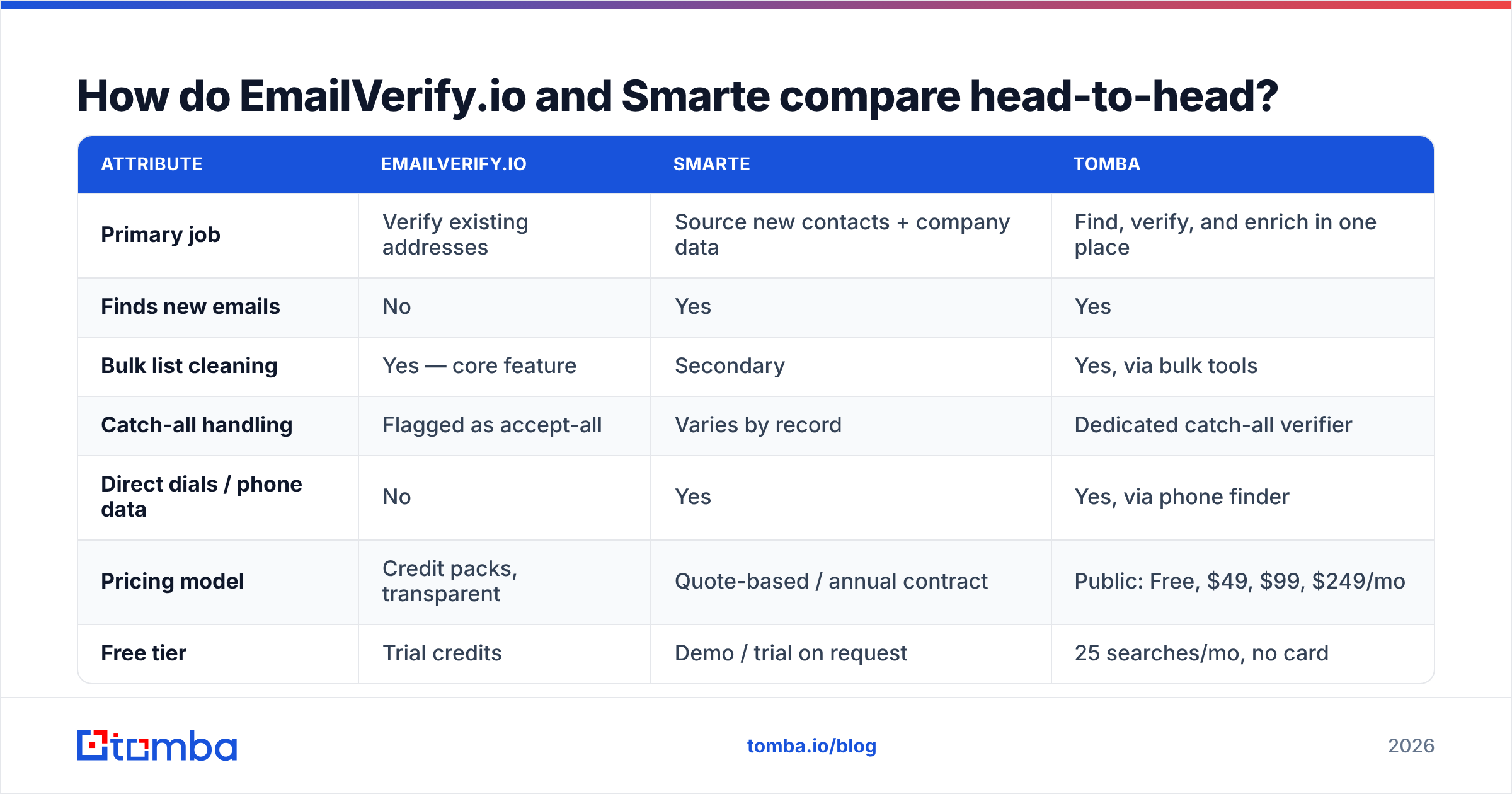
| Attribute | EmailVerify.io | Smarte | Tomba |
|---|---|---|---|
| Primary job | Verify existing addresses | Source new contacts + company data | Find, verify, and enrich in one place |
| Finds new emails | No | Yes | Yes |
| Bulk list cleaning | Yes — core feature | Secondary | Yes, via bulk tools |
| Catch-all handling | Flagged as accept-all | Varies by record | Dedicated catch-all verifier |
| Direct dials / phone data | No | Yes | Yes, via phone finder |
| Pricing model | Credit packs, transparent | Quote-based / annual contract | Public: Free, $49, $99, $249/mo |
| Free tier | Trial credits | Demo / trial on request | 25 searches/mo, no card |
| API access | Yes | Yes, plan-dependent | Yes, on all paid plans |
| Best fit | Marketers cleaning a large list | Enterprise GTM teams buying data at scale | SMB to mid-market outbound teams |
| Contract friction | Low — self-serve | Higher — sales-led | Low — self-serve |
The pattern holds across this category. Verification tools compete on price per thousand and on how much you can trust a "valid" flag. Data platforms compete on coverage, refresh rate, and CRM fit. A single scorecard flatters neither.
EmailVerify.io vs Smarte: which one is more accurate?#
Accuracy means two different things here. Teams get burned when they mix them up.
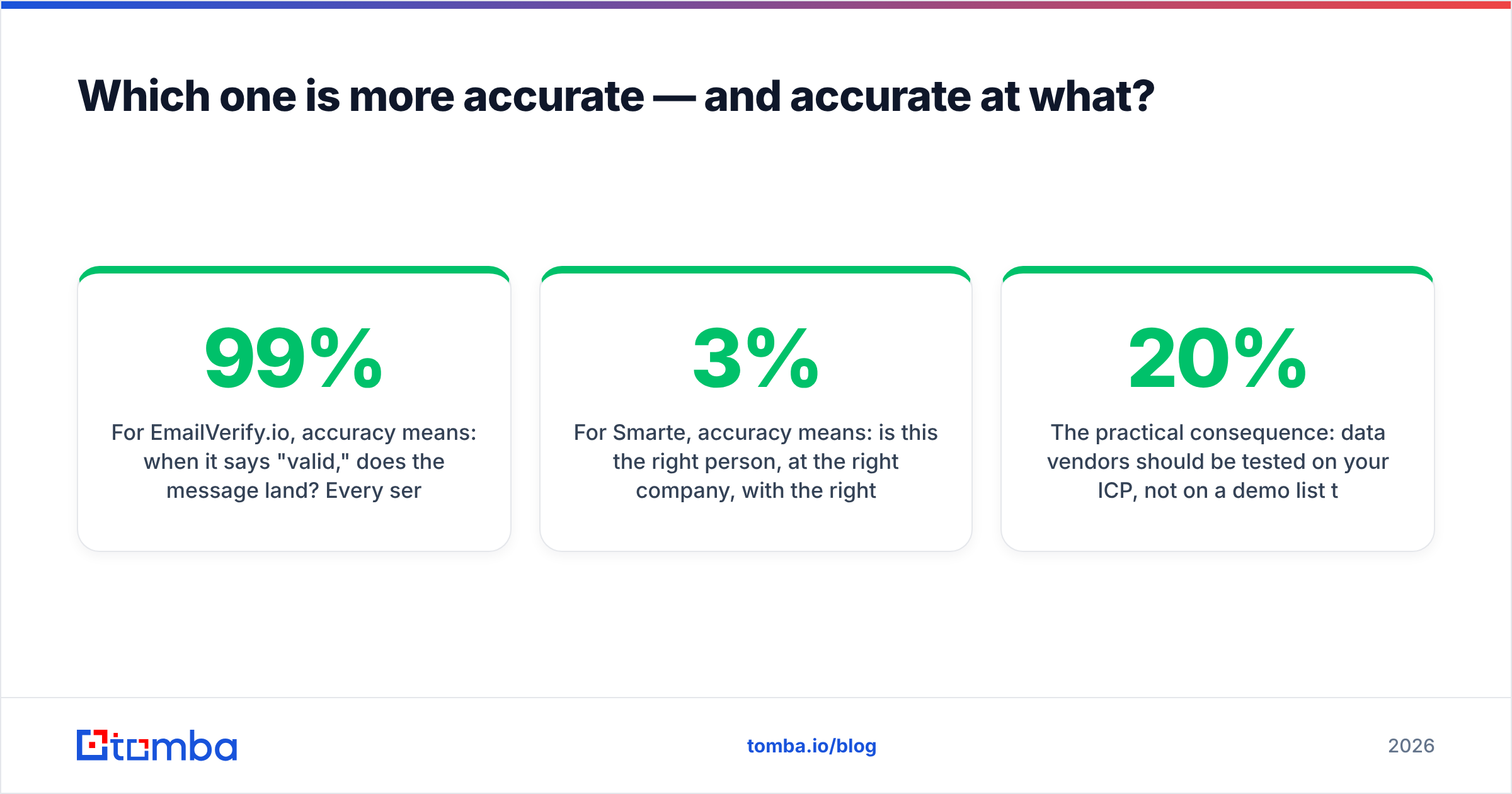
For EmailVerify.io, accuracy means one thing: when it says "valid," does the message land? Every serious verifier claims 95-99%. What varies is how each vendor handles the messy middle. That middle is catch-all domains, greylisting servers, and providers like Microsoft 365 that now block SMTP probes.
A vendor that marks every catch-all as "valid" shows a great pass rate and a terrible bounce rate. A vendor that marks them "unknown" looks worse on paper and protects you better. Read the status labels before you read the marketing number.
For Smarte, accuracy means something else. Is this the right person, at the right company, with the right title? And is the email still theirs? B2B contact data goes stale fast. The common figure is 2.5-3% per month as people change jobs. That is a third of a database in a year.
Buyer reviews on G2 are a useful sanity check, because coverage varies a lot by region and by industry. A provider that is strong for US SaaS mid-market can be thin for EMEA manufacturing.
So test data vendors on your own ICP, not on a demo list they picked. Ask for 200 records that match your exact filters. Then run those records through a separate verifier. If 20% bounce, the "verified emails" claim means less than you assumed.
That test — buy data from vendor A, check it with vendor B — is why so many teams end up with a two-tool stack they never planned.
EmailVerify.io vs Smarte: what does each one cost?#
Open pricing is the clearest difference between these two.
EmailVerify.io publishes credit-pack pricing. You buy a block of verifications, use them, then buy more. Rates in this category usually land under a cent per verification at volume, and the per-unit price drops as packs get bigger. Budgeting is simple: list size times rate.
Smarte does not publish rates. Like most sales-led data platforms, it quotes you a price based on seats, credit volume, and the modules you turn on. That is not a knock. Enterprise data deals really are built per customer. But you cannot compare price without a call, and annual terms are the norm.
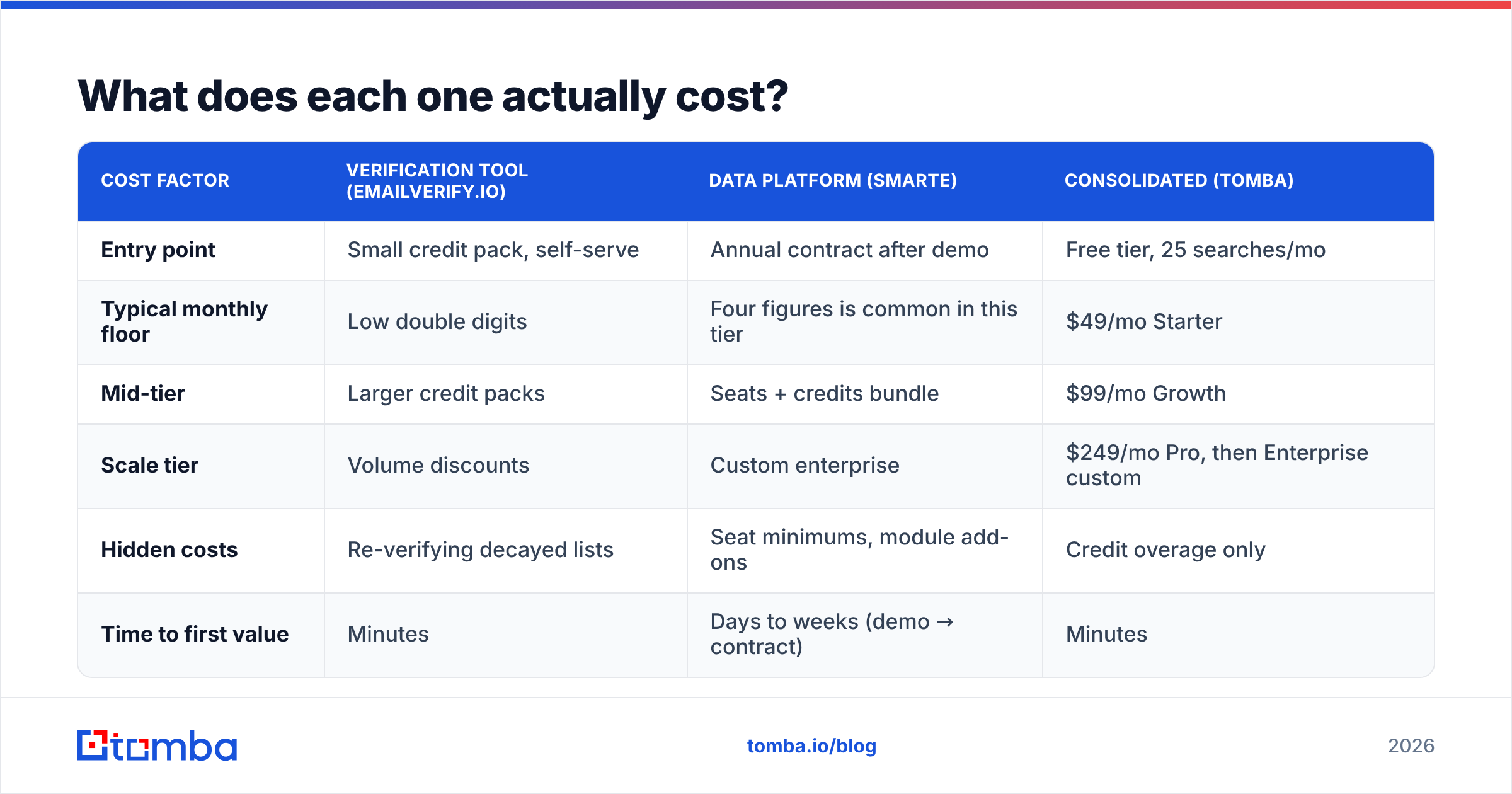
| Cost factor | Verification tool (EmailVerify.io) | Data platform (Smarte) | Consolidated (Tomba) |
|---|---|---|---|
| Entry point | Small credit pack, self-serve | Annual contract after demo | Free tier, 25 searches/mo |
| Typical monthly floor | Low double digits | Four figures is common in this tier | $49/mo Starter |
| Mid-tier | Larger credit packs | Seats + credits bundle | $99/mo Growth |
| Scale tier | Volume discounts | Custom enterprise | $249/mo Pro, then Enterprise custom |
| Hidden costs | Re-verifying decayed lists | Seat minimums, module add-ons | Credit overage only |
| Time to first value | Minutes | Days to weeks (demo → contract) | Minutes |
If you are a two-person team testing an outbound motion, the sales-led path is friction you cannot afford. If you run 40 reps with a RevOps function and a CRM to feed, that path buys coverage and support a credit pack never will. Both choices are rational, for different companies.
Want a published mid-market number to compare against? The Tomba pricing page lists every tier without a call.
Who should pick EmailVerify.io?#
The EmailVerify.io vs Smarte call is easy when all of these are true:
- You already have the list. Scraped, exported from an old CRM, inherited from a past SDR, or bought years ago. The records exist. You just do not trust them.
- Deliverability is the visible symptom. Bounce rate above 3%, spam complaints creeping up, Google Postmaster showing a slip. Clean the list first, before you touch copy or cadence.
- You want no contract. Buy credits, run the list, walk away.
- You need an API for signup forms. Real-time checks at the point of capture pay for themselves, and they have nothing to do with outbound.
What it will not do: create a single new contact. If your problem is "not enough people to email," a verifier is the wrong buy. It will only show you how few of your contacts are real.
Who should pick Smarte?#
Choose it when:
- You are building a target account list from scratch and need firmographic filters, not just email lookup.
- You want direct dials next to emails. Phone coverage is a real gap for pure verifiers. If dialing is part of the motion, this matters.
- You have CRM infrastructure to feed. Data platforms earn their keep when records flow into Salesforce or HubSpot on their own, not when someone downloads a CSV.
- You have budget approval and a procurement process. The sales-led motion is a feature if you need security review, DPAs, and a named CSM. It is pure friction if you do not.
Before the demo, read HubSpot's guidance on B2B data quality. It makes vendor claims much easier to question.

Where does a combined stack beat either one?#
Here is the uncomfortable math. The two-vendor stack — data platform plus verifier — is common because each vendor is good at its half. But it costs you three things:
- Double spend on one record. You pay to source the contact, then pay again to check it. At volume, the verify layer can add 20-40% to your data bill.
- A sync gap. Records get sourced Monday, verified Thursday, loaded Friday. Anything that changed in between stays invisible. Two systems means two versions of the same person.
- Two vendor relationships. Two renewals, two support queues, two security reviews, two sets of API limits.
The fix is a platform where finding and verifying happen in one call. That is the design behind Tomba. The email finder returns a confidence score from the verify engine at lookup time, so no unverified address reaches your sequence. Bulk jobs run the same path through the bulk email finder. Catch-all domains get a dedicated check instead of an "unknown" bucket.

That does not make one platform right for everyone. If you need intent signals, technographics, and org-chart mapping, a dedicated GTM data platform still does things a finder cannot. The honest test: do you use those features, or just pay for them?
What should you actually do next?#
Run a 200-record bake-off. It takes an afternoon, and it settles the EmailVerify.io vs Smarte debate better than any review site.
- Pick 200 accounts that match your real ICP, not your best-case ICP.
- Source contacts for 100 of them with each tool.
- Verify every result with a third, neutral verifier.
- Send a small, genuine campaign to both groups.
- Compare three numbers only: coverage, bounce rate, and reply rate.
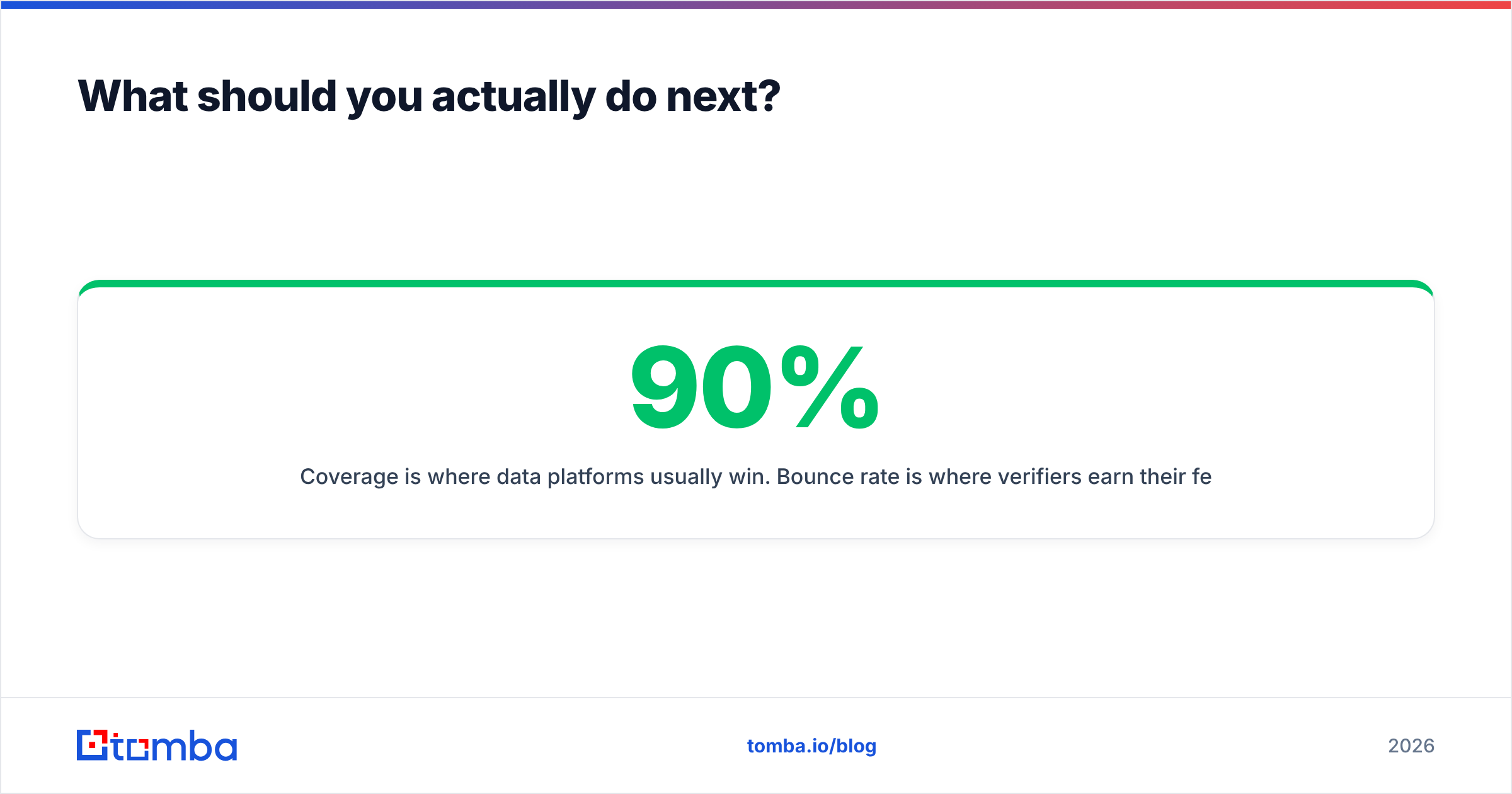
Coverage is where data platforms win. Bounce rate is where verifiers earn their fee. Reply rate is the only one your CFO cares about. A tool with 90% coverage and 12% bounces is worse than one with 65% coverage and 1% bounces. The second one does not cost you your sending domain.
The verdict#
EmailVerify.io vs Smarte comes down to one question: are you fixing a list or building one? EmailVerify.io is the cheaper, self-serve answer to bad data you already own. Smarte is the answer to having no data at all, priced for teams with a procurement process and a CRM to fill. Judging them on features is a category error. Judging them on budget is fair, and the sales-led path costs more.
Somewhere in the middle? You need new contacts, you need them verified, and you would rather not run two contracts. Start with the Tomba Email Finder. Every lookup comes back with a verification status. Catch-all domains get their own path. The free tier gives you 25 searches a month to test on your own ICP before you spend a cent. Paid plans start at $49/mo, published, no call required.
Related guides#
Ready to find emails that actually work?
Join 150,000+ professionals who stopped guessing and started sending. Free credits on signup — no credit card required.
Get the Tomba newsletter
Practical outbound tactics and product updates — once every two weeks.
About the author