Endole vs Tomba: UK Company Data vs Email Finding in 2026
Endole maps UK companies, directors, and filings. Tomba finds and verifies the email addresses you actually send to. Here is where each one wins, where each one leaves a gap, and how to run both without paying twice.
TL;DR
- Endole and Tomba are not really competitors — they solve different halves of the same problem. Endole tells you which UK company to target and how healthy it is. Tomba tells you who to email and whether that address will bounce.
- Endole's strength is depth on UK-registered entities: filings, financials, directors, group structures, credit signals. Its weakness for outbound is contactability — you rarely leave with a verified work email for a named decision-maker.
- Tomba's strength is contact discovery and verification at scale: email finder, domain search, catch-all handling, and an API. Its weakness is that it is not a UK filings database — it will not score a company's credit risk.
- Pricing models differ in kind, not just amount. Endole sells access to a company database; Tomba sells credits against contact lookups, starting free (25 searches/mo) and moving to $49/mo Starter.
- If you sell to UK SMBs and need firmographic qualification and deliverable contacts, the honest answer is: use both, and let Endole set the target list while Tomba resolves the people.
What is Endole and who is it actually for?#
Endole is a UK business information platform. It aggregates public registry data — primarily from Companies House — and layers on financial history, director records, group ownership, industry classification, and risk indicators. Its Explorer product lets you build filtered lists of UK companies by turnover, employee count, SIC code, region, incorporation date, and financial trajectory.
The typical Endole user is not a cold-email operator. It's a credit controller checking whether a prospective customer can pay, an M&A analyst mapping a sector, an accountant reviewing a client's group structure, or a BDR building a territory list of "UK manufacturing firms with £2–10M turnover in the North West."
That is a genuinely useful job, and Endole does it with more UK granularity than most global databases. Where a US-built platform gives you a rough employee estimate scraped from LinkedIn, Endole gives you filed accounts. For UK-focused ABM, that difference is not cosmetic — it changes who lands on your target list.
The limitation shows up one step later. You now have 400 qualified UK companies and a set of director names. What you generally do not have is 400 deliverable work email addresses for the specific people who own the budget for your product. Registry data lists officers, not buyers. The Head of Operations who actually evaluates your software is usually not a registered director.
What is Tomba and what does it actually do?#
Tomba is a contact discovery and verification platform. You give it a domain, a name, or a company, and it returns professional email addresses along with a confidence score and the public sources it used. The core product is the email finder; around it sit an email verifier, domain search, catch-all verification, phone finder, and enrichment.
Practically, Tomba answers three questions Endole does not:
- What is this company's email pattern? Is it
first.last@,flast@, orfirst@? Domain search resolves the pattern from observed addresses rather than guessing. - Who works there beyond the registered officers? Domain search returns discovered contacts with job titles and departments, including the mid-level operators who typically evaluate and champion purchases.
- Will this address bounce? Verification runs syntax, MX, disposable-domain, role-account, and SMTP checks, then flags catch-all domains separately instead of pretending they're clean.
Tomba is also API-first. If your workflow is "pull a filtered company list, enrich it programmatically, push into the CRM," the Tomba API is the piece that makes it run unattended. Endole exports; Tomba integrates into a pipeline.
The honest limitation: Tomba will not tell you a company's filed turnover, its charge history, or whether its accounts are overdue. It is a contact layer, not a UK registry.
Endole vs Tomba: how do they compare head-to-head?#
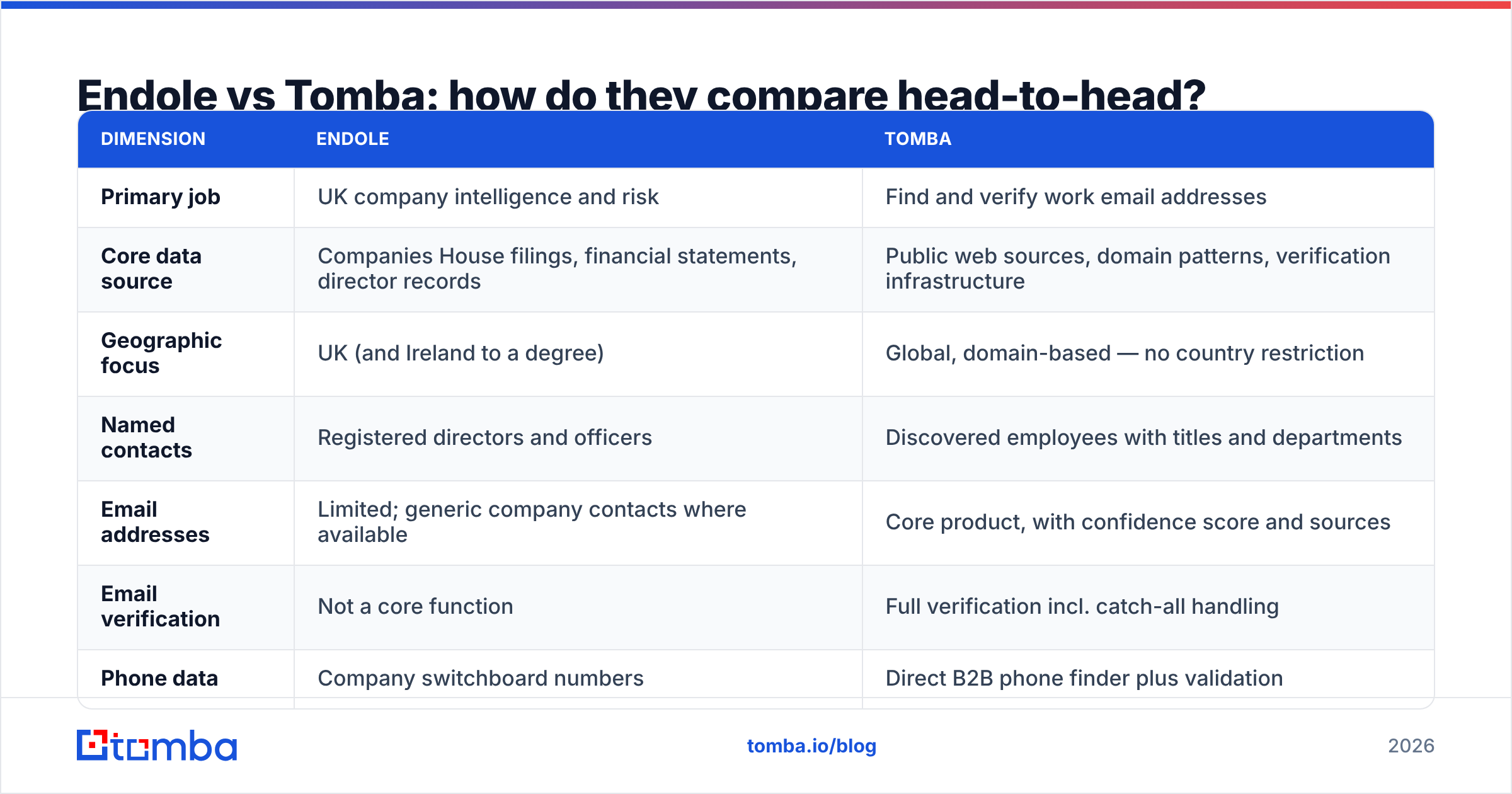
| Dimension | Endole | Tomba |
|---|---|---|
| Primary job | UK company intelligence and risk | Find and verify work email addresses |
| Core data source | Companies House filings, financial statements, director records | Public web sources, domain patterns, verification infrastructure |
| Geographic focus | UK (and Ireland to a degree) | Global, domain-based — no country restriction |
| Named contacts | Registered directors and officers | Discovered employees with titles and departments |
| Email addresses | Limited; generic company contacts where available | Core product, with confidence score and sources |
| Email verification | Not a core function | Full verification incl. catch-all handling |
| Phone data | Company switchboard numbers | Direct B2B phone finder plus validation |
| Firmographics | Deep: turnover, assets, employees, SIC, group structure | Basic: industry, size, tech signals via enrichment |
| Credit and risk scoring | Yes — a headline feature | No |
| API access | Available on business plans | Yes, on all paid tiers, documented and rate-limited |
| Bulk workflow | Export filtered company lists | Bulk email finder and bulk verification |
| Free entry point | Free basic company profile lookups | Free tier, 25 searches/month |
| Best-fit user | Credit, finance, UK research, territory planning | SDRs, growth, recruiters, RevOps, developers |
Two things stand out in that table. First, the overlap is thin — there are maybe two rows where these tools genuinely contest the same ground. Second, the gaps are complementary. Endole's blank cells are Tomba's product, and vice versa.
Which one actually gives you contactable leads?#
Tomba, and it isn't close — but the framing matters.
Registry-derived data gives you an entity and its officers. Outbound needs a person, a role, and a mailbox. The gap between those two is where most UK prospecting programs quietly leak pipeline. Teams pull a beautiful filtered list of 600 companies, then spend three weeks manually hunting emails on LinkedIn, guessing patterns, and eating a 20–30% bounce rate that damages sender reputation before the campaign has a chance.
Here's the sequence that actually works when your source list comes from a registry platform:
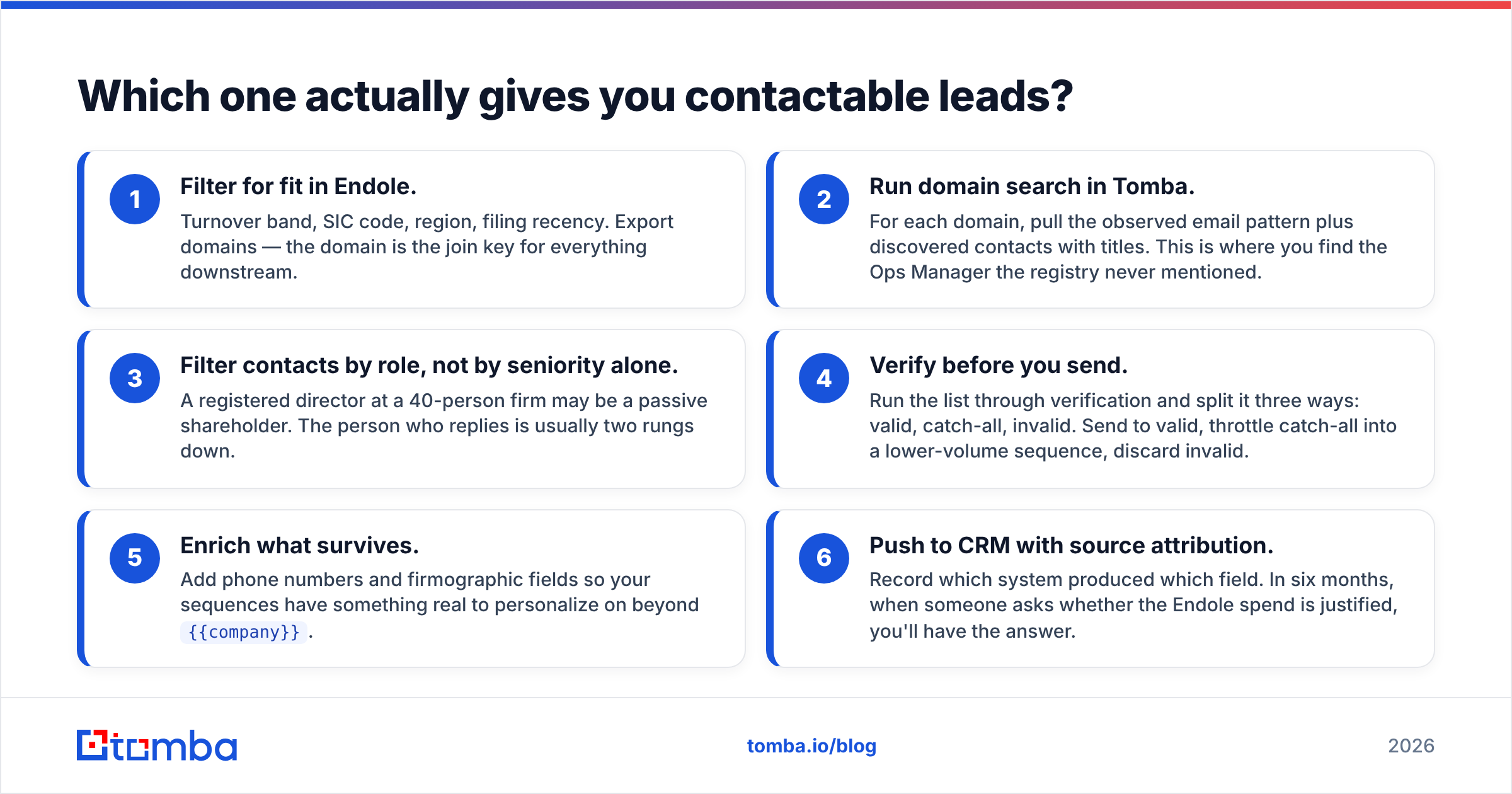
- Filter for fit in Endole. Turnover band, SIC code, region, filing recency. Export domains — the domain is the join key for everything downstream.
- Run domain search in Tomba. For each domain, pull the observed email pattern plus discovered contacts with titles. This is where you find the Ops Manager the registry never mentioned.
- Filter contacts by role, not by seniority alone. A registered director at a 40-person firm may be a passive shareholder. The person who replies is usually two rungs down.
- Verify before you send. Run the list through verification and split it three ways: valid, catch-all, invalid. Send to valid, throttle catch-all into a lower-volume sequence, discard invalid.
- Enrich what survives. Add phone numbers and firmographic fields so your sequences have something real to personalize on beyond
{{company}}. - Push to CRM with source attribution. Record which system produced which field. In six months, when someone asks whether the Endole spend is justified, you'll have the answer.
Skip step 4 and steps 1–3 are wasted. A perfectly qualified list that bounces at 25% is worse than a mediocre list that lands, because the bounce damage follows your domain into the next campaign.
How does pricing compare, and what are you really paying for?#
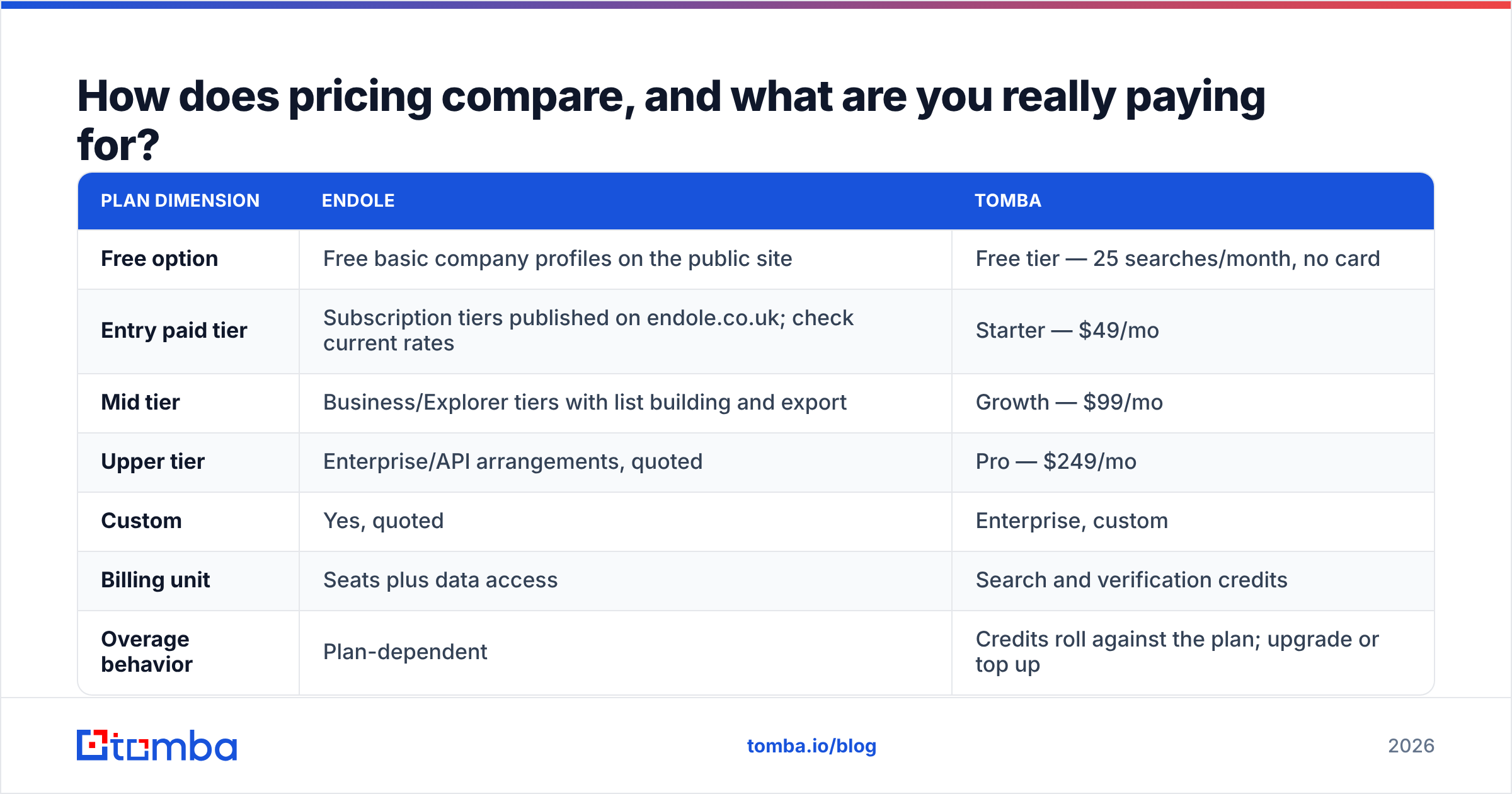
The two products bill on different axes, which makes direct per-month comparison misleading. Endole charges for access to a company database — you're buying breadth of records and report depth. Tomba charges for lookups — you're buying resolved contacts.
| Plan dimension | Endole | Tomba |
|---|---|---|
| Free option | Free basic company profiles on the public site | Free tier — 25 searches/month, no card |
| Entry paid tier | Subscription tiers published on endole.co.uk; check current rates | Starter — $49/mo |
| Mid tier | Business/Explorer tiers with list building and export | Growth — $99/mo |
| Upper tier | Enterprise/API arrangements, quoted | Pro — $249/mo |
| Custom | Yes, quoted | Enterprise, custom |
| Billing unit | Seats plus data access | Search and verification credits |
| Overage behavior | Plan-dependent | Credits roll against the plan; upgrade or top up |
One caveat worth stating plainly: Endole has revised its packaging more than once, and published tiers change. Check their site for current numbers rather than trusting any comparison post — including this one — on that specific field. Tomba's tiers are the ones listed above, and you can confirm them on the Tomba pricing page.
The more useful question is cost per usable contact. A registry subscription that produces 500 qualified companies but zero verified emails has a cost-per-sendable-contact of infinity until you add a contact layer. Conversely, a contact layer pointed at an unqualified domain list produces cheap emails to companies that will never buy. The efficient spend is usually a mid-tier plan on each rather than a top-tier plan on one.
What happens when your market isn't only the UK?#
This is the clearest decision point in the whole comparison.
Endole's value is bounded by UK company registration. That's not a flaw — it's the product's premise, and it's why the UK depth is better than what generalist global databases offer. But the moment your ICP includes German, Dutch, or US companies, Endole covers a shrinking slice of your addressable market, and you need a second source anyway.
Tomba is domain-based, which makes it geography-agnostic. A .de domain, a .com, and a .co.uk go through the same resolution path. If you're selling into multiple markets, the contact layer stays constant while the qualification layer changes per country — you might use Endole for the UK, a local registry for France, and a general firmographic database elsewhere.
There's a related point on data provenance. Both platforms operate under UK GDPR when processing UK contacts, and both publish their approach. Endole's data is largely public registry material. Tomba documents where its data comes from and supports removal requests. If you're running outbound into the UK or EU, read both policies before your first send — B2B legitimate interest is workable, but it is not a blank cheque, and buyer-side procurement teams increasingly ask.
Where does each tool genuinely beat the other?#
Endole wins when:
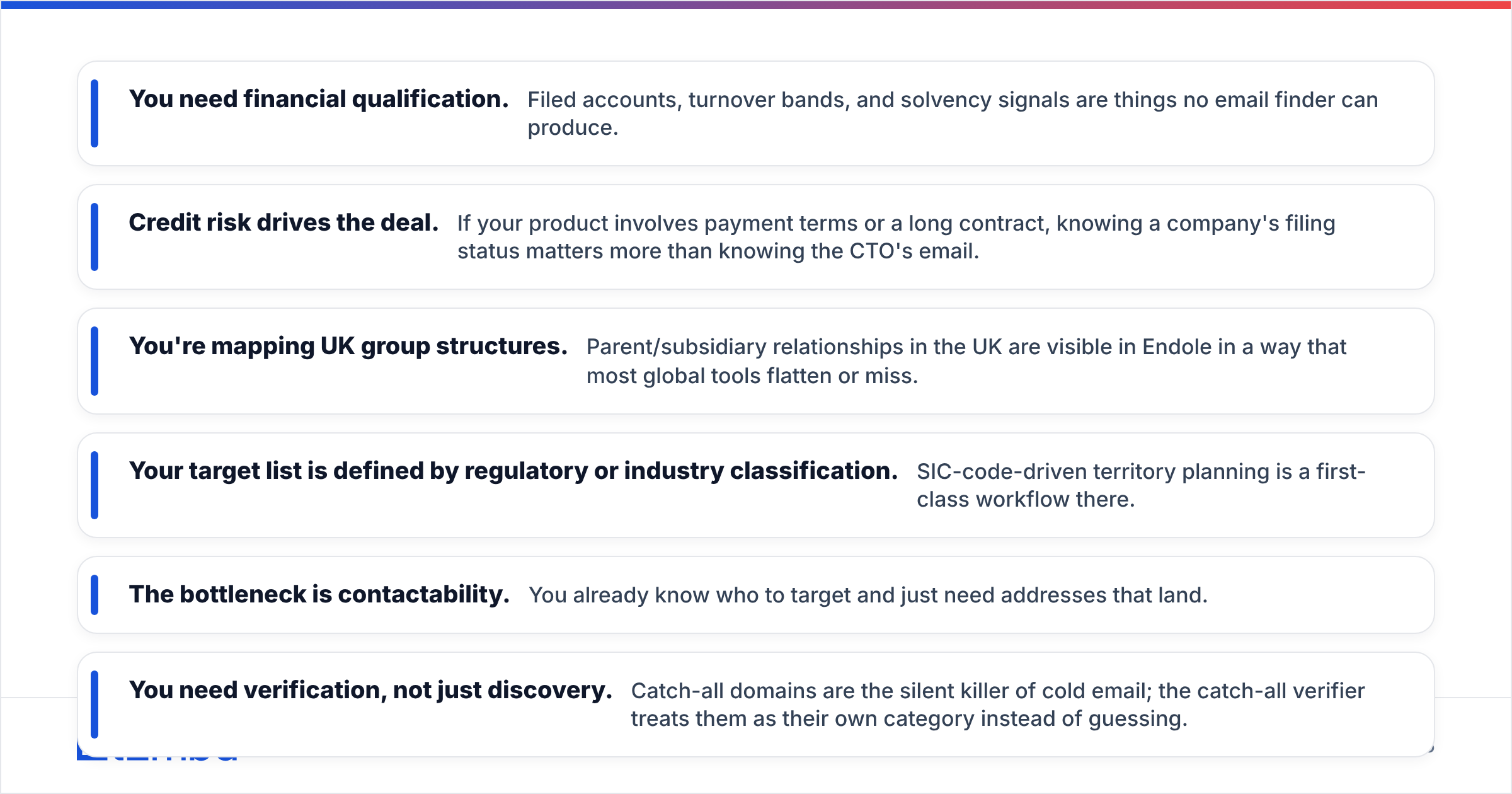
- You need financial qualification. Filed accounts, turnover bands, and solvency signals are things no email finder can produce.
- Credit risk drives the deal. If your product involves payment terms or a long contract, knowing a company's filing status matters more than knowing the CTO's email.
- You're mapping UK group structures. Parent/subsidiary relationships in the UK are visible in Endole in a way that most global tools flatten or miss.
- Your target list is defined by regulatory or industry classification. SIC-code-driven territory planning is a first-class workflow there.
Tomba wins when:
- The bottleneck is contactability. You already know who to target and just need addresses that land.
- You need verification, not just discovery. Catch-all domains are the silent killer of cold email; the catch-all verifier treats them as their own category instead of guessing.
- You want automation. API, CLI, Sheets, Excel, and CRM integrations mean enrichment runs without a human exporting CSVs.
- Your market is global. Domain-based resolution doesn't care where a company is registered.
- You're testing before committing. The free tier gives you 25 searches to check accuracy on your own domains — which is the only accuracy test that means anything. Vendor-published hit rates, including everyone's, are measured on their own sample. Run yours.
Are there other tools worth considering alongside these?#
Yes, and it's worth being direct about the landscape rather than pretending it's a two-horse race.
For UK company data, Endole competes with Companies House itself (free, raw, no enrichment), Creditsafe, and Dun & Bradstreet. For contact data, Tomba sits alongside a crowded field of finders and verifiers — you'll find candid user reviews of most of them on G2. Providers like BookYourData take a different route again, selling pre-built contact lists rather than on-demand lookups, which suits teams that want volume up front rather than a per-domain API call. Different shape of purchase, and for some buying motions it's the better fit.
The point isn't that one category is superior. It's that "company intelligence" and "contact resolution" are separate procurement decisions, and treating them as one line item is how teams end up with an expensive tool that does 60% of two jobs instead of two tools that each do one properly.
So which should you choose for 2026?#
Pick by the bottleneck you actually have, not by feature count.
- UK-only, finance-led sales, long contracts, credit exposure → Endole is your primary, with a contact layer bolted on for the last mile.
- Volume outbound, multi-market, SDR-driven → Tomba is your primary; add a firmographic source only when your qualification is genuinely weak.
- UK-focused outbound at scale → Both. Endole defines the list, Tomba makes it sendable. This is the most common real-world configuration, and the combined spend is usually less than one enterprise all-in-one that does neither part well.
- Building an automated GTM pipeline → Tomba first, because the API and integrations are what make the loop run without manual exports.
The one configuration to avoid: buying a company database, exporting names, and then hand-guessing emails in a spreadsheet. That's where bounce rates climb, domains get flagged, and someone concludes "cold email doesn't work" when what didn't work was the missing verification step.
Ready to turn a company list into contacts that actually reply? Start with the Tomba Email Finder — the free tier gives you 25 searches a month with no card, enough to run your own accuracy test against domains you already know. Feed it the export from whatever qualification tool you use, verify before you send, and see what your reply rate looks like when the addresses are real.
Related guides#
Ready to find emails that actually work?
Join 150,000+ professionals who stopped guessing and started sending. Free credits on signup — no credit card required.
Get the Tomba newsletter
Practical outbound tactics and product updates — once every two weeks.
About the author