Enginy Pros and Cons (2026): An Honest Buyer's Breakdown
Enginy promises AI-assisted prospecting that replaces half your outbound stack. Here is a neutral look at what it actually does well, where it falls short, and which teams should pick something cheaper and more transparent.
The Enginy pros and cons come down to one trade-off. You gain a guided AI prospecting workflow. You give up published pricing and control over the data underneath it. This guide breaks down both sides so you can tell which one matters for your team.
TL;DR
- Enginy sits in the AI-assisted prospecting category: it wraps lead research, list building, and outreach prep into one guided workflow instead of selling raw contact records.
- The strongest pros are workflow consolidation, research summarisation, and a shorter ramp for junior SDRs who do not know how to build an ICP-aligned list yet.
- The biggest cons are pricing opacity, dependence on third-party data underneath the AI layer, and limited control when you want to audit why a lead was suggested.
- If your bottleneck is "we do not know who to contact," an AI prospecting layer helps. If your bottleneck is "the emails we have bounce," you need a data and verification vendor instead.
- Cheapest honest test: run 200 of Enginy's suggested contacts through an independent verifier before you sign anything longer than a month.
What is Enginy, and who is it built for?#
Enginy belongs to the newer wave of AI prospecting tools — software that tries to compress the "research the account, find the right person, figure out the angle, write the first touch" loop into a single guided flow. That category is distinct from two neighbours it gets confused with:
- Contact data providers — vendors whose product is the record: a verified work email, a direct dial, a firmographic field. You pay per lookup or per credit, and accuracy is the whole promise.
- Sequencers and sending platforms — tools that own the inbox, the cadence, the reply detection, and the deliverability layer.
- AI prospecting layers (where Enginy sits) — software that reasons on top of data and hands you a shortlist plus context, then pushes it downstream.
- CRMs and pipeline systems — the system of record everything eventually writes into.
That taxonomy matters more than any feature checklist, because it tells you what a bad outcome looks like. A weak AI prospecting layer wastes your reps' time on plausible-but-wrong accounts. A weak data provider burns your sending domain. Those are different failure modes with different fixes, and buying the wrong category to solve the wrong problem is the most common and most expensive mistake in outbound tooling.
If you are evaluating Enginy, the honest first question is not "is it good?" It is "which of those four layers is actually broken in my funnel right now?" Tools in the AI prospecting category are reviewed across G2 and Capterra, and the review volume in this segment is still thin compared to established data vendors — worth remembering when you see a small number of glowing five-star entries.
What are Enginy's biggest pros?#
Most of the Enginy pros and cons debate starts here. These are the advantages worth weighing seriously, based on how tools in this category are built and what buyers report:
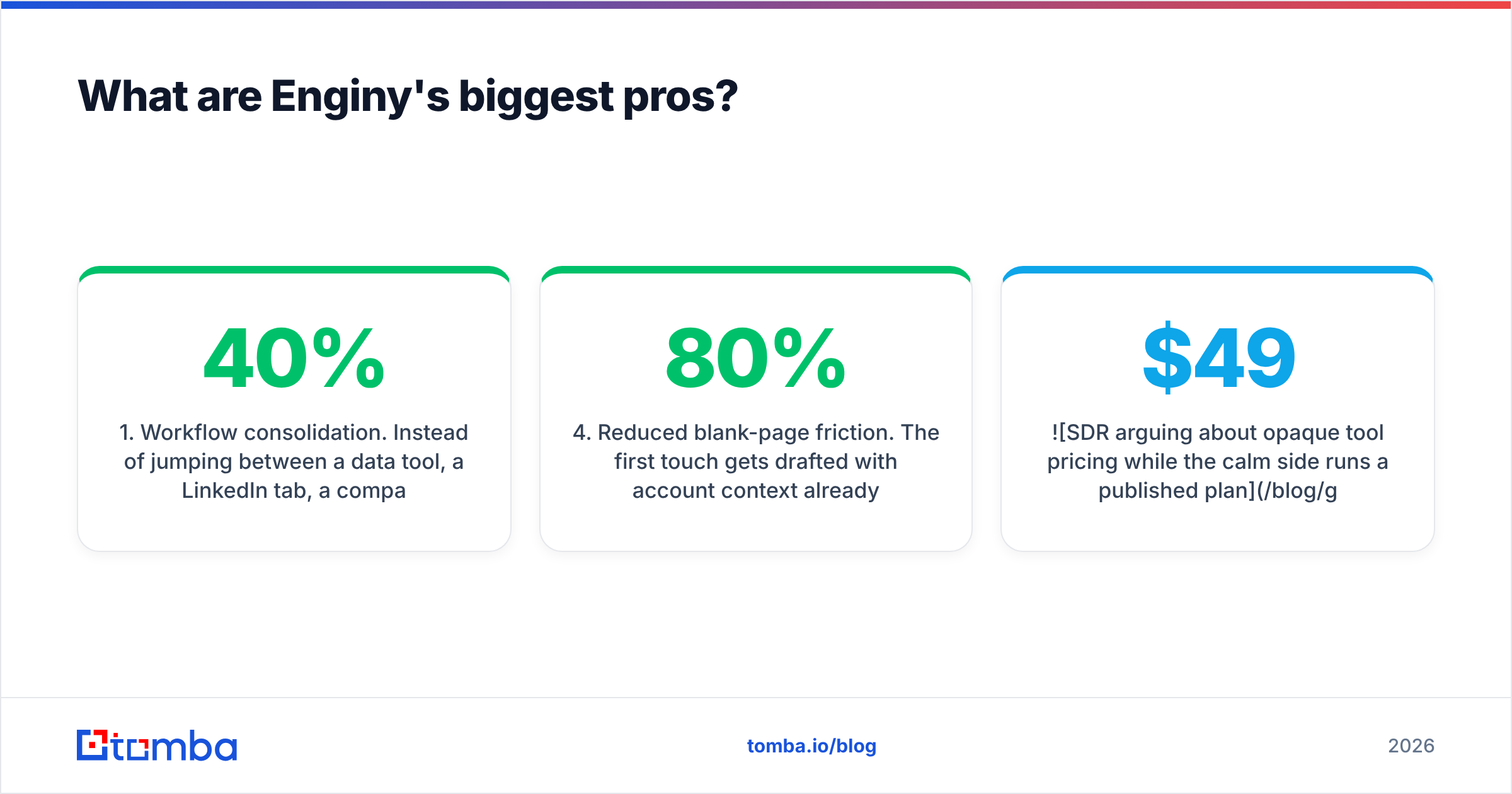
- Workflow consolidation. A rep works inside one flow instead of jumping between a data tool, a LinkedIn tab, a company website, and a doc of notes. For teams running four or five point tools, that is a real productivity gain — often 20–40% less context-switching per prospecting hour, by most teams' own time-tracking.
- Faster ramp for junior reps. The hardest skill to teach a new SDR is not writing. It is judgement about who to contact and why. AI prospecting layers encode that judgement into the product. A rep in week two produces a list that looks like a rep in month six built it. Whether it converts like month six is a separate question.
The next three pros are quieter, but they show up every day in a rep's calendar.
- Research summaries that are genuinely useful. Pulling recent funding, headcount changes, tech-stack signals, and job-post language into a two-line brief is exactly the kind of task where language models earn their keep. It is compression of public information, not invention.
- Reduced blank-page friction. The first touch gets drafted with account context already loaded. Even if you rewrite 80% of it, starting from a bad draft beats starting from nothing.
- Guided ICP definition. Founders and small teams who have never formalised an ideal customer profile get walked through segment definition. That has value beyond the software itself.

None of these are trivial. If your team's problem is genuinely "we stare at a spreadsheet and do not know where to start," an AI prospecting layer solves a real thing. The question is whether it solves it at a price and with a level of transparency you can live with for twelve months.
What are Enginy's main cons?#
Here is where a neutral review has to be blunt:
- Pricing opacity. Enginy does not publish a clear, self-serve price ladder the way commodity data vendors do. Quote-based pricing is not automatically bad — it is standard for enterprise software — but it costs you the ability to benchmark. When a competitor publishes $49/mo and your vendor says "let's talk," you have lost the cheapest form of comparison shopping. Always ask for the per-contact effective cost, not the platform fee.
- You are renting someone else's data. AI prospecting layers rarely own their contact data end to end. They license it, aggregate it, or scrape it. Your email accuracy is inherited, not engineered. When the underlying supplier changes terms or coverage, your hit rate moves without warning.
The next two cons hurt most in teams that have to explain their numbers to someone else.
- Limited auditability. When the tool says "contact this VP of Operations," can you see the signal chain behind that pick? In most AI prospecting products the answer is partial at best. For a RevOps team that has to defend pipeline attribution, "the model suggested it" is a weak answer.
- Coverage cliffs outside core geographies. Nearly every prospecting tool is strongest in US mid-market SaaS and thinnest in EMEA SMB, APAC, and non-English markets. If your ICP is a German manufacturer with 80 employees, run the trial against that segment, not against the demo account.
The last two are the ones buyers notice only after they sign.
- Verification is usually not the strong suit. An AI layer optimises for relevance, not for whether the mailbox accepts mail today. Email deliverability failures do not show up in a demo. They show up six weeks later as a bounce rate that quietly torches your sender reputation.
- Lock-in through workflow, not contract. Once your reps' whole prospecting motion lives inside a tool, switching is painful even on a monthly plan. That is a design feature of consolidated products, and it is worth pricing into your decision.
How does Enginy compare to other prospecting stacks?#
The realistic comparison is not Enginy vs. one competitor — it is "one consolidated AI layer" vs. "a lean, transparent stack you assemble yourself."
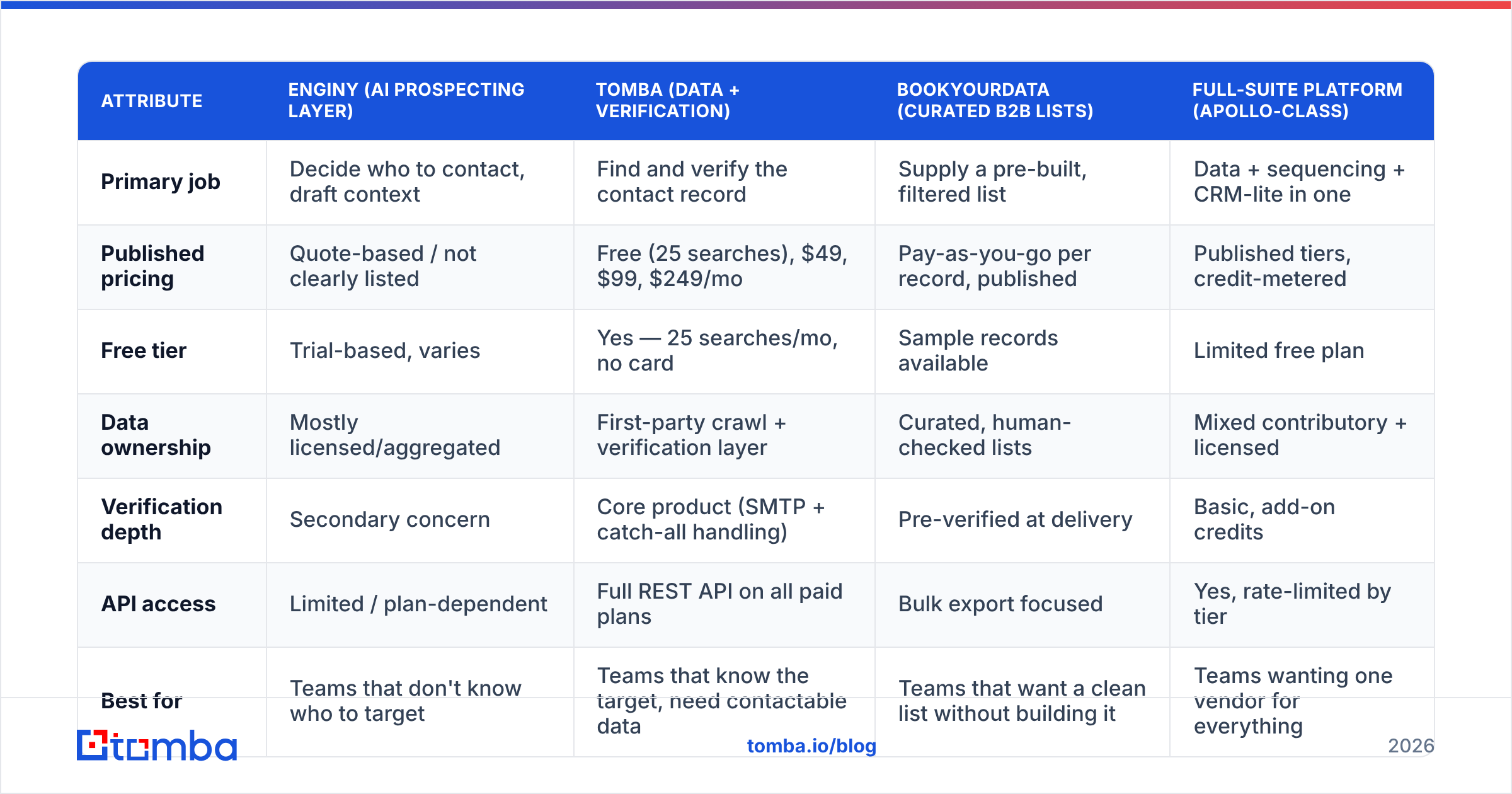
| Attribute | Enginy (AI prospecting layer) | Tomba (data + verification) | BookYourData (curated B2B lists) | Full-suite platform (Apollo-class) |
|---|---|---|---|---|
| Primary job | Decide who to contact, draft context | Find and verify the contact record | Supply a pre-built, filtered list | Data + sequencing + CRM-lite in one |
| Published pricing | Quote-based / not clearly listed | Free (25 searches), $49, $99, $249/mo | Pay-as-you-go per record, published | Published tiers, credit-metered |
| Free tier | Trial-based, varies | Yes — 25 searches/mo, no card | Sample records available | Limited free plan |
| Data ownership | Mostly licensed/aggregated | First-party crawl + verification layer | Curated, human-checked lists | Mixed contributory + licensed |
| Verification depth | Secondary concern | Core product (SMTP + catch-all handling) | Pre-verified at delivery | Basic, add-on credits |
| API access | Limited / plan-dependent | Full REST API on all paid plans | Bulk export focused | Yes, rate-limited by tier |
| Best for | Teams that don't know who to target | Teams that know the target, need contactable data | Teams that want a clean list without building it | Teams wanting one vendor for everything |
| Main risk | Opaque cost, inherited data quality | You still need your own sequencer | List goes stale after purchase | Jack-of-all-trades depth |
Read that table as a routing decision, not a scoreboard. BookYourData, for example, is a genuinely different purchase — you are buying a curated, ready-to-use list rather than a subscription workflow, and for a one-off campaign that is often the cleanest option. Tomba sits at the other end: you bring the targeting logic, it supplies contactable, verified records via email finder and API. Enginy tries to own the reasoning step above both.
Is Enginy's data accurate enough for cold outreach?#
Treat every vendor accuracy claim — Enginy's included — as a marketing number until you test it. Published accuracy figures in this industry are measured under conditions the vendor chooses, on segments the vendor is strongest in.
Here is the test that actually settles it, and it takes an afternoon:
- Pull 200 contacts from the trial, restricted to your real ICP — right country, right company size, right seniority. Not the demo dataset.
- Run them through an independent email verifier that you control. You want deliverable / risky / invalid buckets, plus explicit catch-all flagging.
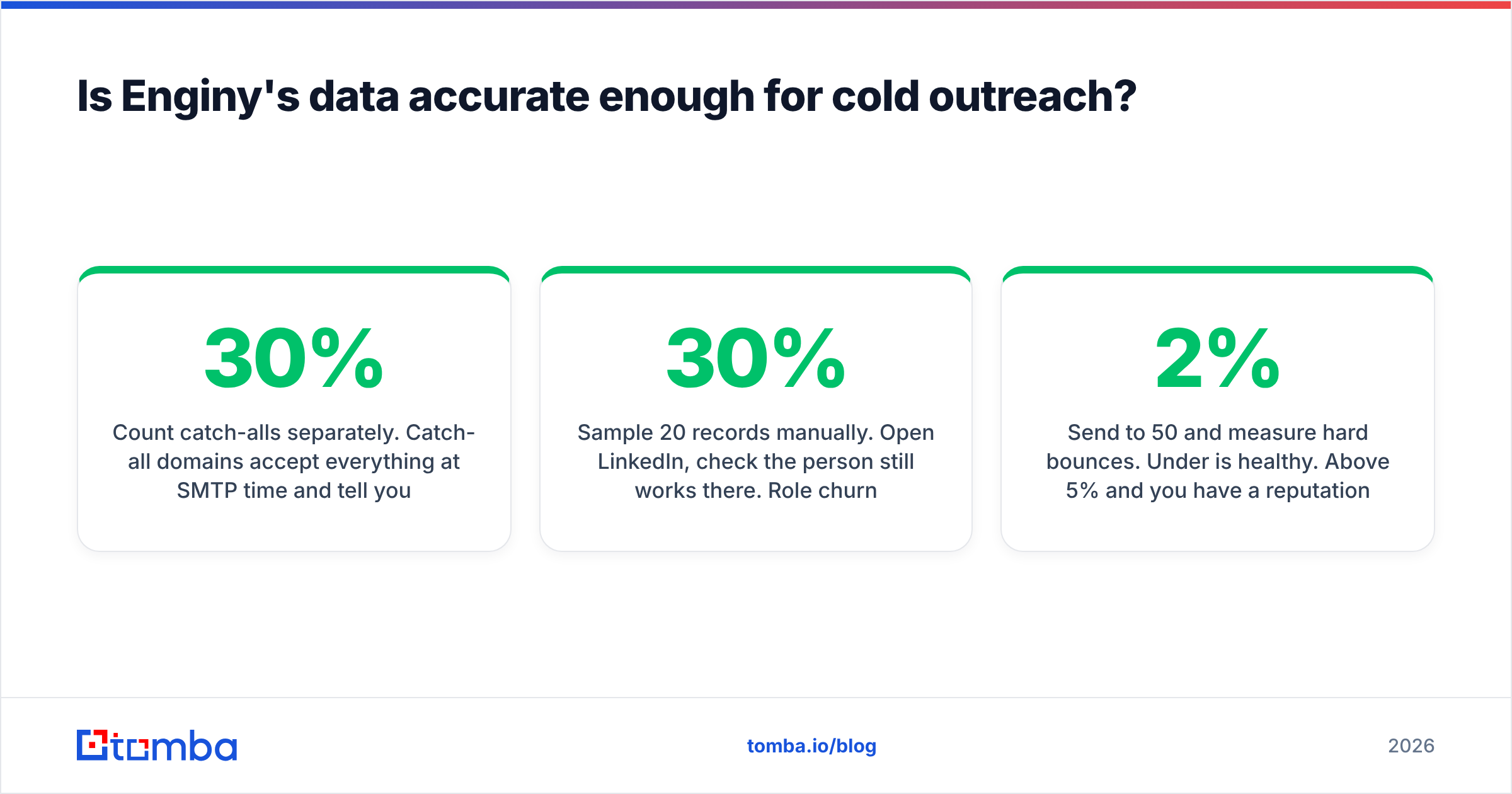
- Count catch-alls separately. Catch-all domains accept everything at SMTP time and tell you nothing. If 30% of the list is catch-all, your "95% valid" number is closer to 65% actionable.
- Sample 20 records manually. Open LinkedIn, check the person still works there. Role churn is the silent killer — B2B contact data decays at roughly 22–30% per year, and every vendor in this space is fighting the same decay curve.
- Send to 50 and measure hard bounces. Under 2% is healthy. Above 5% and you have a reputation problem forming, regardless of what the dashboard said.

That last step is the one everyone skips. Bounce rate is the only accuracy metric your mail provider cares about, and it is the only one that costs you money when it is wrong. If Enginy's suggested contacts pass that test on your segment, the AI layer above them is worth evaluating on its own merits. If they don't, no amount of research summarisation saves the campaign.
How much does Enginy cost compared to alternatives?#
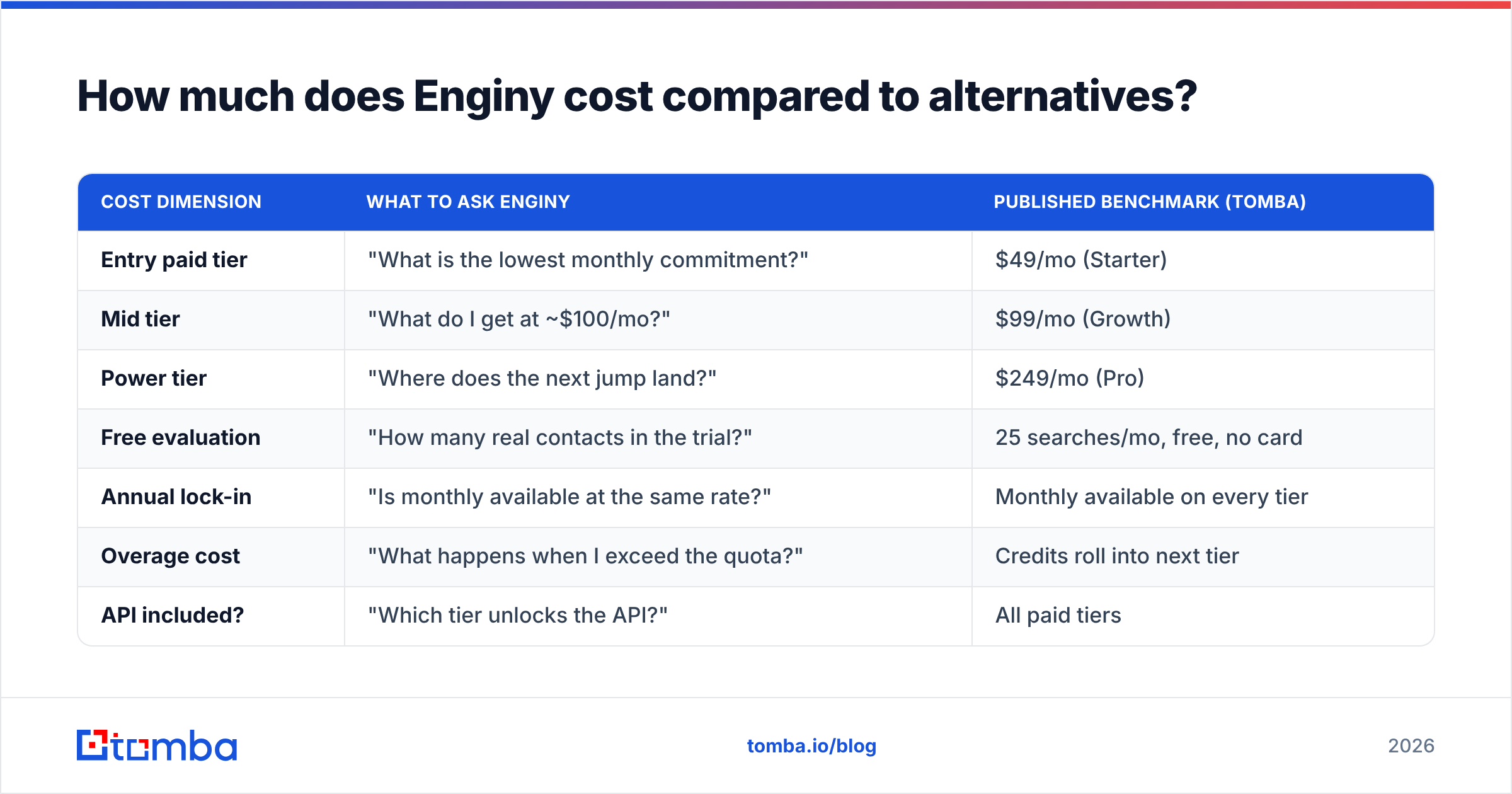
Because Enginy's pricing is not published as a simple ladder, the honest comparison is against tools that do publish. Use this as your negotiation floor:
| Cost dimension | What to ask Enginy | Published benchmark (Tomba) |
|---|---|---|
| Entry paid tier | "What is the lowest monthly commitment?" | $49/mo (Starter) |
| Mid tier | "What do I get at ~$100/mo?" | $99/mo (Growth) |
| Power tier | "Where does the next jump land?" | $249/mo (Pro) |
| Free evaluation | "How many real contacts in the trial?" | 25 searches/mo, free, no card |
| Annual lock-in | "Is monthly available at the same rate?" | Monthly available on every tier |
| Overage cost | "What happens when I exceed the quota?" | Credits roll into next tier |
| API included? | "Which tier unlocks the API?" | All paid tiers |
Full Tomba pricing is public precisely so it can be used this way. If a vendor's quote lands materially above a published equivalent, the delta is what you are paying for the AI reasoning layer — and you should be able to name the value it returns. "It saves reps time" is fine. "We are not sure yet" means negotiate harder or start monthly.
One more cost that never appears on a quote: the cost of a burned sending domain. A three-week deliverability recovery costs more in lost pipeline than a year of most subscriptions. Weight verification quality accordingly.
Who should buy Enginy, and who should skip it?#
Buy Enginy if:
- Your reps are new and you have no documented ICP or research playbook.
- You are consolidating four or more point tools and can quantify the switching gain.
- Your ICP sits squarely in the segments the vendor is strongest in — confirm this in the trial, not on the pricing page.
- You value speed-to-first-touch over granular control of every field.
Skip Enginy if:
- Your targeting is already sharp and your gap is contactable, verified records. Buy data, not reasoning.
- You run high-volume outbound where a two-point bounce-rate difference decides the quarter.
- You need auditable provenance for compliance, procurement, or attribution reasons.
- Your budget is under $100/mo — quote-based tools are rarely the right fit at that scale.
- You need programmatic enrichment inside your own systems, in which case a documented Tomba API or equivalent beats a UI-first workflow.
The unglamorous truth is that most outbound teams that think they have a targeting problem actually have a data-hygiene problem. They are contacting the right kind of person at the right kind of company with an address that stopped working in March. An AI layer does not fix that. A verification layer does.
What should you ask on the demo call?#
Bring these five and do not accept a deflection on any of them:
- "Where does the underlying contact data come from, and who owns it?" Licensed, contributory, and first-party crawled data have very different decay profiles.
- "Show me a catch-all-heavy segment." Ask them to run your worst domain list live. The reaction tells you more than the answer.
- "What is the effective cost per contactable record at my volume?" Divide the quote by the realistic usable output, not the credit allowance.
- "Can I export everything if I leave?" Workflow lock-in is real; export rights are your exit.
- "What is the monthly rate with no annual commitment?" If monthly is unavailable or punitively priced, the product is not confident in its own retention.
The bottom line on Enginy pros and cons#
Enginy is a reasonable buy for teams whose genuine constraint is prospecting judgement — junior orgs, new market entries, founders doing outbound before their first sales hire. The workflow consolidation and research compression are real advantages, and the category is improving quickly.
It is a poor buy for teams whose constraint is data quality, cost transparency, or programmatic control. Those teams should assemble a leaner stack: a targeting definition they own, a verified data source they can audit, and a sequencer they already trust.
So weigh the Enginy pros and cons against the layer that is actually broken. If yours is the contact record — the emails bounce, the direct dials are dead, the enrichment fields are half empty — run 25 free searches through the Tomba Email Finder against your real ICP before you sit through another demo. Published pricing from $49/mo, verification built into the same product, and a full API on every paid tier. Test it against whatever quote Enginy sends you, and let the bounce rate decide.
Related guides#
Ready to find emails that actually work?
Join 150,000+ professionals who stopped guessing and started sending. Free credits on signup — no credit card required.
Get the Tomba newsletter
Practical outbound tactics and product updates — once every two weeks.
About the author