FindThatLead vs Harmonic: Which B2B Data Tool Wins in 2026
One tool finds cheap emails at volume. The other maps startup signals for investors and GTM teams. Here is the honest breakdown of FindThatLead vs Harmonic, including where both fall short.
FindThatLead vs Harmonic looks like a head-to-head fight. It is not one. One tool finds cheap emails at volume. The other tracks startup signals in near real time. Here is the short version.
TL;DR
- FindThatLead and Harmonic are not real competitors. FindThatLead is a low-cost email finder and sender. Harmonic is a startup intelligence graph for venture funds and GTM teams.
- Need 5,000 verified emails this month for under $100? FindThatLead is the closer match. Need to know which seed-stage firms just doubled engineering headcount? Only Harmonic answers that.
- FindThatLead publishes pricing, roughly $49–$399/mo by tier. Harmonic is sales-led and quote-based, so expect a four-to-five-figure annual deal.
- Want accurate contact data, clear per-credit pricing, and a real API? Neither is a clean fit. That gap is where Tomba, Findymail, and Apollo live.
- Buy Harmonic for discovery and timing. Buy an email finder for contact data. Making one do the other's job is the most common budget mistake here.
What are FindThatLead and Harmonic, exactly?#
Start here. The two products get lumped together in "B2B data tool" listicles that never explain the one thing that matters: they solve different problems.
FindThatLead is a Barcelona-based prospecting suite. It launched in 2015. The core loop is simple. Give it a domain, or a name plus a company, and it returns a likely business email. You can verify that email, then push the list into its built-in cold email sender. There is also a Chrome extension, a bulk CSV uploader, a "Prospector" search by role and location, and a lead-scoring layer. Prices are low, and the target user is the solo founder, the agency, or the small sales team. See findthatlead.com for the current feature list.
Harmonic (harmonic.ai) is a company and people intelligence platform. It was built first for venture capital. It tracks tens of millions of companies and hundreds of millions of people. More to the point, it watches them change over time: funding rounds, headcount shifts by department, founder job changes, stealth companies, GitHub and app-store activity. You build saved searches that fire when a company crosses a line you care about. Those hits flow into Affinity, Salesforce, or HubSpot.
One tool sells you who to email. The other sells you when a company became worth emailing.
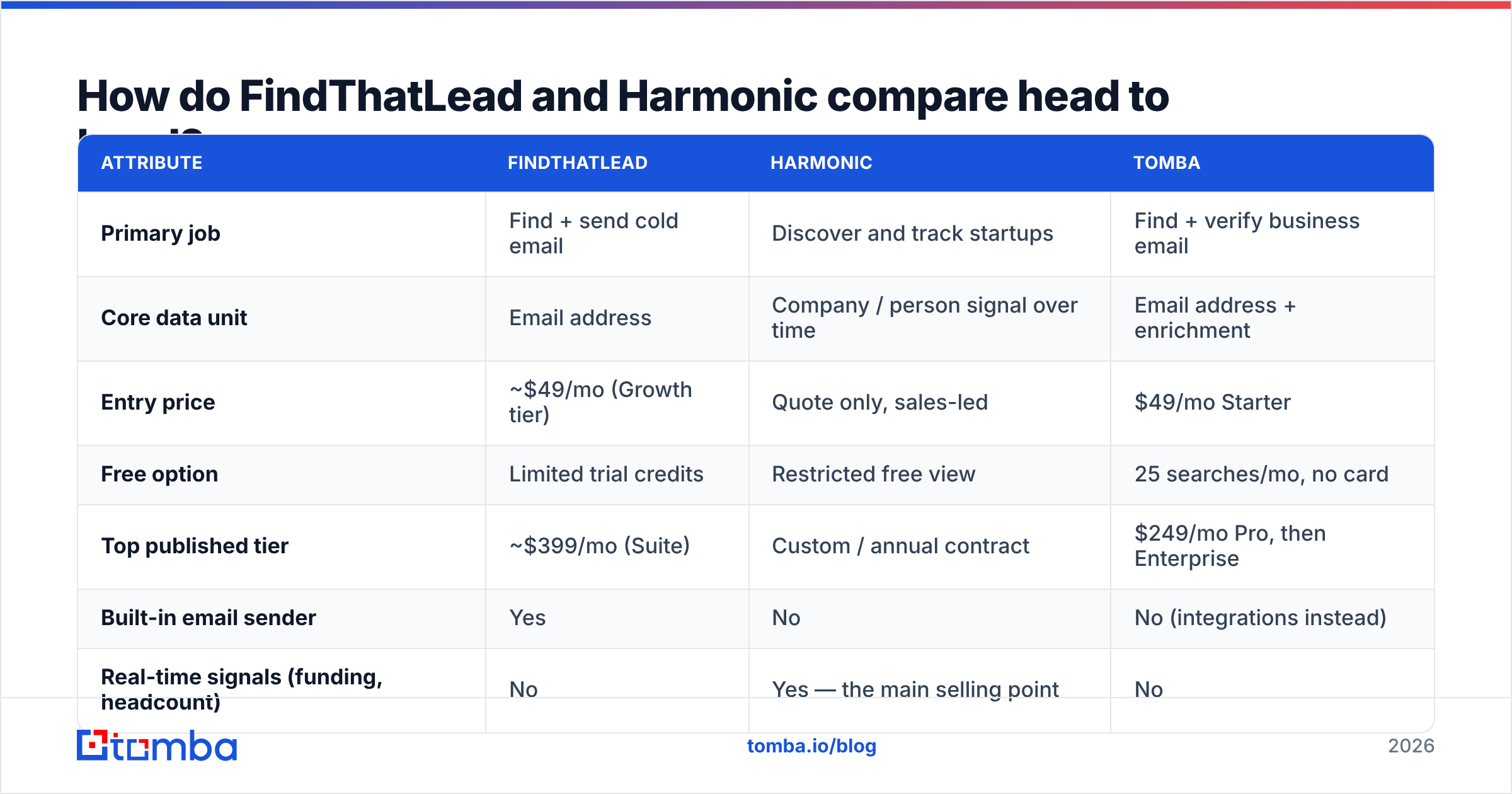
FindThatLead vs Harmonic: how do they compare head to head?#
Here is the practical comparison. Treat the pricing as directional. FindThatLead changes its tiers, and Harmonic does not publish rates at all, so check both before you sign.
| Attribute | FindThatLead | Harmonic | Tomba |
|---|---|---|---|
| Primary job | Find + send cold email | Discover and track startups | Find + verify business email |
| Core data unit | Email address | Company / person signal over time | Email address + enrichment |
| Entry price | ~$49/mo (Growth tier) | Quote only, sales-led | $49/mo Starter |
| Free option | Limited trial credits | Restricted free view | 25 searches/mo, no card |
| Top published tier | ~$399/mo (Suite) | Custom / annual contract | $249/mo Pro, then Enterprise |
| Built-in email sender | Yes | No | No (integrations instead) |
| Real-time signals (funding, headcount) | No | Yes — the main selling point | No |
| Verification depth | Basic validation | Not a verification tool | Dedicated verifier + catch-all handling |
| Public API | Yes, limited | Yes, contract-gated | Yes, documented and self-serve |
| Typical buyer | Solo founder, agency, SMB SDR | VC associate, GTM/RevOps at Series B+ | Growth team, agency, developer |
The table shows the real decision. You are not picking a winner on features. You are picking which half of the prospecting problem blocks you today.
Which one has better data?#
Wrong question — but here is the answer anyway, split by data type.
On contact data, FindThatLead is the stronger of the two. That is the whole point of the product. User reviews on G2 put its find rates in a good-but-not-elite band. It does well on well-indexed SaaS and tech domains. It does worse on small businesses, non-English domains, and catch-all mail servers. Its verification is a basic validity check, not a deep SMTP-and-pattern confidence score, so some "valid" results still bounce. Budget a 3–8% bounce rate unless you clean the list with a dedicated email verifier first.
On company and timing data, Harmonic wins outright. FindThatLead has no answer to "show me every company where the VP of Engineering left in the last 60 days." It cannot surface companies whose headcount grew 40% in a quarter either. Harmonic refreshes its graph continuously, and its person-level history runs deep. That is why funds pay for it.
Here is the failure mode teams hit. They buy Harmonic, build a sharp signal-driven target list, then find the attached emails too thin for outbound at volume. Harmonic surfaces the person. Turning that person into a deliverable inbox is still a separate step. That is why teams pair it with an email finder or an enrichment waterfall.
Four accuracy questions to ask either vendor before you buy#
- What is the real verified-deliverable rate, not the "found" rate? Found includes guesses. Ask for the bounce-adjusted number.
- How are catch-all domains handled? A tool that returns catch-alls as "valid" is padding its own scorecard. Ask if there is a separate catch-all verifier step.
- How often is the data refreshed? Contact data refreshed once a quarter is close to useless in a market with this much job movement.
- Do you burn credits on failed lookups? Some vendors charge for every attempt. Others charge only when they return a result. Over 10,000 lookups, that gap is real money.
Who should actually buy FindThatLead?#
Buy it if you match most of these:
- You are cost-constrained. Under $100 a month for real volume is hard to beat.
- You want find-and-send in one tab. The built-in sender takes you from search to sequence without a second subscription. For a one-person GTM motion, that is a real convenience.
- Your ICP is well-indexed. Tech companies, agencies, and e-commerce brands with a public domain and a LinkedIn presence.
- You accept some cleanup work. You will export, dedupe, and verify before you send. Plan for it.
Skip it in three cases. You need strong coverage in EMEA outside the UK. Your compliance team will check data sources line by line. Or your sending setup cannot absorb a mediocre bounce rate. On that last point: a 6% bounce on a cold domain is a sender reputation problem long before it is a data problem.
Who should actually buy Harmonic?#
Buy it if you match most of these:
- Timing is your edge. You win deals by reaching companies within weeks of a trigger event, not by reaching more companies.
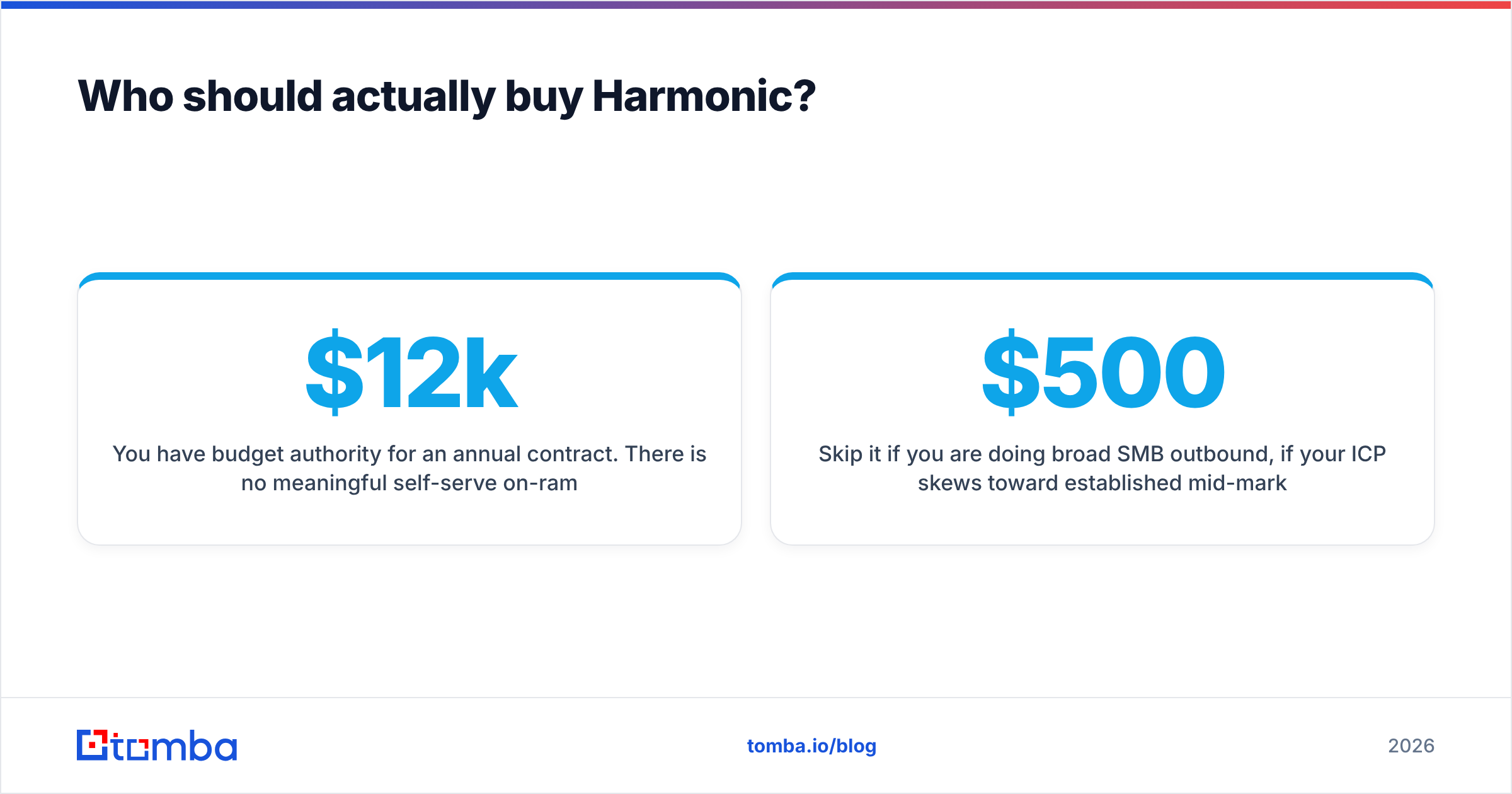
- You can sign an annual contract. There is no real self-serve on-ramp. If a $12k–$40k line item needs three approvals at your company, plan for that delay.
- You sell to startups or invest in them. Harmonic is deepest exactly where most B2B databases are thinnest: pre-seed through Series B, including stealth.
- You already have a contact-data layer. Harmonic sits above your email tooling, not instead of it.
Skip it if you run broad SMB outbound. Skip it if your ICP is mid-market and enterprise, where Crunchbase, ZoomInfo, or a plain domain search covers you for far less. And skip it if your whole tooling budget is under $500 a month.
Where does each tool break down?#
Every honest FindThatLead vs Harmonic comparison needs this section.
FindThatLead's weak points: verification depth, coverage outside the US and UK, and the sender. The built-in sender is fine at low volume. It is not Instantly or Smartlead, though: inbox rotation, warmup, and deliverability tooling are all basic. Teams that pass a few thousand sends a month tend to move sending elsewhere. At that point they pay for a bundle they only half-use. Support also gets mixed marks in public reviews.
Harmonic's weak points: unclear pricing, contact data that lags its company data, and a heavy setup. You will spend time building the right saved searches before the tool pays for itself. If your team swaps tools every quarter, you will not see value before renewal. Pricing is negotiated too, so two similar companies often pay very different rates. Always benchmark against a second quote.
A shared weak point: neither tool gives you clean, documented, per-call API access at a price a small engineering team would wave through. FindThatLead's API exists but is limited. Harmonic's is powerful and locked behind a contract. If you are building enrichment into your own product or a Clay-style waterfall, both add friction.

Is there a middle ground between the two?#
Yes, and it is worth naming. Many teams buying either tool are really shopping for something in between: reliable contact data, clear pricing, and an API that does not require a sales cycle.
That is roughly the slot Tomba fills. The Starter plan is $49/mo, Growth is $99/mo, and Pro is $249/mo. A free tier gives you 25 searches a month to test before you commit. The stack covers finder, verifier, domain search, catch-all checks, phone finder, and data enrichment. All of it runs through a documented Tomba API, a CLI, and a Chrome extension. It does not send email and it does not track funding rounds. That is the honest limit.
Other options are worth a look, depending on your angle. Apollo bundles a database and a sequencer in one seat. Findymail chases raw find-rate on hard domains. BookYourData sells pre-built, verified lists outright, which is a solid choice when you want data delivered rather than queried. Clay lets you chain several providers in a waterfall and pay only for the one that returns a hit.
FindThatLead vs Harmonic: how should you decide?#
Run this in order. It takes about twenty minutes, and it saves a quarter of wasted spend.
- Write the bottleneck in one sentence. "I don't know who to contact" points to Harmonic. "I know who, but not their email" points to FindThatLead or a dedicated finder. If you cannot write that sentence, you are not ready to buy.
- Price the whole workflow, not the tool. Harmonic plus a contact-data layer plus a sender is three line items. FindThatLead is one line item with three mediocre parts. Compare the totals.
- Test on your worst 50 accounts, not your best. Every tool nails Stripe and Notion. Run the trial on the messy mid-market accounts you actually sell to, then score the results yourself.
Then, before you sign anything:
- Measure deliverability, not find rate. Send a small batch. Count bounces. An 80% find rate with a 2% bounce beats a 92% find rate with a 9% bounce every time. The second one quietly damages your email deliverability.
- Check the exit. Can you export your data? Is the API documented in public? Locked APIs and export limits are how tools keep customers who would rather leave.
- Negotiate Harmonic, not FindThatLead. Quote-based vendors expect a counteroffer. Published-price vendors rarely move far below list.
Frequently asked questions#
Is FindThatLead a direct Harmonic competitor? No. FindThatLead vs Harmonic is a comparison across categories, not within one. Harmonic competes with Crunchbase, PitchBook, Specter, and Tracxn. FindThatLead competes with Hunter, Tomba, Snov.io, and Findymail.
Does Harmonic provide email addresses? It provides person profiles with contact details attached. The depth varies by profile, and it is not built as a bulk email-finding engine. Most teams enrich Harmonic exports through a dedicated finder before they send.
Which is cheaper? FindThatLead, by an order of magnitude at the entry point. Whether it is better value depends on your bottleneck: discovery or contactability.
Can I use both? Yes. For well-funded GTM teams selling into startups it is a reasonable stack: Harmonic for the trigger, a finder plus verifier for the contact, and a sending platform for the sequence.
The bottom line#
FindThatLead vs Harmonic comes down to one question: which problem are you stuck on? The fastest way to waste money is to buy one and expect it to do the other's job. Pick Harmonic when timing is your edge and you have budget for an annual contract. Pick FindThatLead when you need volume email discovery on a small budget and can tolerate cleanup.
Maybe what you need is the contact layer: accurate emails, real verification including catch-all domains, and an API you can wire into your own stack without a sales call. If so, start with the Tomba Email Finder. The free tier gives you 25 searches a month, enough to benchmark it against your current tool before you spend a dollar. Test it on your hardest fifty accounts, count the bounces, and let the numbers pick the winner.
Related guides#
Ready to find emails that actually work?
Join 150,000+ professionals who stopped guessing and started sending. Free credits on signup — no credit card required.
Get the Tomba newsletter
Practical outbound tactics and product updates — once every two weeks.
About the author