FindThatLead vs SeamlessAI (2026): Which Tool Actually Wins?
FindThatLead is a lightweight prospecting tool with a cheap entry price. Seamless.AI is a full sales-intelligence database with a sales-heavy contract. Here is which one fits your team — and where both fall short.
FindThatLead vs SeamlessAI comes down to one trade. One tool returns fewer emails, and fewer of them bounce. The other returns far more, and more of them bounce. This guide covers the data, the real price, and the fine print.
TL;DR — FindThatLead vs SeamlessAI in 60 seconds#
- FindThatLead is a lightweight, self-serve prospecting tool: domain-based email search, a bulk uploader, a small built-in cold-email sender, and low monthly pricing. Good for solo founders and micro-agencies.
- Seamless.AI is a full sales-intelligence platform: a large contact database, buyer intent, job-change alerts, and Chrome-based scraping — sold through a sales rep, usually on an annual contract.
- Accuracy is the real fight. Seamless.AI's "AI search engine" builds and guesses contact data at scale. That inflates volume, and it inflates bounce risk too. FindThatLead is smaller and more careful, but thinner outside Europe and SMB SaaS.
- Pricing transparency is the second fight. FindThatLead publishes plans. Seamless.AI does not publish a public price list for most tiers, and its "unlimited" language is credit-gated in practice.
- Neither is a verification tool. Whichever you pick, run the export through a dedicated email verifier before you send, or your domain absorbs the guesswork.
What is FindThatLead, and who is it actually built for?#
FindThatLead is a Barcelona-built prospecting suite that started as a simple email finder and grew sideways into a small outbound stack. You give it a domain, a first/last name, or a LinkedIn profile, and it returns a probable business email. It also bundles a "Prospector" filter (search by role, industry, and location), a bulk CSV enricher, and a basic cold-email sender.
Its real identity is cheap, self-serve, and small-batch. There is no procurement call, no demo gate, no annual lock. You sign up, buy credits, and pull a few thousand contacts a month. That's a genuine advantage when your motion is "find 200 marketing directors in Spain and Portugal this week" rather than "build a 90,000-record territory model."
Where it strains: enterprise coverage, mobile phone numbers, org-chart depth, and intent data. Those simply aren't the product. Teams outgrow the small-batch motion fast. The ceiling shows up once you need verified direct dials and a real API budget.
What is Seamless.AI, and what does "AI search engine" really mean?#
Seamless.AI positions itself as a real-time B2B search engine rather than a static database. Instead of licensing a fixed contact file, it crawls, infers, and assembles contact records on demand — then validates them at query time. In practice that means the record you pull today may not have existed as a stored row yesterday.
That architecture has a real upside: coverage breadth. Seamless.AI advertises well over a billion contact records and layers on buyer intent, job-change tracking, and a Chrome extension that scrapes LinkedIn and company sites as you browse. For a mid-market SDR team running high-volume territory builds, that breadth matters.
The downside is baked into the same architecture. Assembled contact data is pattern-inferred data. Say the system builds first.last@company.com because that pattern is common at the domain. Then it marks the address "verified" after a soft check. What you get back is a confident guess. G2 and Capterra reviews for Seamless.AI cite bounce rates and stale titles as often as they praise volume. Check that pattern yourself on G2 before you commit.


FindThatLead vs SeamlessAI: how do they compare head-to-head?#
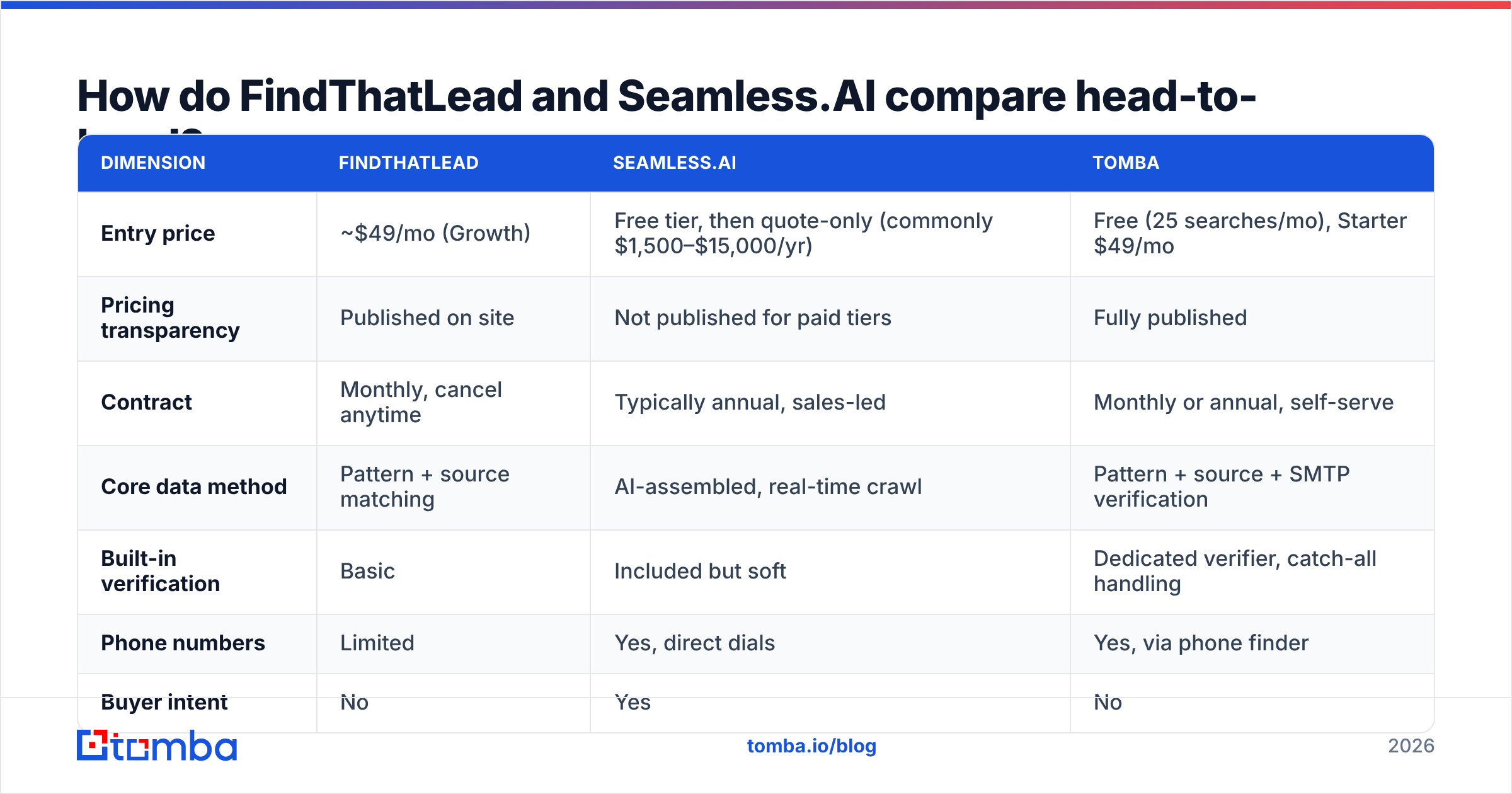
Here's the practical breakdown. Prices reflect publicly listed information as of early 2026; Seamless.AI's tiers are quote-based, so treat the range as directional, not a quote.
| Dimension | FindThatLead | Seamless.AI | Tomba |
|---|---|---|---|
| Entry price | ~$49/mo (Growth) | Free tier, then quote-only (commonly $1,500–$15,000/yr) | Free (25 searches/mo), Starter $49/mo |
| Pricing transparency | Published on site | Not published for paid tiers | Fully published |
| Contract | Monthly, cancel anytime | Typically annual, sales-led | Monthly or annual, self-serve |
| Core data method | Pattern + source matching | AI-assembled, real-time crawl | Pattern + source + SMTP verification |
| Built-in verification | Basic | Included but soft | Dedicated verifier, catch-all handling |
| Phone numbers | Limited | Yes, direct dials | Yes, via phone finder |
| Buyer intent | No | Yes | No |
| Cold email sending | Yes, basic | Via integrations | No — integrates instead |
| API access | Yes, limited | Yes, enterprise-tier | Yes, all paid plans |
| Best fit | Solo founders, EU SMB outreach | Mid-market SDR teams, US-heavy | Accuracy-first teams and developers |

Which one has better data accuracy?#
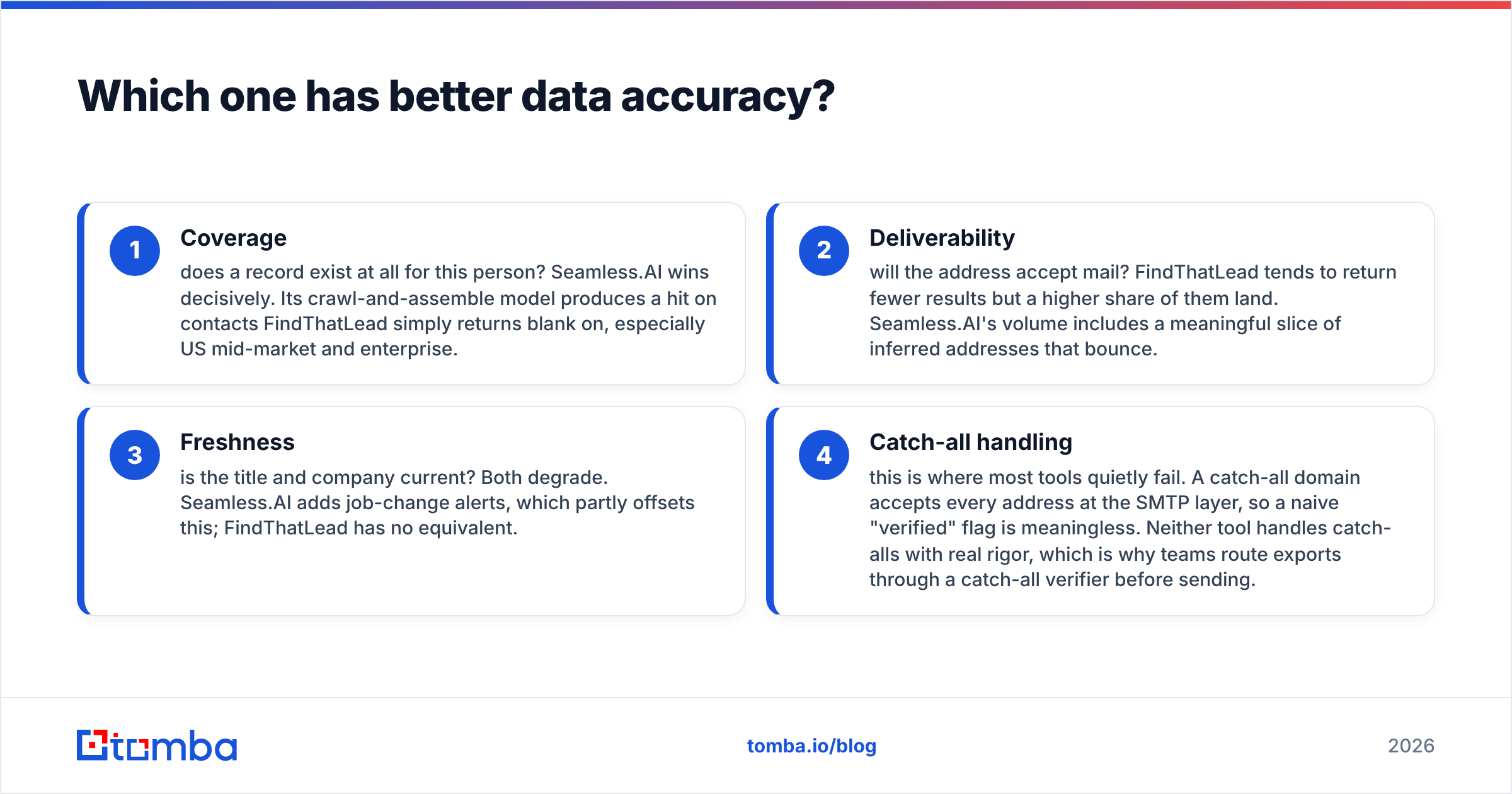
Short answer: FindThatLead bounces less, Seamless.AI finds more. That trade is the whole comparison.
Break accuracy into four things buyers usually conflate:
- Coverage — does a record exist at all for this person? Seamless.AI wins decisively. Its crawl-and-assemble model produces a hit on contacts FindThatLead simply returns blank on, especially US mid-market and enterprise.
- Deliverability — will the address accept mail? FindThatLead tends to return fewer results but a higher share of them land. Seamless.AI's volume includes a meaningful slice of inferred addresses that bounce.
- Freshness — is the title and company current? Both degrade. Seamless.AI adds job-change alerts, which partly offsets this; FindThatLead has no equivalent.
- Catch-all handling — this is where most tools quietly fail. A catch-all domain accepts every address at the SMTP layer, so a naive "verified" flag is meaningless. Neither tool handles catch-alls with real rigor, which is why teams route exports through a catch-all verifier before sending.
If you only remember one thing: a tool's advertised "95% accuracy" figure is measured on the results it chose to return. It is not measured on your list. Test both on 200 of your ICP records and count real bounces. That five-dollar test beats every vendor claim in this post.
What does each one actually cost in 2026?#
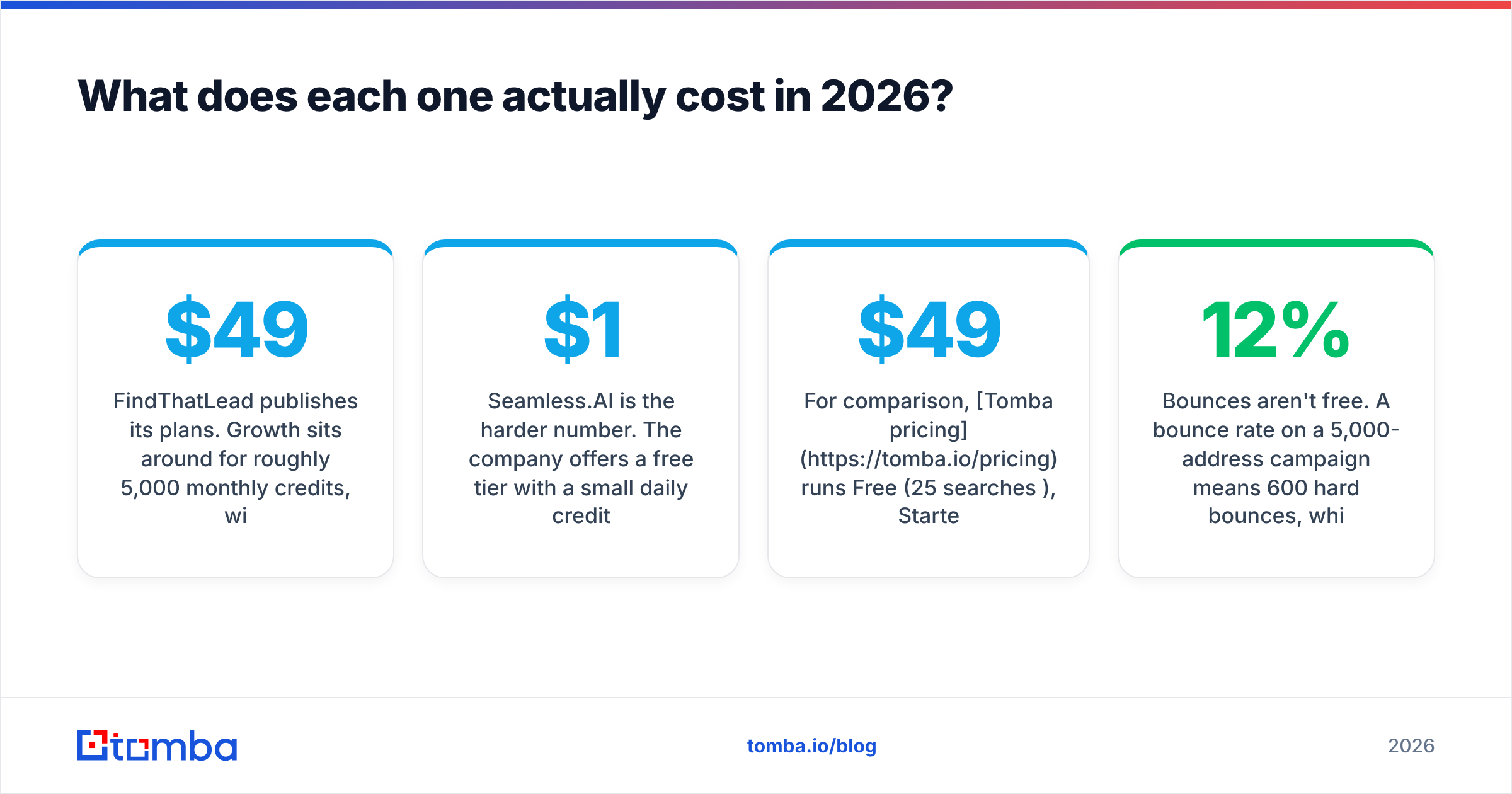
FindThatLead publishes its plans. Growth sits around $49/mo for roughly 5,000 monthly credits, with a Startup tier near $150/mo and a Suite tier above that. Credits reset monthly, don't roll over on lower plans, and a failed search still consumes budget on bulk jobs.
Seamless.AI is the harder number. The company offers a free tier with a small daily credit allotment, then routes everything else through a sales conversation. Reported contract values from review sites cluster between $1,500 and $15,000 per year depending on seats and credit volume. Two recurring complaints show up in public reviews: the difficulty of getting a price without a demo, and auto-renewal terms that catch teams off guard. Read the renewal clause. Twice.
For comparison, Tomba pricing runs Free (25 searches/mo), Starter $49/mo, Growth $99/mo, Pro $249/mo, and Enterprise on quote — with the API included on every paid tier rather than gated behind an enterprise upgrade.
The hidden cost nobody prices in#
Bounces aren't free. A 12% bounce rate on a 5,000-address campaign means 600 hard bounces. That is enough to visibly damage sender reputation at Google and Microsoft. Recovery means new domains, a fresh warmup cycle, and weeks of throttled sending. That bill often beats the yearly price gap between these two tools. Price the data quality, not the seat.
Which tool fits which team?#
Pick FindThatLead if:
- You're a solo founder or 2–5 person team sending under 3,000 emails a month
- Your ICP skews European SMB, agency, or SaaS
- You want one bill, month-to-month, no sales call
- You value a built-in sender over best-in-class data
Pick Seamless.AI if:
- You run an SDR pod of 5+ reps with a defined US territory
- You need direct dials and buyer intent in the same workflow
- You have budget approval for an annual commitment and someone to negotiate it
- Your team will actually use job-change alerts and the Chrome extension daily
Pick neither if:
- Your bottleneck is verification, not discovery
- You need clean data piped into a product or workflow via API
- You're comparing a $49/mo tool to a $9,000/yr contract and the honest answer is "a focused email finder plus a verifier"
For teams that fall in that third bucket, the practical stack is a precise email finder for discovery, a domain search pass to map every reachable contact at a target account, and a verification step before anything touches a sequencer. That's three cheap steps instead of one expensive contract.

Are there better alternatives to both?#
Yes — and the honest framing is that "FindThatLead vs SeamlessAI" is a false binary for most buyers. The category splits into three jobs:
- Discovery at scale — Seamless.AI, Apollo, ZoomInfo, and BookYourData all serve this well. BookYourData in particular is worth a look if you want a pay-as-you-go, verified list-building model without a subscription; it's a strong fit for teams that buy in bursts rather than monthly.
- Precision finding — Tomba, Hunter, Findymail. Smaller result sets, higher confidence per result, transparent pricing.
- Verification and hygiene — ZeroBounce, NeverBounce, and Tomba's verifier. This layer is not optional regardless of which finder you use.
Teams that mix layers 2 and 3 usually beat teams that buy one expensive layer-1 contract. The expensive contract still hands you unverified rows. If you're evaluating Seamless.AI specifically, it's worth reading through the Seamless.AI alternative breakdown alongside the vendor's own materials so you're negotiating from a two-sided view.
One more practical note: whatever you choose, check the export format early. FindThatLead and Seamless.AI both export CSV, but field mapping into your CRM is where hours disappear. Confirm the HubSpot integration or Salesforce path works with your object model before you buy 12 months of credits, not after.
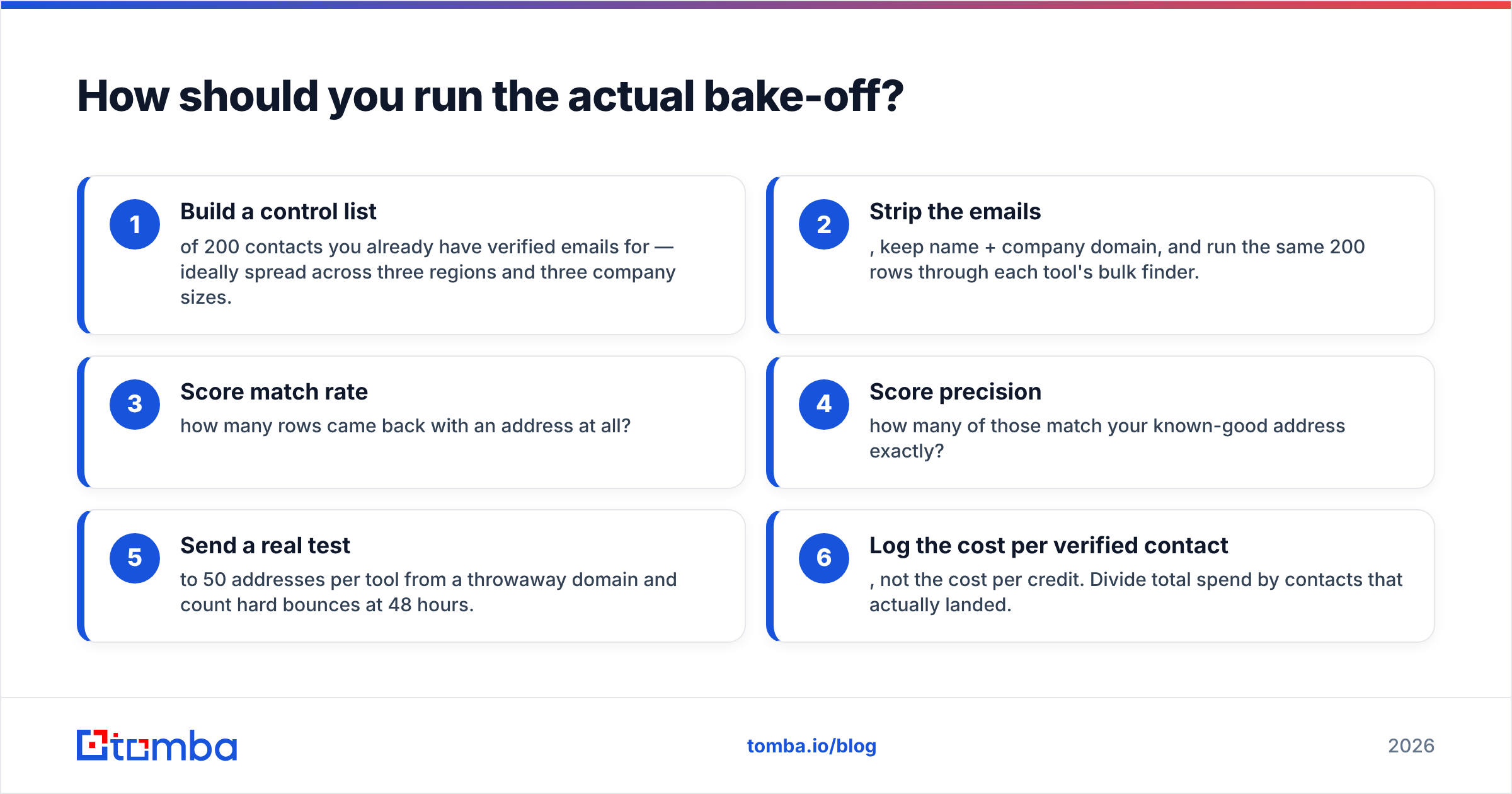
How should you run the actual bake-off?#
Don't compare marketing pages. Run this in an afternoon:
- Build a control list of 200 contacts you already have verified emails for — ideally spread across three regions and three company sizes.
- Strip the emails, keep name + company domain, and run the same 200 rows through each tool's bulk finder.
- Score match rate — how many rows came back with an address at all?
- Score precision — how many of those match your known-good address exactly?
- Send a real test to 50 addresses per tool from a throwaway domain and count hard bounces at 48 hours.
- Log the cost per verified contact, not the cost per credit. Divide total spend by contacts that actually landed.
Most teams find that their match-rate winner and their precision winner are different tools. That's the point. It is also why the two-layer stack — finder plus verifier — tends to beat any single-vendor answer. If you want to script the whole test rather than click through dashboards, both a bulk email finder and a straightforward REST endpoint make step 2 a ten-line job.
The verdict#
If forced to pick one: Seamless.AI for volume-driven US SDR teams with budget; FindThatLead for lean European operators who want to stay month-to-month. Neither is a general-purpose recommendation, and neither solves verification for you.
The bigger insight is that both tools optimize the wrong end of the funnel for most buyers. Discovery has commoditized. Dozens of vendors can hand you a plausible email. What hasn't commoditized is knowing which of those emails is real before you spend your domain reputation finding out. That's the layer worth paying for, and both of these tools treat it as a checkbox feature.
Start there, and the tool choice above it gets much cheaper.
Try a precision-first approach. If your problem is bounce rate rather than result volume, run your next 100 prospects through the Tomba Email Finder — SMTP-level verification on every result, catch-all detection built in, and 25 free searches a month with no sales call and no annual contract. Compare the bounce rate against whatever you're using now, then decide. The free tier is enough to settle the argument.
Related guides#
Ready to find emails that actually work?
Join 150,000+ professionals who stopped guessing and started sending. Free credits on signup — no credit card required.
Get the Tomba newsletter
Practical outbound tactics and product updates — once every two weeks.
About the author