FindThatLead vs Vainu: Which B2B Prospecting Tool Wins in 2026?
FindThatLead finds and emails contacts. Vainu scores companies with firmographic and trigger data. They solve different halves of outbound — here is which one your team actually needs, and what it costs.
FindThatLead vs Vainu is an odd matchup. One tool finds email addresses. The other tells you which companies deserve a call. Here is what each one does, what it costs, and which one your team needs.
TL;DR
- FindThatLead and Vainu are not real rivals. FindThatLead works at the contact level: find an email, verify it, send it. Vainu works at the company level: firmographics, buying signals, CRM enrichment.
- Pick FindThatLead if your bottleneck is "I need 2,000 verified emails this month." Pick Vainu if your bottleneck is "I don't know which of my 40,000 target companies to call."
- Vainu is strongest in the Nordics and the Netherlands. There it pulls from official company registries. Outside that footprint the data thins out fast.
- FindThatLead bundles sending. That is handy early on. It is also why teams outgrow it, since a bundled sender rarely matches a dedicated cold-email platform.
- Need only the data layer — find, verify, enrich? A focused API-first provider usually costs less than either tool.
What problem does each tool solve?#
Start here. The "vs" framing hides the real difference.
Think of outbound as a two-story building. The ground floor is account selection: which companies deserve your reps' time this quarter. The second floor is contact acquisition: who you email there, and what their address is.
Vainu lives on the ground floor. It reads company registry filings, financial statements, websites, job posts, news, and tech signals. It turns all of that into filters and triggers. You can build a list like "Finnish manufacturers, 50–200 staff, revenue up more than 15%, hiring a supply chain manager, running SAP." Then you push those accounts into HubSpot, Salesforce, or Pipedrive with the fields already filled in.
FindThatLead lives on the second floor. Give it a domain or a name. It returns a business email, checks that the address is deliverable, and can drop the contact into a cold email sequence. Its Prospector feature filters by location, industry, and job title. But that is contact search with filters on top, not a company intelligence graph.
So the honest answer to "FindThatLead vs Vainu" is that most teams buy neither on its own. They buy an account layer, a contact layer, and a sending layer. The real question is which vendor covers which layer, and at what cost.
FindThatLead vs Vainu: how do they compare head to head?#
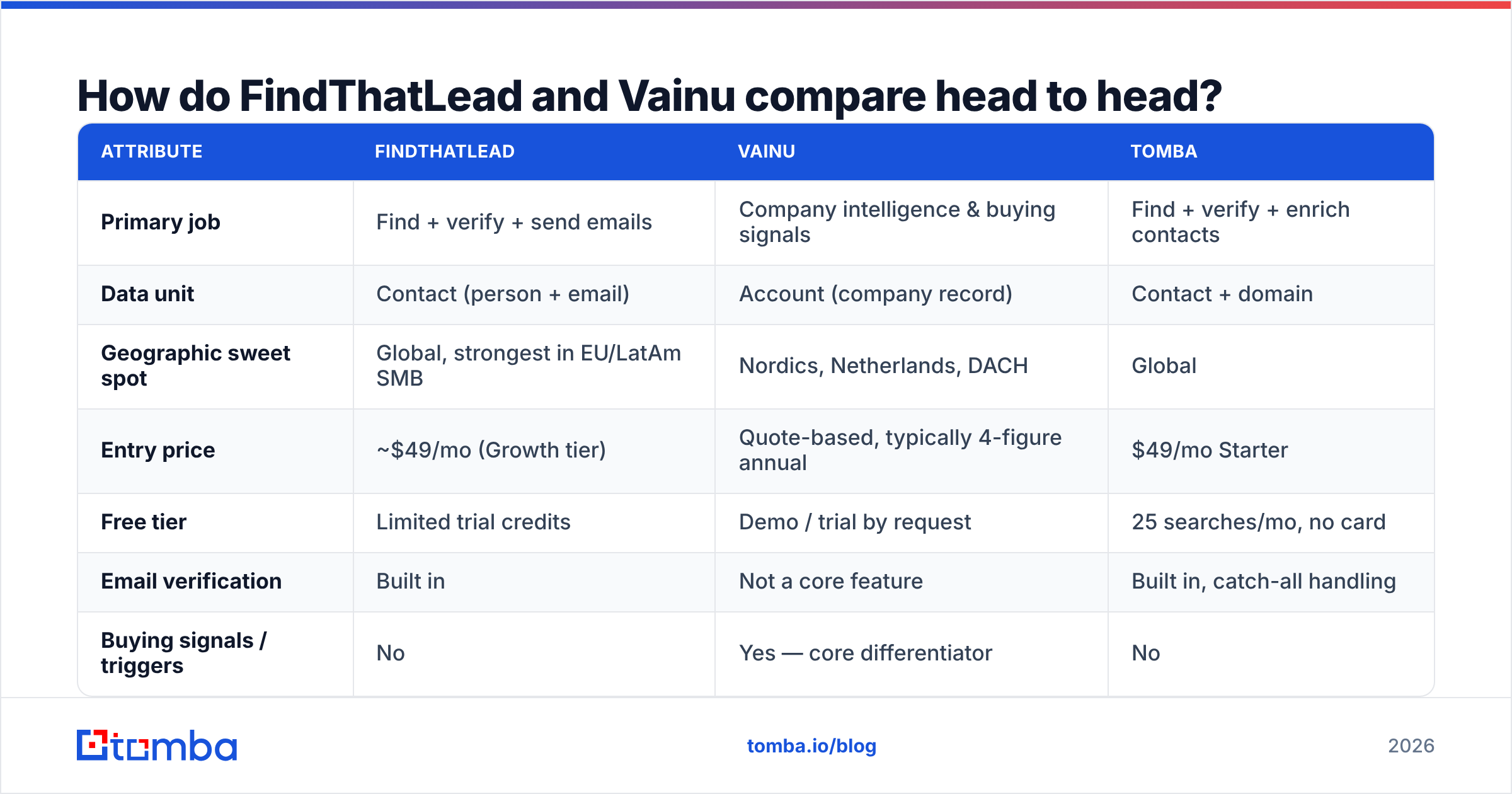
Pricing moves on both platforms. Vainu quotes most tiers rather than publishing them. Treat the numbers below as directional and check the vendor pages before you sign.
| Attribute | FindThatLead | Vainu | Tomba |
|---|---|---|---|
| Primary job | Find + verify + send emails | Company intelligence & buying signals | Find + verify + enrich contacts |
| Data unit | Contact (person + email) | Account (company record) | Contact + domain |
| Geographic sweet spot | Global, strongest in EU/LatAm SMB | Nordics, Netherlands, DACH | Global |
| Entry price | ~$49/mo (Growth tier) | Quote-based, typically 4-figure annual | $49/mo Starter |
| Free tier | Limited trial credits | Demo / trial by request | 25 searches/mo, no card |
| Email verification | Built in | Not a core feature | Built in, catch-all handling |
| Buying signals / triggers | No | Yes — core differentiator | No |
| Native cold email sending | Yes | No | No (integrations instead) |
| CRM enrichment | Basic export/integrations | Deep two-way CRM sync | API + native integrations |
| API | Yes, limited endpoints | Yes, company data API | Full REST API, CLI, MCP |
| Best for | Solo founders, small agencies, SMB outbound | Mid-market/enterprise ABM in Northern Europe | Data layer for any sending stack |
Two rows deserve a closer look.
Price shape, not price level. FindThatLead and Tomba sell credits. You pay per lookup, so a slow month costs less. Vainu sells seats on annual contracts. You commit up front, and each extra record is free. Neither model is wrong. They just punish different habits. Credits punish sloppy list-building. Seats punish small teams and stop-start campaigns.
Verification. Vainu does not sell itself as an email verification vendor, and it would be unfair to grade it as one. Route Vainu accounts into a sequencer and you still need an email verifier in between. Skip it and your bounce rate becomes a sender reputation problem.
Is Vainu's data actually better?#
In its home markets, yes. And it is not close.
Vainu's edge is structural. In Finland, Sweden, Norway, Denmark, and the Netherlands, companies file data with public registries in machine-readable form. Vainu reads those filings. So you get real revenue, real headcount, real ownership, and real filing dates. A scraped LinkedIn band like "estimated 51–200 employees" is a different quality tier.
Outside that footprint, the picture changes. Vainu covers other regions, but the registry edge disappears. There you are back to web-crawled and licensed data, the same raw material everyone else uses. Reviewers on G2 flag this pattern often: happy Nordic customers, mixed reports from teams targeting the US or APAC.
FindThatLead faces a different data problem. It is not describing companies. It is guessing and confirming an email address. That runs on pattern inference — first.last@, f.last@, firstname@ — plus verification. So accuracy rests on two things. How good is the pattern library for that domain? And how honest is the verification step about doubt?
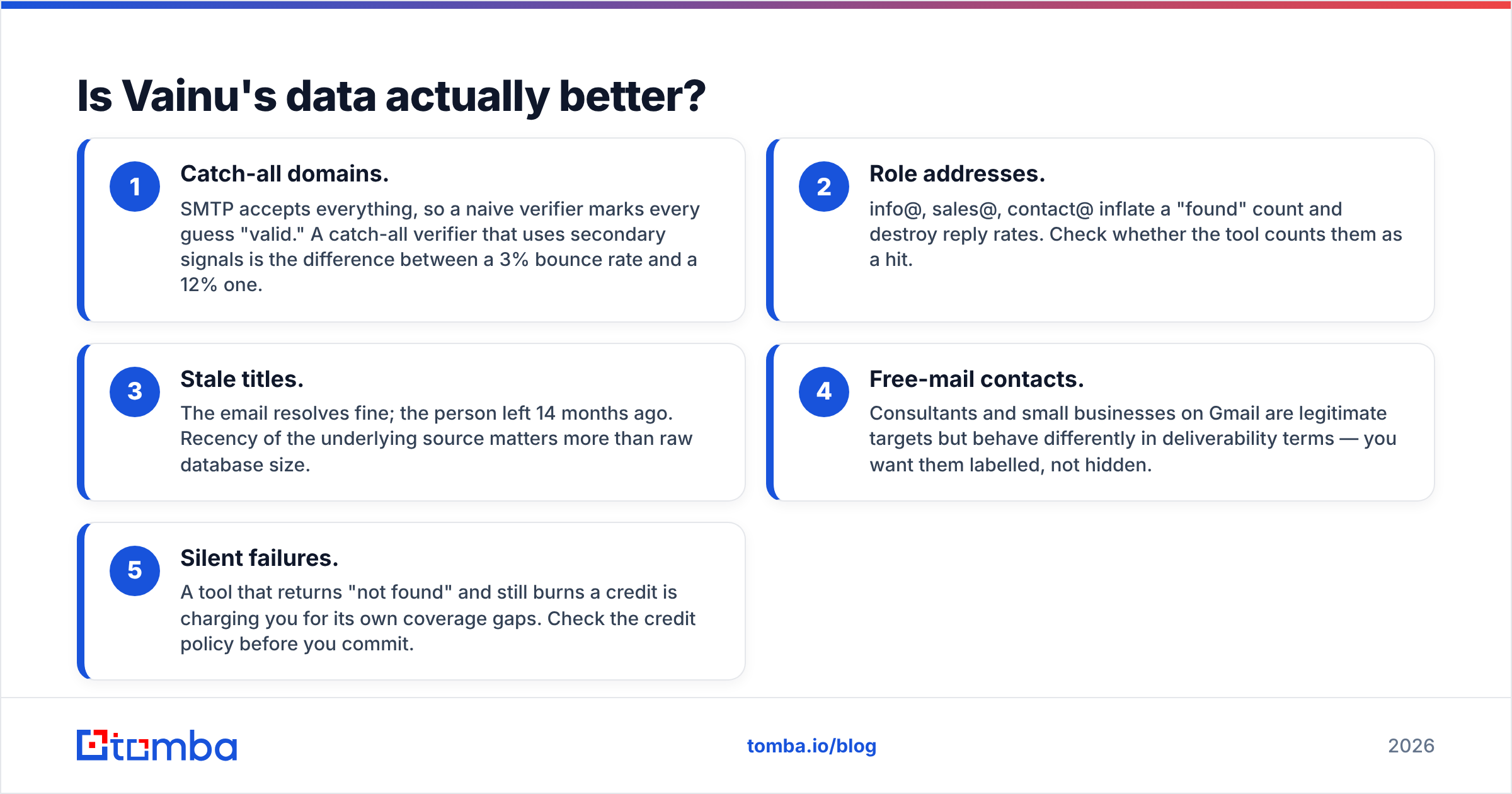
Contact-level tools fail in the same five places across the whole category:
- Catch-all domains. The server accepts every address, so a naive verifier marks each guess "valid." A catch-all verifier that reads other signals is the gap between a 3% bounce rate and a 12% one.
- Role addresses. info@, sales@, and contact@ pad the "found" count and sink reply rates. Check whether the tool counts them as hits.
- Stale titles. The email works. The person left 14 months ago. How fresh the source is matters more than how big the database is.
- Free-mail contacts. Consultants and small businesses on Gmail are fair targets. They just behave differently in deliverability terms. You want them labelled, not hidden.
- Silent failures. A tool that returns "not found" and still burns a credit charges you for its own gaps. Read the credit policy first.
Want to know where a vendor's records come from? Look for a published data sources page. Vendors that will not describe their pipeline usually have a reason.
Which one fits your team size and motion?#
Here is the call framed by who you are, not by feature count.
Solo founder or two-person startup. FindThatLead makes sense. Finding, verification, and sending come in one subscription. You are not juggling three vendors before product-market fit. The ceiling is low, but revenue problems will hit you first. Vainu's four-figure annual commitment is hard to justify this early.
SMB agency running outbound for clients. Volume and per-client segments matter more than depth of intelligence. Credit-based data plus a dedicated sequencer beats a bundled tool here. You will want separate sending domains and separate reputations per client anyway. Bulk workflows help most: a bulk email finder runs against uploaded domain lists and saves more hours than any UI tweak.
Mid-market sales team in Northern Europe. This is Vainu's home turf, and it earns its price. Registry-grade firmographics and trigger alerts cut wasted rep hours. Triggers include funding, hiring, expansion, and leadership changes. Pair it with a contact-data provider. Vainu tells you which company to work, not whose inbox to land in.
Enterprise ABM team, global territory. Neither tool is a full answer. You will end up with an intelligence platform, a contact database, and an enrichment API for CRM hygiene. Then you decide which pieces to buy and which to build. A data enrichment layer is what keeps the CRM from rotting at 2–3% per month.
Developer or RevOps engineer. Ask one blunt question first. Is there a real API with documented rate limits, or just an "API" checkbox on the pricing page? A workflow like "enrich on form fill, enrich on CRM create, re-verify quarterly" needs code access, not a dashboard. Read the email finder API docs of every shortlisted vendor before the demo call, not after.
FindThatLead vs Vainu: what does each one cost?#
Sticker price is the least useful number. Model the cost per usable contact instead.
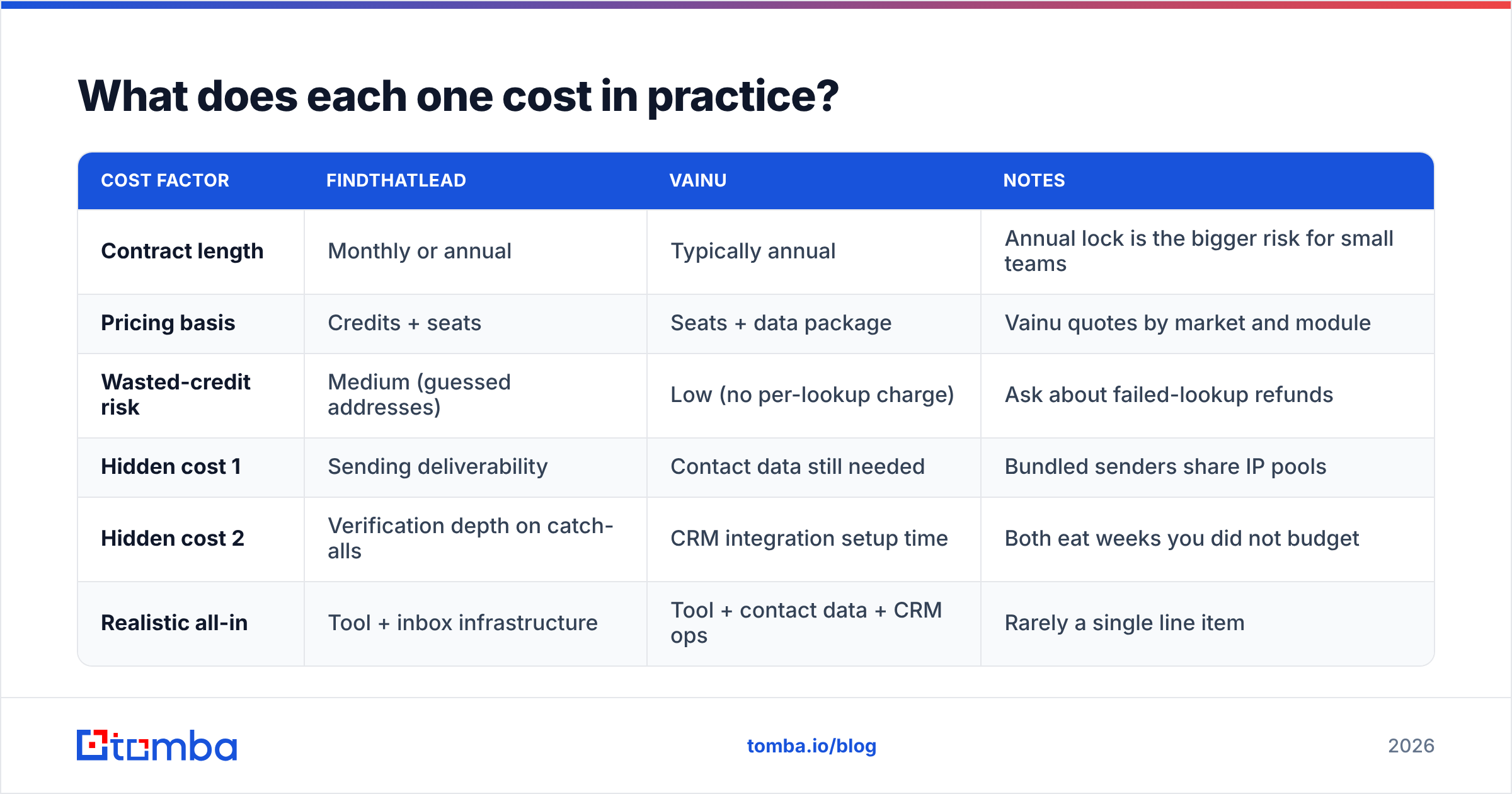
| Cost factor | FindThatLead | Vainu | Notes |
|---|---|---|---|
| Contract length | Monthly or annual | Typically annual | Annual lock is the bigger risk for small teams |
| Pricing basis | Credits + seats | Seats + data package | Vainu quotes by market and module |
| Wasted-credit risk | Medium (guessed addresses) | Low (no per-lookup charge) | Ask about failed-lookup refunds |
| Hidden cost 1 | Sending deliverability | Contact data still needed | Bundled senders share IP pools |
| Hidden cost 2 | Verification depth on catch-alls | CRM integration setup time | Both eat weeks you did not budget |
| Realistic all-in | Tool + inbox infrastructure | Tool + contact data + CRM ops | Rarely a single line item |
Run the math on your own funnel. Say you need 3,000 verified contacts a month, and a tool returns 55% valid addresses. You are really buying 5,500 lookups. A plan that is 30% cheaper per credit but 15 points worse on valid addresses costs you more.
For reference, Tomba pricing runs Free (25 searches a month), Starter at $49/mo, Growth at $99/mo, Pro at $249/mo, and custom Enterprise. It is credit-based, with no seat minimum. Verification is included, not sold as a second SKU.
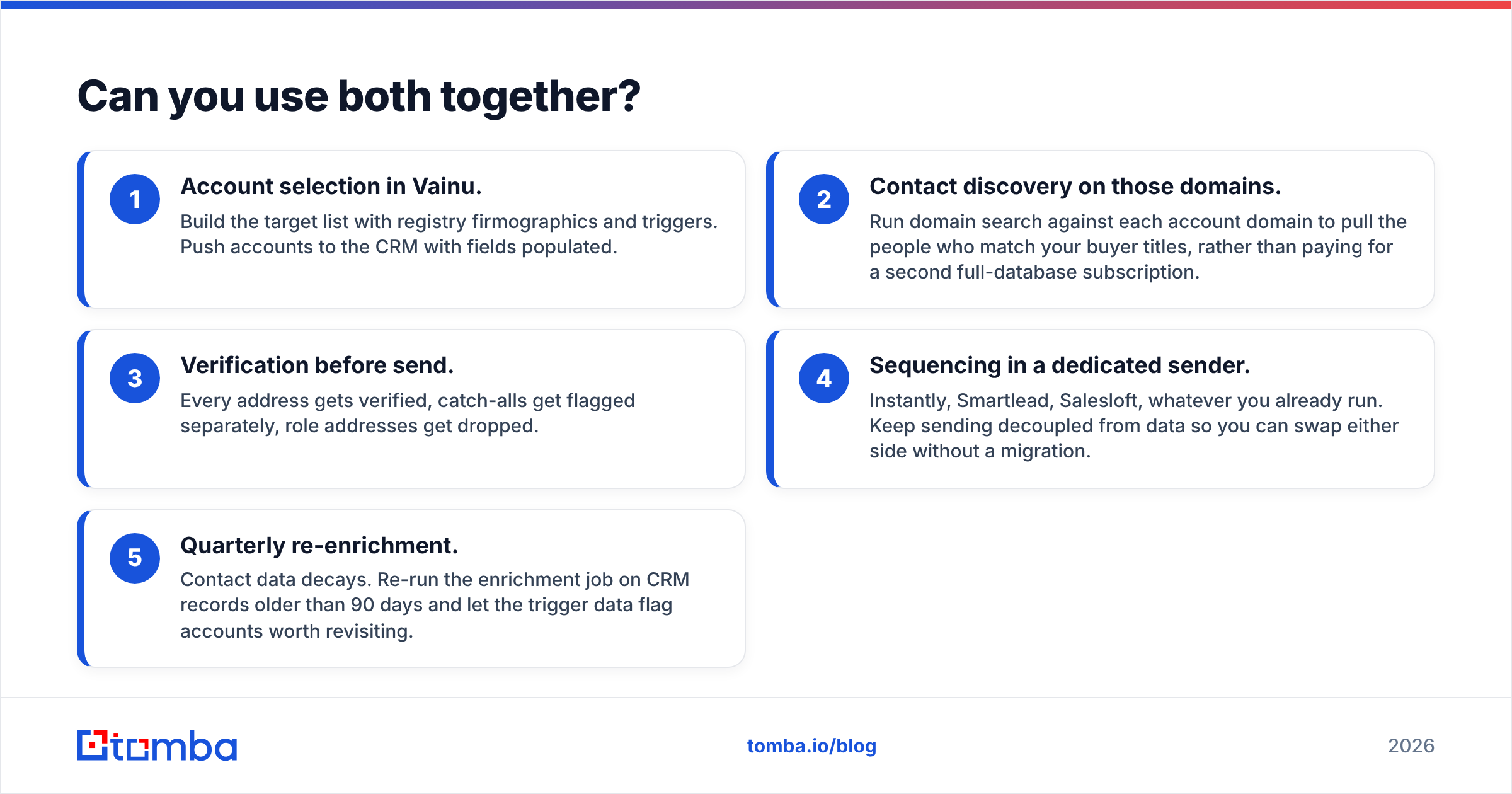
Can you use both together?#
Yes. For one profile it is the strongest setup available.
The pattern looks like this:
- Pick accounts in Vainu. Build the target list with registry firmographics and triggers. Push accounts to the CRM with fields filled in.
- Find contacts on those domains. Run domain search on each account domain. That pulls the people who match your buyer titles, so you skip a second full-database subscription.
- Verify before you send. Every address gets checked. Catch-alls get flagged separately. Role addresses get dropped.
- Sequence in a dedicated sender. Instantly, Smartlead, Salesloft — whatever you already run. Keep sending apart from data so you can swap either side without a migration.
- Re-enrich each quarter. Contact data decays. Re-run enrichment on CRM records older than 90 days. Let trigger data flag the accounts worth a second look.
That stack costs more than FindThatLead alone and less than a full enterprise data platform. Each layer is also replaceable on its own, which is the part that matters two years in.
FindThatLead vs Vainu: the honest weaknesses#
FindThatLead. The bundling that draws you in is also the ceiling. A finder-plus-sender has to split engineering time across two hard problems, and sending is the harder one. It means SPF, DKIM, DMARC, warmup, inbox rotation, and reputation monitoring. If deliverability is your constraint, a bundled sender is unlikely to be the fix. The intelligence layer is thin too: filters, not signals. And like every guess-and-verify tool, accuracy swings by domain type. It is strong on mid-size companies with clean patterns and weaker on large enterprises with legacy schemes.
Vainu. Geography is the whole story. If your ICP sits outside the Nordics, the Netherlands, or DACH, you pay premium prices for data that is no longer premium. The annual commitment and seat-based model also fit poorly under about ten reps. And Vainu does not solve contact acquisition. Budget it as your whole "data spend" and you will be short one line item.
The shared weakness. Neither tool fixes what kills most outbound programs: message relevance. Better accounts and better addresses raise the ceiling on a good campaign. They do nothing for a bad one.
Which should you buy?#
Most FindThatLead vs Vainu decisions come down to three questions, in order.
Is my problem targeting or reach? Reps working plausible accounts but stuck for addresses? Buy contact data. Reps with plenty of addresses and poor conversion? Buy intelligence.
Where is my ICP? A Nordics or Benelux focus makes Vainu's registry data a real moat. Global or US-centric makes it a much closer call against generalist providers.
How much do I want bundled? Bundling saves setup time and costs flexibility. Most teams that pass roughly 50 sends a day per inbox unbundle anyway. Deciding that up front beats migrating later.
If the answer is contact data — verified addresses, at volume, with no seat minimum and no annual contract — start with the Tomba Email Finder. The free tier gives you 25 searches a month, so you can test accuracy on your own domains first. Starter is $49/mo. Verification and catch-all handling are included, not upsold. The API, CLI, and integrations let the data layer plug into any sequencer and CRM you already run. Test it on your real target list, not a vendor demo list. That is the only benchmark that predicts your bounce rate.
Related guides#
Ready to find emails that actually work?
Join 150,000+ professionals who stopped guessing and started sending. Free credits on signup — no credit card required.
Get the Tomba newsletter
Practical outbound tactics and product updates — once every two weeks.
About the author