Findymail vs Mattermark: Which B2B Data Tool Wins in 2026?
Findymail finds verified emails. Mattermark scores companies. They solve different halves of the same pipeline problem — here's which one your team actually needs, and what it costs.
Findymail vs Mattermark is an odd matchup. One tool finds email addresses. The other scores companies. This guide compares Findymail vs Mattermark on data type, accuracy, price, and fit, so you can solve the right half of your pipeline problem first.
TL;DR
- Findymail and Mattermark are not rivals. Findymail is a contact-level email finder for outbound lists. Mattermark is a company-level signal database for account targeting and research.
- Have 400 target accounts but no emails? That is a Findymail job. Don't know which 400 accounts to target? That is a Mattermark job.
- Pricing models differ sharply. Findymail sells per-lead credits from about $49/mo. Mattermark has sold annual data seats in the four-figure range, quoted rather than published.
The rest of the Findymail vs Mattermark summary:
- Neither one is a full stack. Most teams that buy one end up needing the other half. That is why bundled platforms that search, verify, and enrich in one place win on total cost.
- Verification is the deciding variable. Stale company data costs you a bad guess. Stale contact data costs you a bounce and a burned sender reputation.
What are Findymail and Mattermark actually built for?#
Short answer: Findymail turns a name into a deliverable email. Mattermark turns a market into a ranked list of companies.
That gap matters more than any feature table. It decides who on your team should run the trial. Findymail sits with the SDR manager and the outbound ops person. Mattermark sits with the market researcher, the corp-dev analyst, or a founder building an ICP from scratch.
Think of it like a house move. Mattermark tells you which neighborhoods are growing and which houses just sold. Findymail gives you the mailbox number, so the letter arrives. Mix the two up and you get a lovely target list with a 22% bounce rate.
Findymail started as an anti-bounce email finder. The pitch is narrow and honest. You get fewer results, but they are verified, and bounced credits come back. It leans on LinkedIn and Sales Navigator workflows, plus CSV enrichment.
Mattermark came out of the startup-data world. Think funding rounds, headcount growth, web traffic, and tech signals, all in a searchable company graph. It has been acquired and relaunched more than once. Today it looks closer to a market-intelligence subscription than a self-serve SaaS tool. So check the current product and contract terms yourself before you judge Findymail vs Mattermark on 2018 memories.

Findymail vs Mattermark: how do they compare head-to-head?#
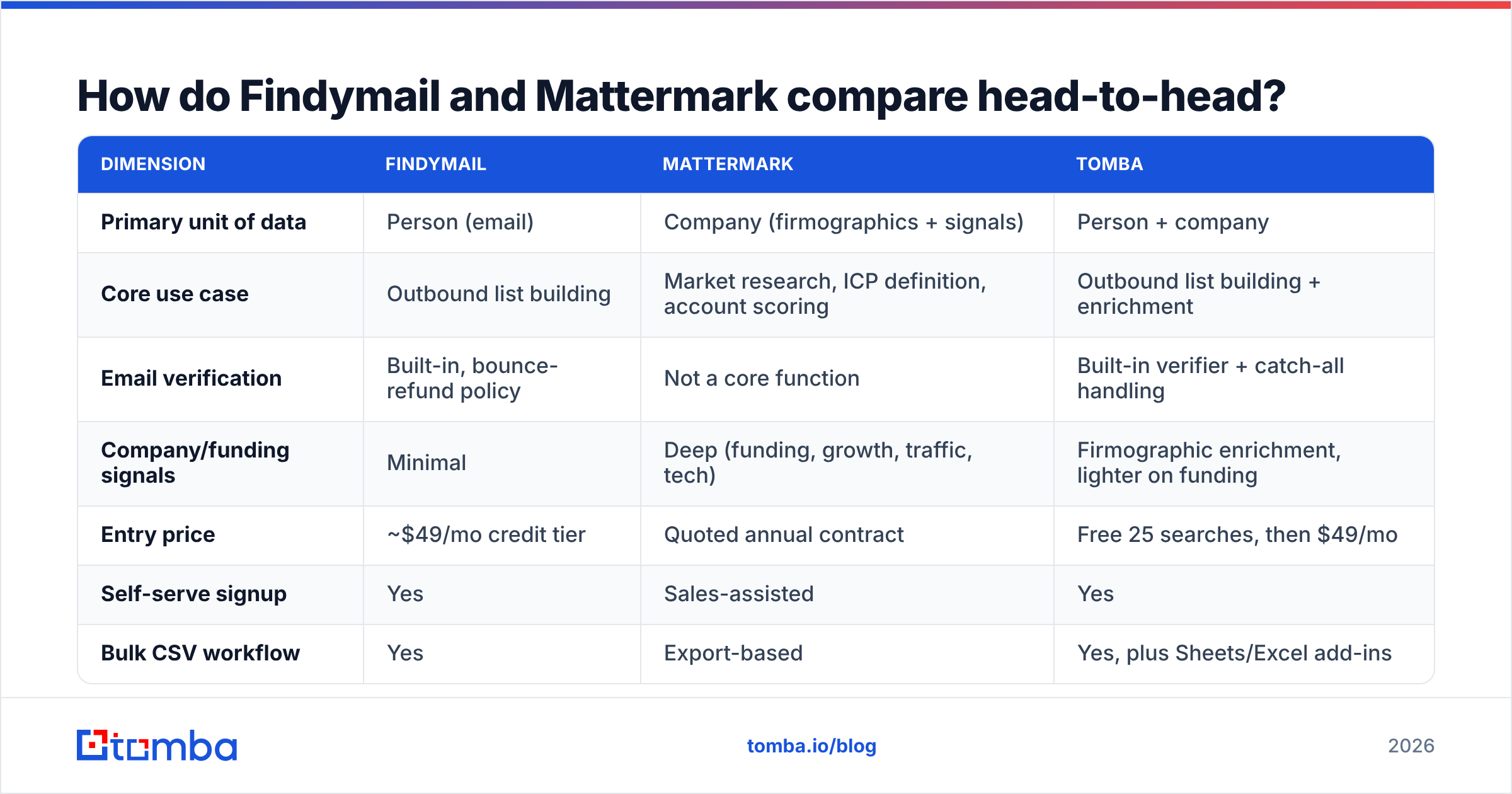
Here is the practical comparison. Few rows overlap. That is the finding, not a formatting accident.
| Dimension | Findymail | Mattermark | Tomba |
|---|---|---|---|
| Primary unit of data | Person (email) | Company (firmographics + signals) | Person + company |
| Core use case | Outbound list building | Market research, ICP definition, account scoring | Outbound list building + enrichment |
| Email verification | Built-in, bounce-refund policy | Not a core function | Built-in verifier + catch-all handling |
| Company/funding signals | Minimal | Deep (funding, growth, traffic, tech) | Firmographic enrichment, lighter on funding |
| Entry price | ~$49/mo credit tier | Quoted annual contract | Free 25 searches, then $49/mo |
| Self-serve signup | Yes | Sales-assisted | Yes |
| Bulk CSV workflow | Yes | Export-based | Yes, plus Sheets/Excel add-ins |
| Public API | Yes | Historically yes, contract-gated | Yes, documented and self-serve |
| Phone numbers | No | No | Yes |
| Best for | SDR teams sending cold email | Analysts and founders sizing a market | Teams needing both contact + verification |
The first row should decide your purchase. Everything else follows from one question: do you need person-level or company-level data this quarter?
Which one is better for cold outbound?#
Findymail, by a wide margin. Mattermark is not trying to win here, so don't score it as if it were.
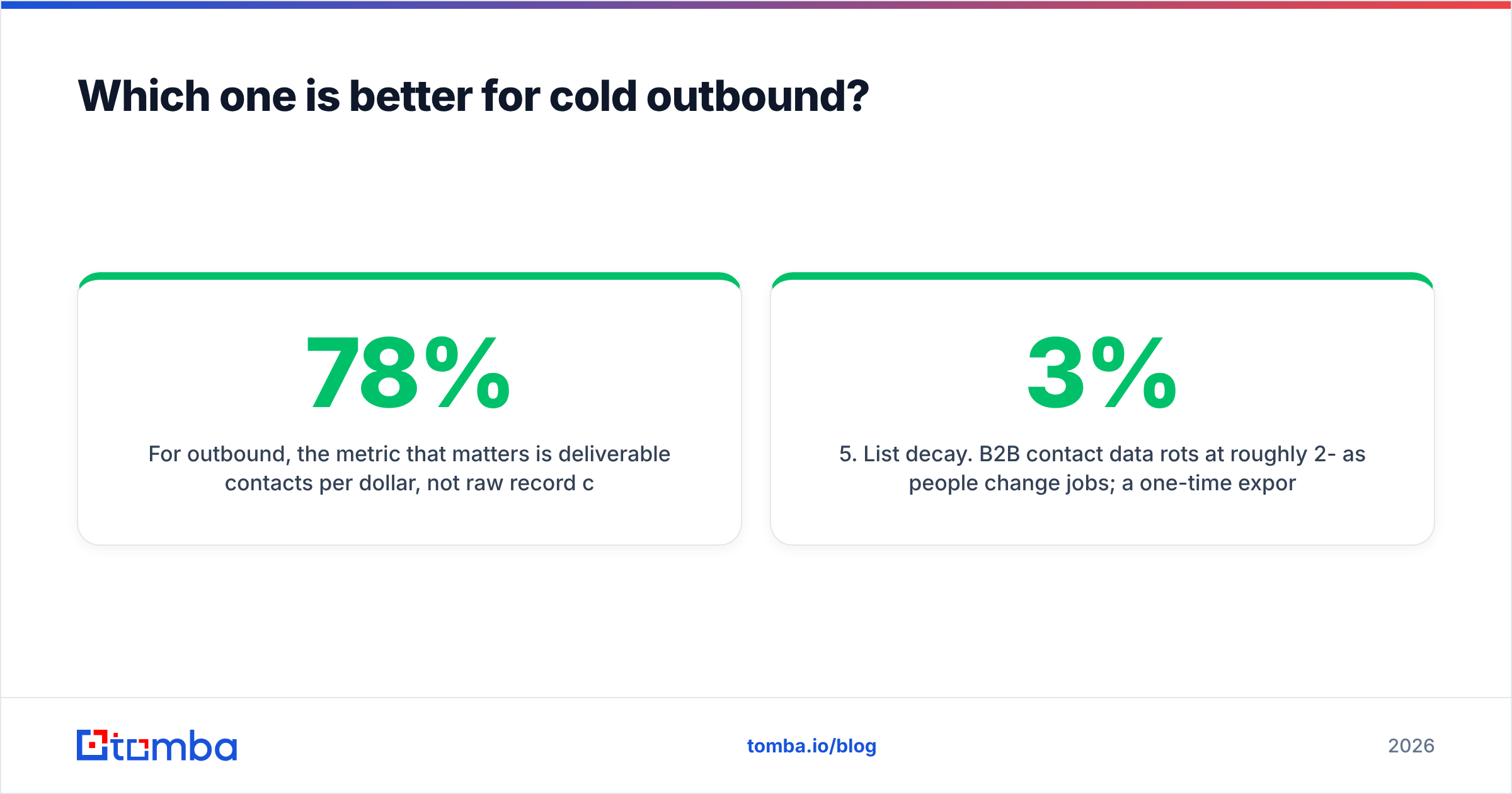
For outbound, one metric matters: deliverable contacts per dollar. Raw record count does not. A tool that returns 1,000 emails at 78% validity is worse than one that returns 600 at 97%. Those 220 bad addresses waste credits. Worse, they damage your sender reputation and drag the good 780 out of the inbox.
Findymail's product design reflects that. It returns fewer results on purpose and refunds bounces. For outbound, that is the right trade.
Where teams hit friction with a pure email finder:
- No phone fallback. When email fails on a big account, you have nothing else. A phone finder fills that gap.
- Catch-all domains stay ambiguous. About a fifth of B2B domains accept everything at the SMTP layer. So a "valid" result really means "unknown." A dedicated catch-all verifier scores those instead of guessing.
- No company context. You get an email, but no headcount, tech stack, or funding stage to personalize against.
- Per-lead pricing punishes exploration. Testing a new segment costs the same as working a proven one.
- List decay. B2B contact data rots at roughly 2-3% per month as people change jobs. A one-time export is stale within two quarters.
That last point is why re-verification beats a one-time buy. Running your CRM through an email verifier each quarter costs less than replacing the list.

Which one is better for account targeting and research?#
Mattermark. This is where it earns its price tag.
Say you are defining an ICP from scratch. Or sizing a market. Or listing every company that raised a Series A in the last 90 days on a given tech stack. A firmographic signal database does that job; an email finder cannot. Findymail has no view on whether a company is worth contacting. It only tells you how to reach a person there.
Typical Mattermark-shaped jobs:
- Market sizing — how many companies in this segment, at what stage, in what geography.
- Trigger-based targeting — funding events, headcount jumps, technology adoption.
- Competitive landscape mapping — who is growing, who is flat, who is hiring and where.
- Investor and corp-dev research — the use case Mattermark was built around.
- Account scoring inputs — feeding a lead scoring model with real growth signals instead of gut feel.
The catch is procurement. Company-intelligence platforms sell annual contracts with seat minimums. Pricing is quoted, not listed. Budget for that, and ask for a data sample before you sign. One question does most of the work: what share of records were refreshed in the last 90 days? Buyer reviews on G2 help too. They show whether coverage claims hold up in the segments you care about.
What does each one actually cost?#
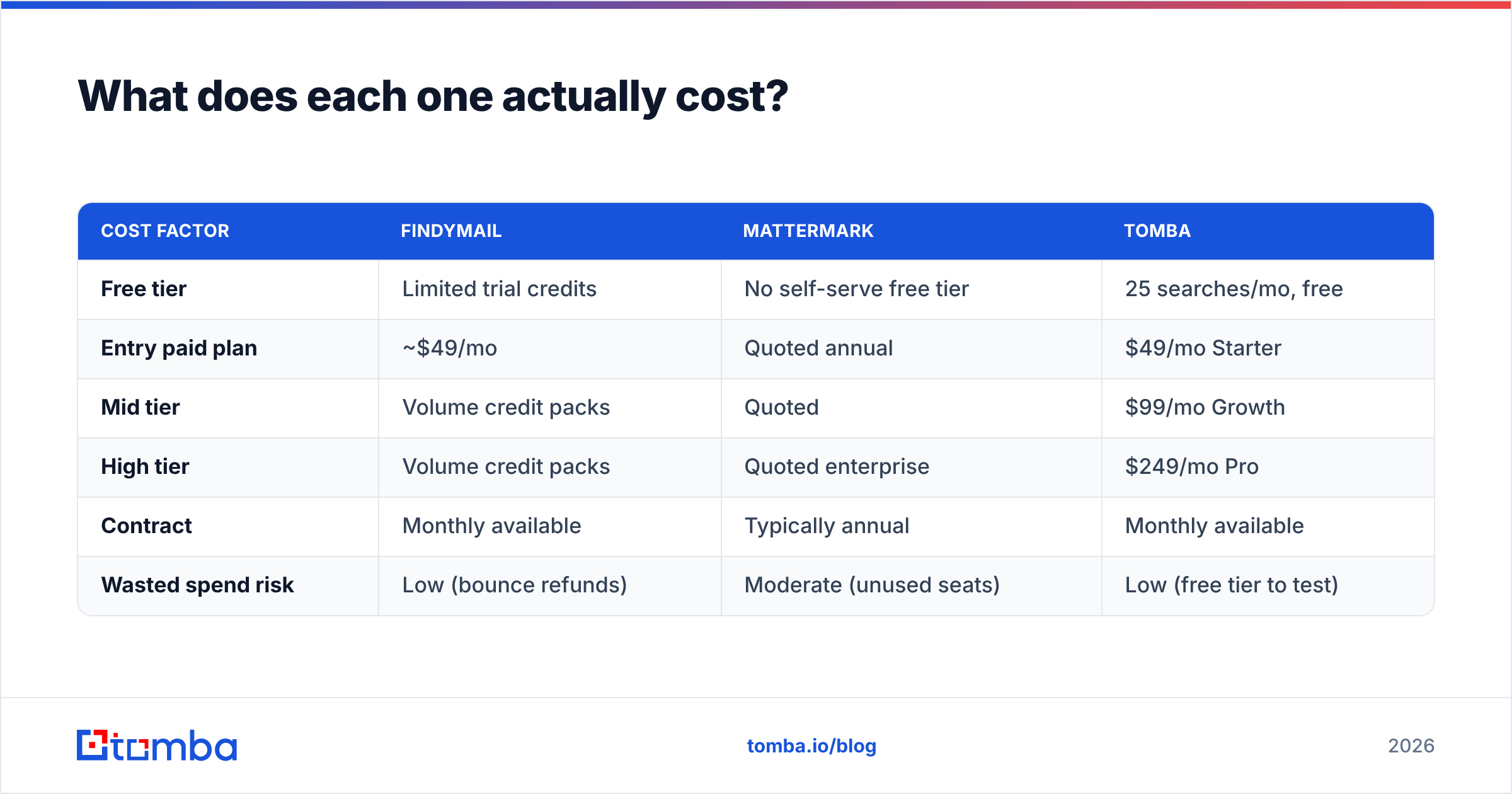
Findymail publishes credit-based tiers. They start in the low double digits per month and scale with lead volume. Expect about $49/mo for an SDR-scale plan, and more once you run thousands of leads. Credits are spent on found emails, and bounces are credited back.
Mattermark's pricing is not public in a way you can plan against. Historically it sat in the annual-contract bracket, next to other company-intelligence products. Think four figures a year and up, with a sales conversation attached. If a third-party blog quotes a hard number, verify it directly. This category re-prices often.
| Cost factor | Findymail | Mattermark | Tomba |
|---|---|---|---|
| Free tier | Limited trial credits | No self-serve free tier | 25 searches/mo, free |
| Entry paid plan | ~$49/mo | Quoted annual | $49/mo Starter |
| Mid tier | Volume credit packs | Quoted | $99/mo Growth |
| High tier | Volume credit packs | Quoted enterprise | $249/mo Pro |
| Contract | Monthly available | Typically annual | Monthly available |
| Wasted spend risk | Low (bounce refunds) | Moderate (unused seats) | Low (free tier to test) |
Compare that with Tomba pricing. The free tier lets you test accuracy on your own domains before you spend a cent. Test on your real target accounts, not a vendor's demo list. That is the only benchmark that means anything.
Can one tool replace both?#
Partly. Here the honest answer gets uncomfortable for all three vendors.
No single product does deep funding-signal intelligence and best-in-class email verification at a self-serve price. What you can consolidate is the contact side. Find, verify, and enrich in one workflow instead of bolting a finder to a separate verifier to a separate enrichment API.
That is the bundle argument. Maybe you pay today for a finder, a verifier, a Chrome extension, and an enrichment call. One platform with domain search, verification, and data enrichment on a shared credit pool usually costs less per usable contact. It also ends the CSV shuffle between tools.
For the company-signal half, you have real alternatives:
- You need funding and growth signals at depth — Mattermark or a similar intelligence subscription. No shortcut here.
- You need firmographics for personalization only — enrichment from your contact provider is usually enough, and far cheaper.
- You need buying-intent signals — that is a third category, intent data. Neither tool covers it well.
- You need verified B2B records at volume with predictable per-record pricing — a database provider like BookYourData is a solid, well-regarded option, especially for pay-as-you-go lists.

What should you check before you buy either one?#
Run this list before any contract. Run it on your own accounts.
- Sample 100 real target accounts. Use your actual pipeline, not a curated demo list. Vendor demo data is always their best data.
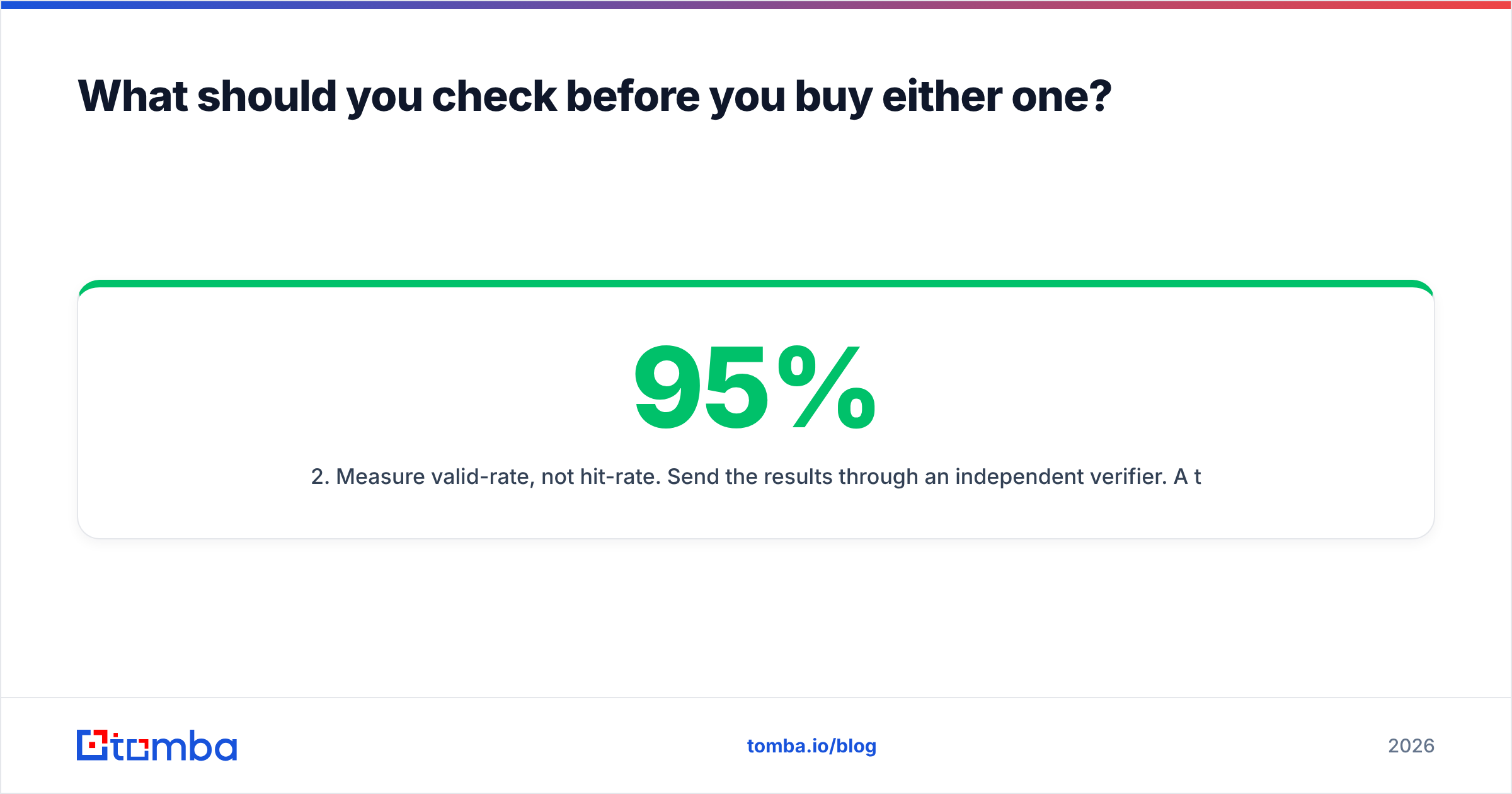
- Measure valid-rate, not hit-rate. Push the results through an independent verifier. 95% coverage at 80% validity loses to 60% coverage at 97%.
- Test the catch-all handling. Add five known catch-all domains. See whether the tool flags them honestly or marks them "valid."
Then check how the data reaches your team:
- Ask for the refresh date distribution. "How old is the median record?" separates real vendors from resellers of a 2022 scrape.
- Check the export and API path. Manual CSV work costs more than the invoice. Look for native integrations and a documented Tomba API-style endpoint.
- Read the credit-refund policy line by line. "Refund on bounce" means something. "Credits for invalid results at our discretion" does not.
One more discipline point. Keep verification separate from finding, even when one vendor does both. Verify at send time, not at list-build time. A contact verified in March and emailed in July is stale.
Findymail vs Mattermark: what's the verdict?#
Buy Findymail if outbound volume is your bottleneck. It is purpose-built, self-serve, and priced sanely. The bounce policy puts the vendor on your side. It will not tell you who to target.
Buy Mattermark if targeting is your bottleneck. If your reps work a list nobody checked against market signals, better email accuracy just reaches the wrong people faster. Budget for an annual contract and a procurement cycle.
Buy neither if money is tight and both halves hurt. Start on a free-tier contact platform. Prove your ICP by hand with public sources. Then invest in a signal database once you know which signals track your closed-won deals. Most teams under 20 reps never need that second half.
One failure mode beats all others in the Findymail vs Mattermark debate: buying company intelligence to fix a contact-data problem, or the reverse. Different diseases need different medicine. The wrong prescription is expensive both ways.
Ready to fix the contact-data half?#
If your gap is deliverable emails rather than market signals, start there. It is the cheaper and faster problem to solve. The Tomba Email Finder gives you 25 free searches a month, no card needed. Benchmark it against Findymail on your own target accounts before you spend anything. Paid plans start at $49/mo and include verification, domain search, and enrichment in one credit pool. That beats paying three vendors to build one clean list.
Run your next 100 prospects through it. Check the bounce rate against whatever you use now. Let the numbers pick the winner.
Related guides#
Ready to find emails that actually work?
Join 150,000+ professionals who stopped guessing and started sending. Free credits on signup — no credit card required.
Get the Tomba newsletter
Practical outbound tactics and product updates — once every two weeks.
About the author