Fintrx vs Warpleads: Which B2B Data Platform Wins in 2026?
Fintrx sells depth on private wealth. Warpleads sells volume you can export all day. They barely compete on the same axis — here's how to tell which one your pipeline actually needs, and what both leave you to fix.
TL;DR
- Fintrx and Warpleads are not really competitors. Fintrx is a private-wealth intelligence platform (family offices, RIAs, private investors). Warpleads is a high-volume B2B lead export tool built for cold outbound at scale.
- Pick Fintrx if you sell into wealth management, raise capital, or need relationship maps and mandate data that no generic database carries.
- Pick Warpleads if you run volume outbound, need lists you can export without credit anxiety, and your ICP is normal B2B (SaaS, agencies, services).
- Neither is a verification layer. Both hand you addresses; both leave you responsible for whether those addresses still bounce. That gap is where most of the wasted spend lives.
- Cost profile is opposite: Fintrx is annual, quote-based, enterprise-priced. Warpleads is self-serve monthly with export-heavy plans.
What are Fintrx and Warpleads, actually?#
One is a research terminal. The other is a fire hose.
Fintrx is a private wealth intelligence platform. Its coverage is deliberately narrow: family offices, registered investment advisors, wealth managers, and the professionals inside them. The value isn't the email address — it's knowing that a specific single-family office in Dallas allocates to real assets, who the CIO reports to, and which conferences that person shows up at. That's research data with contact info attached, not a contact list.
Warpleads sits at the other end. It's an export-first B2B lead database aimed at cold email operators: filter by role, industry, geography, company size, then pull the list out and push it into your sequencer. The pitch is volume without per-record haggling — you're buying throughput, not depth.
So "Fintrx vs Warpleads" is really a question about your go-to-market shape, not a feature bake-off. If you're comparing them seriously, you're probably at a fork: do I need 400 extremely well-understood accounts, or 40,000 reachable ones?
How do Fintrx and Warpleads compare head to head?#
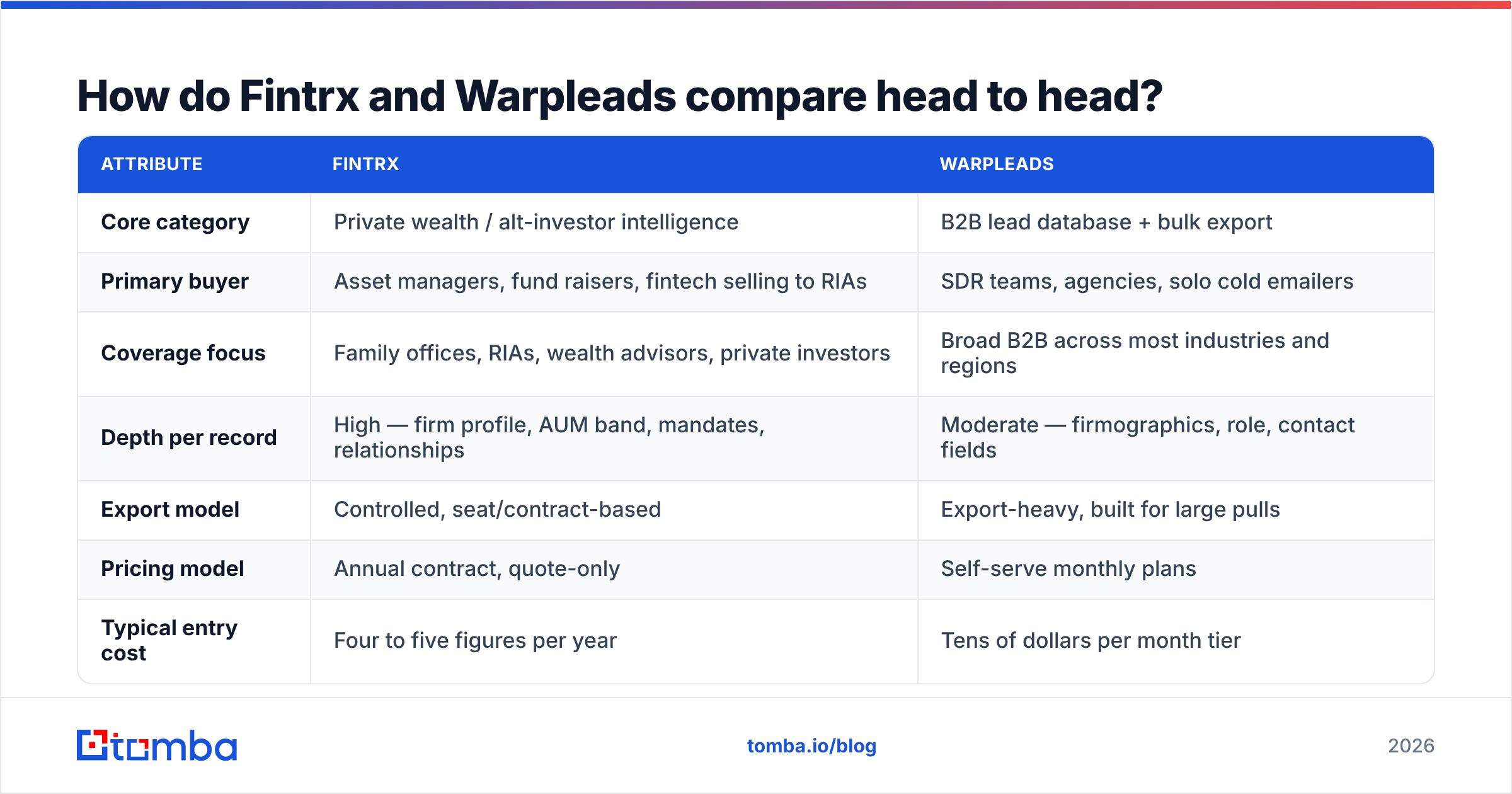
| Attribute | Fintrx | Warpleads |
|---|---|---|
| Core category | Private wealth / alt-investor intelligence | B2B lead database + bulk export |
| Primary buyer | Asset managers, fund raisers, fintech selling to RIAs | SDR teams, agencies, solo cold emailers |
| Coverage focus | Family offices, RIAs, wealth advisors, private investors | Broad B2B across most industries and regions |
| Depth per record | High — firm profile, AUM band, mandates, relationships | Moderate — firmographics, role, contact fields |
| Export model | Controlled, seat/contract-based | Export-heavy, built for large pulls |
| Pricing model | Annual contract, quote-only | Self-serve monthly plans |
| Typical entry cost | Four to five figures per year | Tens of dollars per month tier |
| Free trial | Demo-gated | Self-serve entry available |
| Built-in verification | Not the product's job | Basic, varies by list |
| Best at | Account research and relationship mapping | Filling a sequencer fast |
| Weak at | Volume outbound, generic B2B ICPs | Niche financial-services depth |
Read the table as two different purchases. Fintrx is closer to buying a data subscription your analysts live in. Warpleads is closer to buying raw material for a machine you already built.
Which one fits your ICP?#
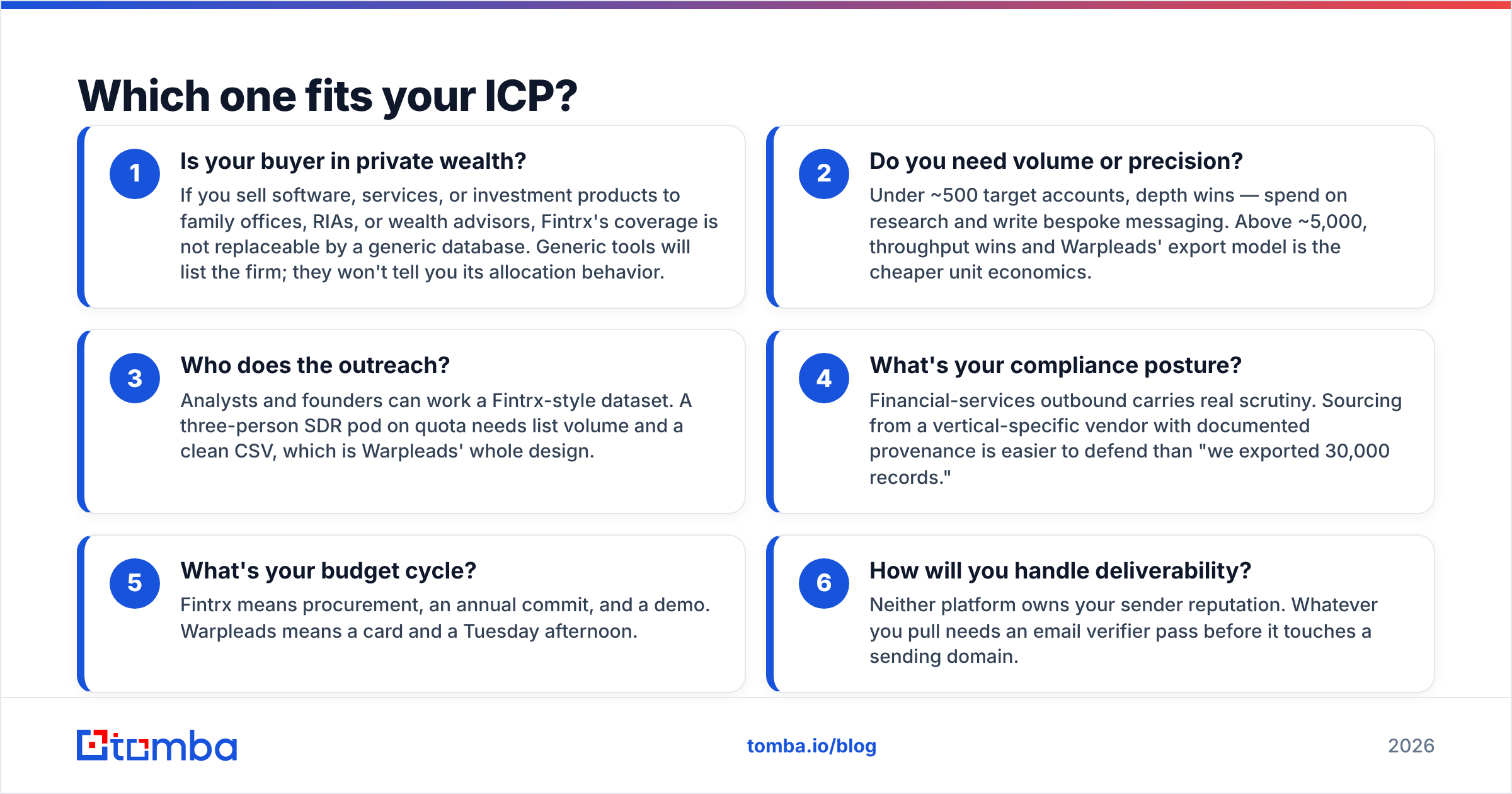
Here's the decision path, in the order it actually matters:
- Is your buyer in private wealth? If you sell software, services, or investment products to family offices, RIAs, or wealth advisors, Fintrx's coverage is not replaceable by a generic database. Generic tools will list the firm; they won't tell you its allocation behavior.
- Do you need volume or precision? Under ~500 target accounts, depth wins — spend on research and write bespoke messaging. Above ~5,000, throughput wins and Warpleads' export model is the cheaper unit economics.
- Who does the outreach? Analysts and founders can work a Fintrx-style dataset. A three-person SDR pod on quota needs list volume and a clean CSV, which is Warpleads' whole design.
- What's your compliance posture? Financial-services outbound carries real scrutiny. Sourcing from a vertical-specific vendor with documented provenance is easier to defend than "we exported 30,000 records."
- What's your budget cycle? Fintrx means procurement, an annual commit, and a demo. Warpleads means a card and a Tuesday afternoon.
- How will you handle deliverability? Neither platform owns your sender reputation. Whatever you pull needs an email verifier pass before it touches a sending domain.
That last point is where most teams under-plan. A database's freshness claim and your bounce rate are two different numbers.
Is Fintrx worth the enterprise price tag?#
It is — if your average contract value justifies it, and only then.
Fintrx pricing is quote-based and annual; there's no public self-serve tier, so treat any number you see repeated on a review site as a starting anchor, not a rate card. Check current terms on G2 and in a live demo rather than trusting secondhand figures.
What you're paying for:
- Vertical coverage that doesn't exist elsewhere. Single-family offices are famously opaque. They don't publish contacts, they don't run marketing sites, and they don't appear cleanly in general-purpose databases.
- Context per record. Mandate types, AUM bands, service-provider relationships, and professional history change how you open a conversation.
- Research time saved. If an analyst spends six hours a week reconstructing a family-office org chart, the platform pays for itself fast.
Where it disappoints buyers: teams that bought it expecting a general prospecting tool. If your ICP is "VP of Marketing at a Series B SaaS," Fintrx is an expensive way to get worse coverage than a $99/month tool. Buyer's remorse in this category is almost always an ICP-fit mistake, not a product-quality one.
Is Warpleads good enough for serious outbound?#
For volume plays, yes — with the same caveat every export-heavy database earns.
Warpleads' advantage is that it removes the psychological tax of credits. When every lookup costs a token, reps under-search, over-filter, and build lists that are technically efficient and commercially useless. Unlimited-style export plans invert that: you can be generous with your filters, pull wide, then narrow on your own terms.
The trade-off is variance. Broad databases carry a mix of freshly sourced records and long-tail entries that have aged out — job changes alone churn a meaningful share of B2B contact data every year. That's not a Warpleads-specific flaw; it's structural to any large aggregated database, including the ones charging ten times more.
Practical way to run it:
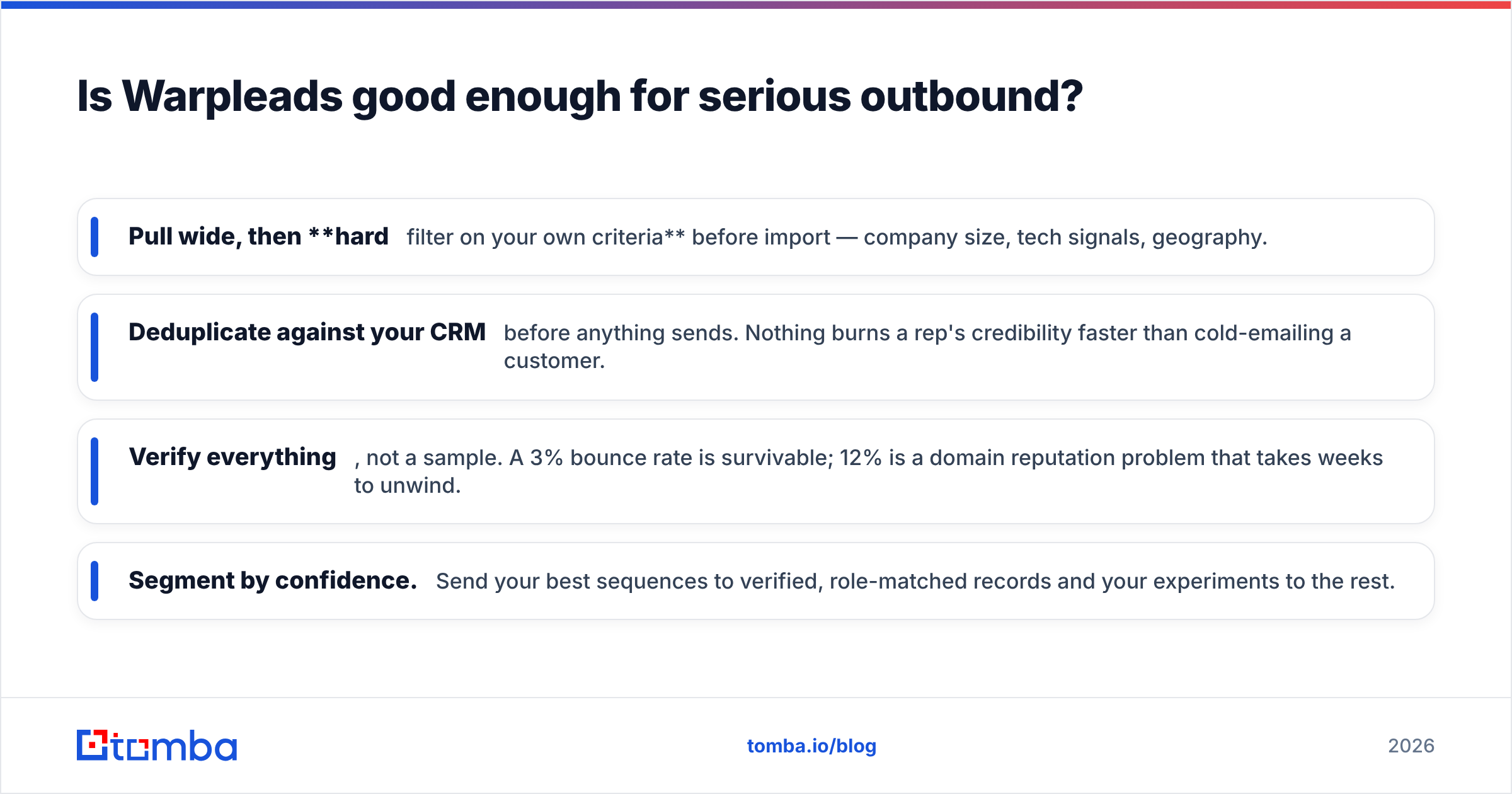
- Pull wide, then hard-filter on your own criteria before import — company size, tech signals, geography.
- Deduplicate against your CRM before anything sends. Nothing burns a rep's credibility faster than cold-emailing a customer.
- Verify everything, not a sample. A 3% bounce rate is survivable; 12% is a domain reputation problem that takes weeks to unwind.
- Segment by confidence. Send your best sequences to verified, role-matched records and your experiments to the rest.
If your team wants a pay-as-you-go alternative where you own the list outright, BookYourData is a well-regarded option in that lane and worth a look alongside Warpleads — different billing philosophy, similar "give me the data and get out of my way" ergonomics.
What do both tools leave you to solve?#
Three things, and they're the expensive ones.
Verification. Databases report on what they believe to be true at ingestion time. Your sending server finds out what's true at send time. The gap between those two moments is where bounces live. Run every list through verification, and treat catch-all domains as a separate bucket — they need a catch-all verifier rather than a pass/fail check, because a standard SMTP probe can't tell you anything useful about them.
Enrichment gaps. Both platforms return a partial record. You'll frequently have a name and a company but no work email, or an email with no phone. That's a fill-in job, not a re-buy job — data enrichment against your existing rows is far cheaper than purchasing the same contact twice from a second vendor.
Format drift. Company email patterns change after rebrands, acquisitions, and migrations to a new domain. A record sourced 14 months ago against firstname.lastname@ may now need flastname@. Pattern-aware lookup catches this; a static export never will.

How does a verification layer change the math?#
It changes the only number that matters: cost per conversation, not cost per record.
Say you export 10,000 contacts. At a 15% invalid rate — realistic for aged, broadly-sourced B2B data — 1,500 of them are dead on arrival. Those don't just fail silently. They drag your bounce rate above the thresholds mailbox providers watch, which suppresses inbox placement for the 8,500 good addresses too. You paid for 10,000 and effectively degraded delivery on all of them.
Now run the same list through verification first. You drop the 1,500, quarantine a few hundred catch-alls for a lower-volume approach, and send to a clean core. Same source data, materially better outcome, and your sending domain survives to run next quarter's campaign.
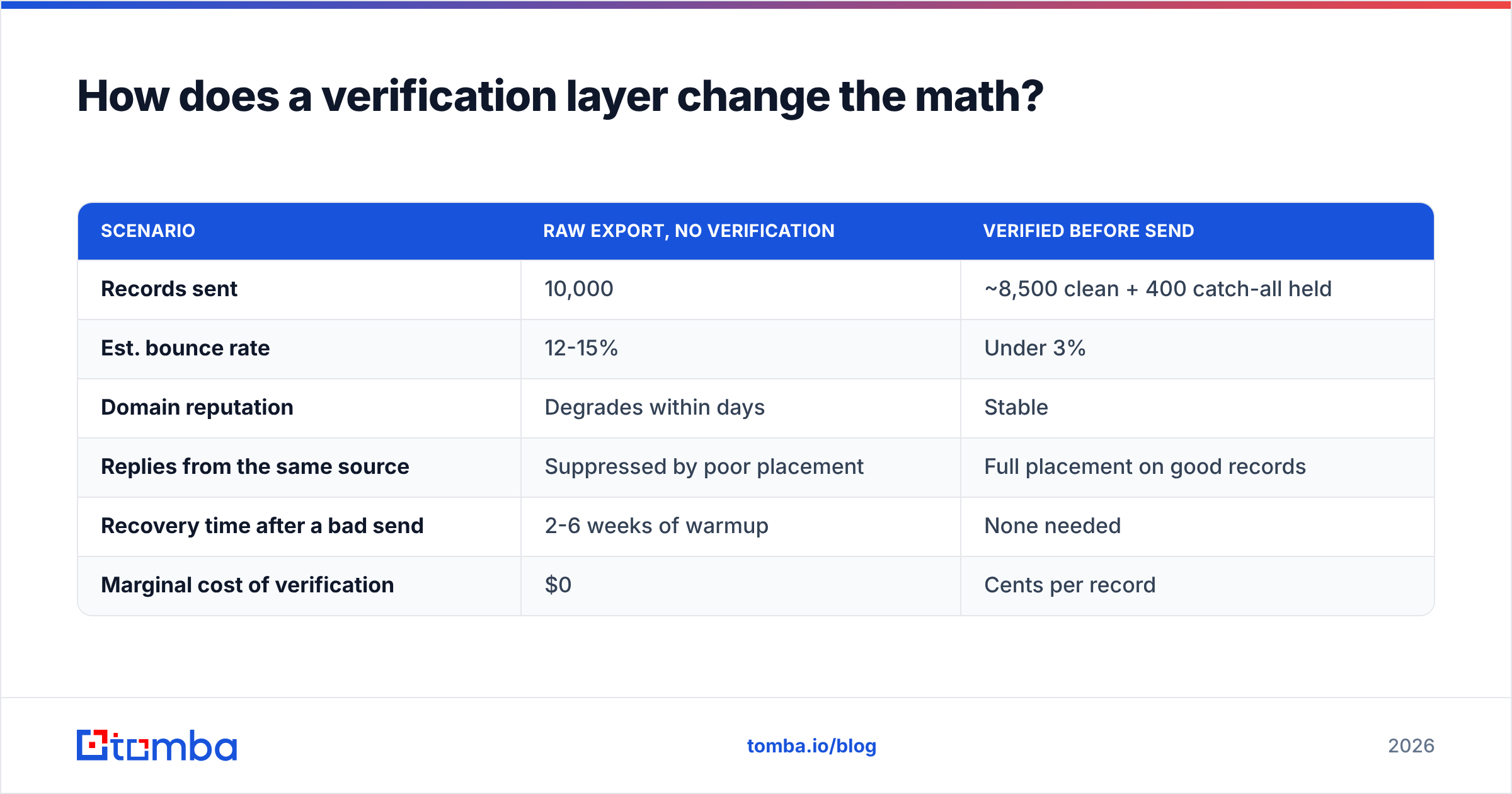
| Scenario | Raw export, no verification | Verified before send |
|---|---|---|
| Records sent | 10,000 | ~8,500 clean + 400 catch-all held |
| Est. bounce rate | 12-15% | Under 3% |
| Domain reputation | Degrades within days | Stable |
| Replies from the same source | Suppressed by poor placement | Full placement on good records |
| Recovery time after a bad send | 2-6 weeks of warmup | None needed |
| Marginal cost of verification | $0 | Cents per record |
The verification step is close to a rounding error against the price of either platform, which is why skipping it is the least defensible decision in the whole stack. If you're processing lists at volume, a bulk email finder workflow handles find-and-verify in one pass instead of two tools and a spreadsheet.
Which should you buy in 2026?#
Short answer, by situation:
- You sell to family offices, RIAs, or wealth managers. Fintrx. Nothing generic substitutes for that coverage, and your deal sizes almost certainly absorb the annual cost.
- You run high-volume cold outbound to mainstream B2B. Warpleads. The export model matches how your team actually works, and the monthly commitment is low-risk.
- You're a founder doing both — a little research, a little volume. Neither, yet. Start with targeted lookup tooling and a verification layer, then buy a database once you know which direction your pipeline pulls. Compare Tomba pricing against a five-figure annual commit before signing anything.
- You already own one of them and results are flat. The problem is probably not the database. Audit bounce rate, catch-all handling, and how stale your oldest exports are before you go shopping for a replacement.
And a note on stacking: these two coexist fine. Several teams run a vertical intelligence platform for the 200 accounts that matter and a volume database for everything else. What breaks that setup is not the tooling — it's pushing both feeds into a sequencer without a common verification and dedupe step in between.
Getting the addresses right, whichever you pick#
Whatever database you land on, the last mile is the same: turn a name and a company into a deliverable address, and confirm it's still live before you send.
That's exactly what the Tomba Email Finder is built for. Feed it a name and domain, get back a pattern-matched address with a confidence score, and verify in the same workflow — no credit anxiety on the free tier (25 searches a month), and paid plans start at $49/month if you need volume. It slots in behind Fintrx, behind Warpleads, or in front of both. Run your next export through it before it touches your sending domain and watch what happens to your bounce rate.
Sources:
Related guides#
Ready to find emails that actually work?
Join 150,000+ professionals who stopped guessing and started sending. Free credits on signup — no credit card required.
Get the Tomba newsletter
Practical outbound tactics and product updates — once every two weeks.
About the author