11 Best Fireflies.ai Alternatives in 2026 (Tested & Ranked)
Fireflies.ai records your calls, but transcription alone doesn't close deals. Here are 11 alternatives ranked by pricing, accuracy, privacy controls, and what they actually do with your meeting data.
TL;DR
- Fireflies.ai is a solid, cheap meeting recorder — its weakness is depth: coaching, deal intelligence, and forecasting live in higher tiers or other tools entirely.
- If you want revenue intelligence, look at Gong or Clari Copilot. If you want a better notetaker at a lower price, look at Otter, Fathom, or tl;dv.
- Privacy-sensitive teams (legal, healthcare, EU) should shortlist Bluedot or Jamie — no bot joins the call, and audio can stay local.
- Fathom's free tier is the most generous unlimited-recording option in the category as of 2026.
- Meeting AI only pays off if the pipeline feeding it is real. Transcripts of the wrong calls are still the wrong calls.
Fireflies.ai has quietly become the default meeting notetaker for a huge number of B2B teams. It joins your Zoom, Meet, or Teams call as a bot, transcribes everything, generates a summary, and pushes notes to your CRM. At roughly $10–$19 per seat per month, it is hard to argue with the price.
But "hard to argue with the price" is not the same as "the right tool." Teams churn off Fireflies for specific, repeatable reasons: bot-joining is awkward with external prospects, the search across past calls gets slow at volume, the AskFred assistant is capped on lower plans, and anything resembling real deal intelligence — talk-track scoring, deal risk, forecast rollups — sits either in the Business tier or outside the product entirely.
This is a neutral rundown of the alternatives that actually replace it, sorted by what you are trying to fix.
What does Fireflies.ai actually do — and where does it stop?#
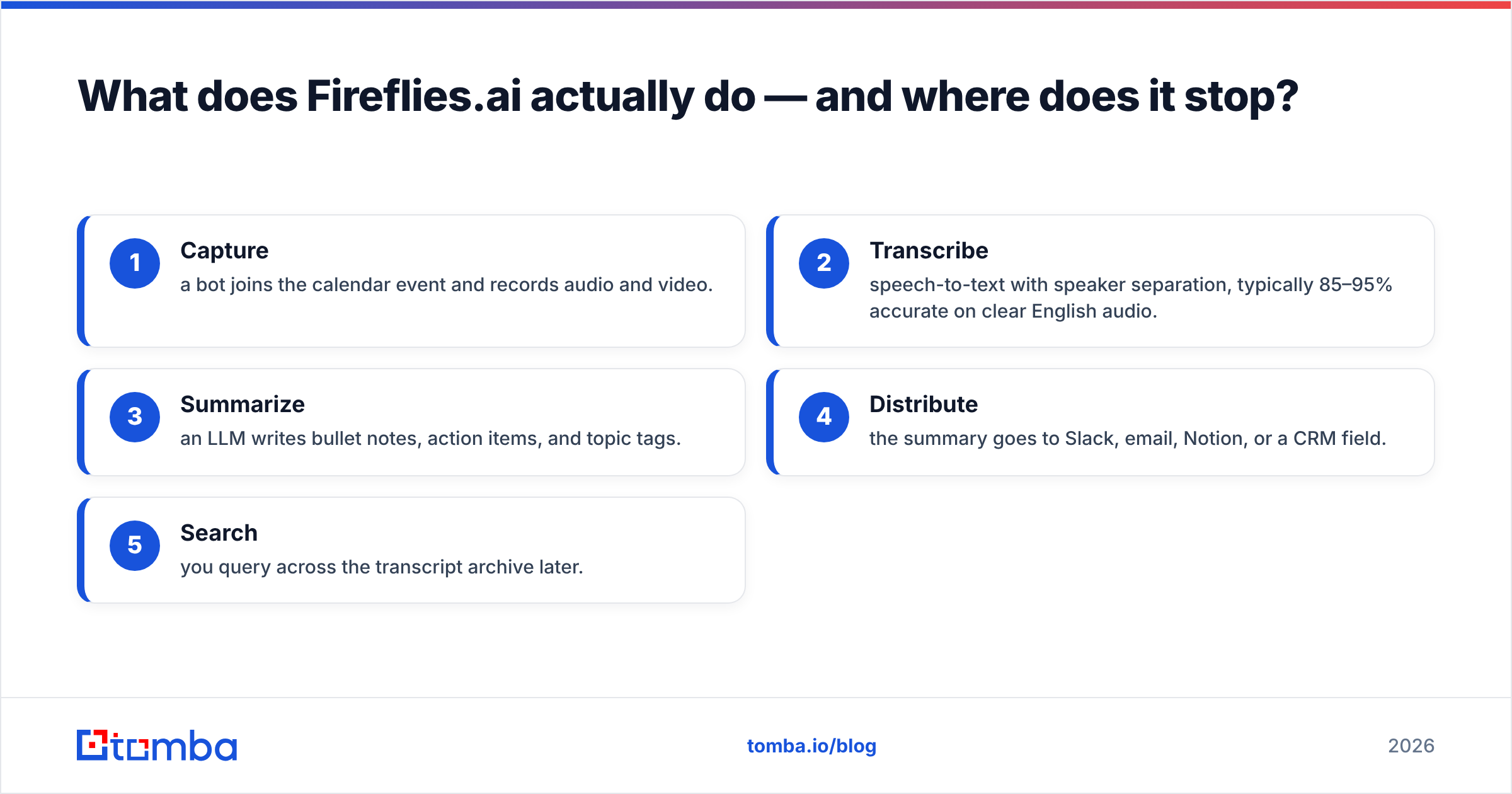
Fireflies sits in the "AI meeting assistant" category. The core loop is simple:
- Capture — a bot joins the calendar event and records audio and video.
- Transcribe — speech-to-text with speaker separation, typically 85–95% accurate on clear English audio.
- Summarize — an LLM writes bullet notes, action items, and topic tags.
- Distribute — the summary goes to Slack, email, Notion, or a CRM field.
- Search — you query across the transcript archive later.
That loop is genuinely useful and Fireflies executes it competently. Where it stops is step six: turning conversation data into a coaching and forecasting system. Gong, Clari, and Chorus built entire companies on step six, and the gap is real. Fireflies' conversation intelligence features exist but are shallow compared to a purpose-built revenue platform.
The second gap is upstream. A meeting assistant only helps once a meeting exists. Getting the meeting booked is a prospecting and data problem — accurate contacts, verified emails, clean enrichment — and no notetaker solves it. Teams that treat Fireflies as a pipeline tool are disappointed; teams that treat it as a documentation tool are happy.
How do the top Fireflies.ai alternatives compare on price and features?#
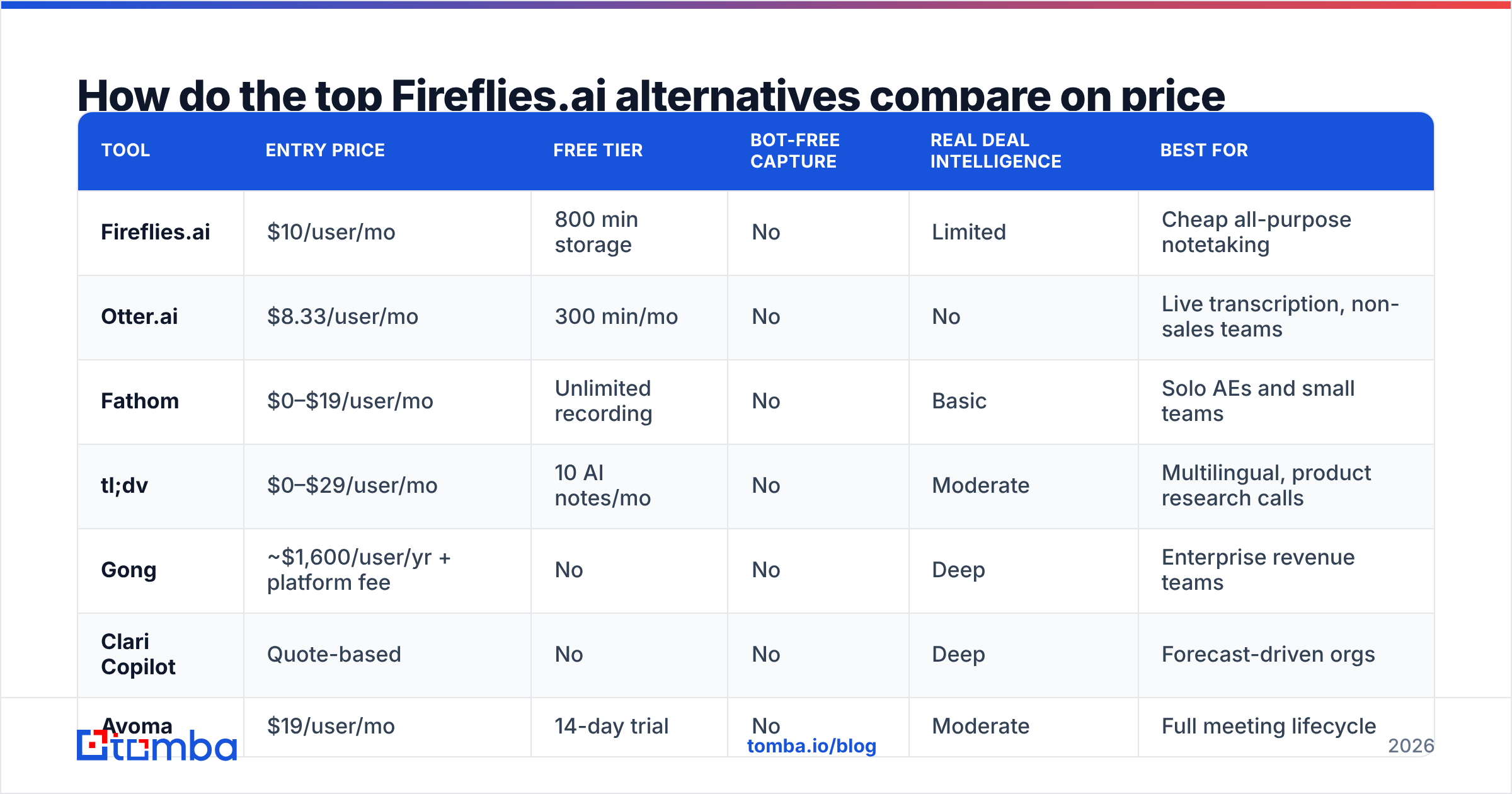
Pricing below reflects publicly listed per-user monthly rates on annual billing as of early 2026. Always confirm on the vendor's own page — this category re-prices constantly.
| Tool | Entry price | Free tier | Bot-free capture | Real deal intelligence | Best for |
|---|---|---|---|---|---|
| Fireflies.ai | $10/user/mo | 800 min storage | No | Limited | Cheap all-purpose notetaking |
| Otter.ai | $8.33/user/mo | 300 min/mo | No | No | Live transcription, non-sales teams |
| Fathom | $0–$19/user/mo | Unlimited recording | No | Basic | Solo AEs and small teams |
| tl;dv | $0–$29/user/mo | 10 AI notes/mo | No | Moderate | Multilingual, product research calls |
| Gong | ~$1,600/user/yr + platform fee | No | No | Deep | Enterprise revenue teams |
| Clari Copilot | Quote-based | No | No | Deep | Forecast-driven orgs |
| Avoma | $19/user/mo | 14-day trial | No | Moderate | Full meeting lifecycle |
| Grain | $19/user/mo | Limited | No | Moderate | Customer research clips |
| Bluedot | $18/user/mo | Limited | Yes | Basic | Privacy-first recording |
| Jamie | ~$27/user/mo | 15 meetings | Yes | No | In-person + EU data residency |
| Sembly | $10/user/mo | 4 hrs/mo | No | Basic | Multi-language enterprise notes |
The pattern is clear once you lay it out: you are choosing between cheap documentation ($8–$20/user), mid-market meeting lifecycle ($19–$29/user), and enterprise revenue intelligence (four figures per rep per year). Fireflies lives firmly in bucket one. Paying Gong money to solve a Fireflies problem is a waste; expecting Fireflies to do Gong's job is equally wasteful.
Which Fireflies.ai alternatives are worth shortlisting?#
1. Otter.ai — the transcription purist#
Otter predates the current wave and still has the best live-transcription experience. You see words appear as people speak, which matters if you take notes during the call rather than after. Otter's summaries are competent but less sales-shaped than Fireflies'. Its CRM story is weaker. Choose Otter if transcription quality and live capture matter more than pipeline workflow — research interviews, university settings, accessibility use cases.
Downside: minute limits on lower tiers bite fast on a full-time selling calendar.
2. Fathom — the best free tier in the category#
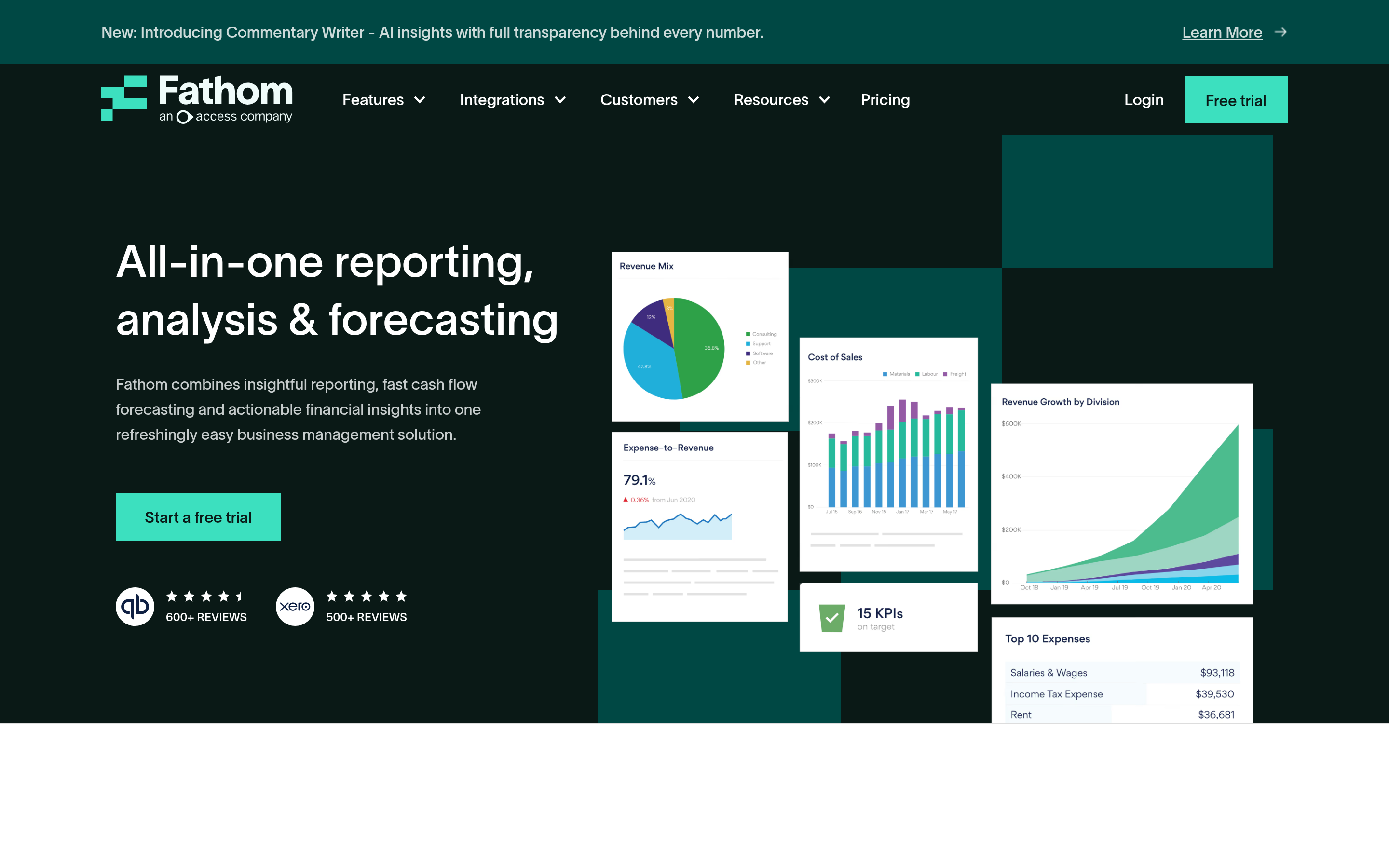
Fathom offers unlimited recording, transcription, and summaries on a genuinely free plan, monetising through team features and CRM sync. For a solo AE or a two-person founding team, this is the clearest Fireflies replacement on cost alone. The AI summaries are tight, the highlight-clipping is fast, and the Zoom integration is clean.
Downside: thin analytics. There is no serious coaching layer, and admin controls are lighter than what a 50-rep org needs.
3. tl;dv — multilingual and clip-heavy#
tl;dv's strength is turning calls into shareable moments. Timestamped clips, reels of customer objections, and strong support across 30+ languages make it a favourite with product and UX research teams as much as sales. Its speaker insights are more developed than Fireflies'.
Downside: the free plan's AI note cap is restrictive, and pricing climbs quickly once you want the coaching features.
4. Gong — the enterprise standard#
Gong is not a notetaker. It is a revenue intelligence platform that happens to record calls. Deal boards, warning signals, talk-ratio benchmarks, and forecast integration are the product. If your problem is "our reps do not know why they lose," Gong answers it and Fireflies does not.
Downside: cost and commitment. Expect annual contracts, a platform fee on top of seats, and a real implementation project. Check its G2 category listing before you assume it is a drop-in swap.
5. Clari Copilot — forecasting-first#
Formerly Wingman, Clari Copilot folds conversation data into Clari's forecasting engine. Live battlecards during calls are the standout feature. If your RevOps team already lives in Clari, this is the path of least resistance.
Downside: quote-based pricing and limited standalone value if you do not use the wider Clari suite.
6. Avoma — the meeting lifecycle tool#
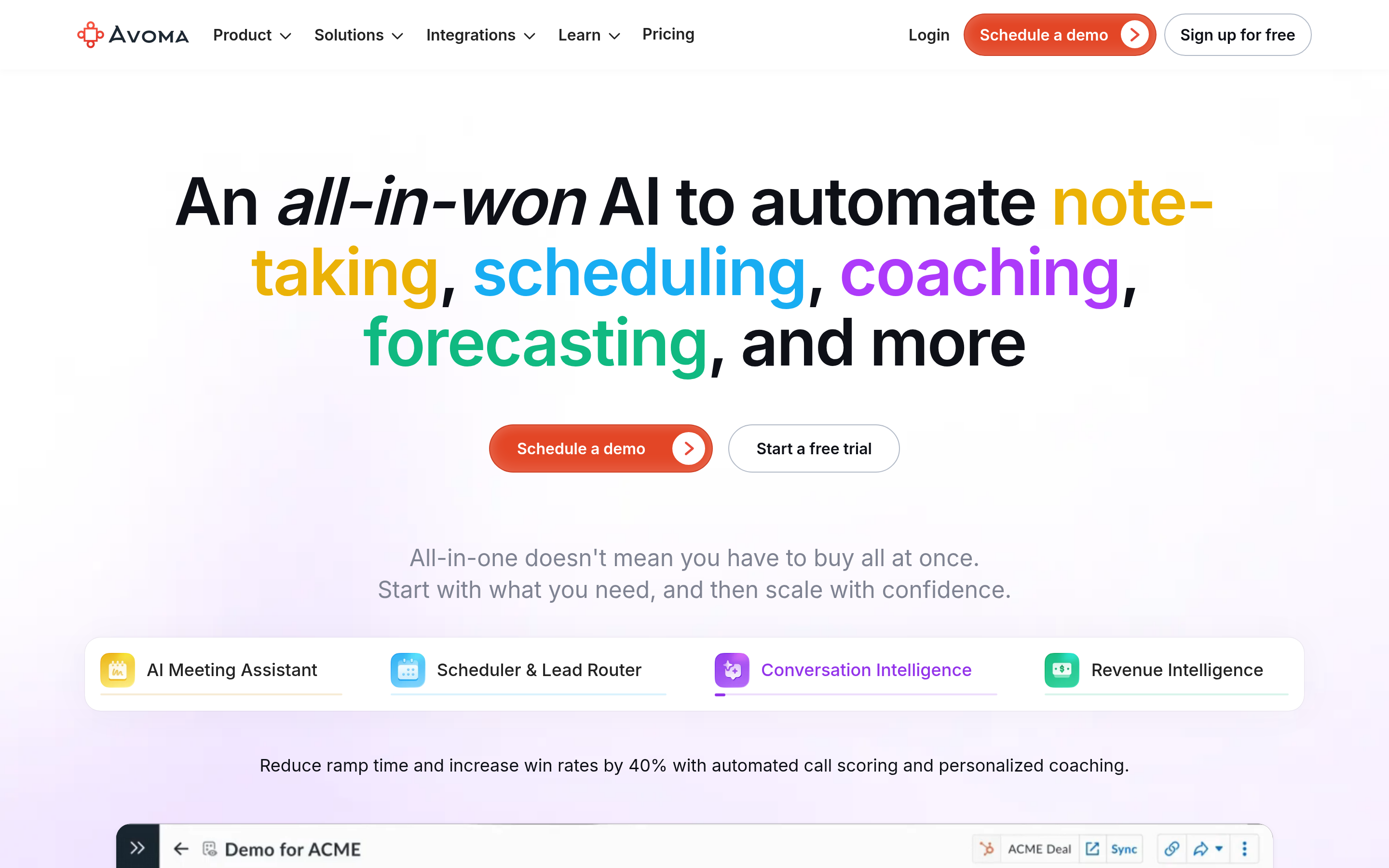
Avoma handles the whole arc: agenda templates before, notes during, and follow-up automation after. It is the closest thing to a "meeting operations" platform at a mid-market price, and its scheduler bundling makes it a two-in-one purchase for some teams.
Downside: the interface carries a lot of surface area, and onboarding takes longer than Fathom or Fireflies.
7. Grain — customer voice for product teams#
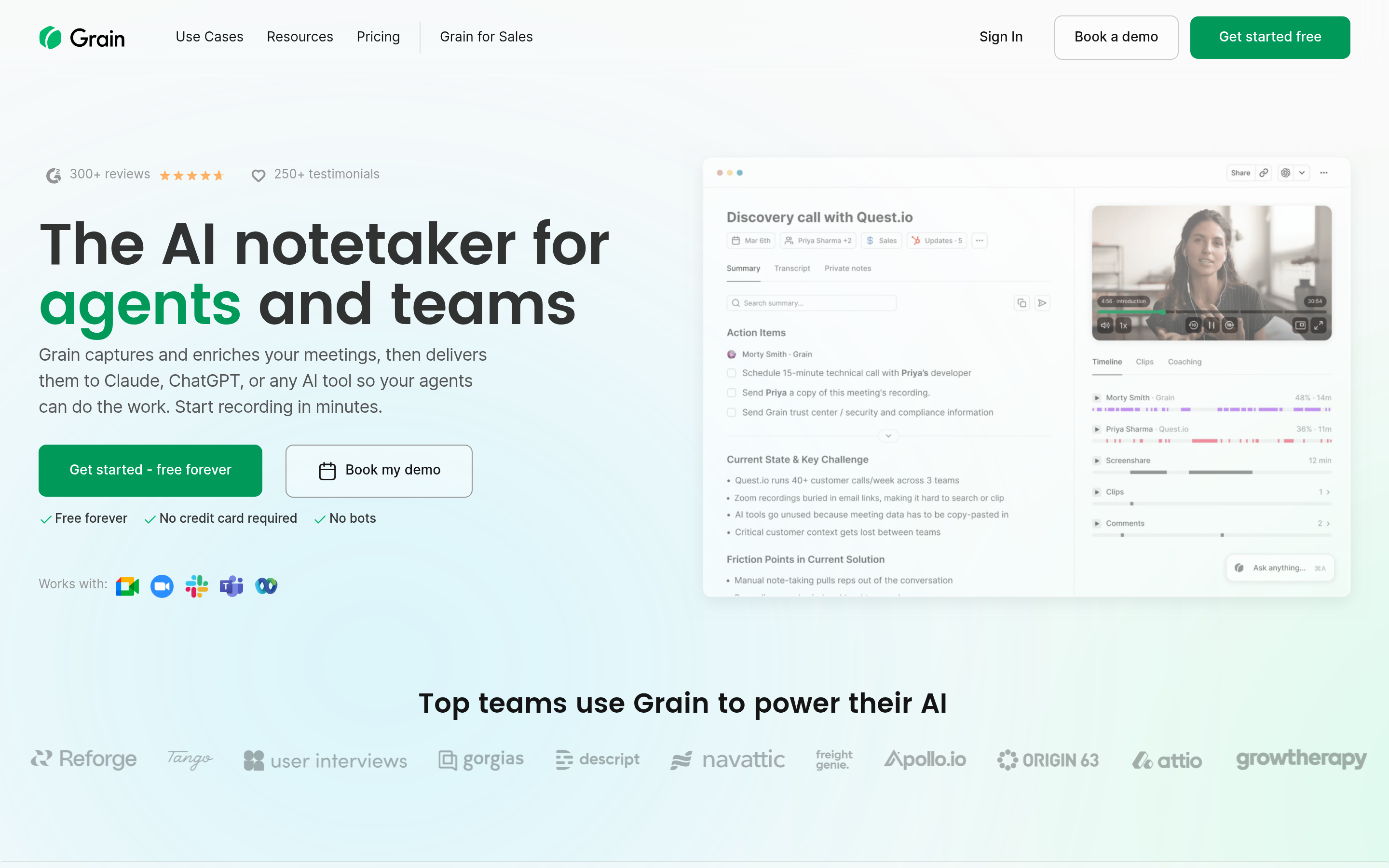
Grain's clip and story features are built for sharing customer quotes across a company. Product managers love it. Sales leaders find the coaching depth moderate.
8. Bluedot — privacy-first, no bot#
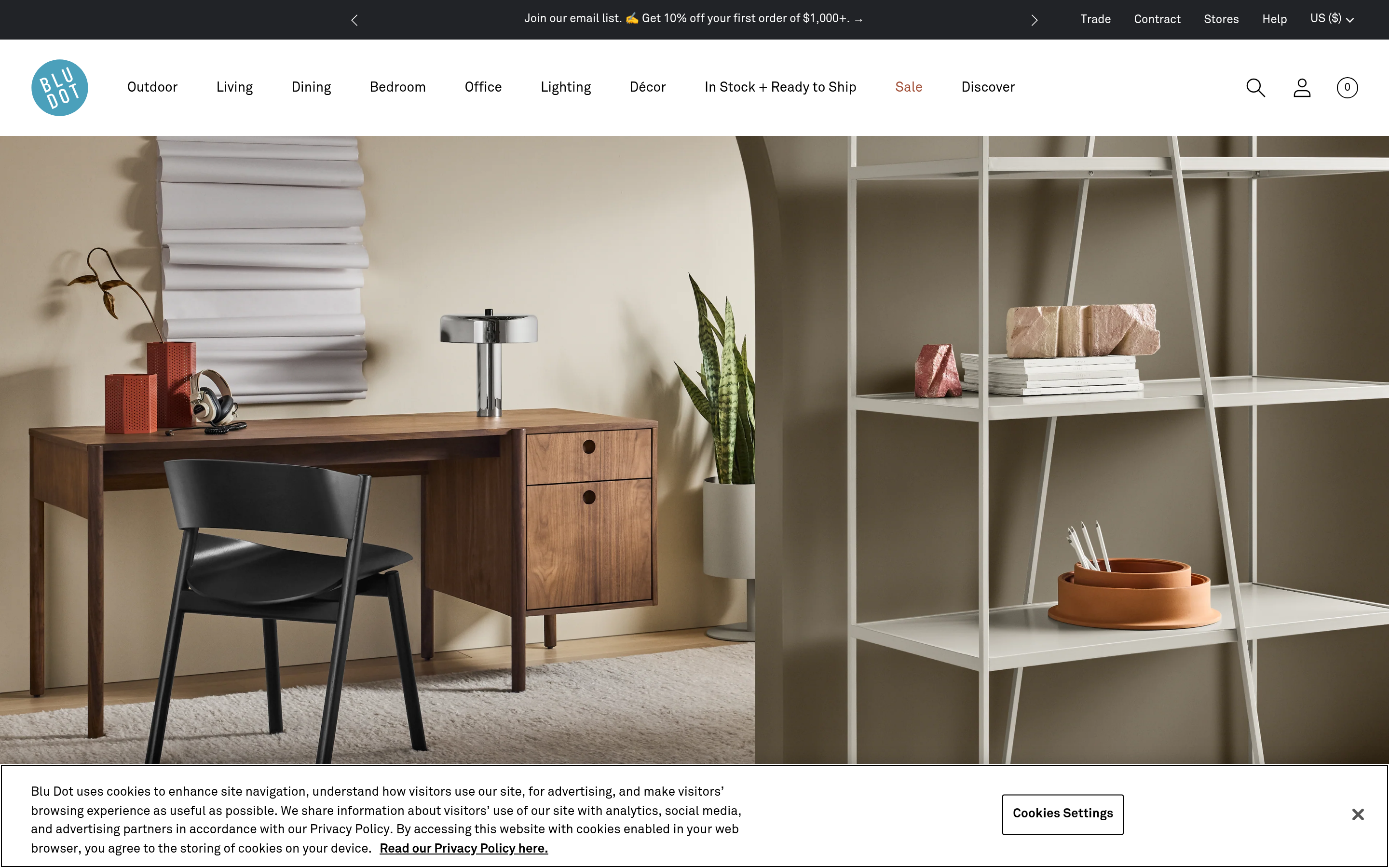
Bluedot records via a Chrome extension rather than sending a bot into the room. Nobody sees "Bluedot Notetaker has joined." For sensitive commercial conversations, legal calls, or anywhere the bot itself creates friction, that is a meaningful difference.
9. Jamie — in-person and EU-native#
Jamie runs on the desktop, captures system audio, and works for in-room meetings where no video conference exists. Its EU hosting and data residency stance appeal to teams under strict GDPR scrutiny.
10. Sembly AI — multi-language notes at scale#
Sembly's strength is broad language support and structured meeting artefacts (tasks, risks, decisions) rather than raw transcript dumps. Priced comparably to Fireflies.
11. Read AI — meeting quality scoring#
Read scores meetings on engagement and sentiment, then recommends shorter agendas. It is more meeting-hygiene tool than sales tool, but for orgs drowning in low-value calls, that framing is the point.
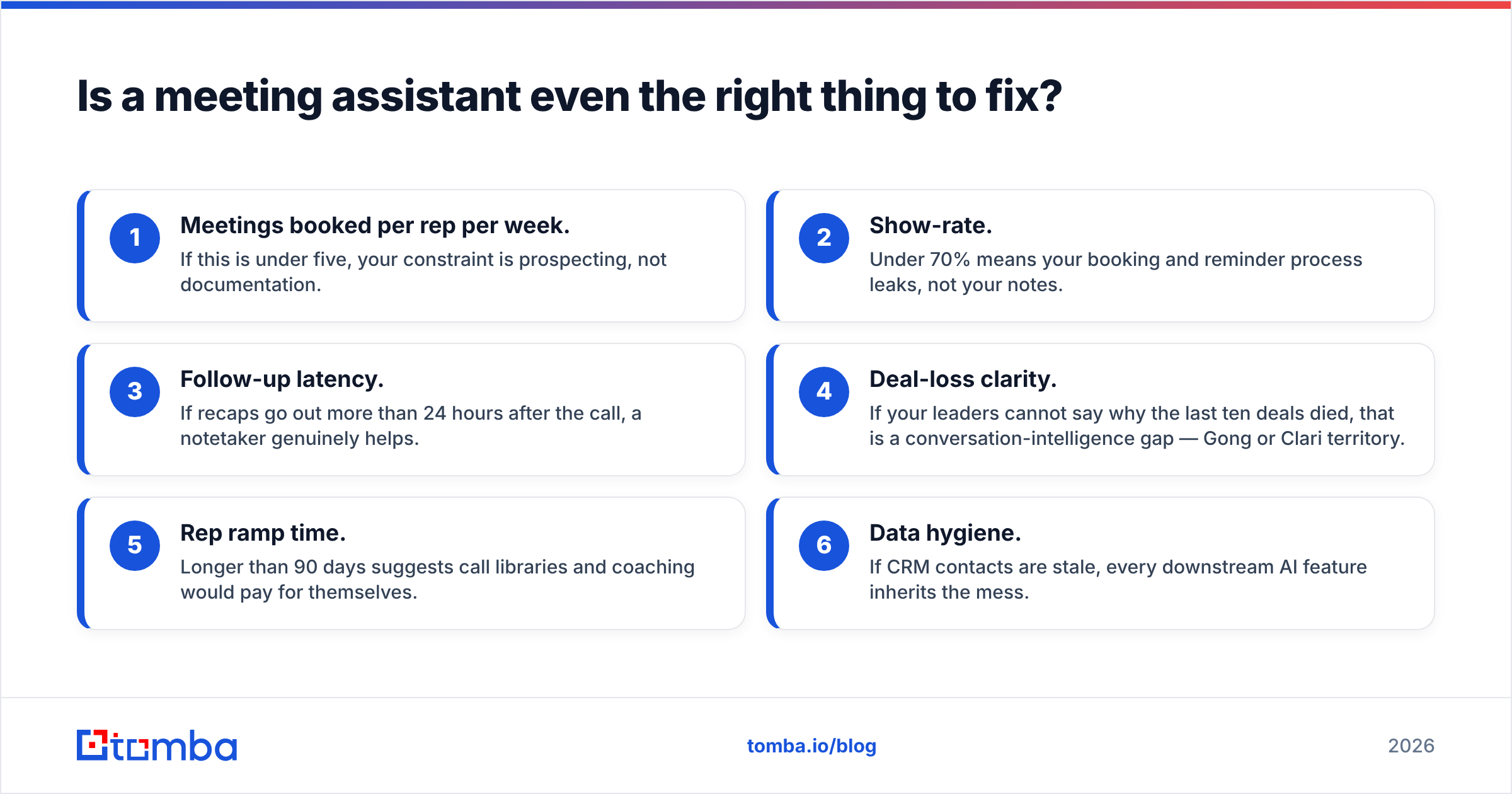
Is a meeting assistant even the right thing to fix?#
Here is the uncomfortable question most comparison posts skip: if your calls are not converting, is the transcript the problem?
Run the arithmetic on your own funnel before you buy anything.
- Meetings booked per rep per week. If this is under five, your constraint is prospecting, not documentation.
- Show-rate. Under 70% means your booking and reminder process leaks, not your notes.
- Follow-up latency. If recaps go out more than 24 hours after the call, a notetaker genuinely helps.
- Deal-loss clarity. If your leaders cannot say why the last ten deals died, that is a conversation-intelligence gap — Gong or Clari territory.
- Rep ramp time. Longer than 90 days suggests call libraries and coaching would pay for themselves.
- Data hygiene. If CRM contacts are stale, every downstream AI feature inherits the mess.
Points one, two, and six are contact-data problems. No notetaker fixes them. That is where a dedicated email finder and email verifier do more for pipeline than any transcription upgrade — bounced invitations and wrong-contact outreach kill more meetings than bad note-taking ever will.
What should you check before you switch?#
Migration off Fireflies is easier than most SaaS switches, but there are traps.
Transcript export. Confirm you can bulk-export historical transcripts in a usable format before you cancel. Some vendors gate exports behind the plan you are leaving.
CRM field mapping. Fireflies writes to specific CRM note and activity objects. A replacement may write elsewhere, breaking reports your team already built. Check the HubSpot integration docs or your CRM's equivalent before assuming parity.
Recording consent. Two-party consent states and most of the EU require disclosure. A bot-free tool changes your consent workflow, not your consent obligation. Get legal sign-off.
Storage retention. Cheap tiers often cap storage in minutes or months. A 40-call-per-week rep exhausts an 800-minute allowance quickly.
Language coverage. If you sell across regions, test actual accented audio during the trial. Vendor language lists and real-world accuracy diverge.
Seat math. Many tools price per host but require paid seats for anyone who needs search access. That doubles the quoted cost in some org shapes.

How do you build a stack where the notetaker actually earns its seat?#
Treat meeting AI as the third layer, not the first.
Layer one — accurate contact data. You cannot record a meeting that never happened. Verified emails, direct dials, and enriched firmographics decide whether a rep gets on the calendar at all. Tools like data enrichment and bulk email finder workflows sit here. If you are comparing providers in this layer, established B2B data vendors such as BookYourData and Tomba solve slightly different problems — prebuilt list purchase versus on-demand lookup and verification — and plenty of teams run both.
Layer two — sequencing and delivery. Cold email infrastructure, deliverability, and follow-up cadence. Great data delivered to spam is wasted data.
Layer three — meeting capture and intelligence. Fireflies or its alternatives. This layer compounds the value of the two beneath it and creates almost none on its own.
Teams that buy layer three first end up with beautifully transcribed records of an empty calendar. Teams that fix layers one and two first find that even a free Fathom account is sufficient — and if they later upgrade to Gong, the investment pays back because there are enough calls to learn from.
A practical sequencing rule: only spend enterprise money on conversation intelligence when each rep runs 15+ discovery calls a week. Below that volume, the sample size is too small for the analytics to say anything trustworthy, and a $10 notetaker does the same job.
Which alternative should you pick?#
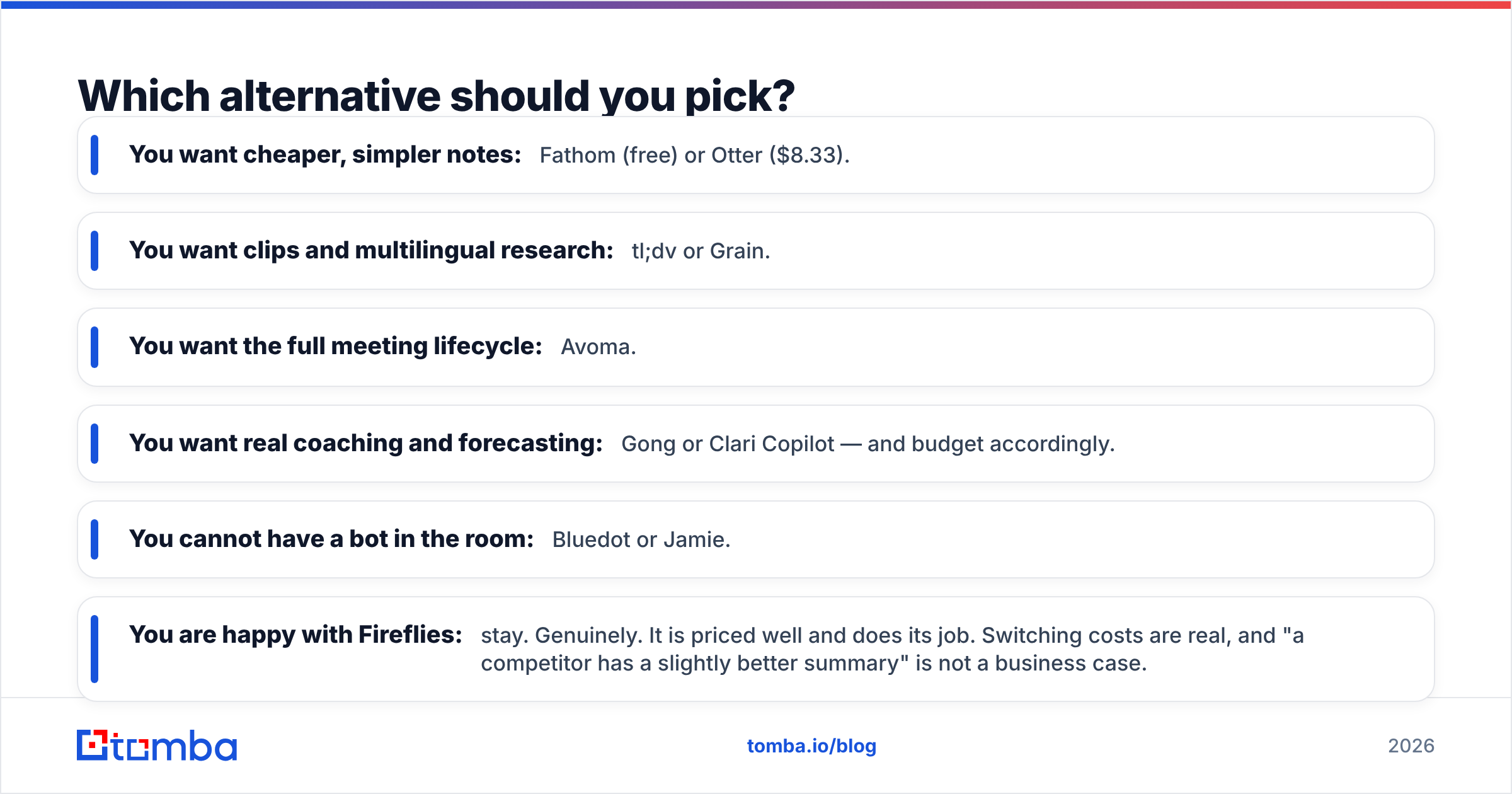
- You want cheaper, simpler notes: Fathom (free) or Otter ($8.33).
- You want clips and multilingual research: tl;dv or Grain.
- You want the full meeting lifecycle: Avoma.
- You want real coaching and forecasting: Gong or Clari Copilot — and budget accordingly.
- You cannot have a bot in the room: Bluedot or Jamie.
- You are happy with Fireflies: stay. Genuinely. It is priced well and does its job. Switching costs are real, and "a competitor has a slightly better summary" is not a business case.
The teams who benefit most from switching are the ones at a threshold: growing past 10 reps and needing coaching, or shrinking budgets and needing free. Everyone in the middle is usually better served by fixing the pipeline that feeds the meetings.
Ready to fix the layer above the transcript?#
Meeting AI is the easy purchase. The hard part is filling the calendar with the right people in the first place. If your reps spend more time hunting for a contact's real email address than reviewing call notes, the notetaker is not your bottleneck.
Try the Tomba Email Finder — find verified professional email addresses by name, domain, or company, then push them straight into your sequencer or CRM. The free tier gives you 25 searches a month to test accuracy on your own target accounts, and paid plans start at $49/mo. Check Tomba pricing for the full breakdown, or hit the Tomba API if you would rather wire it into your own workflow. Get the meetings booked first — then argue about which AI takes the notes.
Related guides#
Ready to find emails that actually work?
Join 150,000+ professionals who stopped guessing and started sending. Free credits on signup — no credit card required.
Get the Tomba newsletter
Practical outbound tactics and product updates — once every two weeks.
About the author