Free Lead Generation Sites: 14 Real Sources That Work in 2026
Most "free lead generation sites" hand you stale records and a paywall at record 26. Here are the 14 sources that still produce usable B2B contacts in 2026, ranked by what you actually get for $0.
TL;DR
- "Free" on most lead generation sites means a trial credit pool (25–50 records), not an open database. The paywall usually lands between record 25 and record 100.
- The genuinely free sources are structural, not commercial: Google operators, LinkedIn search, company sites, government registries, review platforms, and community directories.
- Free tiers from real tools — Tomba's 25 searches/mo, HubSpot's free CRM, Google Search Console — are the highest-quality "free" because the data is live, not scraped from 2019.
- The real cost of free leads is verification. A $0 list with a 22% bounce rate can torch a sending domain that took six months to warm.
- Best practical stack for $0: LinkedIn + Google operators for targeting, a free email finder tier for the addresses, a free verifier before you send.
What Do People Actually Mean by "Free Lead Generation Sites"?#
Three very different things get filed under the same phrase, and conflating them is why most people waste a weekend.
- Free-tier commercial tools. Real, live databases that give you a monthly credit allowance at no cost — 25 to 50 lookups, typically. The data quality matches the paid product because it is the paid product. The limit is volume, not accuracy.
- Free public sources. Google, LinkedIn, company websites, Crunchbase profiles, GitHub, government business registries, chamber-of-commerce lists. Unlimited, genuinely free, and completely unstructured. You supply the labor.
- "Free" scraped list sites. Sites promising "10 million B2B emails free download." These are almost always recycled 2018–2021 dumps with 30–60% decay. Downloading one and mailing it is the fastest way to get your domain blacklisted.
Category 3 is not a strategy. Categories 1 and 2 are, and combined they can carry a solo founder or a two-person SDR team to a few hundred qualified contacts a month without a card on file.
Which Free Lead Generation Sites Are Worth Your Time in 2026?#
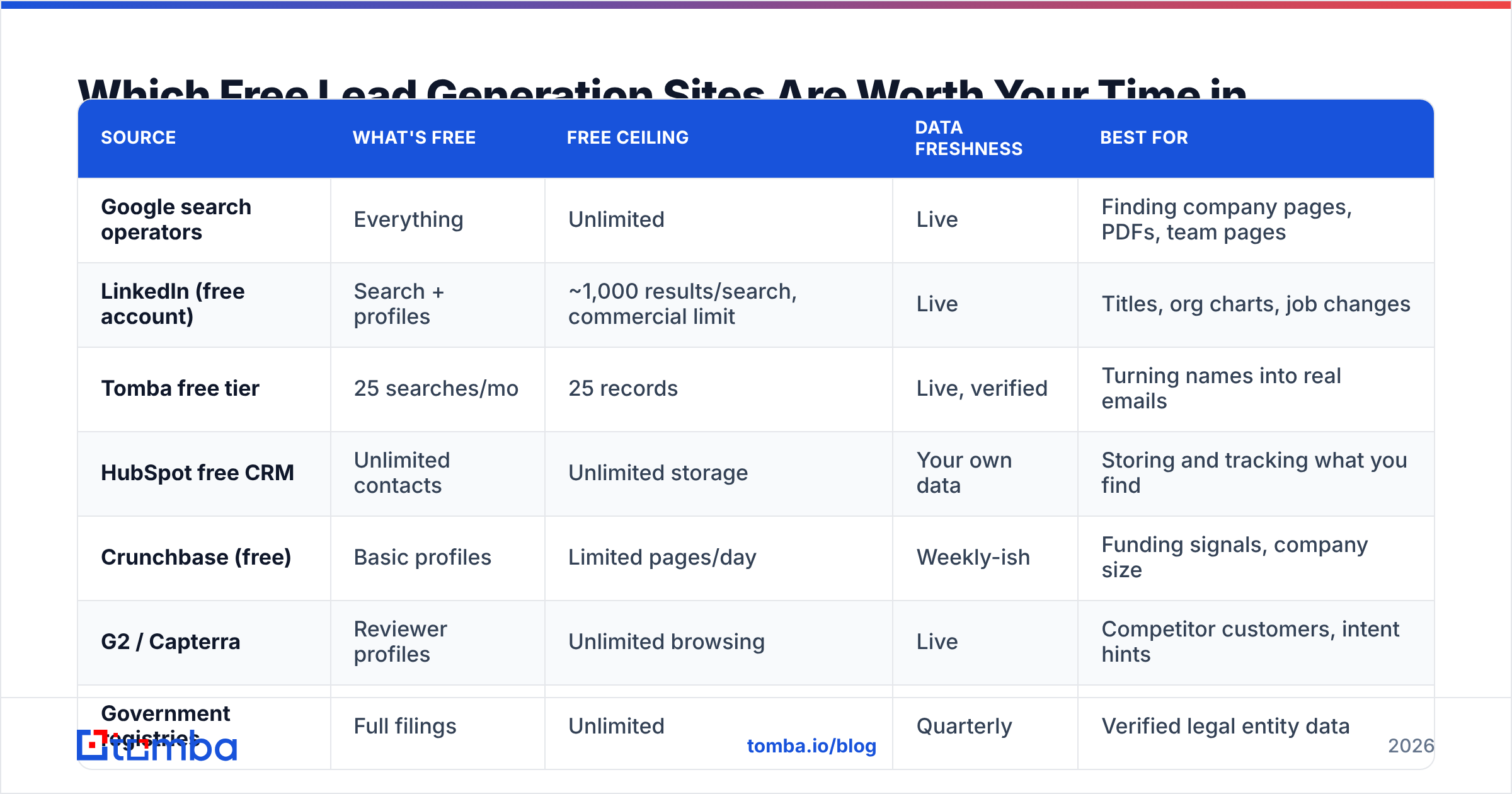
Here's the honest ranking. "Free ceiling" is what you get before any payment is required, and "data freshness" reflects how current the underlying records are.
| Source | What's free | Free ceiling | Data freshness | Best for |
|---|---|---|---|---|
| Google search operators | Everything | Unlimited | Live | Finding company pages, PDFs, team pages |
| LinkedIn (free account) | Search + profiles | ~1,000 results/search, commercial limit | Live | Titles, org charts, job changes |
| Tomba free tier | 25 searches/mo | 25 records | Live, verified | Turning names into real emails |
| HubSpot free CRM | Unlimited contacts | Unlimited storage | Your own data | Storing and tracking what you find |
| Crunchbase (free) | Basic profiles | Limited pages/day | Weekly-ish | Funding signals, company size |
| G2 / Capterra | Reviewer profiles | Unlimited browsing | Live | Competitor customers, intent hints |
| Government registries | Full filings | Unlimited | Quarterly | Verified legal entity data |
| BookYourData | Sample records | Trial credits | Live, verified | Pay-as-you-go top-ups without a subscription |
| GitHub | Profiles + orgs | Unlimited | Live | Dev-tool and technical buyers |
| Reddit / Slack / Discord | Community access | Unlimited | Live | Pain-point research, warm intros |
| Job boards (Indeed, LinkedIn Jobs) | Postings | Unlimited | Live | Hiring signals = budget signals |
| Chamber of commerce | Member directories | Unlimited | Annual | Local and SMB targeting |
| Product Hunt | Maker profiles | Unlimited | Live | Early-stage founders |
| Google Search Console | Your own query data | Unlimited | Daily | Inbound intent you already earned |
Two rows deserve elaboration.
LinkedIn's free tier is the single most underrated free lead generation site. You don't need Sales Navigator to filter by title, company size, geography, and recent activity. What you don't get is contact info — LinkedIn deliberately withholds it. That's the seam where a free email finder tier slots in.
Government registries — Companies House in the UK, SEC EDGAR in the US, the EU Business Registers portal — are free, authoritative, and shockingly under-used. Filings give you directors' names, registered addresses, incorporation dates, and sometimes revenue bands. For compliance-heavy or high-ACV targeting, that beats any scraped list.
How Do You Turn Free Sources Into Actual Contact Data?#
The gap in every free stack is the same: you can find who, but not how to reach them. Here's the sequence that closes it.
- Define the account list first. Ten well-chosen companies beat a thousand random ones. Use job postings, funding announcements, or a competitor's review page on G2 to build a list of 30–50 accounts with a plausible reason to buy.
- Find the right human on LinkedIn. Search by company + title. Note the exact spelling of the name — "Katherine Ng" and "Kate Ng" resolve to different addresses.
- Determine the company's email pattern. Most orgs use one of six formats. A free company email pattern check on a known address at that domain tells you which one, and then every other contact at that company becomes trivially derivable.
- Resolve the actual address. Pattern-guessing gets you a candidate; it doesn't get you a confirmed mailbox. This is where a free tier of a real email finder does the work — it checks the address against live sources rather than assuming.
- Verify before sending. Non-negotiable. Run every address through a free email checker or a bulk verifier. Catch-all domains need their own handling — a plain SMTP ping returns "valid" for every address on a catch-all, including addresses that don't exist.
- Log it somewhere. HubSpot's free CRM, Airtable, or even a Google Sheet with a Sheets email finder add-on. Untracked leads get worked twice or not at all.
Steps 3 through 5 are where free public sources stop and free tool tiers start. You can do step 3 manually. You cannot do step 5 manually at any useful volume.
Is Free B2B Data Accurate Enough to Send To?#
Depends entirely on which "free" you mean, and this is where most people get burned.
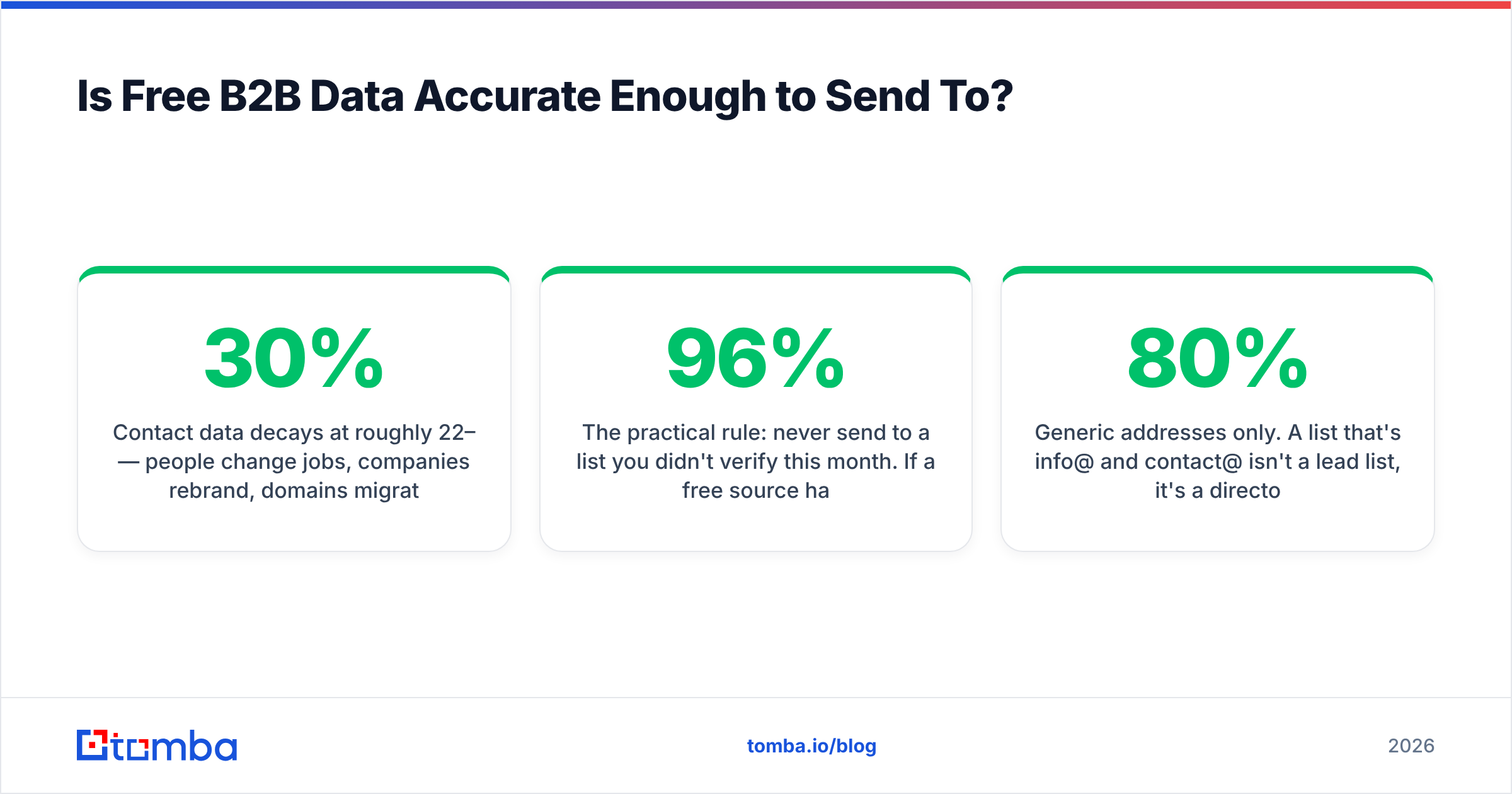
Contact data decays at roughly 22–30% per year — people change jobs, companies rebrand, domains migrate. A list scraped in 2022 and offered as a free download in 2026 is, mathematically, mostly wrong. Sending to it produces bounce rates that trip Google's and Microsoft's sender thresholds, and once your sender reputation is damaged, even your good emails land in spam.
Free tiers of live tools behave differently. When you use 25 free lookups against a real database, those 25 records were resolved against current sources at the moment you asked. The accuracy matches the paid tier exactly. You're rate-limited, not quality-limited — a distinction that matters enormously.
The practical rule: never send to a list you didn't verify this month. If a free source hands you 500 addresses and you can only afford to verify 100, send to 100. A 100-contact campaign at 96% deliverability outperforms a 500-contact campaign at 68%, and it doesn't cost you the domain.
Watch for these specific red flags on any free list site:
- No date on the dataset. If they won't say when it was compiled, it's old.
- Generic addresses only. A list that's 80%
info@andcontact@isn't a lead list, it's a directory scrape. - No verification claim, or a vague one. "Verified" without a stated method or bounce guarantee means nothing.
- Volume framing over fit framing. "5 million contacts" is a warning, not a feature. You need 200 right ones.
- Download-and-go with no filtering. Real databases let you segment before export. Dumps don't.
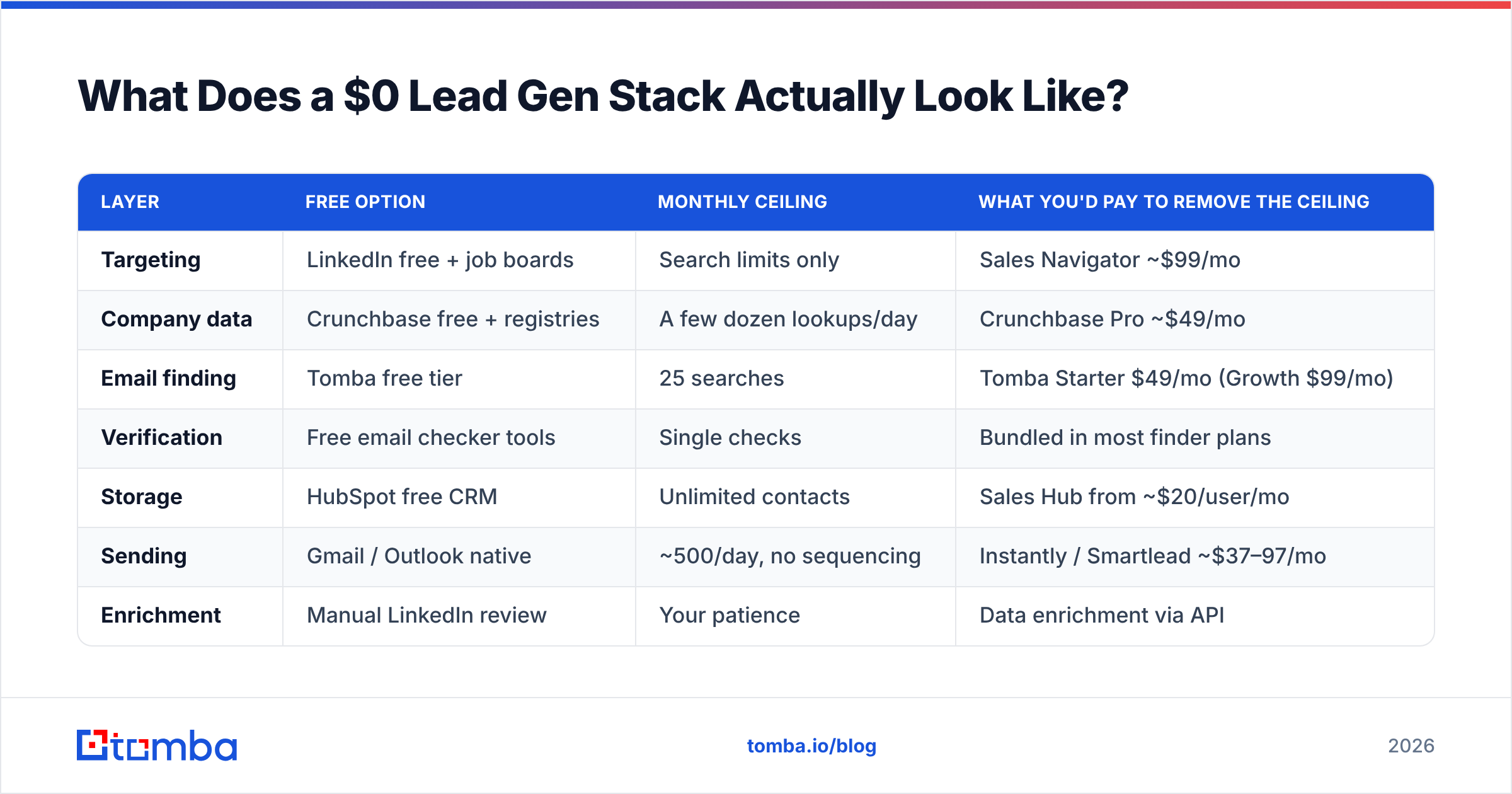
What Does a $0 Lead Gen Stack Actually Look Like?#
Here's a stack that costs nothing and produces roughly 25–60 verified contacts a month — enough to test a message and prove a channel before you spend.
| Layer | Free option | Monthly ceiling | What you'd pay to remove the ceiling |
|---|---|---|---|
| Targeting | LinkedIn free + job boards | Search limits only | Sales Navigator ~$99/mo |
| Company data | Crunchbase free + registries | A few dozen lookups/day | Crunchbase Pro ~$49/mo |
| Email finding | Tomba free tier | 25 searches | Tomba Starter $49/mo (Growth $99/mo) |
| Verification | Free email checker tools | Single checks | Bundled in most finder plans |
| Storage | HubSpot free CRM | Unlimited contacts | Sales Hub from ~$20/user/mo |
| Sending | Gmail / Outlook native | ~500/day, no sequencing | Instantly / Smartlead ~$37–97/mo |
| Enrichment | Manual LinkedIn review | Your patience | Data enrichment via API |
Total: $0. Real output: enough contacts to validate an ICP hypothesis.
The moment to upgrade is well-defined and it isn't "when I feel like it." Upgrade when the free tier's ceiling is costing you more in labor hours than the plan costs in dollars. If you spend six hours a month manually guessing addresses that a $49/mo plan would resolve in ninety seconds, the free tier is now the expensive option. Compare Tomba pricing tiers against your own hourly rate and the math answers itself.

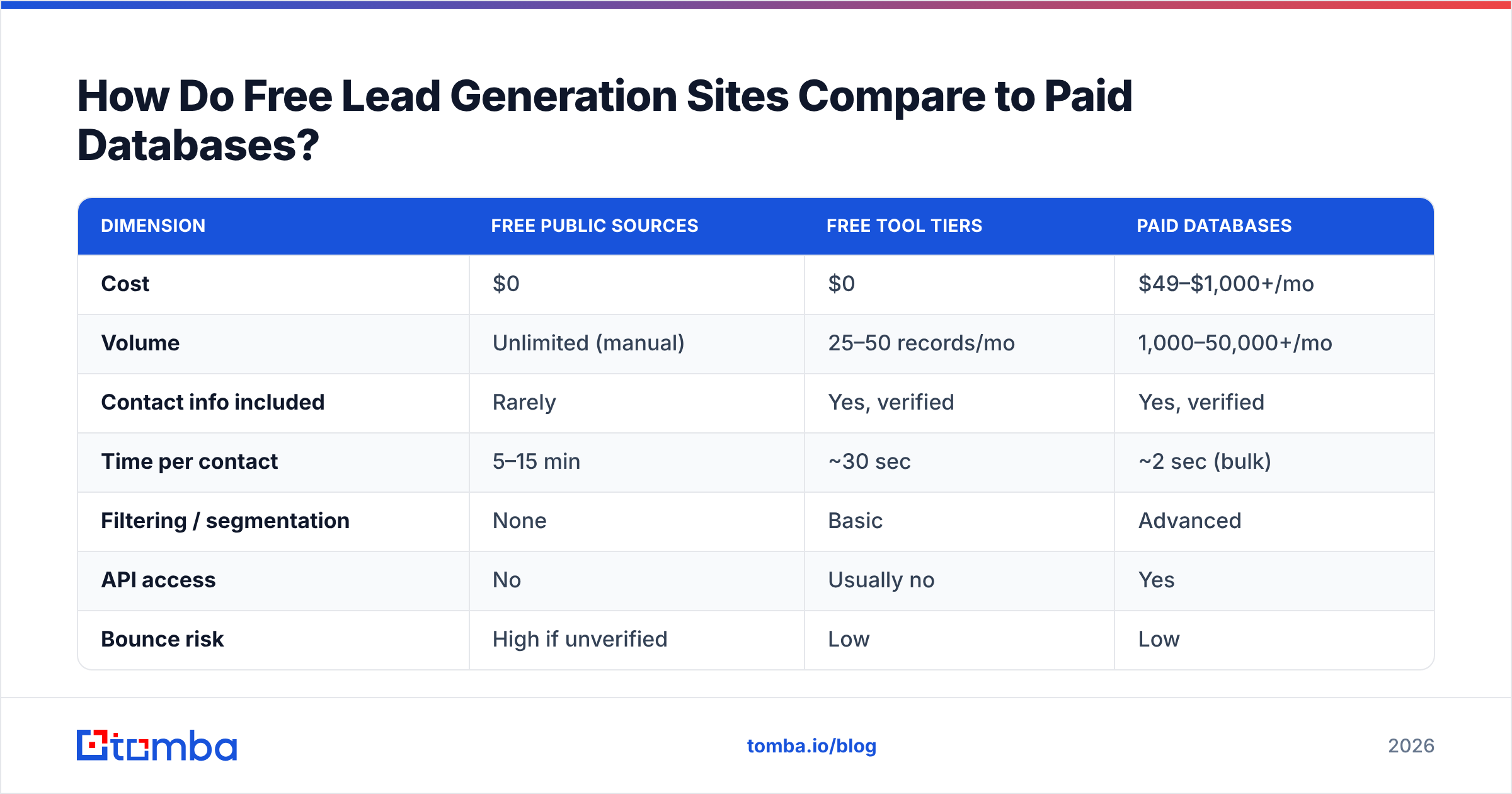
How Do Free Lead Generation Sites Compare to Paid Databases?#
Direct comparison, no hedging:
| Dimension | Free public sources | Free tool tiers | Paid databases |
|---|---|---|---|
| Cost | $0 | $0 | $49–$1,000+/mo |
| Volume | Unlimited (manual) | 25–50 records/mo | 1,000–50,000+/mo |
| Contact info included | Rarely | Yes, verified | Yes, verified |
| Time per contact | 5–15 min | ~30 sec | ~2 sec (bulk) |
| Filtering / segmentation | None | Basic | Advanced |
| API access | No | Usually no | Yes |
| Bounce risk | High if unverified | Low | Low |
| Compliance record | You're on your own | Vendor-documented | Vendor-documented, DPA available |
The honest read: free public sources cost time instead of money, and time is the more expensive currency once you're past validation. A rep at $60k fully loaded costs about $0.50/minute. Ten minutes of manual sourcing per contact is $5 a contact. Paid tools land between $0.02 and $0.30 a contact. Free sourcing only makes economic sense when your time genuinely has no alternative use — which is true for exactly one stage of company-building and no others.
That said, free tool tiers are legitimately good economics at low volume, and vendors know it. They're a sampling mechanism. Use them as one. Run the same 20 test contacts through two or three free tiers, check which returns the most valid, non-catch-all addresses, and let that decide where your money goes later. Where the data comes from matters more than the marketing page claims — vendors that document their sources tend to hold up better under a blind test.
What About Compliance — Is Scraping Free Leads Legal?#
Short answer: sourcing business contact data from public sources is generally lawful in the US and permitted under GDPR's legitimate-interest basis in the EU, but the sending is where the rules bite.
- CAN-SPAM (US) doesn't require prior consent for B2B email, but it does require accurate headers, a real physical address, and a working opt-out honored within 10 business days.
- GDPR (EU/UK) permits B2B outreach under legitimate interest, but you must be able to document the basis, honor deletion requests, and disclose your source if asked. Scraped lists with unknown provenance make that impossible — which is the strongest practical argument against free download dumps.
- CASL (Canada) is the strict one: express or implied consent is required for most commercial email. Implied consent exists for conspicuously published business addresses relevant to the recipient's role, which is narrower than most people assume.
- LinkedIn's Terms of Service prohibit automated scraping. Manual research is fine; a bot pulling profiles at scale gets accounts restricted, and the enforcement has gotten noticeably more aggressive.
The compliance advantage of tool-based sourcing over dump-based sourcing is documentation. When a recipient asks where you got their address, "our vendor's documented public-source pipeline" is an answer. "A CSV I downloaded" is not.
For a broader vocabulary of the terms that come up in these conversations, the B2B glossary covers the acronyms without the vendor spin.
Where Should You Start This Week?#
Pick one motion and run it end to end rather than sampling twelve sites.
If you sell to SMBs: chamber of commerce directories + Google Maps + a free email finder tier. High volume, low ACV, pattern-based addresses are usually reliable.
If you sell to mid-market SaaS: G2 review profiles of your closest competitor + LinkedIn title search + verification. Reviewers have already declared a category budget and a pain point in public.
If you sell to enterprise: SEC filings + job postings + LinkedIn org mapping. Slower, but the account list is small enough that manual sourcing is genuinely economical.
If you sell to developers: GitHub org members + Product Hunt makers + community Slacks. Contact info is often public in profiles or commit histories, and outreach norms are different — be technical or be ignored.
In all four cases, the bottleneck arrives at the same place: you have names and companies, and you need addresses that don't bounce. Free public sites get you to that line. They don't get you across it.
The Bottom Line#
Free lead generation sites are real, but "free" splits cleanly into two things: unlimited-but-unstructured public sources, and limited-but-clean tool tiers. The winning play uses both — public sources to decide who, a free tool tier to resolve how to reach them, and verification before anything leaves your outbox. Skip the download-a-million-emails sites entirely; the domain damage costs more than any tool subscription.
When you're ready to close the gap between "I found the right person on LinkedIn" and "I have their verified work address," start with the Tomba Email Finder. The free tier gives you 25 searches a month with the same verification pipeline the paid plans use — enough to test whether your target list is reachable before you commit a dollar. If it works, Starter is $49/mo and Growth is $99/mo, and the bulk email finder handles the volume once your free ceiling starts costing you hours instead of saving you money.
Sources referenced: G2, HubSpot, Crunchbase.
Related guides#
// get started
Find, verify and enrich your first contacts today
Start on the free plan with 25 searches a month, then scale when your team is ready.
Free plan · No credit card required · GDPR & CCPA
// about the author