B2B Contact Database Free: 9 Best Options in 2026 (Tested)
Looking for a B2B contact database free of charge? Here are 9 real free tiers, what their credits actually get you, and how to avoid stale, unverified data.

You want a B2B contact database, you want it free, and you do not want a credit card form blocking the door. Fair. The good news: several legitimate platforms give you real records for $0. The catch: "free" ranges from genuinely useful to a thin teaser designed to make you upgrade by Tuesday.
This guide cuts through it. You will see which free tiers actually let you export usable contacts, how many credits you realistically get, and where the data quality quietly falls apart.
TL;DR#
- A B2B contact database free tier usually means 25–100 credits per month, where one credit equals one revealed or verified contact.
- Free does not mean accurate. Scraped, never-verified lists decay 25–30% per year, so verification matters more than raw volume.
- The best free options pair a real contact finder with an email verifier so you are not emailing dead inboxes.
- Tomba's free plan gives you 25 searches per month with verification built in — enough to test accuracy before you commit budget.
- Avoid "free" databases that won't show data provenance. If a vendor can't say where the data came from, your deliverability pays for it.
What is a B2B contact database, and what does "free" actually buy you?#
A B2B contact database is a searchable store of professional records — names, company emails, job titles, phone numbers, and firmographics like industry and headcount. Think of it as a phone book that knows who decides budgets, except the phone book also goes out of date the moment someone changes jobs.
"Free" comes in three flavors, and confusing them is how people waste a week:
- Free trial — full features for 7–14 days, then a paywall. Good for a one-time burst, useless for ongoing prospecting.
- Free tier (freemium) — a permanent monthly allowance of credits. This is what most people mean by a b2b contact database free plan.
- Free tools — single-purpose utilities (an email permutator, a pattern checker) that cost nothing but don't give you a database.
The unit that matters is the credit. One credit typically reveals one email or verifies one address. A "free" plan advertising "unlimited searches" but 25 credits means you can browse all day and export almost nothing.
How accurate is free B2B contact data?#
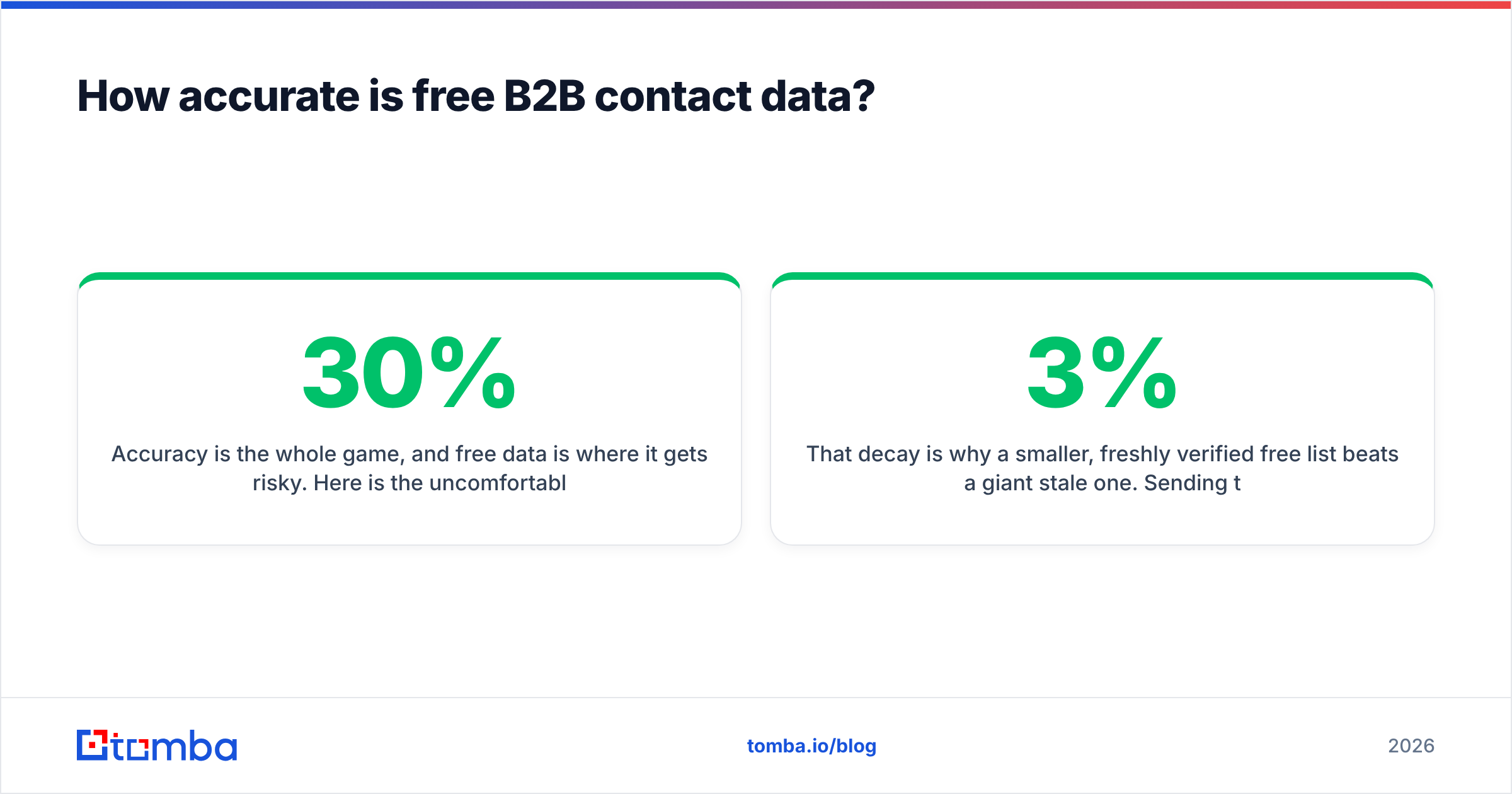
Accuracy is the whole game, and free data is where it gets risky. Here is the uncomfortable math: B2B data decays roughly 25–30% per year because people switch jobs, companies rebrand, and domains change. A database that was 95% accurate at collection can be 70% accurate twelve months later if nobody re-verifies it.
That decay is why a smaller, freshly verified free list beats a giant stale one. Sending to unverified addresses inflates your bounce rate, and once bounces climb past 2–3%, mailbox providers throttle you. Your email deliverability — and your sender reputation — take the hit, not the data vendor's.
So judge any free B2B contact database on three things:
- Provenance — does the vendor disclose where data comes from? Tomba publishes its data sources; many "free list" sites do not.
- Verification — is each email SMTP-checked, or just guessed from a pattern?
- Recency — when was the record last confirmed?
If a free provider can't answer those, treat the data as a starting point to verify, not a list to blast.
Which free B2B contact database tools are worth it in 2026?#
Below are nine options people actually use, grouped by what they do best. None of these require payment to start, though limits vary widely.
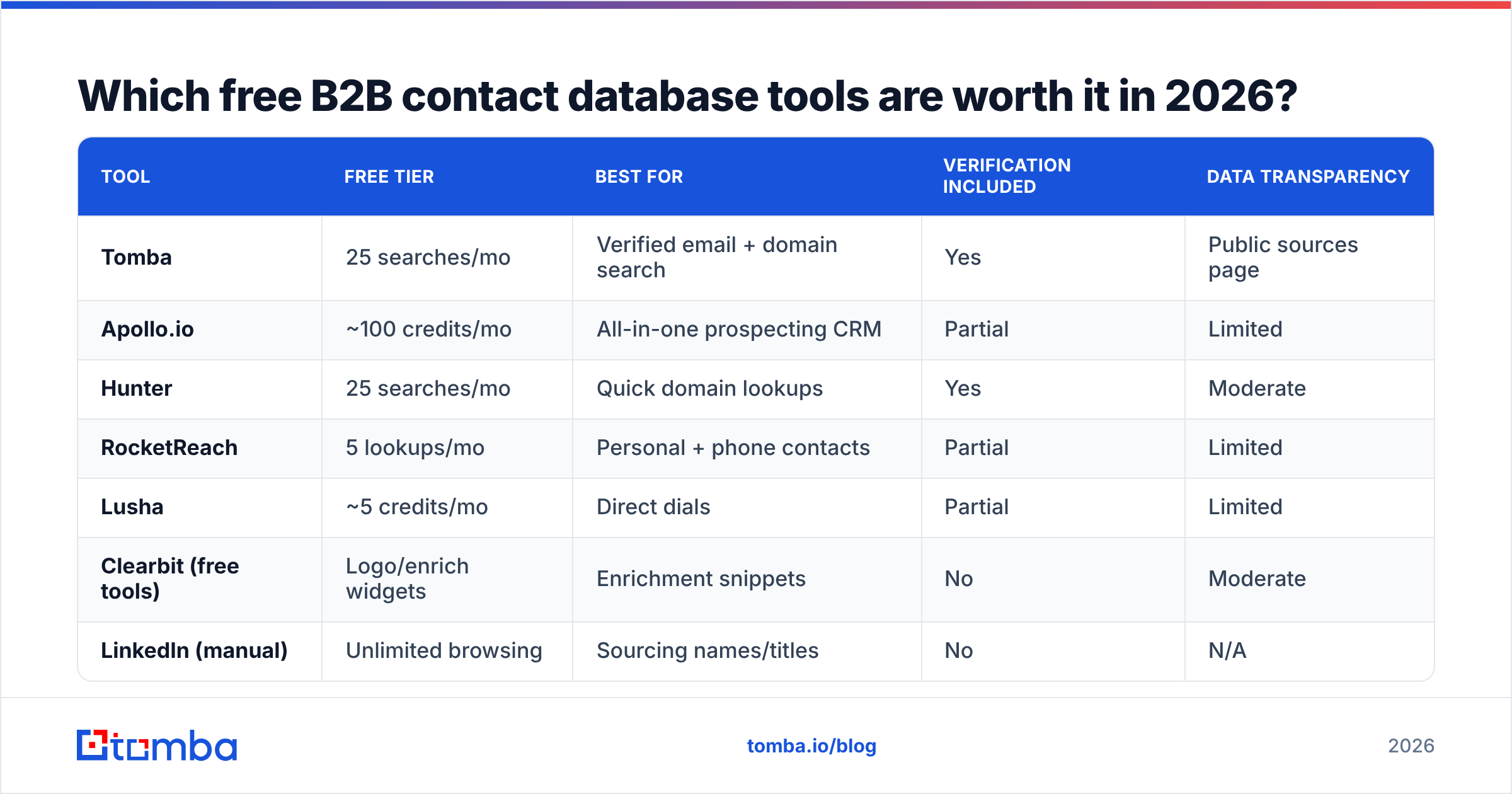
| Tool | Free tier | Best for | Verification included | Data transparency |
|---|---|---|---|---|
| Tomba | 25 searches/mo | Verified email + domain search | Yes | Public sources page |
| Apollo.io | ~100 credits/mo | All-in-one prospecting CRM | Partial | Limited |
| Hunter | 25 searches/mo | Quick domain lookups | Yes | Moderate |
| RocketReach | 5 lookups/mo | Personal + phone contacts | Partial | Limited |
| Lusha | ~5 credits/mo | Direct dials | Partial | Limited |
| Clearbit (free tools) | Logo/enrich widgets | Enrichment snippets | No | Moderate |
| LinkedIn (manual) | Unlimited browsing | Sourcing names/titles | No | N/A |
| Tomba free tools | Unlimited | Permutator, checker, extractor | Partial | Public |
| Crunchbase (free) | Limited profiles | Company firmographics | No | Moderate |
A few honest notes on this table:
- Apollo has the most generous credit count, but free-tier exports and email reveals are capped and its older free records can be hit-or-miss. It's still a strong starting point if you want a database plus a sequencer in one place — and if you outgrow it, there are leaner Apollo alternatives worth testing.
- Hunter and Tomba overlap on domain-based lookups. Both verify, both have a free tier near 25 searches.
- RocketReach and Lusha lean toward personal emails and phone numbers but have stingy free limits — fine for a handful of priority accounts, not list-building. If phone coverage is your priority, compare dedicated RocketReach alternatives too.
- LinkedIn isn't a database you can export legally at scale, but it's the best free source for names and titles you then resolve to emails with a finder.
How do I build a free B2B contact list without getting burned?#
You don't need a paid plan to assemble a clean starter list. You need a repeatable, three-step loop that respects the free credits you have.
Step 1 — Source the targets (free). Use LinkedIn search, a company's team page, or Crunchbase to collect company domains and the names/titles of the people you want. This costs zero credits anywhere.
Step 2 — Resolve contacts (free tier). Feed those domains into a finder. A domain search returns every public email pattern for a company in one query, which is far more credit-efficient than looking up people one at a time. When you have a name but no email, an email finder resolves the specific address.
Step 3 — Verify before sending (non-negotiable). Run every address through an email verifier so you catch dead inboxes and catch-all domains before they bounce. This single step protects the deliverability you'll rely on for months.
This loop turns 25 free credits into a tight, verified list of real decision-makers instead of 1,000 guessed addresses that torch your domain.

Free vs. paid B2B databases: when should you upgrade?#
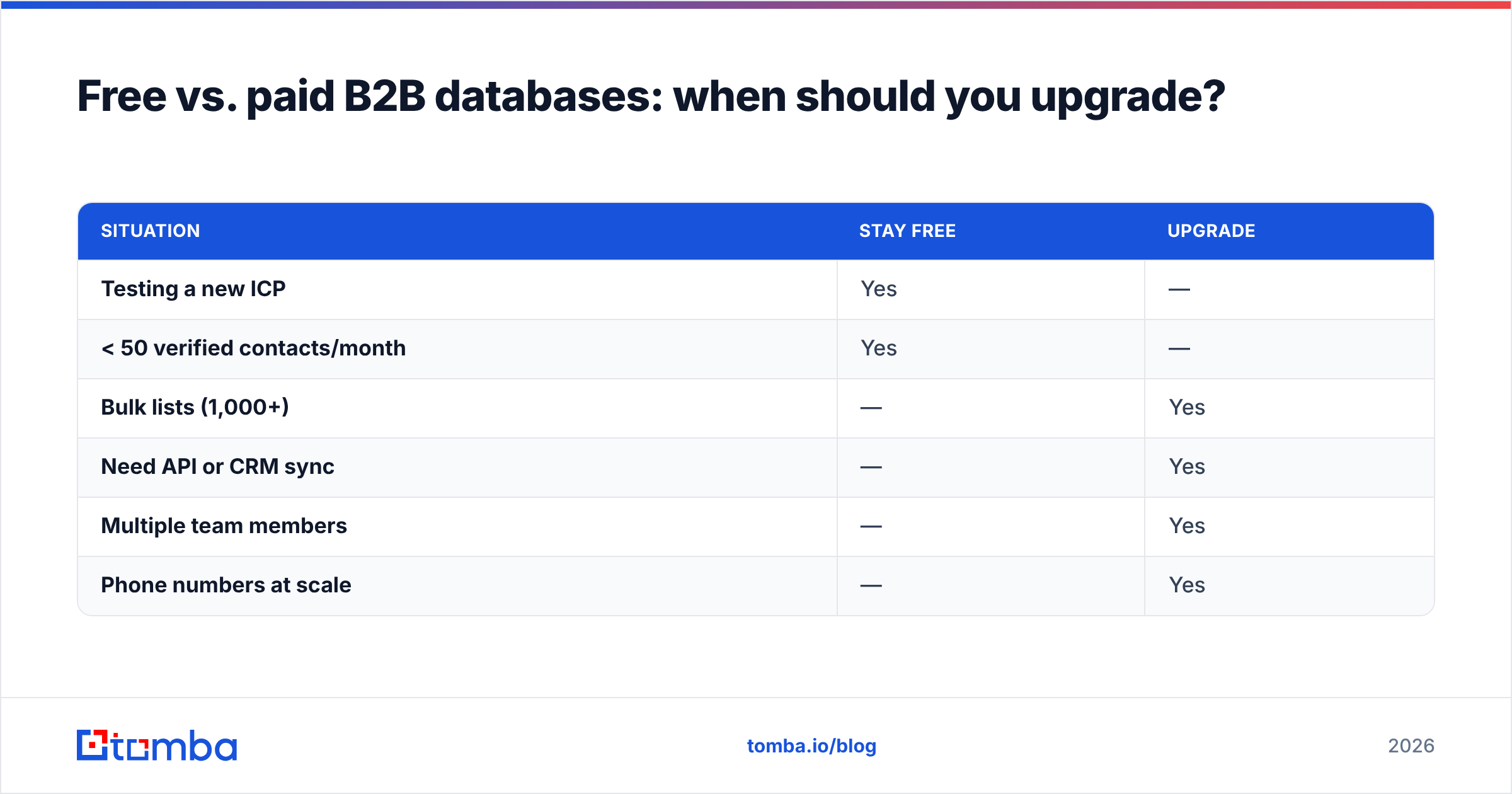
Free tiers are perfect for validation: testing accuracy, running a small campaign, proving the channel works. They break down once you need volume, automation, or team seats.
Here's a clean decision framework:
| Situation | Stay free | Upgrade |
|---|---|---|
| Testing a new ICP | Yes | — |
| < 50 verified contacts/month | Yes | — |
| Bulk lists (1,000+) | — | Yes |
| Need API or CRM sync | — | Yes |
| Multiple team members | — | Yes |
| Phone numbers at scale | — | Yes |
When you do cross that line, the jump shouldn't be brutal. Tomba's paid plans start at $49/mo (Starter), then $99/mo (Growth) and $249/mo (Pro), with a custom Enterprise tier — full Tomba pricing breaks down the credit allowances. The point of the free tier is to confirm the data is good before you spend, not to trap you.
For heavier workflows, a bulk email finder processes whole CSVs at once, and the Tomba API lets you enrich records inside your own app or CRM. That's the natural graduation path from a free database to an automated pipeline.
What mistakes make free B2B databases useless?#
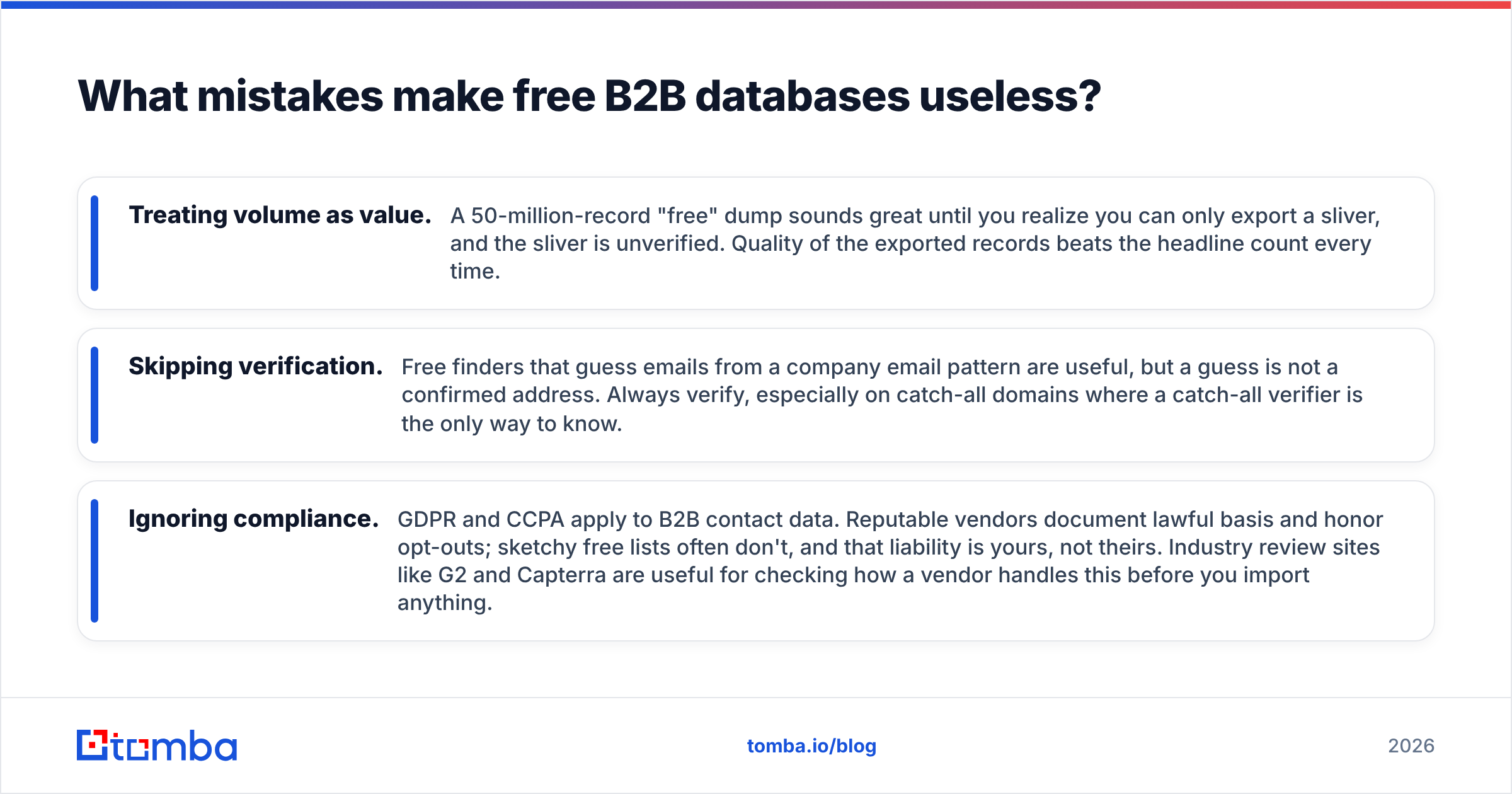
Three avoidable errors turn a promising free tier into wasted effort:
- Treating volume as value. A 50-million-record "free" dump sounds great until you realize you can only export a sliver, and the sliver is unverified. Quality of the exported records beats the headline count every time.
- Skipping verification. Free finders that guess emails from a company email pattern are useful, but a guess is not a confirmed address. Always verify, especially on catch-all domains where a catch-all verifier is the only way to know.
- Ignoring compliance. GDPR and CCPA apply to B2B contact data. Reputable vendors document lawful basis and honor opt-outs; sketchy free lists often don't, and that liability is yours, not theirs. Industry review sites like G2 and Capterra are useful for checking how a vendor handles this before you import anything.
Avoid those three and a free tier becomes a genuine asset rather than a deliverability landmine.
How does Tomba's free B2B contact database compare?#
Tomba's free plan is built around the part most free tiers skip: trust. You get 25 searches per month, every result runs through verification, and the data sources are published openly rather than hidden behind a marketing claim. For a free tier, that combination — real records, SMTP verification, and transparent provenance — is the differentiator.
Beyond the core finder, the free account unlocks a stack of zero-cost utilities: an email checker, an email extractor, and a Chrome extension that surfaces verified contacts as you browse company sites and LinkedIn. If you want to pressure-test accuracy against vendors like HubSpot's data tools or Apollo, the free tier is enough to run a fair head-to-head. (For context on how the broader market frames B2B data, HubSpot's own sales resources and the methodology notes on Wikipedia's CRM overview are solid neutral references.)
The honest summary: no free tier hands you an unlimited, perfectly fresh database — that product doesn't exist at $0. What you can get for free is a verified, transparent sample large enough to validate the channel and seed real campaigns.
Start building a clean list with Tomba's free tier#
If you want a B2B contact database that's free to start and honest about its data, begin with the Tomba Email Finder. Pull verified, deliverable contacts by name, company, or domain on the 25-searches-a-month free plan, confirm the accuracy yourself, and only upgrade once the channel has proven it pays for itself. Source smart, verify always, and let the free tier earn your budget before it asks for it.
// get started
Find, verify and enrich your first contacts today
Start on the free plan with 25 searches a month, then scale when your team is ready.
Free plan · No credit card required · GDPR & CCPA
Get the Tomba newsletter
Product and data updates
// about the author