Free Lead Generation Tools for B2B: 15 Tested Picks (2026)
Most "free" B2B lead gen tools are trials in disguise. Here's what 15 popular free tiers actually give you each month, where they stop, and how to chain them into a working $0 pipeline.
TL;DR
- Almost no B2B tool is free forever at scale. What you actually get is a monthly credit allowance (5–100 contacts), a feature-locked CRM, or a 7–14 day trial wearing a "free plan" badge.
- The three free tiers that survive real use are a CRM (HubSpot), an email finder with verification built in (Tomba's 25 searches/month), and a spreadsheet you control.
- Free enrichment credits are the bottleneck in every $0 stack. Everything else — forms, sequencing, list building — has a usable free option.
- Export restrictions matter more than credit counts. A tool that shows you 500 contacts but blocks CSV export is worth less than one that gives you 25 you can actually use.
- Budget roughly 25–60 verified contacts/month from a pure free stack. Past that, a single paid seat around $49/month replaces four free tools and saves more hours than it costs.
What counts as a "free" lead generation tool in 2026?#
Three different things get labeled "free," and conflating them is why most $0 stacks collapse in week two.
Free forever, credit-capped. You get a permanent account with a monthly allowance that resets. Tomba's free tier (25 searches/month), HubSpot's free CRM, and most email verifiers work this way. This is the only category you can actually plan around.
Free forever, feature-capped. Unlimited use of a narrow slice. Google Sheets, Calendly's single event type, LinkedIn's basic search. No credit anxiety, but you hit a wall the moment you need automation or team access.
Free trial in costume. 14 days, 250 credits, then a paywall. Instantly, Clay, and most sequencing platforms live here. Useful for a one-off campaign sprint, useless as infrastructure.
The fourth pattern is the one that burns people: free to search, paid to export. Several well-known databases will happily show you 2,000 matching contacts and then require an upgrade to move them anywhere. Always test the CSV button before you build a workflow on top of a tool.

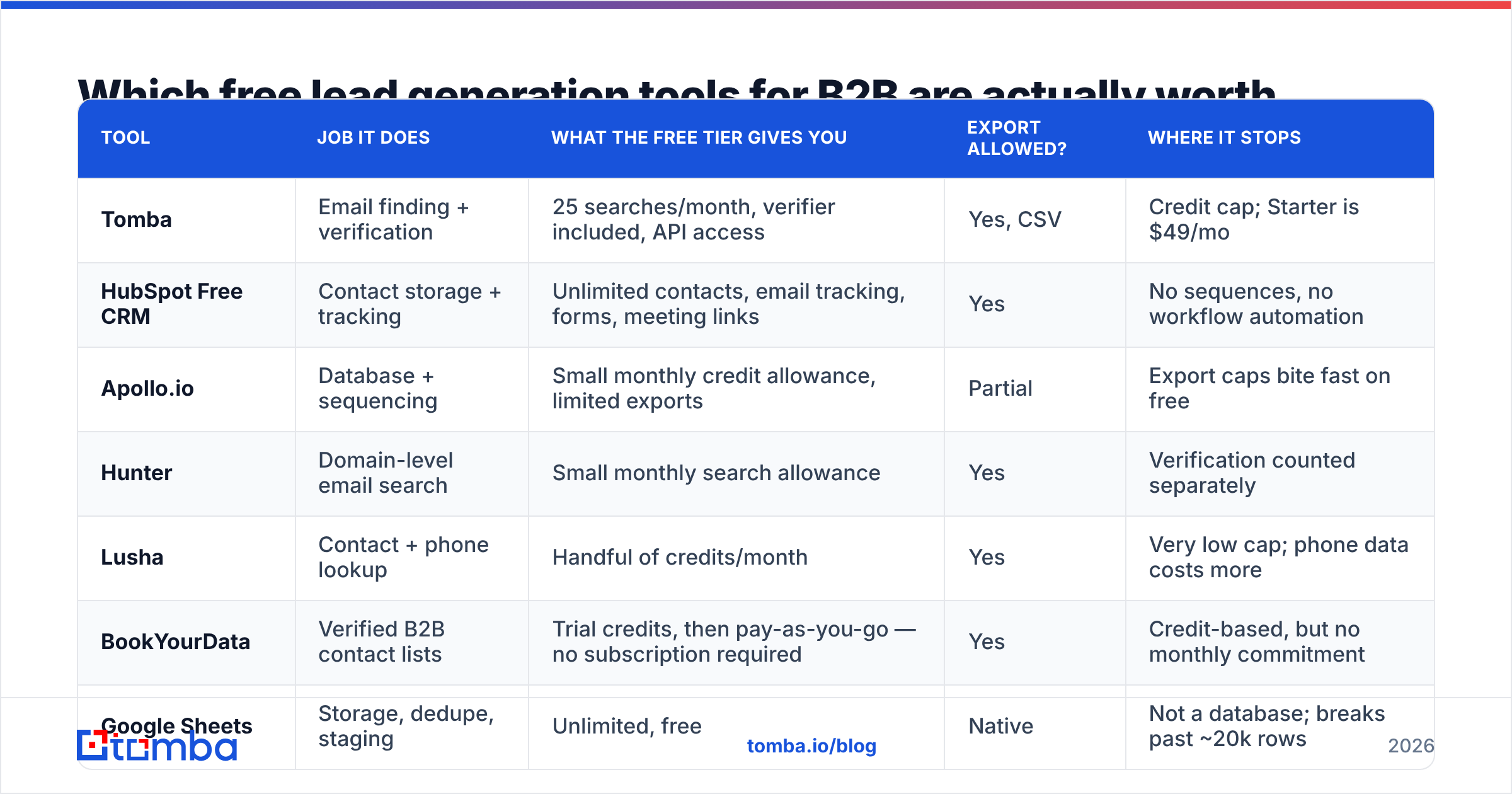
Which free lead generation tools for B2B are actually worth setting up?#
Here's the honest comparison across the five jobs a lead gen stack has to do. Free tiers change constantly — treat these as the shape of each offer, not a contract, and verify on the vendor's pricing page before you commit.
| Tool | Job it does | What the free tier gives you | Export allowed? | Where it stops |
|---|---|---|---|---|
| Tomba | Email finding + verification | 25 searches/month, verifier included, API access | Yes, CSV | Credit cap; Starter is $49/mo |
| HubSpot Free CRM | Contact storage + tracking | Unlimited contacts, email tracking, forms, meeting links | Yes | No sequences, no workflow automation |
| Apollo.io | Database + sequencing | Small monthly credit allowance, limited exports | Partial | Export caps bite fast on free |
| Hunter | Domain-level email search | Small monthly search allowance | Yes | Verification counted separately |
| Lusha | Contact + phone lookup | Handful of credits/month | Yes | Very low cap; phone data costs more |
| BookYourData | Verified B2B contact lists | Trial credits, then pay-as-you-go — no subscription required | Yes | Credit-based, but no monthly commitment |
| Google Sheets | Storage, dedupe, staging | Unlimited, free | Native | Not a database; breaks past ~20k rows |
| LinkedIn (basic) | Prospect discovery | Search, filters, profile viewing | Manual only | Commercial use limit throttles you monthly |
| Instantly | Sending + warmup | Time-boxed trial | Yes | Trial, not a free tier |
| Clay | Waterfall enrichment | Small monthly credit grant | Yes | Credits evaporate on multi-provider waterfalls |
Two things stand out when you line them up. First, the storage and outreach layers are genuinely solvable for $0 — HubSpot's free CRM is unusually generous and G2 reviewers consistently rate it as a real product rather than a lead magnet. Second, every stack converges on the same choke point: contact data.
BookYourData deserves a specific note because it solves a different problem than the rest. It's not a monthly subscription — you buy credits, they don't expire on a billing cycle, and the lists come pre-verified. If your buying pattern is "one campaign a quarter, 2,000 contacts," a credit model is often cheaper and cleaner than paying for twelve months of a seat you use twice. Check bookyourdata.com for current credit pricing.
How far do free email finder credits actually get you?#
This is the number that determines everything downstream, so it's worth doing the arithmetic instead of vibing it.
A realistic cold outbound campaign needs 300–500 verified contacts to produce statistically meaningful reply data. At 25 free searches per month, a single free tier gets you to that number in roughly 14 months. Stacking four free tiers gets you there in three or four months — assuming every provider has data on your specific niche, which they won't.
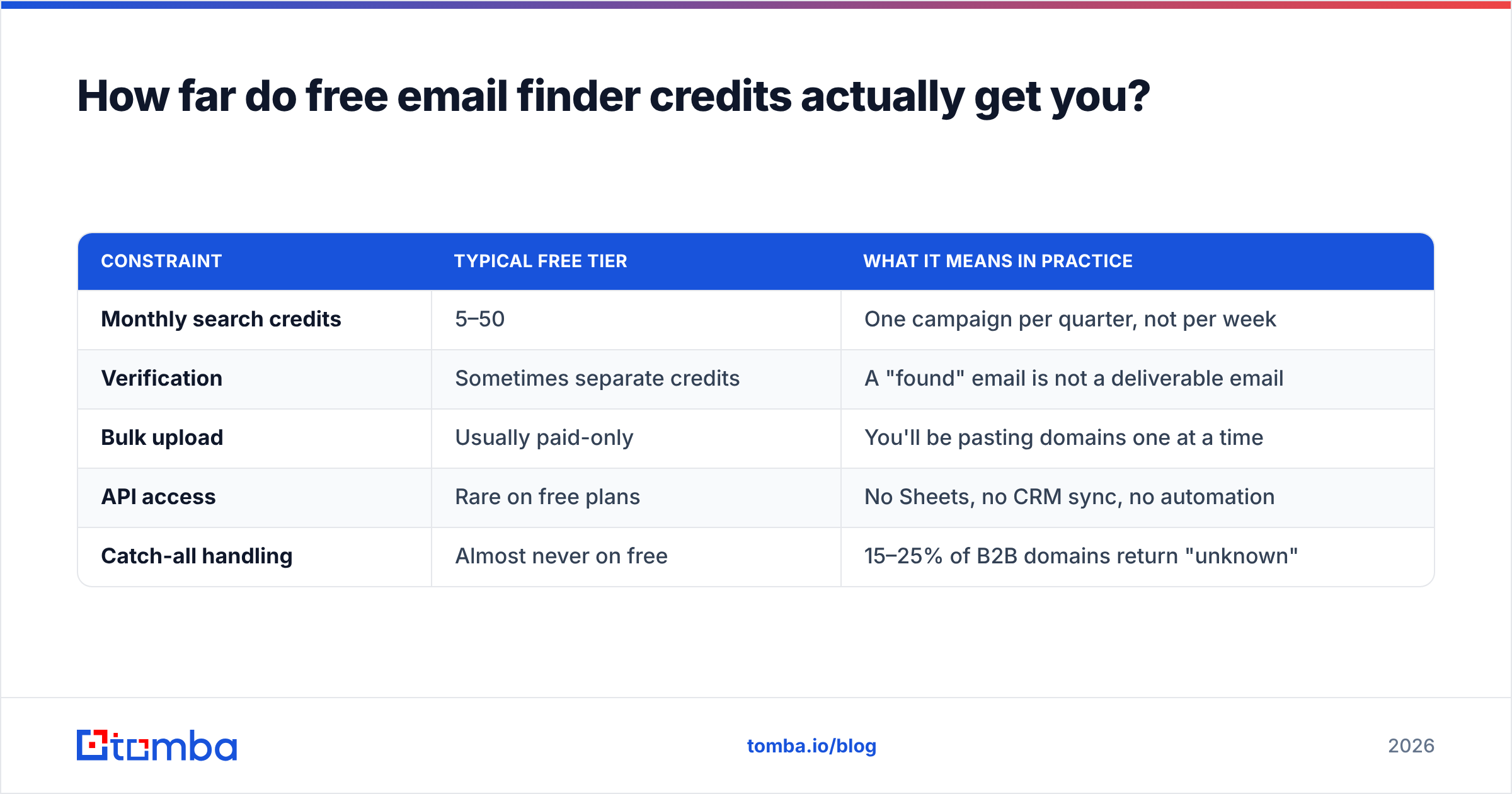
| Constraint | Typical free tier | What it means in practice |
|---|---|---|
| Monthly search credits | 5–50 | One campaign per quarter, not per week |
| Verification | Sometimes separate credits | A "found" email is not a deliverable email |
| Bulk upload | Usually paid-only | You'll be pasting domains one at a time |
| API access | Rare on free plans | No Sheets, no CRM sync, no automation |
| Catch-all handling | Almost never on free | 15–25% of B2B domains return "unknown" |
Tomba's free plan is unusual in including email verification and API access rather than gating them behind a paid tier — which matters because an unverified address costs you more than it saves. Bounces above roughly 3% start damaging sender reputation, and reputation damage is expensive to undo. Twenty-five verified addresses beat 200 guessed ones every time.
The other free-tier trap is catch-all domains. A lot of mid-market companies accept mail to any address at their domain, so a naive finder reports "valid" with no real confidence. A dedicated catch-all verifier is the difference between a 2% bounce rate and a 12% one, and it's rarely part of any free bundle.
What does a working $0 B2B lead gen stack look like?#
You can build something functional. It won't scale, but it will produce meetings. Here's the sequence that wastes the least effort:
- Define the account list manually. LinkedIn basic search, a Crunchbase filter, or an industry directory. Aim for 50–80 companies, not 500. Your free credits can't cover more, so a larger list just creates guilt.
- Find the pattern, not every person. Use a company email pattern check on one known contact per domain. Once you know the company uses
first.last@, you can generate the rest without burning a lookup on each one. - Verify everything you generate. Pattern-generated addresses are hypotheses. Run them through a free email checker before they touch your sending inbox. This is the step people skip and the reason their domain gets flagged.
- Store in HubSpot Free, not a spreadsheet. The free CRM gives you open tracking and meeting links, which a spreadsheet can't. Sheets is for staging and dedupe; the CRM is the system of record.
- Send from a warmed personal inbox. Free warmup tools are all trials. A regular Google Workspace inbox that has been sending human email for six months is already warm — use it, keep volume under 30/day, and skip the warmup tooling entirely at this stage.
- Measure reply rate, not open rate. Open tracking is unreliable post-MPP. If you're getting under a 3% response rate across 100 sends, the problem is targeting or copy, not volume.
That stack costs nothing and produces roughly 25–60 verified contacts per month. It's a proof-of-concept engine, not a growth engine.

Where do free lead generation tools break down?#
Four failure modes, in the order you'll hit them.
The credit reset trap. Free allowances reset monthly, which sounds fine until you realize campaign work is bursty. You need 400 contacts in week one of a quarter, not 25 evenly spread across twelve months. Credit models that don't expire — like pay-as-you-go providers — fit real campaign rhythm better than monthly resets, even though monthly resets look more generous on a pricing page.
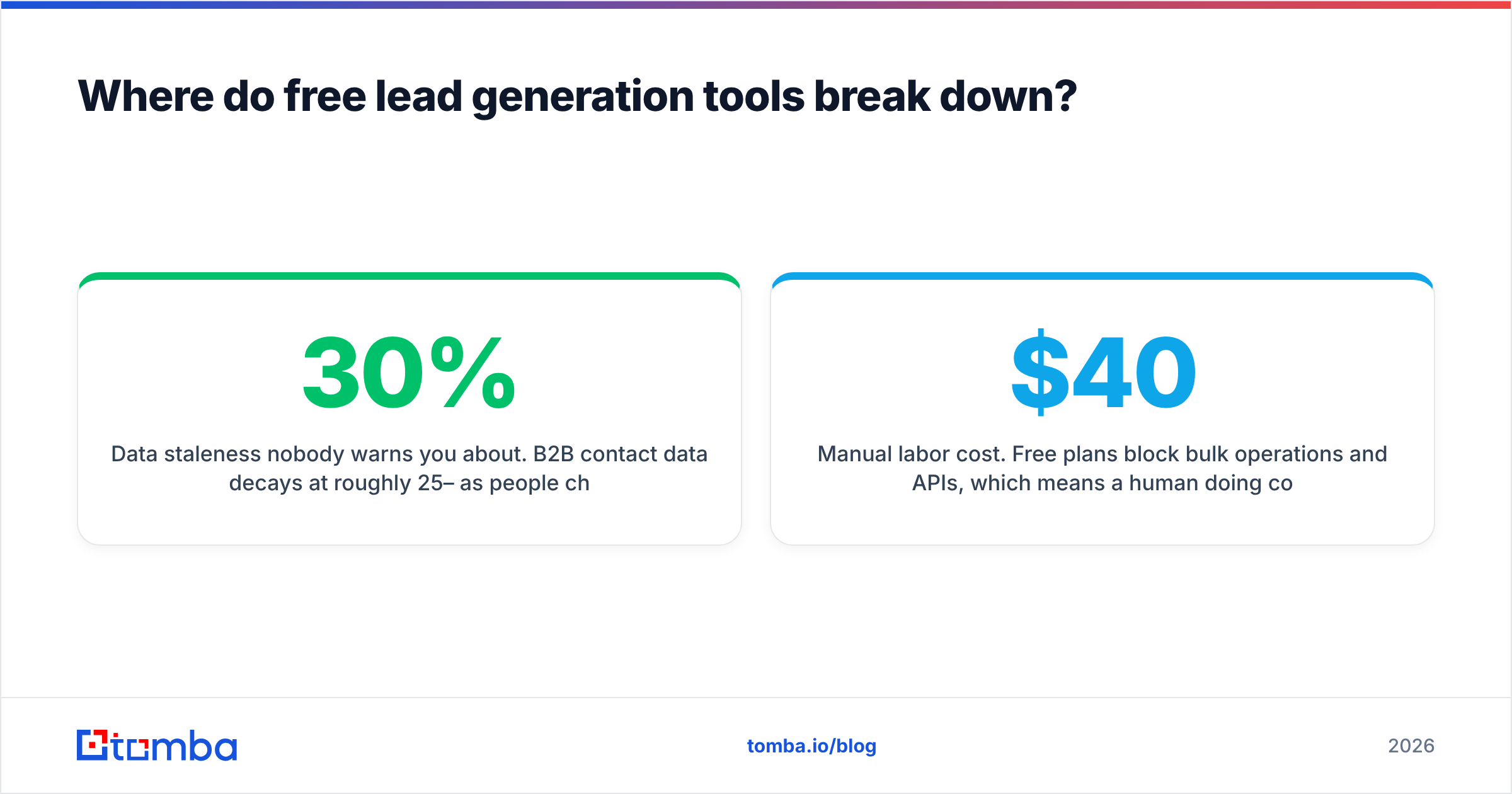
Data staleness nobody warns you about. B2B contact data decays at roughly 25–30% per year as people change jobs, and free tiers are typically served from the same index as paid ones with no freshness guarantee. A contact you pulled in January may be dead by June. This is why data sources and refresh cadence matter more than raw database size.
Manual labor cost. Free plans block bulk operations and APIs, which means a human doing copy-paste. At 90 seconds per contact, 400 contacts is ten hours of work. If your time is worth $40/hour, you just spent $400 to avoid a $49 subscription. Run that math before you commit to a free stack — HubSpot's own research on sales productivity has hammered on this point for years, and it holds.
No automation surface. Without API access, nothing talks to anything. Every handoff between finder, verifier, CRM, and sender is a human moving a CSV. That's fine at 50 contacts and unbearable at 500. The moment you want a Google Sheets formula or a HubSpot integration doing the lookup for you, you've outgrown free.
When should you stop using free tools and pay?#
There are three clear trigger points, and none of them are about revenue.
Trigger one: you're spending more than four hours a month on manual data entry. That's the break-even against a $49/month seat at almost any hourly rate. Bulk lookup and API access are what you're actually buying.
Trigger two: your bounce rate crossed 3%. Free verification is usually shallow — syntax and MX record checks, not SMTP-level validation with catch-all logic. Once deliverability is at risk, verification stops being a nice-to-have. Run your domain through an SPF checker at the same time; misconfigured authentication doubles the damage of a bad list.
Trigger three: two or more people need the same data. Free tiers are single-seat by design. The moment an SDR and a founder are both looking things up, you're maintaining two disconnected credit pools and a shared spreadsheet, which is worse than either alternative.
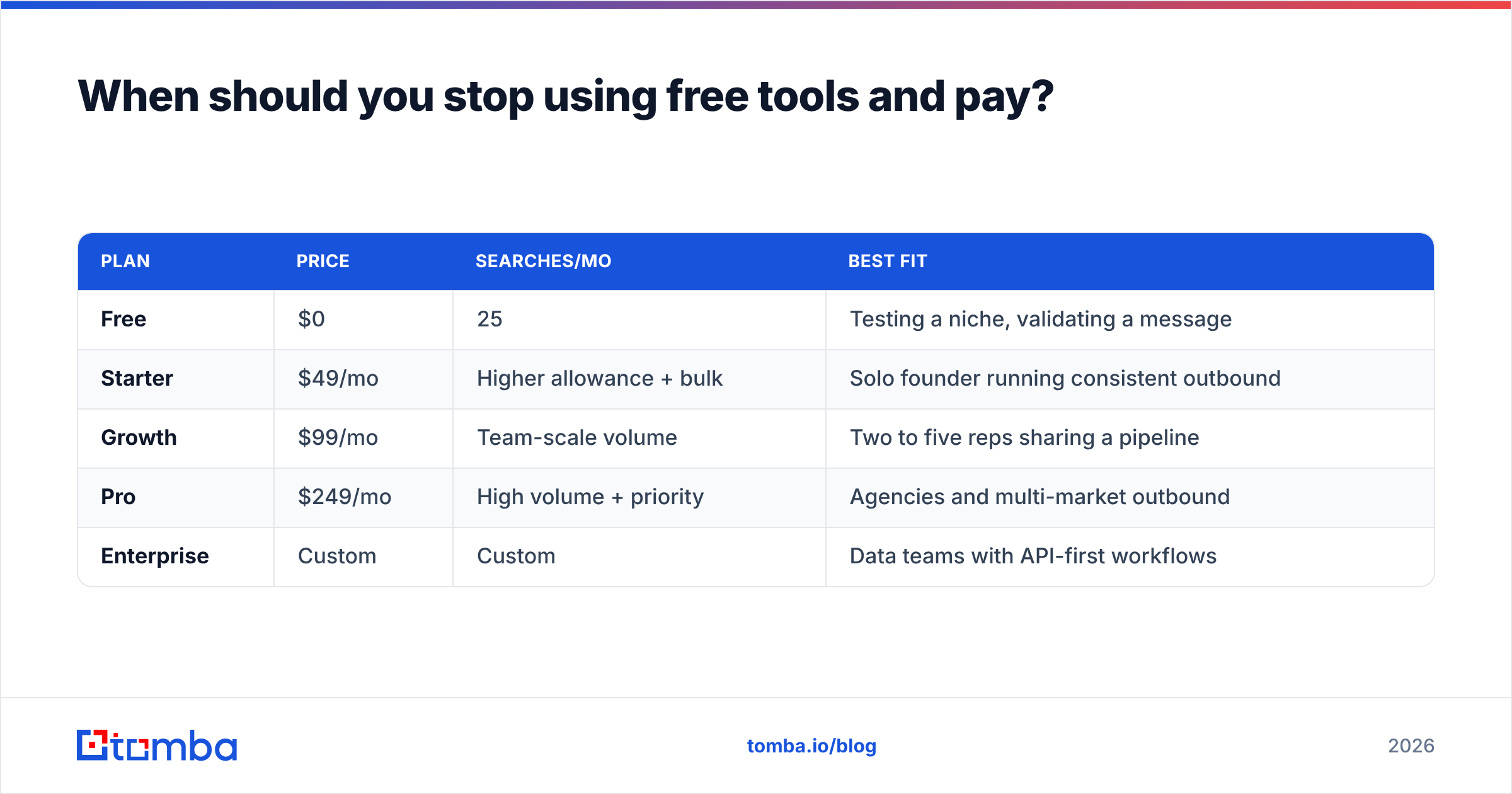
Here's how the tiers compare once you cross those lines:
| Plan | Price | Searches/mo | Best fit |
|---|---|---|---|
| Free | $0 | 25 | Testing a niche, validating a message |
| Starter | $49/mo | Higher allowance + bulk | Solo founder running consistent outbound |
| Growth | $99/mo | Team-scale volume | Two to five reps sharing a pipeline |
| Pro | $249/mo | High volume + priority | Agencies and multi-market outbound |
| Enterprise | Custom | Custom | Data teams with API-first workflows |
The jump from free to Starter is the one that changes behavior. Bulk operations and API access mean the tool works while you don't, which is the entire point of tooling.
What's the fastest way to test whether free is enough for you?#
Run one 30-day experiment before you spend anything.
Pick 40 target accounts. Find and verify contacts at all 40 using free credits across two providers. Send a five-email sequence from a single warmed inbox. Record three numbers: hours spent, bounce rate, and replies.
If you spent under three hours, bounced under 2%, and got replies — free is genuinely enough for your current volume. Stay there. If you spent nine hours, bounced at 7%, and got silence, the problem was never budget. It was data quality and manual overhead, and both are exactly what a paid tier fixes.
Most people running this test land in the middle: the outreach works, but the sourcing is unsustainable. That's the signal to upgrade the data layer and leave everything else free. You don't need a paid CRM, a paid sequencer, and a paid enrichment tool. You need one reliable source of verified contacts and the discipline to keep using the free tools around it.
Start with the free tier and see how far it gets you. Tomba's Email Finder gives you 25 searches per month at no cost, with verification and API access included rather than gated — enough to validate a niche and pressure-test your messaging before you commit a dollar. When manual lookups start eating your week, the $49/month Starter plan adds bulk processing and domain search so the sourcing runs without you. Test it against your worst-performing list and compare the bounce rates.
Related guides#
// get started
Find, verify and enrich your first contacts today
Start on the free plan with 25 searches a month, then scale when your team is ready.
Free plan · No credit card required · GDPR & CCPA
Get the Tomba newsletter
Product and data updates
// about the author