FullCircl vs Jet Leads Pro: Which B2B Data Tool Wins in 2026?
FullCircl sells regulated-market intelligence with quote-only pricing. Jet Leads Pro sells volume lead lists with almost no public documentation. Here is how the two actually compare — and when neither is what your pipeline needs.
TL;DR
- FullCircl is a UK-headquartered customer lifecycle intelligence platform built around company-level data, regulatory checks, and onboarding workflows. It sells to banks, insurers, and regulated B2B firms on quote-only contracts.
- Jet Leads Pro positions itself in the volume lead-list space. Public documentation, pricing, and independent review coverage are thin — treat every claim as unverified until you run your own sample test.
- These two tools barely overlap. FullCircl is a compliance-and-account-intelligence layer; Jet Leads Pro is a contact-list source. Comparing them is really a question about which problem you have.
- Neither is a purpose-built email finder. If your bottleneck is "I have a company and a name, I need a verified work email," you are paying for the wrong layer.
- Ask every vendor in this category for a 100-row blind sample before you sign. Bounce rate on that sample tells you more than any G2 badge.
What are FullCircl and Jet Leads Pro?#
FullCircl is the merged entity of Artesian Solutions and DueDil, two UK data companies that combined in 2021. The product sits between marketing, sales, and compliance: it ingests company registry data, financials, news signals, and risk flags, then surfaces them inside CRM workflows. Their own positioning — visible on fullcircl.com — leans heavily on "customer lifecycle intelligence" and know-your-business (KYB) onboarding, not on cold outbound. Banks, insurers, and B2B lenders are the core buyer.
Jet Leads Pro occupies a very different corner. It markets itself as a lead-generation and contact-list product aimed at outbound teams who want records in bulk. Here is the honest caveat: unlike FullCircl, Jet Leads Pro has minimal independent footprint. There is no substantial G2 or Capterra review corpus to cross-check, no published data-source methodology, and no public pricing page at the time of writing. That is not automatically disqualifying — plenty of useful tools are small — but it does shift the burden of proof onto you, the buyer.
So the honest framing of FullCircl vs Jet Leads Pro is not "which is better." It is: one of these is an enterprise data infrastructure purchase with a procurement cycle, and the other is a list purchase with a credit card. Deciding between them means deciding which of those two things you actually need.

How do FullCircl and Jet Leads Pro compare head-to-head?#
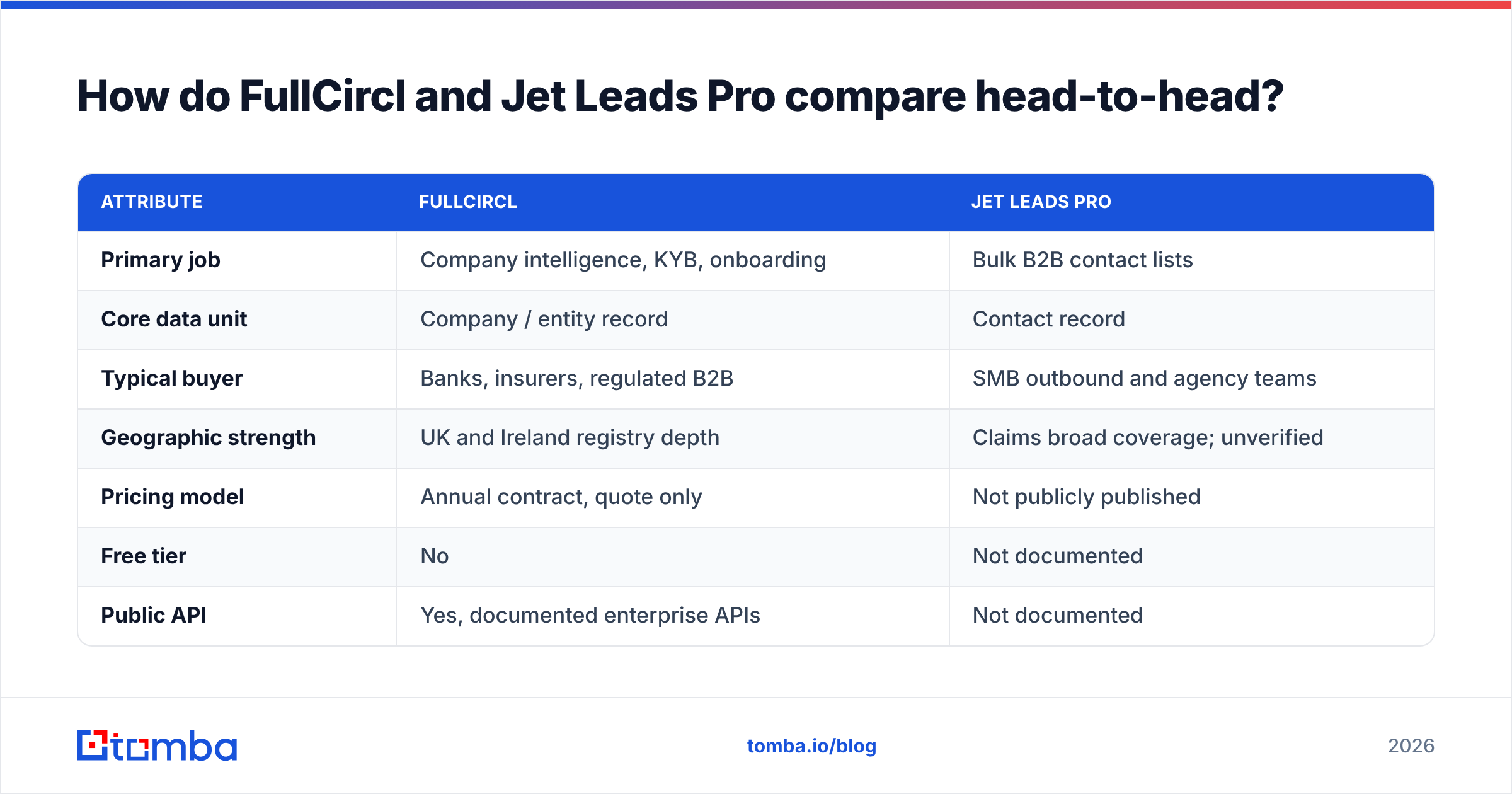
| Attribute | FullCircl | Jet Leads Pro |
|---|---|---|
| Primary job | Company intelligence, KYB, onboarding | Bulk B2B contact lists |
| Core data unit | Company / entity record | Contact record |
| Typical buyer | Banks, insurers, regulated B2B | SMB outbound and agency teams |
| Geographic strength | UK and Ireland registry depth | Claims broad coverage; unverified |
| Pricing model | Annual contract, quote only | Not publicly published |
| Free tier | No | Not documented |
| Public API | Yes, documented enterprise APIs | Not documented |
| Independent review volume | Moderate, enterprise-skewed | Very limited |
| Email verification included | Not the core function | Claimed; verify before you buy |
| Contract friction | High — procurement, security review | Low |
Read that table twice before you shortlist. The row that matters most is "core data unit." FullCircl answers "tell me everything about this company and whether we can safely do business with it." A list tool answers "give me 5,000 people who match this filter." Those are different budgets, different owners, and usually different quarters.
Which one has better data coverage and accuracy?#
FullCircl's strength is verifiable because it is structurally sourced. Company registry filings, financial statements, and director records come from official registries — that data is auditable, and if it is wrong, you can trace the error back to the filing. For UK and Irish entities in particular, this is genuinely deep. It is also why regulated buyers tolerate the price: an auditor will accept "we pulled this from Companies House via FullCircl" in a way they will never accept "we bought a list."
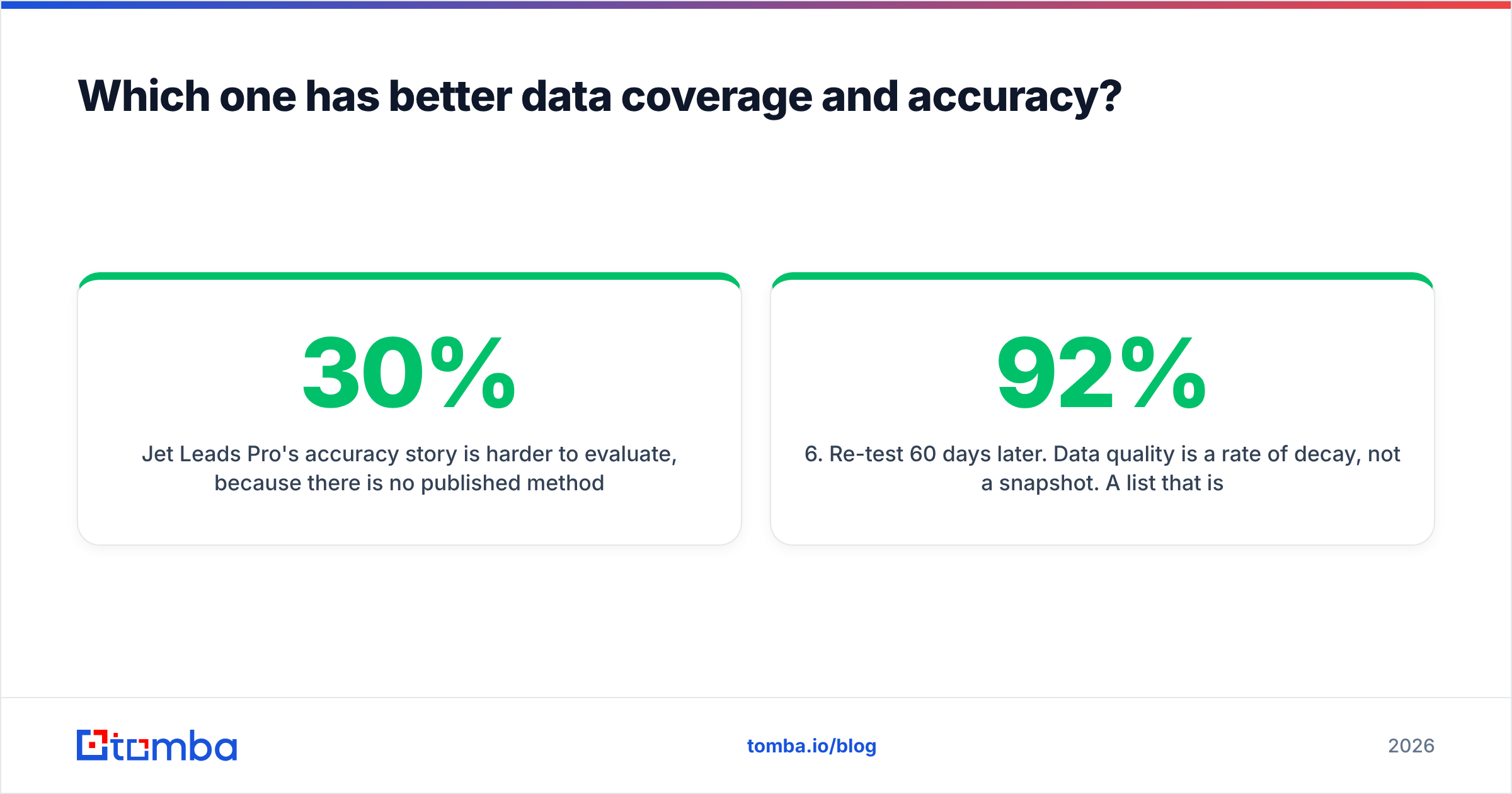
Jet Leads Pro's accuracy story is harder to evaluate, because there is no published methodology. Volume-first list vendors generally assemble records from three places: scraped public profiles, purchased third-party aggregations, and permutation-plus-verification (guessing first.last@domain.com and SMTP-testing it). Each has a different decay curve. Scraped profile data goes stale roughly 25–30% per year as people change jobs. Permutation data is only as good as the verification step behind it.
Here is the practical test that cuts through all of it:
- Pull a blind sample. Give the vendor 100 target companies you already have verified contacts for. Do not tell them which ones you know.
- Measure match rate, not database size. "300 million contacts" means nothing. What percentage of your 100 came back with a usable contact?
- Measure bounce rate separately. Run the returned emails through an independent email verifier before you send anything. A vendor grading its own homework is not evidence.
- Check catch-all handling. Ask what the tool returns for catch-all domains. "Valid" on a catch-all domain is a guess dressed up as a result, and it is where most surprise bounce spikes come from.
- Check recency stamps. Ask when each record was last verified. If the vendor cannot tell you, assume the worst case.
- Re-test 60 days later. Data quality is a rate of decay, not a snapshot. A list that is 92% valid on day one and 74% valid on day sixty is a worse buy than one that starts at 88% and holds.
Run those six steps against both vendors and you will not need anyone's opinion — including this one.
How do the pricing models actually differ?#
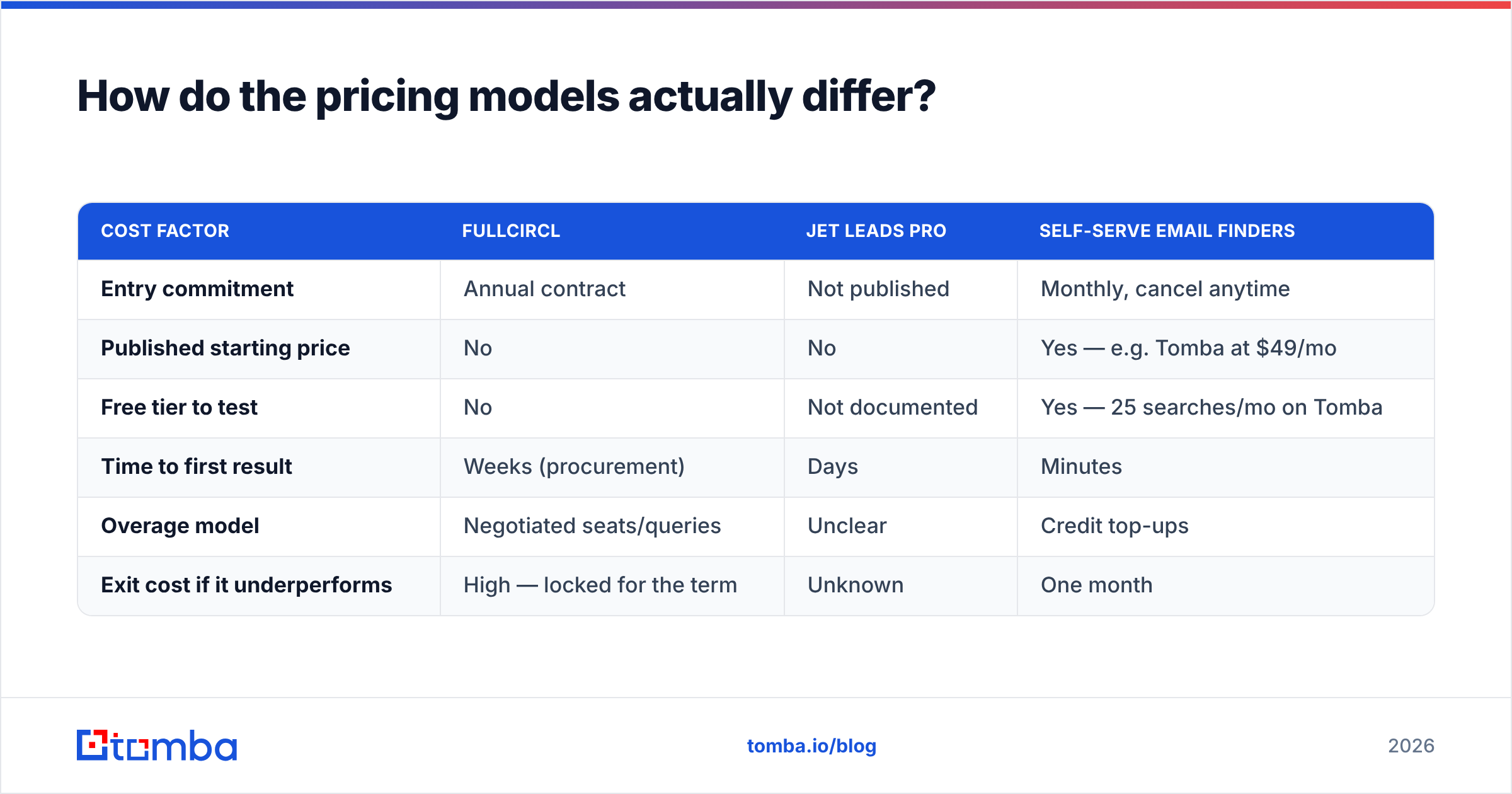
Neither vendor publishes a self-serve price list, which is itself informative. Quote-only pricing is standard in enterprise data and a red flag in the SMB list market.
| Cost factor | FullCircl | Jet Leads Pro | Self-serve email finders |
|---|---|---|---|
| Entry commitment | Annual contract | Not published | Monthly, cancel anytime |
| Published starting price | No | No | Yes — e.g. Tomba at $49/mo |
| Free tier to test | No | Not documented | Yes — 25 searches/mo on Tomba |
| Time to first result | Weeks (procurement) | Days | Minutes |
| Overage model | Negotiated seats/queries | Unclear | Credit top-ups |
| Exit cost if it underperforms | High — locked for the term | Unknown | One month |
The asymmetry here is the real story. With FullCircl you are buying a system of record, and the annual contract is the honest price of that. With an undocumented list vendor, the same opacity buys you nothing — you take on contract risk and data risk simultaneously.
For comparison, Tomba pricing runs Free (25 searches/mo), Starter at $49/mo, Growth at $99/mo, and Pro at $249/mo, with enterprise quotes above that. That is not a claim that Tomba does what FullCircl does — it emphatically does not do KYB or regulatory screening. It is a claim that the contact discovery slice of the problem has a transparent market price, and you should not pay enterprise-contract rates for it by accident.
What does FullCircl do well that a lead list cannot?#
Three things, and they are all compliance-adjacent:
- KYB and onboarding checks. Verifying that a business entity is real, active, and not flagged is a legal requirement in regulated sectors. No contact-list vendor touches this.
- Financial and risk signals. Filing delinquency, credit deterioration, and ownership changes are churn and credit-risk predictors, not prospecting filters.
- Trigger-based account monitoring. Watching a book of existing accounts for change events is a retention play. Most outbound tools are acquisition-only.
If your compliance team is in the buying committee, FullCircl is a legitimate shortlist entry and a list tool is not a substitute at any price. If compliance is not in the room, you are almost certainly overbuying.
Where does Jet Leads Pro realistically fit?#
The honest answer is: possibly nowhere in your stack, and possibly as a cheap top-of-funnel volume source — but you cannot tell from the outside, which is the problem.
If you are evaluating it, hold it to the same bar you would hold any unbranded data vendor:
- Source disclosure. Where does the data come from? "Proprietary" is not an answer. Legitimate vendors publish something like Tomba's data sources page.
- Compliance posture. GDPR lawful basis, CCPA opt-out handling, and a documented suppression process. Buying EU contact data without this transfers the liability to you.
- Verification transparency. Does the tool verify at query time or serve cached results from months ago?
- Refund policy on bad records. Serious vendors credit back invalid rows. If there is no policy, the invalid rows are your problem by design.
- A real support channel. Not a contact form that routes to nowhere.
If a vendor cannot clear those five, the price is irrelevant. A cheap list that torches your sending domain costs more than an expensive one that does not.

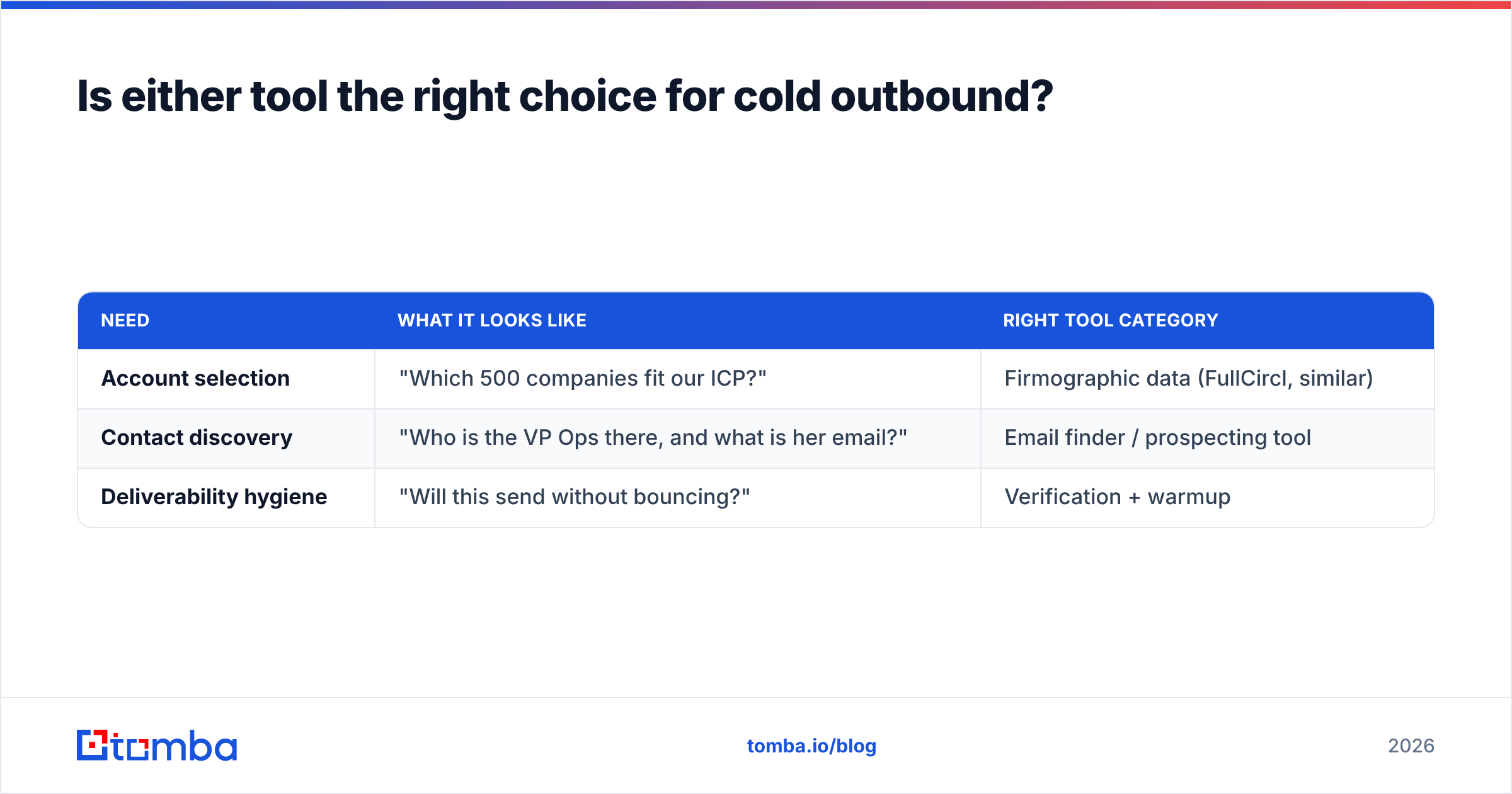
Is either tool the right choice for cold outbound?#
Probably not — and this is the most useful thing in this comparison.
Cold outbound has three distinct data needs, and buyers routinely conflate them:
| Need | What it looks like | Right tool category |
|---|---|---|
| Account selection | "Which 500 companies fit our ICP?" | Firmographic data (FullCircl, similar) |
| Contact discovery | "Who is the VP Ops there, and what is her email?" | Email finder / prospecting tool |
| Deliverability hygiene | "Will this send without bouncing?" | Verification + warmup |
FullCircl is strong on row one and irrelevant to row two. A bulk list vendor claims row two and typically ignores row three. Teams that buy one tool for all three end up with a compliance platform they use as a prospect list, or a prospect list they trust as a compliance platform. Both failure modes are expensive.
The stack that actually works is layered: pick accounts with firmographic data, resolve contacts with a dedicated email finder or a domain search against your target company list, then verify before every send. Each layer is cheap on its own and none of them pretends to be the others.
What should you actually do next?#
- You are in a regulated sector and compliance signs the PO → evaluate FullCircl properly, book the demo, budget for an annual contract.
- You need 2,000 verified emails for a Q4 campaign next week → neither of these. Use a self-serve finder with a published match rate and a free tier you can test today.
- You are already paying for a big data platform and still hand-guessing emails → your gap is contact resolution, not more firmographics. Add an email verification API to what you have rather than replatforming.
- You are tempted by an undocumented cheap list → run the six-step blind sample test above first. It costs an afternoon and has saved a lot of sending domains.
The bottom line#
FullCircl vs Jet Leads Pro is a comparison between a mature, compliance-grade company-intelligence platform and a lead-list product with very little public accountability. FullCircl is the safer buy if you are in its lane — regulated B2B, UK-heavy, compliance in the loop — and an expensive detour if you are not. Jet Leads Pro cannot be responsibly recommended or dismissed from public information alone, which in a market with dozens of transparent alternatives is reason enough to make it prove itself before it gets your budget.
If what you actually need is the boring middle layer — a verified work email for a named person at a known company, with a published price and a bounce rate you can audit — start with the Tomba Email Finder. The free tier gives you 25 searches a month, which is enough to run the blind-sample test on your own target list before you commit a cent. Paid plans start at $49/mo, and every result comes with a confidence score and sources you can inspect rather than a number you have to take on faith.
Related guides#
Ready to find emails that actually work?
Join 150,000+ professionals who stopped guessing and started sending. Free credits on signup — no credit card required.
Get the Tomba newsletter
Practical outbound tactics and product updates — once every two weeks.
About the author