FullCircl vs Pubrio: B2B Data Platforms Compared (2026)
FullCircl sells regulated-industry customer intelligence. Pubrio sells AI-assisted prospecting data. They barely overlap — and picking the wrong one costs you a year of budget. Here's the honest split.
TL;DR
- FullCircl and Pubrio get compared because both sell "B2B data," but they solve opposite problems. FullCircl is customer intelligence and onboarding/KYC tooling aimed at regulated industries; Pubrio is an AI-assisted prospecting database aimed at outbound teams.
- FullCircl is quote-only, contract-led, and typically annual. Pubrio is self-serve with published tiers and a free entry point. That single difference eliminates one of them for most buyers before features matter.
- If your problem is "who should we approach, and are they creditworthy/compliant?", FullCircl wins. If your problem is "get me 5,000 verified contacts for a campaign this week," Pubrio is closer.
- Neither is a great pure email-finding layer. Both bundle contact data into a broader platform, which means you pay platform pricing for a job a dedicated tool does cheaper and more accurately.
- The most common winning stack in 2026: one intelligence or database layer for targeting, plus a specialist finder/verifier like Tomba for the last-mile email work.
What are FullCircl and Pubrio?#
FullCircl is a UK-headquartered customer intelligence platform, formed from the merger of DueDil and Artesian Solutions and later joined with nCino's onboarding business. Its centre of gravity is regulated industries — banking, insurance, commercial finance, professional services. It combines company firmographics (Companies House-grade registry data, financials, group structures, directors) with monitoring, risk signals, and onboarding/KYB workflows. You can see the current product framing on the FullCircl site.
Pubrio is a newer, AI-first lead generation platform. It bundles a B2B contact and company database, AI-assisted search ("describe your ICP in plain language"), email finding and verification, buyer-intent style signals, and workflow features for building lists. It's built for the self-serve motion: sign up, search, export, send. Its product pages live at pub.rio.
So the honest framing of FullCircl vs Pubrio is not "which tool has better data." It's "which category of problem are you funding this year?"
How do FullCircl and Pubrio compare head-to-head?#
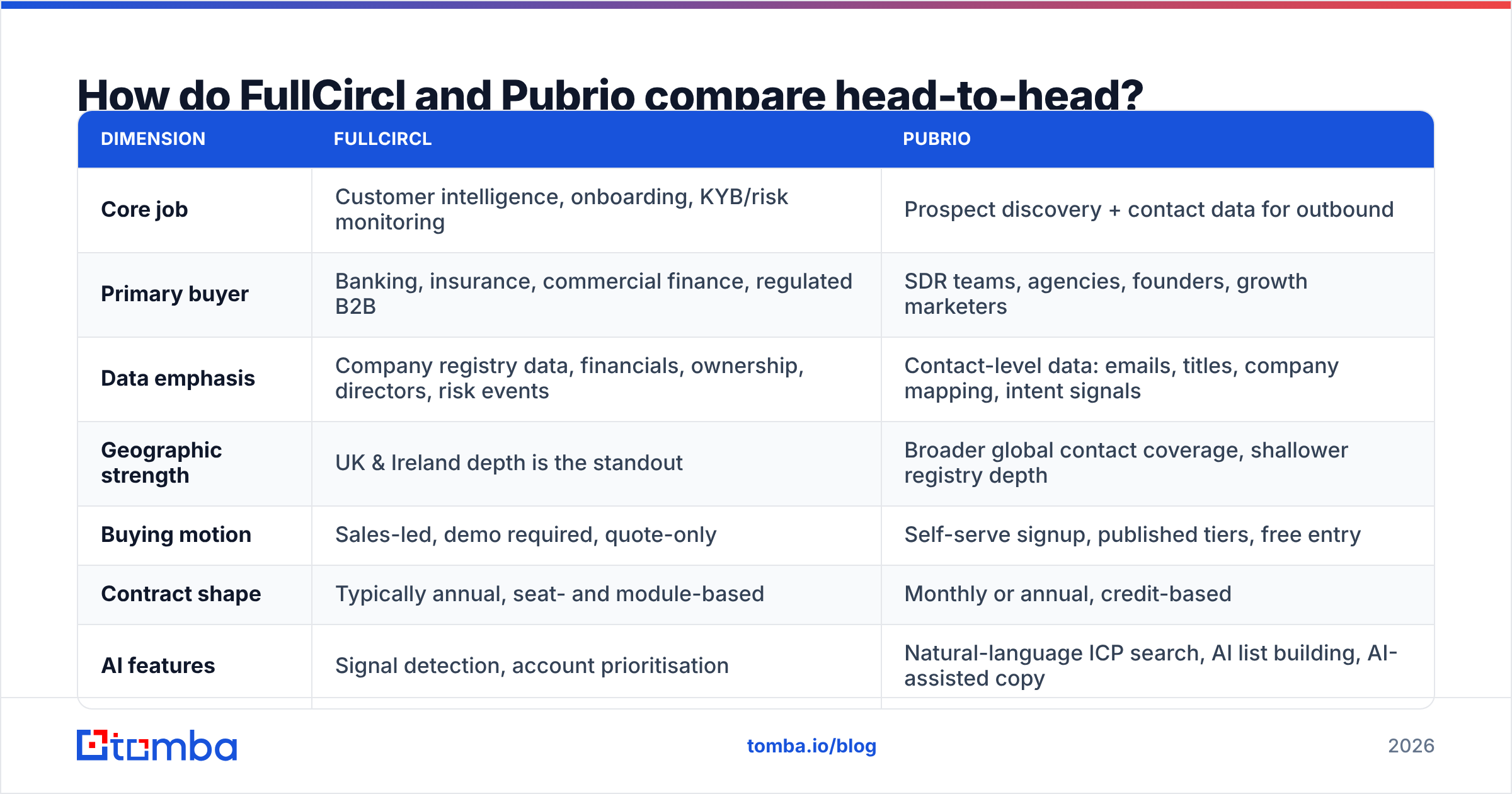
| Dimension | FullCircl | Pubrio |
|---|---|---|
| Core job | Customer intelligence, onboarding, KYB/risk monitoring | Prospect discovery + contact data for outbound |
| Primary buyer | Banking, insurance, commercial finance, regulated B2B | SDR teams, agencies, founders, growth marketers |
| Data emphasis | Company registry data, financials, ownership, directors, risk events | Contact-level data: emails, titles, company mapping, intent signals |
| Geographic strength | UK & Ireland depth is the standout | Broader global contact coverage, shallower registry depth |
| Buying motion | Sales-led, demo required, quote-only | Self-serve signup, published tiers, free entry |
| Contract shape | Typically annual, seat- and module-based | Monthly or annual, credit-based |
| AI features | Signal detection, account prioritisation | Natural-language ICP search, AI list building, AI-assisted copy |
| Email verification | Not the core product | Built in, part of the credit model |
| CRM fit | Deep Salesforce/Dynamics integrations, workflow-grade | Standard exports + common CRM connectors |
| Best for | "Should we do business with this company?" | "Who do I email on Monday?" |
| Worst for | Fast, cheap, high-volume list building | Compliance, credit risk, group-structure analysis |
That table is the whole review in miniature. The rest of this post explains where each column is stronger than it looks — and where it's weaker.
What does FullCircl actually do well?#
Three things, and they're genuinely hard to replicate.
- Registry-grade company depth. For UK and Irish entities, FullCircl works from official filings rather than scraped web data. Group structures, ultimate beneficial owners, filed accounts, charges, and director histories are first-class objects, not enrichment guesses. If your commercial decision depends on who legally owns this entity, scraped databases will not get you there.
- Trigger-based account monitoring. The Artesian DNA shows up here: news, filings, hiring signals, and financial changes get turned into "act now" alerts on accounts you already care about. That's a retention and expansion play as much as a new-business one.
- Onboarding and KYB workflow. Screening, verification, and periodic review sit inside the same platform as the intelligence. For a lender or insurer, collapsing "research the prospect" and "compliantly onboard the prospect" into one vendor is a real cost line, not a nice-to-have.
Where it disappoints: contact-level coverage. FullCircl will tell you a company is worth approaching and who the directors are. It is not designed to hand you fifty verified email addresses across a target account's marketing org. Teams routinely bolt a dedicated email finder onto FullCircl for exactly this reason.
Also: the buying process. Expect a demo, a scoping call, and an annual commitment. If you are a five-person team that wants to test something next Tuesday, this is friction you will not enjoy.
What does Pubrio actually do well?#
Pubrio's pitch is speed and accessibility, and it delivers on both.
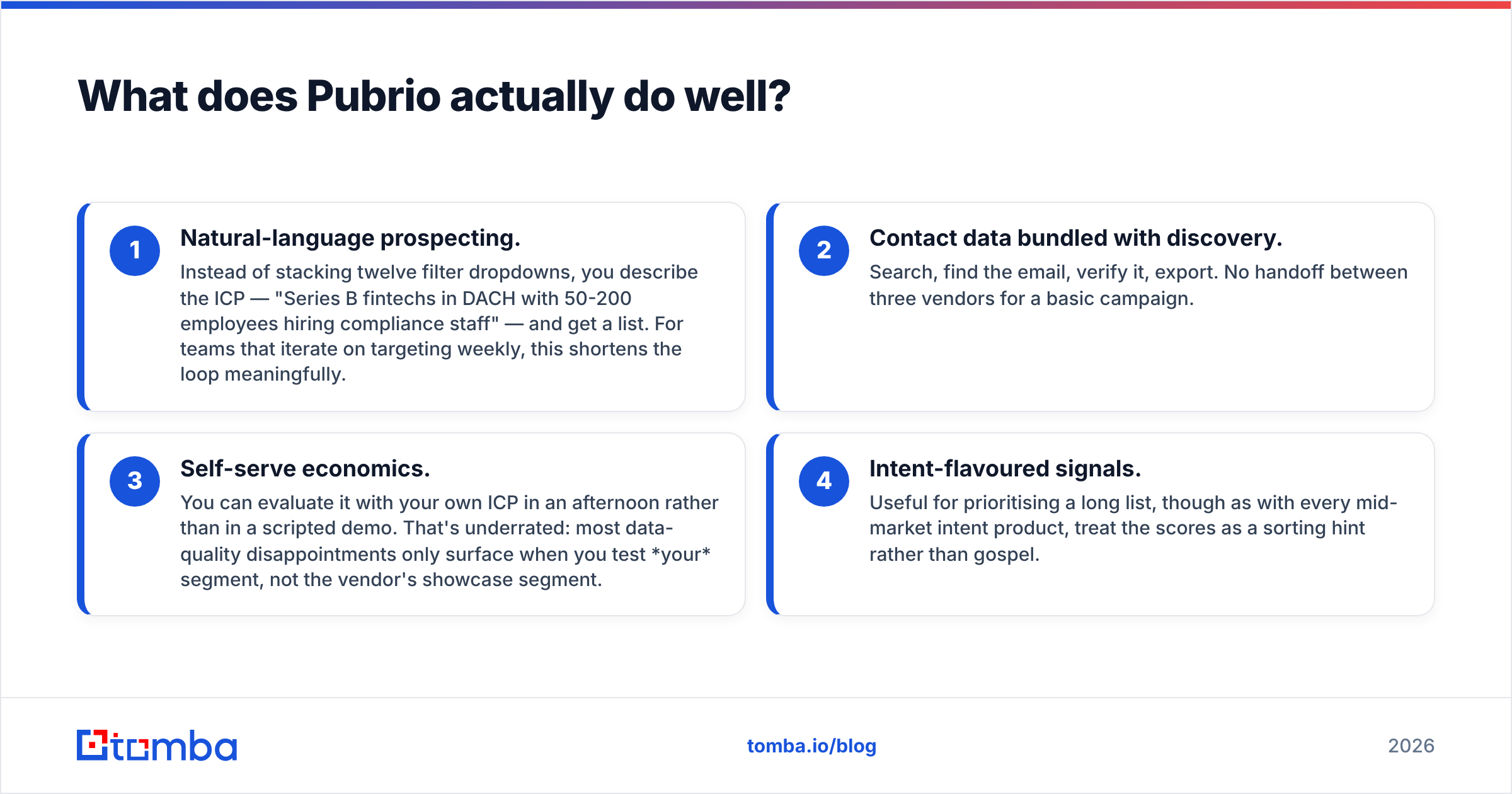
- Natural-language prospecting. Instead of stacking twelve filter dropdowns, you describe the ICP — "Series B fintechs in DACH with 50-200 employees hiring compliance staff" — and get a list. For teams that iterate on targeting weekly, this shortens the loop meaningfully.
- Contact data bundled with discovery. Search, find the email, verify it, export. No handoff between three vendors for a basic campaign.
- Self-serve economics. You can evaluate it with your own ICP in an afternoon rather than in a scripted demo. That's underrated: most data-quality disappointments only surface when you test your segment, not the vendor's showcase segment.
- Intent-flavoured signals. Useful for prioritising a long list, though as with every mid-market intent product, treat the scores as a sorting hint rather than gospel.
Where it disappoints: depth and defensibility. AI-assembled contact records are probabilistic. Coverage varies hard by region and seniority — strong for US/EU tech mid-market, thinner for non-English SMBs, industrial firms, and anyone with a low web footprint. And "verified" inside a bundled platform usually means a lighter check than a dedicated verifier performs. If you're sending at volume, run the export through a separate email verifier before it touches your sending domain.
How do the two data models actually differ?#
This is the part buyers skip and then regret. The underlying data philosophies are not comparable, and that determines what each tool can and can't be good at.
- Source of truth. FullCircl anchors on official registries and filed financials — slow-moving, auditable, legally meaningful. Pubrio anchors on web-scale signals, public profiles, and pattern inference — fast-moving, broad, probabilistic.
- Unit of record. FullCircl's atom is the entity (a legal company, its structure, its risk profile). Pubrio's atom is the person (a contact at a company, reachable by email).
- Freshness model. Registry data updates when a filing happens, which can be months. Contact data decays roughly 2-3% per month as people change jobs — a completely different maintenance problem requiring continuous re-verification.
- Failure mode. FullCircl fails by being incomplete outside its core geographies. Pubrio fails by being confidently wrong on individual records — a plausible-looking email that bounces.
- Compliance posture. Registry data is public record by definition. Person-level data carries GDPR/CCPA obligations that sit with you, not the vendor, so check the vendor's data sources documentation before you buy anything person-level.
Understand those five rows and the "which is better" question dissolves. They're answering different questions with different evidence.
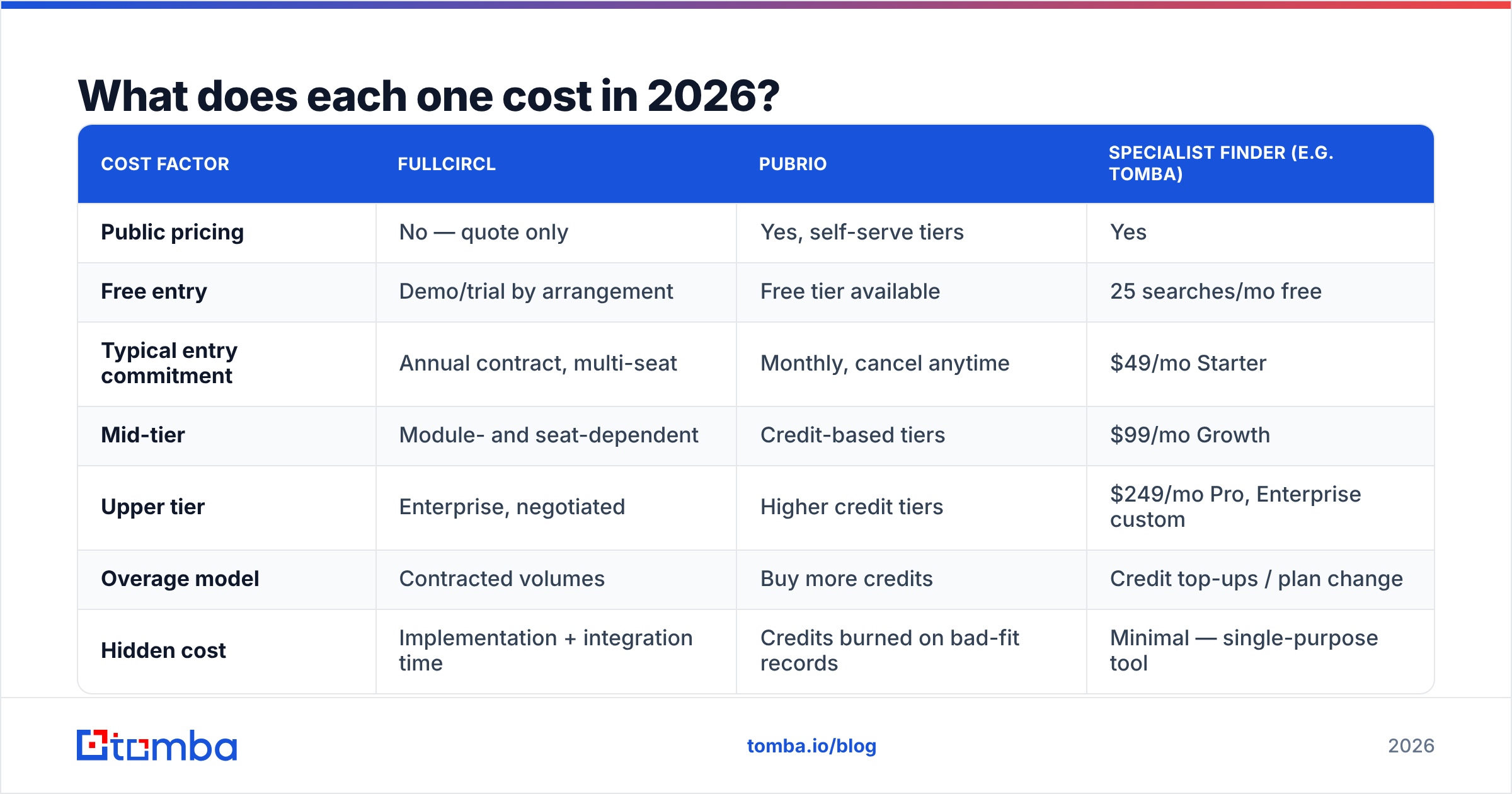
What does each one cost in 2026?#
Here's the honest answer: one publishes prices, one doesn't, and that asymmetry is itself a decision input.
| Cost factor | FullCircl | Pubrio | Specialist finder (e.g. Tomba) |
|---|---|---|---|
| Public pricing | No — quote only | Yes, self-serve tiers | Yes |
| Free entry | Demo/trial by arrangement | Free tier available | 25 searches/mo free |
| Typical entry commitment | Annual contract, multi-seat | Monthly, cancel anytime | $49/mo Starter |
| Mid-tier | Module- and seat-dependent | Credit-based tiers | $99/mo Growth |
| Upper tier | Enterprise, negotiated | Higher credit tiers | $249/mo Pro, Enterprise custom |
| Overage model | Contracted volumes | Buy more credits | Credit top-ups / plan change |
| Hidden cost | Implementation + integration time | Credits burned on bad-fit records | Minimal — single-purpose tool |
Two warnings, both learned the expensive way.
First, on FullCircl: quote-only enterprise data platforms rarely price for small teams, and the implementation effort is a real second line item. Budget for integration work into Salesforce or Dynamics, not just licences. If nobody on your team owns that integration, the platform underdelivers and it will not be the vendor's fault.
Second, on any credit-based tool including Pubrio: credits are consumed by searches, not by usable results. A segment with 40% coverage burns the same credits as one with 90% coverage. Always test your specific ICP against the free tier before committing to an annual plan.

Which one should you pick?#
Pick FullCircl if:
- You operate in UK/Irish financial services, insurance, or lending.
- Your commercial decisions require verified company structure, financials, or risk exposure.
- Onboarding and KYB are cost centres you want to consolidate.
- You have budget for an annual platform and someone to own the CRM integration.
Pick Pubrio if:
- You need contact volume for outbound campaigns, now.
- Your ICP is tech-adjacent and predominantly US/EU.
- You want to test with your own data before committing budget.
- Nobody on your team is going to configure a workflow platform.
Pick neither if:
- Your actual bottleneck is finding and verifying email addresses at a specific set of companies you've already identified. That's a narrow job, and buying a platform to do it is how data budgets get wasted. A domain search against your target account list solves it for a fraction of the cost.
A quick sanity check before you sign anything: pull the current reviews for both on G2 and filter to companies your size in your region. Enterprise platforms review well from enterprise buyers and badly from small teams; the aggregate score hides that completely.
Where does a dedicated email finder fit in?#
Most teams that end up happy run a two-layer stack rather than a single platform.
Layer 1 — targeting. This is where FullCircl or Pubrio earns its keep. FullCircl if the qualifying question is financial or regulatory. Pubrio if it's ICP-fit and volume. This layer answers which accounts and which people.
Layer 2 — contactability. This is where a specialist tool wins on both accuracy and cost. You already know the company and the person; you need a deliverable address, a confidence score, and a clean handoff to your sequencer.
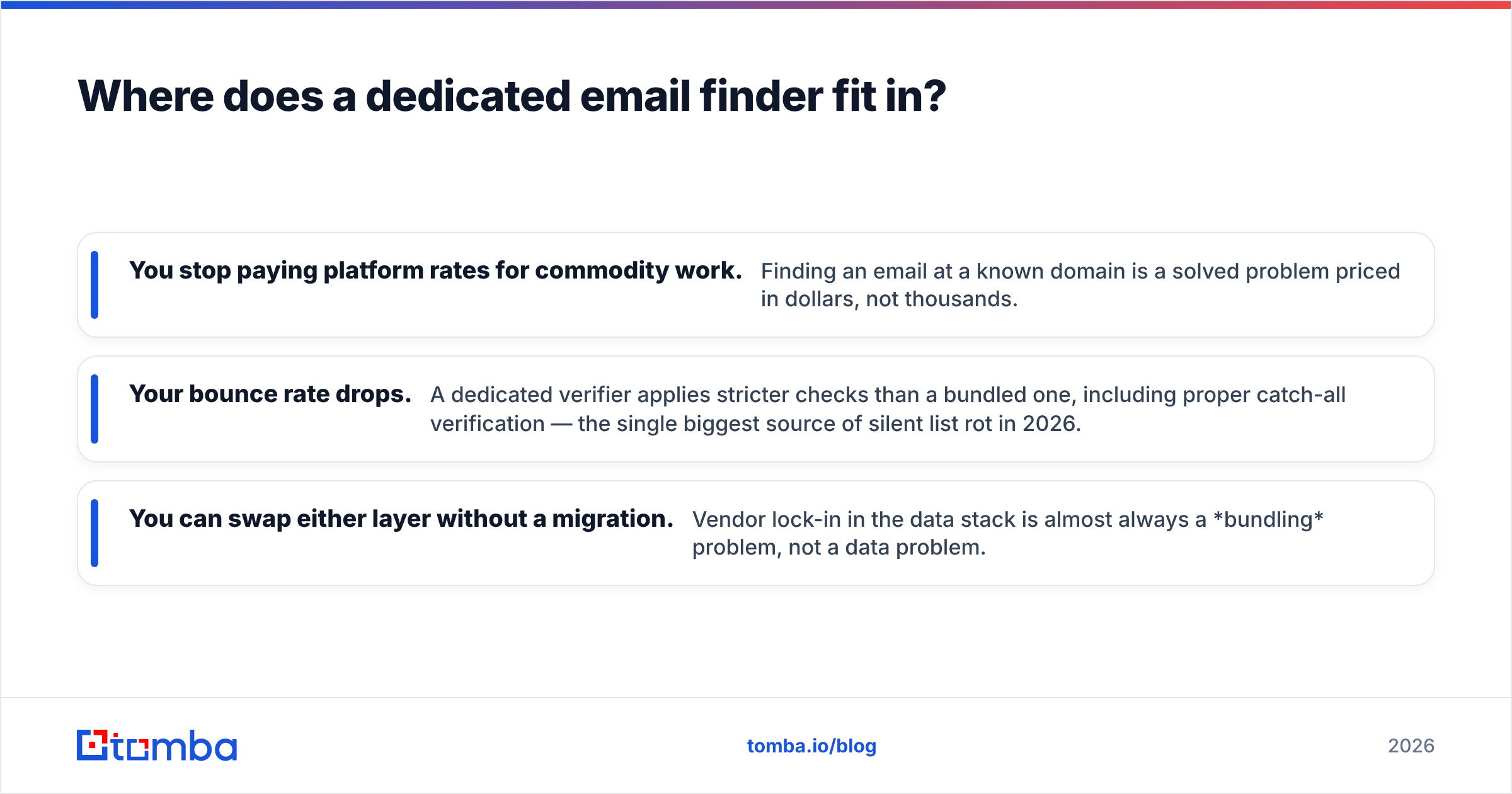
Splitting the layers has three practical benefits:
- You stop paying platform rates for commodity work. Finding an email at a known domain is a solved problem priced in dollars, not thousands.
- Your bounce rate drops. A dedicated verifier applies stricter checks than a bundled one, including proper catch-all verification — the single biggest source of silent list rot in 2026.
- You can swap either layer without a migration. Vendor lock-in in the data stack is almost always a bundling problem, not a data problem.
If your CRM is the system of record, wire the finder in directly rather than exporting CSVs — a HubSpot integration or an API call at record-creation time keeps enrichment continuous instead of quarterly. For a broader view on how deliverability compounds from list hygiene, the email deliverability fundamentals are worth ten minutes.
Frequently asked questions#
Is FullCircl a direct Pubrio competitor? Not really. They overlap on "B2B company data" and almost nowhere else. Comparing them is like comparing a credit bureau to a prospecting list — both contain company records, for entirely different purposes.
Which has better email data? Pubrio, unambiguously — it's a core product there and a side effect at FullCircl. But "better than FullCircl" is a low bar for contact data. Benchmark any bundled finder against a dedicated one on your own domains before you rely on it.
Can I use both? Yes, and in regulated industries with outbound motions that's a reasonable stack: FullCircl for qualification and compliance, a prospecting layer for reach. Just don't pay two platforms for the same contact-finding job.
What about GDPR? Registry data is public record. Person-level contact data is not, and the controller obligations sit with you. Ask both vendors for their lawful-basis documentation in writing — for European contacts specifically, not a generic policy page. Anthropic-style AI disclaimers won't cover you; a documented legitimate-interest assessment will.
The practical next step#
Before you book a demo with either vendor, run a control test. Take 100 accounts you already know well — ideally a mix of closed-won and closed-lost — and see how many contactable, deliverable decision-maker emails each option returns. Coverage on your list is the only benchmark that predicts your results.
That test costs nothing with Tomba's Email Finder: the free tier gives you 25 searches a month, and paid plans start at $49/mo with domain search, catch-all verification, bulk processing, and API access included. Run your 100 accounts through it, then judge whether a full platform is solving a problem you actually have — or one a $49 tool already closed. Full Tomba pricing is public, so you can do that maths before anyone books a call with you.
Related guides#
Ready to find emails that actually work?
Join 150,000+ professionals who stopped guessing and started sending. Free credits on signup — no credit card required.
Get the Tomba newsletter
Practical outbound tactics and product updates — once every two weeks.
About the author