Gamalogic vs OneMoreLead (2026): Which B2B Email Tool Wins
Gamalogic finds and verifies emails on demand. OneMoreLead sells you a prebuilt B2B list. They solve different problems — here is which one actually fits your outbound motion, and where both fall short.
Gamalogic vs OneMoreLead is a fight between two different jobs. One tool finds and checks a single email address. The other sells you a big list you filter down. Here is the short version first.
TL;DR
- They are not the same category. Gamalogic is an on-demand email finder and verifier. You feed it names and domains, and it returns addresses. OneMoreLead is a prebuilt B2B contact database. You filter a static list and export it.
- Pick Gamalogic if you already know who you want to reach. You just need the address plus an SMTP check.
- Pick OneMoreLead if you have no target list at all and want cheap volume. Just know that database records age fast.
- Neither is a full outbound stack. Gamalogic is thin on company data. OneMoreLead skews US SMB, and its records need a re-check before you send.
- There is a third option. One tool can do discovery and live verification. That is why we compare both against Tomba's free-to-$49/mo tier at the end.
Gamalogic vs OneMoreLead: what does each tool actually do?#
Think of it like finding someone's house. Gamalogic is a locksmith. It checks whether your key opens a specific door. OneMoreLead is an old phone book. It lists thousands of addresses, but nobody promises those people still live there.
Here is the plain version:
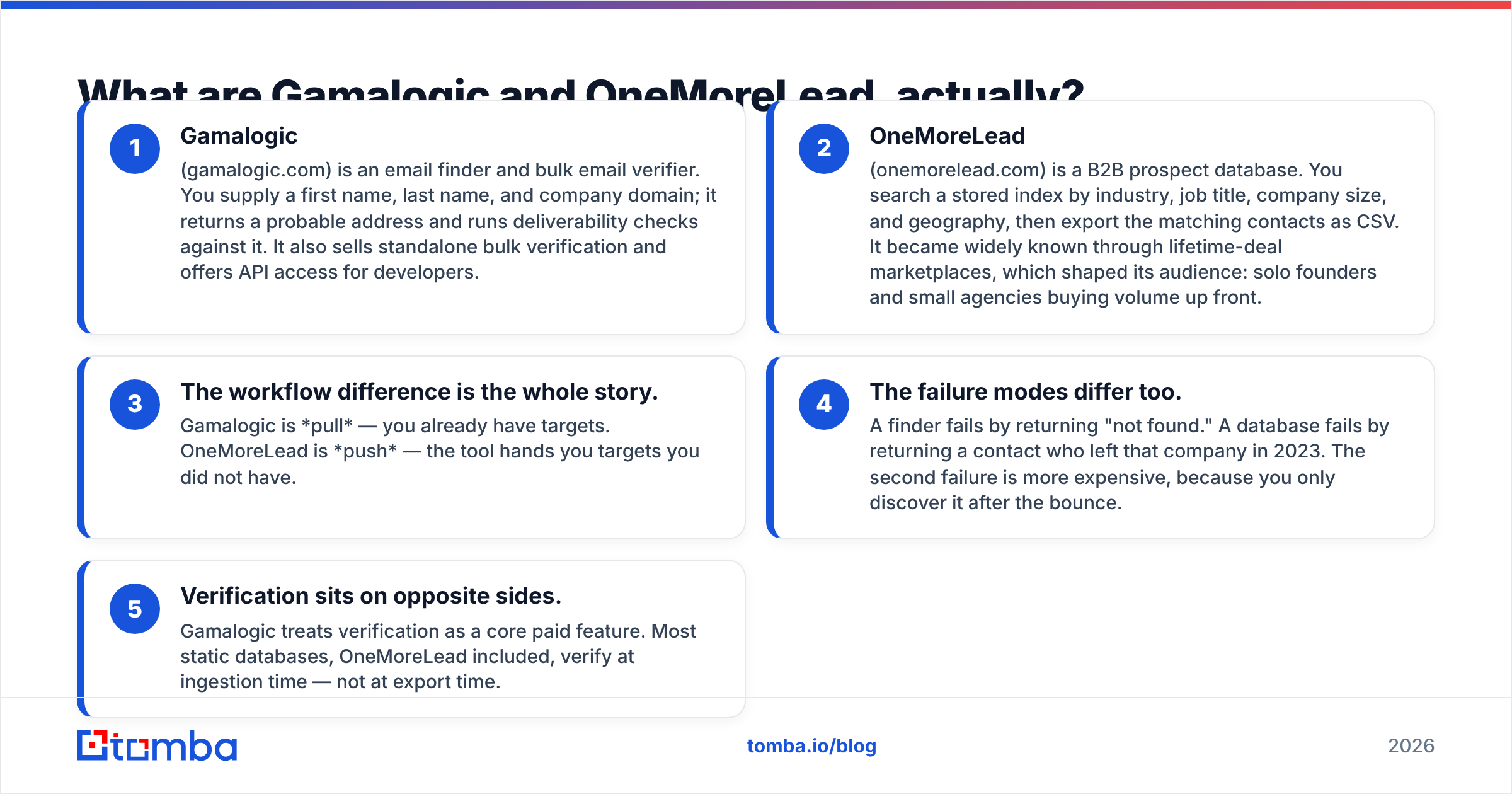
- Gamalogic (gamalogic.com) is an email finder and bulk verifier. You give it a first name, a last name, and a company domain. It returns a likely address and checks whether that address can receive mail. It also sells bulk verification and an API.
- OneMoreLead (onemorelead.com) is a B2B prospect database. You search a stored index by industry, job title, company size, and location. Then you export the matches as a CSV. It grew up on lifetime-deal sites, so its users are mostly solo founders and small agencies.
The workflow gap is the whole story. Gamalogic is pull: you already have targets. OneMoreLead is push: it hands you targets you did not have.
The two tools also fail in different ways. A finder fails by saying "not found." A database fails by handing you someone who left the company in 2023. The second failure costs more, because you only learn about it after the bounce.
Verification sits on opposite sides too. Gamalogic treats it as a core paid feature. Static databases like OneMoreLead check records when they load them, not when you export them.
Remember one thing. A static list is a snapshot, and B2B contact data decays about 2–3% per month as people change jobs. That is why email verification is not optional with either tool.

Gamalogic vs OneMoreLead: how do the features compare?#
Here is the head-to-head on the things that change your reply rate. Treat the prices as directional. Both vendors revise plans, and lifetime-deal tiers do not match today's retail pricing. Check each vendor's page before you buy.
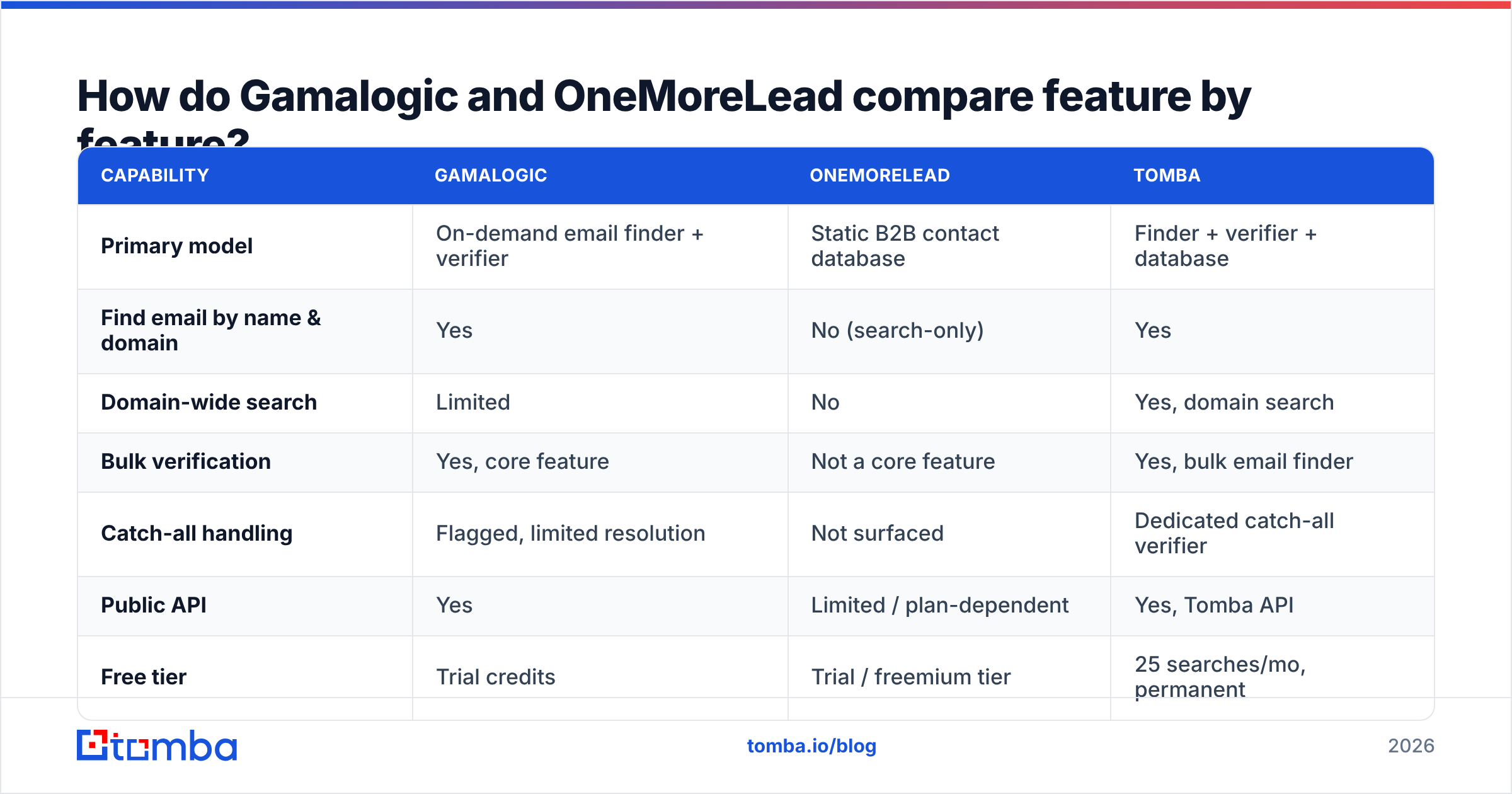
| Capability | Gamalogic | OneMoreLead | Tomba |
|---|---|---|---|
| Primary model | On-demand email finder + verifier | Static B2B contact database | Finder + verifier + database |
| Find email by name & domain | Yes | No (search-only) | Yes |
| Domain-wide search | Limited | No | Yes, domain search |
| Bulk verification | Yes, core feature | Not a core feature | Yes, bulk email finder |
| Catch-all handling | Flagged, limited resolution | Not surfaced | Dedicated catch-all verifier |
| Public API | Yes | Limited / plan-dependent | Yes, Tomba API |
| Free tier | Trial credits | Trial / freemium tier | 25 searches/mo, permanent |
| Entry paid price | Credit packs, low entry | Low entry, LTD legacy tiers | $49/mo Starter |
| Best for | Verifying a known target list | Building a list from zero | Both, in one workflow |
Two rows deserve a closer look.
Catch-all handling. About one in five business domains accepts mail for every address. That makes a standard SMTP check useless, because the server says "yes" to everything. Gamalogic flags catch-alls, but like most verifiers it cannot fully resolve them. OneMoreLead does not show catch-all status in exports at all. Those records then look identical to verified ones inside your sequence. If much of your ICP sits on Microsoft 365 with catch-all on, this single row decides the tool.
API access. An on-demand API matters if you enrich inside a CRM or a product signup flow. A CSV database cannot enrich a user who signed up 30 seconds ago. Gamalogic wins this row by default. The real question is whether its endpoints and rate limits hold up at your volume.
Gamalogic vs OneMoreLead: which one is more accurate?#
Neither vendor publishes an audited accuracy number. Be wary of any provider that claims 99% without naming its test set. An accuracy claim means nothing until you know three things: which domains were sampled, whether catch-alls counted as valid, and whether "accuracy" means found-rate or bounce-rate.

You can run your own test in under an hour. It beats any vendor claim:
- Build a 100-contact control set. Use people you can confirm yourself: LinkedIn connections, past customers, event attendee lists.
- Run the same set through both tools. Record the found-rate, not just the "valid" verdicts.
- Send a small, warm batch from a spare domain. Count hard bounces after 48 hours.
- Score each tool on cost per deliverable contact, not cost per credit. A cheap credit that bounces hurts your sender reputation, and that costs far more.
- Split the results by domain type. Most tools look fine on large firms with tidy
first.last@patterns. They struggle on companies under 500 people.
The split is easy to predict. Gamalogic acts like a solid pattern-plus-SMTP finder. It is strong when a domain has a clear format, and weak on privacy-hardened or catch-all domains. OneMoreLead acts like a database. Recall is good on recent US mid-market records. It drops off fast once your ICP moves away from that center: non-US buyers, technical roles, or companies under 20 people.
A European ICP adds a legal layer. GDPR puts a paperwork burden on static lists that a single named lookup does not carry. That is a legal question, not a feature question. Talk to counsel before you buy list volume.
How do pricing and credits compare?#
The trap here is comparing sticker prices instead of unit economics. A finder charges per lookup. A database charges per export or per seat. Those numbers only line up once you convert both into cost per contact you actually emailed.
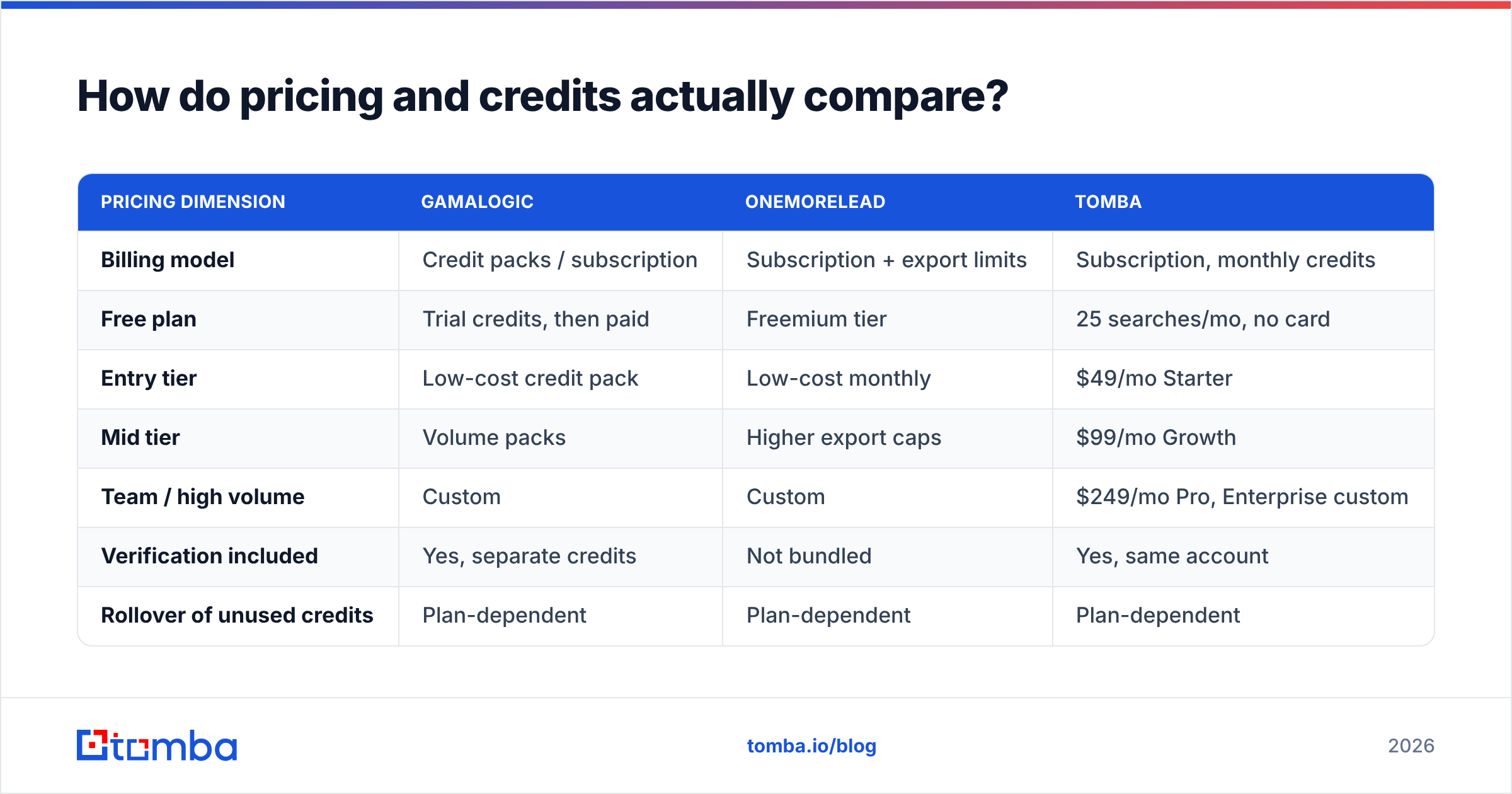
| Pricing dimension | Gamalogic | OneMoreLead | Tomba |
|---|---|---|---|
| Billing model | Credit packs / subscription | Subscription + export limits | Subscription, monthly credits |
| Free plan | Trial credits, then paid | Freemium tier | 25 searches/mo, no card |
| Entry tier | Low-cost credit pack | Low-cost monthly | $49/mo Starter |
| Mid tier | Volume packs | Higher export caps | $99/mo Growth |
| Team / high volume | Custom | Custom | $249/mo Pro, Enterprise custom |
| Verification included | Yes, separate credits | Not bundled | Yes, same account |
| Rollover of unused credits | Plan-dependent | Plan-dependent | Plan-dependent |

Three cost details people miss:
A database means a second bill. Say OneMoreLead exports 5,000 contacts and you run them through an outside verifier. Your true cost per usable contact can double. Budget for that up front. When finding and verifying share one credit pool, that second line item disappears, which is how Tomba pricing is built.
Lifetime deals are not the bargain they look like. An LTD locks the software, not the data refresh. You keep access. You do not keep freshness. Plenty of buyers found that out when a 2022 list started bouncing at 15% in 2024.
Failed lookups should not bill you. Ask both vendors whether a "not found" result burns a credit. Policies vary a lot. On hard domains, where 40% of lookups fail, that one rule separates a fair price from a bad one.

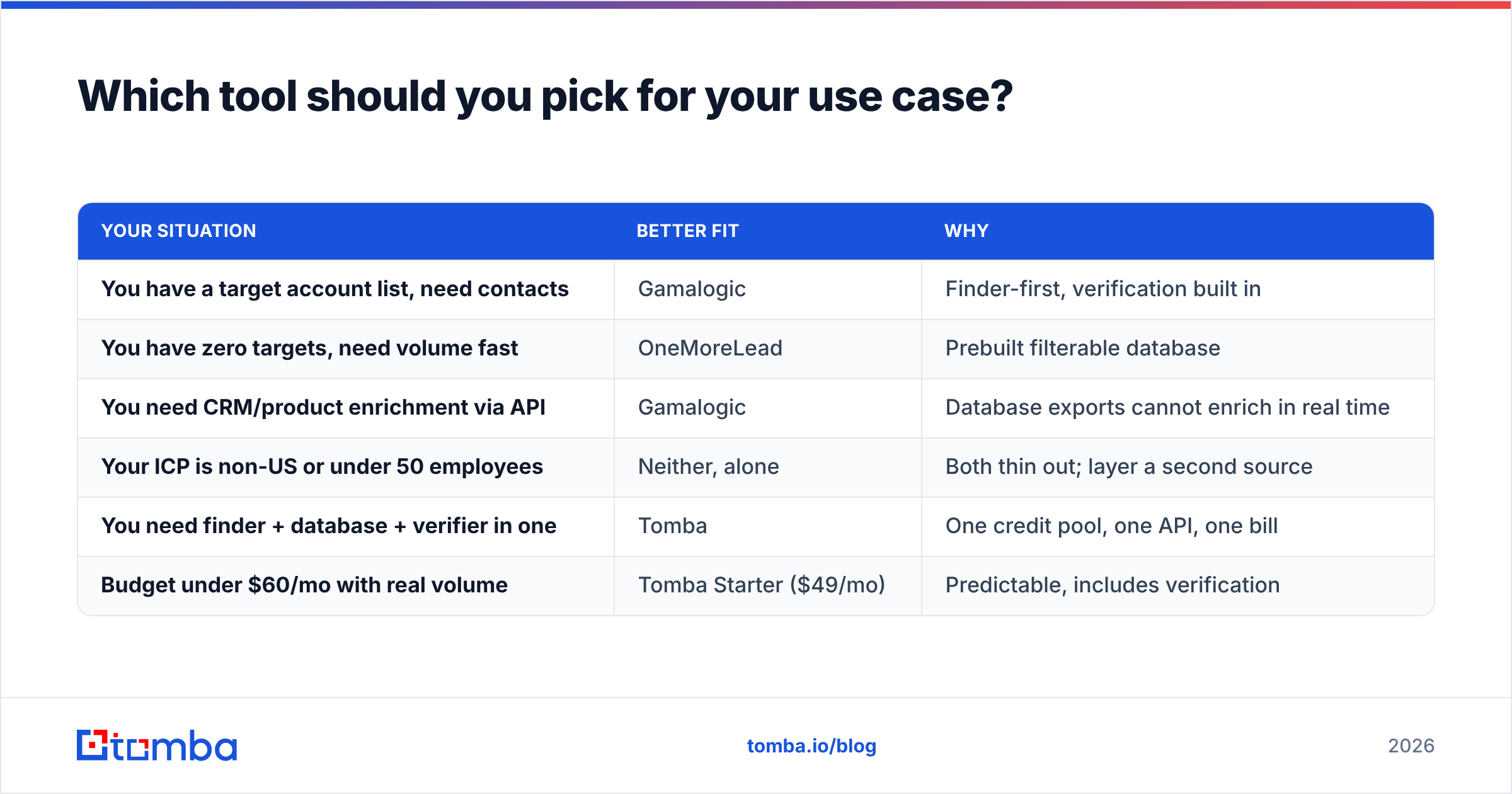
Which tool should you pick for your use case?#
| Your situation | Better fit | Why |
|---|---|---|
| You have a target account list, need contacts | Gamalogic | Finder-first, verification built in |
| You have zero targets, need volume fast | OneMoreLead | Prebuilt filterable database |
| You need CRM/product enrichment via API | Gamalogic | Database exports cannot enrich in real time |
| Your ICP is non-US or under 50 employees | Neither, alone | Both thin out; layer a second source |
| You need finder + database + verifier in one | Tomba | One credit pool, one API, one bill |
| Budget under $60/mo with real volume | Tomba Starter ($49/mo) | Predictable, includes verification |
Most teams that "solve" this end up running two tools anyway. A database for discovery, a finder and verifier for the last mile. That works. It also means two subscriptions, two credit systems, and a CSV shuttle in between. Price the combined option first, because the two-tool stack usually costs more than one mid-tier plan.
Shopping the category more broadly? BookYourData sells pay-as-you-go B2B lists with a bounce guarantee. Review sites like G2's lead intelligence category show current user sentiment. Vendor pages tell you the ceiling. Reviews tell you the floor.
What do you lose by picking either one?#
With Gamalogic, you lose discovery. It cannot tell you who to contact. If your growth motion depends on finding new accounts that match a profile, you need a database or an intent tool beside it. Plan for enrichment too, because a finder returns an address, not context.
With OneMoreLead, you lose freshness and control. A static export is a snapshot. The record was right the day it was scraped. The day you send is a different day. You also cannot chase one named person at one company on demand. That is the exact motion account-based outbound needs when your CEO asks for the VP of Eng at 12 accounts.
With both, you lose deliverability safety unless you add a step. Neither tool replaces the basics: an authenticated sending domain, a warmed inbox, and a verified list. Check your SPF record, warm the domain, and re-verify any list older than 30 days. Skip that and a data problem becomes a sender reputation problem. Reputation takes months to repair.
What is the verdict on Gamalogic vs OneMoreLead?#
Gamalogic wins on precision. OneMoreLead wins on cold-start volume. If you must pick one, pick based on the half of the problem you already solved. Have a list? Gamalogic. Have nothing? OneMoreLead — then verify everything before it touches a sequence.
The framing is the real problem. Gamalogic vs OneMoreLead is hard to call because each tool is half a workflow. You need to find the company, find the people, get the address, confirm it is deliverable, and push it into your CRM. Splitting that across two vendors adds cost, delay, and a CSV step nobody wants to own.
That is the gap Tomba fills. The Tomba Email Finder handles name-and-domain lookups and domain-wide discovery. Verification runs on the same credits. Catch-all domains get their own resolution path. Everything is available through one API, a Chrome extension, or a Google Sheets add-on.
Start on the free tier: 25 searches a month, no card. Run it against your own control list next to Gamalogic and OneMoreLead. Let the bounce rate pick the winner. If it holds up, Starter is $49/mo and Growth is $99/mo, with the verifier included rather than billed separately.
Test with your own domains. That is the only benchmark that matters.
Related guides#
Ready to find emails that actually work?
Join 150,000+ professionals who stopped guessing and started sending. Free credits on signup — no credit card required.
Get the Tomba newsletter
Practical outbound tactics and product updates — once every two weeks.
About the author