Gamalogic vs SeamlessAI: Which B2B Email Tool Wins in 2026?
Gamalogic sells cheap, verification-first email lookups. Seamless.AI sells a seat-based contact database with AI search. They fail in opposite ways — here's which one fits your outbound motion, and what a 100-lead bake-off actually reveals.
Gamalogic vs SeamlessAI is a choice between two different jobs. One finds the email for a name you already have. The other hands you the name in the first place. Both bill you as if they were the same product. Here is how they split, and which one fits your outbound motion.
TL;DR
- Gamalogic is a lean, credit-priced email finder and verifier. You bring the names and domains; it returns addresses and a validity status. Cheap per lookup, thin on everything else.
- Seamless.AI is a seat-priced contact database with AI-assisted search, Chrome extension, and CRM push. You get volume and discovery, but credits are capped per user and pricing is sales-led.
- The real split is enrichment vs discovery. If you already have a target list, Gamalogic's model is cheaper. If you need to build the list from scratch, a database wins.
- Neither tool is a clean winner on data quality. Independent review counts on G2 show Seamless.AI users complaining loudest about stale contacts; Gamalogic has far fewer reviews to judge from.
- If you want credit-based pricing and real verification depth, run all three against the same 100 rows before signing anything.
What are Gamalogic and Seamless.AI?#
They solve two different problems that look identical on a pricing page.
Gamalogic (gamalogic.com) is an email-finding and email-verification service built around a simple input/output contract: give it a person's name plus a company domain, get back the most probable work email and a deliverability verdict. It ships a bulk uploader and an API, and it prices in credits. There is no prospecting database underneath it — it is a resolver, not a source of leads.
Seamless.AI (seamless.ai) is the opposite architecture. It maintains a large contact database, layers AI search on top, and sells access per seat. You search by title, industry, headcount, or technology, then export contacts with emails and phone numbers into your CRM. Discovery is the product; verification is a claim made about the database rather than a step you control.
That difference explains almost every complaint you'll read about either tool. Gamalogic gets criticised for not having enough data. Seamless.AI gets criticised for having too much of the wrong kind.

Gamalogic vs SeamlessAI: how do they compare head-to-head?#
Here is the honest side-by-side. Pricing figures for both vendors change frequently. Seamless.AI does not publish a standard public price list, so treat the pricing row as a shape, not a quote, and confirm on the vendor's own page.
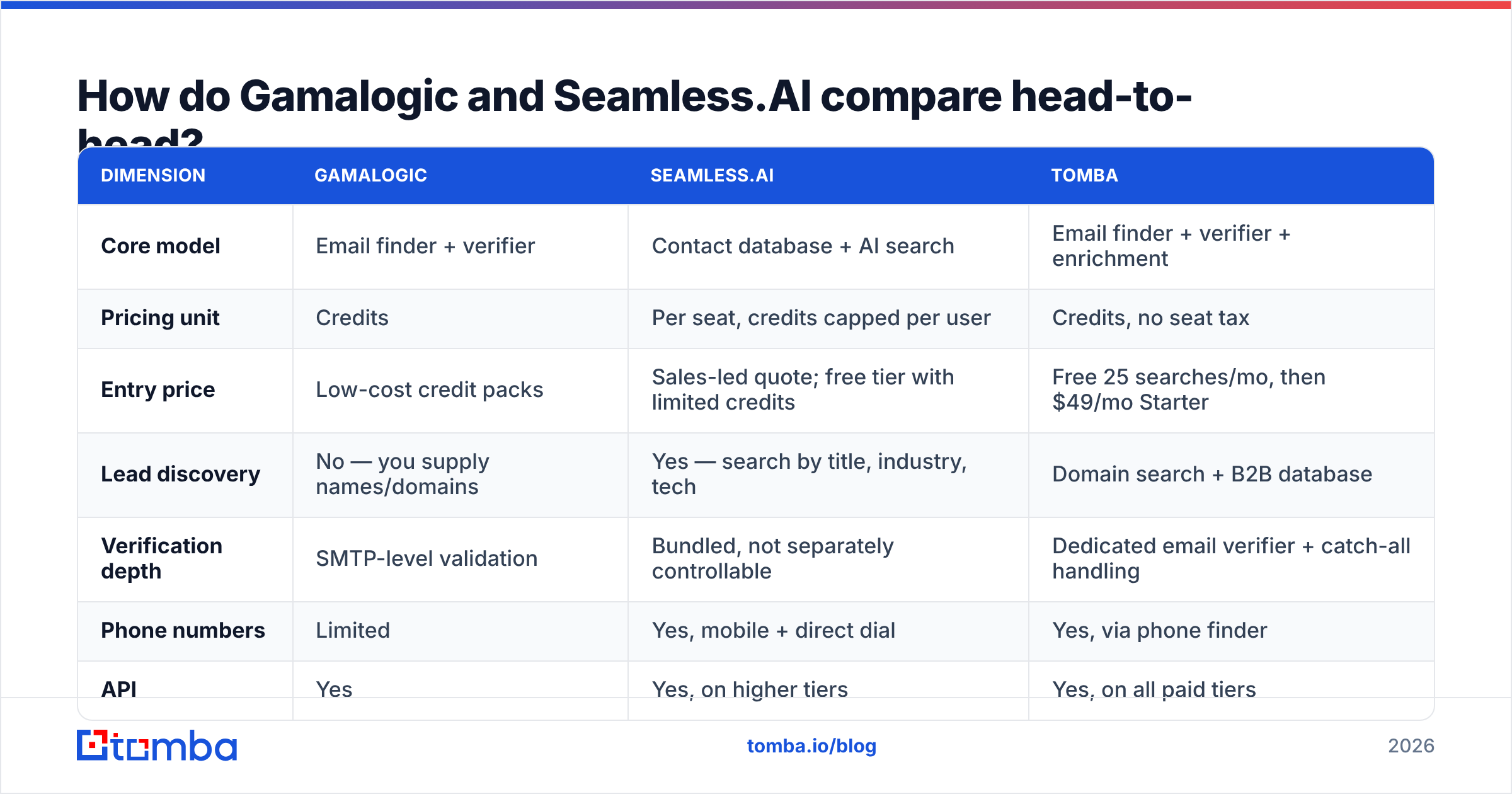
| Dimension | Gamalogic | Seamless.AI | Tomba |
|---|---|---|---|
| Core model | Email finder + verifier | Contact database + AI search | Email finder + verifier + enrichment |
| Pricing unit | Credits | Per seat, credits capped per user | Credits, no seat tax |
| Entry price | Low-cost credit packs | Sales-led quote; free tier with limited credits | Free 25 searches/mo, then $49/mo Starter |
| Lead discovery | No — you supply names/domains | Yes — search by title, industry, tech | Domain search + B2B database |
| Verification depth | SMTP-level validation | Bundled, not separately controllable | Dedicated email verifier + catch-all handling |
| Phone numbers | Limited | Yes, mobile + direct dial | Yes, via phone finder |
| API | Yes | Yes, on higher tiers | Yes, on all paid tiers |
| Best for | Enriching an existing list | Building lists from scratch | Both, at credit pricing |
The row that matters most for budgeting is pricing unit. Seat-based pricing punishes teams that want three people occasionally checking data. Credit-based pricing punishes nobody until volume climbs, then it punishes everyone equally and predictably.
Which tool actually finds more valid emails?#
Neither vendor's published accuracy number should move your decision. Every email-finder vendor computes accuracy differently. Some count "found" as a hit even when the address is a catch-all guess. Others only count SMTP-confirmed mailboxes. The denominators are not comparable.

What holds up across real tests is the pattern, not the percentage:
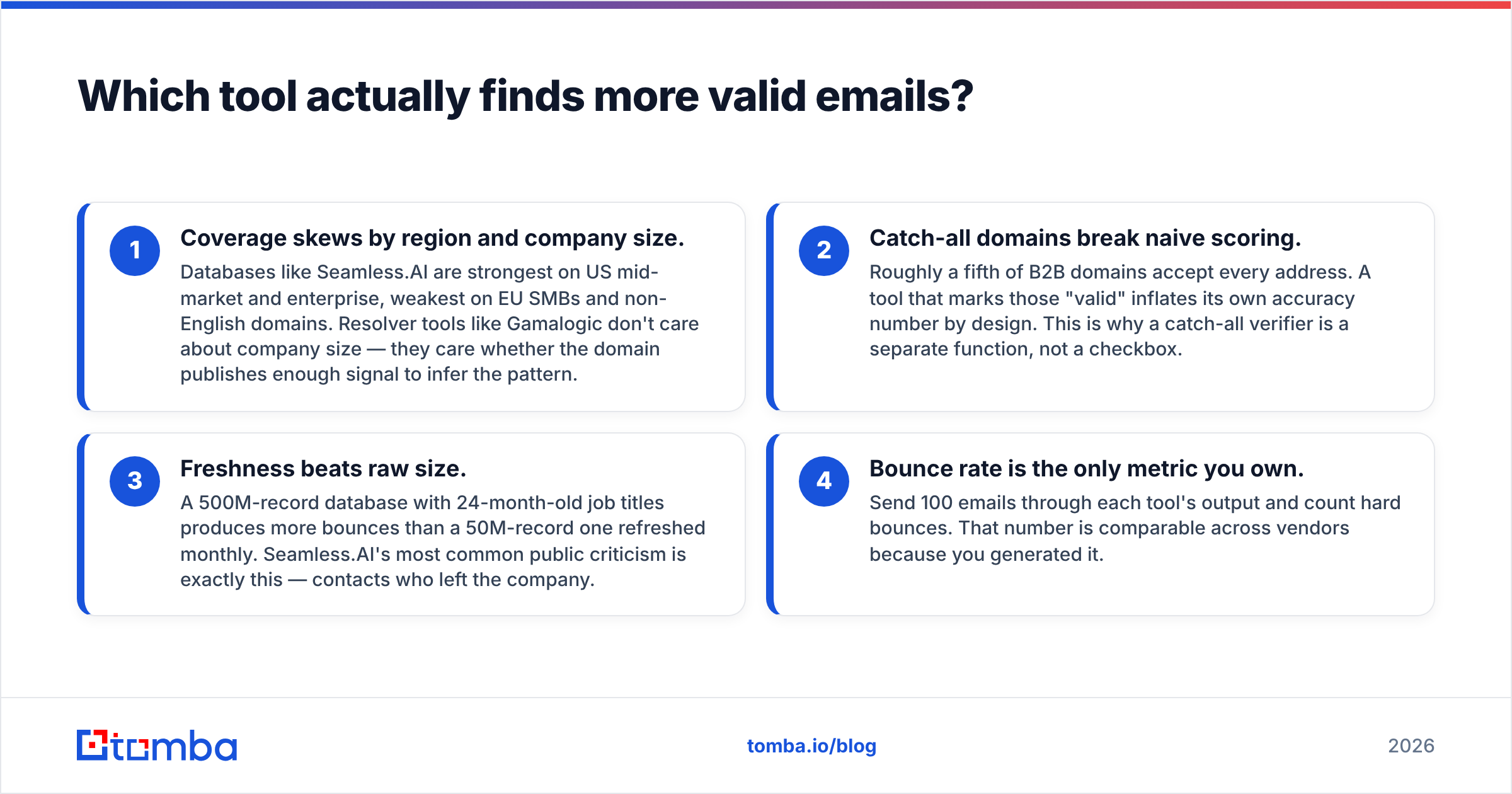
- Coverage skews by region and company size. Databases like Seamless.AI are strongest on US mid-market and enterprise, weakest on EU SMBs and non-English domains. Resolver tools like Gamalogic don't care about company size — they care whether the domain publishes enough signal to infer the pattern.
- Catch-all domains break naive scoring. Roughly a fifth of B2B domains accept every address. A tool that marks those "valid" inflates its own accuracy number by design. This is why a catch-all verifier is a separate function, not a checkbox.
Two more patterns show up in every bake-off:
- Freshness beats raw size. A 500M-record database with 24-month-old job titles produces more bounces than a 50M-record one refreshed monthly. Seamless.AI's most common public criticism is exactly this — contacts who left the company.
- Bounce rate is the only metric you own. Send 100 emails through each tool's output and count hard bounces. That number is comparable across vendors because you generated it.
Set your own threshold before testing. Under 3% hard bounce is acceptable. Over 5% and your sender reputation starts absorbing damage that no amount of copy testing will undo.
How does the pricing actually work in practice?#
This is where the two tools diverge hardest, and where most buyers get surprised at renewal.
Gamalogic sells credits. One lookup consumes one credit, verification is typically bundled or cheap, and unused credits either roll or expire depending on the pack. There's no per-user fee, so a three-person team on one account pays the same as one person. The ceiling is low and so is the floor.
Seamless.AI sells seats with credit allocations attached. The published free tier gives you a small number of credits to try it; everything beyond that is a sales conversation. Users on review sites consistently flag two things: credits deplete faster than expected because previewing contacts can consume them, and annual contracts are the default rather than the exception. Neither is disqualifying. But you should walk into that call knowing your true monthly lookup volume, because the quote will be built around it.
Tomba sits in the credit camp with published numbers: a free tier at 25 searches/mo, Starter at $49/mo, Growth at $99/mo, Pro at $249/mo, and custom Enterprise. The full breakdown is on the Tomba pricing page. The relevant point for this comparison isn't that it's cheaper in absolute terms — it's that you can compute your cost before talking to anyone.

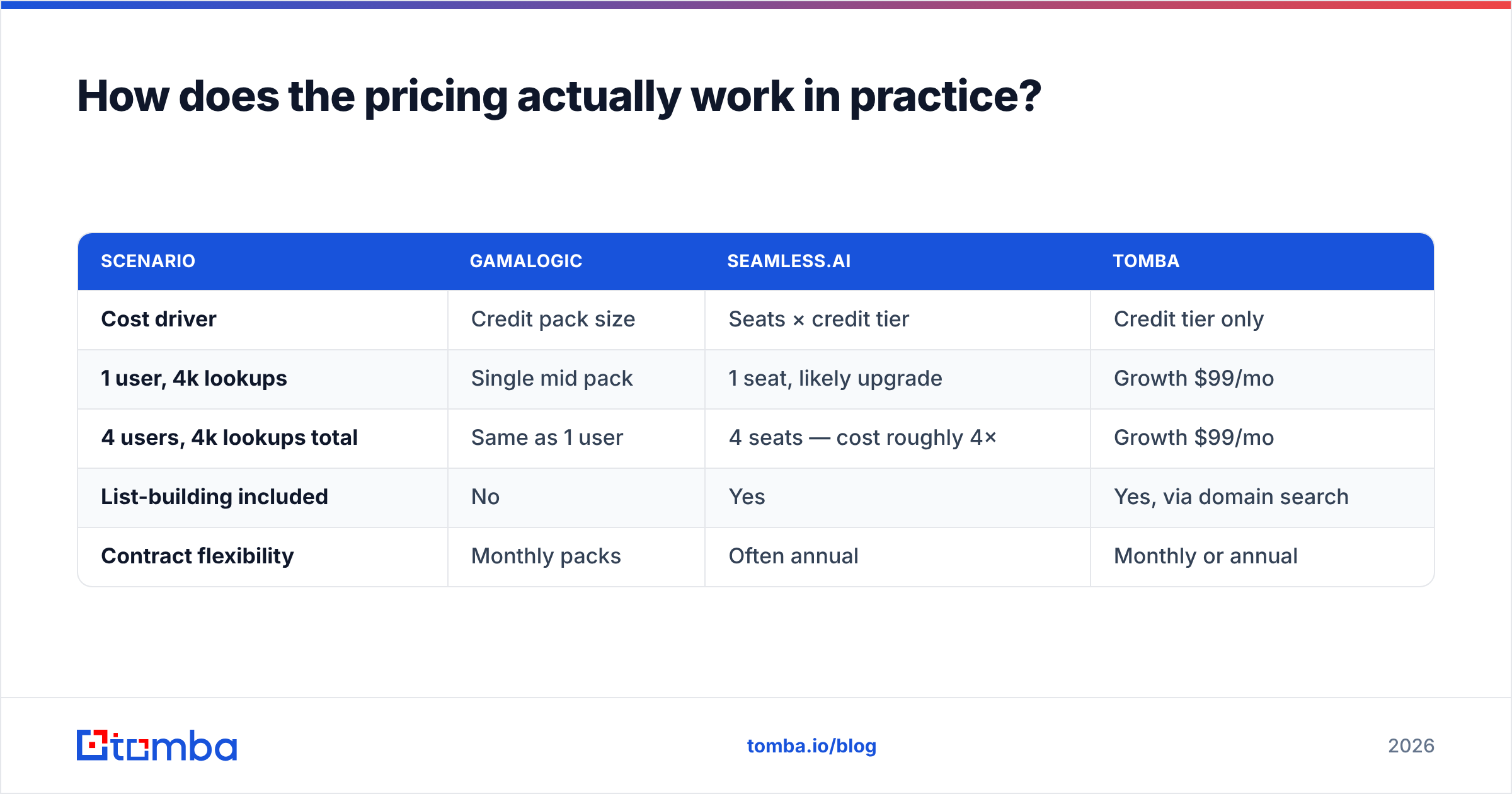
A quick sanity model. If your SDR team needs 4,000 verified contacts a month:
| Scenario | Gamalogic | Seamless.AI | Tomba |
|---|---|---|---|
| Cost driver | Credit pack size | Seats × credit tier | Credit tier only |
| 1 user, 4k lookups | Single mid pack | 1 seat, likely upgrade | Growth $99/mo |
| 4 users, 4k lookups total | Same as 1 user | 4 seats — cost roughly 4× | Growth $99/mo |
| List-building included | No | Yes | Yes, via domain search |
| Contract flexibility | Monthly packs | Often annual | Monthly or annual |
The four-user row is the whole argument. Seat-based tools charge for access; credit-based tools charge for consumption. Most B2B teams consume far less than their headcount implies.
Who should choose Gamalogic?#
Pick Gamalogic when your bottleneck is resolution, not discovery.
- You export lists from LinkedIn Sales Navigator, a conference attendee sheet, or a partner referral file, and you need emails attached to names you already have.
- Your volume is spiky — 10,000 lookups one month, 500 the next — and you want to buy credits rather than carry a subscription.
- You're technical enough to live in an API and a CSV, and you don't need a Chrome extension, a sequencer, or a CRM sync built in.
- Your budget genuinely will not stretch to a mid-market data platform.
Skip it when you need phone numbers, intent signals, or a way to answer "who at these 200 companies runs demand gen?" It was never built to answer that.
Who should choose Seamless.AI?#
Pick Seamless.AI when your bottleneck is finding people at all.
- You're prospecting into US mid-market and enterprise accounts where its coverage is strongest.
- You want direct dials alongside emails and you're running a genuine multi-channel motion, not just email.
- Your reps live in the Chrome extension and push to Salesforce or HubSpot without touching a spreadsheet.
- You have budget approval for annual, per-seat SaaS and a champion who'll enforce credit hygiene.
Skip it if your team is under five people, your ICP is European or APAC SMB, or you can't stomach a sales-led quote for a tool you haven't tested at volume. Buyers who churn from it usually cite one of those three.

Where does Tomba fit between them?#
Honestly: Tomba overlaps both, and it beats neither on every axis.
Seamless.AI has a larger raw contact database and better phone coverage — if pure US enterprise volume is the job, it will out-find Tomba. Gamalogic can be cheaper at the very bottom of the volume curve if all you need is a few hundred lookups.
Where Tomba is the better default is the middle, which is where most teams actually live:
- Discovery and resolution in one tool. Domain search answers "who works here?" and the email finder answers "what's their address?" without two vendors and two invoices.
- Verification you can inspect. SMTP checks, MX validation, and explicit catch-all handling are separate, auditable steps rather than a bundled confidence score.
- No seat tax. Add your whole revenue team to one account; you're billed for the lookups, not the logins.
- Published pricing. $49/mo Starter through $249/mo Pro, with a free tier to test on your own list before you spend anything.
- Integrations where the work happens — HubSpot, Google Sheets, Zapier, plus a documented API.
If you want a third data point in your evaluation, BookYourData is a solid pay-as-you-go option with a similar credit philosophy and a strong verified-contacts guarantee — worth including in any bake-off at this price band.
How should you run your own bake-off?#
Do not decide from review sites. Run this in an afternoon:
- Build one control list of 100 contacts. Real prospects from your actual ICP, mixed across company size and region. Name + company domain only. Never use a vendor's sample list.
- Run the identical list through each tool. Note the found rate, but more importantly note how many were flagged catch-all, risky, or unknown. A tool that says "I don't know" honestly beats one that guesses confidently.
- Spot-check 20 results manually. Cross-reference against LinkedIn, the company site, or a company email pattern check. You're looking for wrong-person matches, not just wrong syntax.
Then measure the part only your own send can tell you:
- Send a real, low-stakes campaign. One plain-text email per address from a warmed domain. Count hard bounces after 48 hours. This is your accuracy number.
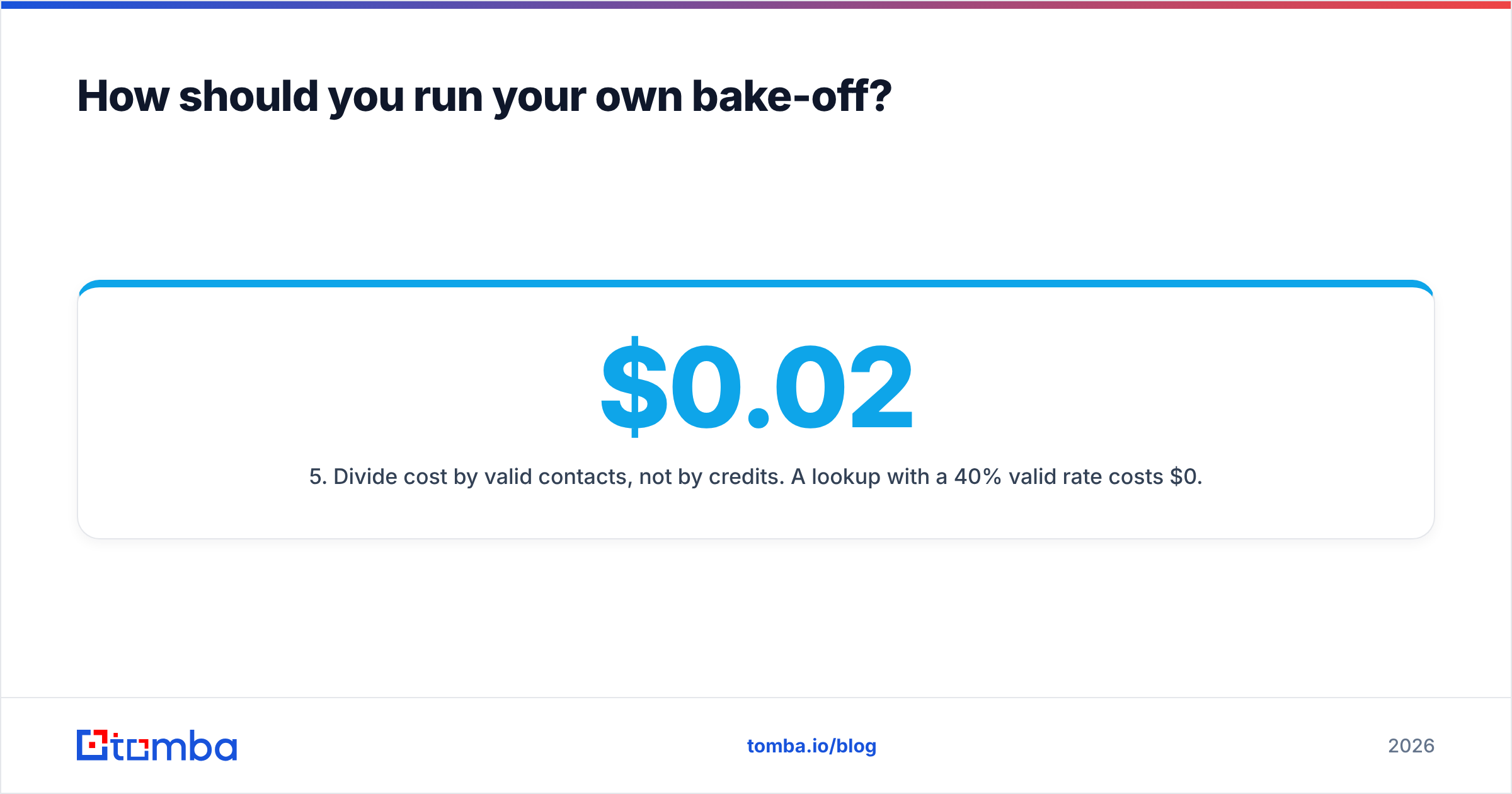
- Divide cost by valid contacts, not by credits. A $0.02 lookup with a 40% valid rate costs $0.05 per usable contact. A $0.04 lookup at 85% costs $0.047. The cheaper credit lost.
- Check the exit. Can you export everything? Is the contract monthly? Does data survive cancellation? Ask before signing, in writing.
Most teams discover in step 5 that the tool they assumed was cheapest wasn't. According to HubSpot's research on B2B data decay, contact databases degrade meaningfully every year. Whatever you measure today is the best that tool will ever look.
Gamalogic vs SeamlessAI: which one wins?#
There is no single winner, and any post that declares one is selling something.
Gamalogic wins on cost-per-lookup for teams that already have their target list and need nothing but resolution and validation.
Seamless.AI wins on discovery breadth for funded US teams running multi-channel outbound at seat scale, where finding the person is harder than finding the address.
Neither wins for the very common case in between: a small-to-mid B2B team that needs to build lists and verify them, without a sales call or a per-seat penalty.
That gap is exactly what Tomba was built for. Start with the Tomba Email Finder on the free tier — 25 searches a month, no card — and run it against the same 100-row control list you use for Gamalogic and Seamless.AI. Compare found rate, catch-all honesty, and hard-bounce rate side by side. If Tomba doesn't win your test, you'll at least have the one number that actually matters, generated on your data instead of a vendor's.
Related guides#
Ready to find emails that actually work?
Join 150,000+ professionals who stopped guessing and started sending. Free credits on signup — no credit card required.
Get the Tomba newsletter
Practical outbound tactics and product updates — once every two weeks.
About the author