Gamalogic vs Smarte: Which B2B Email Data Tool Wins in 2026?
One is a credit-based email finder you can start using in five minutes. The other is a sales-led B2B data platform built for enterprise GTM teams. Here is how Gamalogic and Smarte actually differ — and when neither is the right call.
TL;DR
- Gamalogic is a self-serve, credit-based email finder and verifier. You sign up, buy credits, and start pulling addresses the same day. Pricing is transparent and cheap at low volume.
- Smarte is a sales-led B2B contact and company data platform aimed at GTM and demand-gen teams. Expect a demo, a quote, and an annual contract rather than a checkout page.
- They are not really competing for the same buyer. Gamalogic competes with email-finder APIs. Smarte competes with ZoomInfo-class data vendors.
- If you need verified emails at predictable per-credit cost with a real API, a mid-market finder like Tomba or Gamalogic wins. If you need TAM building, firmographics, and intent signals, Smarte is the closer fit.
- Whichever you pick, run every list through an email verifier before you send. Neither vendor's "verified" flag survives a real send unmodified.
What are Gamalogic and Smarte?#
Gamalogic (gamalogic.com) is a lean email-finding and email-verification service. Its core loop is simple: give it a full name plus a company domain, get back a probable business email and a validity status. It also runs bulk verification on lists you upload and exposes an API for developers who want to embed lookups into their own product or enrichment script. The company positions itself on price-per-credit and speed rather than on breadth of data.
Smarte (smarte.pro) is a different animal. It sells B2B contact and company data to marketing and sales operations teams: build a total addressable market, filter by firmographics and technographics, layer on intent, push the result into Salesforce or HubSpot, and keep the records refreshed. Email addresses are one field among many, not the product itself. Smarte also leans hard on compliance positioning — GDPR and CCPA handling is a headline feature, which matters if you sell into the EU.
That distinction drives almost everything else in this comparison. One tool answers "what is this person's email?" The other answers "who should we be selling to, and what do we know about them?"
How do Gamalogic and Smarte compare head-to-head?#
Here is the practical breakdown. Verify current numbers on each vendor's site before you buy — email data pricing moves.
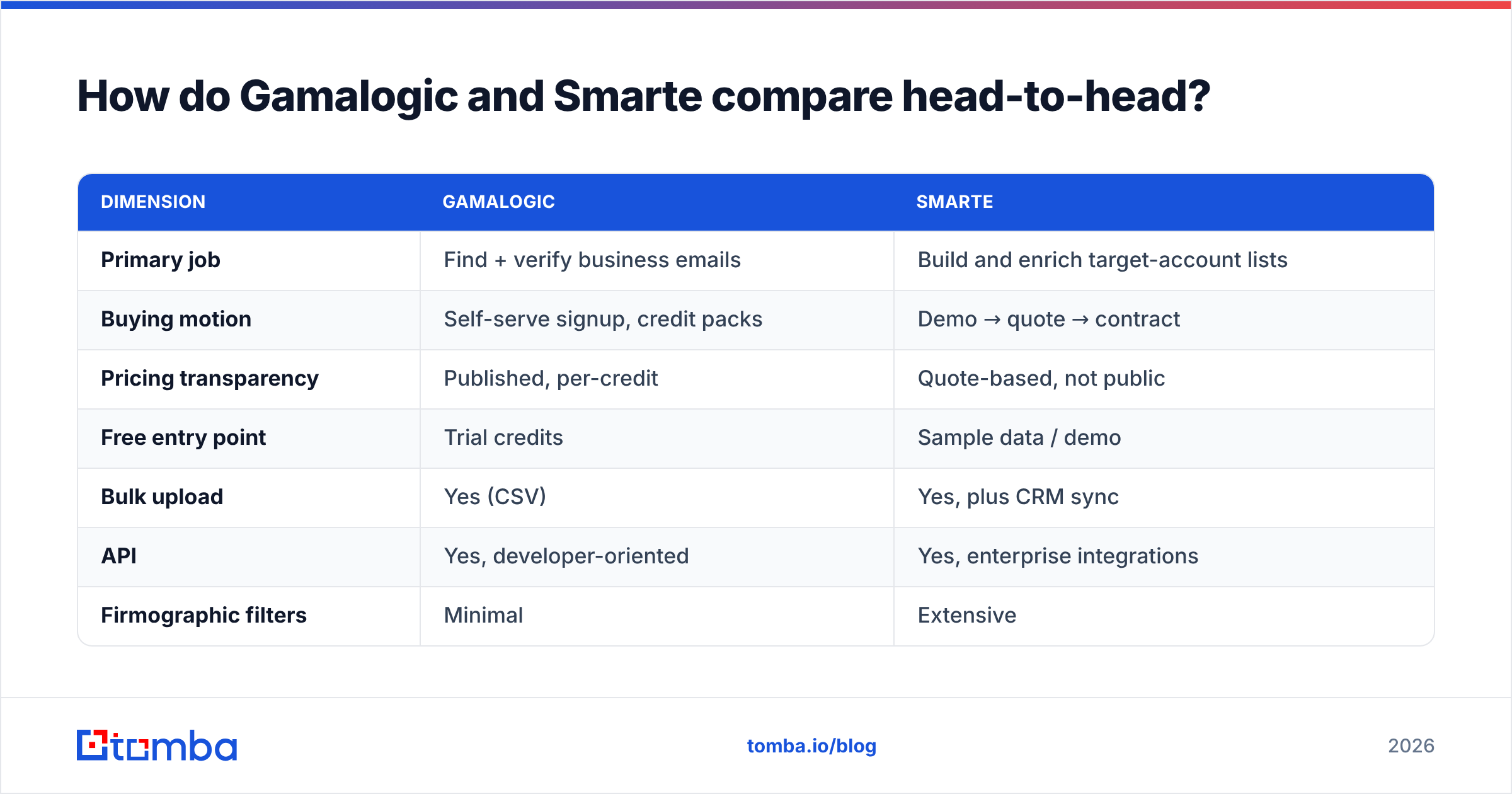
| Dimension | Gamalogic | Smarte |
|---|---|---|
| Primary job | Find + verify business emails | Build and enrich target-account lists |
| Buying motion | Self-serve signup, credit packs | Demo → quote → contract |
| Pricing transparency | Published, per-credit | Quote-based, not public |
| Free entry point | Trial credits | Sample data / demo |
| Bulk upload | Yes (CSV) | Yes, plus CRM sync |
| API | Yes, developer-oriented | Yes, enterprise integrations |
| Firmographic filters | Minimal | Extensive |
| Intent data | No | Yes |
| Phone numbers | Limited | Yes |
| Compliance positioning | Standard | GDPR/CCPA emphasised |
| Best for | Founders, devs, small outbound teams | Mid-market to enterprise GTM |
| Worst for | TAM research, ABM segmentation | Solo users, ad-hoc lookups |
The row that decides most evaluations is buying motion. If your procurement process is "expense it on a company card," Smarte's sales cycle alone will disqualify it. If you have a RevOps team, a CRM hygiene mandate, and a six-figure data line item, Gamalogic will feel too thin.

Which tool finds more valid emails?#
Neither vendor publishes an audited, third-party accuracy benchmark, so treat any single-number claim — theirs or anyone else's — with suspicion. What you can do is run the same control list through both.
Here is the test that actually predicts your bounce rate:
- Build a 200-row control set from domains you already have confirmed contacts at. Mix company sizes: 20-person startups, 500-person mid-market, 10,000-person enterprise.
- Include hard cases on purpose. Add catch-all domains, non-Latin names, hyphenated surnames, and companies that changed domains after an acquisition. This is where cheap providers collapse.
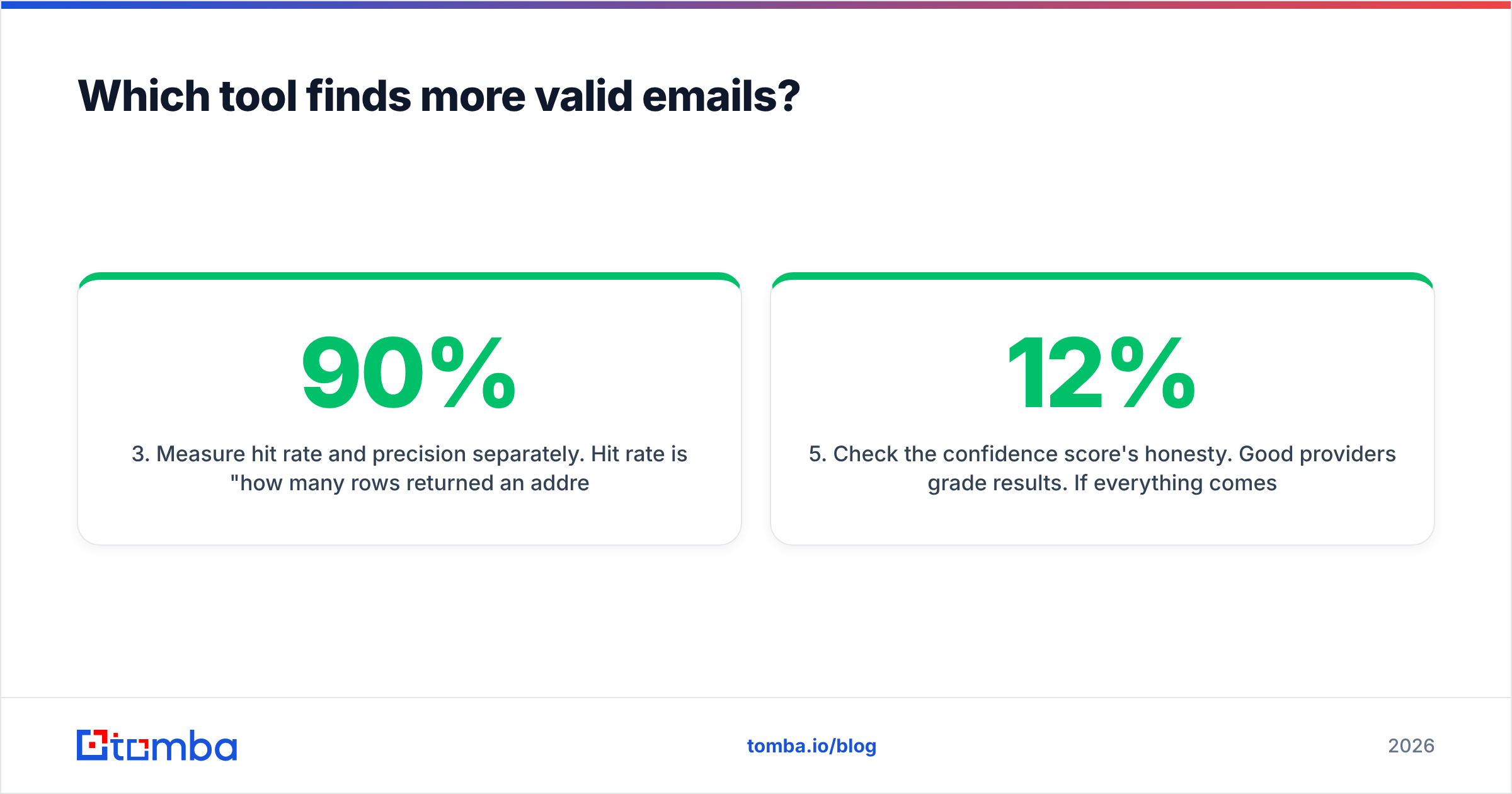
- Measure hit rate and precision separately. Hit rate is "how many rows returned an address." Precision is "how many of those actually deliver." A tool with a 90% hit rate and 70% precision is worse than one with 60% hit rate and 97% precision.
- Send a real 100-address test campaign from a throwaway subdomain and count hard bounces. SMTP-level checks lie about catch-all domains; only a send tells the truth.
- Check the confidence score's honesty. Good providers grade results. If everything comes back "high confidence" and 12% bounce, the score is decoration.

In practice, the pattern across this category is consistent: pure email finders like Gamalogic tend to win on hit rate for known domains, because that is the one thing they optimise. Broad data platforms like Smarte tend to win on record completeness — job title, seniority, company size, tech stack — but the email field itself is often sourced from the same underlying providers everyone else uses.
Catch-all domains are the honest tiebreaker. Roughly a third of B2B domains accept everything at the SMTP layer, which makes standard verification useless. If your ICP skews enterprise, ask both vendors specifically how they handle catch-alls, and test with a dedicated catch-all verifier rather than trusting a binary valid/invalid flag.
How does the pricing really work?#
This is where the two products diverge most sharply, and where a lot of teams make the wrong call.
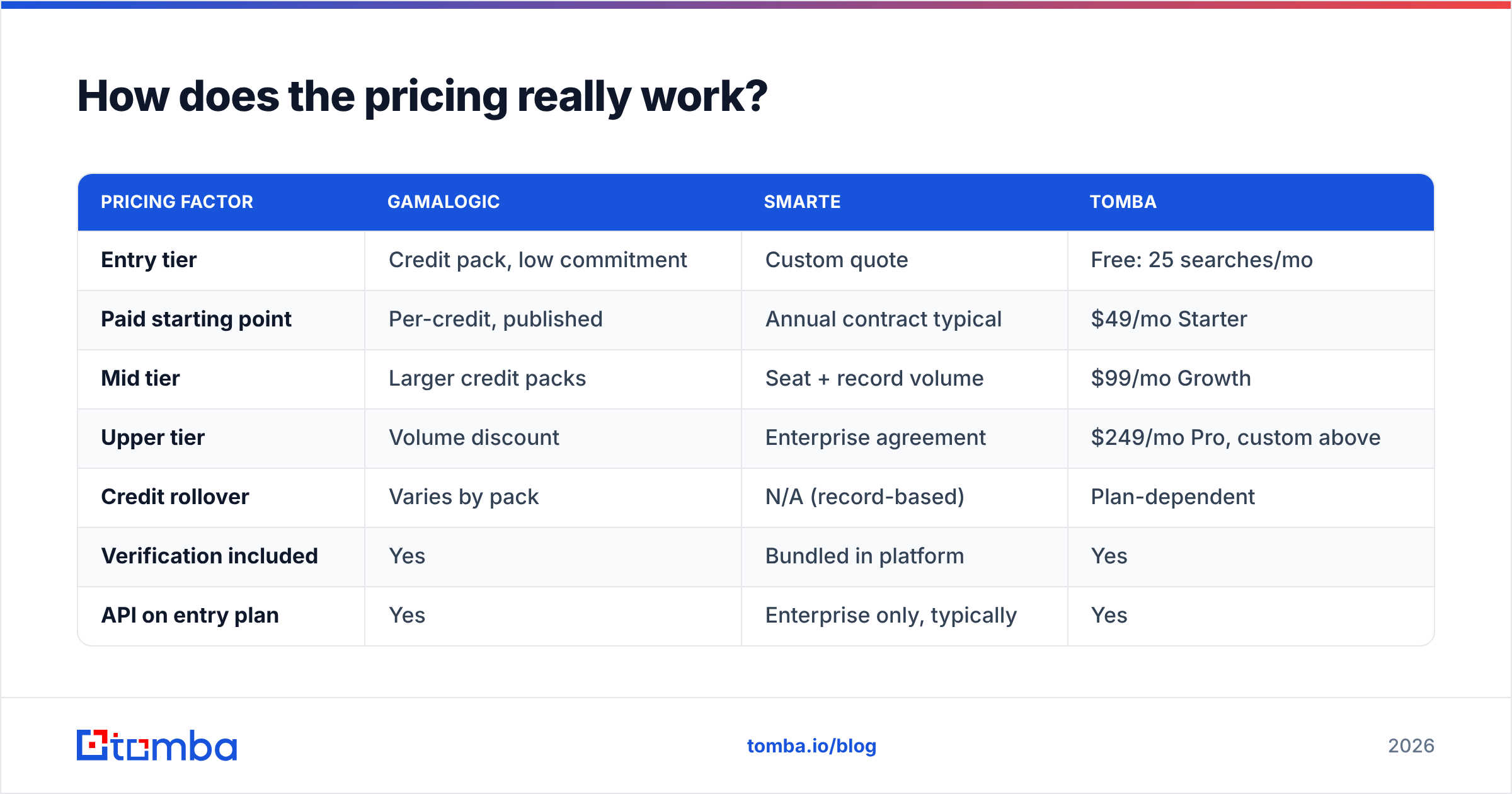
| Pricing factor | Gamalogic | Smarte | Tomba |
|---|---|---|---|
| Entry tier | Credit pack, low commitment | Custom quote | Free: 25 searches/mo |
| Paid starting point | Per-credit, published | Annual contract typical | $49/mo Starter |
| Mid tier | Larger credit packs | Seat + record volume | $99/mo Growth |
| Upper tier | Volume discount | Enterprise agreement | $249/mo Pro, custom above |
| Credit rollover | Varies by pack | N/A (record-based) | Plan-dependent |
| Verification included | Yes | Bundled in platform | Yes |
| API on entry plan | Yes | Enterprise only, typically | Yes |
| Minimum commitment | None meaningful | Usually annual | Monthly |
Two things worth flagging honestly.
First, quote-based pricing is not automatically bad. If you are buying 250,000 records with CRM sync, dedupe rules, and a refresh cadence, a contract with a data provider is the correct instrument. What is bad is entering that motion when you actually needed 3,000 emails a month.
Second, cheap per-credit pricing is not automatically good. If a provider charges half as much per lookup but returns invalid addresses 15% of the time, you paid full price for the good ones and burned domain reputation on the rest. Cost per deliverable address is the only number that matters. Compare that against Tomba pricing and any other shortlist candidate on the same normalised basis.

Who should choose Gamalogic?#
Pick Gamalogic if most of these describe you:
- You already know your accounts. You have a list of 500 target companies and named contacts; you just need addresses. Firmographic filtering is wasted spend for you.
- You are technical. You want an endpoint, not a dashboard. Gamalogic's API-first framing suits engineers wiring enrichment into a signup flow or an internal tool.
- Your volume is spiky. Some months you need 10,000 lookups, some months 200. Credit packs handle that better than seat-based contracts.
- Budget approval is you. No procurement, no security review, no annual commit.
Where it gets thin: reporting, team collaboration, CRM-native workflows, and anything resembling account intelligence. Gamalogic is a component, not a platform. That is a design choice, not a flaw — but do not expect it to replace a data stack.
Who should choose Smarte?#
Pick Smarte if most of these describe you:
- You do not yet know your accounts. Your job this quarter is defining an ICP and building a TAM, which requires filtering across industry, headcount, revenue, geography, and technology.
- EU data compliance is a live risk. Smarte's compliance emphasis is a genuine differentiator if legal has opinions about where your contact data came from.
- You run ABM. Intent signals plus firmographics plus CRM sync is the standard ABM stack, and a pure email finder gives you none of it.
- You have RevOps. Someone needs to own field mapping, dedupe rules, and refresh cadence. Without that person, platform data decays into CRM landfill within two quarters.
Where it gets expensive: annual commitments, seat pricing, and the classic data-vendor problem of paying for records you never touch. Check independent reviews on G2 for renewal-time experiences, not just onboarding sentiment.
What about API access and developer workflow?#
If you are building rather than clicking, the evaluation narrows fast.
Gamalogic exposes a straightforward REST API for single and bulk lookups — the standard shape for this category. Smarte's integrations are real but oriented toward enterprise systems: CRM connectors, data warehouse pushes, and managed syncs. Getting raw API access on a smaller Smarte agreement is often a negotiation.
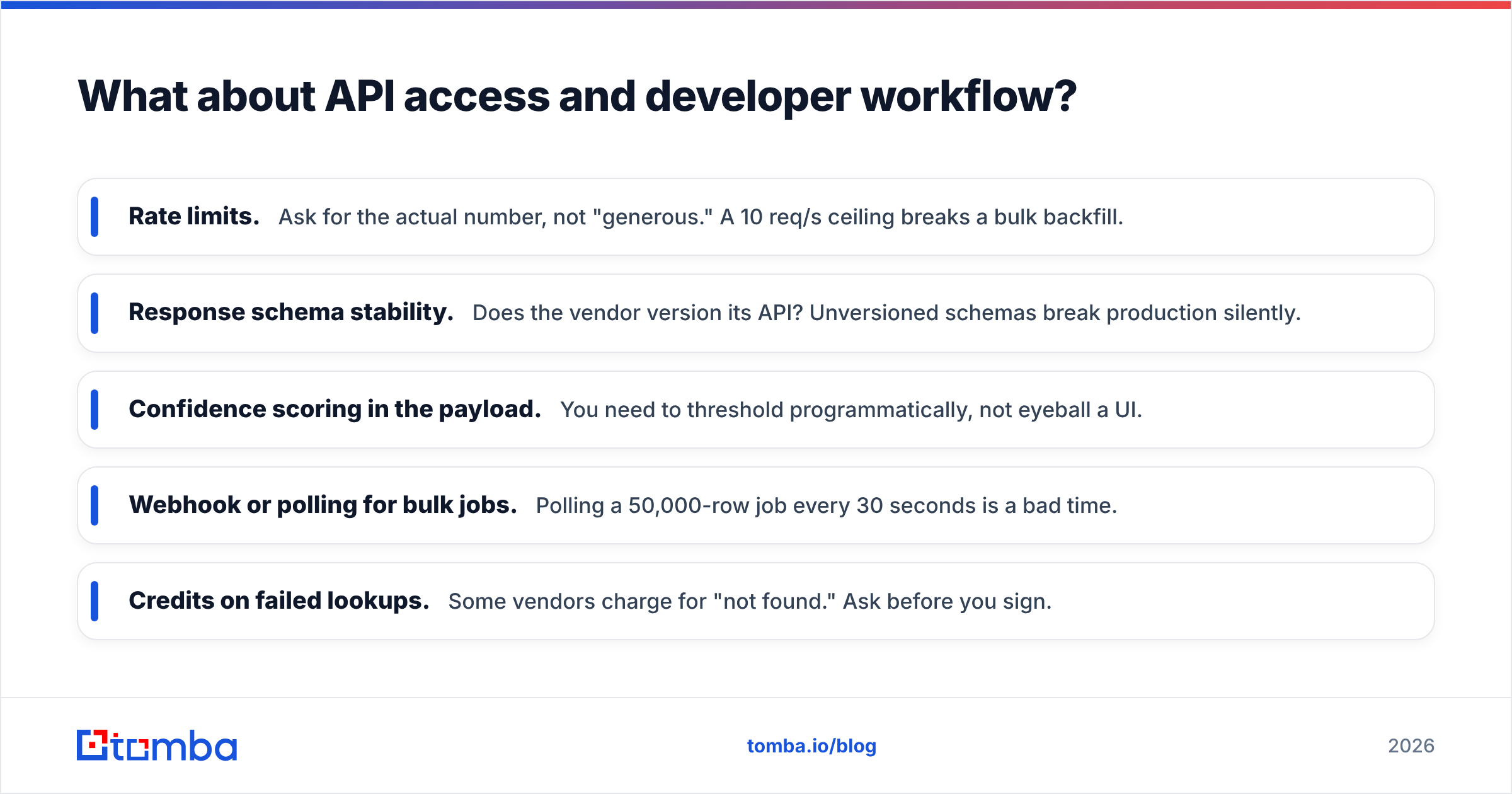
A practical checklist for either vendor:
- Rate limits. Ask for the actual number, not "generous." A 10 req/s ceiling breaks a bulk backfill.
- Response schema stability. Does the vendor version its API? Unversioned schemas break production silently.
- Confidence scoring in the payload. You need to threshold programmatically, not eyeball a UI.
- Webhook or polling for bulk jobs. Polling a 50,000-row job every 30 seconds is a bad time.
- Credits on failed lookups. Some vendors charge for "not found." Ask before you sign.
Tomba's approach here is worth a look if API ergonomics are your deciding factor: the Tomba API covers finder, verifier, domain search, and enrichment under one key, with a documented free tier for testing before you commit budget.
Where does Tomba fit between them?#
Honestly: in the middle, and that is deliberate.
Tomba is self-serve like Gamalogic — you can start on the free tier with 25 searches a month and upgrade to Starter at $49/mo without talking to anyone. But it carries more of the surrounding toolkit than a pure lookup endpoint: domain search for mapping every reachable contact at a company, catch-all handling, bulk processing, enrichment, and native integrations with HubSpot, Salesforce, Pipedrive, Sheets, and Zapier.

| Scenario | Best fit |
|---|---|
| 500 known contacts, need emails today | Gamalogic or Tomba |
| Define ICP, build TAM from scratch | Smarte |
| Embed enrichment in your product | Tomba API or Gamalogic |
| ABM with intent signals | Smarte |
| Sub-$100/mo budget, no procurement | Tomba or Gamalogic |
| EU-heavy prospecting, legal review required | Smarte |
| Mixed: find, verify, enrich in one workflow | Tomba |
It is also fair to say neither Gamalogic nor Smarte is a bad product. They are answers to different questions. The failure mode we see most often is a ten-person startup signing an annual data-platform contract because a demo was impressive, then using it as an expensive email finder. The reverse happens too: an enterprise team stitching together credit-based lookups and spreadsheets because nobody wanted to run a procurement cycle.
What should you do before committing to either?#
Run a 30-day bake-off with real money on the line:
- Same control list, both tools. 200 rows, mixed difficulty, as described above.
- Track cost per deliverable address, not cost per credit.
- Send from a warmed subdomain so bounces do not damage your primary sending domain.
- Time the workflow. How long from "I have a company list" to "I have a sendable CSV"? Platform tools often win here despite worse raw email accuracy, because the surrounding workflow is faster.
- Ask about data refresh. B2B contact data decays around 2-3% per month. A record sourced 18 months ago is a coin flip regardless of vendor.
Then check bounce rate against your own baseline. Anything above 3% is a deliverability problem in the making, and no vendor's marketing page will fix it for you.
Ready to test a finder that does not require a sales call?#
If your real need is verified business emails — fast, at a published price, with an API that works on the entry plan — start with the Tomba Email Finder. The free tier gives you 25 searches a month to run your own control-list test before spending anything, and Starter is $49/mo when you are ready to scale. Build your test list, compare hit rate and bounce rate against Gamalogic and Smarte side by side, and let the deliverability numbers pick the winner instead of the demo deck.
Related guides#
Ready to find emails that actually work?
Join 150,000+ professionals who stopped guessing and started sending. Free credits on signup — no credit card required.
Get the Tomba newsletter
Practical outbound tactics and product updates — once every two weeks.
About the author