GetProspect vs HitHorizons: B2B Data Tools Compared 2026
One finds verified work emails, the other maps 400M+ company records across Europe. Here is where GetProspect and HitHorizons actually overlap, where they don't, and which one belongs in your 2026 stack.
GetProspect vs HitHorizons looks like a head-to-head fight. It isn't. One tool finds the person and their work email. The other maps the company behind the domain. Pick the wrong one and you will buy a second tool within a week.
TL;DR
- GetProspect and HitHorizons are not real rivals. GetProspect is a contact database and email finder. HitHorizons is a company search engine built on registry data, and it leans heavily toward Europe.
- Pick GetProspect when you have the company list and need the person. Pick HitHorizons when you still don't know which companies to target.
- HitHorizons wins on European company coverage, registry-grade firmographics and a free search that is actually useful. It does not hand you verified work emails.
Here is the other half of the trade-off:
- GetProspect wins on contact records, LinkedIn prospecting and CSV enrichment. Accuracy varies by region, and credits get pricey past a few thousand lookups a month.
- Want one line item on the budget? A finder-plus-verifier stack (Tomba, Findymail, BookYourData) usually beats bolting a company-data product onto a contact-data product.
What is GetProspect and what is HitHorizons?#
They sit side by side in the same G2 category. In practice they do different jobs.
GetProspect is a B2B contact database. It ships a LinkedIn Chrome extension, a bulk email finder, an email verifier and a light CRM-style list manager. Its unit of value is a person: name, job title, company, LinkedIn URL, and a work email when the pattern resolves. Most teams use it like any email finder. Import a list of companies, or pull a LinkedIn Sales Navigator search, then extract the contacts.
HitHorizons is a company search engine. Its unit of value is a legal entity: registered name, national registration number, industry code, revenue band, employee count, address and parent company. The data comes from official business registries, sourced through Dun & Bradstreet. It covers roughly 100M+ companies, and Europe is where it runs deepest — including markets where US-first databases go thin (Czechia, Poland, Romania, the Nordics, the Baltics).
The practical difference is simple. HitHorizons tells you that a 180-employee coatings maker in Brno exists and turns over €40M. It will not tell you the plant manager is Petra, or give you her email. GetProspect does the second job and barely tries the first.
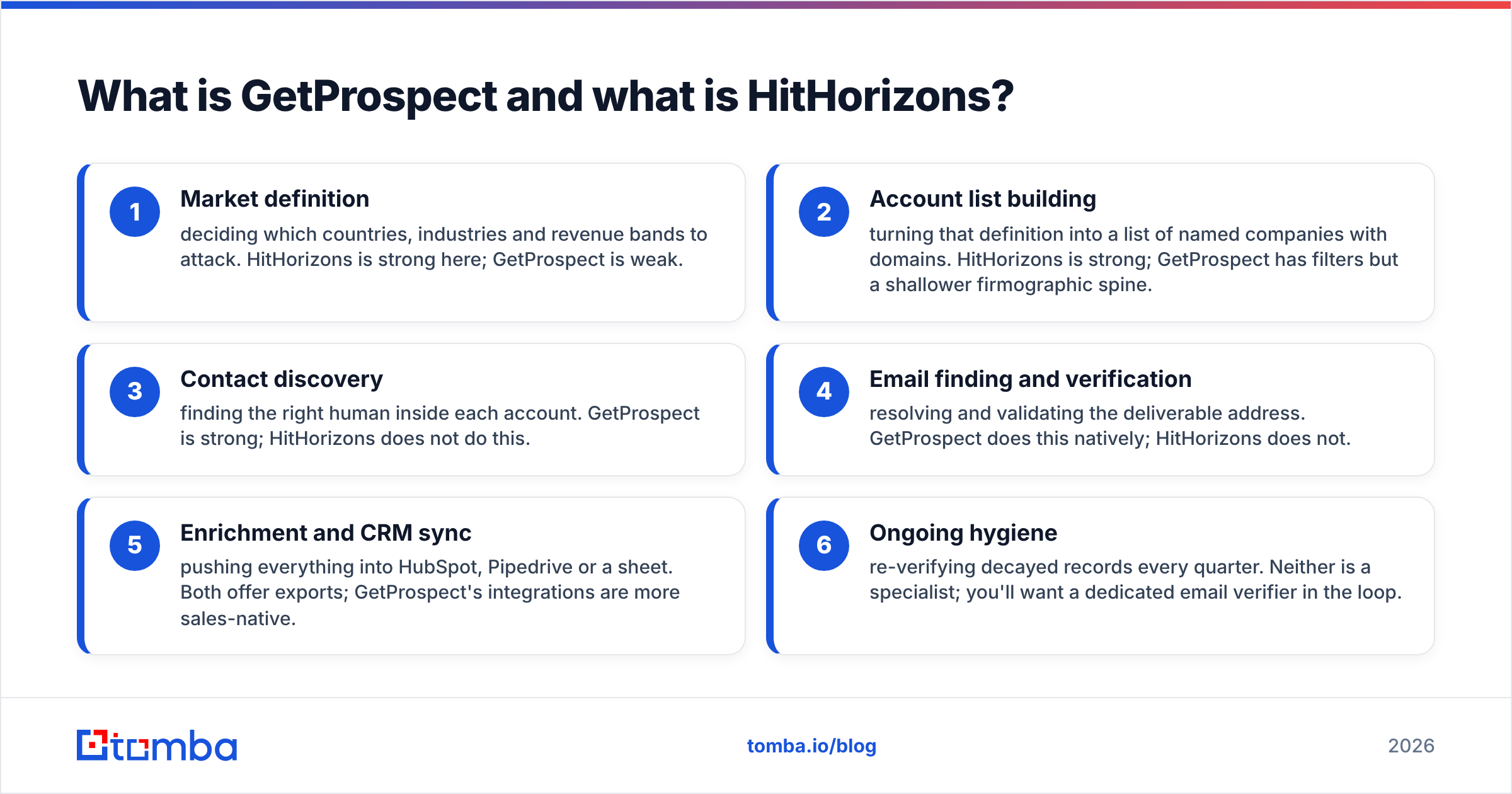
Here is how the two map onto the prospecting workflow:
- Market definition — which countries, industries and revenue bands to attack. HitHorizons is strong here. GetProspect is weak.
- Account list building — turning that definition into named companies with domains. HitHorizons is strong. GetProspect has filters, but a thinner firmographic spine.
- Contact discovery — finding the right human inside each account. GetProspect is strong. HitHorizons does not do this.
- Email finding and verification — resolving and validating the address. GetProspect does this natively. HitHorizons does not.
- Enrichment and CRM sync — pushing records into HubSpot, Pipedrive or a sheet. Both export. GetProspect's integrations are more sales-native.
- Ongoing hygiene — re-verifying decayed records each quarter. Neither is a specialist, so keep a dedicated email verifier in the loop.
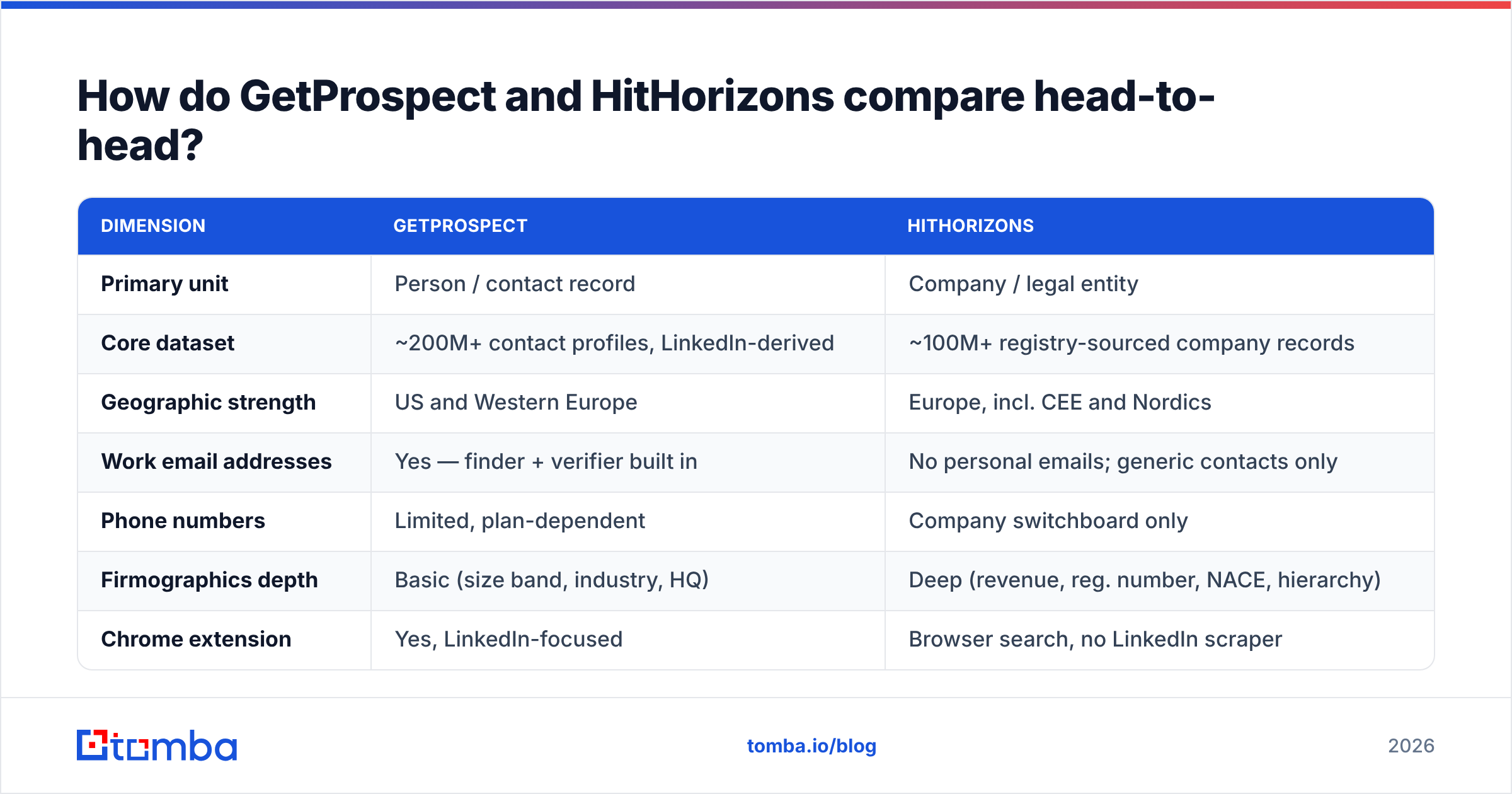
GetProspect vs HitHorizons: how do they compare head-to-head?#
| Dimension | GetProspect | HitHorizons |
|---|---|---|
| Primary unit | Person / contact record | Company / legal entity |
| Core dataset | ~200M+ contact profiles, LinkedIn-derived | ~100M+ registry-sourced company records |
| Geographic strength | US and Western Europe | Europe, incl. CEE and Nordics |
| Work email addresses | Yes — finder + verifier built in | No personal emails; generic contacts only |
| Phone numbers | Limited, plan-dependent | Company switchboard only |
| Firmographics depth | Basic (size band, industry, HQ) | Deep (revenue, reg. number, NACE, hierarchy) |
| Chrome extension | Yes, LinkedIn-focused | Browser search, no LinkedIn scraper |
| API | Yes, credit-metered | Yes, company search + profile endpoints |
| Free tier | ~50 valid emails/month | Free company search, limited profile detail |
| Best for | SDRs building contact lists | RevOps and analysts defining a TAM |
The row that matters most is work email addresses. Buy HitHorizons to run cold email and you will need a second tool within a week. Buy GetProspect for European registry-grade revenue filters and the segmentation will let you down.
Which one has better data accuracy?#
That question splits in two, because the tools measure different things.
HitHorizons accuracy is structural. Registry data is either current or stale. A company either filed its accounts or it didn't. Errors show up as old revenue figures (filings lag 6-18 months in most EU countries), missing domains for small firms, and duplicate records when a group has many subsidiaries. It is rarely wrong. It is sometimes old. For account planning, that is a fair trade.
GetProspect accuracy is a guess with odds. Like every email finder, it tests patterns (first.last@, f.last@, firstlast@) against a domain, then tries SMTP validation. The failure mode is harsher here. A bounce costs you sender reputation, not just a wasted minute. Independent tests of finders keep showing the same shape. Hit rates run high on US mid-market domains, then drop on small European businesses, catch-all domains and freemail-style setups.

Two accuracy rules survive every vendor's marketing:
- Never trust "verified" without a bounce guarantee. Ask what happens on a catch-all domain. Most finders return "accept-all" and still charge a credit for a coin flip. A dedicated catch-all verifier resolves a good share of those instead.
- Re-verify before every send, not at export time. B2B contact data decays about 2-2.5% a month as people change jobs. A list built in January is already rotten by June.
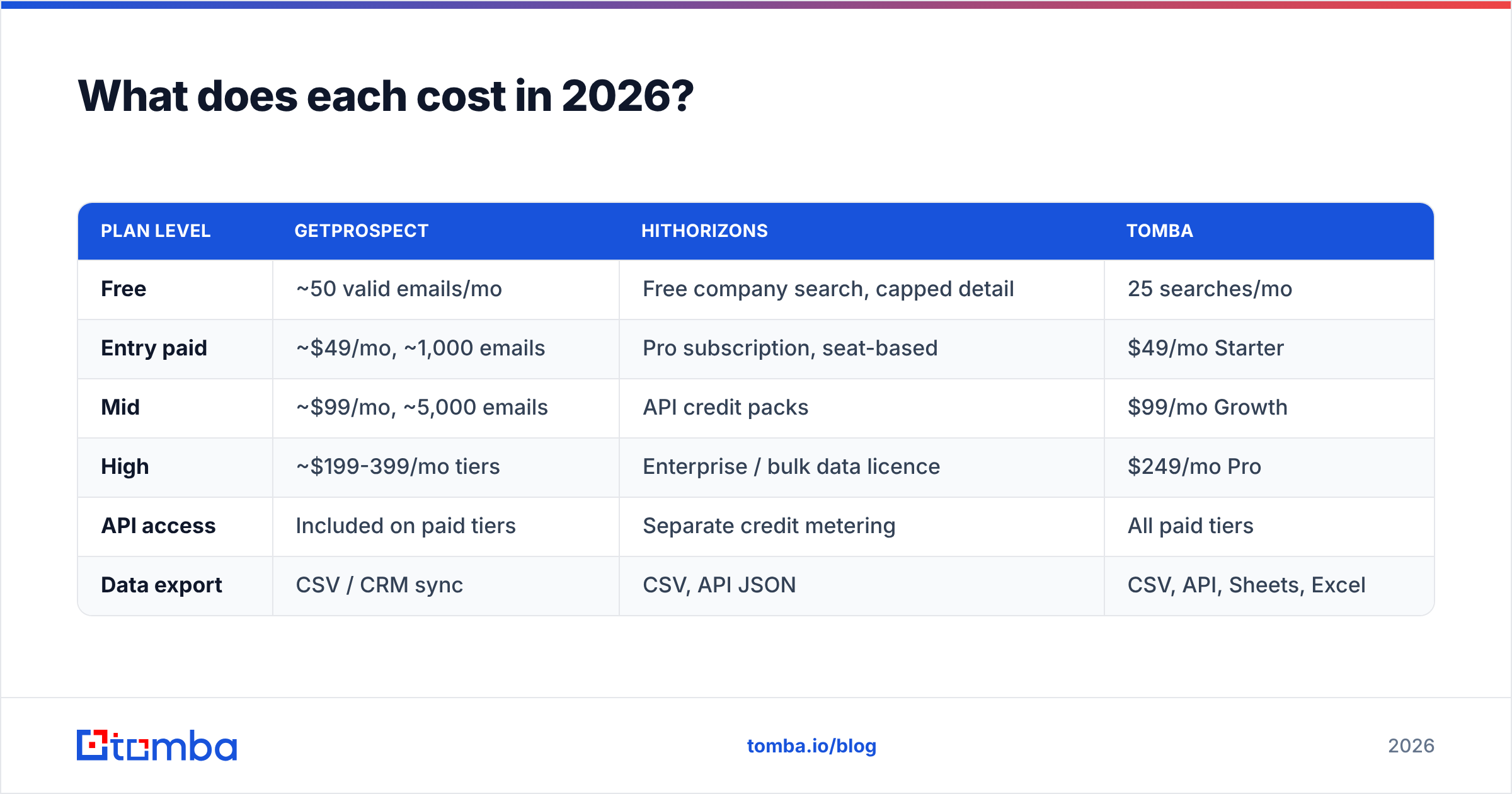
What does each cost in 2026?#
Pricing pages move. Treat these as shapes, not quotes, and check the vendor site before you buy.
| Plan level | GetProspect | HitHorizons | Tomba |
|---|---|---|---|
| Free | ~50 valid emails/mo | Free company search, capped detail | 25 searches/mo |
| Entry paid | ~$49/mo, ~1,000 emails | Pro subscription, seat-based | $49/mo Starter |
| Mid | ~$99/mo, ~5,000 emails | API credit packs | $99/mo Growth |
| High | ~$199-399/mo tiers | Enterprise / bulk data licence | $249/mo Pro |
| API access | Included on paid tiers | Separate credit metering | All paid tiers |
| Data export | CSV / CRM sync | CSV, API JSON | CSV, API, Sheets, Excel |
The sticker price is not the real comparison. Cost per usable record is. Say a $99 plan gives you 5,000 lookups, and 60% land on a valid, deliverable, still-employed contact. That works out to $0.033 per usable record. A cheaper plan that resolves 40% is not cheaper. Run 200 records through a free tier before you commit — see Tomba pricing for how a flat search-credit model compares to per-email credit burn.
One note on HitHorizons. It is a data-licensing product at heart. Heavy or programmatic use pushes you into a commercial agreement rather than a self-serve tier. Budget for a sales call if you want the full firmographic feed.
Who should choose GetProspect?#
Choose GetProspect if three or more of these are true:
- Your ICP is already set. You know the industries and sizes. You just need humans inside those accounts.
- Your team lives in LinkedIn. The extension-and-list workflow is where GetProspect feels good, and Sales Navigator exports are the main input.
- You want finding and verifying in one tab. Not best in class at either, but one login and one invoice.
- Your market skews US, UK, DACH or Benelux. Coverage thins out fast in CEE and southern Europe.
- Volumes are moderate. Under ~5,000 lookups a month, the credit math stays sane.
Where it frustrates people: bulk jobs that quietly burn credits on rows that never resolve, filters that feel coarse next to Apollo or Clay, and slow support on lower tiers. Those are normal trade-offs at this price, not dealbreakers.
Who should choose HitHorizons?#
Choose HitHorizons if:
- You are building a TAM model, not a call list. Revenue bands and registry IDs are what market sizing needs.
- Europe is your market. This is the strongest single argument for the product. Registry-sourced CEE and Nordic data is hard to buy anywhere else at self-serve prices.
- You need entity resolution. Legal names, registration numbers and parent-subsidiary links matter for KYC, credit, compliance and partner-channel work.
- Your CRM has messy company records. Registry identifiers are a cleaner dedupe key than fuzzy name matching.
Where it frustrates people: no contact-level data at all, filing lag on financials, and a UI built for research sessions rather than list-building sprints. It is a reference database that happens to help sales. It is not a sales tool.
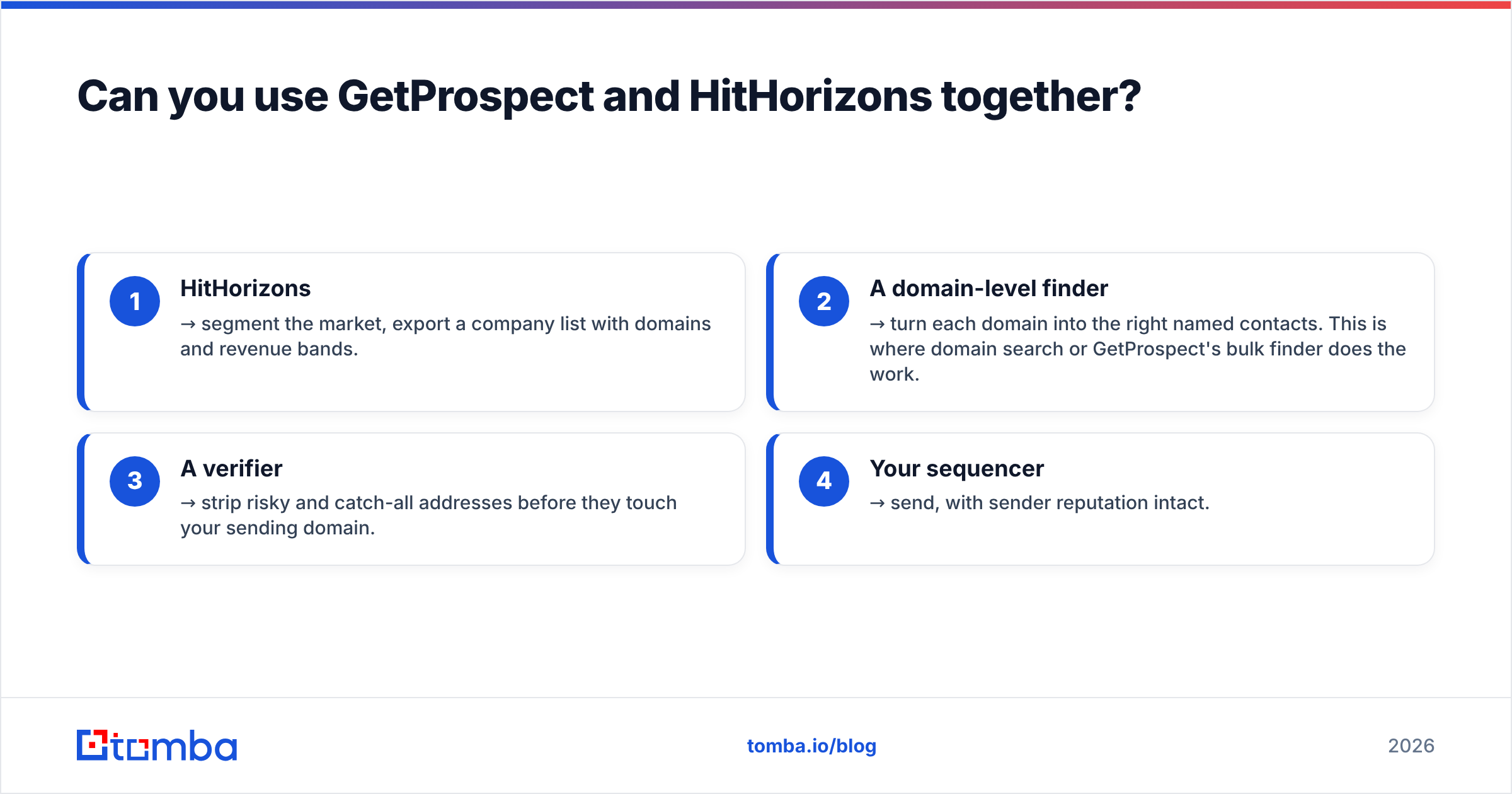
Can you use GetProspect and HitHorizons together?#
Yes. For European outbound teams, that is arguably the right read of GetProspect vs HitHorizons. The stack looks like this:
- HitHorizons → segment the market, export a company list with domains and revenue bands.
- A domain-level finder → turn each domain into the right named contacts. This is where domain search or GetProspect's bulk finder does the work.
- A verifier → strip risky and catch-all addresses before they touch your sending domain.
- Your sequencer → send, with sender reputation intact.
The real question is whether steps 2 and 3 need two paid subscriptions. Most teams under 20 seats do not. One finder-plus-verifier with a solid API covers the middle of that chain at a single price, and HitHorizons stays as the targeting layer.
What are the alternatives to both?#
Neither tool is your only option. An honest comparison names the rest of the field.

- Tomba — email finder, verifier, catch-all handling, domain search and data enrichment in one account. The free tier is 25 searches a month; Starter is $49/mo. Best fit if contacts are your gap and you want API access on every paid plan.
- BookYourData — pay-as-you-go B2B contacts with a bounce guarantee and no lock-in. Good if your buying is bursty rather than monthly. Records are verified on download, which removes a step.
- Apollo.io — the widest all-in-one: database, sequencer, dialer. Heavier, pricier, and you inherit a sending tool you may not want.
- Clay — best for orchestrating several data providers with waterfall enrichment. Powerful, but it is a build, not a purchase.
- Cognism / ZoomInfo — enterprise-grade, with mobile numbers and compliance workflows. Different budget category.
Check current sentiment on G2 before you commit. Category leaders shift every few quarters, and review recency beats star averages.
So which one actually wins?#
Verdict: GetProspect vs HitHorizons ends in a split. HitHorizons wins the targeting layer, GetProspect wins the contact layer, and neither wins outright — they answer different questions.
Forced to pick one? For a European outbound team that already knows who to sell to, GetProspect is the more useful buy. A contact without a company record still lets you send an email. A company record without a contact does not. For an analyst or a partnerships lead sizing an EU market, HitHorizons has no equal at its price.
The mistake is buying both by default. Find your real bottleneck first — targeting or contacting. Then buy the specialist for that half and keep the other half cheap.
If contacts are the bottleneck, start with the Tomba Email Finder. The free tier gives you 25 searches to test resolution rates on your own domain list. Starter is $49/mo. Finder, verifier, catch-all checks and API all sit under one login, so you can pair it with any company-data source without a third invoice.
Related guides#
Ready to find emails that actually work?
Join 150,000+ professionals who stopped guessing and started sending. Free credits on signup — no credit card required.
Get the Tomba newsletter
Practical outbound tactics and product updates — once every two weeks.
About the author