GetProspect vs Thomson Data: Which B2B Data Source Wins in 2026?
GetProspect sells self-serve prospecting credits. Thomson Data sells curated list builds. They solve different problems — here's which one fits your pipeline, and where a verification-first stack beats both.
TL;DR
- GetProspect is a self-serve LinkedIn-oriented email finder: you search, filter, export, and pay per credit. Good for reps who want to build their own lists today.
- Thomson Data is a list-vendor model: you brief a team, they assemble and deliver a targeted file (often with phone, install data, and industry codes). Good for one-off campaigns into niche verticals.
- They are not really competitors. One sells a tool, the other sells a deliverable. Choosing wrongly wastes months, not dollars.
- Both leave the same gap: verification at send time. Any list — scraped or purchased — decays 2-3% per month, and neither model guarantees the inbox on the day you actually email.
- The stack most teams land on: a self-serve finder for volume, a purchased file only for hard-to-reach verticals, and a dedicated verifier in front of the sending tool.
What are GetProspect and Thomson Data, exactly?#
Start with the business model, because that's the real difference.
GetProspect is a SaaS email finder. You log in, run a search by job title, company size, geography, or technology, and get back a list of contacts with work emails. There is a Chrome extension for pulling contacts off LinkedIn search results and profiles, a CRM-ish contact manager inside the app, and an API. You pay monthly for a credit allowance. Nobody at GetProspect knows what campaign you're running — the product is a self-service machine.
Thomson Data is a B2B data provider in the older sense of the phrase. You tell a sales rep what you need — "IT directors at US manufacturers with 200-1,000 employees running SAP" — and they come back with a quote and a file. The pricing is per record and negotiated, not published. The deliverable often includes fields a self-serve tool won't give you: direct dials, SIC/NAICS codes, revenue bands, technology installs, sometimes postal addresses for direct mail.
The mental model: GetProspect is a fishing rod. Thomson Data is a fish delivery service. Both feed you. Only one teaches you where the fish are, and only one gets you a specific fish you'd never catch yourself.

How do GetProspect and Thomson Data compare head-to-head?#
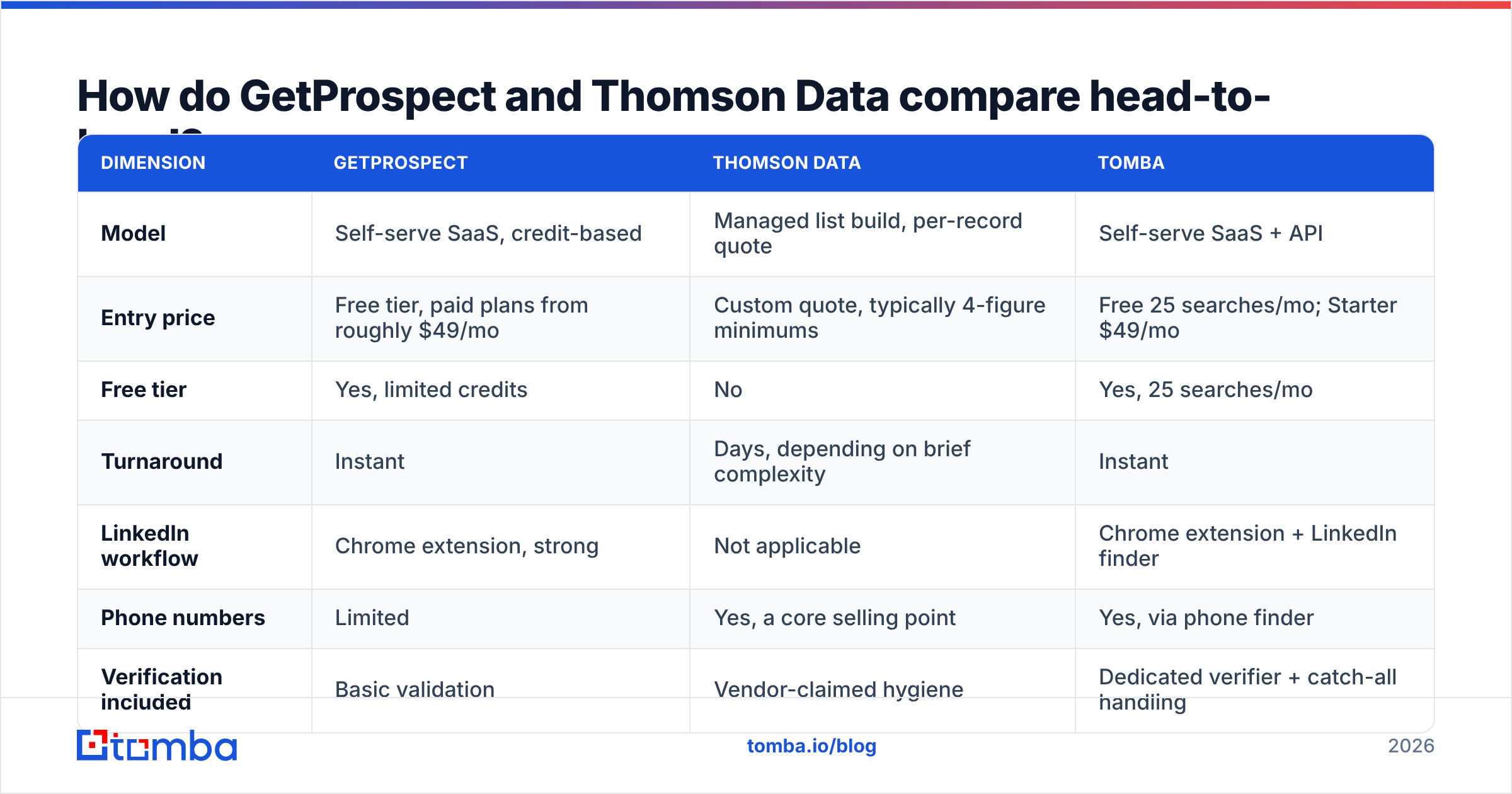
| Dimension | GetProspect | Thomson Data | Tomba |
|---|---|---|---|
| Model | Self-serve SaaS, credit-based | Managed list build, per-record quote | Self-serve SaaS + API |
| Entry price | Free tier, paid plans from roughly $49/mo | Custom quote, typically 4-figure minimums | Free 25 searches/mo; Starter $49/mo |
| Free tier | Yes, limited credits | No | Yes, 25 searches/mo |
| Turnaround | Instant | Days, depending on brief complexity | Instant |
| LinkedIn workflow | Chrome extension, strong | Not applicable | Chrome extension + LinkedIn finder |
| Phone numbers | Limited | Yes, a core selling point | Yes, via phone finder |
| Verification included | Basic validation | Vendor-claimed hygiene | Dedicated verifier + catch-all handling |
| Best for | Reps building their own lists weekly | One-off campaigns into niche verticals | Ongoing outbound with API/automation |
| Data refresh | Continuous crawl | Refreshed at build time | Continuous, verified on request |
| API access | Yes | Rarely | Yes, documented |
Two rows deserve extra weight.
Turnaround. If your campaign brief changes weekly — new ICP test, new geography, new persona — a managed list build is structurally the wrong shape. You will spend more time in email threads with an account manager than in your sequencer. Conversely, if you need 8,000 verified contacts at manufacturing companies running a specific ERP, no self-serve filter set will get you there cleanly.
Verification. GetProspect validates at find time. Thomson Data hygiene-checks at build time. Neither validates at send time, and send time is the only moment that matters to your sender reputation.
Which one is more accurate?#
Honest answer: nobody outside the vendors can measure this cleanly, and any blog post claiming a precise accuracy percentage for both is guessing.
What you can measure is your own bounce rate, and here is what predicts it:
- Recency of the underlying signal. A contact scraped from a live LinkedIn profile last week beats a record refreshed at file-build time three months ago. Self-serve tools win on recency by default.
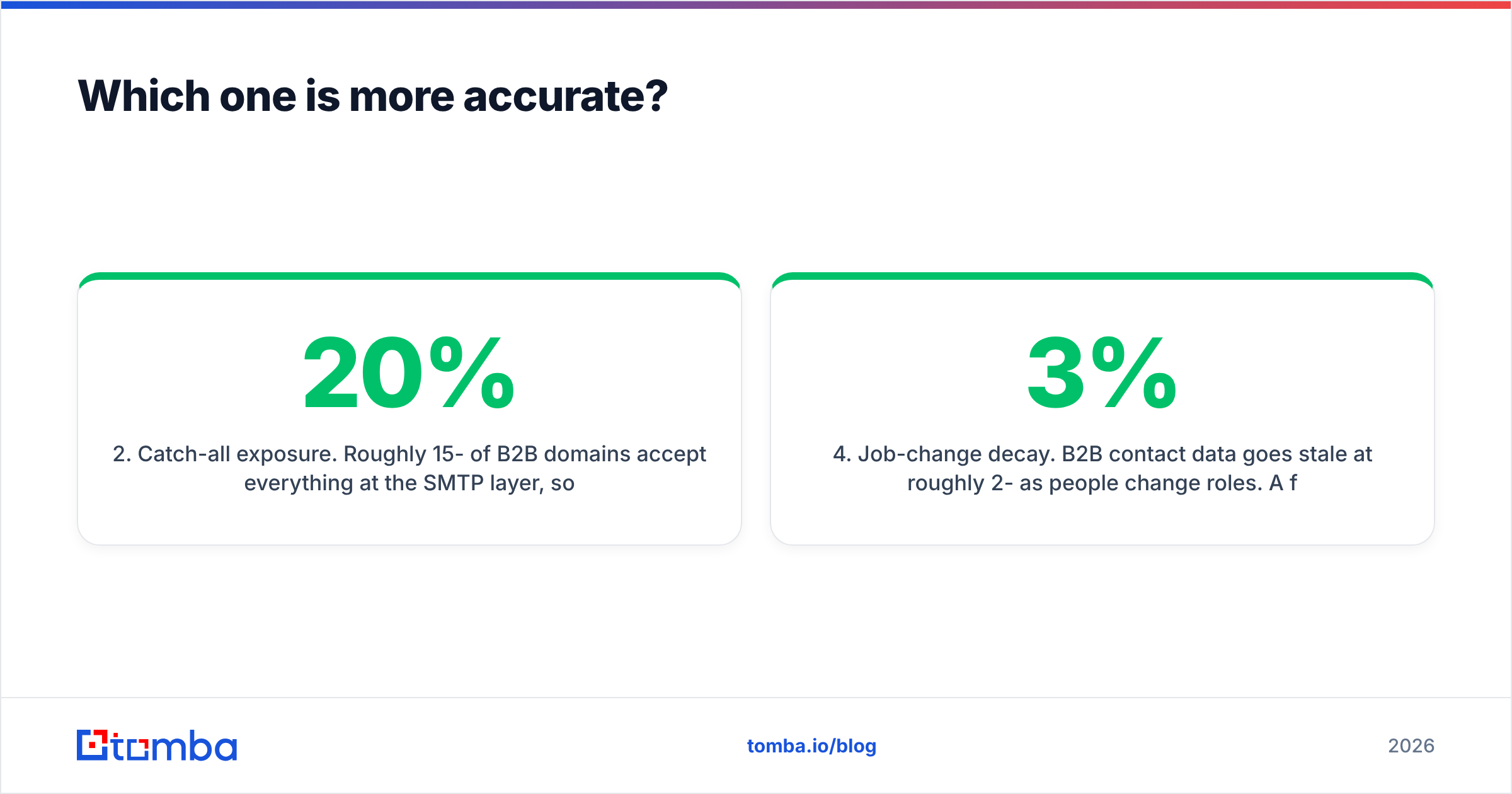
- Catch-all exposure. Roughly 15-20% of B2B domains accept everything at the SMTP layer, so a "valid" result is often unproven. If a vendor reports 98% valid but doesn't disclose its catch-all share, that number is inflated. A catch-all verifier is how you separate the two.
- Role-account contamination. info@, sales@, contact@ inflate record counts and destroy reply rates. Purchased files are more prone to this because volume is the pricing unit.
- Job-change decay. B2B contact data goes stale at roughly 2-3% per month as people change roles. A file bought in January is materially worse in June, whether or not anyone touched it.
- Verification method. MX + SMTP handshake + pattern confidence beats regex-only checks by a wide margin.
A practical rule: whichever source you buy from, run the export through an independent email verifier before it enters your sequencer. Vendors grade their own homework. Your ESP does not care whose fault the bounce was.
When should you buy a list instead of building one?#
Buying makes sense in narrower cases than most teams assume. Thomson Data and similar vendors earn their fee when:
- Your ICP is defined by attributes public sources don't expose. Install base, revenue band, franchise count, licence type, fleet size. Filters in a self-serve tool won't reconstruct this.
- You need phone-first coverage. If your motion is dial-then-email, a managed provider that guarantees direct dials is usually cheaper per connected call than stitching a self-serve finder to a separate phone data source.
- You are running a one-off event or ABM push. A single 3,000-record file for a trade show has a defined end. Paying a monthly SaaS fee for a one-week need is worse economics.
- You need offline channels. Postal addresses for direct mail are outside almost every self-serve tool's scope.
- Compliance requires documented provenance. Regulated buyers sometimes need a contract naming the data source. A credit-based SaaS export gives you a CSV, not a chain of custody.
Outside those five, building is nearly always better: cheaper per contact, fresher, and infinitely re-runnable when the ICP shifts.
What does each one actually cost?#
GetProspect publishes tiered plans starting in the same range as most email finders — a free tier with a small monthly credit allowance, then paid plans that scale with export volume. Costs rise when you need bulk exports, team seats, or higher API throughput.
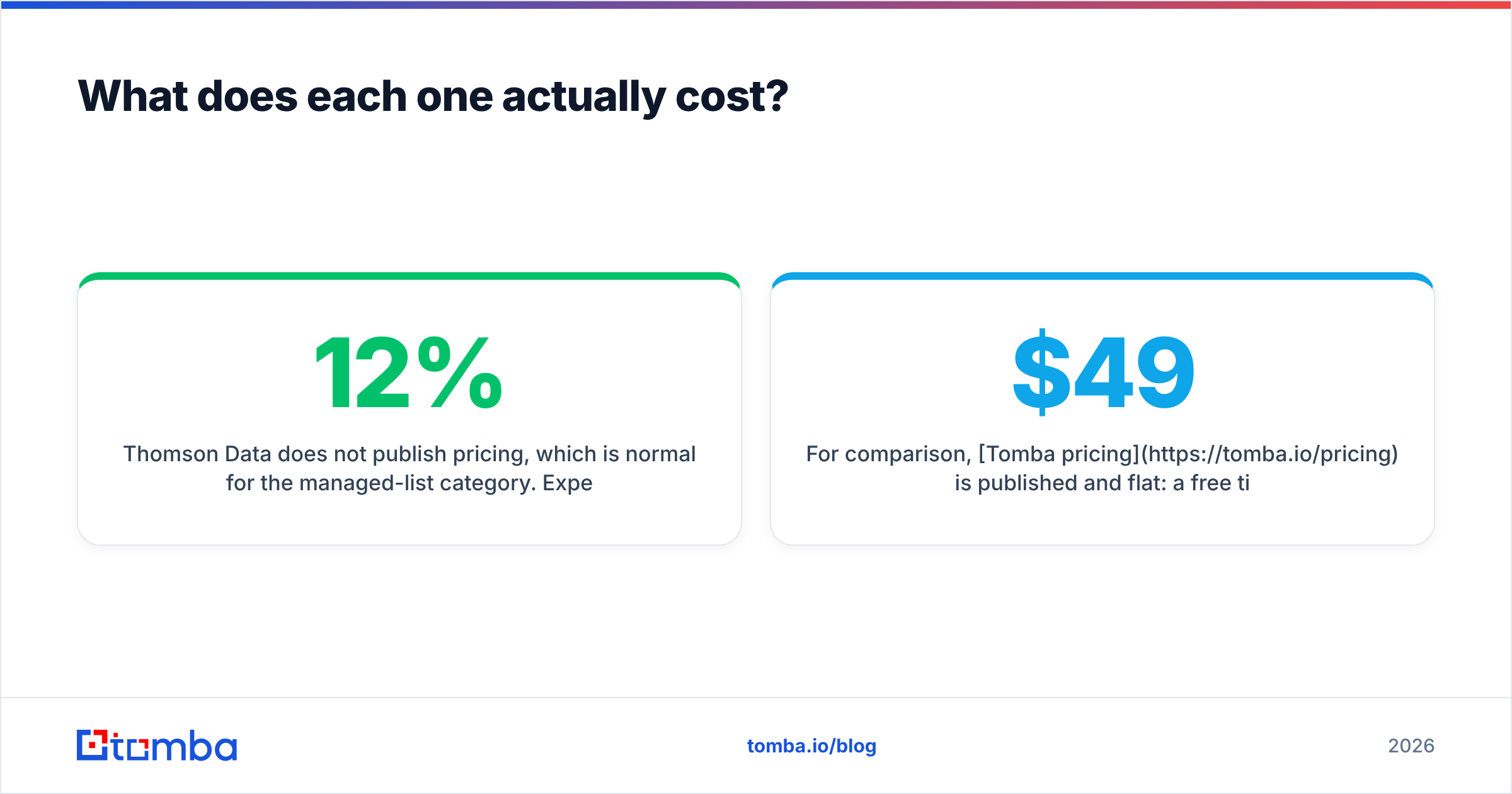
Thomson Data does not publish pricing, which is normal for the managed-list category. Expect a per-record price that falls as volume rises, and a project minimum. The trap is not the sticker price — it's the cost per usable record. If you pay for 10,000 records, 12% bounce, 9% are role accounts, and 20% fall outside your true ICP on inspection, your effective cost per usable contact is roughly 1.7x what the invoice says. Always divide by usable, not delivered.
For comparison, Tomba pricing is published and flat: a free tier at 25 searches per month, Starter at $49/mo, Growth at $99/mo, Pro at $249/mo, and custom Enterprise. Verification, domain search, and enrichment sit on the same credit pool rather than being sold as separate line items — which matters when you're modelling cost per usable record rather than cost per raw record.
Worth naming the third option honestly: providers like BookYourData sit between the two models — self-serve checkout with pre-built, human-verified lists and a published per-record price. If your objection to Thomson Data is the sales cycle rather than the list-buying model itself, that middle lane is a real answer and worth a look before you rule out purchased data entirely.
How do you build a stack that beats either one alone?#
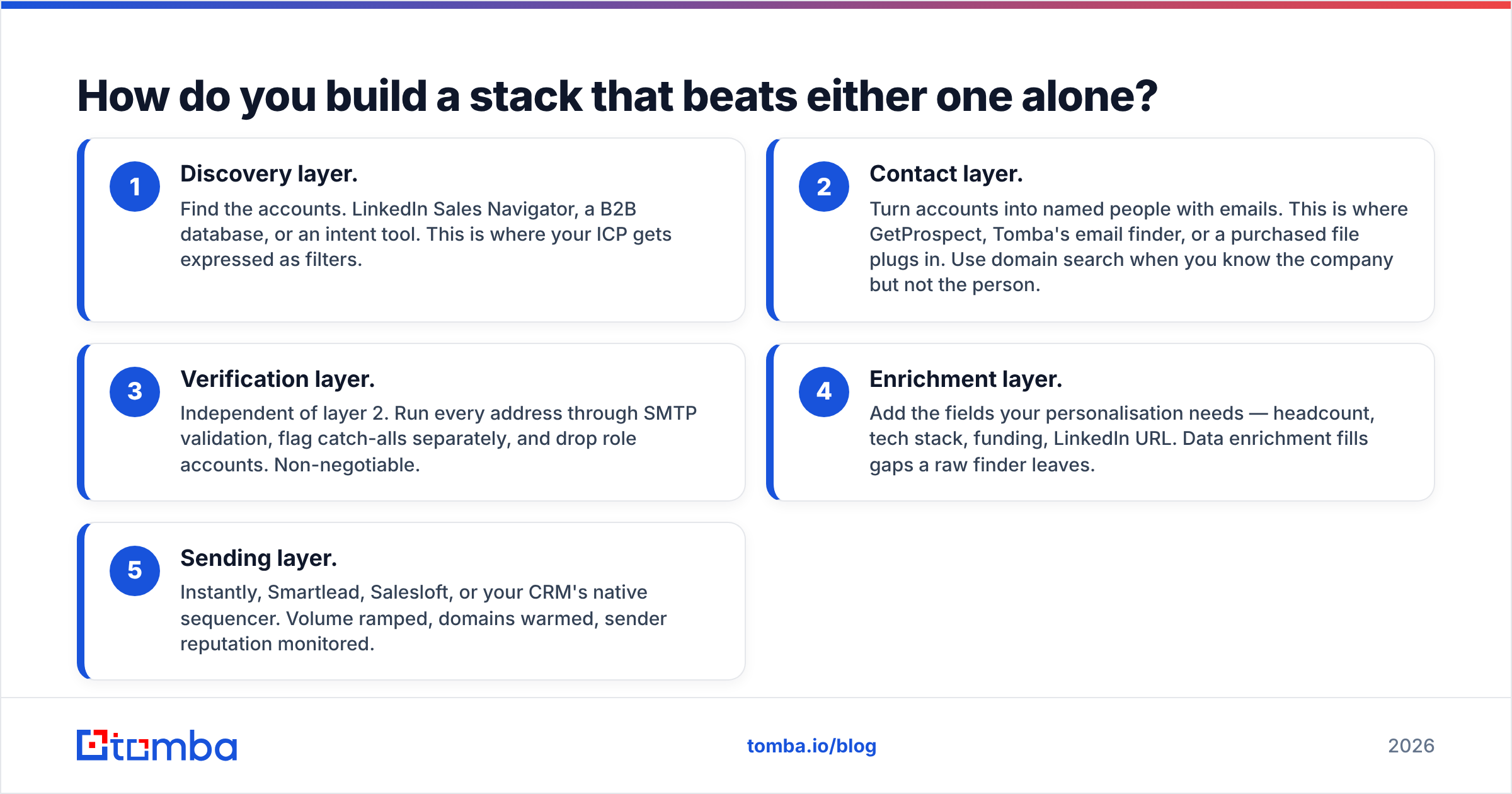
Most teams that get outbound working don't pick a winner. They assemble a chain:
- Discovery layer. Find the accounts. LinkedIn Sales Navigator, a B2B database, or an intent tool. This is where your ICP gets expressed as filters.
- Contact layer. Turn accounts into named people with emails. This is where GetProspect, Tomba's email finder, or a purchased file plugs in. Use domain search when you know the company but not the person.
- Verification layer. Independent of layer 2. Run every address through SMTP validation, flag catch-alls separately, and drop role accounts. Non-negotiable.
- Enrichment layer. Add the fields your personalisation needs — headcount, tech stack, funding, LinkedIn URL. Data enrichment fills gaps a raw finder leaves.
- Sending layer. Instantly, Smartlead, Salesloft, or your CRM's native sequencer. Volume ramped, domains warmed, sender reputation monitored.
The failure mode almost every team hits is collapsing layers 2 and 3 into one vendor and trusting the result. Whether the source is scraped or purchased, an independent verification pass in front of the sequencer is the single highest-ROI step in the chain. G2's category listings are a reasonable place to sanity-check vendor claims against unfiltered user reviews before you commit budget to any layer.
Which should you choose?#
Choose GetProspect if your reps build lists themselves, weekly, from LinkedIn. The extension workflow is the product's real strength, and self-serve credits match a motion where the ICP keeps shifting. You will still want an external verifier in front of your sequencer.
Choose Thomson Data if your target list is defined by attributes no public filter exposes, you need direct dials at volume, or you're running a bounded campaign where a one-time file beats an ongoing subscription. Ask for a sample of 100 records before signing, verify that sample independently, and negotiate on the verified rate — not the promised one.
Choose neither as your whole stack. The genuinely bad outcome is picking one vendor and treating its output as clean. Whichever you buy, the layer that protects your domain is verification, and it belongs to you, not the vendor.
If you're in the "build, don't buy" camp and want one credit pool covering finding, verifying, and enriching rather than three invoices, start with the Tomba Email Finder. The free tier gives you 25 searches a month — enough to run the same 100-contact test against your own ICP that you'd demand from any list vendor, before you spend anything. Run that test on both sides. The bounce report will tell you more than any comparison table, including this one.
Related guides#
Ready to find emails that actually work?
Join 150,000+ professionals who stopped guessing and started sending. Free credits on signup — no credit card required.
Get the Tomba newsletter
Practical outbound tactics and product updates — once every two weeks.
About the author