Goava vs Seamlessai 2026: Which B2B Data Tool Wins?
Goava is a Nordic-focused sales intelligence engine. Seamless.AI is a US-heavy contact database with an AI search layer. They solve different problems — here's which one fits your pipeline, and what each actually costs.
Goava vs Seamlessai is not a fair fight, because the two tools do different jobs. Goava tells a Nordic team which accounts to call. Seamless.AI hands a US team a pile of contacts. Pick the one that matches your gap, not the one with the better demo.
TL;DR
- Goava is a Nordic-first sales intelligence platform: company data, buying signals, and AI-driven account recommendations for Sweden, Norway, Denmark, and Finland. It is an account-selection tool, not a global contact database.
- Seamless.AI is a US-heavy B2B contact database with an AI search layer that assembles emails and phone numbers on demand. Volume is high; reported accuracy is uneven.
- They are not really the same product. If your ICP is Nordic mid-market, Goava wins on relevance. If you need North American contact volume inside a sequencer, Seamless.AI is the closer fit.
On cost:
- Both bundle account data and contact data into one price. If you only need verified emails, you are overpaying — a dedicated email finder plus a free CRM data layer usually costs less.
- Pricing transparency is the real differentiator: neither publishes full per-seat numbers, both push annual contracts, and Seamless.AI's credit model has bitten enough buyers to show up in G2 reviews.
What is Goava and who actually uses it?#
Goava is a Swedish sales intelligence platform built around one question: which companies should you call this week? It pulls in registry data, financials, tech signals, and news from across the Nordics. Then it scores accounts against your current customer base and pushes the best ones into your CRM.
Think of it like a real-estate agent who knows one city block by heart. Ask about that block and the detail is extraordinary. Ask about another continent and there is nothing to give.
The typical Goava buyer is a Nordic B2B sales team — SaaS, staffing, industrial services, media — selling into Swedish or Norwegian companies with 10 to 500 employees. The platform's core value is account prioritization: it tells you that a mid-size logistics firm in Gothenburg just posted three warehouse-ops job ads and grew revenue 22% year over year, so it belongs at the top of today's list.
What Goava is not: a global person-level contact database. Contact coverage is thinner than the company layer, and outside the Nordics the dataset drops off sharply.
What is Seamless.AI and how does its data actually work?#
Seamless.AI takes the opposite approach. Instead of curating one region deeply, it runs a real-time search engine that assembles contact records on demand — scraping, inferring, and pattern-matching email addresses and phone numbers at the moment you query.
That architecture explains both its strengths and its complaints. Coverage is enormous, especially for US-based mid-market and enterprise roles. But "assembled at query time" means some records are guessed, not confirmed. Buyers often report bounce rates well above what the marketing suggests. Read enough G2 reviews and a pattern emerges: people love the volume, then get frustrated by list hygiene and the credit accounting.
Seamless.AI also sells a Chrome extension, a "Buyer Intent" add-on, a writer tool, and data enrichment as separate line items. The base seat gets you search; the useful parts are frequently upsells.
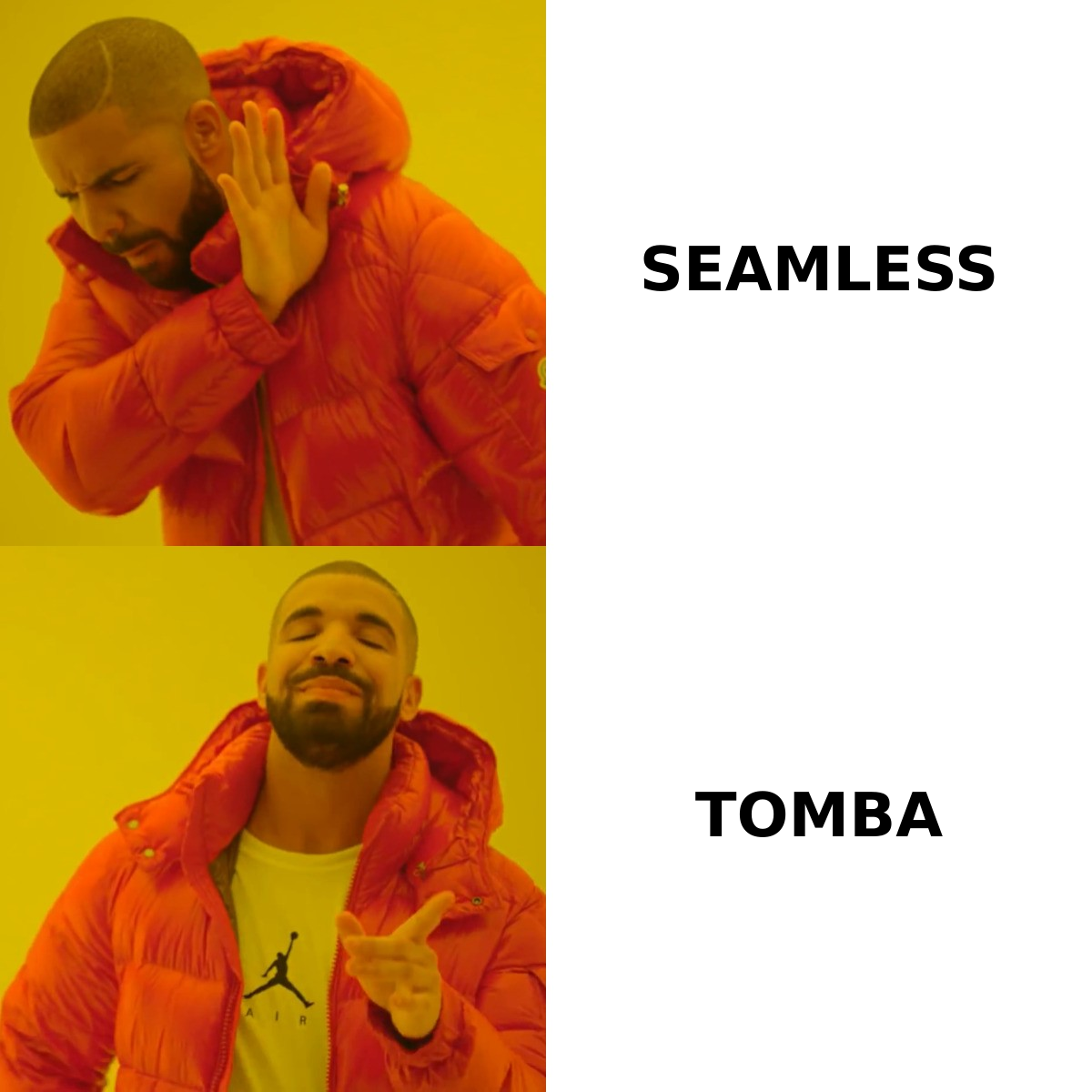
Goava vs Seamlessai: how do they compare head to head?#
Here is the honest side-by-side. Where a vendor does not publish a number, this says so rather than inventing one.
| Dimension | Goava | Seamless.AI |
|---|---|---|
| Primary strength | Nordic account intelligence + prioritization | US contact volume at scale |
| Geographic sweet spot | Sweden, Norway, Denmark, Finland | United States, secondary Canada/UK |
| Data model | Curated registry + signal data, refreshed | Real-time AI assembly at query time |
| Contact-level depth | Moderate; company layer is the strength | High volume, variable verification |
| Phone numbers | Company/switchboard-led | Direct dials available, quality varies |
| Buying signals | Core feature (hiring, financials, news, tech) | Intent sold as a paid add-on |
| Pricing model | Quote-based, per seat, annual | Credit packs + per seat, annual push |
| Published price | Not public | Not fully public; free tier ~50 credits |
| Free option | Demo/trial on request | Limited free plan with credit cap |
| CRM integrations | HubSpot, Salesforce, Pipedrive, Upsales | Salesforce, HubSpot, Outreach, Salesloft |
| Best for | Nordic ABM and territory planning | High-volume US outbound teams |
| Weakest for | Non-Nordic markets | Data hygiene, EU/APAC coverage |
Read that table twice before you take either demo. The row that decides most evaluations is the second one. A Stockholm SaaS company selling to Nordic manufacturers will get more usable pipeline from Goava's 40,000 well-understood accounts than from Seamless.AI's tens of millions of mostly-American records. A Denver sales team selling to US logistics will find the reverse.
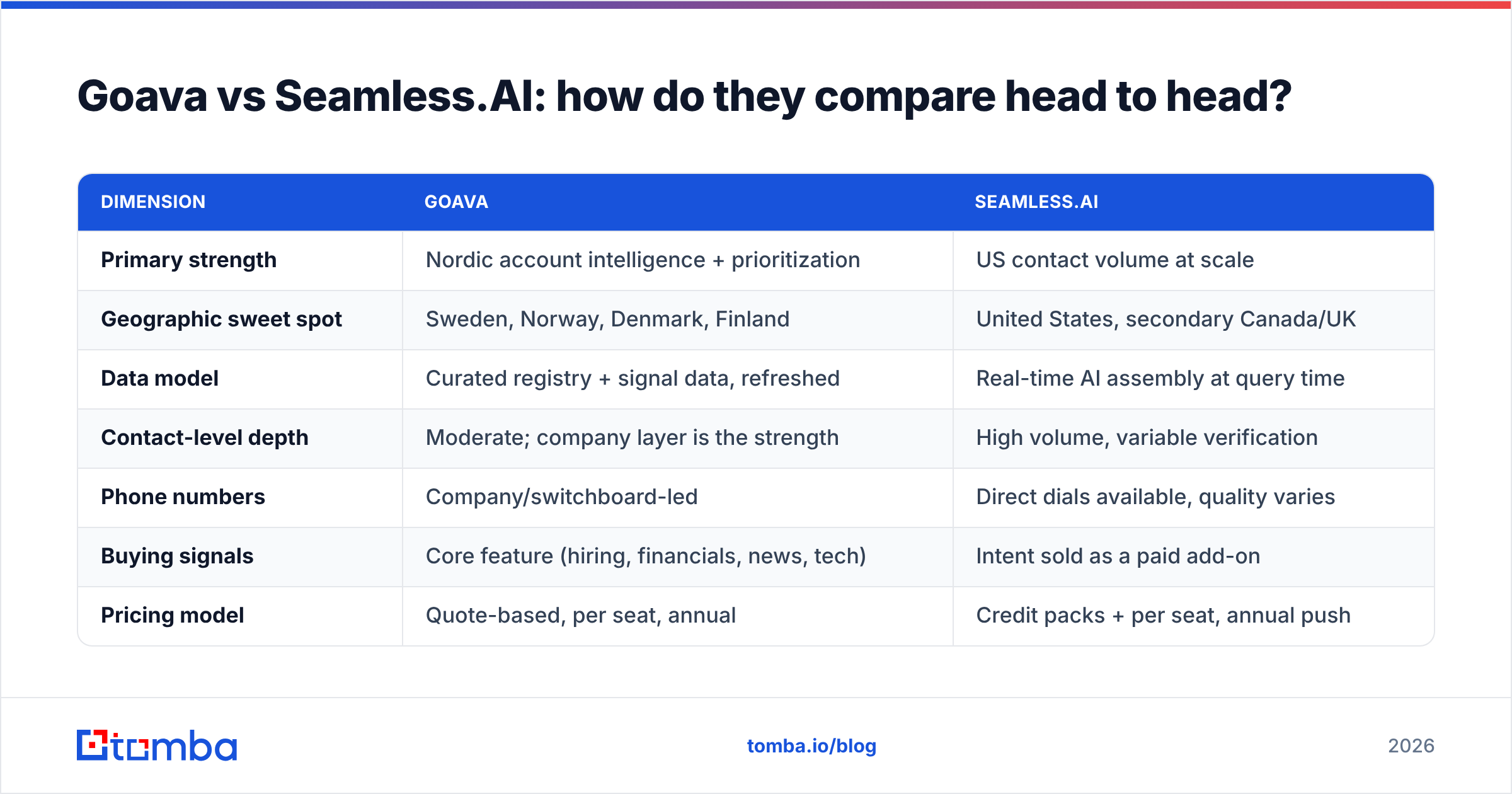
Which one has better data accuracy?#
Neither publishes an audited accuracy figure, so treat any number either sales rep quotes you as marketing until you test it.
What you can evaluate:
- Run the same 100-contact list through both. Same companies, same job titles. Export, then verify with a neutral third-party email verifier before sending a single message.
- Check the catch-all rate, not just the bounce rate. Many enterprise domains accept everything at the SMTP layer. A record that "passes" on a catch-all domain is unproven, not valid — that is what a catch-all verifier resolves.
- Look at recency, not just presence. Ask each vendor when the record was last confirmed. A 2023 email at a company with 40% annual churn is a coin flip.
- Test the roles you actually sell to. Coverage of VP Sales is not coverage of Head of Facilities. Every database has strong and thin verticals.
- Measure phone accuracy separately. Direct-dial claims collapse fastest under testing. Validate with a phone validator before your SDRs burn a week on dead numbers.
The pattern is simple. Goava's accuracy risk sits at the contact layer, because its company data comes from official Nordic registries that are hard to get wrong. Seamless.AI's risk sits in the inference step — an email built from a pattern guess is only as good as the pattern.
What do Goava and Seamless.AI actually cost in 2026?#
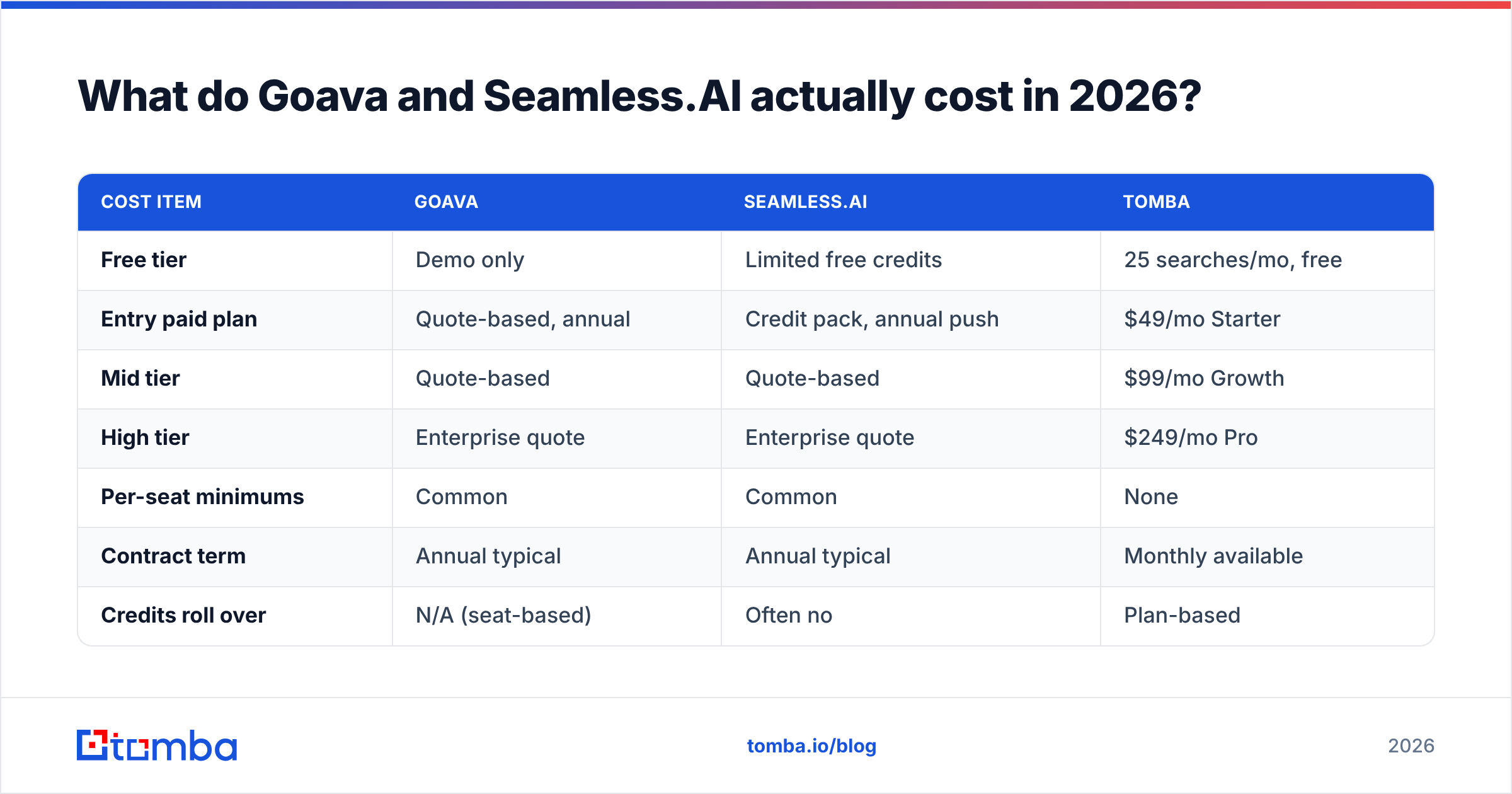
Neither vendor publishes a clean price list, which is itself a signal. Here is what buyers report and what to budget.
| Cost item | Goava | Seamless.AI | Tomba |
|---|---|---|---|
| Free tier | Demo only | Limited free credits | 25 searches/mo, free |
| Entry paid plan | Quote-based, annual | Credit pack, annual push | $49/mo Starter |
| Mid tier | Quote-based | Quote-based | $99/mo Growth |
| High tier | Enterprise quote | Enterprise quote | $249/mo Pro |
| Per-seat minimums | Common | Common | None |
| Contract term | Annual typical | Annual typical | Monthly available |
| Credits roll over | N/A (seat-based) | Often no | Plan-based |
| API access | Limited | Add-on | Included |
Two traps worth naming.
Trap one: the annual lock. Both platforms steer toward 12-month commitments, sometimes with the discount framed as the default price. If you are still validating your ICP, a year-long data contract is the wrong instrument. Ask explicitly for a quarterly term and note whether the rep flinches.
Trap two: credit burn on failed searches. Ask each vendor, in writing, whether a search that returns nothing still consumes a credit. The answer sets your real cost per usable contact, and it is rarely in the brochure. Compare against transparent Tomba pricing, where the tiers and limits are on the page before you talk to anyone.

Is there a better setup than either one?#
Often, yes. Most teams buying these platforms are really paying for two jobs at once, and they only need one of them done well.
Unbundle the job:
- Account selection — deciding which companies to target. Goava is genuinely strong here for the Nordics. Alternatives include your own CRM's closed-won analysis, LinkedIn Sales Navigator filters, or intent vendors.
- Contact discovery — getting a verified email or phone for a named person at a chosen company. This is a commodity function that a focused tool does cheaply and well.
- Enrichment and hygiene — keeping records fresh once they are in your CRM. A scheduled data enrichment job handles this without a per-seat platform fee.
If your bottleneck is "I know who to call, I just can't reach them," you do not need a $15k intelligence platform. You need a domain search to map a company's contacts, a verifier to keep bounce rates under 2%, and a bulk email finder for list runs. That stack starts at $49/mo and requires no annual signature.
If your bottleneck is "we're calling the wrong companies," then intelligence is the right purchase — and in the Nordics, Goava earns its price.
There is a third shape worth knowing. Specialist databases like BookYourData sell pay-as-you-go verified lists with no seat minimum. That suits teams running the odd campaign rather than constant outbound.
How should you run the evaluation?#
Do not take two demos and pick the better presenter. Run a controlled test.
- Define 50 target accounts that represent your real ICP — not your dream logos.
- Ask both vendors to return contacts for the same three job titles at those accounts during the trial.
- Verify every record independently. Neither vendor's own "verified" flag counts as evidence.
- Calculate cost per verified, reachable contact. Divide total annual cost by usable records, not by credits granted.
- Send 100 real emails from each list. Track bounce rate, spam-complaint rate, and reply rate. Protect your sender reputation by warming through a secondary domain if the lists are unproven.
- Score the workflow, not just the data. How many clicks from "found contact" to "sequenced contact"? Friction compounds over a year.
Most teams that run this test find the same thing. The expensive platform wins on one thing they care about. It loses on three they assumed were included.
Which should you choose?#
The goava vs seamlessai decision comes down to one question. Is your gap the account list, or the contact data?
Choose Goava if: your market is Nordic, your problem is account prioritization rather than contact discovery, and you have enough closed-won history for its scoring model to learn from. It is a good regional product. Most comparison articles just ask it to compete outside its lane.
Choose Seamless.AI if: you are running high-volume US outbound, your reps live in a sequencer, and you will tolerate list cleanup as a cost of doing business. Budget for a separate verification step — it is not optional at this volume.
Choose neither if: you already know your target accounts and simply need reliable contact data. That is the most common situation and the one both vendors are overpriced for.
What is the fastest way to test contact quality yourself?#
Start with the layer that is easiest to measure. Take 25 companies you already want to sell to, run them through Tomba's Email Finder, and check the results against whatever Goava or Seamless.AI returns in their trial. The free tier gives you 25 searches a month. No card, no annual contract. That is enough to answer the accuracy question before you sign anything.
If the verified-contact layer alone closes your gap, you have just saved a five-figure annual commitment. If it does not, you still walk into the negotiation with real numbers instead of a sales deck. That alone is worth the twenty minutes.
Related guides#
Ready to find emails that actually work?
Join 150,000+ professionals who stopped guessing and started sending. Free credits on signup — no credit card required.
Get the Tomba newsletter
Practical outbound tactics and product updates — once every two weeks.
About the author