Goava vs SMARTe (2026): Which B2B Data Platform Wins?
Goava is built for Nordic account intelligence. SMARTe is built for global contact data. We compare coverage, workflow fit, pricing models and where both leave gaps in your outbound stack.
TL;DR
- Goava is a Nordic-first sales intelligence platform. Its strength is account selection: which Swedish, Norwegian, Danish or Finnish companies you should call, ranked by fit signals pulled from local registries and web data.
- SMARTe is a global B2B contact data platform. Its strength is contact acquisition: work emails, mobile numbers and firmographics for buyers in North America, EMEA and APAC, surfaced through a browser extension and CRM push.
- They overlap less than the "Goava vs SMARTe" framing suggests. Goava answers who to target; SMARTe answers how to reach them.
- Neither publishes transparent list pricing. Both run annual, seat-based, quote-only contracts, which makes side-by-side cost comparison hard and makes a small pilot essential.
- If you mainly need verified email addresses at a predictable per-credit cost, a dedicated email finder sitting next to either platform is usually cheaper than expanding a seat count.
What are Goava and SMARTe?#
If you have landed on a Goava vs SMARTe comparison, you are probably solving one of two problems: you cannot decide which accounts deserve your reps' time, or you cannot get hold of the people inside those accounts. Each tool was built for a different half of that problem.
Goava is a Swedish sales intelligence company. It aggregates company data from Nordic sources — official business registries, financial filings, web technology signals, news and hiring activity — and layers a recommendation engine on top. The pitch is that the software learns from your closed-won accounts and then ranks the rest of the Nordic market by how closely they resemble your best customers. Reps get a prioritised list instead of an alphabetical one.
SMARTe is a B2B contact and account data provider with a much wider geographic footprint. It publishes coverage in the hundreds of millions of contact records across millions of companies, with a strong emphasis on direct dials and mobile numbers alongside business emails. The delivery model is familiar if you have used Apollo, Lusha or ZoomInfo: search the database, filter by title, industry, headcount and technology, then export or push straight into your CRM. A Chrome extension pulls contact details while you browse LinkedIn or a company site.
So the honest framing is not "which one is better." It is "which layer of your go-to-market data stack are you currently missing."
How do Goava and SMARTe compare head-to-head?#
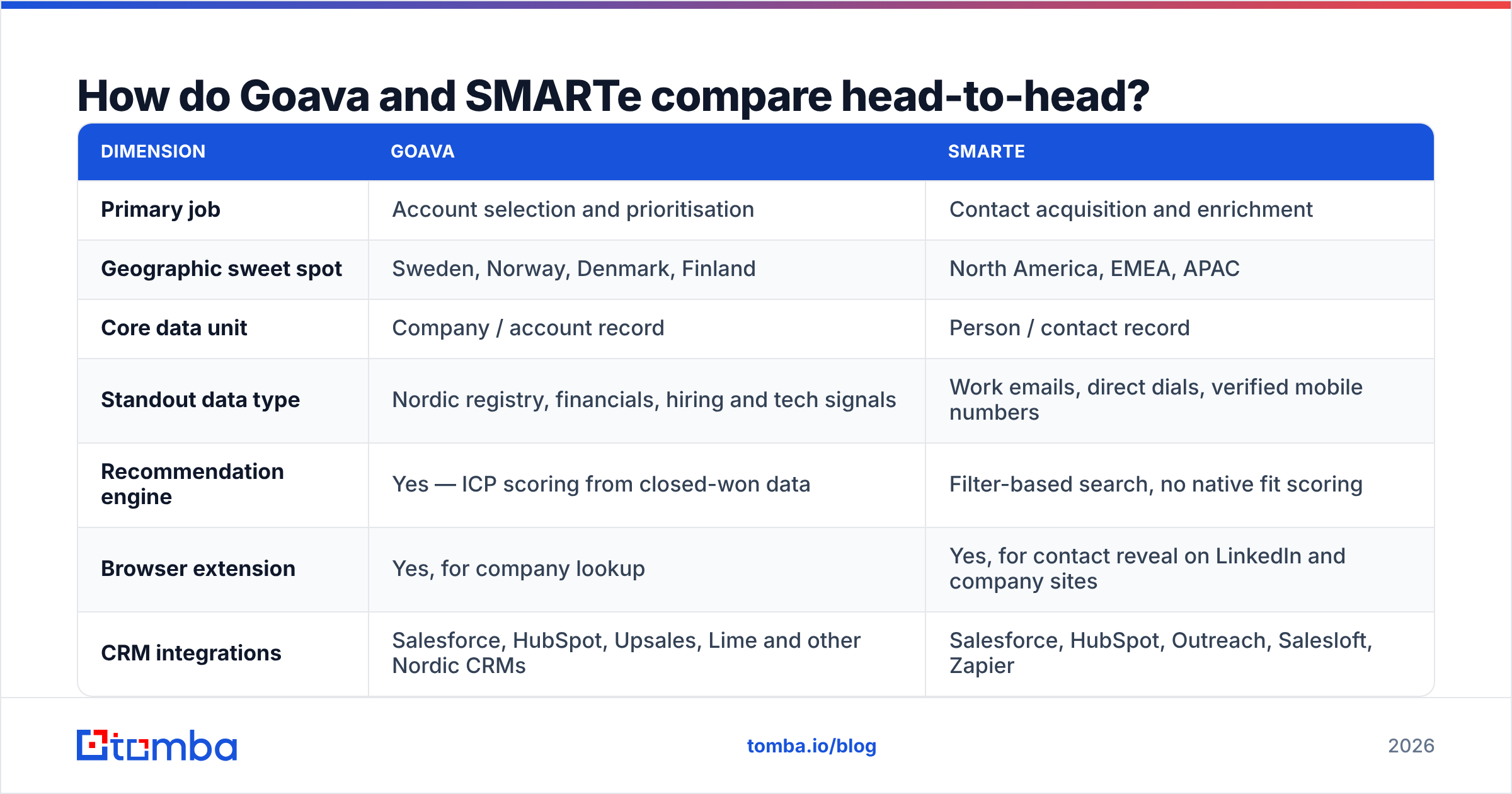
The table below is the fastest way to see where each platform actually earns its budget. Treat coverage numbers as vendor-published claims — both companies update them, and neither publishes an independent audit.
| Dimension | Goava | SMARTe |
|---|---|---|
| Primary job | Account selection and prioritisation | Contact acquisition and enrichment |
| Geographic sweet spot | Sweden, Norway, Denmark, Finland | North America, EMEA, APAC |
| Core data unit | Company / account record | Person / contact record |
| Standout data type | Nordic registry, financials, hiring and tech signals | Work emails, direct dials, verified mobile numbers |
| Recommendation engine | Yes — ICP scoring from closed-won data | Filter-based search, no native fit scoring |
| Browser extension | Yes, for company lookup | Yes, for contact reveal on LinkedIn and company sites |
| CRM integrations | Salesforce, HubSpot, Upsales, Lime and other Nordic CRMs | Salesforce, HubSpot, Outreach, Salesloft, Zapier |
| API access | Available on higher tiers | Available, enrichment-oriented |
| Pricing model | Quote-only, seat-based annual | Quote-only, credit and seat based |
| Free self-serve tier | No | No (trial / sample data on request) |
| Best for | Nordic mid-market and enterprise sales teams | Global outbound and demand-gen teams |
Two rows deserve attention before you book demos.
First, geography is the real decision axis. Goava's advantage compounds inside the Nordics because it pulls from data sources that global vendors index thinly — Bolagsverket-style registry filings, Nordic financial statements, local news. Take the same product to a US-heavy target list and that advantage largely disappears. SMARTe runs the opposite trade: broad international reach, less depth on any single small market.
Second, neither vendor publishes a price page. That is normal in this segment, but it means your evaluation timeline includes a sales cycle, and your renewal includes a negotiation. Budget for both.

What data does each platform actually give you?#
Strip away the marketing and a B2B data platform is a bundle of five distinct assets. Score each vendor separately on all five instead of accepting a single overall verdict.
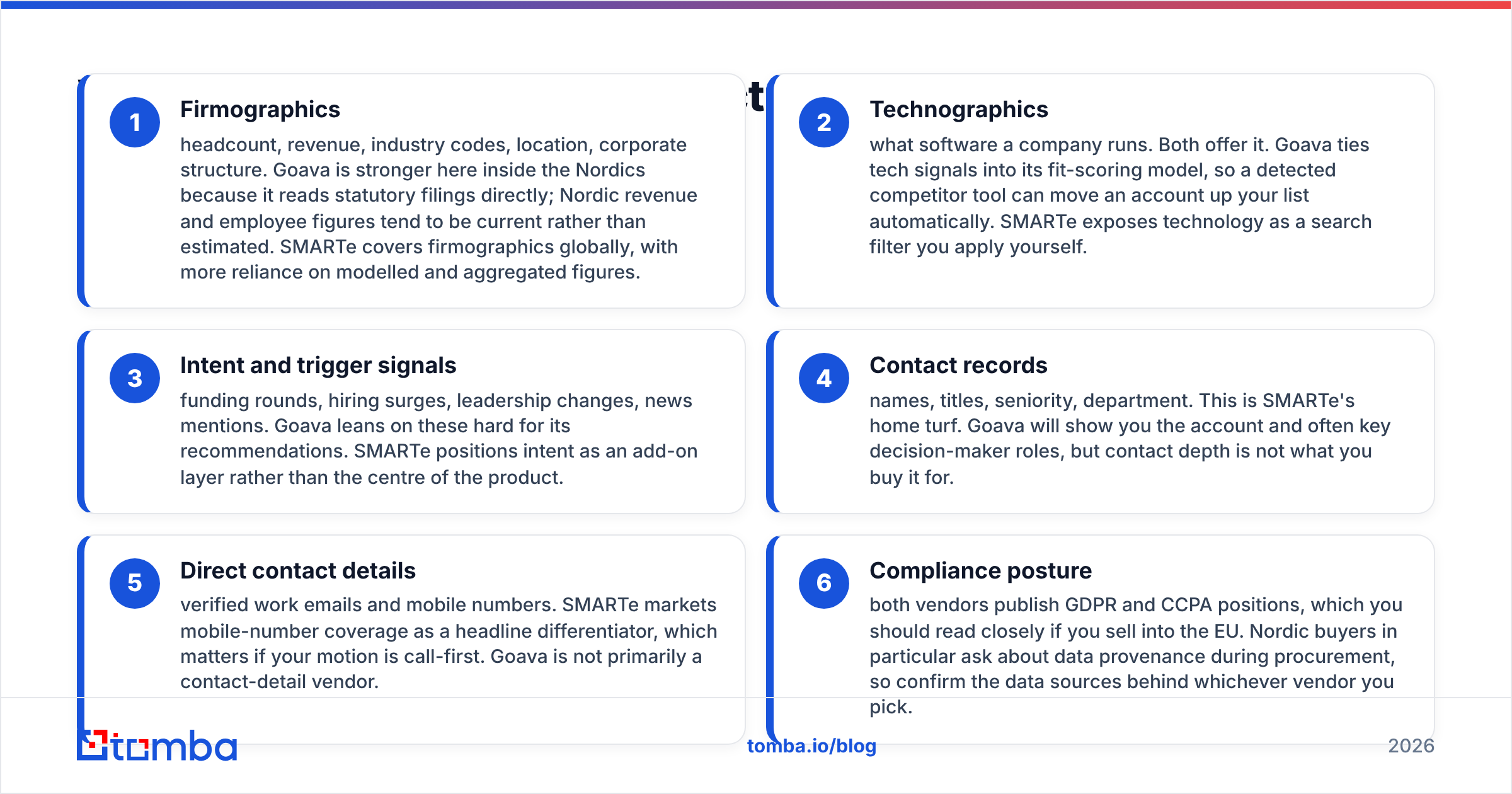
- Firmographics — headcount, revenue, industry codes, location, corporate structure. Goava is stronger here inside the Nordics because it reads statutory filings directly; Nordic revenue and employee figures tend to be current rather than estimated. SMARTe covers firmographics globally, with more reliance on modelled and aggregated figures.
- Technographics — what software a company runs. Both offer it. Goava ties tech signals into its fit-scoring model, so a detected competitor tool can move an account up your list automatically. SMARTe exposes technology as a search filter you apply yourself.
- Intent and trigger signals — funding rounds, hiring surges, leadership changes, news mentions. Goava leans on these hard for its recommendations. SMARTe positions intent as an add-on layer rather than the centre of the product.
- Contact records — names, titles, seniority, department. This is SMARTe's home turf. Goava will show you the account and often key decision-maker roles, but contact depth is not what you buy it for.
- Direct contact details — verified work emails and mobile numbers. SMARTe markets mobile-number coverage as a headline differentiator, which matters if your motion is call-first. Goava is not primarily a contact-detail vendor.
- Compliance posture — both vendors publish GDPR and CCPA positions, which you should read closely if you sell into the EU. Nordic buyers in particular ask about data provenance during procurement, so confirm the data sources behind whichever vendor you pick.
The practical consequence: a lot of teams that "compared Goava vs SMARTe" ended up buying neither exclusively. They bought account intelligence from one layer and contact data from another, because a single seat rarely covers both jobs well.
Is Goava better than SMARTe for Nordic prospecting?#
Yes, if your pipeline is genuinely Nordic — and that qualifier is doing real work.
Goava was built around the assumption that Nordic company data is public, structured and reliable, which it largely is. Swedish and Norwegian registry data includes filed annual accounts, board composition and ownership links. A platform that ingests those filings can tell you that a 60-person logistics company in Gothenburg grew revenue 22% last year and just hired its first CTO. A global database will often show you a stale headcount band and an industry code.
The recommendation engine is the second reason. Instead of asking a rep to build filters, Goava ingests your CRM's closed-won accounts and ranks the addressable market by similarity. For teams without a RevOps function to maintain segmentation logic, that removes real friction. Reviews on G2 consistently praise the account-prioritisation experience and are more mixed on contact-level depth — which tracks with how the product is designed.
Where Goava is the weaker choice:
- You sell outside the Nordics. Coverage thins fast once you cross into DACH, southern Europe or North America.
- You need contact details at volume. Goava will point you at the right company; you still need email addresses for the five people on the buying committee.
- You want month-to-month flexibility. Annual, seat-based contracts are the norm here, so a two-rep experiment is expensive per seat.
Is SMARTe better for global outbound?#
For contact-led outbound across multiple regions, SMARTe is the more natural fit of the two.
The workflow is straightforward: define an ICP with filters, pull contacts, verify, push to your sequencer. The Chrome extension matters more than it sounds — reps living inside LinkedIn Sales Navigator get contact details without leaving the tab, which is the single biggest determinant of whether a data tool actually gets used after week three.
Mobile-number coverage is SMARTe's most-cited differentiator. If your team runs a genuine multi-channel motion where cold calling sits alongside email, that coverage is worth paying for, because mobile data is the hardest and most expensive category to source well.
Where SMARTe is the weaker choice:
- You need deep single-market intelligence. Broad international databases trade depth for reach. In a market like Finland or Denmark, a specialist will beat a generalist on freshness.
- You want fit scoring done for you. SMARTe gives you filters, not a ranked list derived from your closed-won data.
- Your credit consumption is spiky. Credit-based models punish unpredictable months, and unused credits often expire.

What do Goava and SMARTe cost in 2026?#
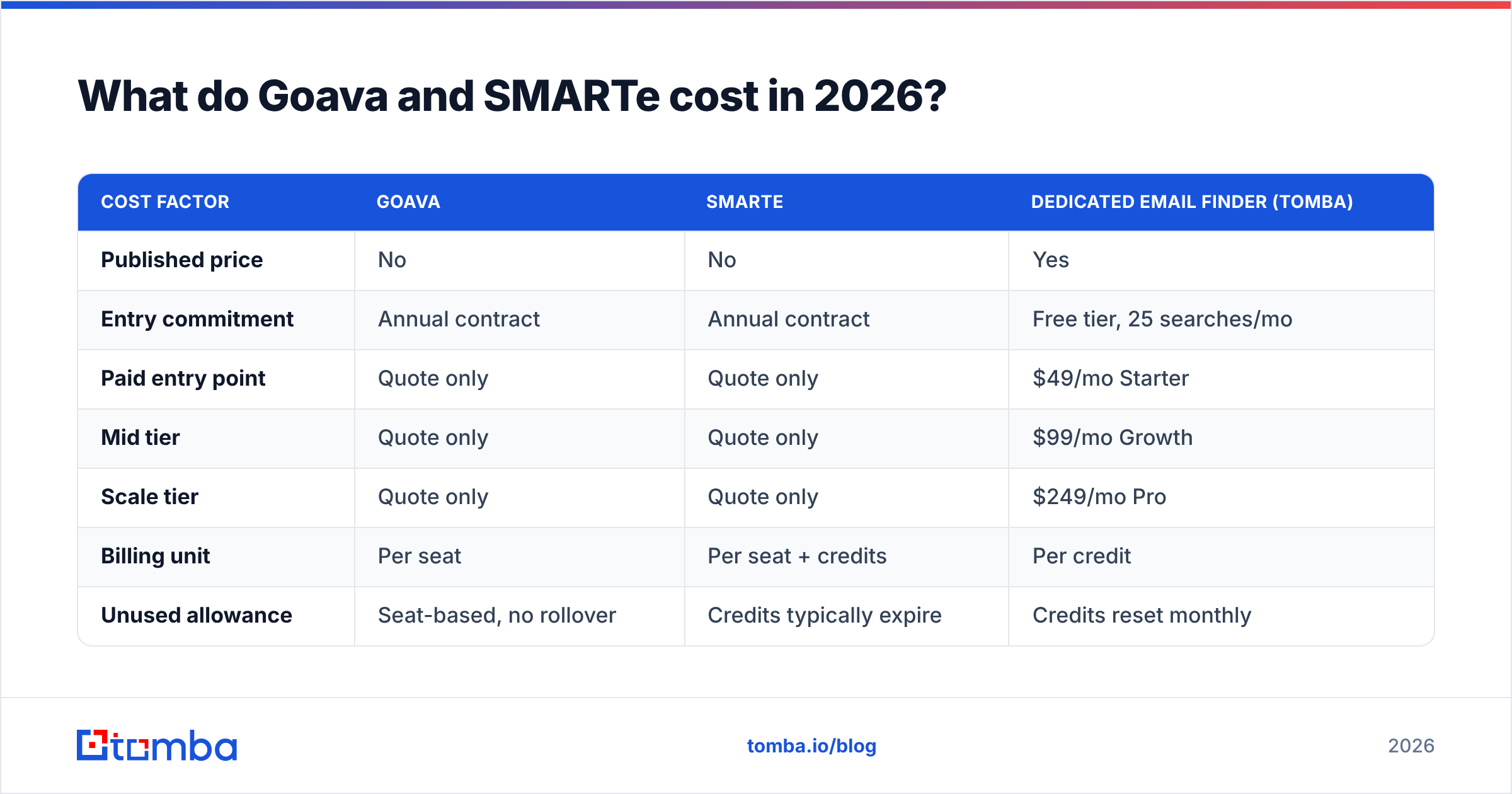
Neither vendor lists prices publicly, so any specific figure you read online is second-hand. What you can compare is the shape of the cost — and that is often more decision-relevant than the number.
| Cost factor | Goava | SMARTe | Dedicated email finder (Tomba) |
|---|---|---|---|
| Published price | No | No | Yes |
| Entry commitment | Annual contract | Annual contract | Free tier, 25 searches/mo |
| Paid entry point | Quote only | Quote only | $49/mo Starter |
| Mid tier | Quote only | Quote only | $99/mo Growth |
| Scale tier | Quote only | Quote only | $249/mo Pro |
| Billing unit | Per seat | Per seat + credits | Per credit |
| Unused allowance | Seat-based, no rollover | Credits typically expire | Credits reset monthly |
| Time to first data | Demo → proposal → onboarding | Demo → proposal → onboarding | Same day, self-serve |
This is where a lot of teams miscount. A quote-only platform is not just a higher price; it is a slower path to your first verified contact and a harder budget line to scale down when hiring pauses. If your immediate blocker is "we cannot get email addresses for the accounts we already know we want," the fastest fix is rarely another annual seat contract. Public, per-credit Tomba pricing starts at $49/mo for Starter, with a free tier that lets you test match rates on your own domain list before any conversation with a salesperson.
Where do both platforms leave a gap?#
Every account-intelligence and contact-database vendor shares the same structural weakness: records decay. Roughly a third of B2B contact data goes stale each year as people change roles, companies rebrand and mailboxes are deactivated. Neither Goava nor SMARTe re-verifies every record the moment you export it.
That produces three recurring failure modes.
- Bounces from stale exports. A contact pulled in January and sequenced in April is a coin flip. Running exports through an email verifier before send is the single highest-ROI step in the whole workflow, and it protects your sender reputation far more than any copy tweak.
- Catch-all domains reported as "valid." Many enterprise domains accept everything at the SMTP layer, so a generic verifier returns a false positive. A dedicated catch-all verifier resolves the ones that can be resolved instead of guessing.
- Missing contacts inside known accounts. Goava tells you the account is a fit. SMARTe covers many buyers but not all of them, especially in smaller European companies. When a specific person is missing, a targeted domain search against the company domain fills the hole faster than filing a data request.
The pattern that works in practice: use the platform you bought for the job it is genuinely good at, and bolt a cheap, API-accessible finder and verifier onto the export step. A Tomba API call inside your enrichment pipeline costs credits, not a seat.
Which one should you choose?#
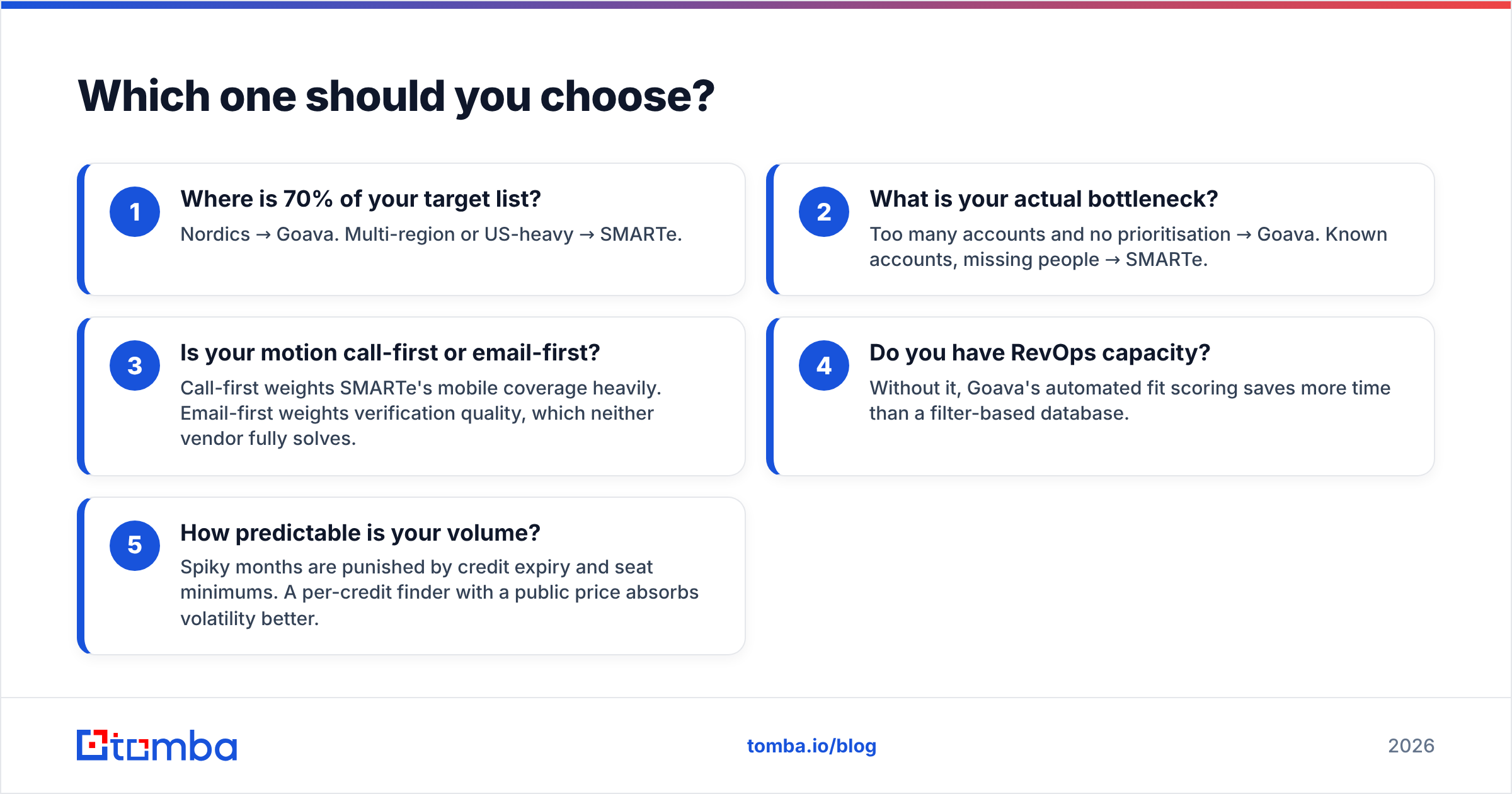
Decide with these five questions rather than a feature matrix.
- Where is 70% of your target list? Nordics → Goava. Multi-region or US-heavy → SMARTe.
- What is your actual bottleneck? Too many accounts and no prioritisation → Goava. Known accounts, missing people → SMARTe.
- Is your motion call-first or email-first? Call-first weights SMARTe's mobile coverage heavily. Email-first weights verification quality, which neither vendor fully solves.
- Do you have RevOps capacity? Without it, Goava's automated fit scoring saves more time than a filter-based database.
- How predictable is your volume? Spiky months are punished by credit expiry and seat minimums. A per-credit finder with a public price absorbs volatility better.
If you cannot answer question 2 confidently, run the cheap experiment first: take 200 target accounts you already believe in, find and verify the buying-committee emails, and send. If the campaign works and you simply need more accounts, buy account intelligence. If it fails because half your list bounced or never reached a decision-maker, your problem was contact data all along — and an annual sales-intelligence contract would not have fixed it.
Where does Tomba fit alongside Goava or SMARTe?#
Tomba is not a replacement for account-level sales intelligence, and pretending otherwise would be dishonest. Goava's Nordic registry depth and SMARTe's global mobile coverage are genuinely different products.
What Tomba does replace is the expensive, slow part of the workflow: turning a company name into verified, deliverable contact addresses. Start with the Tomba Email Finder — feed it a domain and a name, get a confidence-scored address back, and verify it in the same call. The free tier gives you 25 searches a month to test match rates on your own list, and paid plans start at $49/mo with public, per-credit pricing you can forecast. Run it against a sample of your Goava or SMARTe exports before your next renewal call, and you will know exactly which layer of your stack is actually worth the contract.
Related guides#
Ready to find emails that actually work?
Join 150,000+ professionals who stopped guessing and started sending. Free credits on signup — no credit card required.
Get the Tomba newsletter
Practical outbound tactics and product updates — once every two weeks.
About the author