GoHighLevel vs Odoo (2026): Which CRM Actually Wins?
GoHighLevel sells speed for agencies. Odoo sells depth for operations. We break down pricing, CRM power, automation, and the hidden costs each one hides until month three.
GoHighLevel vs Odoo comes down to one question. Is your bottleneck getting leads, or running the business after the sale? GoHighLevel is built for agencies and local service teams. Odoo is a full ERP with a CRM app inside it. This guide compares pricing, CRM depth, automation, and setup cost. Then it names a winner for each kind of buyer.
TL;DR
- GoHighLevel is a marketing and sales system built for agencies and local service businesses. Funnels, SMS, calls, pipelines, review requests, and white-label resale sit in one flat-fee account.
- Odoo is a modular open-source ERP. CRM is one app out of dozens. Accounting, inventory, manufacturing, HR, and e-commerce share the same database.
- Price shape is the real difference. GoHighLevel charges a flat account fee (roughly $97–$497/mo) plus usage. Odoo charges per user, per app tier, and partners often add four to five figures for setup.
- Pick GoHighLevel if your bottleneck is lead follow-up. Pick Odoo if your bottleneck is operations after the sale: quotes, invoices, stock, projects.
- Neither one finds contact data. Both are containers. You still need verified emails and phone numbers feeding the top of the funnel.
What is GoHighLevel, exactly?#
GoHighLevel (often shortened to GHL) is a white-label marketing platform. It packages the tools a small agency would otherwise buy from five vendors. One login gets you funnels and websites, two-way SMS and email, a calling dialer, calendars, and pipelines. It also covers review requests, membership courses, and a workflow builder that ties it all together.
The commercial hook is resale. On the agency tiers you can spin up a sub-account for each client, rebrand the platform under your own domain, and bill for it. That is why the product spread through the agency world faster than its feature list alone would justify. It is a business model as much as a tool. Their official site leans hard on that positioning.
What GoHighLevel is not: a system of record for your money, your stock, or your delivery. It stops at "deal won."
What is Odoo, exactly?#
Odoo is a suite of business apps with an open-source core. CRM, Sales, Accounting, Inventory, Manufacturing, Project, HR, Website, and POS all share one data model. You turn on the apps you need and they work together out of the box. A quote in Sales becomes an invoice in Accounting and a picking in Inventory. No integration required.
Odoo comes in two editions. Community is free, self-hosted, and has fewer features. Enterprise is paid, hosted or on-prem, with the full feature set. Its CRM app is competent but deliberately plain: lead scoring, pipeline stages, activity scheduling, forecast reports. It is not trying to out-feature a dedicated sales tool. It is trying to be the one database your whole company runs on.
GoHighLevel vs Odoo: how do they compare feature by feature?#
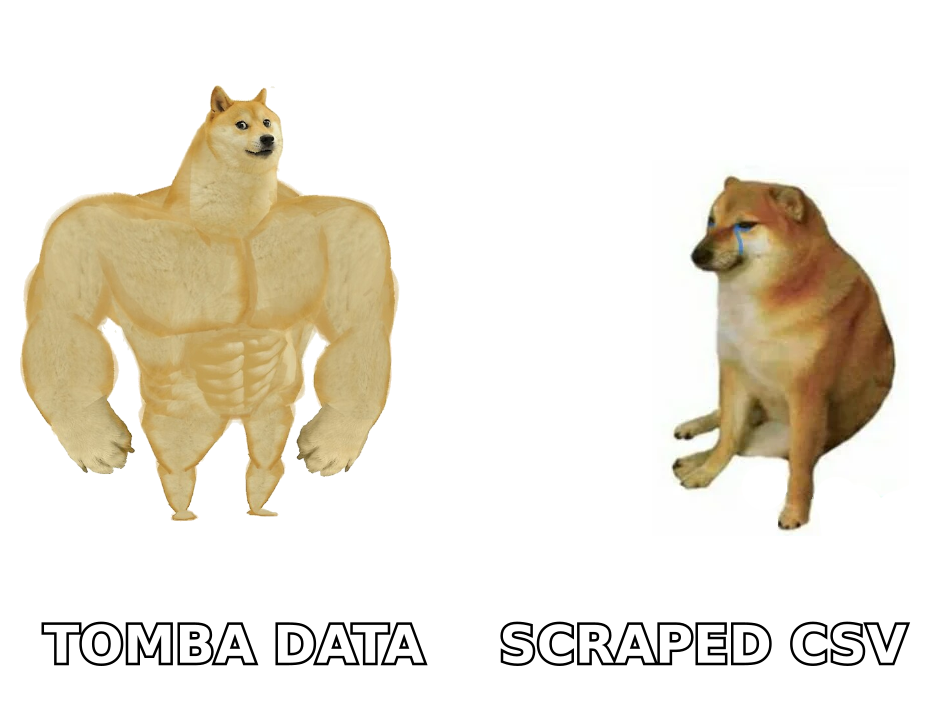
The honest framing: these two products barely overlap outside the CRM module. Comparing them is like comparing a race car to a freight yard. Buyers still weigh both, usually after typing "all-in-one business software" into Google.
| Capability | GoHighLevel | Odoo |
|---|---|---|
| Core identity | Agency marketing + sales OS | Modular open-source ERP |
| CRM pipeline | Strong, opinionated, drag-and-drop | Solid, configurable, report-heavy |
| Email + SMS sending | Native, built in, usage-billed | Marketing Automation app (extra tier) |
| Funnels / landing pages | Native builder, templates included | Website app, developer-friendly |
| Accounting & invoicing | Basic invoices only | Full double-entry accounting |
| Inventory / manufacturing | None | Native apps |
| White-label / resale | Core selling point | Not the business model |
| Self-hosting | No | Yes (Community edition) |
| Customization ceiling | Workflows + API | Full source code, Python modules |
| Typical implementation time | Days to weeks | Weeks to months |
| Best fit | Agencies, local services, coaches | Product, retail, manufacturing, services with ops |
Read that table as a fork, not a scoreboard. Do three or more rows in the Odoo column describe problems you actually have, such as stock counts, VAT, or work orders? Then GoHighLevel cannot solve them at any price. If your only real problem is "leads go cold in 48 hours," Odoo's depth is dead weight. You pay for it in setup time.
What does each one actually cost in 2026?#
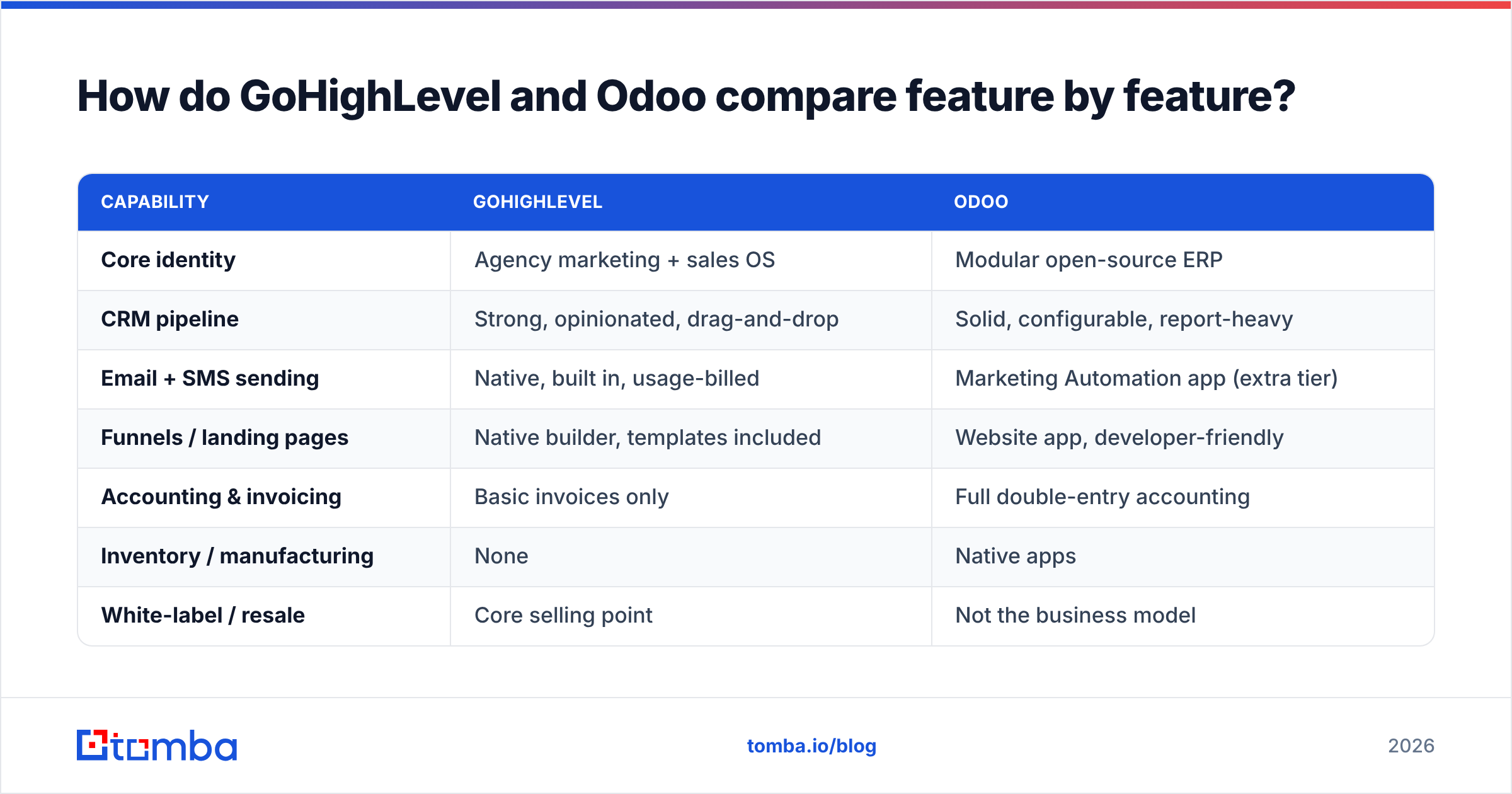
Pricing shape matters more than the headline number. The two vendors bill on completely different axes.
| Cost dimension | GoHighLevel | Odoo |
|---|---|---|
| Entry plan | ~$97/mo (single business) | One App Free (limited) |
| Mid tier | ~$297/mo, unlimited sub-accounts | Standard, per user/month |
| Top tier | ~$497/mo (SaaS resale mode) | Custom, per user/month + studio |
| Billing axis | Flat per account | Per user, per month |
| Usage charges | SMS, calls, email credits, AI | Hosting on-prem, SMS/IAP credits |
| Implementation | Self-serve or agency snapshot | Partner projects commonly $5k–$50k+ |
| Hidden cost | Twilio/LC usage creep | Version upgrades on customized instances |
Two traps worth naming.
GoHighLevel's trap is usage. The subscription is flat, but the phone and email rails are metered. A team blasting SMS reminders across a dozen sub-accounts can double its real bill without changing plan tier. Model your message volume before you commit.
Odoo's trap is customization debt. The per-user price looks fair next to Salesforce. Then you order custom modules, and every major version upgrade turns into a migration project. Ask any partner what "we customized the sales module" costs at upgrade time. Reviews on G2 show this pattern across ERP tools, not just Odoo.
Is GoHighLevel better than Odoo for sales teams?#
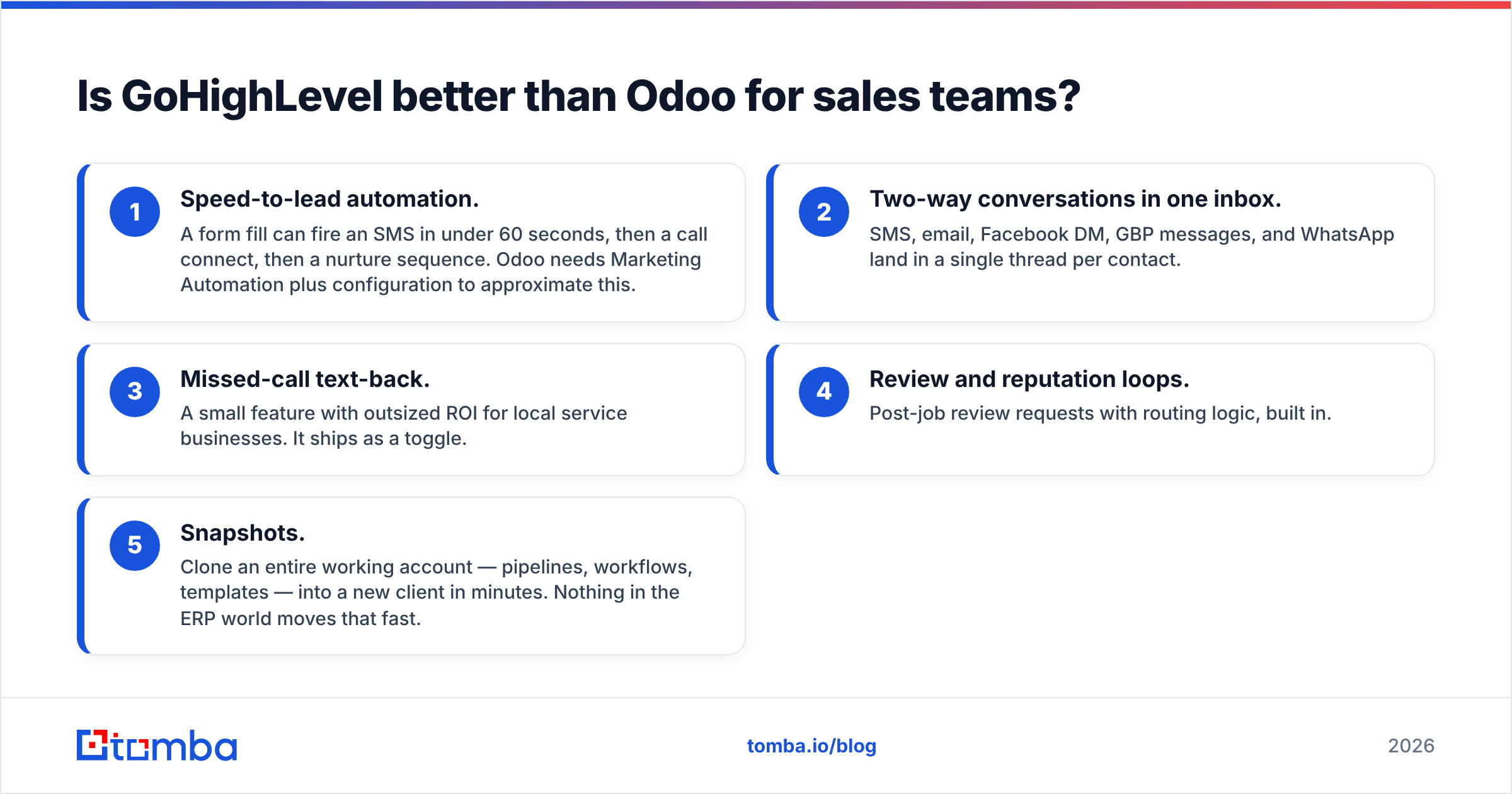
For pure sales motion, yes. GoHighLevel is the stronger tool, and it is not close.
Here is what it does that Odoo's CRM app does not do on its own:
- Speed-to-lead automation. A form fill can fire an SMS in under 60 seconds, then a call connect, then a nurture sequence. Odoo needs Marketing Automation plus setup work to come close.
- Two-way chats in one inbox. SMS, email, Facebook DM, GBP messages, and WhatsApp land in a single thread per contact.
- Missed-call text-back. A small feature that pays back fast for local service businesses. It ships as a toggle.
- Review and reputation loops. Post-job review requests with routing logic, built in.
- Snapshots. Clone a whole working account, including pipelines, workflows, and templates, into a new client in minutes. Nothing in the ERP world moves that fast.
Odoo's answer is that a sale is only the beginning. Do your deals produce work orders, subscriptions, deliveries, or repeat invoices? Then GoHighLevel hands you a won opportunity and shrugs. You will be exporting CSVs into an accounting tool by month two.
When does Odoo clearly win?#
Odoo wins whenever the answer to "what happens after we close?" is complicated.
- You hold inventory. Stock moves, lots, serials, multi-warehouse. GoHighLevel has no concept of any of it.
- You need real accounting. Chart of accounts, reconciliation, multi-currency, and local tax reports in 60+ countries.
- You bill by project or timesheet. Odoo's Project, Timesheets, and Invoicing chain is genuinely good and cheap next to the alternatives.
- You want to own the stack. Self-hosted Community means no per-seat tax and full source access. That matters when data has to stay in one country.
- You have 30+ internal users across departments. One database beats seven integrations, every time, at that headcount.
There is also a quieter win. Odoo scales down awkwardly but sideways beautifully. Adding the Field Service app to an existing Odoo install is a config change. Adding field service to GoHighLevel is a Zapier project.
Can you run both together?#
Plenty of teams do, and it is often the right answer rather than a compromise.
The clean split: GoHighLevel owns everything up to "won." Odoo owns everything after. Leads enter GHL and get worked by reps and automation. On close, the contact and deal data is pushed into Odoo, where the quote, invoice, delivery, and renewal live. Odoo becomes the system of record. GoHighLevel stays the system of engagement.
Wire it with webhooks or a middleware layer. Both platforms expose REST APIs, and Odoo's XML-RPC and JSON-RPC interfaces are well documented. Keep one field as the shared key, usually a verified email address. Enforce it on both sides so records do not fork.
That last point is where most hybrid setups quietly rot.
Why does contact data quality decide the winner?#
Neither platform creates pipeline. Both consume it. And both break the same way when the data coming in is dirty.
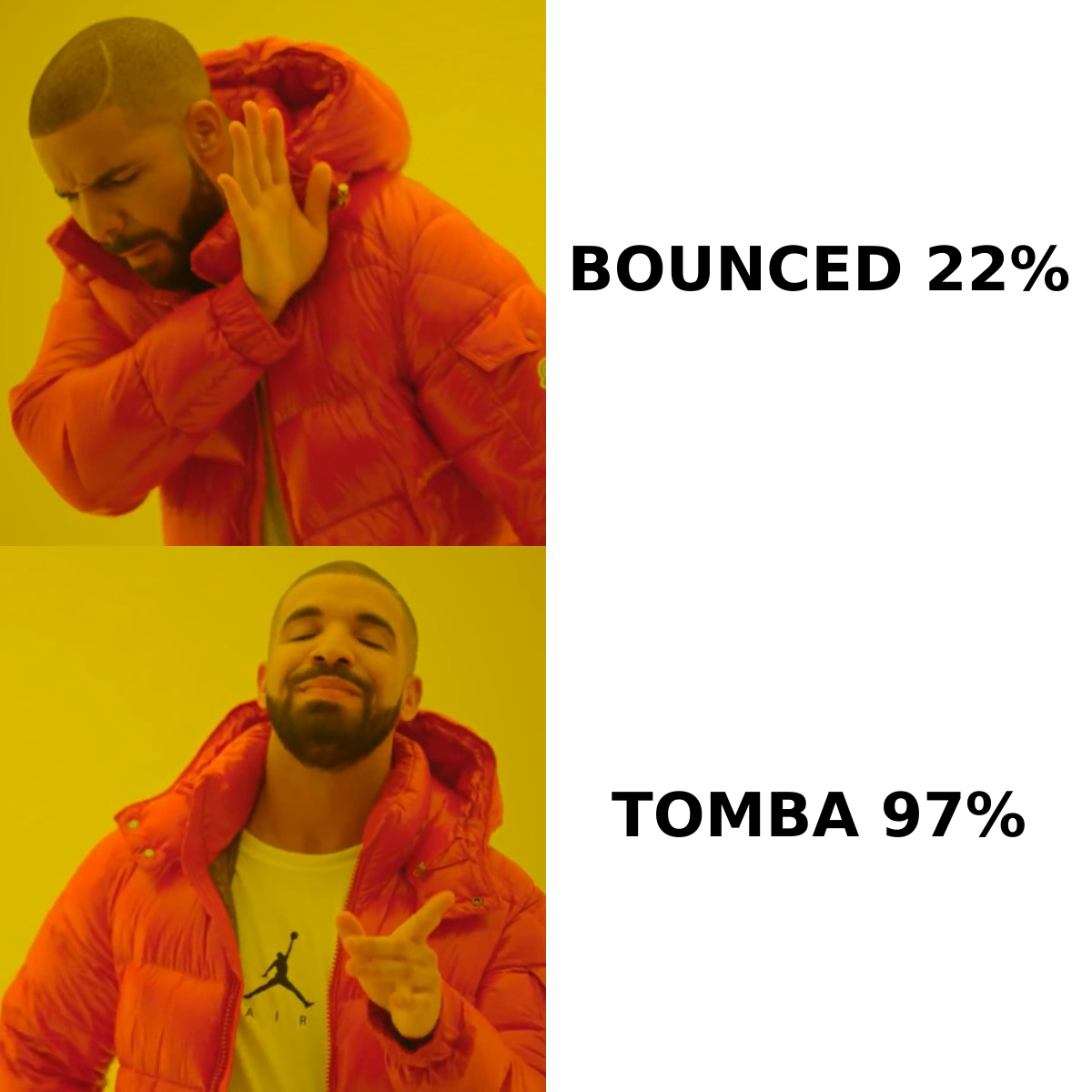
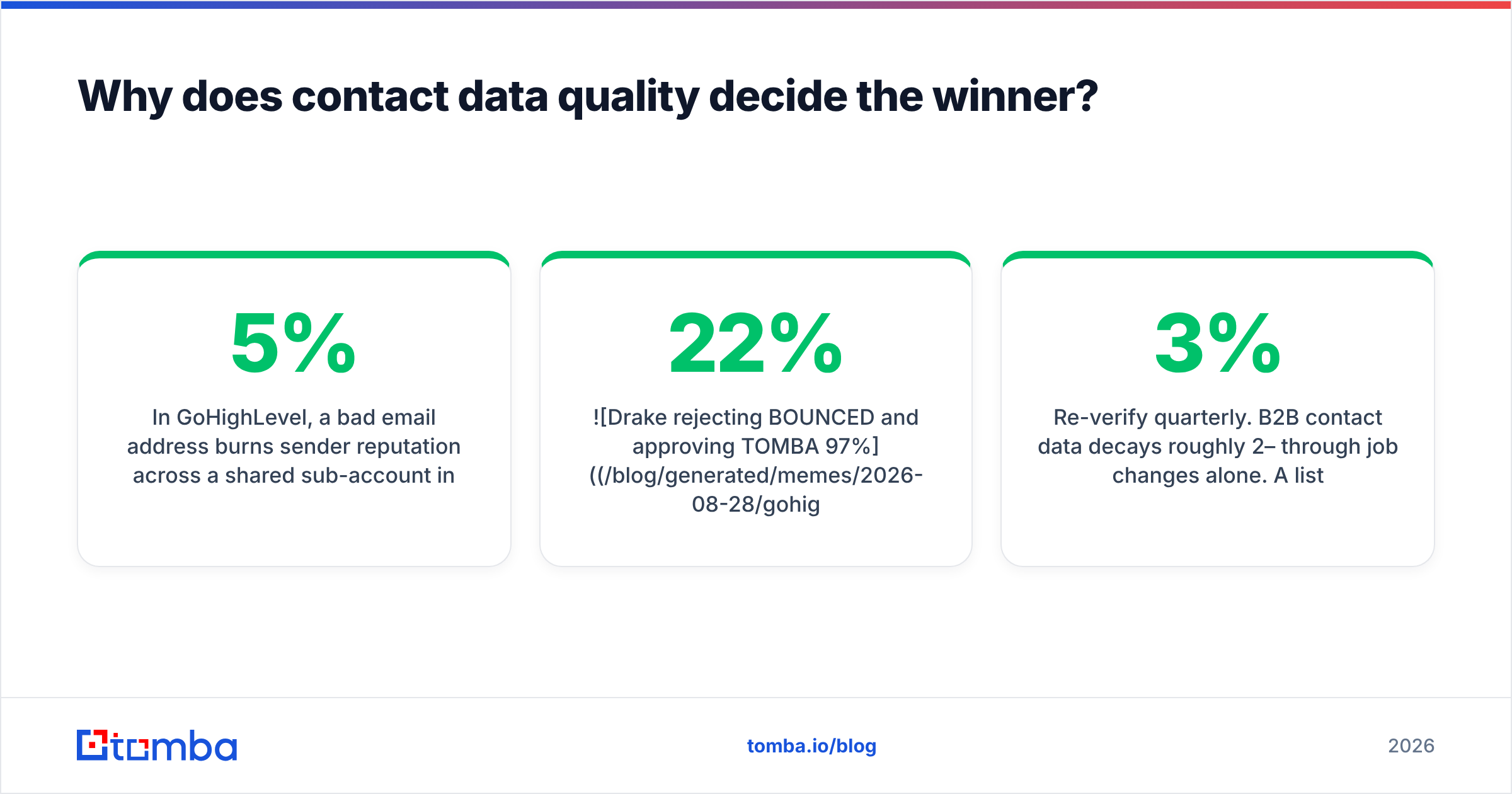
In GoHighLevel, a bad email address burns sender reputation across shared sub-account infrastructure. Bounce rates above 3–5% drag inbox placement down for every client on that domain setup. In Odoo, a duplicate or broken contact spreads into quotes, invoices, and delivery addresses. That is a finance problem, not a marketing one.
The fix is upstream, not downstream. Verify before ingest, not after.
A workable data hygiene loop starts before anything reaches your CRM:
- Source deliberately. Build target lists from real company domains and roles instead of buying a file of unknown age. A domain search against a target account returns the people who work there today.
- Verify before import. Run every address through an email verifier. Syntax errors, spam traps, role accounts, and dead mailboxes never reach your sending platform.
- Handle catch-alls explicitly. Catch-all domains accept everything and confirm nothing. A dedicated catch-all verifier gives you a confidence score instead of a coin flip.
Then keep the records clean once they are inside the system:
- Enrich once, at the boundary. Attach company details and job titles at import time. Your Odoo or GHL records will not need a second lookup later. Data enrichment is cheapest when it happens once.
- Deduplicate on a stable key. Email is the practical primary key across both systems. Normalize case, strip aliases, and reject anything unverified.
- Re-verify quarterly. B2B contact data decays roughly 2–3% per month through job changes alone. A list you cleaned in January is measurably worse by April.
Teams that do this find the platform argument shrinks. GoHighLevel's automations fire against real people. Odoo's invoices reach real inboxes. The tool stops being the variable.
GoHighLevel vs Odoo: which should you choose?#
Decide by bottleneck, not by feature count.
Choose GoHighLevel if: you are an agency reselling marketing services, a local service business drowning in missed calls, or a coaching business where speed-to-lead is the whole game. You want to be live this week, not this quarter, and you do not need real accounting.
Choose Odoo if: you make, ship, or stock products, or you bill complex projects. You have finance people in the buying group. You are willing to pay for setup, because the alternative is six disconnected SaaS tools and a monthly reconciliation nightmare.
Choose both if: your sales motion is fast and your delivery is heavy. That mix is common in home services, B2B services with recurring contracts, and product companies with an inside sales team.
Choose neither yet if: you do not have a repeatable source of qualified contacts. Buying a CRM to fix an empty pipeline is like buying a bigger fridge to fix an empty kitchen. Sort the input first.
What are the common mistakes buyers make here?#
Three come up again and again.
Buying GoHighLevel for the resale dream without clients. The SaaS mode is well built, but it is a distribution business. If you do not already have an audience or an offer, the $497 tier is an expensive hobby.
Underscoping the Odoo rollout. The self-serve trial makes it feel like a simple SaaS product. At any real complexity it is an ERP project with an ERP timeline. Budget for a partner, or budget for someone internal to own it full-time.
Treating either one as a data source. Both platforms will happily store 40,000 contacts. Neither will tell you that 9,000 of them changed jobs last year. Data freshness is a separate line item, and it is the cheapest one relative to what it protects.
Standing up either platform this quarter? Run your import list through a verification pass first. Then check Tomba pricing against the volume you actually need. The free tier covers 25 searches a month, and Starter sits at $49/mo.
Get clean contacts into whichever platform you pick#
GoHighLevel and Odoo are both good at what they were built for. Neither one will find you a single new prospect. That part is yours to solve.
Use the Tomba Email Finder to build target lists from company domains and names. Verify every address before it touches your sending setup. Then push clean records into GoHighLevel's pipelines or Odoo's contact database with the Tomba API. Start on the free tier, check the accuracy on your own accounts, and scale once the bounce rate proves itself. The CRM debate matters less once the data underneath it is right.
Related guides#
Ready to find emails that actually work?
Join 150,000+ professionals who stopped guessing and started sending. Free credits on signup — no credit card required.
Get the Tomba newsletter
Practical outbound tactics and product updates — once every two weeks.
About the author