GrowMeOrganic vs Pubrio: Which B2B Data Tool Wins in 2026?
GrowMeOrganic bundles scraping and sequencing on a flat unlimited plan. Pubrio sells an AI-scored contact database with credit-based exports. Here's which one actually fits your outbound motion — and where both fall short.
TL;DR
- GrowMeOrganic is a LinkedIn/Sales Navigator scraper plus a basic email sequencer, sold on flat "unlimited" plans starting around $49/mo. Best if you live inside LinkedIn and want scraping + sending under one login.
- Pubrio is a searchable B2B contact database with AI lead scoring and intent signals, sold on credit-based tiers with a small free allowance. Best if you want to build lists by firmographic filters instead of scraping profiles.
- They are not really the same product. GrowMeOrganic gives you volume and workflow; Pubrio gives you filters and enrichment depth.
- Both wobble on the same axis: email accuracy on the last mile. Neither publishes an independently audited bounce rate, so plan to run a separate verification pass before you send.
- If your bottleneck is valid, deliverable addresses rather than sequencing UI, a dedicated finder/verifier like Tomba Email Finder is usually the cheaper fix.
What is GrowMeOrganic and who is it for?#
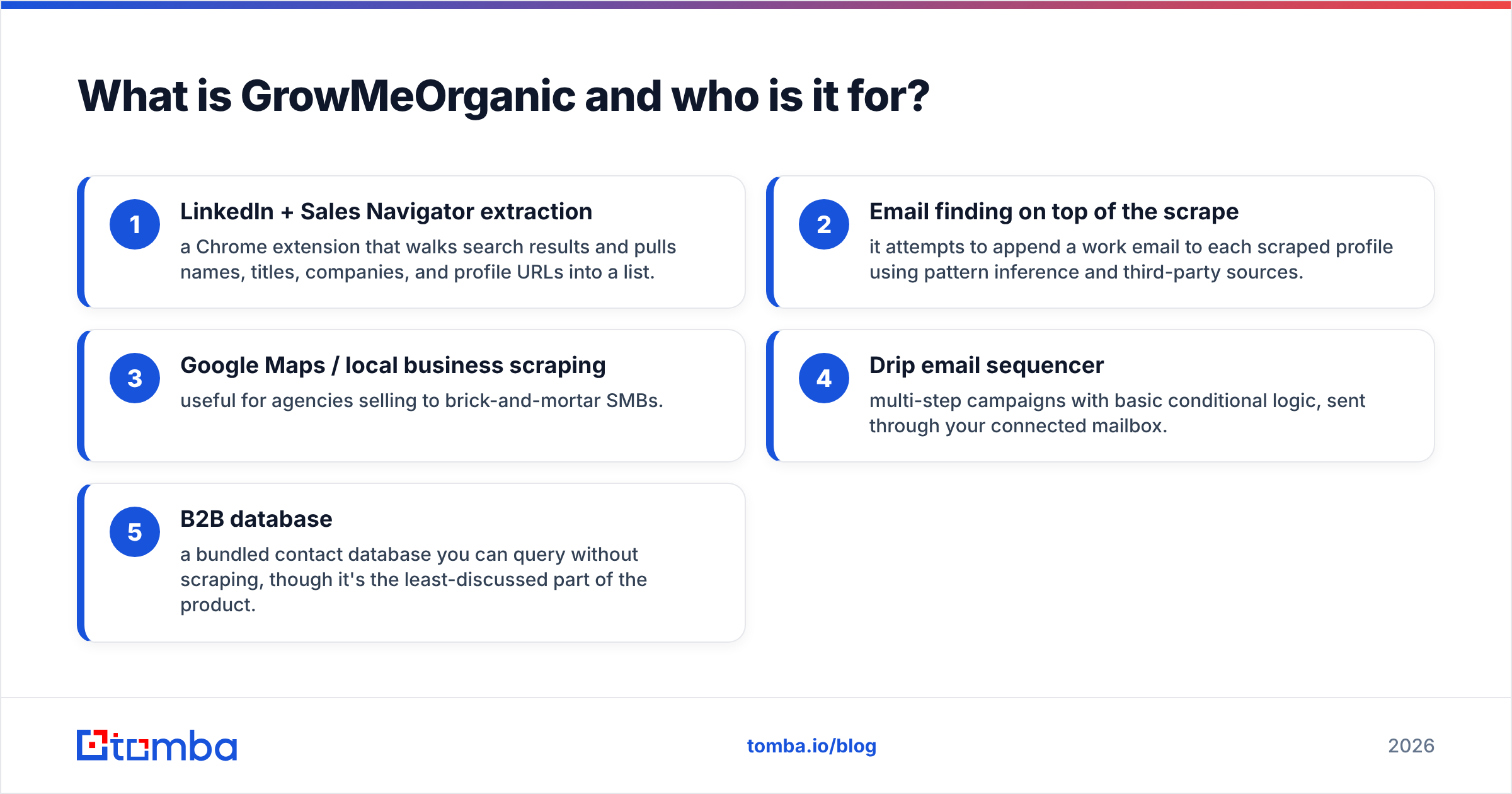
GrowMeOrganic (growmeorganic.com) started as a LinkedIn automation and scraping tool and grew into an all-in-one outbound suite. The pitch is simple: pay one flat monthly fee, extract as many leads as you want from LinkedIn, Sales Navigator, and Google Maps, then email them from the same dashboard.
What you actually get:
- LinkedIn + Sales Navigator extraction — a Chrome extension that walks search results and pulls names, titles, companies, and profile URLs into a list.
- Email finding on top of the scrape — it attempts to append a work email to each scraped profile using pattern inference and third-party sources.
- Google Maps / local business scraping — useful for agencies selling to brick-and-mortar SMBs.
- Drip email sequencer — multi-step campaigns with basic conditional logic, sent through your connected mailbox.
- B2B database — a bundled contact database you can query without scraping, though it's the least-discussed part of the product.
The customer profile is clear: solo founders, agencies, and small SDR teams who want one bill instead of four. The flat-fee model is the whole appeal. If you extract 40,000 profiles in a month, you pay the same as if you extracted 400.
The catch is that "unlimited" applies to extraction, not to accuracy. Scraped LinkedIn rows are only as fresh as the profile, and the email append step is where quality varies. That's the number one complaint pattern across G2 reviews for this category of tool — plenty of rows, uneven deliverability.
What is Pubrio and how does it differ?#
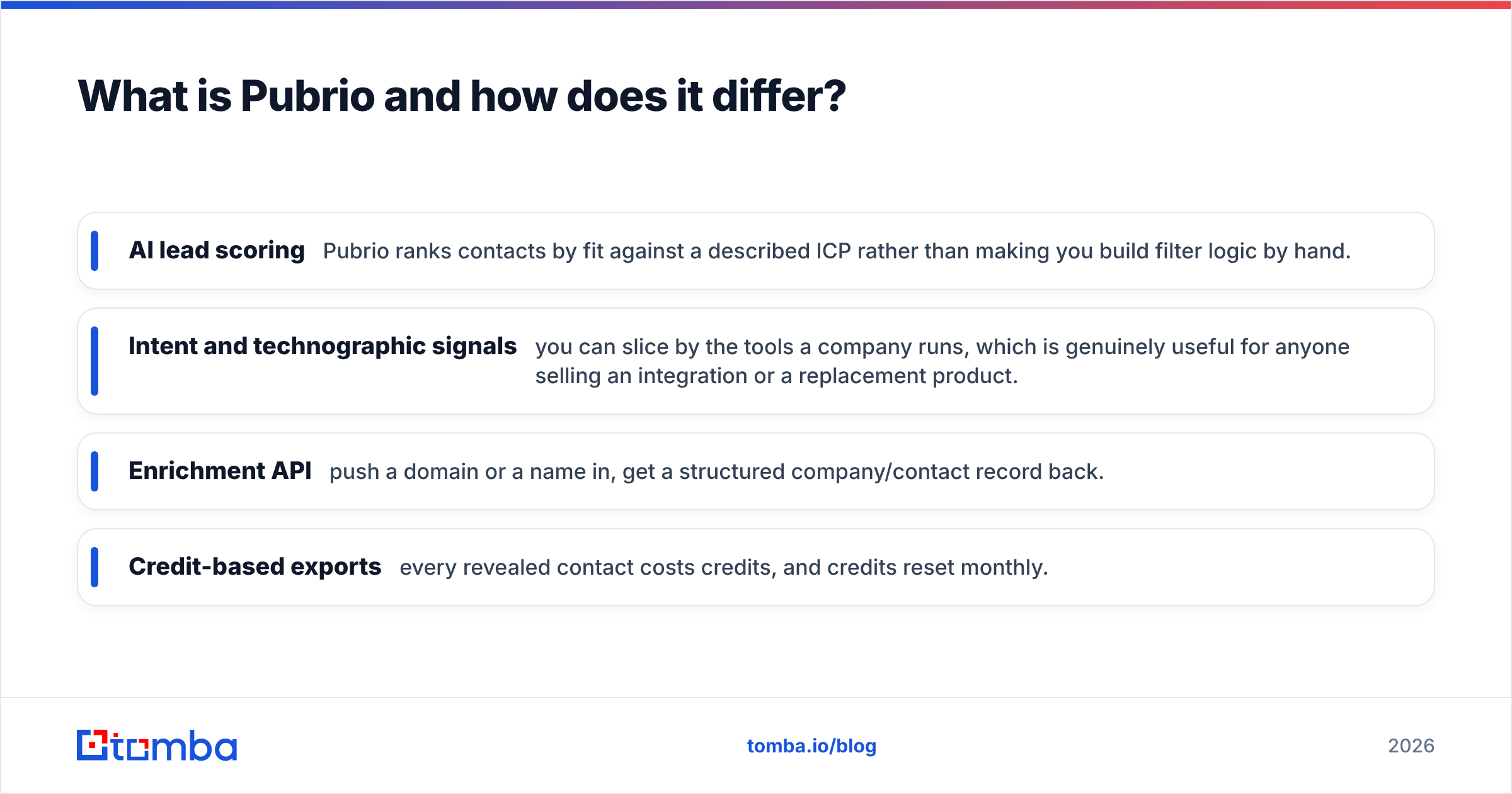
Pubrio (pubrio.com) approaches the same problem from the database side. Instead of scraping profiles one search at a time, you filter a pre-built contact index by industry, headcount, technology stack, revenue band, and job function, then export what matches.
Its differentiators:
- AI lead scoring — Pubrio ranks contacts by fit against a described ICP rather than making you build filter logic by hand.
- Intent and technographic signals — you can slice by the tools a company runs, which is genuinely useful for anyone selling an integration or a replacement product.
- Enrichment API — push a domain or a name in, get a structured company/contact record back.
- Credit-based exports — every revealed contact costs credits, and credits reset monthly.
Pubrio suits teams that already know their ICP in firmographic terms and want repeatable list-building. It suits you badly if your prospecting is opportunistic — reacting to a LinkedIn post, a conference attendee list, or a podcast guest — because there's nothing to scrape from.
The structural trade-off is the one every buyer in this category faces: flat-fee scraping rewards volume; credit-based databases reward precision. Pick the one that matches how you actually generate a list.
GrowMeOrganic vs Pubrio: how do they compare head-to-head?#
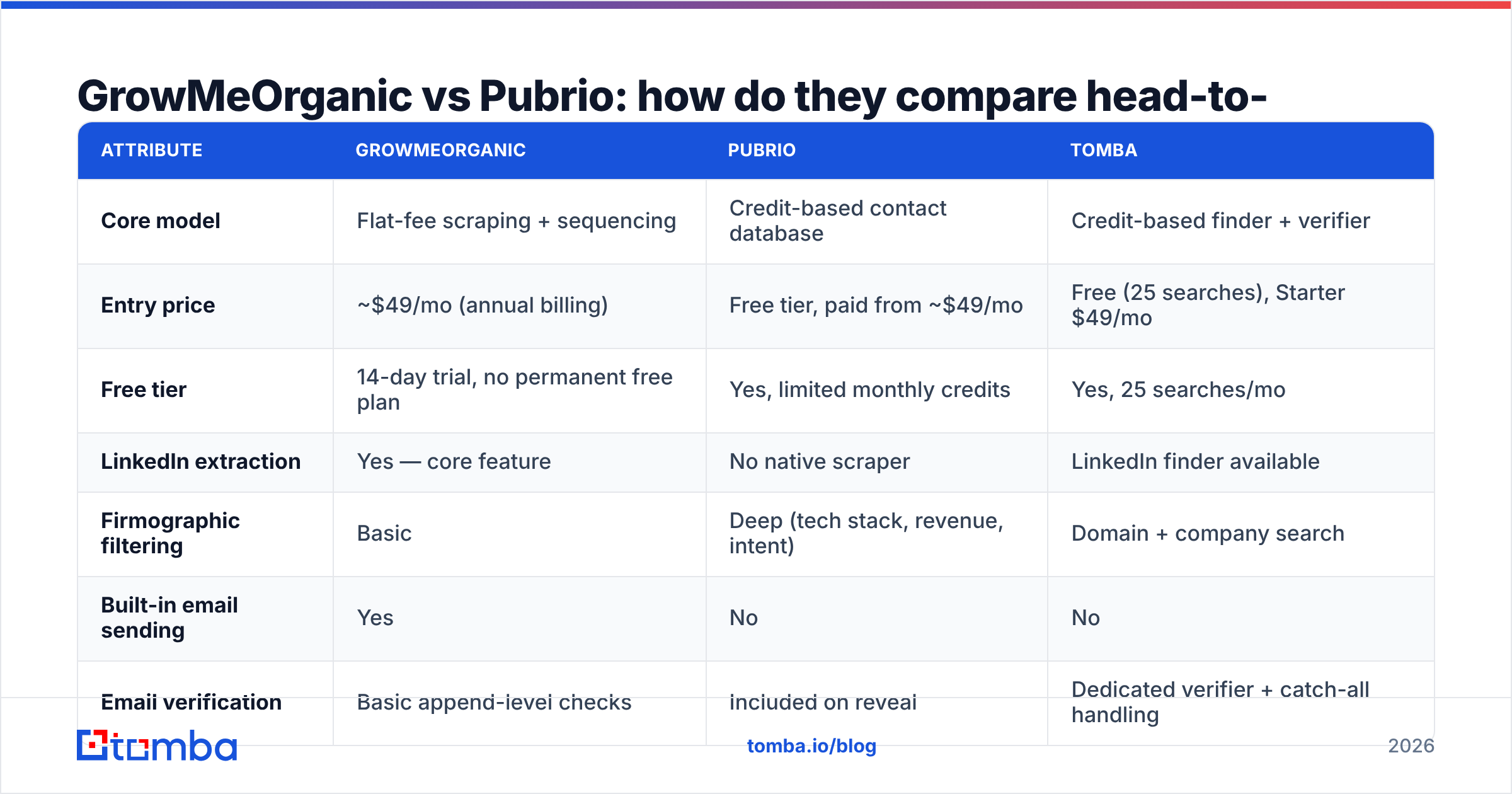
| Attribute | GrowMeOrganic | Pubrio | Tomba |
|---|---|---|---|
| Core model | Flat-fee scraping + sequencing | Credit-based contact database | Credit-based finder + verifier |
| Entry price | ~$49/mo (annual billing) | Free tier, paid from ~$49/mo | Free (25 searches), Starter $49/mo |
| Free tier | 14-day trial, no permanent free plan | Yes, limited monthly credits | Yes, 25 searches/mo |
| LinkedIn extraction | Yes — core feature | No native scraper | LinkedIn finder available |
| Firmographic filtering | Basic | Deep (tech stack, revenue, intent) | Domain + company search |
| Built-in email sending | Yes | No | No |
| Email verification | Basic append-level checks | Included on reveal | Dedicated verifier + catch-all handling |
| API access | Limited | Yes | Full REST API |
| Best for | Agencies, LinkedIn-first SDRs | ICP-driven list building | Accuracy-critical outbound |
Read that table as three jobs, not three competitors. GrowMeOrganic is a workflow tool. Pubrio is a data tool. A dedicated finder is an accuracy tool. Teams that buy the wrong category then complain about the wrong thing.
Pricing: what do you actually pay?#
Published pricing on both moves frequently, so treat these as directional and check the vendor page before you buy.
| Plan tier | GrowMeOrganic | Pubrio |
|---|---|---|
| Free | Trial only (14 days) | Yes — small monthly credit grant |
| Entry paid | ~$49/mo billed annually | ~$49/mo, credit-capped |
| Mid tier | ~$99/mo, more mailboxes + seats | ~$99–$149/mo, higher credit ceiling |
| Top tier | ~$199/mo, agency features | Custom / enterprise |
| Overage model | None — flat unlimited extraction | Buy more credits |
| Annual discount | Significant (often ~50%) | Moderate |
The honest reading: GrowMeOrganic is cheaper at high volume, Pubrio is cheaper if you only need a few hundred right contacts per month. If you export 10,000 rows and 30% bounce, the "unlimited" plan was not actually cheap — you paid for it in domain reputation.
Which one has better data accuracy?#
Neither vendor publishes a third-party-audited bounce rate, and you should be skeptical of any "98% accurate" claim that isn't tied to a methodology. Here's what's structurally true about each approach:
Scrape-then-guess (GrowMeOrganic's model) produces high coverage and variable precision. The scraper reliably gets you the person; the email append is inference. When a company uses an unusual format or a catch-all domain, inference degrades quietly — the tool returns an address, it just may not route to a human.
Index-then-reveal (Pubrio's model) produces lower coverage and generally higher precision, because a record only exists if the provider previously captured and stored it. The failure mode is different: you get fewer matches, and the ones you get can be stale if the contact changed jobs six months ago.
Three checks worth running on any list from either tool:
- Catch-all detection. SMTP-accept-all domains inflate every vendor's "valid" rate. Run them through a catch-all verifier before you decide whether to send.
- Pattern sanity. Confirm the company's real format with a company email pattern check rather than trusting a single guessed address.
- Role-account filtering. Strip info@, sales@, and support@ before they eat your reply rate.
A practical rule: whatever list-building tool you use, treat its output as candidates, then run an independent email verifier pass. Verification costs a fraction of a cent per record and protects an asset — your sending domain — that costs months to rebuild. Google and Yahoo's bulk sender requirements make a sub-0.3% complaint rate a hard operational requirement, not a nice-to-have; Google's own sender guidelines spell out the thresholds.
Is GrowMeOrganic better than Pubrio for cold outreach?#
For end-to-end cold outreach where you want scraping and sending in one place, GrowMeOrganic wins on convenience. One login, one bill, campaigns launched the same afternoon you built the list.
But convenience has a cost. Bundled sequencers are almost always weaker than dedicated ones — fewer inbox rotation controls, thinner deliverability reporting, less granular reply detection. If cold email is your primary channel and you're sending meaningful volume, you'll outgrow the bundled sender before you outgrow the scraper, and you'll end up paying for a dedicated sequencer anyway.
Pubrio doesn't compete here at all. It has no native sender. You export to your sequencer of choice, which is honest positioning — it's a data layer, not a channel.
So the real question isn't "which is better at cold outreach." It's where do you want your single point of failure? A bundled tool means one vendor outage kills both list-building and sending. A split stack means more integrations to maintain but no single blast radius.
What are the main limitations of each?#
GrowMeOrganic — where it strains:
- LinkedIn account risk. Any scraper that automates browsing carries account-restriction risk. Use conservative daily limits and never run it on your only LinkedIn profile.
- Email quality is inference-driven. Expect to verify separately.
- Sequencer depth. Fine for 500 emails/month. Thin at 50,000.
- Annual lock-in. The attractive price usually requires 12 months upfront.
Pubrio — where it strains:
- Coverage gaps outside North America and Western Europe. Common to nearly every B2B database, but worth testing on your actual territory before committing.
- Credit anxiety. Credit models make people conservative with searches, which is the opposite of what good prospecting needs.
- No native sending. Budget for a separate sequencer.
- Smaller ecosystem. Fewer native integrations than incumbents like Apollo or ZoomInfo, so more Zapier glue.
Worth naming a third option: providers like BookYourData sell pay-as-you-go verified lists with no subscription, which is a genuinely different commercial shape — useful when you need 2,000 contacts once, not every month. If your usage is spiky rather than steady, that model can beat both subscription tools on total cost.
How should you actually choose between them?#
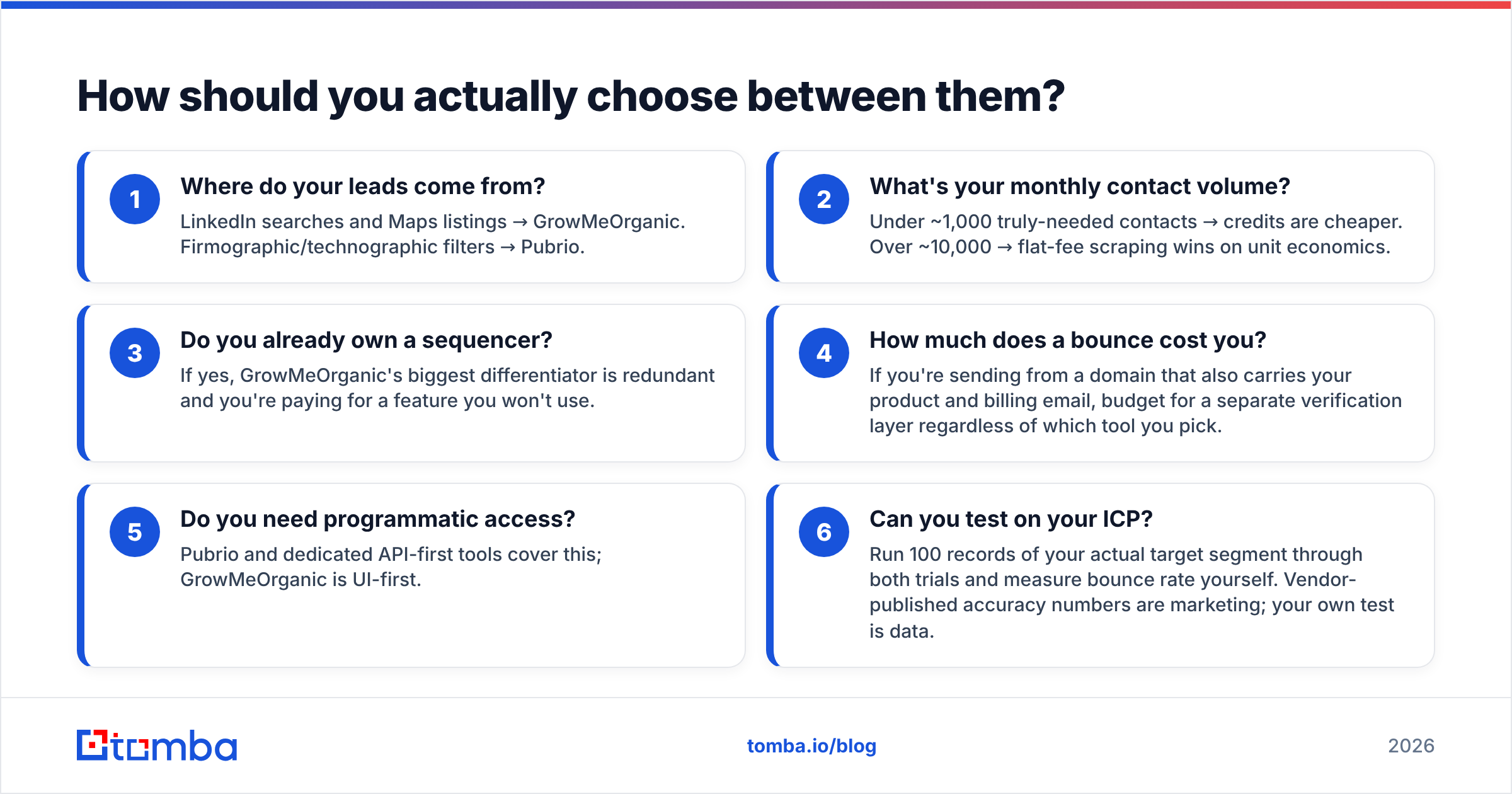
Work through these in order:
- Where do your leads come from? LinkedIn searches and Maps listings → GrowMeOrganic. Firmographic/technographic filters → Pubrio.
- What's your monthly contact volume? Under ~1,000 truly-needed contacts → credits are cheaper. Over ~10,000 → flat-fee scraping wins on unit economics.
- Do you already own a sequencer? If yes, GrowMeOrganic's biggest differentiator is redundant and you're paying for a feature you won't use.
- How much does a bounce cost you? If you're sending from a domain that also carries your product and billing email, budget for a separate verification layer regardless of which tool you pick.
- Do you need programmatic access? Pubrio and dedicated API-first tools cover this; GrowMeOrganic is UI-first.
- Can you test on your ICP? Run 100 records of your actual target segment through both trials and measure bounce rate yourself. Vendor-published accuracy numbers are marketing; your own test is data.
That last step is the only one that matters. Every comparison article — including this one — generalizes. A tool with mediocre average coverage can be excellent on your niche and terrible on someone else's.
Where does a dedicated email finder fit?#
Both tools try to be one-stop shops, and both make the same compromise: email resolution is a feature inside a bigger product rather than the product itself. That's fine until deliverability becomes the constraint.
A focused stack often looks like this:
- List source — GrowMeOrganic (scrape), Pubrio (filter), or your own CRM export
- Resolution + verification — a dedicated finder that handles domain search, catch-all logic, and bulk verification
- Sending — a dedicated sequencer with mailbox rotation and warmup
- Enrichment — a data enrichment layer to fill firmographics before scoring
Splitting these means each layer can be swapped without rebuilding the whole motion. It also means you can benchmark honestly: when reply rates drop, you know whether the problem is the list, the addresses, or the copy.
Final verdict: GrowMeOrganic or Pubrio?#
Choose GrowMeOrganic if you're an agency or solo operator running LinkedIn-first prospecting, you want scraping and sending under one subscription, and your monthly volume is high enough that flat-fee pricing beats credits. Accept that you'll layer verification on top.
Choose Pubrio if your ICP is definable in filters, you value technographic and intent slicing, you already have a sequencer you like, and you'd rather export 500 good contacts than 5,000 uncertain ones.
Choose neither as your accuracy layer. That's the honest conclusion. Both are competent at the job they're built for, and both leave the last mile — is this address real, does it route to a person, will it bounce — as an afterthought.
If deliverable addresses are your actual bottleneck, start with the tool built for exactly that. Tomba's email finder resolves work emails by name and domain, flags catch-all domains explicitly instead of guessing, and runs verification in the same pass. The free tier gives you 25 searches a month to test it against your own list, and paid plans start at $49/mo — see Tomba pricing for the full breakdown. Run 100 of your GrowMeOrganic or Pubrio exports through it and compare bounce rates before your next campaign goes out.
Related guides#
Ready to find emails that actually work?
Join 150,000+ professionals who stopped guessing and started sending. Free credits on signup — no credit card required.
Get the Tomba newsletter
Practical outbound tactics and product updates — once every two weeks.
About the author