GrowMeOrganic vs Respona: Which Outreach Tool Wins in 2026?
GrowMeOrganic and Respona both promise contacts plus outreach in one tab, but they were built for opposite jobs. Here is the honest breakdown of data, pricing, deliverability and who should buy which.
TL;DR
- GrowMeOrganic is a B2B prospecting and cold-email platform. It scrapes LinkedIn and Sales Navigator, exposes a large contact database, and sends drip sequences from your mailbox.
- Respona is a link-building and digital-PR outreach platform. It starts from a search query or a podcast/article, finds the right author, and pitches them.
- They overlap on exactly one feature — finding an email address — and that overlap is where both tools are weakest.
- Pricing is not comparable head-to-head. GrowMeOrganic sells seats and credits for sales teams; Respona sells campaigns and mailboxes for content teams, starting roughly 2x higher.
- Pick by job, not by feature list: outbound pipeline → GrowMeOrganic. Backlinks and press → Respona. Either way, run the emails through a dedicated verifier before you send.
What are GrowMeOrganic and Respona, exactly?#
They get compared constantly because both sit in the "find contacts, then email them" bucket on G2. That framing is misleading. Look at what each product's onboarding asks you to do first and the difference is obvious.
GrowMeOrganic asks you to install a Chrome extension and open LinkedIn Sales Navigator. Its center of gravity is volume prospecting: pull a list of 2,500 marketing managers in SaaS companies with 50–200 employees, enrich them with emails, drop them into a sequence, and send from your connected Google or Outlook mailbox. It bundles a B2B database, an email finder, a sender, and a lightweight CRM into a single subscription — the classic "all-in-one for SMB outbound" positioning.
Respona asks you a different question: what are you trying to get published, ranked, or mentioned? You give it a keyword, a competitor URL, or a podcast topic. It runs a live search, surfaces the pages and shows that matter, identifies the writer or editor behind each one, finds their contact, and helps you personalize a pitch with AI that has actually read the article. It is an outreach tool for people whose KPI is backlinks, mentions, and guest placements — not booked meetings.
So the real question in the GrowMeOrganic vs Respona debate is not "which is better." It is "which job am I hiring a tool for?"

How do GrowMeOrganic and Respona compare head-to-head?#
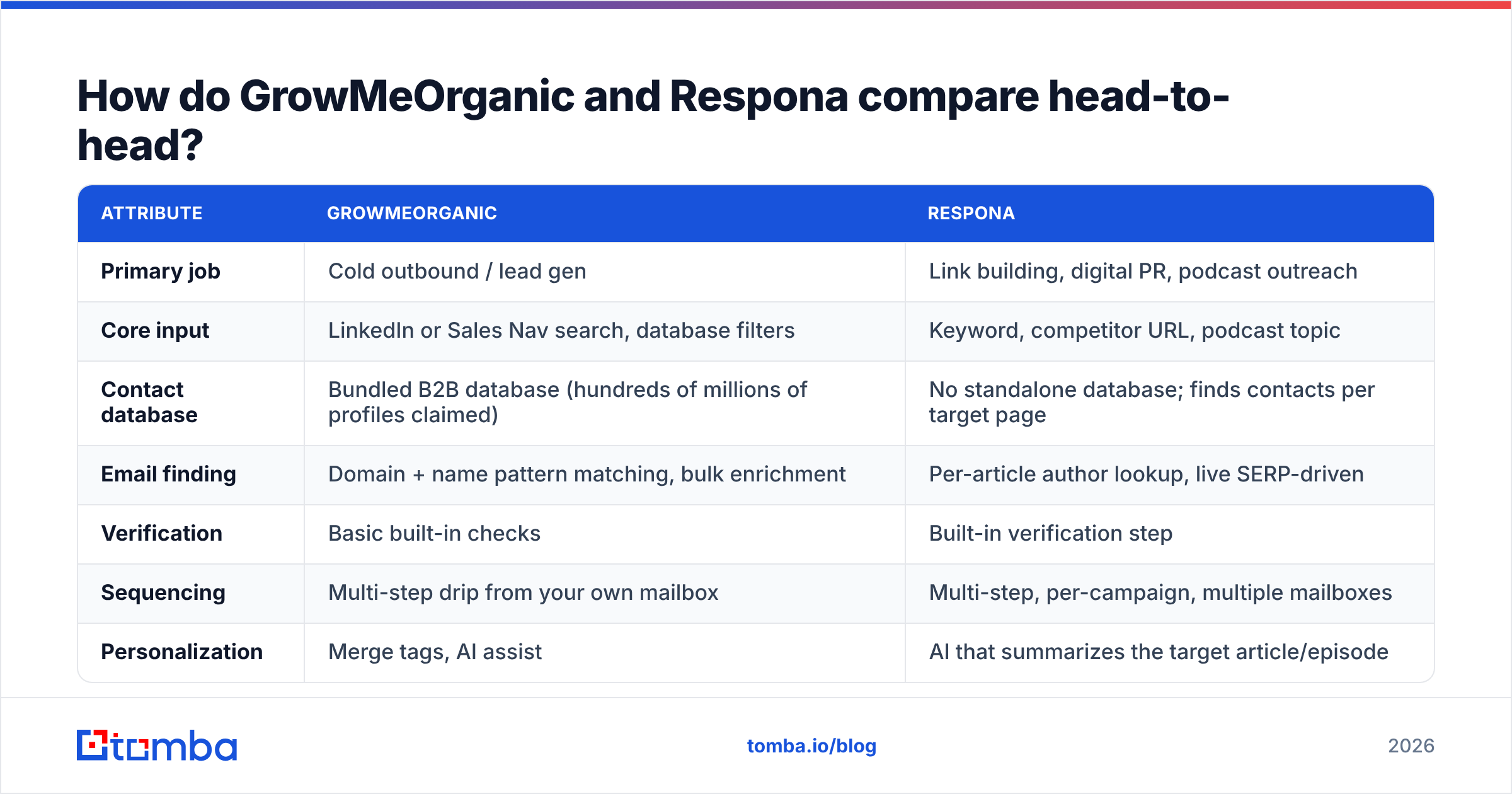
Here is the side-by-side on the attributes that actually change your workflow. Figures reflect publicly listed plans at the time of writing — always confirm on the vendor's own pricing page before you buy.
| Attribute | GrowMeOrganic | Respona |
|---|---|---|
| Primary job | Cold outbound / lead gen | Link building, digital PR, podcast outreach |
| Core input | LinkedIn or Sales Nav search, database filters | Keyword, competitor URL, podcast topic |
| Contact database | Bundled B2B database (hundreds of millions of profiles claimed) | No standalone database; finds contacts per target page |
| Email finding | Domain + name pattern matching, bulk enrichment | Per-article author lookup, live SERP-driven |
| Verification | Basic built-in checks | Built-in verification step |
| Sequencing | Multi-step drip from your own mailbox | Multi-step, per-campaign, multiple mailboxes |
| Personalization | Merge tags, AI assist | AI that summarizes the target article/episode |
| CRM | Lightweight built-in | Campaign-level pipeline, no CRM |
| Entry price | ~$49/mo (annual) | ~$99/mo (annual) |
| Best-fit team | 1–20 rep SMB sales team | SEO, content, or agency link-building team |
| Worst fit | Editorial link outreach | Volume cold sales outbound |
Two rows deserve a flag. First, the database row: GrowMeOrganic gives you a haystack to filter, Respona deliberately does not — it assumes your target list comes from the live web, not a static index. Second, the price row is not apples to apples. Respona's higher entry point buys workflow depth for a narrower job; GrowMeOrganic's lower one buys breadth with thinner execution in each module.
Which tool finds better contact data?#
Neither one is a data company, and that is the honest answer.
GrowMeOrganic's emails come from a mix of licensed data, extension-side scraping, and pattern inference. That last part matters: when the platform cannot confirm an address, it will frequently return a best-guess permutation like first.last@domain.com. On well-indexed mid-market companies that guess lands. On smaller domains, agencies, and anything with a non-standard pattern, it does not, and you find out from your bounce report.
Respona's contact discovery is narrower but more surgical. Because it works one article or episode at a time, it can read the byline, resolve the author, and go looking for that specific person's address. For a 200-prospect link campaign, that precision is worth more than a database with 500 million rows. For a 5,000-prospect sales campaign, it does not scale.
Here is how the accuracy problem actually plays out across the two workflows:
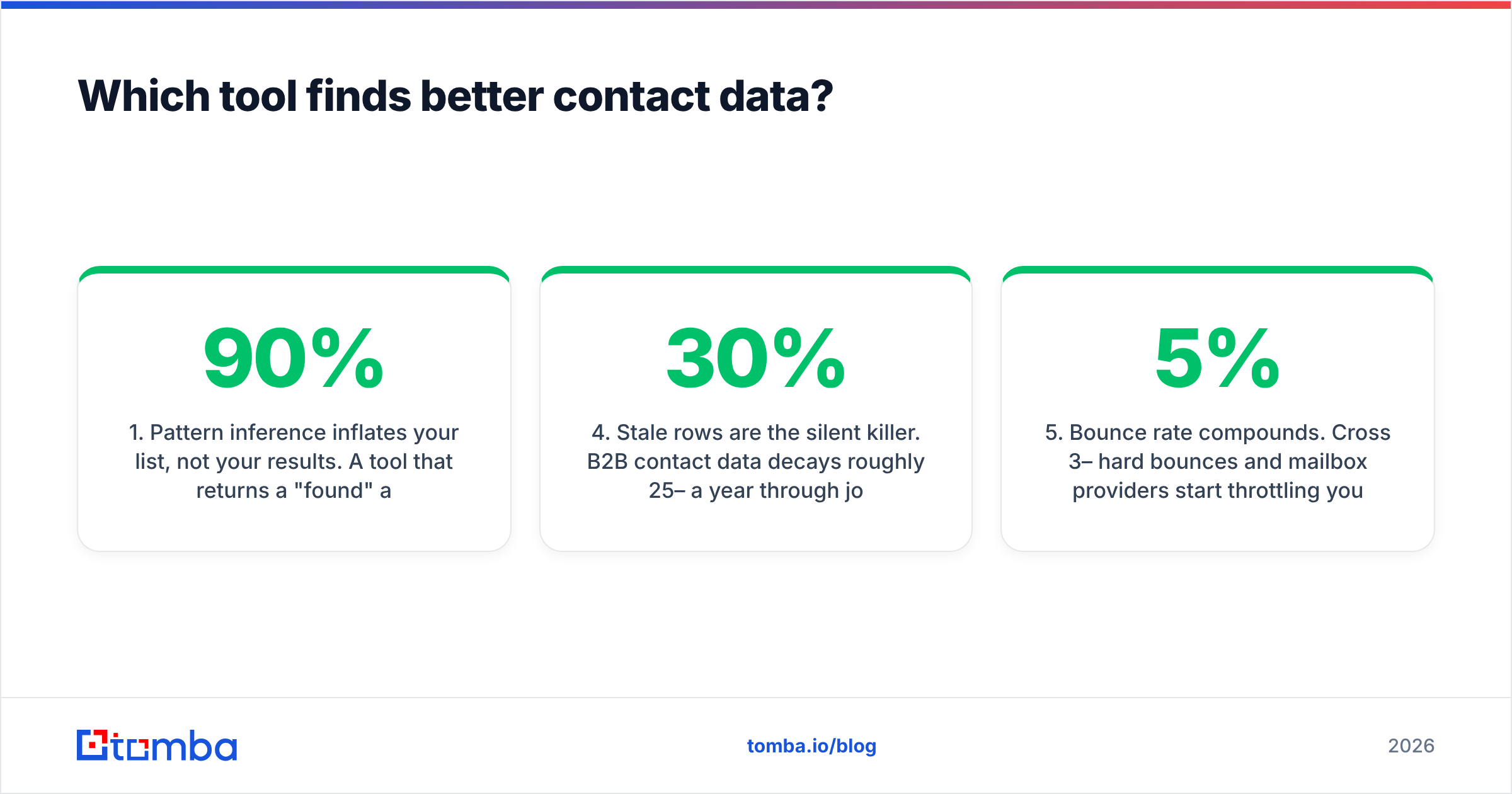
- Pattern inference inflates your list, not your results. A tool that returns a "found" address for 90% of a list has usually guessed a chunk of them. Delivered rate, not found rate, is the number to watch.
- Catch-all domains break both tools. Roughly a fifth of B2B domains accept everything at the SMTP layer, so a simple ping returns "valid" for addresses that do not exist. A catch-all verifier is the only way to grade those properly.
- Role accounts poison deliverability.
info@,press@, andcontact@show up constantly in scraped lists and in editorial outreach. They convert badly and they get flagged. - Stale rows are the silent killer. B2B contact data decays roughly 25–30% a year through job changes alone. A record found in 2024 is not a record you can send to in 2026.
- Bounce rate compounds. Cross 3–5% hard bounces and mailbox providers start throttling your domain, which quietly kills the campaigns that did have good addresses.
That is why most teams running either tool at volume add a dedicated email verifier as a final gate before import. It is the cheapest insurance in the stack.
What does each platform actually cost in 2026?#
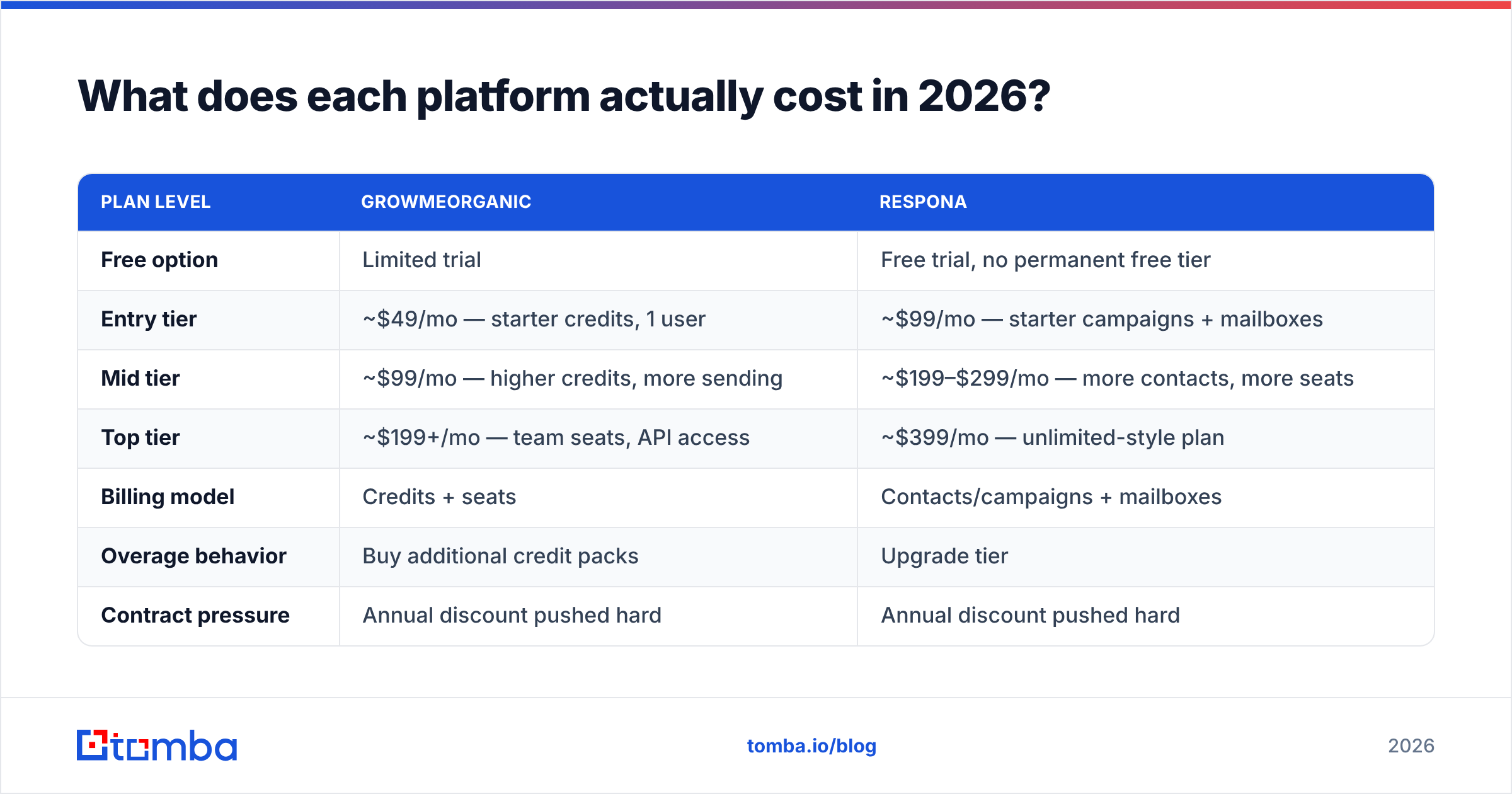
Both vendors price on annual-discount tiers with credit or campaign limits, so the sticker number rarely equals your real cost.
| Plan level | GrowMeOrganic | Respona |
|---|---|---|
| Free option | Limited trial | Free trial, no permanent free tier |
| Entry tier | ~$49/mo — starter credits, 1 user | ~$99/mo — starter campaigns + mailboxes |
| Mid tier | ~$99/mo — higher credits, more sending | ~$199–$299/mo — more contacts, more seats |
| Top tier | ~$199+/mo — team seats, API access | ~$399/mo — unlimited-style plan |
| Billing model | Credits + seats | Contacts/campaigns + mailboxes |
| Overage behavior | Buy additional credit packs | Upgrade tier |
| Contract pressure | Annual discount pushed hard | Annual discount pushed hard |
The hidden costs are similar in shape. On GrowMeOrganic, credits burn whether or not the email you pulled was real, so a low-quality list costs you twice — once in credits, once in domain reputation. On Respona, the constraint is campaign and contact volume rather than lookups, so cost scales with how many link targets you chase, not how many bad emails you generate.
For comparison, standalone data tooling is priced very differently. Tomba pricing runs a free tier at 25 searches/mo, Starter at $49/mo, Growth at $99/mo, and Pro at $249/mo — you pay for finding and verifying, and keep your sending platform separate. That unbundled approach costs more line items but usually less total, because you stop paying a sequencing tool for mediocre data.
Is GrowMeOrganic better than Respona for cold outbound?#
Yes, clearly — and it is not close.
If your goal is booked meetings, GrowMeOrganic is built for the motion end to end. You can go from a Sales Navigator search to a live three-step sequence in under an hour without leaving the browser. The bundled CRM is basic but sufficient for a two-person team that does not want to pay for HubSpot yet, and the LinkedIn extension means your ICP filtering happens where your ICP data already lives.
Where it strains:
- Deliverability tooling is thin. There is sending, but warmup, inbox rotation, and reputation monitoring are not at the level of a dedicated sending platform. If you run more than a couple of mailboxes, you will end up bolting something else on.
- Data quality is uneven by geography and company size. North American mid-market is decent. European SMBs, agencies, and anything outside the main tech corridors get noticeably thinner.
- Support and roadmap velocity draw mixed reviews. Check current sentiment on G2 rather than trusting any single review roundup, including this one.
Respona can technically send a cold sales email. It will just be an expensive, slow way to do something it was not designed for — the per-target research step that makes it excellent for link building is pure overhead when your list is 3,000 generic prospects.

Is Respona better for link building and digital PR?#
Yes, and by a similar margin in the opposite direction.
Respona's differentiator is that the prospecting step and the personalization step are the same step. When it surfaces an article, it also surfaces what the article says, who wrote it, and what they have written before. That context feeds a pitch that reads like a human read the page — which is the entire game in editorial outreach, where a generic template gets deleted in two seconds.
It also handles the operational parts of a link campaign that generic sales tools ignore: multiple sending mailboxes per campaign, per-domain deduplication so you do not pitch three writers at the same publication, and follow-up cadences tuned to editorial response windows rather than sales ones.
The gap is contact coverage on smaller publications and personal blogs — exactly the long-tail targets link builders care about. When Respona cannot resolve a byline to an address, the workflow stalls. That is where an author finder earns its place: point it at the article URL, get the writer's professional address, push it back into the campaign. Same for a domain search when you need every editorial contact at a publication rather than one byline.
Where does each tool fall short?#
A neutral summary of the recurring complaints, from vendor docs, review sites, and practitioner threads:
- GrowMeOrganic: guessed-email pollution inflating bounce rates; UI that feels like several products stitched together; database freshness varying by region; deliverability features that lag purpose-built senders.
- Respona: price shock for solo operators and small agencies; a learning curve that assumes you already know link-building strategy; contact discovery gaps on non-indexed or personal sites; no use case outside content and PR.
- Both: the bundled verification is a checkbox, not a product. Neither vendor's core competency is data hygiene, and both will happily hand you an address they are not confident about.
That last point is the one that costs real money. A 12% bounce rate on a 3,000-contact send does not just waste 360 emails — it drags your sender reputation down far enough that the other 2,640 land in spam.
Which one should you actually buy?#
Use this as the decision rule:
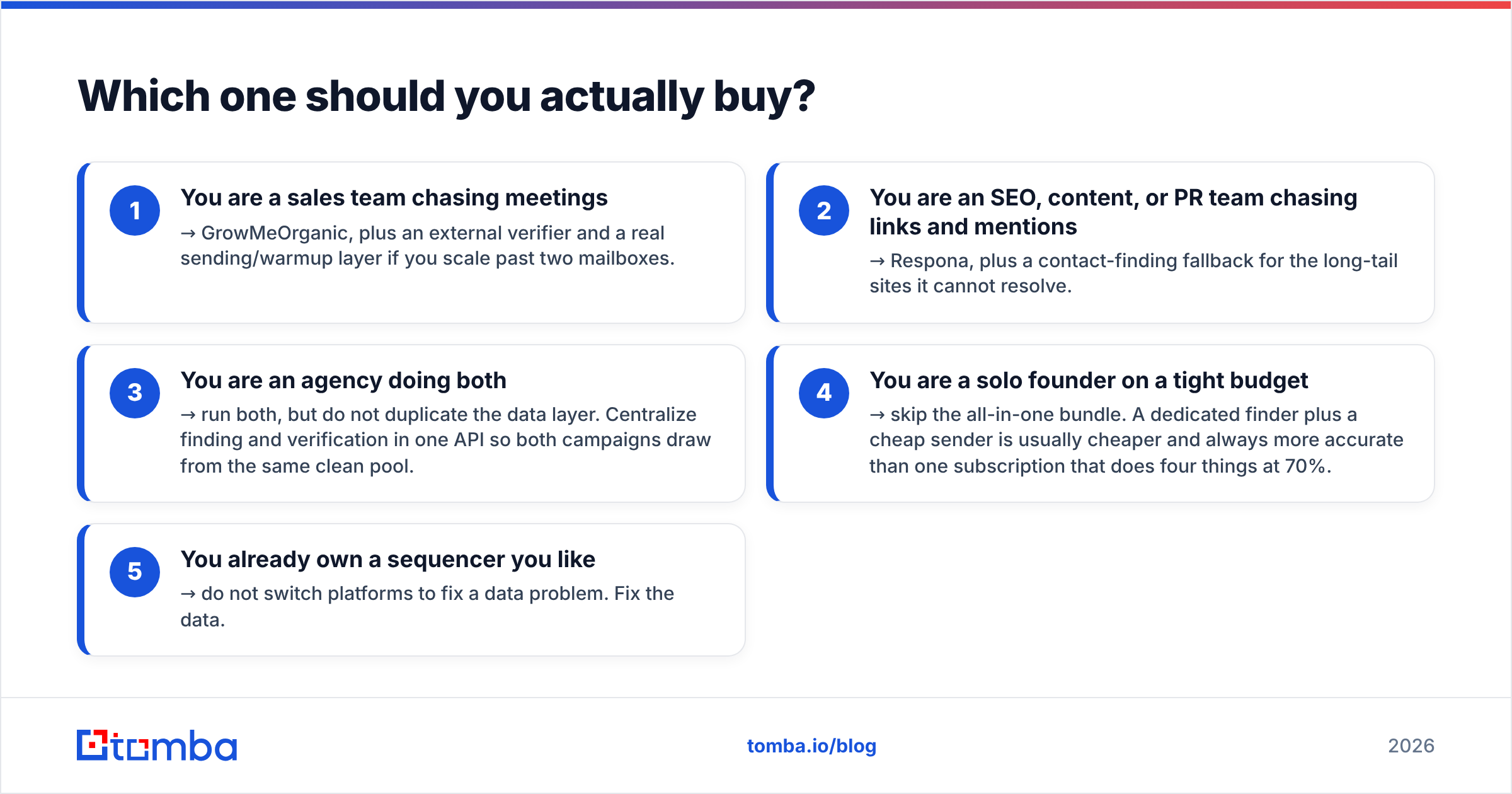
- You are a sales team chasing meetings → GrowMeOrganic, plus an external verifier and a real sending/warmup layer if you scale past two mailboxes.
- You are an SEO, content, or PR team chasing links and mentions → Respona, plus a contact-finding fallback for the long-tail sites it cannot resolve.
- You are an agency doing both → run both, but do not duplicate the data layer. Centralize finding and verification in one API so both campaigns draw from the same clean pool.
- You are a solo founder on a tight budget → skip the all-in-one bundle. A dedicated finder plus a cheap sender is usually cheaper and always more accurate than one subscription that does four things at 70%.
- You already own a sequencer you like → do not switch platforms to fix a data problem. Fix the data.
That fourth and fifth path is where the unbundled stack wins. Pull contacts through a bulk email finder or the Tomba API, verify them, then push clean rows into whichever sender you already trust. You keep your sequencing tool and stop paying it to guess.
What is the fastest way to fix the data layer in either stack?#
Start with the list you already have. Export the last 1,000 contacts either platform gave you, run them through verification, and look at the invalid and catch-all percentages. If more than one in ten is unusable, the tool is not your bottleneck — the data going into it is.
Try Tomba Email Finder for that layer. It plugs into whatever you are already running: search by domain, name, or company, get a confidence score with the source, verify before export, and push clean contacts into GrowMeOrganic, Respona, your CRM, or a spreadsheet. Start free with 25 searches a month, then scale on Starter at $49/mo when the pipeline justifies it. Keep the outreach tool you like — just stop letting it guess.
Related guides#
Ready to find emails that actually work?
Join 150,000+ professionals who stopped guessing and started sending. Free credits on signup — no credit card required.
Get the Tomba newsletter
Practical outbound tactics and product updates — once every two weeks.
About the author