GrowMeOrganic vs Startup Tracker: Which Fits Your 2026 Outbound?
One is an all-in-one scraping and sequencing suite. The other is a funding-signal database that tells you who just raised. Here is how GrowMeOrganic and Startup Tracker actually differ, and which one earns a slot in your stack.
TL;DR
- They are not the same category. GrowMeOrganic is an all-in-one prospecting suite (scraper + database + email sequencer). Startup Tracker is a signal database that surfaces newly funded companies and their teams.
- Pick GrowMeOrganic if you want one login that goes from list-building to sending, and you accept mid-tier data quality as the trade.
- Pick Startup Tracker if your ICP is funded startups and timing is your edge — you sell to companies that just closed a round and suddenly have budget.
- Neither is a verification layer. Both export contacts you should re-check before sending, or you will burn domain reputation on stale records.
- Cheapest realistic stack: signal source (or your own trigger list) + a dedicated finder/verifier + a sender you already trust. That usually beats one bloated all-in-one.
If you are searching for a straight GrowMeOrganic vs Startup Tracker verdict, the honest answer is that most teams are comparing the wrong axis. One tool answers "how do I contact 5,000 people this month?" The other answers "which 40 companies are worth contacting this week?" This post breaks down where each one is genuinely strong, where the data gets thin, and how to assemble a stack that does not double-pay for the same capability.
What is GrowMeOrganic, exactly?#
GrowMeOrganic is a B2B prospecting and outreach platform built around three pieces: a contact database, a Chrome extension that pulls profiles and company data from LinkedIn and Google Maps, and a built-in cold email sequencer with unlimited-sending positioning on higher tiers.
The pitch is consolidation. Instead of paying for a data vendor, a finder, and a sequencer separately, you run everything from one dashboard: build a list from LinkedIn Sales Navigator search, enrich it with work emails, drop it into a drip campaign, and track opens and replies in the same tool.
That consolidation is real, and it is why the product resonates with solo founders and small agencies. It is also the source of most complaints — an all-in-one is rarely best-in-class at any single stage, and when the email-finding layer misses, the sequencer downstream happily sends to whatever was returned.
Practically, GrowMeOrganic fits a persona: a two-to-five person team running high-volume, broad-ICP outbound, where "more contacts per dollar" beats "fewer, cleaner contacts."
What is Startup Tracker, and why do people confuse the two?#
Startup Tracker is a different animal. It monitors funding announcements, tracks which startups just closed a round, and surfaces company profiles plus decision-maker contacts attached to those events. You filter by round stage, amount raised, geography, and industry, then work the resulting list.
The confusion happens because both tools output a CSV of names, companies, and email addresses. On the surface that looks like the same product. It is not. GrowMeOrganic's value is breadth — it will hand you anyone matching a job title filter. Startup Tracker's value is timing — it tells you which subset of the market just became buyable.
A freshly funded Series A company has three things a random company does not: new budget, a mandate to spend it fast, and a hiring spree that creates tool and service gaps. That is a trigger event, and trigger-based outbound consistently outperforms static list blasting on reply rate. The trade is volume. There are only so many funding rounds per month in your segment.

Is GrowMeOrganic vs Startup Tracker the right comparison at all?#
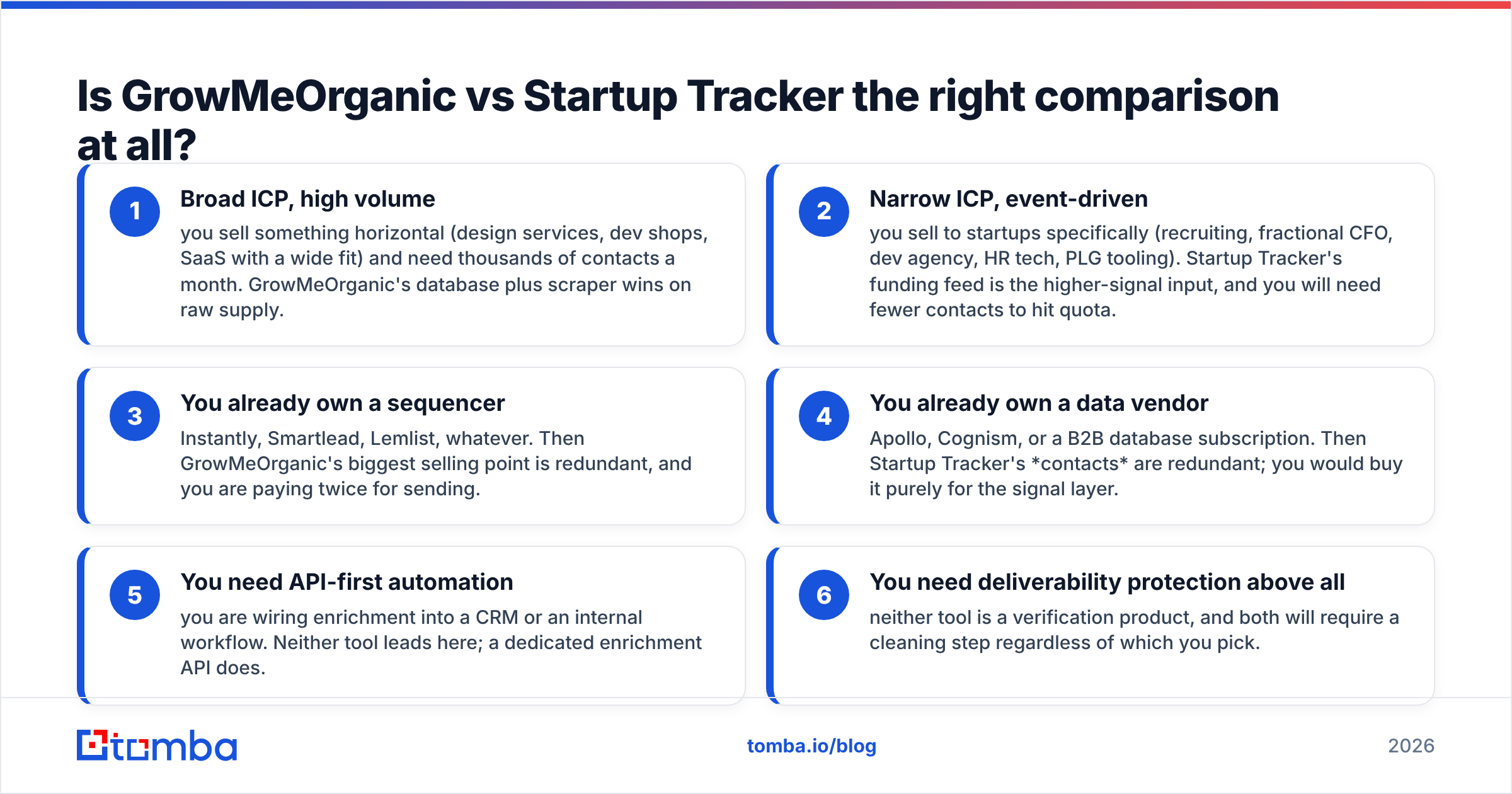
Only if you have one budget line and must choose. If that is the case, run the decision off your ICP, not off the feature list:
- Broad ICP, high volume — you sell something horizontal (design services, dev shops, SaaS with a wide fit) and need thousands of contacts a month. GrowMeOrganic's database plus scraper wins on raw supply.
- Narrow ICP, event-driven — you sell to startups specifically (recruiting, fractional CFO, dev agency, HR tech, PLG tooling). Startup Tracker's funding feed is the higher-signal input, and you will need fewer contacts to hit quota.
- You already own a sequencer — Instantly, Smartlead, Lemlist, whatever. Then GrowMeOrganic's biggest selling point is redundant, and you are paying twice for sending.
- You already own a data vendor — Apollo, Cognism, or a B2B database subscription. Then Startup Tracker's contacts are redundant; you would buy it purely for the signal layer.
- You need API-first automation — you are wiring enrichment into a CRM or an internal workflow. Neither tool leads here; a dedicated enrichment API does.
- You need deliverability protection above all — neither tool is a verification product, and both will require a cleaning step regardless of which you pick.
That framing kills a lot of false comparisons. Most teams asking "GrowMeOrganic or Startup Tracker?" actually need one of them plus a verification layer, not one of them instead of the other.
How do GrowMeOrganic and Startup Tracker compare feature by feature?#
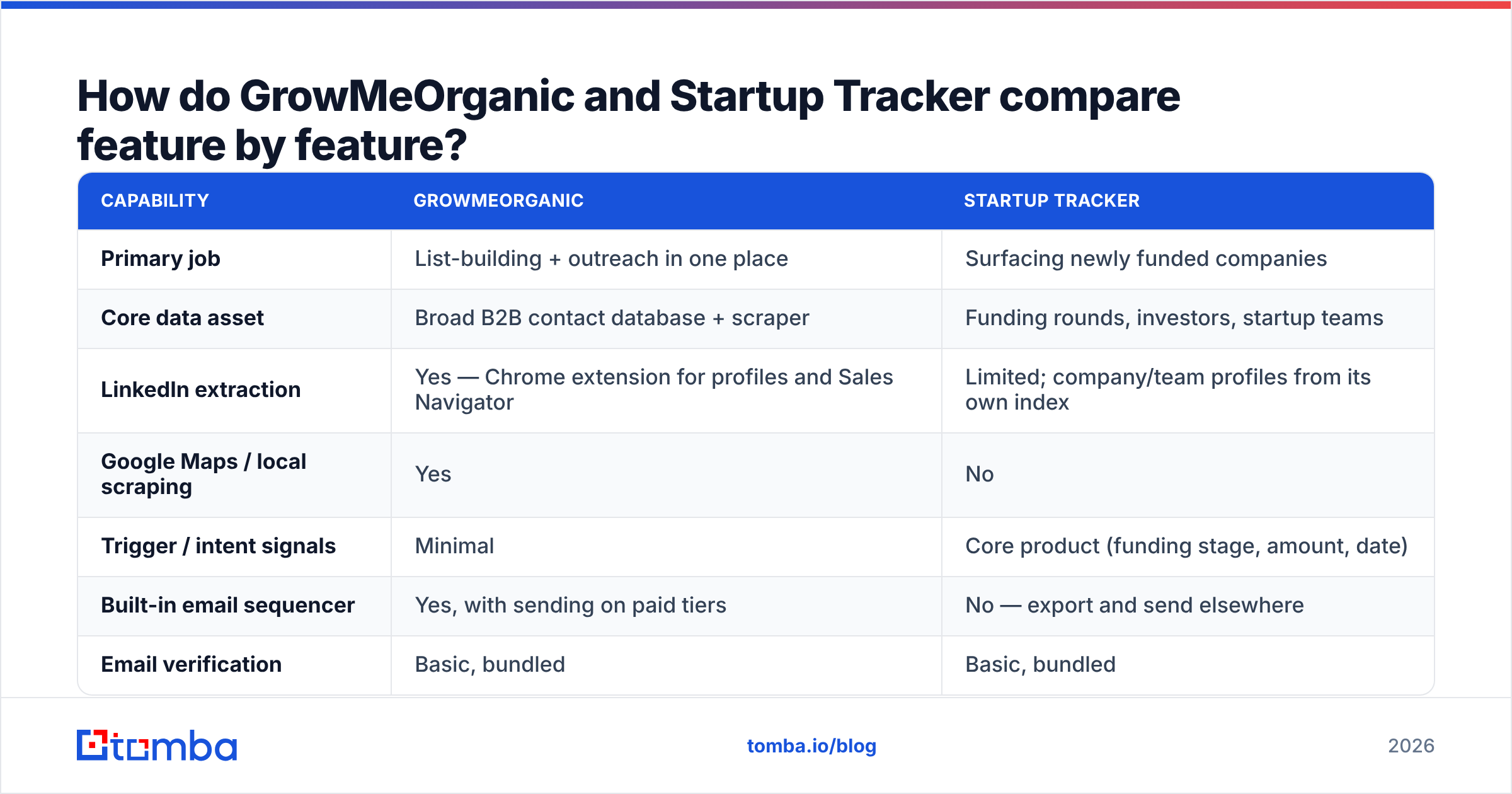
| Capability | GrowMeOrganic | Startup Tracker |
|---|---|---|
| Primary job | List-building + outreach in one place | Surfacing newly funded companies |
| Core data asset | Broad B2B contact database + scraper | Funding rounds, investors, startup teams |
| LinkedIn extraction | Yes — Chrome extension for profiles and Sales Navigator | Limited; company/team profiles from its own index |
| Google Maps / local scraping | Yes | No |
| Trigger / intent signals | Minimal | Core product (funding stage, amount, date) |
| Built-in email sequencer | Yes, with sending on paid tiers | No — export and send elsewhere |
| Email verification | Basic, bundled | Basic, bundled |
| Phone numbers | On higher tiers | Limited |
| API access | Available on upper plans | Available, narrower scope |
| Best-fit buyer | Agencies and SMB teams doing volume outbound | Teams selling to funded startups |
| Realistic weak point | Data freshness on long-tail contacts | Small addressable list per month |
The row that matters most is the last one. GrowMeOrganic's failure mode is quantity without confidence: you get 4,000 rows and no reliable way to know which 900 will bounce. Startup Tracker's failure mode is the opposite: the 60 companies it surfaced this month are genuinely well-timed, but 60 companies is not a pipeline if your deal size is small.
How accurate is the contact data in each?#
Treat every vendor-published accuracy number — including any you see on a comparison page — as a marketing claim until you test it on your own list. Vendors measure accuracy on the segments where they are strongest.
Here is the test that actually settles it. Take 200 contacts from your real ICP. Pull them through both tools. Then run all outputs through an independent email verifier and compare four numbers:
- Coverage: what percentage of the 200 got any email at all? A tool that returns 40% coverage with perfect accuracy may be less useful than one at 75% coverage with a cleaning step.
- Valid rate: of the emails returned, how many verify as deliverable?
- Catch-all share: how many land on catch-all domains where SMTP cannot confirm? This is where most "accuracy" claims quietly hide. A catch-all verifier is the only way to make that bucket usable instead of a coin flip.
- Role-account share: how many are info@, sales@, hello@? Those inflate coverage and depress reply rates.
Scraper-driven products like GrowMeOrganic tend to score well on coverage and weaker on valid rate, because pattern-guessing fills gaps aggressively. Signal databases like Startup Tracker tend to have tighter, smaller datasets — good for the companies they cover, thin outside them.
Neither result is disqualifying. It just means your send list should never be a raw export from either one. Two cents per verification is dramatically cheaper than a burned sending domain, and the deliverability math is not close.
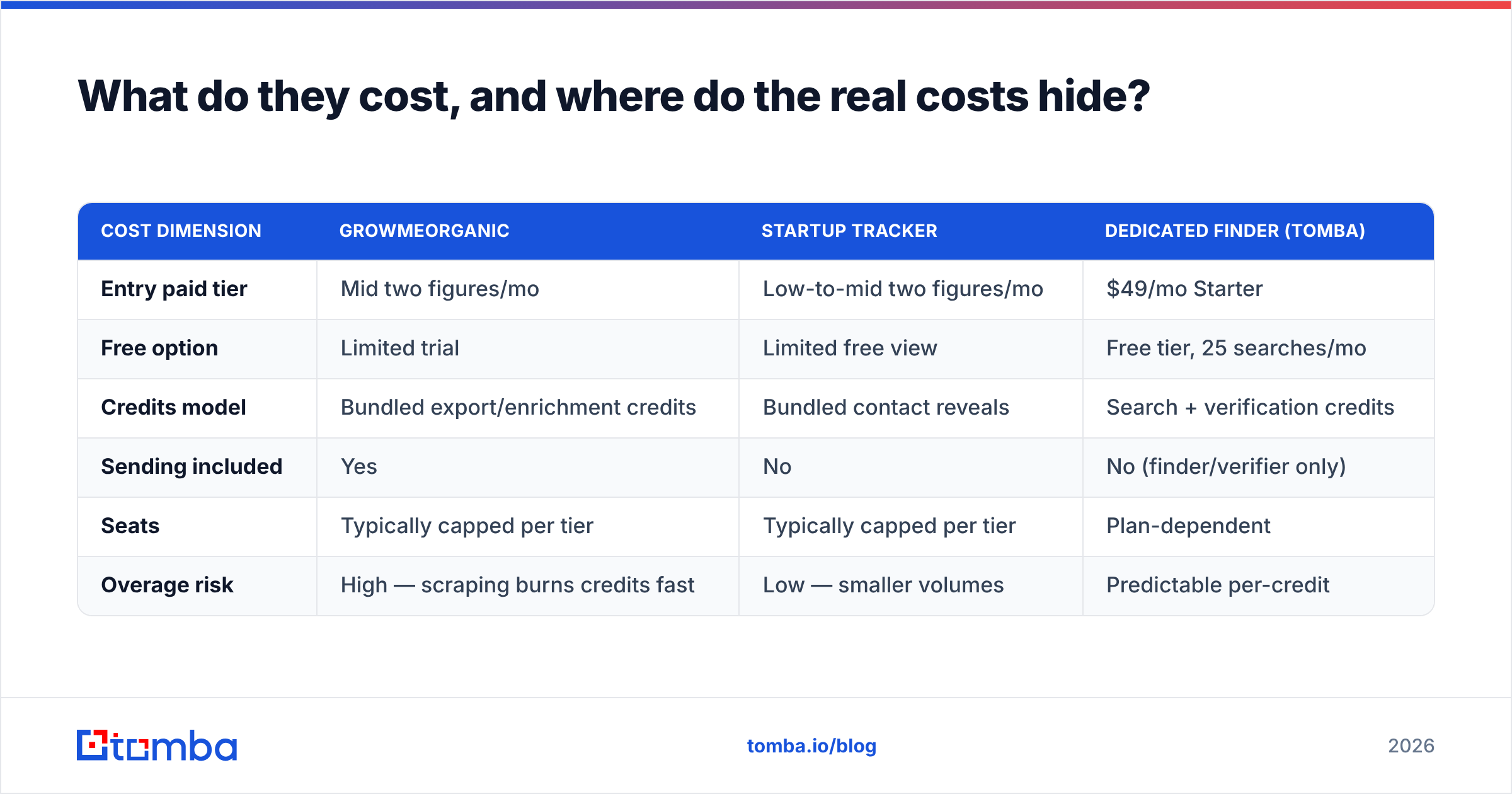
What do they cost, and where do the real costs hide?#
Published pricing moves constantly on both products, and both have run promotional and lifetime-deal pricing at various points — always confirm on the vendor's own pricing page before you commit. What does not move is the shape of the cost.
| Cost dimension | GrowMeOrganic | Startup Tracker | Dedicated finder (Tomba) |
|---|---|---|---|
| Entry paid tier | Mid two figures/mo | Low-to-mid two figures/mo | $49/mo Starter |
| Free option | Limited trial | Limited free view | Free tier, 25 searches/mo |
| Credits model | Bundled export/enrichment credits | Bundled contact reveals | Search + verification credits |
| Sending included | Yes | No | No (finder/verifier only) |
| Seats | Typically capped per tier | Typically capped per tier | Plan-dependent |
| Overage risk | High — scraping burns credits fast | Low — smaller volumes | Predictable per-credit |
The hidden costs are the same three every time:
Credits burned on bad rows. If 25% of what you export never verifies, you paid for 100% and used 75%. That is a real 33% price increase on effective contacts.
Seat caps. Both platforms gate seats by tier. A three-person SDR pod frequently forces an upgrade that has nothing to do with data volume.
The tool you keep anyway. Teams buy GrowMeOrganic for the bundled sequencer, then keep sending from their existing platform because deliverability tooling there is better. You are now paying for two senders. Check honestly whether you will actually migrate.
Compare that against a pure-play pricing ladder — Tomba pricing runs Free (25 searches/mo), Starter $49/mo, Growth $99/mo, Pro $249/mo, Enterprise custom — where you are only buying find-and-verify, not a bundled sender you may never switch to.
Which one should you actually buy in 2026?#
Buy GrowMeOrganic if: you are an agency or SMB running broad outbound, you do not have a sequencer yet, you value one login over best-in-class components, and your ICP is wide enough that a general database covers it. Budget a verification step on top — non-negotiable.
Buy Startup Tracker if: funded startups are your market. Recruiters, agencies, fractional execs, and infrastructure vendors selling into new rounds get outsized value here because the timing signal does work the sequencer cannot. Pair it with a finder that fills contact gaps for the companies it surfaces but does not fully staff.
Buy neither if: you already run Apollo or a comparable database plus a modern sender. In that case the marginal gain is a signal feed, and you can approximate that with funding newsletters and a good enrichment API for a fraction of the cost.
For an outside read on how buyers in each segment rate these categories, G2's software review data is worth ten minutes before you commit to an annual plan — filter reviews by company size, since SMB and mid-market experiences of both tools diverge sharply.
What does a stack that actually works look like?#
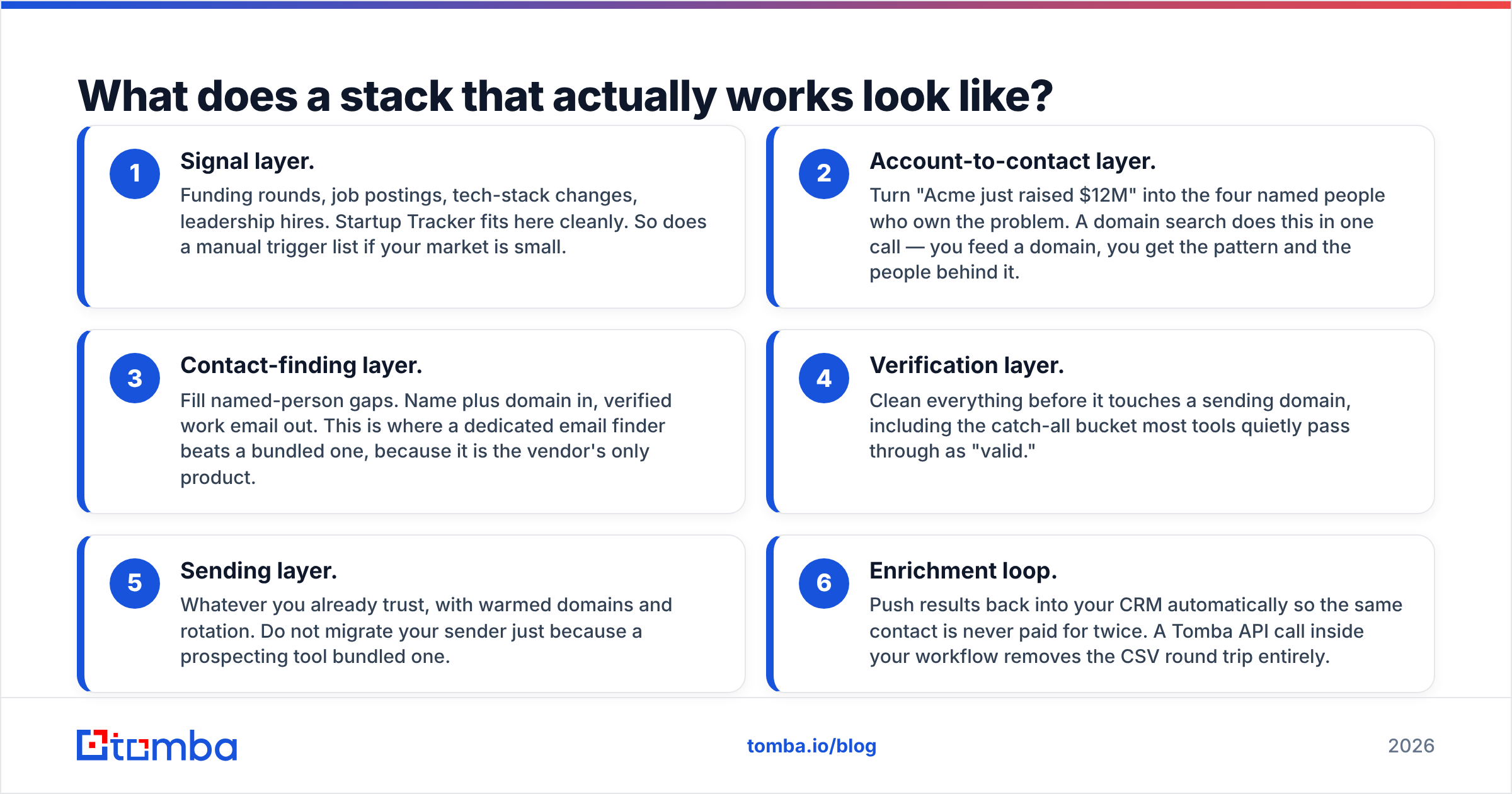
The teams getting the best reply rates in 2026 are not running one tool. They run a chain where each link does one job well:
- Signal layer. Funding rounds, job postings, tech-stack changes, leadership hires. Startup Tracker fits here cleanly. So does a manual trigger list if your market is small.
- Account-to-contact layer. Turn "Acme just raised $12M" into the four named people who own the problem. A domain search does this in one call — you feed a domain, you get the pattern and the people behind it.
- Contact-finding layer. Fill named-person gaps. Name plus domain in, verified work email out. This is where a dedicated email finder beats a bundled one, because it is the vendor's only product.
- Verification layer. Clean everything before it touches a sending domain, including the catch-all bucket most tools quietly pass through as "valid."
- Sending layer. Whatever you already trust, with warmed domains and rotation. Do not migrate your sender just because a prospecting tool bundled one.
- Enrichment loop. Push results back into your CRM automatically so the same contact is never paid for twice. A Tomba API call inside your workflow removes the CSV round trip entirely.
Notice what this structure does to the original question. GrowMeOrganic tries to own steps 2 through 5 in one product. Startup Tracker owns step 1 and part of step 2. They overlap far less than a feature-grid comparison suggests, which is exactly why so many teams end up running both — or running Startup Tracker for signal and a dedicated finder for everything downstream.
What is the final verdict?#
If you must pick one: GrowMeOrganic for volume and consolidation, Startup Tracker for timing and precision. They are optimizing for different bottlenecks, and the right answer is whichever bottleneck is currently costing you more pipeline.
But the sharper move is to stop paying for bundled mediocrity in the middle of the chain. Signal sourcing and sending are both places where specialization pays. So is finding and verifying the address itself — it is the single step where a wrong answer costs you a domain, not just a credit.
Start with the Tomba Email Finder on the free tier (25 searches a month, no card) and run it against 25 contacts from whichever tool you are evaluating. Compare coverage, valid rate, and catch-all share side by side on your own ICP. Twenty minutes of that test will tell you more than any comparison page — including this one.
Related guides#
Ready to find emails that actually work?
Join 150,000+ professionals who stopped guessing and started sending. Free credits on signup — no credit card required.
Get the Tomba newsletter
Practical outbound tactics and product updates — once every two weeks.
About the author