GrowMeOrganic vs VerifyEmail.io: Full 2026 Tool Comparison
One tool builds your prospect list, the other decides which addresses survive. Here is an honest 2026 breakdown of GrowMeOrganic vs VerifyEmail.io — features, pricing models, accuracy, and when you actually need both.
TL;DR
GrowMeOrganic vs VerifyEmail.io is not a real fight. The two tools solve different halves of one pipeline.
- GrowMeOrganic is a lead-generation suite. It scrapes, finds emails, and sends sequences.
- VerifyEmail.io is a narrow email-validation API. It cleans lists. It never builds them.
- Pick GrowMeOrganic if you have no list yet. You get LinkedIn extraction, a B2B database, and a built-in cold email sender in one seat price.
Comparing the two head to head only makes sense when one budget line has to cover both jobs.
- Pick VerifyEmail.io if you already have volume — a CRM export, a signup form, a purchased list — and you need bounces gone before you send.
- Most teams that pick one buy the other within a quarter.
- A platform that finds and verifies on the same credit pool (Tomba, Hunter, Apollo) usually beats two seat licenses on price.
- Your vendor choice is not what moves the reply rate. Verifying catch-all domains before you send is.
What are GrowMeOrganic and VerifyEmail.io?#
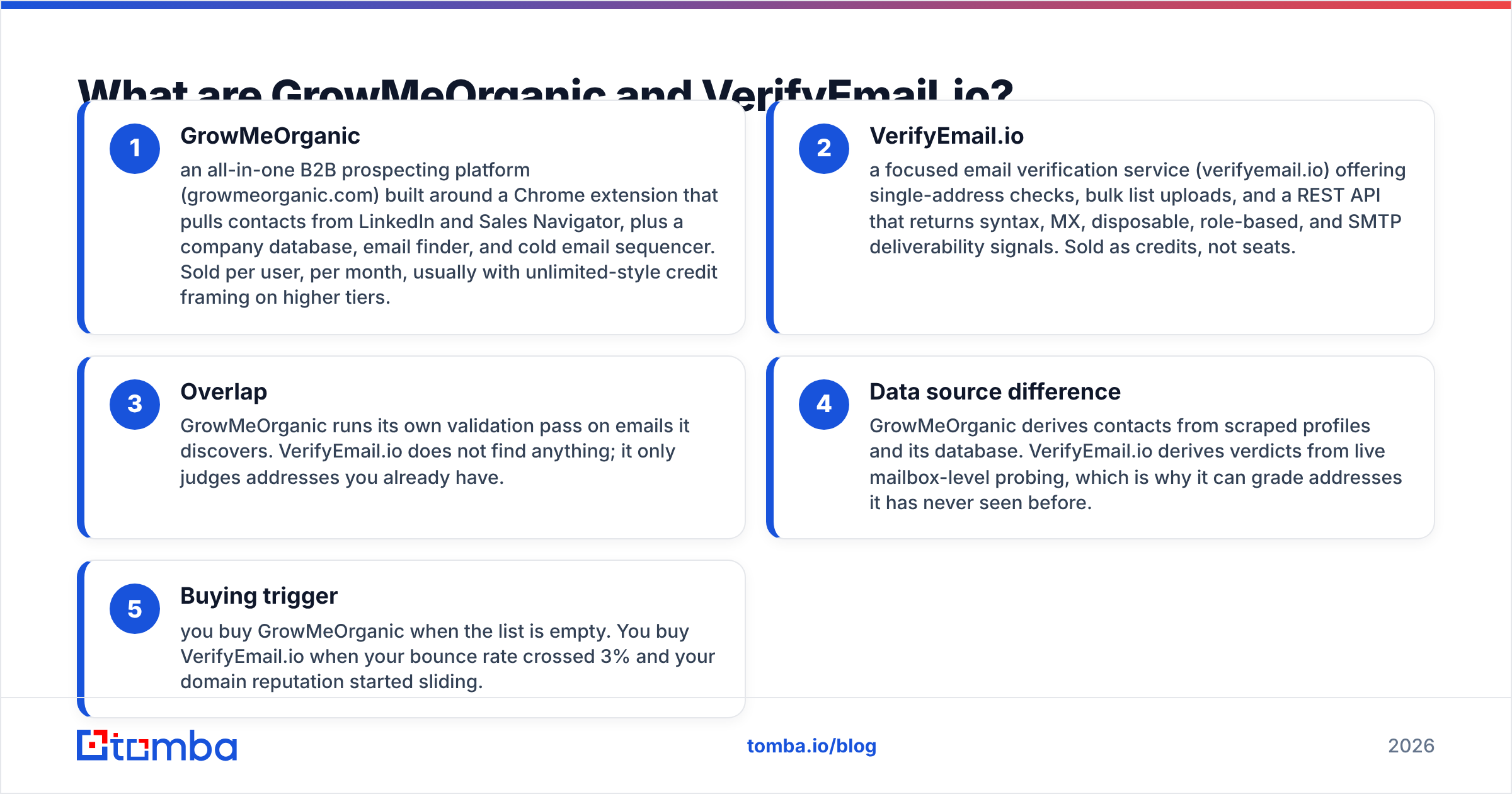
They solve two different halves of the same pipeline. Think of outbound like a restaurant. GrowMeOrganic is the supplier who delivers crates of produce. VerifyEmail.io is the prep cook who throws out anything bruised. You need both jobs done. You do not need two vendors.
Here is the short version of what each one is:
- GrowMeOrganic — an all-in-one B2B prospecting platform (growmeorganic.com). A Chrome extension pulls contacts from LinkedIn and Sales Navigator. You also get a company database, an email finder, and a cold email sequencer. It sells per user, per month, with unlimited-style credit framing on higher tiers.
- VerifyEmail.io — a focused email verification service (verifyemail.io). It offers single-address checks, bulk list uploads, and a REST API. The API returns syntax, MX, disposable, role-based, and SMTP deliverability signals. It sells as credits, not seats.
- Overlap — GrowMeOrganic runs its own validation pass on emails it discovers. VerifyEmail.io finds nothing. It only judges addresses you already have.
Two more differences decide which one you end up buying:
- Data source — GrowMeOrganic derives contacts from scraped profiles and its database. VerifyEmail.io derives verdicts from live mailbox-level probing. That is why it can grade an address it has never seen.
- Buying trigger — you buy GrowMeOrganic when the list is empty. You buy VerifyEmail.io when your bounce rate crosses 3% and your domain reputation starts sliding.
If you only read one line: GrowMeOrganic solves a volume problem, VerifyEmail.io solves a quality problem.
What does GrowMeOrganic actually do well?#
GrowMeOrganic's pull is packaging. For a single per-seat price you get the LinkedIn extractor, a database of company and contact records, an email finder, and a sequencer that sends from your own Gmail or Outlook connection. For a two-person agency that would otherwise stitch together a scraper, a finder, and Instantly, that consolidation is real money saved.
Where it earns its keep:
- LinkedIn and Sales Navigator extraction. Export a search into a usable CSV with names, titles, companies, and enriched emails in one pass.
- Local business scraping. The Google Maps extractor is genuinely useful for agencies selling to restaurants, clinics, gyms, and other SMB verticals that never appear in a B2B database.
- Sequences included. You are not paying a second vendor to actually send the emails.
- Lifetime and annual deal pricing. GrowMeOrganic has historically been aggressive on annual and appsumo-style pricing, which is why it shows up in so many bootstrapped stacks.
Public reviews on G2 and Capterra name the same gaps. Enrichment coverage thins out fast outside the US and Western Europe. "Unlimited" credits come with fair-use throttles. The validation attached to found emails is fine for a first pass, but it is no substitute for a dedicated verifier. If you have ever exported 2,000 contacts, sent to them raw, and watched a 9% bounce rate, you have met that gap.

What does VerifyEmail.io actually do well?#
VerifyEmail.io does one job and stays out of the way. You hand it addresses, it hands back verdicts. The API surface is small, the latency is low, and it slots into a signup form or a CRM sync without a project plan.
The signals that matter in its response:
- Syntax and domain checks — malformed addresses and dead domains filtered before any network cost.
- MX record validation — does this domain accept mail at all?
- Disposable detection — the throwaway-inbox filter that keeps trial-abuse out of your funnel.
- Role-based flags —
info@,sales@,support@, the addresses that inflate list size and depress reply rate. - SMTP-level deliverability — the mailbox-exists check that actually decides your bounce rate.
- Catch-all identification — flagging domains that accept everything, which is where most verifiers quietly give up.
The honest limitation: verification is a commodity. VerifyEmail.io competes with ZeroBounce, NeverBounce, Bouncer, Debounce, and the verification module bundled into every email finder on the market. It wins on simplicity and price-per-check, not on capability nobody else has. And it will never tell you who to email — that is your problem to solve elsewhere.
GrowMeOrganic vs VerifyEmail.io: feature-by-feature comparison#
This is the table most people came for. Prices shift, so treat the pricing rows as shape-of-the-deal rather than a quote. Check each vendor's page before you buy.
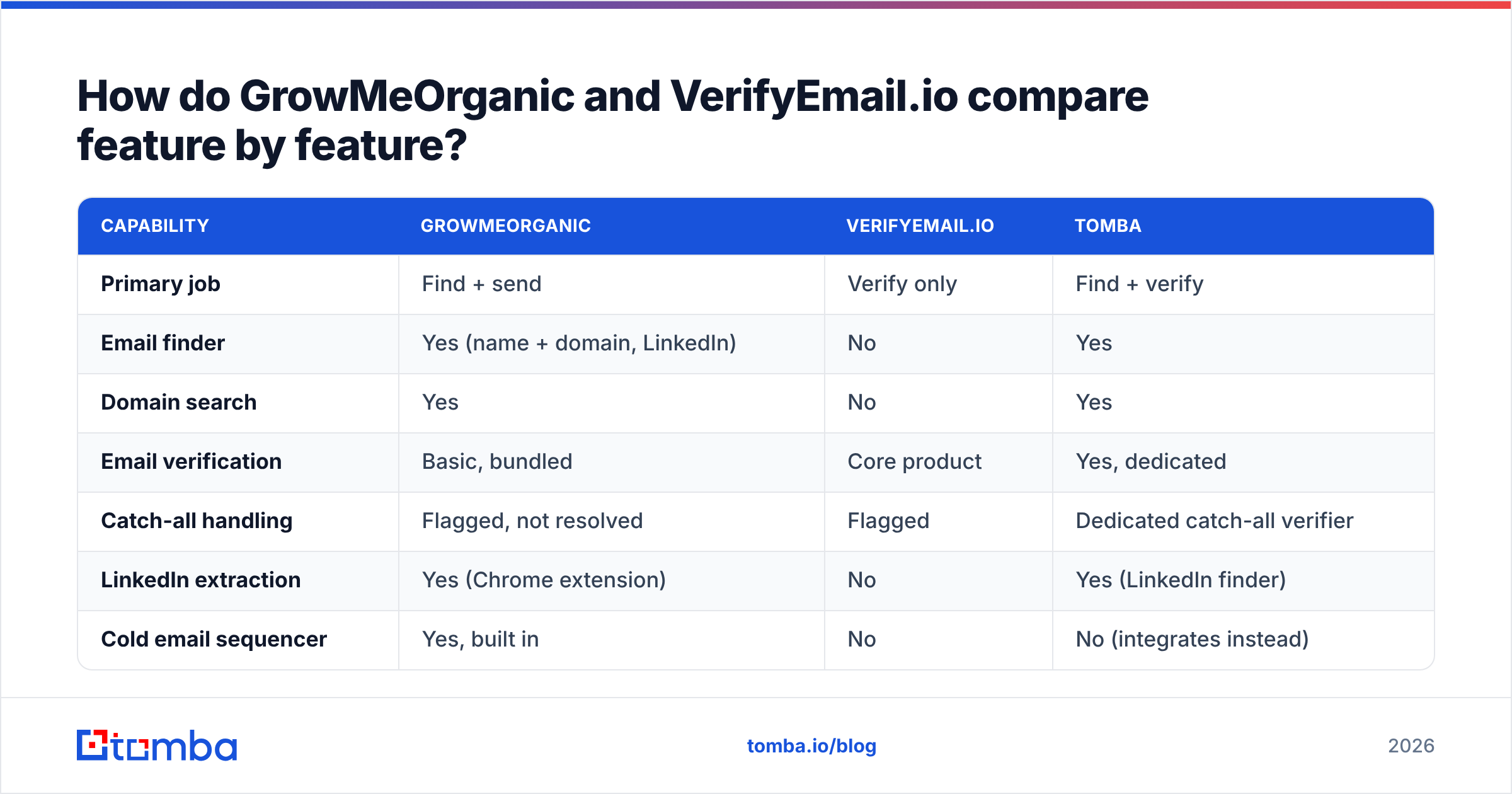
| Capability | GrowMeOrganic | VerifyEmail.io | Tomba |
|---|---|---|---|
| Primary job | Find + send | Verify only | Find + verify |
| Email finder | Yes (name + domain, LinkedIn) | No | Yes |
| Domain search | Yes | No | Yes |
| Email verification | Basic, bundled | Core product | Yes, dedicated |
| Catch-all handling | Flagged, not resolved | Flagged | Dedicated catch-all verifier |
| LinkedIn extraction | Yes (Chrome extension) | No | Yes (LinkedIn finder) |
| Cold email sequencer | Yes, built in | No | No (integrates instead) |
| Phone numbers | Limited | No | Yes |
| Pricing model | Per seat, per month | Credit packs / PAYG | Credit-based, no seat tax |
| Free tier | Trial | Limited free checks | 25 searches/mo, free forever |
| Entry paid price | Roughly $39–$49 per user/mo annually | Volume-priced credits | $49/mo Starter |
| API | Yes | Yes, verification only | Yes, full suite |
| Best for | Agencies with no list | Teams with a dirty list | Teams that need both |

Notice the structural difference. GrowMeOrganic charges per seat. VerifyEmail.io charges per check. Add a third SDR to GrowMeOrganic and your bill jumps, whether or not that SDR sends a single email. Add a third SDR to a credit-based tool and nothing changes until consumption changes. For teams above five people, that single line item usually decides the comparison.
Which one is more accurate?#
Wrong question — they measure different things, and "accuracy" means something different for each.
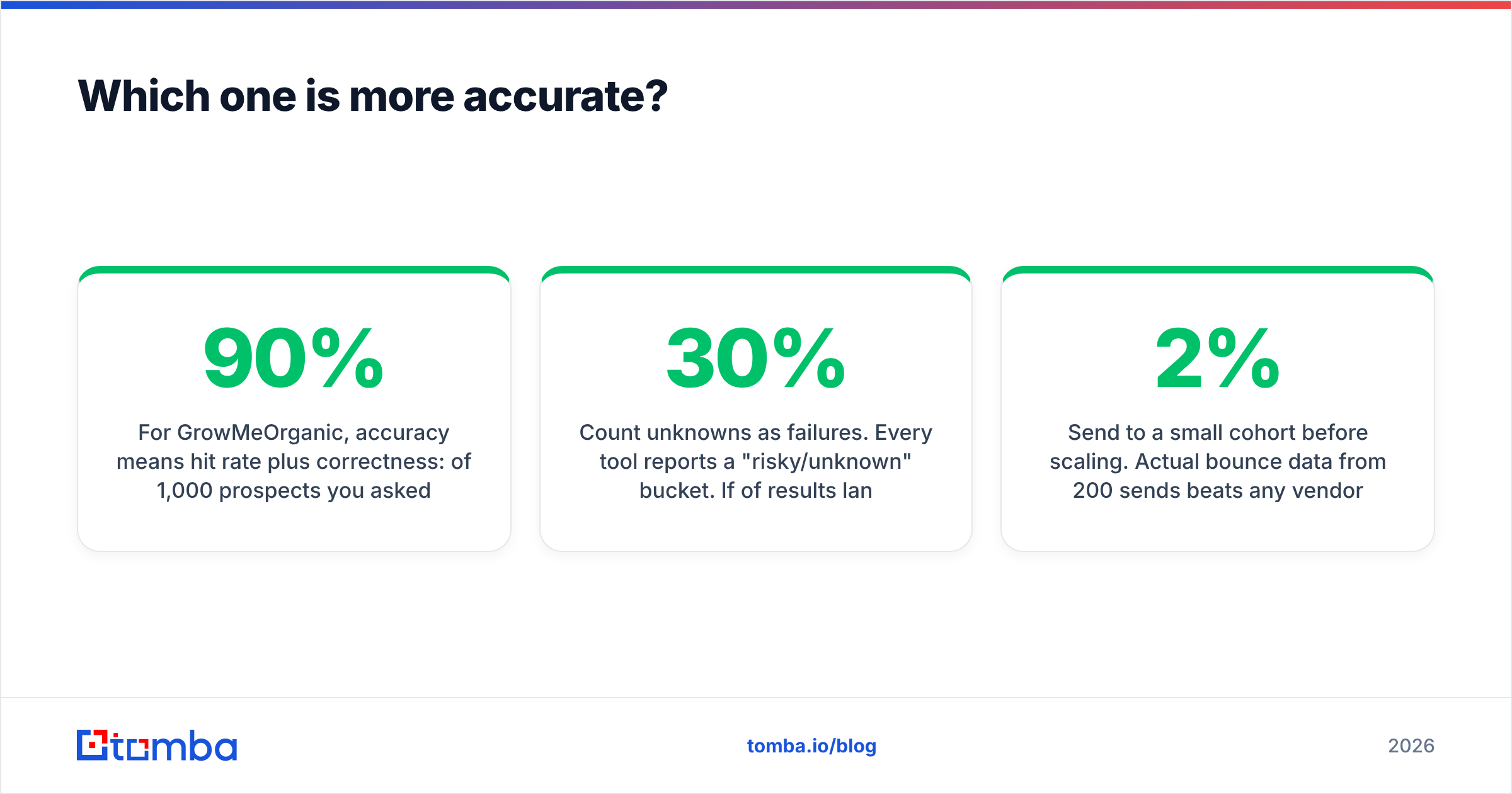
For GrowMeOrganic, accuracy means hit rate plus correctness: of 1,000 prospects you asked it to enrich, how many returned an email, and how many of those actually belong to that person. Pattern-guessing tools inflate hit rate by returning firstname.lastname@domain.com for every miss. That looks like 90% coverage in the dashboard and 12% bounces in your sender.
For VerifyEmail.io, accuracy means verdict reliability: when it says valid, does the message land, and when it says invalid, was it really dead? The expensive failure mode here is the false invalid — a real buyer you deleted from the list because an SMTP probe timed out.

Three rules to keep yourself honest when you run your own test:
- Test on your ICP, not a sample. A vendor strong on US SaaS can be weak on German manufacturing. Take 200 real target accounts, run them through both trials, and compare.
- Count unknowns as failures. Every tool reports a "risky/unknown" bucket. If 30% of results land there, your usable coverage is 70%, whatever the marketing page says.
- Send to a small cohort before scaling. Actual bounce data from 200 sends beats any vendor claim. If bounces exceed 2%, stop and clean before you touch the rest of the list.
For a deeper walk through why catch-all domains break this measurement, our catch-all verifier breakdown covers the mechanics.
How does pricing really compare?#
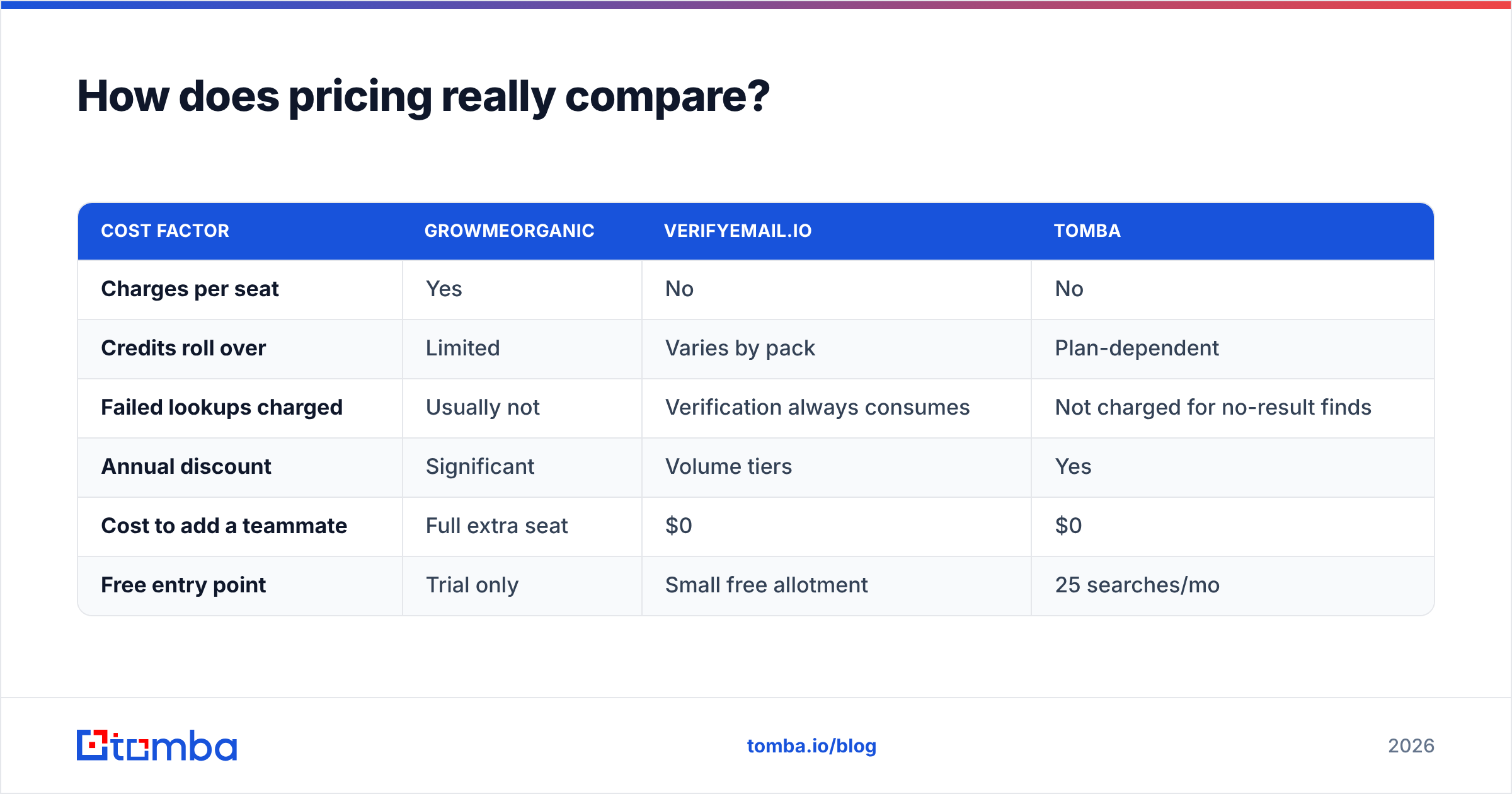
Both vendors publish simple pages that hide the same complexity every data vendor has: what you pay is a function of seats, credits, rollover, and how much waste your workflow generates.
| Cost factor | GrowMeOrganic | VerifyEmail.io | Tomba |
|---|---|---|---|
| Charges per seat | Yes | No | No |
| Credits roll over | Limited | Varies by pack | Plan-dependent |
| Failed lookups charged | Usually not | Verification always consumes | Not charged for no-result finds |
| Annual discount | Significant | Volume tiers | Yes |
| Cost to add a teammate | Full extra seat | $0 | $0 |
| Free entry point | Trial only | Small free allotment | 25 searches/mo |
The trap in stacking both: you pay GrowMeOrganic to find an email, then pay VerifyEmail.io to check the same email. That is double-charging for one contact. If your monthly volume is under roughly 5,000 contacts, a single platform with both functions on one credit pool almost always wins on total cost. Above that, and especially if you are ingesting third-party lists you did not source yourself, the dedicated verifier starts to pay for itself.
Compare that shape against straightforward Tomba pricing — Free at 25 searches a month, Starter at $49/mo, Growth at $99/mo, Pro at $249/mo, Enterprise custom — where finding and verifying draw from the same balance and extra teammates cost nothing.
Which should you choose for your use case?#
Match the tool to the bottleneck, not to the feature list.
- You have zero list and sell to SMBs. GrowMeOrganic. The Google Maps and LinkedIn extractors are the fastest path from nothing to a sendable CSV. The built-in sequencer means you skip a second product on day one.
- You have a 40,000-row list of unknown quality. VerifyEmail.io. Bulk-upload, clean, and only then decide what to do with what survives. Never let a list you did not build touch your primary sending domain unverified.
- You are enriching a CRM continuously. A finder API beats both. You want programmatic lookups on record creation, not a Chrome extension a human has to click. The Tomba API and similar endpoints handle this pattern natively.
The rest of the GrowMeOrganic vs VerifyEmail.io decision hangs on team size and sending risk.
- You send from multiple domains and reputation is fragile. Verification first, always. Read up on email deliverability fundamentals before adding volume. No data vendor can rescue a burned domain.
- You are a 6+ person sales team. Avoid per-seat data pricing. Credit pools scale with usage. Seats scale with headcount, and headcount is the thing you hope grows.
- You need phone numbers too. Neither tool is strong here. Look at a suite with a dedicated phone finder rather than bolting on a third vendor.
What about catch-all domains?#
This is where both tools, and most of the market, get quietly imprecise — and it matters more than any other line in the comparison.
A catch-all domain accepts mail sent to any address at that domain, real mailbox or not. SMTP probing tells you nothing, because the server says yes to everything. Roughly 20–25% of B2B domains are configured this way, concentrated in exactly the enterprise segment you most want to reach.
Most verifiers return "accept-all" or "unknown" and stop. You then face a bad choice: delete a quarter of your enterprise pipeline, or send blind and gamble your bounce rate. Neither GrowMeOrganic's bundled validation nor a standard verification API resolves this — they classify the problem, they do not solve it.
The workarounds that actually help:
- Cross-reference the pattern. If nine known-good emails at the domain follow
first.last@, a tenth in the same shape is a strong bet. - Send catch-alls in isolation. Route them through a separate sending domain so a bad batch cannot damage your primary.
- Use a tool with dedicated catch-all resolution. Some providers, including Tomba's email verifier, apply pattern intelligence and secondary sources rather than returning a shrug.
- Track outcomes by bucket. Report bounce rate for catch-all sends separately. If it stays under 3%, keep sending them. If not, tighten the rule.
GrowMeOrganic vs VerifyEmail.io: the verdict#
Both tools do their jobs. GrowMeOrganic is the better buy if your problem is an empty pipeline and you want extraction plus sending in one seat. VerifyEmail.io is the better buy if your problem is a dirty list and you want a small, fast API that cleans it. Neither is a mistake inside its own lane.
The mistake is buying both and paying twice for the same contact — a per-seat suite for discovery and a per-check API for validation, with no shared credit pool between them. That is the setup most teams drift into by month three, and it is the one worth designing around from the start.
If you want finding and verification on the same balance, with a free tier to test against your own ICP before you commit, start with the Tomba Email Finder. Run 25 of your real target accounts through it, verify the results, and compare bounce rates against whatever you are using now. That test takes twenty minutes and will tell you more than any comparison table — including this one.
Related guides#
Ready to find emails that actually work?
Join 150,000+ professionals who stopped guessing and started sending. Free credits on signup — no credit card required.
Get the Tomba newsletter
Practical outbound tactics and product updates — once every two weeks.
About the author