Harmonix AI (prev. Bloobirds) Pricing, Reviews, Pros & Cons
Harmonix AI, formerly Bloobirds, sells a quote-only AI layer that sits on top of your CRM. Here's what teams actually pay, what reviewers praise, and where it falls short.
TL;DR
- Harmonix AI is the rebranded Bloobirds: it stopped being a standalone prospecting tool and became an AI layer that sits on top of Salesforce, Dynamics 365, and HubSpot.
- Harmonix AI pricing is quote-only. There is no public price card, no self-serve checkout, and no free tier — expect a demo, a discovery call, and an annual contract.
- Reported deals cluster in the $50–$120 per user/month range depending on seat count and CRM, usually with a seat minimum and an implementation fee on top.
- Reviewers consistently praise activity auto-logging and CRM hygiene; the recurring complaints are setup complexity, admin dependency, and the price relative to team size.
- If your actual bottleneck is contact data rather than rep guidance, a $49/mo data tool solves more of the problem than a five-figure CRM overlay.
What is Harmonix AI (previously Bloobirds)?#
Harmonix AI is a sales-execution layer that overlays your existing CRM. Bloobirds launched in Barcelona as a standalone prospecting and sales-engagement platform — sequences, cadences, dialer, playbooks — and competed head-on with Outreach and Salesloft. That was a hard market to win. The rebrand to Harmonix came with a strategic pivot: instead of asking teams to replace their CRM workflow, Harmonix wraps it.
Think of it like a heads-up display in a car. The engine (your CRM) stays exactly where it is. Harmonix projects the next action, the right talk track, and the data-quality warnings onto the glass in front of the rep, then writes everything back down automatically.
Practically, that means three jobs:
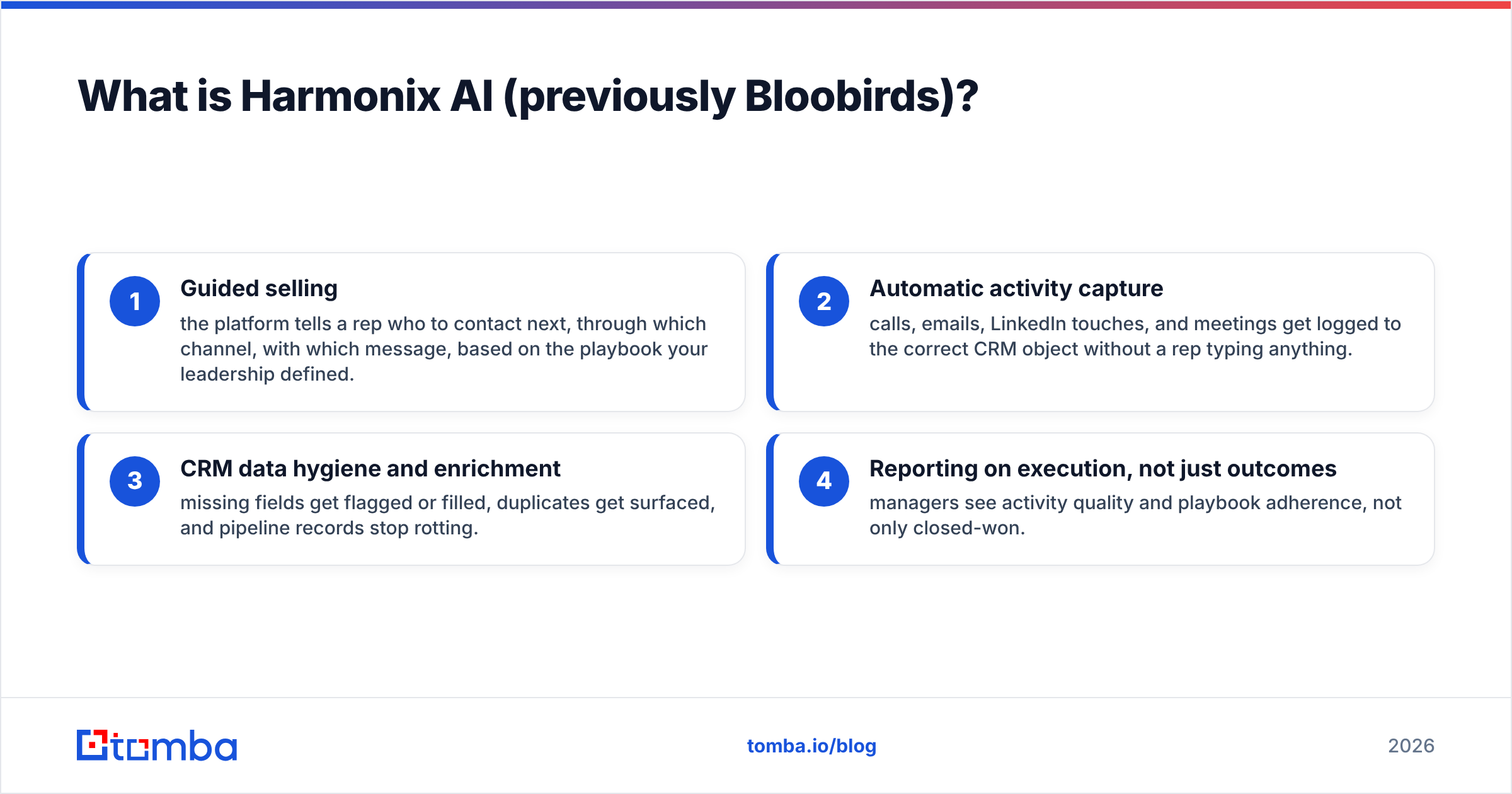
- Guided selling — the platform tells a rep who to contact next, through which channel, with which message, based on the playbook your leadership defined.
- Automatic activity capture — calls, emails, LinkedIn touches, and meetings get logged to the correct CRM object without a rep typing anything.
- CRM data hygiene and enrichment — missing fields get flagged or filled, duplicates get surfaced, and pipeline records stop rotting.
- Reporting on execution, not just outcomes — managers see activity quality and playbook adherence, not only closed-won.
If you have never audited what your CRM actually costs you in lost rep hours, that pitch lands hard. The average rep spends a meaningful chunk of the week on data entry, and every hour of it is non-selling time. Harmonix sells that hour back.
The catch — and the reason you clicked on a pricing post — is that buying it back is not cheap and the price is not published.
How much does Harmonix AI cost in 2026?#
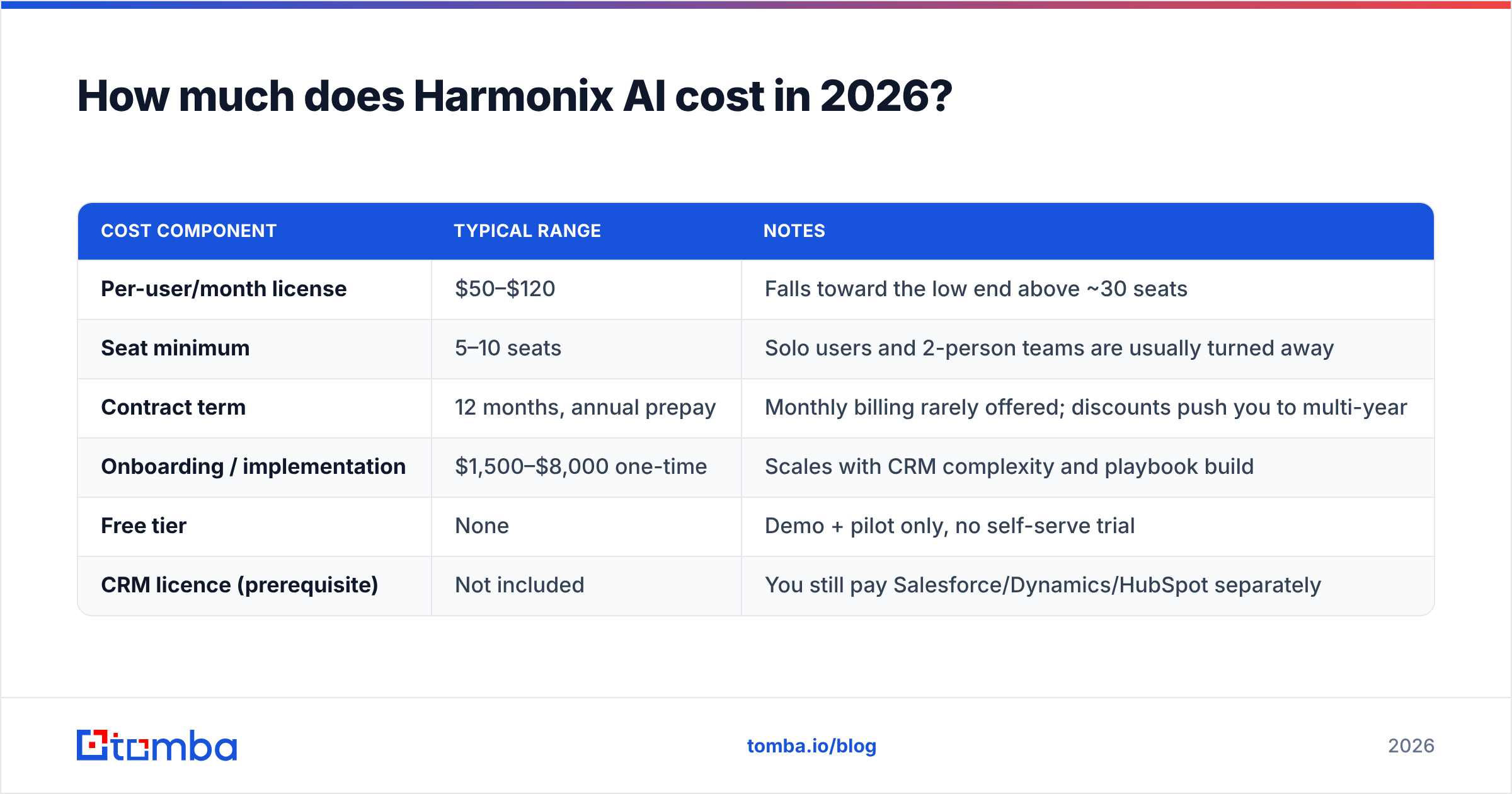
Harmonix does not publish a price card. You will not find plan tiers, per-seat rates, or a free trial button on the site. Every deal runs through a demo and a scoped quote, which means what you pay depends on seat count, which CRM you run, and how much implementation help you need.
Based on how vendors in this category structure deals — and what buyers report on review sites — here is the realistic shape of a Harmonix quote. Treat these as planning estimates to pressure-test against your own quote, not published rates.
| Cost component | Typical range | Notes |
|---|---|---|
| Per-user/month license | $50–$120 | Falls toward the low end above ~30 seats |
| Seat minimum | 5–10 seats | Solo users and 2-person teams are usually turned away |
| Contract term | 12 months, annual prepay | Monthly billing rarely offered; discounts push you to multi-year |
| Onboarding / implementation | $1,500–$8,000 one-time | Scales with CRM complexity and playbook build |
| Free tier | None | Demo + pilot only, no self-serve trial |
| CRM licence (prerequisite) | Not included | You still pay Salesforce/Dynamics/HubSpot separately |
Run that math for a 10-rep team at the midpoint: roughly $850/month in licences plus a $3,000 implementation, so about $13,200 in year one before your CRM bill. For a 40-rep org, you are comfortably into the $40,000–$50,000 range annually.
That is not outrageous for the category — Outreach, Salesloft, and Gong all sit in the same neighbourhood or higher. But it is a budget-line purchase with a procurement cycle, not something a sales manager expenses on a card.
Why doesn't Harmonix publish its pricing?#
Three reasons, and only one of them is annoying.
The legitimate one: implementation genuinely varies. A 12-rep HubSpot team with one playbook is a fundamentally different scope than a 200-rep Salesforce org with six business units, custom objects, and regional compliance rules. A single published number would be wrong for both.
The commercial one: quote-only pricing lets the vendor price-discriminate. Enterprise buyers pay enterprise rates. That is standard practice across sales engagement platforms and not unique to Harmonix.
The annoying one: it costs you time. You cannot compare Harmonix to two alternatives on a spreadsheet on a Tuesday afternoon. You have to book three demos, sit through three discovery calls, and wait a week for numbers. Budget two to four weeks of evaluation time before you can even compare like for like.
Practical tip: ask for the quote in three formats — per-seat at your current headcount, per-seat at headcount +50%, and total year-one cost including implementation. Vendors who quote only the first number are hiding the ramp.
What do Harmonix AI reviews actually say?#
Review volume for Harmonix is thinner than for the category giants, partly because the rebrand split the review history between the Bloobirds and Harmonix listings. Read both. Here is the pattern that holds across G2 and Capterra entries.
What reviewers consistently praise:
- Activity logging that actually works. This is the single most repeated positive. Reps stop doing manual CRM entry and managers stop chasing them for it.
- Support and onboarding responsiveness. Smaller vendors often win here, and Harmonix does. Named contacts, fast replies, real humans.
- Playbook enforcement for new hires. Ramp time drops when a junior rep gets told what to do next instead of guessing.
- CRM data quality improvements. Fewer blank fields, fewer orphaned records, cleaner forecasting inputs.
What reviewers consistently criticise:
- Setup is not a weekend project. Multiple reviews describe an implementation measured in weeks, with heavy admin involvement.
- You need an owner. Playbooks decay. Without someone maintaining them, the guidance goes stale and reps start ignoring it.
- The UI carries legacy weight. Some surfaces still feel like the Bloobirds sales-engagement product rather than a clean AI layer.
- Price sensitivity below 15 seats. Small teams report the per-seat cost is hard to justify against the hours saved.
The honest summary: Harmonix is well-liked by the teams who commit to it and abandoned by the teams who bought it hoping it would work on its own. That is true of most guided-selling software, and it should shape how you scope your pilot.
What are the pros and cons of Harmonix AI?#
| Harmonix AI | |
|---|---|
| Biggest strength | Removes manual CRM entry without replacing the CRM |
| Best-fit team | 15–150 reps on Salesforce or Dynamics with a defined playbook |
| Worst-fit team | Under 10 reps, no sales ops owner, or no CRM discipline yet |
| Pricing transparency | Poor — quote-only, no public tiers, no self-serve trial |
| Time to value | Weeks, not days; implementation is a real project |
| Data included | No contact database — you supply the leads |
| Lock-in risk | Moderate — annual contract, playbooks live in the platform |
| Alternative overlap | High with Outreach, Salesloft, Gong Engage, People.ai |
Note the "data included" row, because it is the one buyers miss most often. Harmonix improves what happens to a record after it enters your CRM. It does not find you new records. If your pipeline problem is "we don't have enough qualified contacts to work," a guided-selling overlay is treating the wrong symptom — you need a B2B database and a way to verify what you pull from it.

Is Harmonix AI worth it compared to the alternatives?#
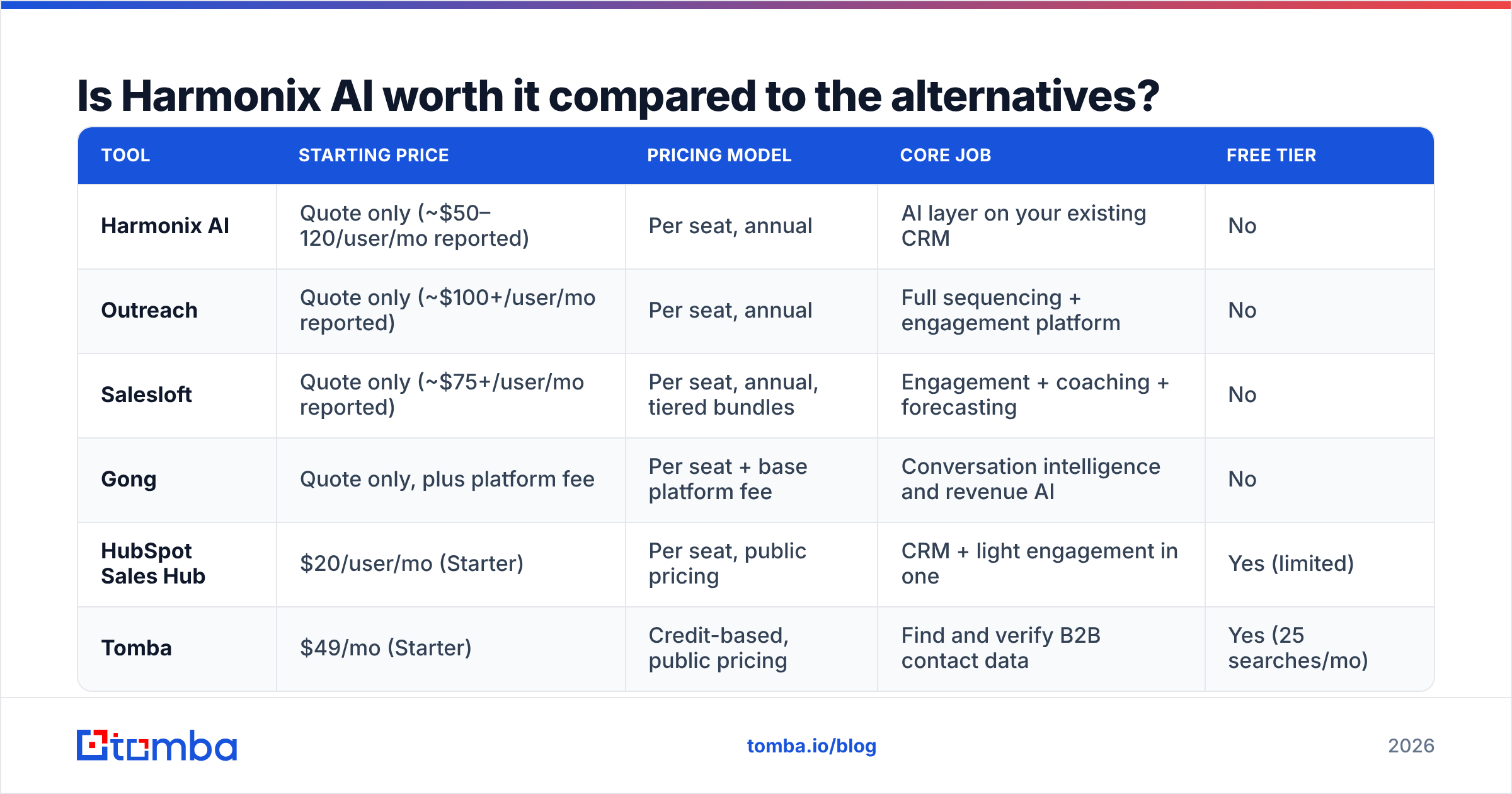
Depends entirely on which problem you are buying against. Here is how the realistic shortlist stacks up.
| Tool | Starting price | Pricing model | Core job | Free tier |
|---|---|---|---|---|
| Harmonix AI | Quote only (~$50–120/user/mo reported) | Per seat, annual | AI layer on your existing CRM | No |
| Outreach | Quote only (~$100+/user/mo reported) | Per seat, annual | Full sequencing + engagement platform | No |
| Salesloft | Quote only (~$75+/user/mo reported) | Per seat, annual, tiered bundles | Engagement + coaching + forecasting | No |
| Gong | Quote only, plus platform fee | Per seat + base platform fee | Conversation intelligence and revenue AI | No |
| HubSpot Sales Hub | $20/user/mo (Starter) | Per seat, public pricing | CRM + light engagement in one | Yes (limited) |
| Tomba | $49/mo (Starter) | Credit-based, public pricing | Find and verify B2B contact data | Yes (25 searches/mo) |
Two things jump out.
First, every direct Harmonix competitor is also quote-only. If opaque pricing is a dealbreaker, this entire category will frustrate you — and HubSpot Sales Hub is the only mainstream option with published per-seat rates and a genuine free entry point.
Second, Tomba is on that table for contrast, not as a like-for-like swap. It solves a different layer of the stack. A guided-selling platform makes 100 existing accounts get worked properly; an email finder turns a list of 100 target companies into 400 reachable, verified contacts. Teams that buy the overlay while their contact data is stale end up with beautifully logged activity against bad addresses.
What hidden costs should you budget for?#
Six line items that rarely appear in the first quote:
- Implementation fee. One-time, scales with CRM complexity. Ask whether it is fixed-scope or time-and-materials.
- Admin time. Somebody internally owns playbook design and maintenance. Budget 0.25–0.5 FTE for the first quarter, less afterwards.
- CRM licence upgrades. Some integrations require a higher CRM edition (API limits, custom objects). Confirm before signing.
- Data enrichment. Harmonix flags missing fields; filling them needs a data source. Either a provider contract or a data enrichment API call.
- Seat creep. Annual per-seat contracts usually let you add seats mid-term at list price, not your negotiated rate. Negotiate the ramp up front.
- Change-management drag. The first four to six weeks, reps are slower, not faster. Real cost, rarely modelled.
Rule of thumb: the sticker per-seat licence is roughly 60–70% of true year-one cost. Model the other 30–40% before you present the business case, or you will be the person explaining the overage in Q2.
Who should buy Harmonix AI — and who shouldn't?#
Buy it if: you run 15+ reps on Salesforce or Dynamics, you have a documented sales process people ignore, your CRM data is unreliable enough that forecasting hurts, and you have an ops person who will own the rollout. In that scenario the ROI story is straightforward — you are converting non-selling admin hours into selling hours across a whole team, and the payback maths works at even modest hourly assumptions.
Skip it if: you have fewer than 10 reps, no defined playbook to enforce, or no full-time ops owner. Guided selling amplifies an existing process. It does not create one. Teams that buy it as a substitute for sales management get an expensive dashboard.
Solve something else first if: your reps have capacity but not enough qualified contacts. That is a data problem wearing a process-problem costume. Fix the top of the funnel — accurate contacts, verified addresses, working phone numbers — before you spend $40k optimising how the empty pipeline gets logged.
How should you run the evaluation?#
Compress it. Book Harmonix, one direct competitor, and one "do nothing but fix the data" option in the same two-week window. For each, demand: total year-one cost at your headcount, implementation scope in writing, named reference customer at your company size, and a 30-day pilot with a rollback clause. Then measure one metric across the pilot — activity logged per rep per week, or meetings booked per 100 contacts touched. Whichever tool moves it, wins.
And check the boring things. Does the integration support your CRM edition? What happens to your playbooks if you churn? What is the renewal uplift cap? Quote-only vendors negotiate on all three, but only if you ask before the contract is drafted.
The bottom line on Harmonix AI pricing#
Harmonix AI is a credible, well-reviewed CRM overlay with real strengths in activity capture and playbook enforcement — and pricing that will take you a demo cycle to discover. Plan on $50–$120 per user/month plus implementation, an annual commitment, and a dedicated internal owner. For mid-market teams with a process problem, that is defensible. For small teams, or for anyone whose real constraint is pipeline volume rather than pipeline hygiene, it is the wrong purchase order.
Before you sign a five-figure contract to organise the contacts you already have, make sure you have enough of the right ones. Tomba's Tomba Email Finder turns a target account list into verified, reachable decision-maker emails — starting free with 25 searches a month, $49/mo on Starter, with transparent Tomba pricing you can read on a webpage instead of extracting from a sales call. Fill the funnel first; optimise the workflow second.
Related guides#
// get started
Find, verify and enrich your first contacts today
Start on the free plan with 25 searches a month, then scale when your team is ready.
Free plan · No credit card required · GDPR & CCPA
// about the author