How Do You Get Clients as a Real Estate Agent in 2026?
Referrals dry up. Zillow leads cost $200 a pop. Here are 9 client-acquisition channels for real estate agents in 2026, ranked by cost per closed deal and time to first commission.
TL;DR
- Buying leads from portals is the fastest way to get clients and the slowest way to get profitable — expect $150–$400 per lead and a 1–3% close rate.
- Your sphere of influence still produces the cheapest closings, but it caps out. Most agents hit that ceiling in year two.
- The channels that compound — geographic farming, investor outreach, builder and property-manager relationships, and expired/FSBO follow-up — all require you to own contact data rather than rent it.
- A 100-door farm you actually contact monthly beats a 5,000-name list you email twice a year. Depth beats reach in residential real estate.
- Track cost per closing, not cost per lead. A $40 lead that closes at 8% is cheaper than a free lead that closes at 0.4%.
Getting clients as a real estate agent is a distribution problem, not a talent problem. Plenty of agents who know their market cold go broke because they never solved for a repeatable source of conversations. Plenty of mediocre agents make $300K because they built one channel and worked it for five years.
This post ranks the nine channels that actually produce closings in 2026, with honest numbers on cost, ramp time, and who each one suits.
Why do most new real estate agents fail to get clients?#
The National Association of Realtors has tracked the same pattern for years: the median agent closes a handful of sides per year, and a large share of new licensees leave the business within two years. The cause is almost never product knowledge. It's that new agents inherit a plan built for someone else's situation.
The standard brokerage onboarding tells you to announce your license on social media, call your contacts, and buy into the office lead program. That plan works if you already have 400 warm relationships in a market you've lived in for a decade. If you moved to the area last year, it produces two lukewarm coffee meetings and a bill for portal leads.
Three failure modes account for most of it:
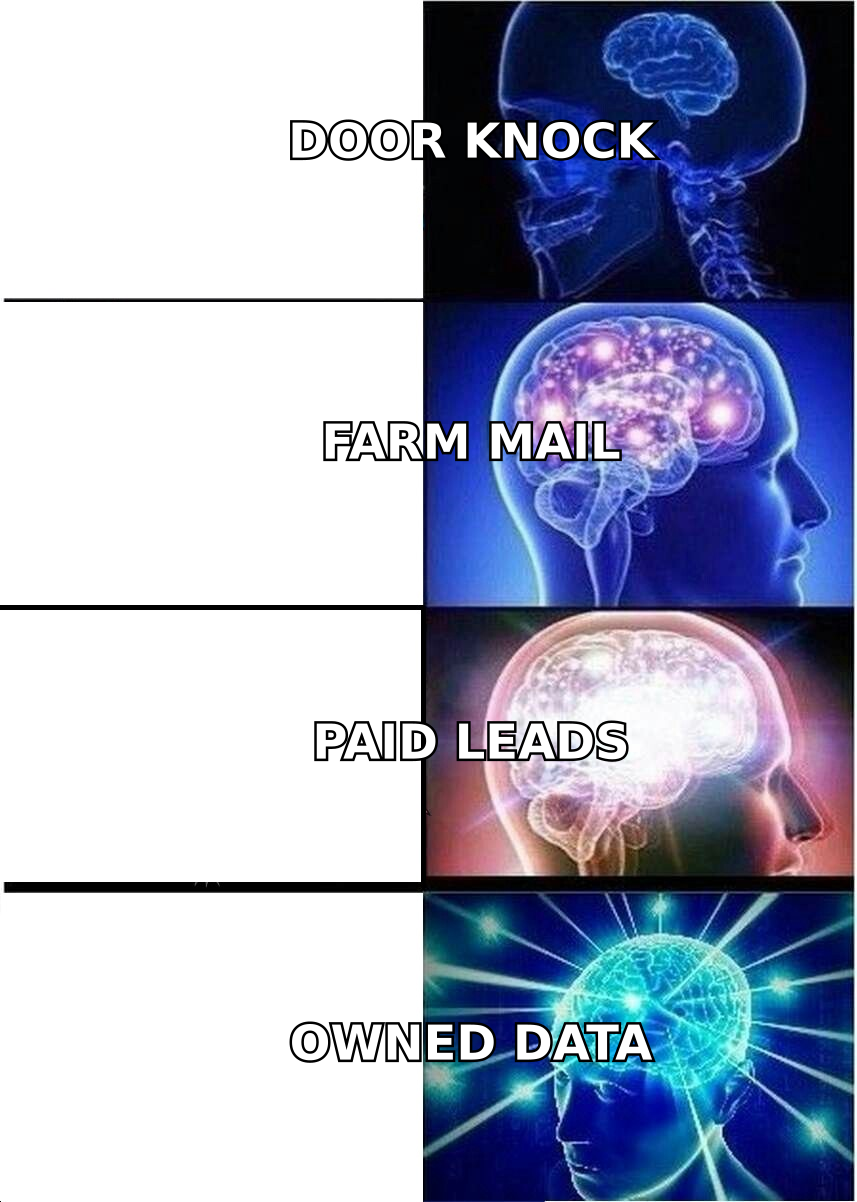
- Renting attention instead of owning it. Portal leads, brokerage round-robin, and paid social all stop the second you stop paying. You build no asset.
- Reach without depth. Blasting 3,000 loose contacts once a quarter converts worse than contacting 150 people eight times a year. Real estate is a low-frequency, high-trust purchase — you win by being present at the moment someone decides to move, which you cannot predict.
- No system of record. Agents who keep leads in their phone's notes app lose 60–80% of them to simple forgetting. The CRM is not optional infrastructure.
What are the nine channels that actually produce clients?#
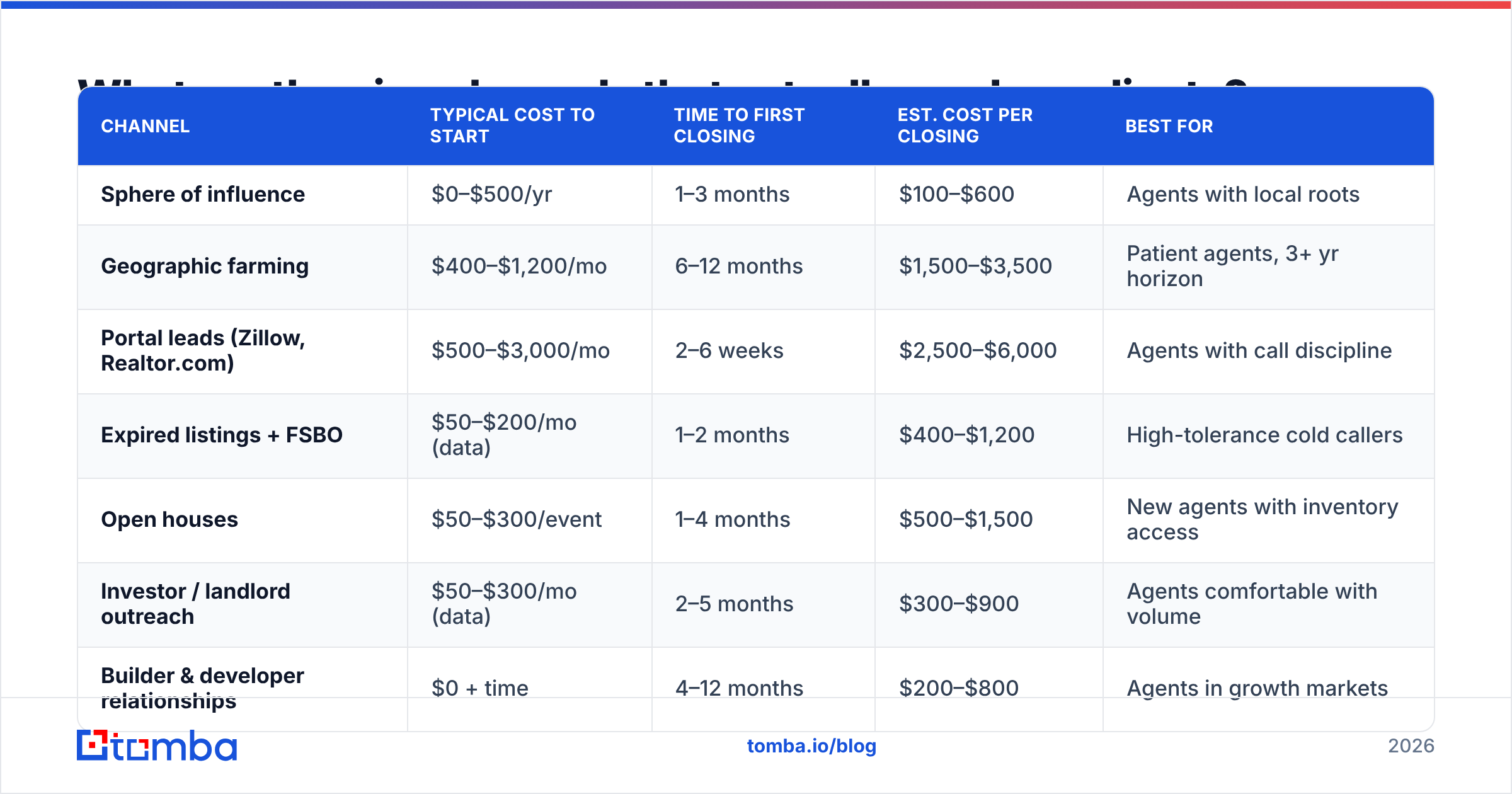
Here's the honest comparison. Cost per closing is an estimate range from agent-reported data across mid-sized US markets; your numbers will vary with price point and competition.
| Channel | Typical cost to start | Time to first closing | Est. cost per closing | Best for |
|---|---|---|---|---|
| Sphere of influence | $0–$500/yr | 1–3 months | $100–$600 | Agents with local roots |
| Geographic farming | $400–$1,200/mo | 6–12 months | $1,500–$3,500 | Patient agents, 3+ yr horizon |
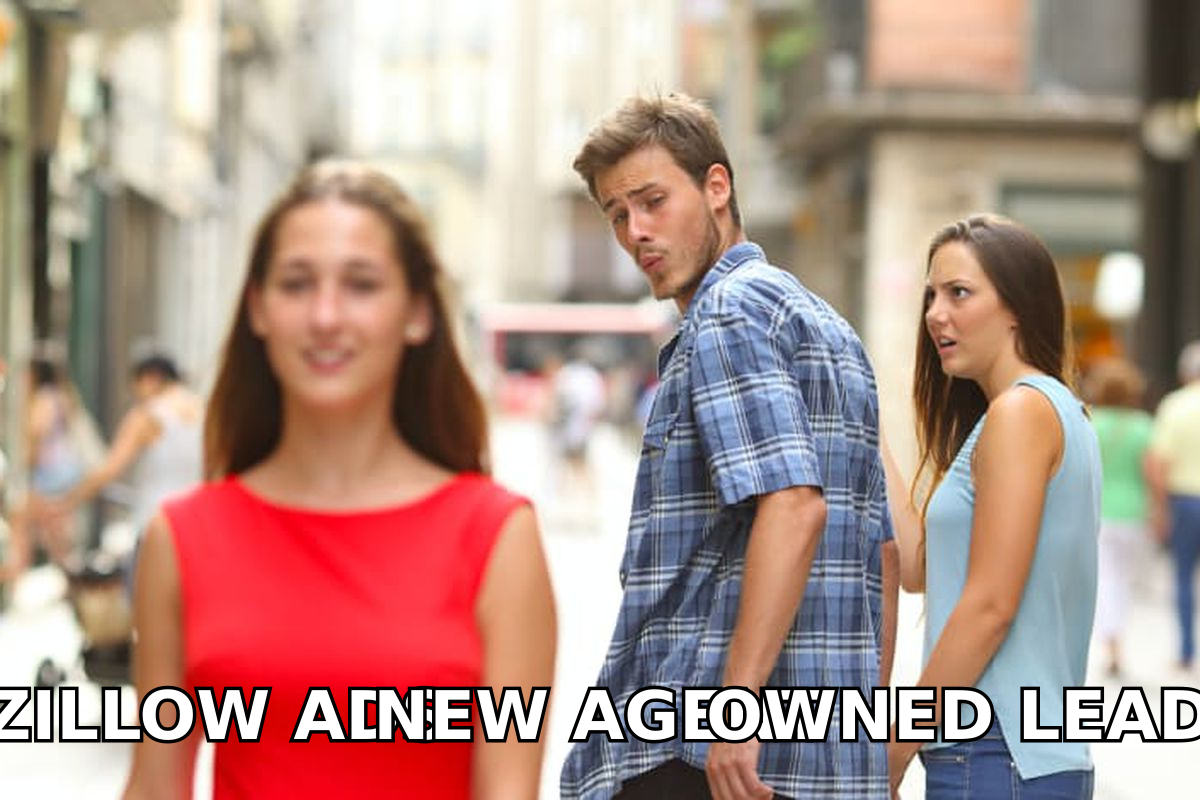
| Portal leads (Zillow, Realtor.com) | $500–$3,000/mo | 2–6 weeks | $2,500–$6,000 | Agents with call discipline |
| Expired listings + FSBO | $50–$200/mo (data) | 1–2 months | $400–$1,200 | High-tolerance cold callers |
| Open houses | $50–$300/event | 1–4 months | $500–$1,500 | New agents with inventory access |
| Investor / landlord outreach | $50–$300/mo (data) | 2–5 months | $300–$900 | Agents comfortable with volume |
| Builder & developer relationships | $0 + time | 4–12 months | $200–$800 | Agents in growth markets |
| Referral networks & relocation | $0 (25–35% referral fee) | 1–3 months | Fee-based | Agents with capacity to spare |
| Content + local SEO | $0–$400/mo | 9–18 months | $200–$700 (once mature) | Agents playing a long game |
Two things jump out. First, the fastest channels are the most expensive per closing. Second, the cheapest channels per closing are the slowest to ramp. That tension is the entire strategic problem: you need a fast channel to pay this quarter's bills and a slow channel so you aren't buying leads forever.
The sane sequencing is to run one fast channel and one compounding channel simultaneously, and let the compounding one gradually replace the paid one.
How do you work your sphere of influence without being annoying?#
Your sphere is everyone who would recognize your name — former colleagues, neighbors, the parents at your kid's soccer practice, your barber. Most agents mine this badly by making one awkward announcement and then going silent.
The version that works is boring and consistent:
- Build the actual list. Export your phone contacts, LinkedIn connections, and email contacts into one spreadsheet. Most agents find 300–800 names they'd forgotten about. Deduplicate the list before you import it anywhere.
- Fill the gaps. Half those contacts will have a name and a stale email or no email at all. This is where an email finder earns its keep — you feed in a name plus their current company domain and get a deliverable business address back, rather than emailing a personal address they abandoned in 2019.
- Segment by likelihood, not affection. Renters at lease end, people who mentioned a job change, anyone who bought 6+ years ago. These groups get more touches.
- Set a touch cadence you can sustain. Thirty-six touches a year is the classic advice and almost nobody does it. Twelve real touches — a market update, a birthday text, a "saw this and thought of you" — beats thirty-six ignored newsletters.
- Ask directly, once a quarter. "Do you know anyone thinking about moving in the next six months?" converts far better than hoping people infer you want referrals.
Before you send anything at scale, run the list through an email verifier. Sphere lists are full of dead addresses, and a 15% bounce rate on your first send will damage your sender reputation for months.
Is geographic farming still worth it in 2026?#
Yes, if you can commit three years and pick a farm you can actually dominate.
Farming means picking a defined neighborhood — usually 200–500 homes — and becoming the obvious local expert through repeated, useful contact. It works because homeowners overwhelmingly hire the agent whose name they already recognize.
The math you need to run before picking a farm:
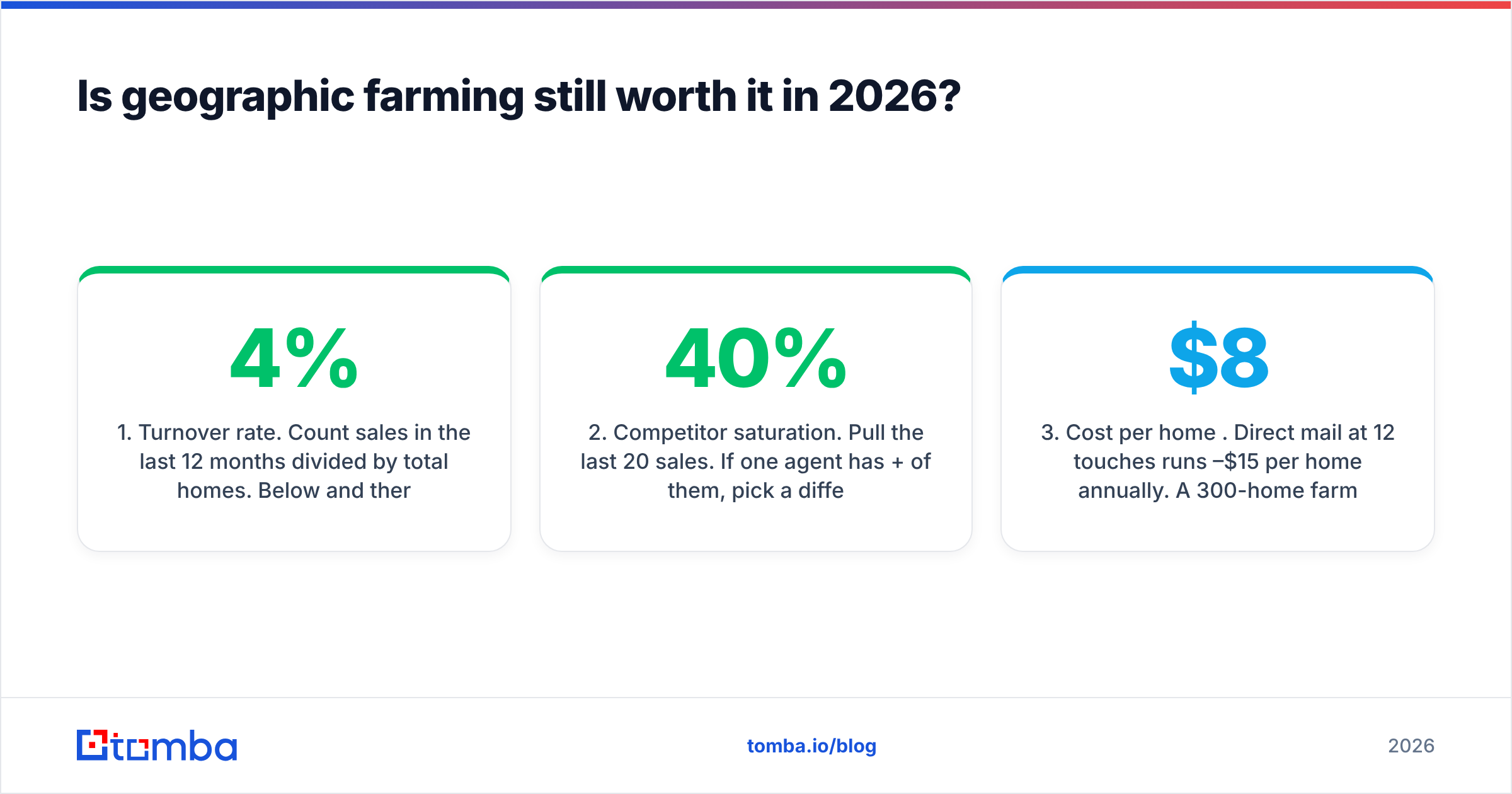
- Turnover rate. Count sales in the last 12 months divided by total homes. Below 4% and there isn't enough transaction volume to justify the spend. Above 8% and you're probably looking at a rental-heavy area with different dynamics.
- Competitor saturation. Pull the last 20 sales. If one agent has 40%+ of them, pick a different farm. You will not outspend an incumbent with ten years of goodwill.
- Cost per home per year. Direct mail at 12 touches runs $8–$15 per home annually. A 300-home farm is $2,400–$4,500/yr. Against a 5% turnover rate, that's 15 transactions in play and you need roughly 2 to break even.
- Your differentiator. "Just listed / just sold" postcards are table stakes. Neighborhood-specific data — actual absorption rates, which renovations returned money on your block — is what gets kept on the fridge.
Farming fails when agents treat it as a mail campaign instead of a presence strategy. The mail is the reminder; the door knocks, the sponsored block party, and the Facebook group participation are the substance.
How do you get real estate clients from investors and landlords?#
This is the most underrated channel for agents who don't mind volume outreach, because investors transact repeatedly and don't need emotional hand-holding.
An investor who buys two properties a year and sells one is worth more than three one-time buyers, and they refer other investors. The barrier is that you can't find them through the MLS — they're behind LLC names on the tax roll.
The workflow:
- Pull the target list. County assessor records give you non-owner-occupied properties and the LLC or trust name on title. Filter for entities holding 2–20 units — big enough to be active, small enough to not have an in-house broker.
- Resolve the entity to a human. Search the LLC in your state's Secretary of State business registry to get the registered agent and managing member names, plus a business address.
- Find contact details. With a name and a company, a domain search will surface the email pattern used at that company and the addresses that exist on it. For smaller operators without a company website, a reverse email lookup can tie a known address back to a person and their other properties.
- Lead with a deal, not a service pitch. Investors ignore "I'd love to be your agent." They open "3-unit on Maple, 8.1% cap at asking, off-market until Friday."
- Verify before sending. Investor lists built from public records have high bounce rates. Run them through verification first, and if a domain is catch-all, use a catch-all verifier rather than guessing.
Expect low response rates — 2–6% is normal — but high value per response. One active investor relationship can produce four sides a year indefinitely.
Should you buy leads from Zillow or Realtor.com?#
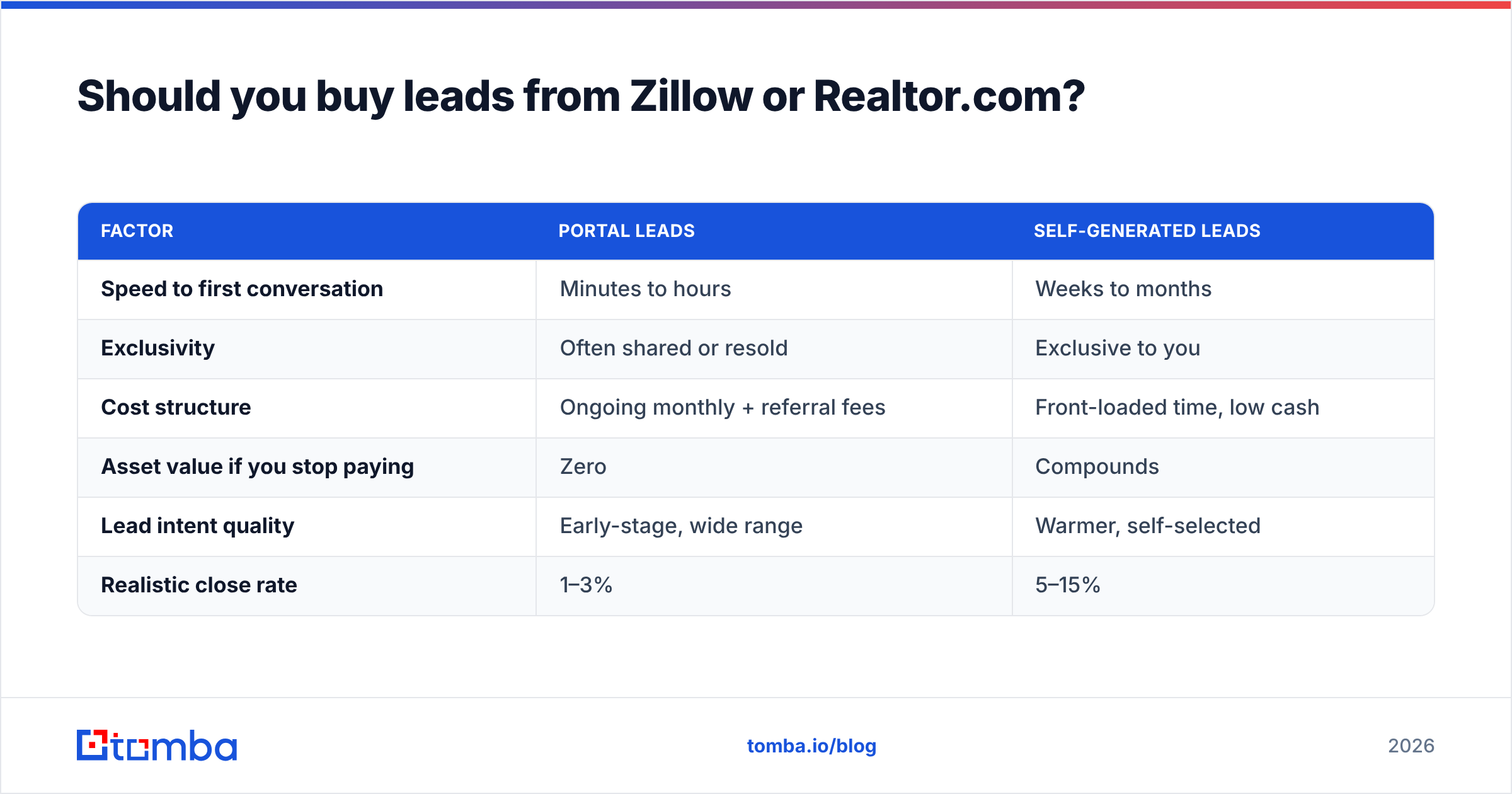
Buy them if you have the call discipline to work them and the cash to survive the first 90 days. Skip them otherwise.
Portal leads are real people who really searched for a home. The problem is that they're sold at scale and shared, and their intent is early. Industry-reported close rates on portal leads sit in the 1–3% range for most agents, with top performers reaching 5–8% purely through speed and persistence.
| Factor | Portal leads | Self-generated leads |
|---|---|---|
| Speed to first conversation | Minutes to hours | Weeks to months |
| Exclusivity | Often shared or resold | Exclusive to you |
| Cost structure | Ongoing monthly + referral fees | Front-loaded time, low cash |
| Asset value if you stop paying | Zero | Compounds |
| Lead intent quality | Early-stage, wide range | Warmer, self-selected |
| Realistic close rate | 1–3% | 5–15% |
Three rules if you do buy:
- Call in under five minutes. Conversion drops off a cliff after the first few minutes — this is the single most consistent finding in inside-sales research, going back to the Lead Response Management studies referenced widely by HubSpot.
- Follow up eight-plus times. Most agents quit after two attempts. The closings live at attempts 5–12.
- Budget for six months. A three-month portal test tells you nothing, because the leads you bought in month one close in month five.
Treat portal spend as a bridge, not a business model. Every dollar should be buying you time to build a channel you own.
What does a client-getting week actually look like?#
Strategy without a calendar is a wish. Here's a workable weekly structure for an agent doing $8–15M in annual volume:
- Monday, 2 hours: Database work. Add every new contact from the previous week, verify emails, set follow-up tasks. This is the hour most agents skip and most regret skipping.
- Tuesday–Thursday, 90 minutes each morning: Live outreach. Calls to expireds, FSBOs, investor list, and sphere check-ins. Non-negotiable, before email.
- Wednesday, 2 hours: Farm presence. Door knocking, mail prep, or neighborhood content.
- Friday, 1 hour: Pipeline review. Which conversations advanced, which went cold, what gets escalated.
- Ongoing: One open house per weekend when you have inventory, or borrow a colleague's listing.
That's roughly 10 hours a week of pure client acquisition. Agents who protect those 10 hours rarely have a lead problem. Agents who let transaction coordination eat them always do.
For scaling the data side of this, batch operations matter. Building a 500-contact investor list one lookup at a time is a waste of a licensed professional's afternoon — a bulk email finder turns that into a single upload, and pushing results into your CRM via a HubSpot integration or Pipedrive integration keeps the follow-up automatic.
How do you measure whether a channel is working?#
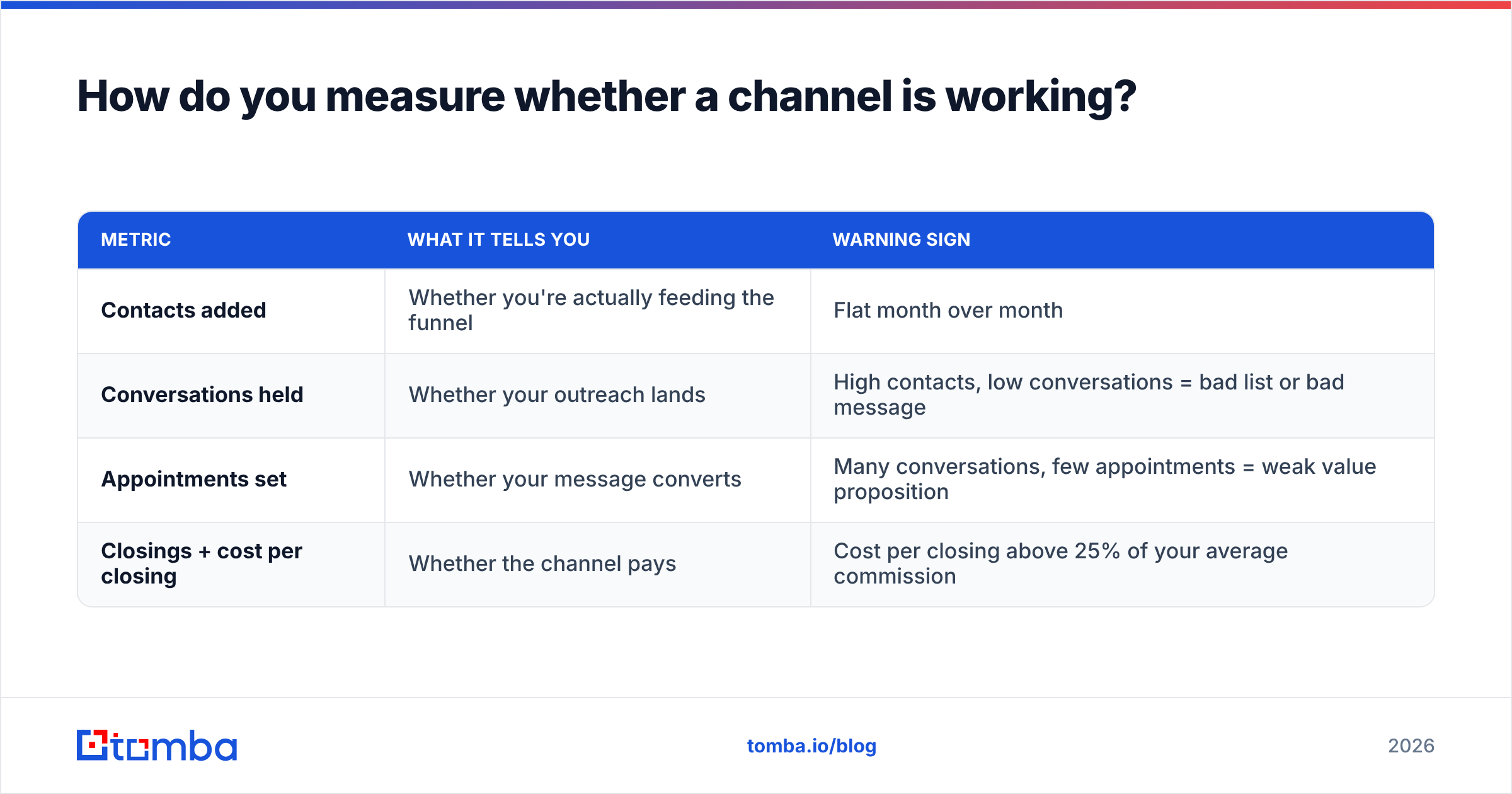
Track four numbers per channel, monthly:
| Metric | What it tells you | Warning sign |
|---|---|---|
| Contacts added | Whether you're actually feeding the funnel | Flat month over month |
| Conversations held | Whether your outreach lands | High contacts, low conversations = bad list or bad message |
| Appointments set | Whether your message converts | Many conversations, few appointments = weak value proposition |
| Closings + cost per closing | Whether the channel pays | Cost per closing above 25% of your average commission |
The most common misread: judging a slow channel on fast-channel timelines. Farming and content both look like total failures at month four and like your best decisions at month eighteen. Set the review horizon when you start the channel, not when you get impatient.
The second most common misread: optimizing cost per lead. A brokerage that gives you free leads that never close is more expensive than a $200 lead that closes at 5%. Only cost per closing is real.
Independent review sites like G2 and Capterra are useful for comparing the CRM and dialer layer, and the NAR research portal publishes the buyer and seller behavior data worth building your messaging against.
What should you do in your first 90 days?#
If you're starting cold, run this:
- Days 1–14: Build and clean the database. Every contact you have, deduplicated, with verified emails. Pick your farm and run the turnover math.
- Days 15–30: Sphere announcement plus individual outreach to your top 100. Not a mass email — 100 individual messages.
- Days 30–60: Launch one compounding channel (farm or investor outreach) and one fast channel (open houses or expireds). Two channels, not five.
- Days 60–90: Review the four metrics. Kill what's dead, double the budget on what produced a conversation.
The agents who make it are not the ones who found a secret channel. They're the ones who picked two channels and ran them long enough to see compounding.
Getting clients as a real estate agent comes down to reaching the right people before they've picked someone else — and that starts with contact data you actually own. Tomba's Email Finder lets you turn a name and a company or domain into a verified, deliverable email address, so your investor lists, sphere rebuilds, and referral-partner outreach land in inboxes instead of bouncing. Start free with 25 searches a month, or move up to the $49/mo Starter plan when your list-building gets serious — see Tomba pricing for the full breakdown.
Related guides#
Ready to find emails that actually work?
Join 150,000+ professionals who stopped guessing and started sending. Free credits on signup — no credit card required.
Get the Tomba newsletter
Practical outbound tactics and product updates — once every two weeks.
About the author