How to Get Leads as a Real Estate Agent in 2026: 9 Proven Channels
Portal leads cost $40-$60 each and close under 5% of the time. Here are nine ways to get real estate leads you actually own, ranked by cost, speed, and close rate.
TL;DR
- Purchased portal leads are the most expensive and lowest-converting channel most agents use. They close in the low single digits and you rent the relationship instead of owning it.
- The three channels with the best economics are sphere-of-influence follow-up, geographic farming with real data behind it, and B2B referral-partner outreach (builders, property managers, relocation coordinators, investors).
- Speed to first contact matters more than lead volume. Contacting a web lead within five minutes instead of thirty changes qualification odds by roughly an order of magnitude.
- If you sell to anyone with a business email — investors, developers, commercial tenants, HR relocation managers — an email finder turns a list of company names into a working outreach list in an afternoon.
- Pick two channels, run them for 90 days with a tracked cost-per-appointment, and kill whatever doesn't produce a signed agreement.
What actually counts as a lead in real estate?#
A lead is a person with a name, a reachable contact method, a timeline, and a reason to move. Everything else is a contact record.
This distinction is why agents burn out on lead gen. You buy 200 "leads" from a portal, 60 have bad phone numbers, 90 are 18-plus months out, 40 already have an agent, and you get maybe 10 real conversations. Your cost per lead was $45. Your cost per conversation was $900.
So the real question is not how to get leads as a real estate agent — it's how to get contactable, timeline-qualified leads at a cost you can defend against your average commission. Run every channel below through that filter.
Three properties separate a good channel from a bad one:
- Ownership. Do you keep the contact if you stop paying? Portal leads: no. Your database: yes.
- Exclusivity. Are you the only agent who received it? Shared leads mean you're competing on response speed against three people who bought the same record.
- Intent proximity. How close is the person to a transaction? A just-listed FSBO is closer than someone who downloaded a home-value PDF.
Which lead sources actually work in 2026?#
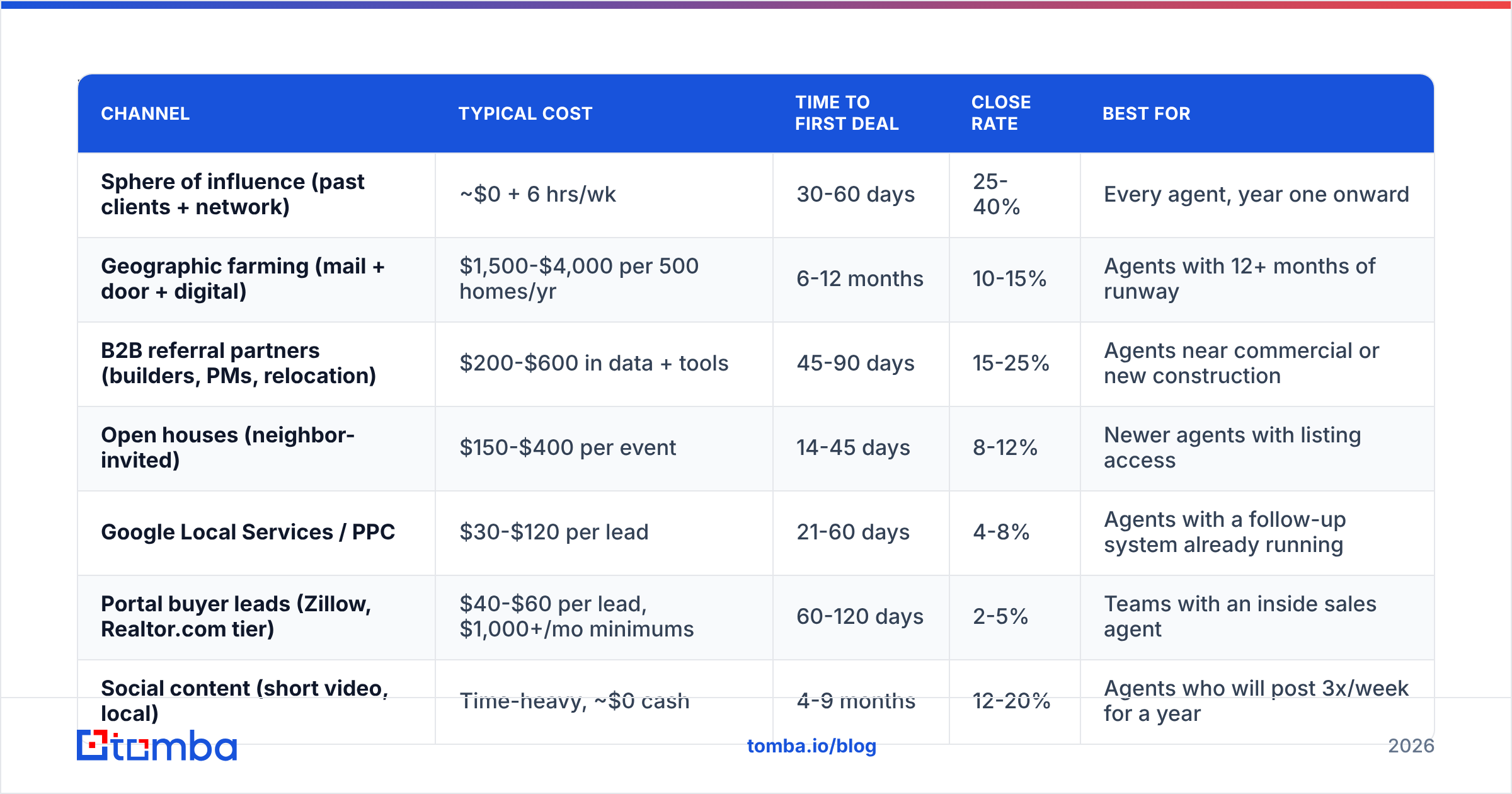
Here is the honest ranking. Costs are national averages for a solo agent working a suburban market; adjust for your price point. "Close rate" means signed representation agreement per qualified conversation, not per raw lead.
| Channel | Typical cost | Time to first deal | Close rate | Best for |
|---|---|---|---|---|
| Sphere of influence (past clients + network) | ~$0 + 6 hrs/wk | 30-60 days | 25-40% | Every agent, year one onward |
| Geographic farming (mail + door + digital) | $1,500-$4,000 per 500 homes/yr | 6-12 months | 10-15% | Agents with 12+ months of runway |
| B2B referral partners (builders, PMs, relocation) | $200-$600 in data + tools | 45-90 days | 15-25% | Agents near commercial or new construction |
| Open houses (neighbor-invited) | $150-$400 per event | 14-45 days | 8-12% | Newer agents with listing access |
| Google Local Services / PPC | $30-$120 per lead | 21-60 days | 4-8% | Agents with a follow-up system already running |
| Portal buyer leads (Zillow, Realtor.com tier) | $40-$60 per lead, $1,000+/mo minimums | 60-120 days | 2-5% | Teams with an inside sales agent |
| Social content (short video, local) | Time-heavy, ~$0 cash | 4-9 months | 12-20% | Agents who will post 3x/week for a year |
| Expired listings / FSBO | $50-$100/mo data | 7-30 days | 6-10% | Agents comfortable on the phone |
Two patterns jump out. First, the cheapest channels take the longest to compound but produce the highest close rates, because they carry trust. Second, the fastest-to-cash channels (expireds, FSBOs) are the ones most agents avoid because they require calling strangers who are already annoyed.
If you have money and no time, buy leads and hire follow-up. If you have time and no money, farm and call. Most agents do the worst possible version: buy a small number of leads, follow up inconsistently, and blame the portal. Zillow and its peers are not scamming you — the model just assumes an aggressive, systematized follow-up operation on your end, and most solo agents don't have one.
How do you build a sphere-of-influence engine that compounds?#
The National Association of Realtors has reported for years that a large share of sellers use an agent referred to them or one they've worked with before. That statistic should reorganize your calendar.
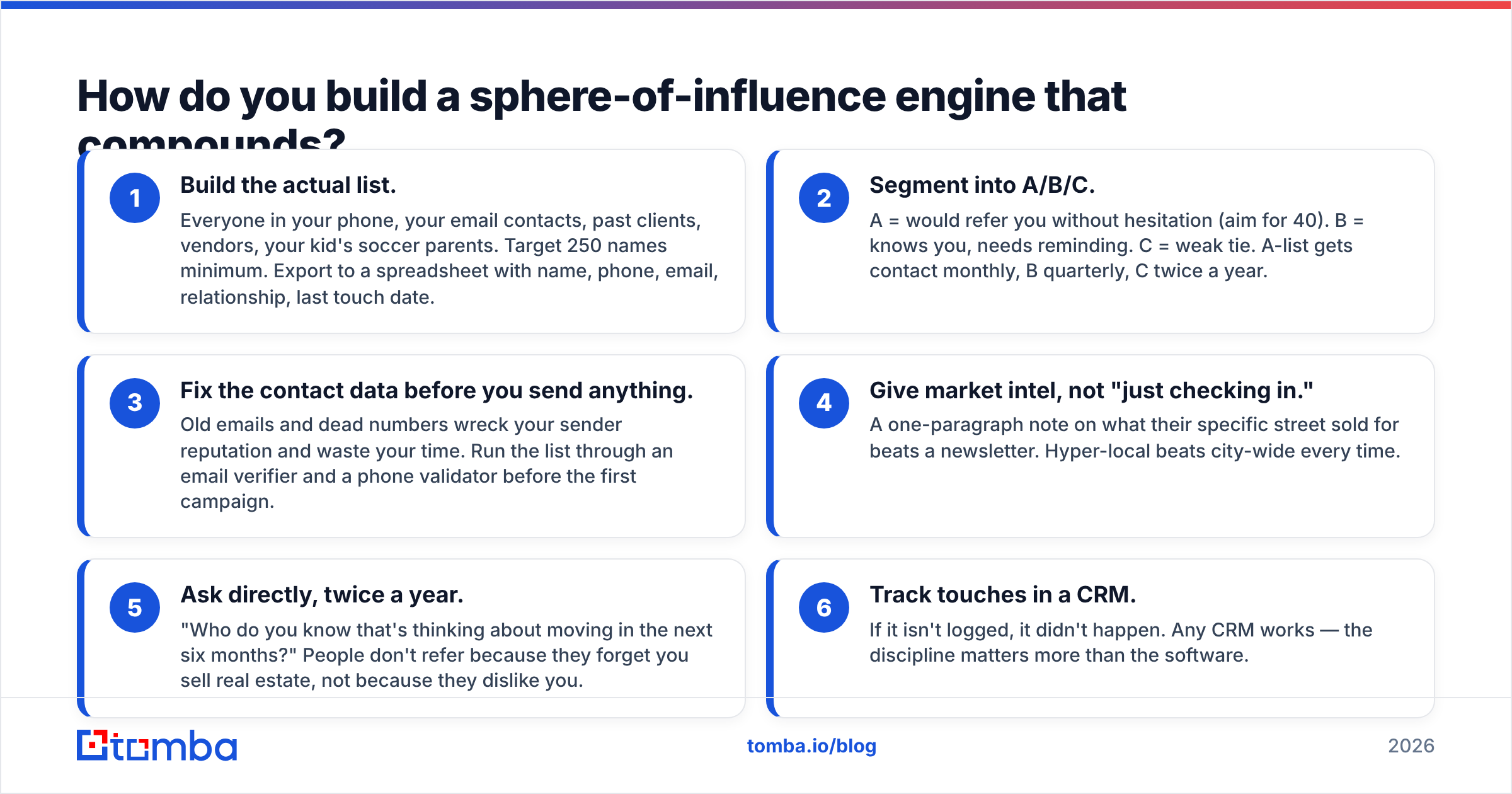
Here's the operating system:
- Build the actual list. Everyone in your phone, your email contacts, past clients, vendors, your kid's soccer parents. Target 250 names minimum. Export to a spreadsheet with name, phone, email, relationship, last touch date.
- Segment into A/B/C. A = would refer you without hesitation (aim for 40). B = knows you, needs reminding. C = weak tie. A-list gets contact monthly, B quarterly, C twice a year.
- Fix the contact data before you send anything. Old emails and dead numbers wreck your sender reputation and waste your time. Run the list through an email verifier and a phone validator before the first campaign.
- Give market intel, not "just checking in." A one-paragraph note on what their specific street sold for beats a newsletter. Hyper-local beats city-wide every time.
- Ask directly, twice a year. "Who do you know that's thinking about moving in the next six months?" People don't refer because they forget you sell real estate, not because they dislike you.
- Track touches in a CRM. If it isn't logged, it didn't happen. Any CRM works — the discipline matters more than the software.
This is boring and it works. Agents who do all six items typically get to a repeat-and-referral majority of their business inside three years.
Where does B2B prospecting fit into residential real estate?#
This is the channel almost nobody runs, which is exactly why it's open.
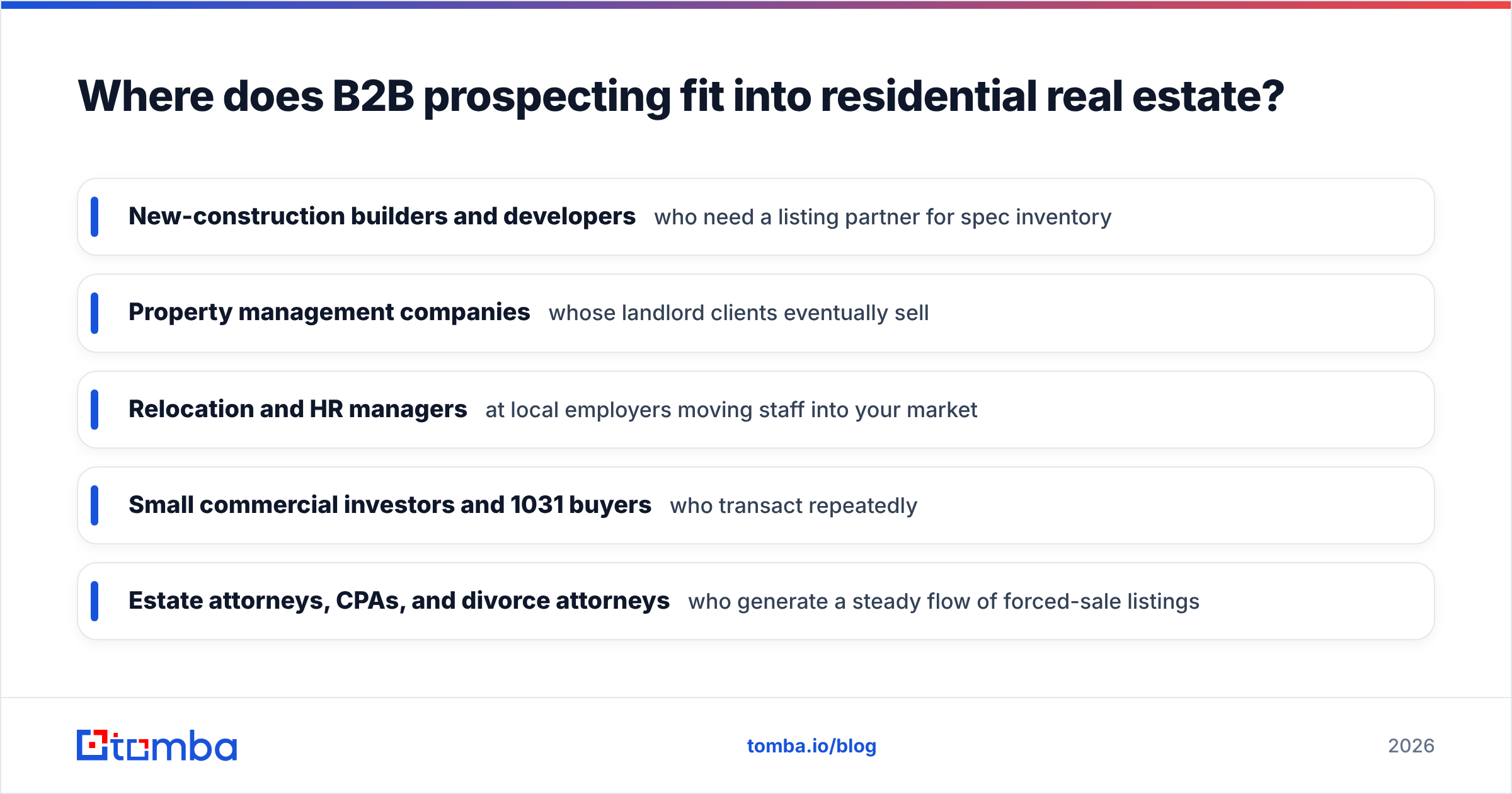
Some of your highest-value counterparties are businesses, not consumers:
- New-construction builders and developers who need a listing partner for spec inventory
- Property management companies whose landlord clients eventually sell
- Relocation and HR managers at local employers moving staff into your market
- Small commercial investors and 1031 buyers who transact repeatedly
- Estate attorneys, CPAs, and divorce attorneys who generate a steady flow of forced-sale listings
Every one of those people has a business email address at a company domain, which means they're findable the same way a B2B sales rep finds prospects. You take a list of 80 local builders, property managers, and mid-size employers, run domain search on each domain, and get named contacts with verified emails. Then you write one genuinely useful email — not a listing presentation, but a data point about absorption rates on their product type — and follow up three times.
Eighty companies is a two-hour data job with a bulk email finder and a month of outreach. If it produces two builder relationships, that's a listing pipeline you didn't have to bid for against seven other agents.
Two honesty notes. First, this channel does not work for finding consumer buyers — private individuals looking for a three-bedroom don't have corporate emails, and scraping personal contacts is both ineffective and legally fraught. Second, cold B2B email requires you to respect CAN-SPAM and local consent rules: real identity, real physical address, working opt-out. Treat it as professional correspondence, not blast marketing.
Is paid lead generation worth it?#
It depends on one number: your cost per signed client, not your cost per lead.
Run the math before you sign a contract. At $50 a lead and a 3% close rate, you need 33 leads per client — $1,650 in acquisition cost. On a $9,000 gross commission with a 70/30 split, you clear $6,300 and spend 26% of it on acquisition. That's survivable but not great, and it collapses the moment your follow-up slips or your market's price point drops.
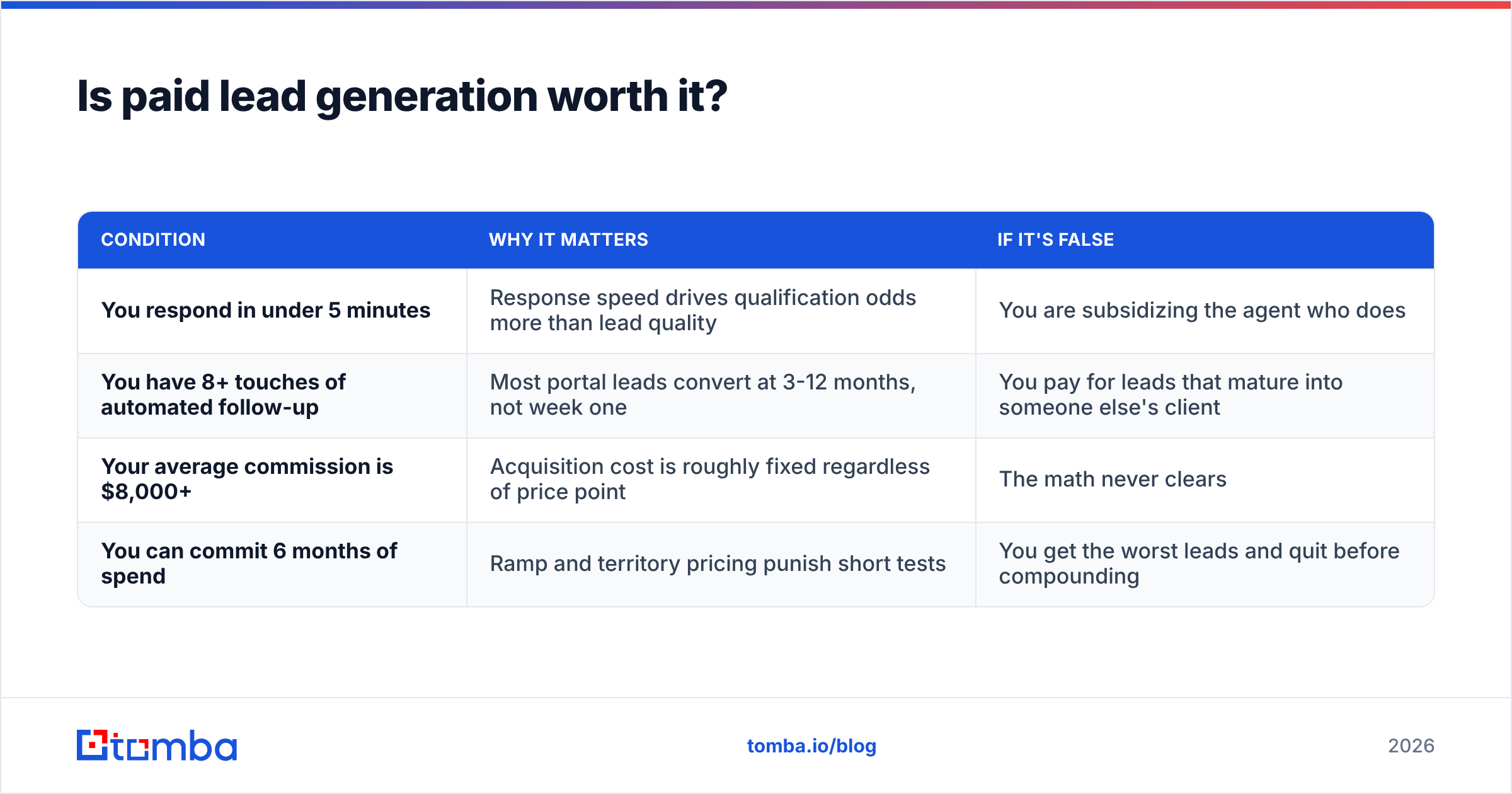
Paid leads make sense when three things are true:
| Condition | Why it matters | If it's false |
|---|---|---|
| You respond in under 5 minutes | Response speed drives qualification odds more than lead quality | You are subsidizing the agent who does |
| You have 8+ touches of automated follow-up | Most portal leads convert at 3-12 months, not week one | You pay for leads that mature into someone else's client |
| Your average commission is $8,000+ | Acquisition cost is roughly fixed regardless of price point | The math never clears |
| You can commit 6 months of spend | Ramp and territory pricing punish short tests | You get the worst leads and quit before compounding |
The five-minute rule isn't folklore. Harvard Business Review's analysis of the short life of online sales leads found the odds of qualifying a lead drop off a cliff after the first hour. In real estate that gap is worse, because portal leads are usually shared.
If you can't hit those four conditions, spend the money on farming or on a virtual assistant to work your database instead.
How do you turn your website into a lead source?#
Most agent websites are digital business cards that convert under 1% of traffic. Three fixes, in order of effort:
- Put one specific offer above the fold. Not "search homes." Something like "What did 14 homes on Maple Ridge actually sell for in the last 90 days?" Specificity is the whole game.
- Add a real IDX search with a soft registration gate. Gate on the third or fourth property viewed, not the first — hard gates kill 80% of sessions.
- Identify anonymous traffic. If you're getting a few hundred local visits a month and only three form fills, website visitor reveal can surface which companies are browsing your commercial or relocation pages so you can reach out first. This works for business visitors, not anonymous consumers.
Also fix your Google Business Profile before anything else. Local map pack visibility is free and it outperforms most agents' paid spend. Ask for a review after every closing — the review count and recency are what move you up.
What does a realistic 90-day plan look like?#
Pick exactly two channels. Running six badly beats running two well only in fantasy.
Days 1-14 — Build the base. Export your full contact list. Clean it. Verify emails and phone numbers. Segment A/B/C. Set up CRM tasks. Write four reusable email templates. If you're adding the B2B channel, build your list of 80 local companies and run the email finder against their domains.
Days 15-45 — Contact everyone once. Every A-list contact gets a personal call. Every B gets a personal email. Every C gets a market update. Log every response. Send the first B2B sequence: initial email, useful follow-up on day 4, short break-up on day 11.
Days 46-75 — Double down on responders. Whoever engaged gets a coffee, a CMA, or a lunch. This is where deals actually originate. Start your second channel — open houses, farming mail drop, or expired calls — while the first one runs on automation.
Days 76-90 — Measure and cut. Calculate cost per conversation and cost per appointment for each channel. Kill the loser. Reinvest its budget in the winner. Repeat.
The agents who plateau are almost always the ones who never got to that last step. They run five channels, measure none, and conclude that "lead gen doesn't work."
What should you do next?#
Start with the list you already have. Before you spend a dollar on new leads, clean and reactivate the contacts sitting in your phone and inbox — that's the highest-return hour of work available to you.
When you're ready to add the B2B layer, the Tomba Email Finder turns a list of local builders, property managers, employers, and investor firms into verified, named contacts you can actually reach. The free tier gives you 25 searches a month to test the approach on a handful of target companies; if it produces conversations, the Starter plan is $49/mo and Growth is $99/mo — see Tomba pricing for the full breakdown. That's less than one shared portal lead per month for a channel you own permanently.
Own your list. Rent nothing you can build.
Related guides#
// get started
Find, verify and enrich your first contacts today
Start on the free plan with 25 searches a month, then scale when your team is ready.
Free plan · No credit card required · GDPR & CCPA
// about the author